

 |
市場調查報告書
商品編碼
2100650
機器人和ADAS車輛感測器:市場佔有率分析、行業趨勢和統計數據以及成長預測(2026-2031年)Robotics and ADAS Vehicles Sensor - Market Share Analysis, Industry Trends & Statistics, Growth Forecasts (2026 - 2031) |
||||||

※ 本網頁內容可能與最新版本有所差異。詳細情況請與我們聯繫。
根據 Mordor Intelligence 預測,機器人和 ADAS 車輛感測器市場規模預計將在 2025 年達到 242.2 億美元,2026 年達到 262.6 億美元,到 2031 年達到 392.7 億美元,在預測期(2026-2031 年)內複合年成長率為 8.38%。
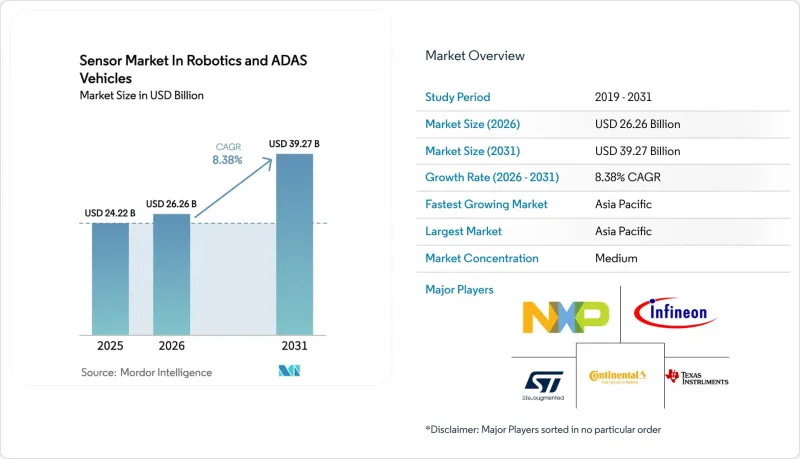
本報告按感測器類型(相機模組、雷射雷達等)、車輛/自動化等級(ADAS L1-L2、ADAS L2+/L3 等)、車輛類型(乘用車和商用車)、動力類型(內燃機車輛和電動車)以及地區(北美、南美、歐洲、亞太、中東和非洲)進行細分。市場預測以美元計價。
全球機器人和ADAS車輛感測器市場趨勢及洞察。
乘用車和商用車對ADAS功能的需求日益成長
隨著這些功能的日益普及,ADAS(高級駕駛輔助系統)正逐漸擺脫豪華車專屬的形象。大眾汽車已將「Travel Assist」系統作為2026款ID.7車型的標配。該系統結合了雷達、攝影機和超音波感測器,並將車道居中保持功能的活化閾值降低至18英里/小時,從而擴大了其在都市區的適用範圍。福特的「Pro Intelligence」套件將360度攝影機和彎道雷達整合到F-150 Lightning的入門級車型中,並將車隊總擁有成本(TCO)計算與安全相關的保險折扣掛鉤。到2025年,L1和L2級ADAS的普及率將在全球汽車產量中佔據相當大的比例。然而,隨著OTA(空中下載)功能解鎖使未使用的硬體商業化,L2+級ADAS的訂閱量正以更快的速度成長。這種行為模式的轉變正在推動感測器的早期部署,即使軟體啟動有所延遲,並維持著機器人和ADAS車輛感測器市場的年銷售額成長。
提高公眾對道路和工人安全的認知,並制定更嚴格的法規。
歐洲新車安全評鑑協會 (Euro NCAP) 2025 年協議規定,行人和騎乘者偵測是獲得五星評級的必要條件,這促使一級供應商從老舊的 120 萬像素成像器過渡到 800 萬像素成像器,後者數據吞吐量,同時在低光照環境下也能滿足倍率檢測閾值。美國國家公路交通安全管理局 (NHTSA) 於 2025 年 1 月發布的一項永久性通用命令要求原始設備製造商 (OEM) 記錄並報告與二級高級駕駛輔助系統 (ADAS) 相關的事故,這使得感測器可靠性成為保險公司在保費計算中使用的精算風險變數。中國修訂後的 GB 7258-2017 標準強制要求重型卡車配備前向碰撞警報和車道偏離預警系統,從而對貨車的雷達和相機模組提出了基本需求。行業監管機構也正在跟進。美國職業安全與健康管理局 (OSHA) 將於 2025 年更新的協作機器人指南將強制要求在倉庫作業中使用基於雷射雷達 (LiDAR) 的工作空間防護措施,使工人安全措施與汽車行業標準保持一致。這些法規結合起來,正在將安全性從一項可選功能轉變為一項採購決策因素,直接擴大了機器人和ADAS車輛感測器的市場。
先進的LiDAR和成像感測器套件高成本
沃爾沃EX90搭載了Luminar的Iris雷射雷達,凸顯了該公司在高階汽車領域的定位。同時,BMWiX則採用了InnovizTwo雷射雷達,儘管與上一代InnovizOne相比成本大幅降低,但其應用僅限於高階車型。然而,汽車製造商(OEM)對其採用仍持謹慎態度,導致其量產計畫進展緩慢。這反過來又阻礙了成本的逐步降低,並造成了「先有雞還是先有蛋」的難題。成像雷達可以作為部分替代方案,但目前其點雲密度遠不及雷射雷達,尤其是在繁忙的城市環境中。這種性能差距在中階車型中依然存在。除非單位成本大幅下降,否則雷射雷達難以廣泛應用,因此,用於機器人和高級駕駛輔助系統(ADAS)車輛的感測器成長速度將會放緩。
細分市場分析
到2025年,相機模組將佔據機器人和ADAS車輛感測器市場55.13%的佔有率。這主要得益於監理機關對前視系統的要求。法雷奧(Valeo)的SCALA 3雷射雷達售價低於600美元,已應用於Stellantis和雷諾車型,標誌著其大規模量產邁出了重要一步。成像雷達也在同步發展。大陸集團(Continental)的ARS540具備高度分類功能,偵測範圍可達300米,使OEM廠商柔軟性在維持功能的同時減少雷射雷達的數量。儘管特斯拉計劃在2024年轉向純視覺系統,但超音波感測器仍繼續用於商用車的近距離操作。博世(Bosch)的第六代超音波感測器整合了片上訊號處理技術,並將線束重量減輕了一半,在低速行駛中仍然發揮著至關重要的作用。除非LiDAR的成本出現顯著下降,否則攝影機在銷售方面仍將保持優勢。然而,LiDAR的複合年成長率為 10.62%,表明在冗餘至關重要的領域,LiDAR將快速應用,多模態架構將在機器人和 ADAS 車輛的整個感測器市場中維持。
儘管攝影機受益於規模經濟和矽節點技術的進步,但在弱光和惡劣天氣條件下仍面臨物理限制。雷達在這些條件下表現出色,但傳統上缺乏垂直解析度。向4D陣列的過渡正在彌補這一不足。LiDAR曾經局限於機械結構,如今正朝著固態化方向發展,減少了移動部件,提高了汽車級可靠性。結合這三種感測器的三模感測器堆疊正在為L3型認證建立標準,並滿足更廣泛的機器人和ADAS車輛感測器市場的多樣化需求。
到2025年,L1和L2級自動駕駛車輛將佔全球部署量的57.25%,每輛車的感測器安裝成本在200至400美元之間。 L2+系統採用雙雷達和倒車相機通道,確保功能安全冗餘,成本也因此翻倍。隨著德國、日本和加州監管政策的明確,高級產品的提升銷售機會日益增多,預計L3級機器人和ADAS車輛感測器的市場將以顯著的複合年成長率成長。賓士的「Drive Pilot」系統就是冗餘性顯著提升的典範。該系統配備兩個LiDAR、五個雷達、六個攝影機和十二個超音波感測器,物料清單(BOM)成本高達3000美元,同時實現了有條件自動駕駛中的責任轉移。
預計到2031年,高度自動化的L4-L5級平台將以9.81%的複合年成長率成長。 L4級無人駕駛計程車和自動駕駛卡車將進一步提升硬體酬載。 「Aurora Driver」配備四個雷射雷達、七個雷達和十二個鏡頭,雖然單價昂貴,但由於人事費用降低,投資可在18個月內收回。 Waymo的第五代系統透過自主生產雷達,將成本降低了一半,這表明垂直整合能夠將高價硬體的價格降至乘用車等級。隨著測試車輛規模的擴大,所獲得的經驗將應用於未來的消費產品,從而提振機器人和ADAS車輛感測器市場的出貨量前景。
區域分析
預計到2025年,亞太地區市場佔有率將達到36.12%,複合年成長率將達到9.25%,這反映了中國C-NCAP碰撞測試和雙積分制政策的影響,該政策強制要求售價低於2.5萬美元的車輛安裝攝影機和雷達。小鵬汽車售價2.8萬美元的P5車型配備了雙合賽雷射雷達單元,象徵中階感測器市場的蓬勃發展,而西方品牌難以複製這一市場格局。在日本,為防止誤操作油門踏板而推出的補貼政策(將於2025年實施)正在推動老年駕駛者對超音波感測器和雷達的需求。同時,在韓國,商用卡車強制安裝ADAS系統正在重振國內供應鏈,進一步鞏固亞太地區在機器人和ADAS車輛感測器市場的領先地位。
2024年7月生效的歐洲通用安全法規(GSR)強制要求車輛配備AEBS、LKA、ISA和DMS等先進駕駛輔助系統。雖然相關的合規成本對小型OEM廠商來說將是一個挑戰,但感測器的最低需求將得到保障。德國以梅賽德斯-奔馳的「Drive Pilot」駕駛輔助系統為核心的L3級認證,為其他歐盟國家可能效仿的法律責任樹立了先例,最終將促進感測器的搭載率。然而,電動車普及速度較慢以及供應商網路分散,意味著歐洲的複合年成長率略低於全球水平,但它仍然對機器人和ADAS車輛感測器市場的成長軌跡有所貢獻。
在北美,情況呈現出兩極化:一方面,一些州的監管較為寬鬆,例如德克薩斯州和亞利桑那州,自動駕駛卡車試驗正在蓬勃發展;另一方面,一些州的監管則更為謹慎,例如加利福尼亞州,該州已限制了商用L4級自動駕駛計程車的部署。儘管如此,美國國家公路交通安全管理局(NHTSA)的事故報告要求正在推動高可靠性感測器套件的普及,因為保險公司已將故障資料納入保費計算。營運物流走廊的車隊營運商現在正將高級駕駛輔助系統(ADAS)作為標準配置,這提高了商用車輛的感測器搭載率,並維持了該地區機器人和ADAS車輛感測器市場的整體需求。
其他好處:
- Excel格式的市場預測(ME)表
- 3個月的分析師支持
目錄
第1章:引言
- 研究假設和市場定義
- 調查範圍
第2章:調查方法
第3章執行摘要
第4章 市場動態
- 市場概覽
- 市場促進因素
- 乘用車和商用車對ADAS功能的需求日益成長
- 提高公眾對道路和工人安全的認知,並制定更嚴格的法規。
- 向感測器融合和軟體定義感知堆疊過渡
- 攝影機、雷達和慣性測量單元的單位成本降低,LiDAR的成本也逐步降低。
- 工業、物流和服務機器人的擴展
- 智慧城市與智慧交通計畫(機器人計程車、接駁車、自動駕駛汽車)
- 市場限制因素
- 先進的LiDAR和成像感測器套件高成本
- 計算、軟體和數據處理的複雜性。
- 與自動化程度提高相關的法規和法律責任的不確定性
- 半導體供應鏈的波動性
- 產業吸引力—五力分析
- 供應商的議價能力
- 消費者議價能力
- 新進入者的威脅
- 替代品的威脅
- 競爭公司之間的競爭
- 產業價值鏈分析
- 按自動駕駛等級分類的輕型乘用車和無人駕駛車輛的銷售統計數據
- 關鍵行業標準和法規
- 汽車感測器技術藍圖(雷達、攝影機、LiDAR)
第5章 市場規模與成長預測
- 依感測器類型
- 相機模組
- LiDAR
- 雷達
- 超音波感測器和其他感測器
- 車輛/自動化級別
- ADAS L1-L2平台
- ADAS L2+/L3平台
- 高度自動化的L4-L5平台
- 車輛類型
- 搭乘用車
- 商用車輛
- 依推進類型
- 內燃機車
- 電動車
- 按地區
- 北美洲
- 美國
- 加拿大
- 其他北美國家
- 南美洲
- 巴西
- 阿根廷
- 其他南美國家
- 歐洲
- 德國
- 英國
- 法國
- 義大利
- 西班牙
- 其他歐洲國家
- 亞太地區
- 中國
- 日本
- 韓國
- 印度
- 台灣
- 其他亞太國家
- 中東和非洲
- 阿拉伯聯合大公國
- 沙烏地阿拉伯
- 南非
- 其他中東和非洲國家
- 北美洲
第6章 競爭情勢
- Vendor Ranking for Top 3 Automotive LiDAR Suppliers
- Vendor Ranking for Top 3 Automotive Image Sensor Suppliers
- Vendor Ranking for Top 3 Automotive Radar Supplier
- 公司簡介
- Infineon Technologies AG
- NXP Semiconductor NV
- Ouster Inc.
- Velodyne LiDAR Inc.
- Luminar Technologies Inc.
- Aurora Innovation Inc.(Incl. Blackmore)
- Robert Bosch GmbH
- Continental AG
- Valeo SA
- ON Semiconductor Corp
- Omnivision Technologies Inc.
- ST Microelectronics NV
- Texas Instruments Incorporated
第7章 市場機會與未來趨勢
According to Mordor Intelligence, the robotics and ADAS Vehicles Sensor Market was valued at USD 24.22 billion in 2025 and is estimated to grow from USD 26.26 billion in 2026 to reach USD 39.27 billion by 2031, at a CAGR of 8.38% during the forecast period (2026-2031).
This report is Segmented by Sensor Type (Camera Modules, Lidar, and More), Vehicle/Automation Level (ADAS L1-L2, ADAS L2+/L3, and More), Vehicle Type (Passenger Car and Commercial Vehicle), Propulsion Type (ICE Vehicles and Electric Vehicles), and Geography (North America, South America, Europe, Asia-Pacific, and Middle East and Africa). Market Forecasts are Provided in Value (USD).
Global Robotics and ADAS Vehicles Sensor Market Trends and Insights
Growing Demand for ADAS Features in Passenger and Commercial Vehicles
Feature democratization is decoupling ADAS from luxury positioning. Volkswagen embedded Travel Assist as standard on the 2026-model ID.7, employing a radar-camera-ultrasonic trio that lowers lane-centering activation thresholds to 18 mph, thereby broadening urban-use applicability. Ford's Pro Intelligence suite integrates 360-degree cameras and corner radar into the F-150 Lightning base trim, aligning fleet total-cost-of-ownership calculators with safety-driven insurance discounts. Penetration at Level 1-Level 2 reached a notable share of global vehicle builds in 2025; however, Level 2+ subscriptions are converting at higher attach rates because over-the-air feature unlocks monetize dormant hardware. This behavioral inflection is reinforcing upfront sensor fitment even where software activation is deferred, sustaining annual volume growth for the Robotics and ADAS Vehicles Sensor Market.
Rising Awareness of Road and Worker Safety and Stringent Regulations
Euro NCAP's 2025 protocols made pedestrian and cyclist detection mandatory for a five-star rating, prompting Tier-1 suppliers to migrate from 1.2-megapixel to 8-megapixel imagers that double data throughput yet satisfy low-light detection thresholds. NHTSA's January 2025 Standing General Order obliges OEMs to log and report Level 2 ADAS crashes, turning sensor reliability into an actuarial risk variable that insurers now price in. China's upgraded GB 7258-2017 standard requires forward-collision and lane-departure warning on heavy trucks, creating baseline demand for radar and camera modules in freight fleets. Industrial regulators are mirroring these moves; OSHA's 2025 guideline update for collaborative robots mandates LiDAR-based workspace safeguarding in warehousing, aligning worker-safety policy with automotive norms. Collectively, these rules transform safety from a discretionary feature to a procurement trigger, directly expanding the Robotics and ADAS Vehicles Sensor Market.
High Cost of Advanced LiDAR and Imaging Sensor Suites
Volvo's EX90 features Luminar's Iris LiDAR, highlighting its premium positioning in a high-end vehicle segment . Meanwhile, BMW's iX incorporates InnovizTwo, which confines its use to luxury trims despite a significant cost reduction from its predecessor, InnovizOne. However, original equipment manufacturers (OEMs) exhibit hesitation, leading to sluggish volume commitments. This, in turn, stifles cost-learning curves, creating a chicken-and-egg dilemma. While imaging radar presents a partial alternative, it falls short of LiDAR's point-cloud density, especially in bustling urban environments. This performance disparity remains unaddressed for mid-priced vehicles. Unless unit costs decrease significantly, widespread adoption will remain elusive, consequently tempering the growth rate for sensors in robotics and Advanced Driver-Assistance Systems (ADAS) vehicles.
Other drivers and restraints analyzed in the detailed report include:
- Shift Toward Sensor Fusion and Software-Defined Perception Stacks
- Falling Unit Costs in Cameras, Radar, IMUs, and Gradual LiDAR Cost Decline
- Compute, Software, and Data-Handling Complexity
For complete list of drivers and restraints, kindly check the Table Of Contents.
Segment Analysis
Camera modules delivered 55.13% of the Robotics and ADAS Vehicles Sensor Market share in 2025, buoyed by regulatory mandates for forward-facing vision systems. Valeo's SCALA 3 LiDAR entered production on Stellantis and Renault models at a sub-USD 600 price, a pivotal step toward volume broadening. Imaging radar evolves in parallel; Continental's ARS540 detects at 300 meters with elevation classification, giving OEMs flexibility to reduce LiDAR count while preserving function. Ultrasonic sensors remain in commercial vehicles for close-range tasks despite Tesla's 2024 vision-only pivot. Bosch's sixth-generation units integrate on-chip signal processing that halves wiring harness weight, keeping them relevant for low-speed maneuvering. Absent a step-change in LiDAR cost, cameras will keep numerical dominance, yet LiDAR's 10.62% CAGR signals accelerative uptake where redundancy is non-negotiable, sustaining multi-modal architectures across the Robotics and ADAS Vehicles Sensor Market.
Cameras benefit from economies of scale and silicon-node migration, but they confront physics limits in poor lighting and adverse weather. Radar excels under such conditions but historically lacked vertical resolution; the shift to 4D arrays now bridges that gap. LiDAR, once confined to mechanical architectures, is moving to solid-state, trimming moving parts and enhancing automotive-grade reliability. Collectively, tri-modal sensor stacks establish a baseline in Level 3 homologations, preserving demand diversification within the broader Robotics and ADAS Vehicles Sensor Market industry.
Level 1-Level 2 vehicles formed 57.25% of global deployments in 2025, each carrying USD 200-400 in sensor content. Level 2+ systems double that spend, leveraging dual radar and backup camera channels for functional-safety redundancy. The Robotics and ADAS Vehicles Sensor Market for Level 3 is projected to expand at a notable CAGR because regulatory clarity in Germany, Japan, and California unlocks premium upsell opportunities. Mercedes Drive Pilot exemplifies the redundancy step-function: 2 LiDAR, 5 radars, 6 cameras, and 12 ultrasonics elevate BOM to USD 3,000 while granting conditional-automation liability shifts.
Highly Automated L4-L5 Platforms are set to expand at a 9.81% CAGR through 2031. Level 4 robotaxis and autonomous trucks intensify hardware content further. Aurora Driver fields 4 LiDAR, 7 radars, and 12 cameras, costing highly per unit yet justifying payback within 18 months via labor substitution. Waymo's 5th-generation suite halves prior-gen cost by internalizing radar production, revealing that vertical integration can whittle premium hardware to near-passenger-car affordability. As pilot fleets scale, learnings cascade into future consumer releases, bolstering shipment outlook for the Robotics and ADAS Vehicles Sensor Market.
Complete Report Scope:
- By Sensor Type
- Camera Modules
- LiDAR
- Radar
- Ultrasonic and Other Sensors
- By Vehicle / Automation Level
- ADAS L1-L2 Platforms
- ADAS L2+/L3 Platforms
- Highly Automated L4-L5 Platforms
- By Vehicle Type
- Passenger Car
- Commercial Vehicle
- By Propulsion Type
- Internal Combustion Engine Vehicles
- Electric Vehicles
- By Geography
- North America
- United States
- Canada
- Rest of North America
- South America
- Brazil
- Argentina
- Rest of South America
- Europe
- Germany
- United Kingdom
- France
- Italy
- Spain
- Rest of Europe
- Asia-Pacific
- China
- Japan
- South Korea
- India
- Taiwan
- Rest of Asia-Pacific
- Middle East and Africa
- United Arab Emirates
- Saudi Arabia
- South Africa
- Rest of the Middle East and Africa
- North America
Geography Analysis
Asia-Pacific's 36.12% market share in 2025 and 9.25% CAGR mirror China's C-NCAP and dual-credit mandates that bake camera and radar into sub-USD 25,000 vehicles. XPeng's USD 28,000 P5, equipped with dual Hesai LiDAR units, exemplifies mid-tier sensor saturation difficult for Western brands to replicate. Japan's 2025 subsidy for pedal-misapplication prevention drives ultrasonic and radar demand among elderly drivers, while South Korea's compulsory ADAS for commercial trucks stimulates domestic supply chains, reinforcing Asia-Pacific leadership in the Robotics and ADAS Vehicles Sensor Market.
Europe's July 2024 GSR makes AEBS, LKA, ISA, and DMS mandatory; compliance costs challenge smaller OEMs but guarantee baseline sensor volumes. Germany's Level 3 approval anchored by Mercedes Drive Pilot sets a liability precedent that other EU states may mimic, eventually enlarging the sensor attachment rate. However, slower EV uptake and fragmented supplier networks temper Europe's CAGR, marginally under the global pace but still additive to the Robotics and ADAS Vehicles Sensor Market' trajectory.
North America splits between permissive states-Texas, Arizona-where autonomous trucking pilots proliferate, and cautious regulators such as California that cap commercial Level 4 robotaxis. Still, NHTSA's crash-reporting mandate incentivizes high-reliability sensor suites because insurers translate failure data into policy premiums. Fleet operators in logistics corridors now spec ADAS as standard, lifting commercial-vehicle sensor content and sustaining overall demand within the regional Robotics and ADAS Vehicles Sensor Market.
- Infineon Technologies AG
- NXP Semiconductor N.V.
- Ouster Inc.
- Velodyne LiDAR Inc.
- Luminar Technologies Inc.
- Aurora Innovation Inc. (Incl. Blackmore)
- Robert Bosch GmbH
- Continental AG
- Valeo SA
- ON Semiconductor Corp
- Omnivision Technologies Inc.
- ST Microelectronics NV
- Texas Instruments Incorporated
Additional Benefits:
- The market estimate (ME) sheet in Excel format
- 3 months of analyst support
TABLE OF CONTENTS
1 Introduction
- 1.1 Study Assumptions and Market Definition
- 1.2 Scope of the Study
2 Research Methodology
3 Executive Summary
4 Market Dynamics
- 4.1 Market Overview
- 4.2 Market Drivers
- 4.2.1 Growing Demand for ADAS Features in Passenger and Commercial Vehicles
- 4.2.2 Rising Awareness of Road and Worker Safety and Stringent Regulations
- 4.2.3 Shift Toward Sensor Fusion and Software-Defined Perception Stacks
- 4.2.4 Falling Unit Costs in Cameras, Radar, IMUs, and Gradual LiDAR Cost Decline
- 4.2.5 Expansion of Industrial, Logistics, and Service Robotics
- 4.2.6 Smart City and Intelligent Transport Initiatives (Robotaxis, Shuttles, AVs)
- 4.3 Market Restraints
- 4.3.1 High Cost of Advanced LiDAR and Imaging Sensor Suites
- 4.3.2 Compute, Software, and Data-Handling Complexity
- 4.3.3 Regulatory and Liability Uncertainty for Higher Automation Levels
- 4.3.4 Semiconductor Supply-Chain Volatility
- 4.4 Industry Attractiveness - Porter's Five Forces Analysis
- 4.4.1 Bargaining Power of Suppliers
- 4.4.2 Bargaining Power of Consumers
- 4.4.3 Threat of New Entrants
- 4.4.4 Threat of Substitutes
- 4.4.5 Intensity of Competitive Rivalry
- 4.5 Industry Value Chain Analysis
- 4.6 Light Passenger Car and Robotic Vehicle Sales Statistics by Level of Autonomy
- 4.7 Key Industry Standards & Regulations
- 4.8 Technological Roadmap for Automotive Sensors (Radar, Camera and LiDAR)
5 Market Size & Growth Forecasts (Value (USD))
- 5.1 By Sensor Type
- 5.1.1 Camera Modules
- 5.1.2 LiDAR
- 5.1.3 Radar
- 5.1.4 Ultrasonic and Other Sensors
- 5.2 By Vehicle / Automation Level
- 5.2.1 ADAS L1-L2 Platforms
- 5.2.2 ADAS L2+/L3 Platforms
- 5.2.3 Highly Automated L4-L5 Platforms
- 5.3 By Vehicle Type
- 5.3.1 Passenger Car
- 5.3.2 Commercial Vehicle
- 5.4 By Propulsion Type
- 5.4.1 Internal Combustion Engine Vehicles
- 5.4.2 Electric Vehicles
- 5.5 By Geography
- 5.5.1 North America
- 5.5.1.1 United States
- 5.5.1.2 Canada
- 5.5.1.3 Rest of North America
- 5.5.2 South America
- 5.5.2.1 Brazil
- 5.5.2.2 Argentina
- 5.5.2.3 Rest of South America
- 5.5.3 Europe
- 5.5.3.1 Germany
- 5.5.3.2 United Kingdom
- 5.5.3.3 France
- 5.5.3.4 Italy
- 5.5.3.5 Spain
- 5.5.3.6 Rest of Europe
- 5.5.4 Asia-Pacific
- 5.5.4.1 China
- 5.5.4.2 Japan
- 5.5.4.3 South Korea
- 5.5.4.4 India
- 5.5.4.5 Taiwan
- 5.5.4.6 Rest of Asia-Pacific
- 5.5.5 Middle East and Africa
- 5.5.5.1 United Arab Emirates
- 5.5.5.2 Saudi Arabia
- 5.5.5.3 South Africa
- 5.5.5.4 Rest of the Middle East and Africa
- 5.5.1 North America
6 Competitive Landscape
- 6.1 Vendor Ranking for Top 3 Automotive LiDAR Suppliers
- 6.2 Vendor Ranking for Top 3 Automotive Image Sensor Suppliers
- 6.3 Vendor Ranking for Top 3 Automotive Radar Supplier
- 6.4 Company Profiles (Includes Global Level Overview, Market Level Overview, Core Segments, Financials as Available, Strategic Information, Market Rank/Share for Key Companies, Products and Services, SWOT Analysis, and Recent Developments)
- 6.4.1 Infineon Technologies AG
- 6.4.2 NXP Semiconductor N.V.
- 6.4.3 Ouster Inc.
- 6.4.4 Velodyne LiDAR Inc.
- 6.4.5 Luminar Technologies Inc.
- 6.4.6 Aurora Innovation Inc. (Incl. Blackmore)
- 6.4.7 Robert Bosch GmbH
- 6.4.8 Continental AG
- 6.4.9 Valeo SA
- 6.4.10 ON Semiconductor Corp
- 6.4.11 Omnivision Technologies Inc.
- 6.4.12 ST Microelectronics NV
- 6.4.13 Texas Instruments Incorporated
7 Market Opportunities & Future Trends

 自動駕駛汽車感測器市場-2026-2032年全球市場預測
 2035年前先進自動駕駛汽車感測器市場分析和預測 :按類型、產品、技術、組件、應用、最終用戶、功能、安裝類型和解決方案。
 2026年全球自動駕駛汽車感測器市場報告
 2026-2030年全球自動駕駛汽車感測器市場
 自動駕駛車用感測器市場 (~2035年):零組件·自動性層級·推動區分·感測器·車輛類型·用途·銷售管道·企業·主要各地區 - 產業趨勢·全球市場的預測
 自動駕駛汽車感測器:全球市場佔有率和排名、總收入和需求預測(2025-2031年)
 2030 年自動駕駛汽車感測器市場預測:按感測器類型、車輛類型、自動化程度、測量範圍、感測器技術、應用和地區進行的全球分析