


 |
市場調查報告書
商品編碼
2100625
傾斜感測器:市場佔有率分析、產業趨勢與統計、成長預測(2026-2031)Tilt Sensor - Market Share Analysis, Industry Trends & Statistics, Growth Forecasts (2026 - 2031) |
||||||

※ 本網頁內容可能與最新版本有所差異。詳細情況請與我們聯繫。
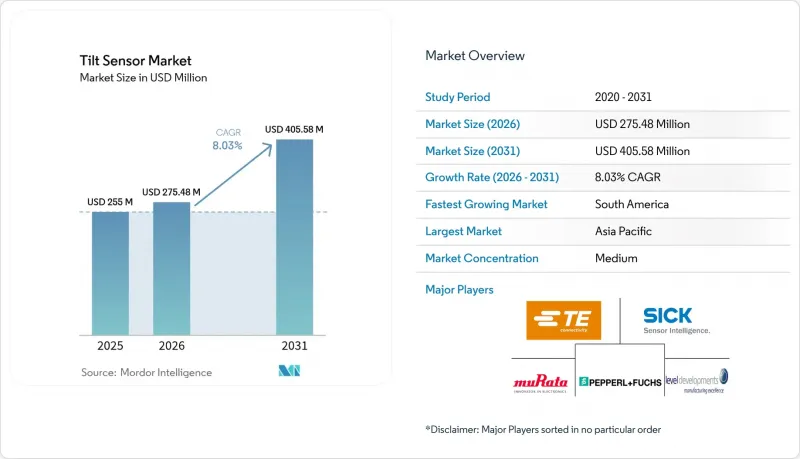
據 Mordor Intelligence 稱,2025 年傾斜感測器市值為 2.55 億美元,預計到 2031 年將達到 4.0558 億美元,而 2026 年為 2.7548 億美元,預測期(2026-2031 年)的複合年成長率為 8.03%。
本報告按機殼材質(金屬、非金屬)、技術(MEMS、力平衡等)、軸數(單軸等)、輸出介面(類比電壓/電流、數位等)、終端用戶產業(採礦、建設業等)和地區進行細分。市場預測以美元計價。
全球傾斜感測器市場趨勢及洞察
亞洲工業自動化領域基於MEMS的物聯網節點迅速普及
中國、日本和韓國各地的工廠數位化專案正日益依賴緊湊型MEMS傾角儀,這種傾角儀能夠偵測到機器故障前發生的微小偏差。這些應用已使意外停機時間減少了37%,並將無線節點電池壽命延長了五年以上,隨著投資報酬率(ROI)的日益顯現,重複訂單也隨之而來。
歐洲強制監測風力發電機塔架傾斜度
歐盟安全法規強制要求持續追蹤傾角,風力渦輪機營運商正在維修其感測器陣列,使其具備雙重冗餘功能。雖然0.5°的傾角偏差會導致1.5%的功率損失,但最佳化葉片槳距角可提升2-3%的性能,因此必須迅速回應法規要求。
對成本敏感的原始設備製造商而言,力平衡感測器和MEMS感測器之間的價格差異
儘管解析度達到了0.0013°,但超高解析度力平衡裝置的成本仍然是MEMS裝置的5到7倍。印度和印尼超過65%的潛在買家正在轉向成本更低的MEMS產品,這限制了高階供應商的潛在市場。
細分市場分析
到2025年,金屬外殼將佔銷售額的66.32%,為對抗衝擊性和熱穩定性要求極高的傾斜感測器市場提供支撐。它們將繼續在採礦、重型建築以及高功率發電機附近的高電磁干擾環境中保持主導地位。同時,非金屬複合材料正以9.84%的複合年成長率快速成長,其中聚合物和陶瓷混合物可減輕40%的重量,並達到IP69K防塵防水等級,從而在海上風力發電機和船舶等領域得到更廣泛的應用。
這種輕質耐腐蝕外殼可直接連接到引擎室結構和無人機機身。混合結構結合了金屬框架和複合材料外殼,兼顧了防護功能和輕量化設計,彌合了傳統設計與新一代設計之間的差距。因此,設計人員可以將傾角儀嵌入成型聚合物組件中,從而簡化組裝並提高長期可靠性。隨著離岸風力發電總裝置容量在2030年前不斷成長,採用複合材料外殼的傾角儀市場預計將穩定成長。
微機電系統(MEMS)憑藉其成熟的供應鏈和極具吸引力的成本績效,預計到2025年將佔44.48%的市場佔有率。同時,由於測量單元成本降低了35%,因此光纖布拉格光柵(FBG)裝置預計將以11.43%的複合年成長率成長。這將使其能夠應用於變電站、鐵路隧道和電弧爐等電磁干擾可能導致電子設備故障的場所。這些光學元件不受雷擊突波的影響,目前已達到±0.05°的精度,可與高階MEMS相媲美。
力平衡式感測器用於科學和航太航太任務,這些任務要求在所有方向上的解析度均達到 0.001°,但其高昂的成本限制了其廣泛應用。液態電解填充式感測器仍用於監測靜態結構,但在動態環境和高低溫循環中會面臨漂移問題。電容式感測器則用於穿戴式裝置和汽車儀錶板,這些應用對精度要求不高。這些技術層級的結合維持了傾斜感測器市場的多樣性,使客戶能夠根據預算選擇合適的性能等級。
區域分析
亞太地區擁有強大的微機電系統(MEMS)製造能力和龐大的工業基本客群,預計到2025年將佔全球銷售額的35.62%。中國基礎設施的擴張推動了結構完整性監測設備的大量訂單,而日本工廠則指定使用精度低於0.1°的感測器用於精密機器人。韓國造船廠正在將傾角儀整合到船體分段中,以追蹤下水過程中的變形,這進一步推動了市場成長。政府對國內半導體生產的支持使該地區的裝置成本降低了30%,進一步增強了亞洲的價格競爭力。
南美洲是成長最快的地區,預計到2031年,傾斜感測器市場將以每年9.62%的速度成長。巴西的大型鐵礦石企業和智利的銅礦企業在發生多起嚴重事故後,正在尾礦壩部署無線傾斜感測器陣列。太陽能閘道器使得在安第斯山脈和亞馬遜河流域的偏遠地區安裝這些設備成為可能。哥倫比亞和秘魯的基礎設施建設進一步擴大了潛在需求,尤其是在需要預警系統的滑坡易發地區。
在監管政策和可再生能源普及的推動下,歐洲繼續保持其高階市場的地位。北海離岸風力發電的擴張持續推高了對IP防護等級、耐腐蝕感知器的需求。德國憑藉機械出口在出貨量方面領先,而英國和法國則正在加速老舊橋樑和隧道的維修。能夠提供可操作洞察而非原始數據的整合監控解決方案,正在使本地供應商脫穎而出,並鞏固歐洲作為傾斜感測器市場創新中心的地位。
其他好處:
- Excel格式的市場預測(ME)表
- 3個月的分析師支持
目錄
第1章:引言
- 研究假設和市場定義
- 調查範圍
第2章:調查方法
第3章執行摘要
第4章 市場狀況
- 市場概覽
- 市場促進因素
- 亞洲工業自動化領域基於MEMS的物聯網節點正快速普及
- 歐洲關於風力渦輪機塔架傾斜監測的強制性法規
- 加速在北美推廣高精度GNSS導航施工機械
- 澳洲和南美洲地下採礦計畫的擴張需要強大的傾斜偵測能力。
- 電動商用車中主動懸吊和穩定性控制系統的應用日益廣泛
- 都市區高層建築中用於通訊的 5G 毫米波天線的佈置要求(中東)
- 市場限制因素
- 注重成本的原廠設備製造商對力平衡感測器和MEMS的價格溢價
- 極端溫度條件下充液感測器的校準漂移
- 高階MEMS ASIC供應鏈向台灣集中,造成了地緣政治風險。
- 非洲和加勒比地區的中小型建築公司意識水平較低
- 價值供應鏈分析
- 監管和技術展望
- 波特五力分析
- 投資分析
- 宏觀經濟動盪的影響
第5章 市場規模與成長預測
- 依住宅類型
- 金屬
- 非金屬(聚合物、陶瓷、複合材料)
- 透過技術
- MEMS
- 力平衡
- 液態電解型
- 電容式
- 布拉格纖維
- 按軸數
- 單軸
- 2軸
- 三軸和多軸
- 透過輸出介面
- 類比電壓/電流
- 數位式(I2C、SPI、UART)
- CAN/CANopen/SAE J1939
- 工業乙太網(Profinet、EtherCAT)
- 按最終用戶行業分類
- 採礦和建設業
- 航太/國防
- 汽車和運輸業
- 通訊基礎設施
- 工業自動化與機器人技術
- 可再生能源(風能、太陽能追蹤系統)
- 海洋/近海
- 其他(醫療和家用電子電器)
- 按地區
- 北美洲
- 美國
- 加拿大
- 南美洲
- 巴西
- 阿根廷
- 其他南美國家
- 加勒比海國家
- 波多黎各
- 多明尼加共和國
- 其他加勒比海地區
- 歐洲
- 英國
- 德國
- 法國
- 義大利
- 北歐的
- 其他歐洲國家
- 中東
- 沙烏地阿拉伯
- 阿拉伯聯合大公國
- 土耳其
- 其他中東國家
- 非洲
- 南非
- 奈及利亞
- 其他非洲國家
- 亞太地區
- 中國
- 日本
- 印度
- 韓國
- ASEAN
- 其他亞太國家
- 北美洲
第6章 競爭情勢
- 市場集中度
- 策略趨勢
- 市佔率分析
- 公司簡介
- TE Connectivity Ltd.
- Sick AG
- Murata Manufacturing Co., Ltd.
- Pepperl+Fuchs Vertrieb GmbH and Co. KG
- Level Developments Ltd.
- IFM Electronic GmbH
- Balluff GmbH
- Jewell Instruments LLC
- The Fredericks Company
- DIS Sensors BV
- Gefran SpA
- MEMSIC Inc.
- Analog Devices, Inc.
- Honeywell International Inc.
- Bosch Sensortec GmbH
- Parker Hannifin Corporation
- Omron Corporation
- Sensata Technologies, Inc.
- Tokyo Sokushin Co., Ltd.
- Posital Fraba Inc.
- TWK-ELEKTRONIK GmbH
- RION Co., Ltd.
- Trimble Inc.
- STMicroelectronics NV
- InnaLabs Ltd.
- Hirose Electric Co., Ltd.
- ASC GmbH
- L3Harris Technologies, Inc.
第7章 市場機會與未來展望
According to Mordor Intelligence, the tilt sensor market size was valued at USD 255 million in 2025 and estimated to grow from USD 275.48 million in 2026 to reach USD 405.58 million by 2031, at a CAGR of 8.03% during the forecast period (2026-2031).
This report is Segmented by Housing Material Type (Metal, Non-Metal), Technology (MEMS, Force Balance and More), Number of Axes (Single Axis, and More), Output Interface (Analog Voltage/Current, Digital and More), End-User Vertical (Mining and Construction, and More), Geography. The Market Forecasts are Provided in Terms of Value (USD).
Global Tilt Sensor Market Trends and Insights
Rapid Proliferation of MEMS-Based IoT Nodes in Industrial Automation Across Asia
Factory digitalization programs in China, Japan, and South Korea increasingly depend on compact MEMS inclinometers that reveal micro-deflections preceding machine failure. Deployments cut unplanned downtime by 37% and extend wireless-node battery life beyond five years, catalyzing repeat orders as return-on-investment becomes visible.
Mandatory Tilt Monitoring Regulations for Wind-Turbine Towers in Europe
EU safety rules now require continuous inclination tracking, prompting wind-farm operators to retrofit dual-redundant sensor arrays. Power-output losses of 1.5% per 0.5° misalignment and the potential for 2-3% performance gains from blade-pitch optimization encourage rapid compliance.
Price Premium of Force-Balance Sensors vs. MEMS in Cost-Sensitive OEMs
Ultrahigh-resolution force-balance devices remain 5-7 times pricier than MEMS units even though they deliver 0.0013° resolution. More than 65% of prospective buyers in India and Indonesia switch to lower-cost MEMS alternatives, restricting the addressable market for premium suppliers.
Other drivers and restraints analyzed in the detailed report include:
- Accelerated Deployment of High-Precision GNSS-Guided Construction Equipment in North America
- Telecom 5G mmWave Antenna Alignment Requirements in Urban Skyscrapers (Middle East)
- Calibration Drift in Fluid-Filled Sensors under Extreme Temperatures
For complete list of drivers and restraints, kindly check the Table Of Contents.
Segment Analysis
Metal housings delivered 66.32% of 2025 revenue, anchoring the tilt sensor market where impact resistance and thermal stability matter. They retain dominance in mining, heavy construction, and high-EMI locations near powerful generators. Meanwhile, non-metal composites are expanding at a 9.84% CAGR as polymer-ceramic blends shed 40% weight and reach IP69K ingress ratings, opening use cases on offshore turbines and marine vessels.
Lightweight corrosion-proof casings permit direct mounting on nacelle structures and drone airframes. Hybrid architectures that combine metal backbones with composite exteriors merge shielding with weight reduction, creating a bridge between legacy and next-generation designs. As a result, designers can embed inclinometers inside moulded polymer components, simplifying assembly and improving long-term reliability. The tilt sensor market size for composite housings is projected to climb steadily as total installed offshore wind capacity accelerates through 2030.
MEMS held 44.48% market share in 2025 due to established supply chains and attractive price-performance ratios. Yet optical fiber Bragg grating devices are set for 11.43% CAGR as interrogation-unit costs fall 35%, enabling their deployment at substations, rail tunnels, and electric-arc-furnace sites where EMI cripples electronics. These optical units now match the +-0.05° accuracy of premium MEMS while remaining immune to lightning-induced surges.
Force-balance instruments serve scientific and aerospace missions that need 0.001° resolution at any orientation, although their price premium narrows uptake. Fluid-filled electrolytic solutions persist in static-structure monitoring but face drift issues in dynamic or hot-cold cycles. Capacitive designs capture wearables and automotive dashboards where moderate accuracy suffices. Together, these technology tiers keep the tilt sensor market diversified, ensuring customers can align performance with budget.
Complete Report Scope:
- By Housing Material Type
- Metal
- Non-metal (Polymer, Ceramic, Composite)
- By Technology
- MEMS
- Force Balance
- Fluid Filled Electrolytic
- Capacitive
- Optical (Fibre Bragg)
- By Number of Axes
- Single-Axis
- Dual-Axis
- 3-Axis and Multi-Axis
- By Output Interface
- Analog Voltage/Current
- Digital (I2C, SPI, UART)
- CAN / CANopen / SAE J1939
- Industrial Ethernet (Profinet, EtherCAT)
- By End-user Vertical
- Mining and Construction
- Aerospace and Defense
- Automotive and Transportation
- Telecommunications Infrastructure
- Industrial Automation and Robotics
- Renewable Energy (Wind, Solar Tracking)
- Marine and Offshore
- Others (Healthcare, Consumer Electronics)
- By Geography
- North America
- United States
- Canada
- South America
- Brazil
- Argentina
- Rest of South America
- Caribbeans
- Puerto Rico
- Dominican Republic
- Rest of Caribbeans
- Europe
- United Kingdom
- Germany
- France
- Italy
- Nordics
- Rest of Europe
- Middle East
- Saudi Arabia
- United Arab Emirates
- Turkey
- Rest of Middle East
- Africa
- South Africa
- Nigeria
- Rest of Africa
- Asia-Pacific
- China
- Japan
- India
- South Korea
- ASEAN
- Rest of Asia-Pacific
- North America
Geography Analysis
Asia-Pacific held 35.62% of global sales in 2025, benefiting from extensive MEMS fabrication capacity and a vast base of industrial customers. Chinese infrastructure expansion fuels bulk orders for structural-health monitoring, while Japanese factories specify sub-0.1° sensors for precision robotics. South Korean shipyards now integrate inclinometers into hull blocks to track deformation during launch, adding another growth layer. Government incentives for local semiconductor production have trimmed regional device costs by 30%, reinforcing Asia's price leadership.
South America is the fastest-growing region, with the tilt sensor market forecast to rise 9.62% yearly through 2031. Brazil's iron-ore giants and Chile's copper mines deploy wireless inclination arrays on tailings dams after several notable failures. Solar-powered gateways make remote deployments feasible in the Andes and Amazon basin. Infrastructure upgrades across Colombia and Peru further expand addressable demand, especially for landslide-hazard zones that require early-warning systems.
Europe remains a premium market driven by regulation and renewable-energy penetration. Offshore-wind build-outs in the North Sea create sustained pull for IP-rated, corrosion-proof sensors. Germany leads volume shipments thanks to its machinery exports, while the United Kingdom and France accelerate retrofits on aging bridges and tunnels. Integrated monitoring suites that deliver actionable insights rather than raw measurements differentiate local suppliers, cementing Europe's role as an innovation hub within the tilt sensor market.
- TE Connectivity Ltd.
- Sick AG
- Murata Manufacturing Co., Ltd.
- Pepperl+Fuchs Vertrieb GmbH and Co. KG
- Level Developments Ltd.
- IFM Electronic GmbH
- Balluff GmbH
- Jewell Instruments LLC
- The Fredericks Company
- DIS Sensors BV
- Gefran S.p.A.
- MEMSIC Inc.
- Analog Devices, Inc.
- Honeywell International Inc.
- Bosch Sensortec GmbH
- Parker Hannifin Corporation
- Omron Corporation
- Sensata Technologies, Inc.
- Tokyo Sokushin Co., Ltd.
- Posital Fraba Inc.
- TWK-ELEKTRONIK GmbH
- RION Co., Ltd.
- Trimble Inc.
- STMicroelectronics N.V.
- InnaLabs Ltd.
- Hirose Electric Co., Ltd.
- ASC GmbH
- L3Harris Technologies, Inc.
Additional Benefits:
- The market estimate (ME) sheet in Excel format
- 3 months of analyst support
TABLE OF CONTENTS
1 INTRODUCTION
- 1.1 Study Assumptions and Market Definition
- 1.2 Scope of the Study
2 RESEARCH METHODOLOGY
3 EXECUTIVE SUMMARY
4 MARKET LANDSCAPE
- 4.1 Market Overview
- 4.2 Market Drivers
- 4.2.1 Rapid Proliferation of MEMS-Based IoT Nodes in Industrial Automation Across Asia
- 4.2.2 Mandatory Tilt Monitoring Regulations for Wind Turbine Towers in Europe
- 4.2.3 Accelerated Deployment of High-Precision GNSS-Guided Construction Equipment in North America
- 4.2.4 Expansion of Underground Mining Projects in Australia and South America Demanding Rugged Tilt Sensing
- 4.2.5 Rising Adoption of Active Suspension and Stability Control in Electric Commercial Vehicles
- 4.2.6 Telecom 5G mmWave Antenna Alignment Requirements in Urban Skyscrapers (Middle East)
- 4.3 Market Restraints
- 4.3.1 Price Premium of Force-Balance Sensors vs. MEMS in Cost-Sensitive OEMs
- 4.3.2 Calibration Drift in Fluid-Filled Sensors under Extreme Temperatures
- 4.3.3 Supply-Chain Concentration of High-End MEMS ASICs in Taiwan Creating Geopolitical Risk
- 4.3.4 Limited Awareness Among SME Construction Contractors in Africa and Caribbeans
- 4.4 Value / Supply-Chain Analysis
- 4.5 Regulatory and Technological Outlook
- 4.6 Porter's Five Forces Analysis
- 4.6.1 Bargaining Power of Suppliers
- 4.6.2 Bargaining Power of Buyers
- 4.6.3 Threat of New Entrants
- 4.6.4 Threat of Substitutes
- 4.6.5 Intensity of Competitive Rivalry
- 4.7 Investment Analysis
- 4.8 Impact of Macroeconomic Disruptions
5 MARKET SIZE AND GROWTH FORECASTS (VALUE)
- 5.1 By Housing Material Type
- 5.1.1 Metal
- 5.1.2 Non-metal (Polymer, Ceramic, Composite)
- 5.2 By Technology
- 5.2.1 MEMS
- 5.2.2 Force Balance
- 5.2.3 Fluid Filled Electrolytic
- 5.2.4 Capacitive
- 5.2.5 Optical (Fibre Bragg)
- 5.3 By Number of Axes
- 5.3.1 Single-Axis
- 5.3.2 Dual-Axis
- 5.3.3 3-Axis and Multi-Axis
- 5.4 By Output Interface
- 5.4.1 Analog Voltage/Current
- 5.4.2 Digital (I2C, SPI, UART)
- 5.4.3 CAN / CANopen / SAE J1939
- 5.4.4 Industrial Ethernet (Profinet, EtherCAT)
- 5.5 By End-user Vertical
- 5.5.1 Mining and Construction
- 5.5.2 Aerospace and Defense
- 5.5.3 Automotive and Transportation
- 5.5.4 Telecommunications Infrastructure
- 5.5.5 Industrial Automation and Robotics
- 5.5.6 Renewable Energy (Wind, Solar Tracking)
- 5.5.7 Marine and Offshore
- 5.5.8 Others (Healthcare, Consumer Electronics)
- 5.6 By Geography
- 5.6.1 North America
- 5.6.1.1 United States
- 5.6.1.2 Canada
- 5.6.2 South America
- 5.6.2.1 Brazil
- 5.6.2.2 Argentina
- 5.6.2.3 Rest of South America
- 5.6.3 Caribbeans
- 5.6.3.1 Puerto Rico
- 5.6.3.2 Dominican Republic
- 5.6.3.3 Rest of Caribbeans
- 5.6.4 Europe
- 5.6.4.1 United Kingdom
- 5.6.4.2 Germany
- 5.6.4.3 France
- 5.6.4.4 Italy
- 5.6.4.5 Nordics
- 5.6.4.6 Rest of Europe
- 5.6.5 Middle East
- 5.6.5.1 Saudi Arabia
- 5.6.5.2 United Arab Emirates
- 5.6.5.3 Turkey
- 5.6.5.4 Rest of Middle East
- 5.6.6 Africa
- 5.6.6.1 South Africa
- 5.6.6.2 Nigeria
- 5.6.6.3 Rest of Africa
- 5.6.7 Asia-Pacific
- 5.6.7.1 China
- 5.6.7.2 Japan
- 5.6.7.3 India
- 5.6.7.4 South Korea
- 5.6.7.5 ASEAN
- 5.6.7.6 Rest of Asia-Pacific
- 5.6.1 North America
6 COMPETITIVE LANDSCAPE
- 6.1 Market Concentration
- 6.2 Strategic Moves
- 6.3 Market Share Analysis
- 6.4 Company Profiles (includes Global level Overview, Market level overview, Core Segments, Financials as available, Strategic Information, Market Rank/Share for key companies, Products and Services, and Recent Developments)
- 6.4.1 TE Connectivity Ltd.
- 6.4.2 Sick AG
- 6.4.3 Murata Manufacturing Co., Ltd.
- 6.4.4 Pepperl+Fuchs Vertrieb GmbH and Co. KG
- 6.4.5 Level Developments Ltd.
- 6.4.6 IFM Electronic GmbH
- 6.4.7 Balluff GmbH
- 6.4.8 Jewell Instruments LLC
- 6.4.9 The Fredericks Company
- 6.4.10 DIS Sensors BV
- 6.4.11 Gefran S.p.A.
- 6.4.12 MEMSIC Inc.
- 6.4.13 Analog Devices, Inc.
- 6.4.14 Honeywell International Inc.
- 6.4.15 Bosch Sensortec GmbH
- 6.4.16 Parker Hannifin Corporation
- 6.4.17 Omron Corporation
- 6.4.18 Sensata Technologies, Inc.
- 6.4.19 Tokyo Sokushin Co., Ltd.
- 6.4.20 Posital Fraba Inc.
- 6.4.21 TWK-ELEKTRONIK GmbH
- 6.4.22 RION Co., Ltd.
- 6.4.23 Trimble Inc.
- 6.4.24 STMicroelectronics N.V.
- 6.4.25 InnaLabs Ltd.
- 6.4.26 Hirose Electric Co., Ltd.
- 6.4.27 ASC GmbH
- 6.4.28 L3Harris Technologies, Inc.
7 MARKET OPPORTUNITIES AND FUTURE OUTLOOK
- 7.1 White-space and Unmet-Need Assessment
- 7.1.1 Integration of AI-Based Auto-Calibration to Eliminate Field Re-zeroing
- 7.1.2 Development of IP69K-Rated Non-metal Housings for Offshore Wind
- 7.1.3 Bundled Sensor-as-a-Service Models for Mid-Size Crane Fleets
- 7.1.4 Adoption of Fibre Bragg Grating Tilt Sensors in Smart Rail Infrastructure
- 7.1.5 Printable MEMS Tilt Sensors for Wearable and Biomedical Devices

 全球傾斜感測器市場規模、佔有率、趨勢和成長分析報告(2026-2034年)
 高精度無線傾斜感測器市場:全球市場預測(2026-2032年)傾斜感測器市場:全球市場預測,2026-2032年
 傾斜感測器市場:按機殼材質、技術、終端用戶產業和地區分類
 傾斜感測器市場分析及預測(至2035年):按類型、產品類型、技術、組件、應用、材質、最終用戶、安裝類型和功能分類
 傾斜感測器市場 - 全球產業規模、佔有率、趨勢、機會、預測:按外殼材料類型、技術、垂直市場、地區和競爭格局分類,2021-2031年
 傾角儀市場規模、佔有率和成長分析(按外殼、技術、應用和地區)- 產業預測 2025-2032
 全球傾斜感測器市場:市場規模、佔有率、趨勢分析(按機殼材料類型、技術、應用和地區)、細分市場預測(2025-2030 年)
 全球傾斜感測器市場(2024-2028)