


 |
市場調查報告書
商品編碼
2100585
紫外線LED:市場佔有率分析、產業趨勢與統計、成長預測(2026-2031年)UV LED - Market Share Analysis, Industry Trends & Statistics, Growth Forecasts (2026 - 2031) |
||||||

※ 本網頁內容可能與最新版本有所差異。詳細情況請與我們聯繫。
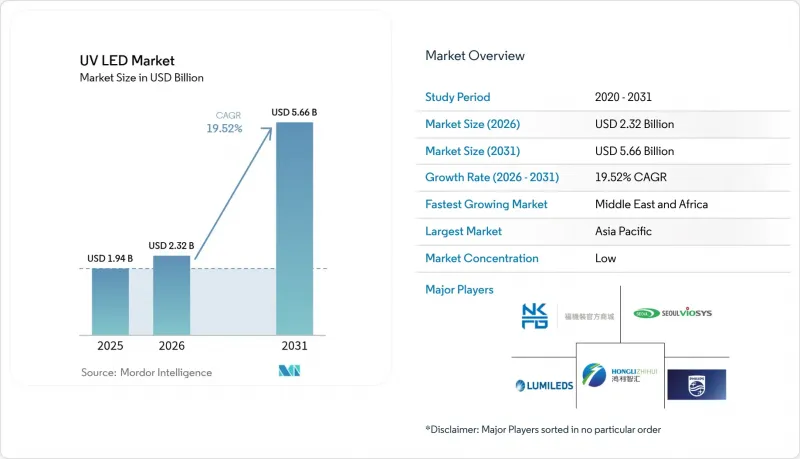
據 Mordor Intelligence 稱,UV LED 市場規模預計在 2026 年達到 23.2 億美元,高於 2025 年的 19.4 億美元,預計到 2031 年將達到 56.6 億美元。
預計從 2026 年到 2031 年,其複合年成長率將達到 19.52%。
本報告按技術(波長)(UV-A、UV-B、UV-C)、產品/外形規格(燈管、模組等)、功率輸出(低功率、中功率等)、應用(固化、消毒/滅菌等)、終端用戶行業(醫療保健/生命科學、印刷/包裝、汽車/航太等)和地區進行細分。市場預測以美元(USD)為單位。
全球紫外LED市場趨勢與洞察
嚴格的汞燈淘汰政策正在加速紫外線LED的普及。
全球法規正逐步淘汰照明產業的汞光源。 《水俁公約》的147個締約國同意在2027年前逐步淘汰螢光,該公約已將每盞燈的汞含量限制在5毫克以內,預計在2027年後將完全停用。加拿大2025年的法規也遵循了這個趨勢。隨著用戶的轉型,印刷生產線在用固體LED陣列取代汞燈後,能耗降低了85%。因此,已獲得UV LED設備預認證的供應商正在獲得長期維修合約。
亞洲各地對「用水點(PoU)」水消毒的需求正在激增。
快速的都市化給印度、印尼和中國沿海地區的中心供水網路帶來了巨大壓力。挪威的實地測試表明,LED反應器每天可從545立方公尺的水中去除3個對數單位的大腸桿菌群,證實了該技術在都市區水流中的適用性。其緊湊的外形尺寸使得UV-C發射器可以整合到家用飲水機、小規模工廠和鄉村診所。亞洲設備製造商正在擴大基於太陽能微電網的整合模組的運作規模,加速在離網環境中普及安全供水。
量子效率的上限限制了其在高功率應用中的發展。
波長低於280奈米的深紫外線LED的電光轉換效率通常低於5%,遠低於低壓汞燈20-30%的效率。需要千瓦級輸出功率的供水事業必須部署大規模LED陣列,導致資本投資成本大幅增加。目前,研究重點集中在量子點、超晶格和透明基板,以提高電洞注入和光提取效率。雖然AlGaN超晶格設計已將量子效率(EQE)提高到35毫瓦功率下的8.6%,但要實現這種性能水平的大規模生產預計仍需數年時間。
細分市場分析
預計到2025年,UV-A系統將佔銷售額的71.45%,並繼續在印刷業的固化製程和仿冒品檢測領域佔據主導地位。同時,隨著醫療和市政用戶採用無汞消毒解決方案,UV-C預計將以21.62%的複合年成長率成長。歐司朗的OSLON™ UV 3535紫外線殺菌燈,在265奈米波長下可提供115毫瓦的功率,並擁有20,000小時的使用壽命,是可靠水-空氣反應器發展歷程中的重要里程碑。 UV-B的細分市場正在湧現一些特殊需求領域,例如照光治療和農業光形態發生技術。
不同地區的應用趨勢各不相同。在歐洲,255-275奈米波長發光二極體的標準化正在推進,以應用於食品加工管道;而在日本,308奈米波長的UV-B紫外線正被考慮用於皮膚病學醫療應用。隨著量子效率的不斷提高,用於醫療空氣消毒的UV-C模組的紫外線LED市場預計到2030年將以行業平均速度的兩倍成長。遠紫外線(UVC)222奈米準分子發光元件的技術突破將使人員密集場所的安全、持續消毒成為可能,並有望進一步拓展其應用範圍。
由於易於整合,模組預計將在2025年保持最大的市場佔有率,佔銷售額的41.35%。同時,晶片預計將實現22.85%的複合年成長率,反映出消費性電子和實驗室設備對客製化光學引擎的需求。 GaN-on-SiC基板降低了熱阻,使得2025年原型晶片的輸出功率達到100 mW。用於改造現有插座的燈具細分市場,隨著陣列式燈具的日益普及,預計銷售量將逐漸下降。
超小型晶片正成為新興生物感測器和晶片實驗室(LoC)設備的基礎。研究人員已展示了尺寸為90奈米的奈米級鈣鈦礦LED,其外量子效率(EQE)可達20%。隨著封裝材料從陶瓷轉向模塑複合材料,每毫瓦的平均成本正在下降,推動了其在攜帶式消毒設備中的應用。因此,預計到2031年,紫外線LED在晶片級銷售中的市佔率將上升至34.20%。
區域分析
到2025年,亞太地區將佔據紫外線LED市場54.30%的主導地位。中國大力推動自主化,催生了許多本土外延供應商和內部元件封裝生產線。日本和韓國提供高精度製造技術,而台灣則專注於深紫外線(DUV)晶片的氮化鎵基板。隨著公共衛生預算的增加,大都會圈對紫外線水淨化和空氣淨化技術的需求日益成長,進一步鞏固了該地區的市場主導地位。
北美位居第二。加州加速淘汰汞燈,加上聯邦政府撥款擴大國內晶片產能,正在推動醫療和先進製造業領域的應用。然而,複雜的專利障礙和高昂的人事費用正在減緩其擴張速度。歐洲緊隨北美之後,這得益於強制性的能源效率法規。生態設計法規為紫外線解決方案創造了有利環境,預計2030年,96%的紫外線燈將是LED燈。
中東和非洲是成長最快的地區,年複合成長率高達20.05%,主要得益於LED反應器在海水淡化廠和新建醫院的應用。海灣國家正在資助智慧城市項目,強制要求使用無汞照明。在南美洲,瓶裝飲料和水產養殖產業發展勢頭強勁,但由於認證週期較長,市政供水計畫的進展較為緩慢。整體而言,隨著監管政策的完善和技術的成熟,紫外線LED市場在所有地區都呈現出趨同成長的趨勢。
其他好處:
- Excel格式的市場預測(ME)表
- 3個月的分析師支持
目錄
第1章:引言
- 研究假設和市場定義
- 調查範圍
第2章:調查方法
第3章執行摘要
第4章 市場狀況
- 市場概覽
- 市場促進因素
- 歐盟和加州對汞燈實施嚴格的淘汰政策,加速了紫外線LED燈的普及。
- 在亞洲各地,新冠疫情後,對場所水消毒的需求激增。
- 為了符合食品安全標準,軟質包裝產業正迅速轉向低遷移 UV LED 油墨。
- 歐洲能源價格上漲正在推動低功率紫外線LED固化生產線的普及。
- Mini-LED背光技術的發展藍圖正在推動半導體製造中深紫外線(DUV)檢測設備的普及。
- 擴大遠紫外線 (222 nm) 在機場、醫院等人員密集場所進行空氣消毒的應用。
- 市場限制因素
- 基於 AlGaN 的 UVC 晶片的量子效率上限及其不到 5% 的市場佔有率限制了其在高功率應用領域的擴展。
- 智慧財產權帶來的沉重專利費負擔提高了新進入北美市場的企業的成本門檻。
- 工業固化生產線中高密度紫外線LED陣列的溫度控管挑戰
- 冗長的認證過程(NSF/ANSI 55-2022)正在延誤新興經濟體地方政府的水利工程。
- 產業生態系分析
- 技術展望
- 波特五力分析
第5章 市場規模與成長預測
- 按技術(波長)
- UV-A
- UV-B
- UV-C
- 按產品/外形規格
- 燈
- 模組
- 大批
- 提示
- 依輸出類型
- 低功率(小於10毫瓦)
- 中功率(10-100mW)
- 高功率(超過100毫瓦)
- 透過使用
- 固化(油墨、塗料、黏合劑)
- 消毒/滅菌
- 感測與測量
- 藥物治療和照光治療
- 仿冒品品檢測與安全
- 園藝和室內農業
- 其他(3D列印、光刻)
- 按最終用戶行業分類
- 醫療保健和生命科學
- 印刷和包裝
- 電子和半導體
- 供水和污水處理設施
- 食品/飲料加工
- 汽車和航太
- 住宅/商業建築
- 工業生產
- 按地區
- 北美洲
- 美國
- 加拿大
- 墨西哥
- 歐洲
- 德國
- 英國
- 法國
- 義大利
- 西班牙
- 其他歐洲國家
- 亞太地區
- 中國
- 日本
- 韓國
- 印度
- 東南亞
- 其他亞太國家
- 南美洲
- 巴西
- 其他南美國家
- 中東和非洲
- 中東
- 阿拉伯聯合大公國
- 沙烏地阿拉伯
- 其他中東國家
- 非洲
- 南非
- 其他非洲國家
- 中東
- 北美洲
第6章 競爭情勢
- 市場集中度
- 策略趨勢
- 市佔率分析
- 公司簡介
- ams OSRAM AG
- Signify NV
- Nichia Corporation
- Seoul Viosys Co., Ltd.
- Crystal IS Inc.(Asahi Kasei)
- Lumileds Holding BV
- Nikkiso Co., Ltd.(UV Business)
- LG Innotek Co., Ltd.
- LITE-ON Technology Corp.
- Honlitronics(Hongli Zhihui Group)
- Stanley Electric Co., Ltd.
- SemiLEDs Corporation
- Violumas Inc.
- DOWA Electronics Materials Co., Ltd.
- Nordson Corporation
- Luminus Devices, Inc.
- Heraeus Holding GmbH(Noblelight)
- Phoseon Technology(Excelitas)
- Sensor Electronic Technology Inc.(SETi)
- Bolb Inc.
第7章 市場機會與未來展望
According to Mordor Intelligence, UV LED market size in 2026 is estimated at USD 2.32 billion, growing from 2025 value of USD 1.94 billion with 2031 projections showing USD 5.66 billion, growing at 19.52% CAGR over 2026-2031.
This report is Segmented by Technology (Wavelength) (UV-A, UV-B, and UV-C), Product/Form Factor (Lamps, Modules, and More), Power Output (Low Power, Medium Power, and More), Application (Curing, Disinfection and Sterilization, and More), End-User Industry (Healthcare and Life Sciences, Printing and Packaging, Automotive and Aerospace, and More), and Geography. The Market Forecasts are Provided in Terms of Value (USD).
Global UV LED Market Trends and Insights
Stringent Mercury-Lamp Phase-Out Policies Accelerating UV LED Adoption
Global regulation is eliminating mercury sources in lighting. The Minamata Convention aligned 147 signatories on a 2027 fluorescent exit. The EU RoHS Directive already caps mercury content at 5 mg per lamp, with full bans expected after 2027. Canada's 2025 rules mirror this direction. As users transition, printing lines report 85% lower energy use after swapping mercury lamps for solid-state arrays. Vendors that pre-qualified UV LED equipment are therefore securing long-term retrofit contracts.
Surge in Point-of-Use Water Disinfection Demand Across Asia
Rapid urbanisation stresses central water grids in India, Indonesia, and coastal China. Field trials in Norway demonstrated 3-log coliform removal at 545 m3/day using LED reactors, validating the technology's viability for municipal flows. Compact form factors allow embedding UV-C emitters in home dispensers, small factories, and rural clinics. Asian equipment makers are scaling integrated modules that operate on solar micro-grids, accelerating off-grid water-safety rollouts.
Quantum Efficiency Ceiling Limiting High-Power Applications
Deep-UV LEDs below 280 nm typically deliver <5% wall-plug efficiency, far below the 20-30% of low-pressure mercury lamps.Water utilities needing kilowatt-scale output must deploy large LED arrays, inflating capital costs. Research now focuses on quantum dots, super-lattices, and transparent substrates to improve hole injection and light extraction. AlGaN super-lattice designs boosted EQE to 8.6% at 35 mW, yet mass manufacturing at such performance remains years away.
Other drivers and restraints analyzed in the detailed report include:
- Rapid Shift to Low-Migration UV LED Inks in Flexible Packaging
- Energy Price Inflation Favouring Low-Power UV LED Curing Lines
- Royalty-Heavy IP Landscape Raising Cost Barriers
For complete list of drivers and restraints, kindly check the Table Of Contents.
Segment Analysis
UV-A systems held 71.45% revenue share in 2025, retaining dominance in graphic-arts curing and counterfeit detection. UV-C, however, is set for a 21.62% CAGR as healthcare and municipal users deploy mercury-free germicidal solutions. ams OSRAM's OSLON(TM) UV 3535 delivers 115 mW at 265 nm with 20,000-hour life, a key milestone for reliable water and air reactors. The UV-B niche addresses phototherapy and agricultural photomorphogenesis, carving specialised demand pockets.
Adoption dynamics vary by region. Europe is standardising 255-275 nm emitters in food-processing pipelines, while Japan explores 308 nm UV-B for dermatology. As quantum-efficiency gains continue, the UV LED market size for UV-C modules targeting medical air sterilisation is projected to grow at double the sector average through 2030. Breakthroughs in far-UVC 222 nm excimer emitters promise human-safe continuous disinfection of occupied spaces, further widening the use-case frontier.
Modules retained the largest 41.35% slice of 2025 revenue due to integration ease. Chips, though, will post a 22.85% CAGR, reflecting demand for custom optical engines in consumer devices and lab instruments. GaN-on-SiC substrates cut thermal resistance, enabling chip-level powers of 100 mW in 2025 prototypes. The lamps sub-segment serves retrofit sockets but faces gradual volume decline as arrays gain traction.
Ultra-miniaturised chips underpin emerging biosensors and lab-on-a-chip devices. Researchers have demonstrated nano-scale perovskite LEDs with 20% EQE at 90 nm dimensions. As packaging shifts from ceramic to moulded composites, median cost per milliwatt is falling, stimulating design-in across portable sterilisation gadgets. Consequently, the UV LED market share of chip-level sales is forecast to rise to 34.20% by 2031.
Complete Report Scope:
- By Technology (Wavelength)
- UV-A
- UV-B
- UV-C
- By Product/Form Factor
- Lamps
- Modules
- Arrays
- Chips
- By Power Output
- Low Power (<10 mW)
- Medium Power (10-100 mW)
- High Power (>100 mW)
- By Application
- Curing (Inks, Coatings and Adhesives)
- Disinfection and Sterilization
- Sensing and Instrumentation
- Medical and Phototherapy
- Counterfeit Detection and Security
- Horticulture and Indoor Farming
- Other Niche Applications (3-D Printing, Lithography)
- By End-user Industry
- Healthcare and Life Sciences
- Printing and Packaging
- Electronics and Semiconductors
- Water and Wastewater Utilities
- Food and Beverage Processing
- Automotive and Aerospace
- Residential and Commercial Buildings
- Industrial Manufacturing
- By Geography
- North America
- United States
- Canada
- Mexico
- Europe
- Germany
- United Kingdom
- France
- Italy
- Spain
- Rest of Europe
- Asia-Pacific
- China
- Japan
- South Korea
- India
- South East Asia
- Rest of Asia-Pacific
- South America
- Brazil
- Rest of South America
- Middle East and Africa
- Middle East
- United Arab Emirates
- Saudi Arabia
- Rest of Middle East
- Africa
- South Africa
- Rest of Africa
- Middle East
- North America
Geography Analysis
Asia Pacific held a commanding 54.30% share of UV LED market revenue in 2025. China's self-reliance push is spawning local epitaxy suppliers and captive device packaging lines. Japan and South Korea add high-precision fabrication know-how, while Taiwan specialises in gallium-nitride substrates for deep-UV chips. Rising public-health budgets channel demand for UV-based water and air purification across megacities, cementing regional dominance.
North America ranks second. California's accelerated mercury-lamp phase-out, coupled with federal funding for domestic chip capacity, drives adoption in healthcare and advanced manufacturing. However, a dense patent thicket and higher labour costs temper the expansion pace. Europe follows closely, powered by energy-efficiency mandates. Ecodesign rules forecast that 96% of installed lamps will be LEDs by 2030, creating a receptive environment for UV solutions.
The Middle East & Africa is the fastest-growing area, showing a 20.05% CAGR as desalination plants and new hospitals incorporate LED reactors. Gulf states fund smart-city programmes that specify mercury-free lighting. South America sees momentum in beverage bottling and aquaculture, though municipal water projects move slowly due to certification cycles. Across all geographies, simultaneous regulation and technology maturation keep the UV LED market on a convergent uplift path.
- ams OSRAM AG
- Signify N.V.
- Nichia Corporation
- Seoul Viosys Co., Ltd.
- Crystal IS Inc. (Asahi Kasei)
- Lumileds Holding B.V.
- Nikkiso Co., Ltd. (UV Business)
- LG Innotek Co., Ltd.
- LITE-ON Technology Corp.
- Honlitronics (Hongli Zhihui Group)
- Stanley Electric Co., Ltd.
- SemiLEDs Corporation
- Violumas Inc.
- DOWA Electronics Materials Co., Ltd.
- Nordson Corporation
- Luminus Devices, Inc.
- Heraeus Holding GmbH (Noblelight)
- Phoseon Technology (Excelitas)
- Sensor Electronic Technology Inc. (SETi)
- Bolb Inc.
Additional Benefits:
- The market estimate (ME) sheet in Excel format
- 3 months of analyst support
TABLE OF CONTENTS
1 INTRODUCTION
- 1.1 Study Assumptions and Market Definition
- 1.2 Scope of the Study
2 RESEARCH METHODOLOGY
3 EXECUTIVE SUMMARY
4 MARKET LANDSCAPE
- 4.1 Market Overview
- 4.2 Market Drivers
- 4.2.1 Stringent Mercury Lamp Phase-Out Policies in EU and California Accelerating UV-LED Adoption
- 4.2.2 Surge in Point-of-Use Water Disinfection Demand Post-COVID-19 Across Asia
- 4.2.3 Rapid Shift to Low-Migration UV LED Inks in Flexible Packaging for Food Safety Compliance
- 4.2.4 Energy Price Inflation in Europe Favouring Low-Power UV-LED Curing Lines
- 4.2.5 Mini-LED Backlighting Roadmaps Driving Deep-UV Inspection Tools Adoption in Semiconductor Fabs
- 4.2.6 Growing Acceptance of Far-UVC (222 nm) for Occupied-Space Air Sanitisation in Airports and Hospitals
- 4.3 Market Restraints
- 4.3.1 Quantum Efficiency Ceiling (<5 %) of AlGaN-Based UVC Chips Limits High-Power Applications
- 4.3.2 Royalty-Heavy IP Landscape Raising Cost Barriers for New Entrants in North America
- 4.3.3 Thermal Management Challenges in High-Density UV LED Arrays for Industrial Curing Lines
- 4.3.4 Slow Certification Cycles (NSF/ANSI 55-2022) Delaying Municipal Water Projects in Emerging Economies
- 4.4 Industry Ecosystem Analysis
- 4.5 Technological Outlook
- 4.6 Porter's Five Forces Analysis
- 4.6.1 Bargaining Power of Suppliers
- 4.6.2 Bargaining Power of Buyers
- 4.6.3 Threat of New Entrants
- 4.6.4 Threat of Substitutes
- 4.6.5 Intensity of Competitive Rivalry
5 MARKET SIZE AND GROWTH FORECASTS (VALUES)
- 5.1 By Technology (Wavelength)
- 5.1.1 UV-A
- 5.1.2 UV-B
- 5.1.3 UV-C
- 5.2 By Product/Form Factor
- 5.2.1 Lamps
- 5.2.2 Modules
- 5.2.3 Arrays
- 5.2.4 Chips
- 5.3 By Power Output
- 5.3.1 Low Power (<10 mW)
- 5.3.2 Medium Power (10-100 mW)
- 5.3.3 High Power (>100 mW)
- 5.4 By Application
- 5.4.1 Curing (Inks, Coatings and Adhesives)
- 5.4.2 Disinfection and Sterilization
- 5.4.3 Sensing and Instrumentation
- 5.4.4 Medical and Phototherapy
- 5.4.5 Counterfeit Detection and Security
- 5.4.6 Horticulture and Indoor Farming
- 5.4.7 Other Niche Applications (3-D Printing, Lithography)
- 5.5 By End-user Industry
- 5.5.1 Healthcare and Life Sciences
- 5.5.2 Printing and Packaging
- 5.5.3 Electronics and Semiconductors
- 5.5.4 Water and Wastewater Utilities
- 5.5.5 Food and Beverage Processing
- 5.5.6 Automotive and Aerospace
- 5.5.7 Residential and Commercial Buildings
- 5.5.8 Industrial Manufacturing
- 5.6 By Geography
- 5.6.1 North America
- 5.6.1.1 United States
- 5.6.1.2 Canada
- 5.6.1.3 Mexico
- 5.6.2 Europe
- 5.6.2.1 Germany
- 5.6.2.2 United Kingdom
- 5.6.2.3 France
- 5.6.2.4 Italy
- 5.6.2.5 Spain
- 5.6.2.6 Rest of Europe
- 5.6.3 Asia-Pacific
- 5.6.3.1 China
- 5.6.3.2 Japan
- 5.6.3.3 South Korea
- 5.6.3.4 India
- 5.6.3.5 South East Asia
- 5.6.3.6 Rest of Asia-Pacific
- 5.6.4 South America
- 5.6.4.1 Brazil
- 5.6.4.2 Rest of South America
- 5.6.5 Middle East and Africa
- 5.6.5.1 Middle East
- 5.6.5.1.1 United Arab Emirates
- 5.6.5.1.2 Saudi Arabia
- 5.6.5.1.3 Rest of Middle East
- 5.6.5.2 Africa
- 5.6.5.2.1 South Africa
- 5.6.5.2.2 Rest of Africa
- 5.6.5.1 Middle East
- 5.6.1 North America
6 COMPETITIVE LANDSCAPE
- 6.1 Market Concentration
- 6.2 Strategic Moves
- 6.3 Market Share Analysis
- 6.4 Company Profiles (includes Global level Overview, Market level overview, Core Segments, Financials as available, Strategic Information, Market Rank/Share, Products and Services, Recent Developments)
- 6.4.1 ams OSRAM AG
- 6.4.2 Signify N.V.
- 6.4.3 Nichia Corporation
- 6.4.4 Seoul Viosys Co., Ltd.
- 6.4.5 Crystal IS Inc. (Asahi Kasei)
- 6.4.6 Lumileds Holding B.V.
- 6.4.7 Nikkiso Co., Ltd. (UV Business)
- 6.4.8 LG Innotek Co., Ltd.
- 6.4.9 LITE-ON Technology Corp.
- 6.4.10 Honlitronics (Hongli Zhihui Group)
- 6.4.11 Stanley Electric Co., Ltd.
- 6.4.12 SemiLEDs Corporation
- 6.4.13 Violumas Inc.
- 6.4.14 DOWA Electronics Materials Co., Ltd.
- 6.4.15 Nordson Corporation
- 6.4.16 Luminus Devices, Inc.
- 6.4.17 Heraeus Holding GmbH (Noblelight)
- 6.4.18 Phoseon Technology (Excelitas)
- 6.4.19 Sensor Electronic Technology Inc. (SETi)
- 6.4.20 Bolb Inc.
7 MARKET OPPORTUNITIES AND FUTURE OUTLOOK
- 7.1 White-space and Unmet-Need Assessment

 紫外線LED光源-2026-2032年全球市佔率及排名、總收入及需求預測
 2026年全球深層紫外線LED市場報告
 紫外線LED市場:按技術、應用和地區分類
 紫外線LED市場規模、佔有率、趨勢和預測:按類型、材料、應用、產業和地區分類,2026-2034年
 深紫外線(DUV)LED市場趨勢及產品分析(2026年)
 紫外線LED市場分析及預測(至2035年):依類型、產品、服務、技術、組件、應用、材料類型、裝置、最終使用者及解決方案分類
 紫外線LED市場機會、成長促進因素、產業趨勢分析及預測(2026-2035年)2026年全球UV-C LED市場報告
 紫外線LED市場-全球產業規模、佔有率、趨勢、機會及預測(依技術、應用、區域及競爭格局分類,2021-2031年)
 UV LED固化市場:預測(2025-2030年)