

 |
市場調查報告書
商品編碼
2100579
水泥板:市場佔有率分析、產業趨勢與統計、成長預測(2026-2031)Cement Board - Market Share Analysis, Industry Trends & Statistics, Growth Forecasts (2026 - 2031) |
||||||

※ 本網頁內容可能與最新版本有所差異。詳細情況請與我們聯繫。
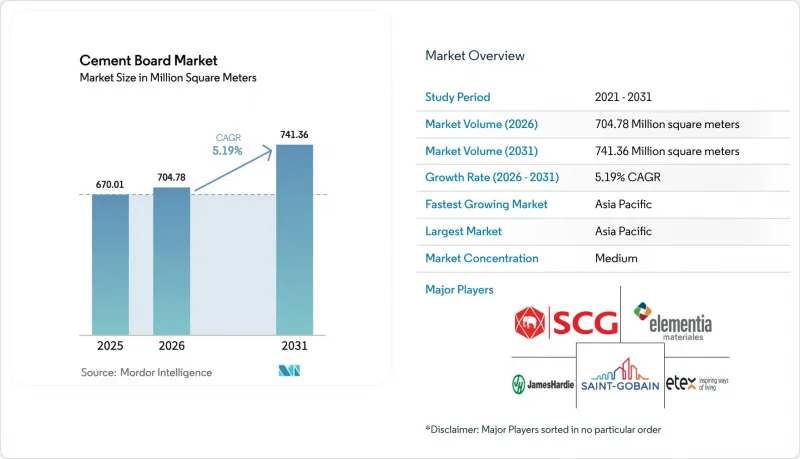
根據 Mordor Intelligence 預測,水泥板市場規模將從 2025 年的 6.7001 億平方公尺和 2026 年的 7.0478 億平方公尺成長到 2031 年的 7.4136 億平方公尺,2026 年至 2031 年的年複合成長率(CAGR)為 5.00%。
本報告按產品類型(例如,纖維增強水泥板 (FCB)、木絲水泥板 (WWCB)、木屑水泥板 (WSCB))、應用領域(例如,地板材料、屋頂、柱/梁、外牆)、終端用戶行業(例如,住宅、商業)和地區(亞太地區、北美、歐洲、南美、中東和非洲)進行細分。市場預測以銷售量(平方公尺)為單位。
全球水泥板市場趨勢及洞察
在住宅和商業建築中推廣應用
由於建築規範日益嚴格和勞動力短缺,水泥板已成為住宅和非住宅建築的首選基材。加州2024年修訂的CALGreen法規強制要求覆材必須提供環境產品聲明(EPD),這將禁止使用乙烯基產品,並迫使建築商改用纖維水泥板。在印度,預計到2025年,住宅占地面積將增加4.5億平方英尺,其中大部分將使用水泥板天花板和樓梯間襯裡,以滿足90分鐘的防火標準。新加坡和香港的商業維修工程正在從石膏板轉向12毫米厚的水泥板,以達到綠建築標誌鉑金級認證的抗衝擊標準。現場工人安裝預切割板材的速度比濕抹灰快40%,可將中層建築的工期縮短2-3週。
強制性綠建築法規建議使用不含石棉的板材。
2024年歐盟建築產品法規修正案強制要求提交性能聲明,確認石棉含量為零,這將加速纖維水泥的普及應用。澳洲2025年國家建築規範堵住了先前允許進口未經認證板材的漏洞。紐約市第97號地方法律限制了外牆嵌入碳的含量,並鼓勵開發商用水泥板取代鋁複合材料,從而減少35%的碳足跡。已擁有EPD庫和ISO 8336耐火測試數據的製造商可以比新參與企業提前6到9個月進入市場。
與石膏板或定向塑合板相比,初始成本較高
在北美,纖維水泥板的零售價格在每塊18美元到24美元之間,比X型石膏板高出40%到60%。隨著波特蘭水泥價格在2025年上漲12%,而石膏價格保持不變,這個價格差距進一步擴大。人事費用也是造成價格上漲的原因之一,因為使用硬質合金刀片和預鑽孔會使工時增加10%到15%。在印度和東南亞的低收入住宅預算中,材料成本通常受到限制,這導致全生命週期成本較低,但短期市場滲透率也有限。
細分市場分析
預計到2025年,纖維水泥板(FCB)將佔總銷售量的58.76%,憑藉符合ASTM C1186標準的成熟產品線,其市場地位將得到鞏固。 James Hardy公司生產的高壓釜處理的板材抗彎強度達18-22 MPa,尺寸公差為±0.3%,可同時用作覆材和結構襯墊。其他類型的產品,例如氧化鎂或稻殼製成的板材,由於成本較高且具有更優異的抗氯化物性能,正以5.56%的複合年成長率快速成長,使其適用於沿海地區的建築。在這些產品中,高性能FCB水泥板市場預計將在北美和歐盟等建築規範嚴格的地區實現最快成長。木絲和塑合板等特殊產品形式可用作吸音天花板材料,其降噪係數(NRC)最高可達0.75。印度和越南的製造商現在用稻殼纖維取代高達 40% 的纖維素,平方公尺可降低 5 美元的原料成本,而不會影響 A 級防火性能。
稻殼板和鎂板有望挑戰FCB在價格敏感型和細分市場中較小的市場佔有率。然而,在抗震性、防火性和保固標準比初始成本差異更為重要的市場,高壓釜的FCB仍將繼續主導水泥板市場。 FCB憑藉其在沙烏地阿拉伯海上專案、日本多用戶住宅大樓和美國資料中心等領域久經考驗的卓越性能而備受青睞。完善的EPD(環境產品聲明)庫也為這一發展勢頭提供了有力支撐,該庫有助於建築商實現其碳排放目標。
區域分析
亞太地區是水泥板市場的主要驅動力,預計2025年將佔銷售量的44.07%,並以5.42%的複合年成長率成長。僅印度的「人人享有住房計畫」(PMAY)一項,強制沿海各邦使用抗旋風覆覆材材料,預計到2025年將產生1800萬平方公尺的需求。在越南,360億美元的外國直接投資流入電子園區,推動市場滲透率從2023年的12%成長到2025年的22%。在日本的預製房屋領域,能夠承受0.4g側向荷載的韌性纖維水泥的應用仍在持續。
在北美,加州的WUI(牆體入侵森林)建築規範強制要求在危險區域使用A級覆材,每年新增600萬平方公尺的需求。美國住房與城市發展部(HUD)2025年指南建議在模組化低收入住宅中使用纖維水泥,導致賓州和安大略省的工廠訂單增加。加拿大2025年建築規範加強了寒冷氣候下的防潮規定,優先使用板材而非定向塑合板(OSB)。
歐洲市場規模的形成受到格倫費爾大廈火災後消防法規和《建築能源性能指令》的影響。德國的《建築能源法》對能夠穩定室內溫度波動的高熱容量隔間牆給予獎勵。在英國,自2024年以來,已有2500棟建築用纖維水泥板取代了易燃外牆。在北歐預製房屋行業,高氣密性板材被指定用於實現被動式房屋的目標,而在南歐,這些板材則被用作抵禦野火的措施。
在南美、中東和非洲地區,巴西的「我的家」(Minha Casa)計畫於2024年重新啟動,該計畫強制要求使用防白蟻覆材,並在2025年新增了300萬平方公尺的涵蓋範圍積。在沙烏地阿拉伯的「2030願景」住宿設施中,水泥板被用於承受高達攝氏50度C的溫度波動。阿拉伯聯合大公國的「綠色建築認證」(Estidama Al Sa'fat)計畫為獲得EPD認證的板材授予積分,以支援提供透明碳數據的供應商。
其他好處:
- Excel格式的市場預測(ME)表
- 3個月的分析師支持
目錄
第1章:引言
- 研究的先決條件
- 調查範圍
第2章:調查方法
第3章執行摘要
第4章 市場狀況
- 市場概覽
- 市場促進因素
- 在住宅和商業建築中推廣應用
- 強制性綠建築標準建議使用不含石棉的板材。
- 對具有卓越耐久性和抗衝擊性的室內板材的需求
- 異地批量模組化建築的採用現狀
- 獲得防火認證的覆材可享有火災保險折扣。
- 市場限制因素
- 與石膏板和定向塑合板相比,初始成本較高
- 水泥和纖維素纖維價格波動/二氧化碳課稅
- 廢舊產品回收基礎設施有限。
- 價值鏈分析
- 波特五力模型
第5章 市場規模與成長預測
- 依產品類型
- 纖維水泥板(FCB)
- 纖維增強水泥板(FCB)
- 木絲水泥板(WWCB)
- 木屑水泥板(WSCB)
- 其他(氧化鎂水泥板(MOCB)、稻殼水泥板)
- 透過使用
- 地板材料
- 外牆與隔牆
- 屋頂材料
- 柱/樑
- 立面、外牆板、覆層
- 隔音和隔熱
- 其他(預製建築、防火建築)
- 按最終用戶行業分類
- 住宅
- 商業設施
- 工業和公共設施
- 按地區
- 亞太地區
- 中國
- 印度
- 日本
- 韓國
- 越南
- 馬來西亞
- 印尼
- 泰國
- 其他亞太國家
- 北美洲
- 美國
- 加拿大
- 墨西哥
- 歐洲
- 德國
- 英國
- 法國
- 義大利
- 俄羅斯
- 土耳其
- 西班牙
- 北歐國家
- 其他歐洲國家
- 南美洲
- 巴西
- 阿根廷
- 哥倫比亞
- 其他南美國家
- 中東和非洲
- 沙烏地阿拉伯
- 南非
- 卡達
- 奈及利亞
- 阿拉伯聯合大公國
- 其他中東和非洲國家
- 亞太地區
第6章 競爭情勢
- 市場集中度
- 策略趨勢
- 市佔率和排名分析
- 公司簡介
- Allura
- BetonWood SRL
- Century Ply
- CONWOOD Co.,LTD
- CSR
- ELEMENTIA MATERIALES, SAB DE CV
- Etex Group
- Everest Industries Limited
- James Hardie Industries plc.
- Johns Manville
- National Gypsum Services Company
- NICHIHA
- Saint-Gobain
- Siam Cement Public Company Limited
第7章 市場機會與未來展望
According to Mordor Intelligence, the cement board market size is projected to expand from 670.01 Million square meters in 2025 and 704.78 Million square meters in 2026 to 741.36 Million square meters by 2031, registering a CAGR of 5.19% between 2026 to 2031.
This report is Segmented by Product Type (Fiber Cement Board, Wood Wool Cement Board, Wood Strand Cement Board, and More), Application (Flooring, Roofing, Columns and Beams, Facades, and More), End-User Industry (Residential, Commercial, and More), and Geography (Asia-Pacific, North America, Europe, South America, and Middle East and Africa). The Market Forecasts are Provided in Terms of Volume (Square Meters).
Global Cement Board Market Trends and Insights
Rising Adoption in Residential and Commercial Construction
Tighter building codes and labor shortages make cement board a preferred substrate in both housing and non-residential work. California's 2024 CALGreen update requires Environmental Product Declarations for exterior cladding, disqualifying vinyl options and pushing contractors toward fiber cement. India added 450 million ft2 of residential floor area in 2025, much of it using cement board soffits and stairwell liners to meet 90-minute fire-rating rules. Commercial retrofits in Singapore and Hong Kong now swap gypsum for 12 mm boards to achieve Green Mark Platinum impact-resistance targets. On-site crews can fasten pre-scored panels 40% faster than wet plaster, trimming mid-rise schedules by two to three weeks.
Mandatory Green-Building Codes Favoring Non-Asbestos Boards
The European Union's 2024 revision to the Construction Products Regulation mandates a Declaration of Performance confirming zero asbestos content, accelerating fiber cement uptake. Australia's 2025 National Construction Code closed import loopholes that once allowed uncertified boards. New York City's Local Law 97 caps facade embodied carbon, prompting developers to replace aluminum composites with cement board for a 35% footprint cut. Manufacturers holding ready EPD libraries and ISO 8336 fire-test data reach the market six to nine months sooner than new entrants.
High Initial Cost Versus Gypsum and OSB
Fiber cement panels retail at USD 18-24 in North America, 40-60% above Type X gypsum. The price gap widened after Portland-cement increases of 12% in 2025, whereas gypsum stayed flat. Labor adds cost because carbide blades and pre-drilling extend crew hours by 10-15%. Affordable-housing budgets in India and Southeast Asia often cap material spend, limiting near-term penetration despite lower life-cycle outlays.
Other drivers and restraints analyzed in the detailed report include:
- Demand for Durable, Impact-Resistant Interior Panels
- Uptake in Off-Site Volumetric Modular Buildings
- Volatile Cement and Cellulose Fiber Prices / CO2 Levies
For complete list of drivers and restraints, kindly check the Table Of Contents.
Segment Analysis
Fiber Cement Board captured 58.76% of 2025 volume, locking in its position through mature ASTM C1186-compliant lines. James Hardie's autoclaved boards post 18-22 MPa flexural strength and +-0.3% dimensional tolerance, satisfying both cladding and structural-sheathing roles. Other product types, such as magnesium oxide and rice-husk variants, while costlier, are expanding at a 5.56% CAGR on superior chloride resistance that suits coastal builds. Within this mix, the cement board market size for high-performance FCB is projected to widen fastest in code-driven regions such as North America and the EU. Niche formats, wood wool, and strand boards serve acoustic ceilings, offering NRC values up to 0.75. Producers in India and Vietnam now substitute up to 40% cellulose with rice-husk fiber, lowering raw costs by USD 5 /m2 without sacrificing Class A fire ratings.
Rice-husk and magnesium boards are poised to erode small shares from FCB in price-sensitive and specialty markets. However, the cement board market share of autoclaved FCB will remain dominant where seismic, fire, and warranty criteria override first-cost differences. Saudi Arabian marine projects, Japanese multifamily towers, and U.S. data centers all specify FCB for its verified performance envelope. Momentum also rests on well-documented EPD libraries that help builders meet embodied-carbon targets.
Complete Report Scope:
- By Product Type
- Fiber Cement Board (FCB)
- Wood Wool Cement Board (WWCB)
- Wood Strand Cement Board (WSCB)
- Cement-Bonded Particle Board (CBPB)
- Other Product Types (Magnesium Oxide Cement Board (MOCB), Rice Husk Cement Board)
- By Application
- Flooring
- Exterior and Partition Walls
- Roofing
- Columns and Beams
- Facades, Weatherboard and Cladding
- Acoustic and Thermal Insulation
- Other Applications (Prefabricated and Fire-resistant Construction)
- By End-user Industry
- Residential
- Commercial
- Industrial and Institutional
- By Geography
- Asia-Pacifc
- China
- India
- Japan
- South Korea
- Vietnam
- Malaysia
- Indonesia
- Thailand
- Rest of Asia-Pacific
- North America
- United States
- Canada
- Mexico
- Europe
- Germany
- United Kingdom
- France
- Italy
- Russia
- Turkey
- Spain
- NORDIC Countries
- Rest of Europe
- South America
- Brazil
- Argentina
- Colombia
- Rest of South America
- Middle East and Africa
- Saudi Arabia
- South Africa
- Qatar
- Nigeria
- United Arab Emirates
- Rest of Middle East and Africa
- Asia-Pacifc
Geography Analysis
Asia-Pacific dominated the cement board market with 44.07% of 2025 volume and is poised for a 5.42% CAGR. India's PMAY program alone generated 18 million m2 of demand in 2025 by mandating cyclone-resistant cladding in coastal states. Vietnam's USD 36 billion FDI inflow into electronics parks drove penetration from 12% in 2023 to 22% in 2025. Japan's prefab sector continues to install ductile fiber cement that withstands 0.4 g lateral loads.
In North America, California's WUI code requires Class A cladding in hazard zones, adding 6 million m2 of annual demand. HUD guidance in 2025 promoted fiber cement for modular affordable housing, boosting orders from Pennsylvania and Ontario plants. Canada's 2025 code tightened moisture-management rules in cold climates, favoring boards over OSB.
Europe's market volume is shaped by post-Grenfell fire statutes and the Energy Performance of Buildings Directive. Germany's Building Energy Act credits high-thermal-mass partitions that stabilize indoor temperature swings. The UK replaced combustible facades on 2,500 buildings after 2024, converting to fiber cement. Nordic prefab ventures specify airtight boards to meet Passive House targets, while southern Europe deploys them as wildfire defenses.
In South America and the Middle East & Africa region, Brazil's relaunched Minha Casa program in 2024 mandated termite-resistant cladding, adding 3 million m2 in 2025. Saudi Arabia's Vision 2030 hospitality builds use cement board to tolerate 50°C temperature swings. UAE green-building schemes under Estidama and Al Sa'fat grant credits for EPD-certified boards, nudging suppliers with transparent carbon data.
- Allura
- BetonWood SRL
- Century Ply
- CONWOOD Co.,LTD
- CSR
- ELEMENTIA MATERIALES, S.A.B. DE C.V
- Etex Group
- Everest Industries Limited
- James Hardie Industries plc.
- Johns Manville
- National Gypsum Services Company
- NICHIHA
- Saint-Gobain
- Siam Cement Public Company Limited
Additional Benefits:
- The market estimate (ME) sheet in Excel format
- 3 months of analyst support
TABLE OF CONTENTS
1 Introduction
- 1.1 Study Assumptions
- 1.2 Scope of the Study
2 Research Methodology
3 Executive Summary
4 Market Landscape
- 4.1 Market Overview
- 4.2 Market Drivers
- 4.2.1 Rising adoption in residential and commercial construction
- 4.2.2 Mandatory green-building codes favouring non-asbestos boards
- 4.2.3 Demand for durable, impact-resistant interior panels
- 4.2.4 Uptake in off-site volumetric modular buildings
- 4.2.5 Wild-fire insurance discounts for fire-rated cladding
- 4.3 Market Restraints
- 4.3.1 High initial cost versus gypsum and OSB
- 4.3.2 Volatile cement and cellulose fibre prices / CO2 levies
- 4.3.3 Limited end-of-life recycling infrastructure (under-the-radar)
- 4.4 Value Chain Analysis
- 4.5 Porter's Five Forces
- 4.5.1 Bargaining Power of Suppliers
- 4.5.2 Bargaining Power of Buyers
- 4.5.3 Threat of New Entrants
- 4.5.4 Threat of Substitutes
- 4.5.5 Degree of Competition
5 Market Size and Growth Forecasts (Area)
- 5.1 By Product Type
- 5.1.1 Fiber Cement Board (FCB)
- 5.1.2 Wood Wool Cement Board (WWCB)
- 5.1.3 Wood Strand Cement Board (WSCB)
- 5.1.4 Cement-Bonded Particle Board (CBPB)
- 5.1.5 Other Product Types (Magnesium Oxide Cement Board (MOCB), Rice Husk Cement Board)
- 5.2 By Application
- 5.2.1 Flooring
- 5.2.2 Exterior and Partition Walls
- 5.2.3 Roofing
- 5.2.4 Columns and Beams
- 5.2.5 Facades, Weatherboard and Cladding
- 5.2.6 Acoustic and Thermal Insulation
- 5.2.7 Other Applications (Prefabricated and Fire-resistant Construction)
- 5.3 By End-user Industry
- 5.3.1 Residential
- 5.3.2 Commercial
- 5.3.3 Industrial and Institutional
- 5.4 By Geography
- 5.4.1 Asia-Pacifc
- 5.4.1.1 China
- 5.4.1.2 India
- 5.4.1.3 Japan
- 5.4.1.4 South Korea
- 5.4.1.5 Vietnam
- 5.4.1.6 Malaysia
- 5.4.1.7 Indonesia
- 5.4.1.8 Thailand
- 5.4.1.9 Rest of Asia-Pacific
- 5.4.2 North America
- 5.4.2.1 United States
- 5.4.2.2 Canada
- 5.4.2.3 Mexico
- 5.4.3 Europe
- 5.4.3.1 Germany
- 5.4.3.2 United Kingdom
- 5.4.3.3 France
- 5.4.3.4 Italy
- 5.4.3.5 Russia
- 5.4.3.6 Turkey
- 5.4.3.7 Spain
- 5.4.3.8 NORDIC Countries
- 5.4.3.9 Rest of Europe
- 5.4.4 South America
- 5.4.4.1 Brazil
- 5.4.4.2 Argentina
- 5.4.4.3 Colombia
- 5.4.4.4 Rest of South America
- 5.4.5 Middle East and Africa
- 5.4.5.1 Saudi Arabia
- 5.4.5.2 South Africa
- 5.4.5.3 Qatar
- 5.4.5.4 Nigeria
- 5.4.5.5 United Arab Emirates
- 5.4.5.6 Rest of Middle East and Africa
- 5.4.1 Asia-Pacifc
6 Competitive Landscape
- 6.1 Market Concentration
- 6.2 Strategic Moves
- 6.3 Market Share(%)/Ranking Analysis
- 6.4 Company Profiles (includes Global level Overview, Market level overview, Core Segments, Financials as available, Strategic Information, Market Rank/Share, Products and Services, Recent Developments)
- 6.4.1 Allura
- 6.4.2 BetonWood SRL
- 6.4.3 Century Ply
- 6.4.4 CONWOOD Co.,LTD
- 6.4.5 CSR
- 6.4.6 ELEMENTIA MATERIALES, S.A.B. DE C.V
- 6.4.7 Etex Group
- 6.4.8 Everest Industries Limited
- 6.4.9 James Hardie Industries plc.
- 6.4.10 Johns Manville
- 6.4.11 National Gypsum Services Company
- 6.4.12 NICHIHA
- 6.4.13 Saint-Gobain
- 6.4.14 Siam Cement Public Company Limited
7 Market Opportunities and Future Outlook
- 7.1 White-space and Unmet-Need Assessment
- 7.2 Consumer inclination towards asthetic interior

 水泥板市場:按產品類型、應用、最終用戶和地區分類。
 水泥板市場:按類型、表面處理、厚度、銷售管道、應用、終端用戶產業分類,全球預測(2026-2032年)
 日本水泥板市場規模、佔有率、趨勢和預測:按產品類型、應用、最終用途行業和地區分類,2026-2034年
 2026年全球水泥板市場報告
 纖維水泥板及片材市場-全球產業規模、佔有率、趨勢、機會、預測:依原料、應用、最終用戶、地區及競爭格局分類,2021-2031年
 夯土建築材料市場規模、佔有率和趨勢分析報告:按產品、最終用途、地區和細分市場預測(2025-2033 年)水泥板市場-全球產業規模、佔有率、趨勢、機會和預測(按產品類型、應用、最終用戶、地區和競爭細分,2020-2030 年)
 夯土市場機會、成長動力、產業趨勢分析與 2024 - 2032 年預測