

 |
市場調查報告書
商品編碼
2100576
自帶設備辦公室 (BYOD):市場佔有率分析、行業趨勢和統計數據、成長預測(2026-2031 年)BYOD - Market Share Analysis, Industry Trends & Statistics, Growth Forecasts (2026 - 2031) |
||||||

※ 本網頁內容可能與最新版本有所差異。詳細情況請與我們聯繫。
據 Mordor Intelligence 稱,2025 年 BYOD 市值為 1322.2 億美元,預計到 2031 年將達到 3150.7 億美元,而 2026 年為 1527.9 億美元,預測期(2026-2031 年)的複合年成長率為 15.62%。
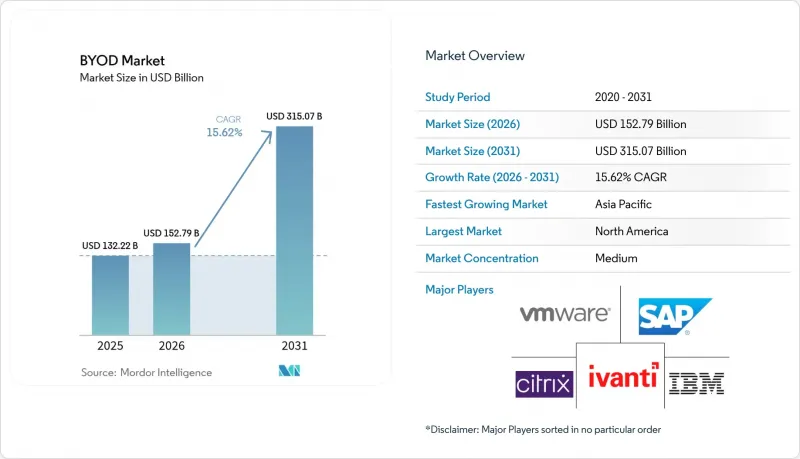
本報告按部署方式(本地部署/雲端)、設備類型(智慧型手機、平板電腦等)、安全解決方案(行動裝置管理 (MDM)、統一端點管理 (UEM) 等)、組織規模(大型企業、中小企業 (SME))、最終用戶產業(IT 和電信、醫療保健、其他)以及地區進行細分。市場預測以美元 (USD) 為單位。
全球自帶設備辦公室 (BYOD) 市場趨勢與洞察
5G智慧型設備的普及正在加速企業對其的採用。
亞太地區七個國家部署的商用5G獨立組網(SA)網路,正在推動低延遲工廠自動化、近即時遠端醫療和影像密集型現場服務運營,所有這些都可以在員工自有終端上無縫運行。 GSMA預測,到2030年,5G將為亞太經濟帶來約1,300億美元的收益,主要與依賴整合終端管理的智慧工廠和智慧電網應用相關。這些資料密集型任務進一步凸顯了人工智慧驅動的策略編配的重要性,以最佳化頻寬、自動分類敏感流量並即時強制執行合規性。因此,部署私有5G網路的公司正在強制實施將無線上下文感知策略設定與行為分析結合的UEM解決方案。同時,設備製造商正在整合專用AI推理引擎,以實現本地威脅偵測和資料遺失防護。這降低了將資料發送到雲端的成本,並將個人資訊保留在邊緣設備上。
混合辦公模式的永久化正在推動對統一電子模組(UEM)的投資。
目前,美國和歐洲三分之二的跨國公司已正式採用混合辦公模式作為其永久營運模式。這種轉變迫使IT團隊監控位於企業網路邊界之外的非託管筆記型電腦、平板電腦和智慧型手機。預計到2024年,基於雲端原生架構的Intune租戶將實現兩位數成長,這主要得益於零接觸配置功能,該功能可在用戶首次登入前部署安全基準、憑證和應用程式集。由Kusto查詢語言驅動的即時分析功能使安全團隊能夠在幾秒鐘內獲取跨裝置的遙測資訊。人工智慧驅動的輔助功能可對異常情況進行優先排序並推薦即時採取的糾正措施,即使使用者透過住宅寬頻連接,也能縮短事件回應週期。因此,服務台諮詢量顯著減少,平均修復時間(MTTR)縮短,資訊長們也積極回應他們對更有效率終端運維的需求。
與未管理的終端相關的網路保險費上漲
隨著勒索軟體索賠激增,保險承保人正更加密切地審查行動裝置的安全狀況。終端可見性不足的組織可能面臨高達 20% 的保費上漲。保險公司在簽訂保單前,越來越要求提供持續監控、基於策略的加密以及檢驗的備份程序的證明。供應商正在積極應對,將基於機器學習的異常檢測和整合報告功能整合到行動裝置、桌面裝置和虛擬機器中。自動化操作手冊透過隔離或初始化高風險設備,產生風險緩解的精算證據。合規性儀表板允許將證明報告直接匯出給保險公司,從而減少人工流程,並提高保單續保率。
細分市場分析
預計到2025年,雲端服務將佔據BYOD市場佔有率的63.05%,複合年成長率(CAGR)為16.55%。各組織正在將工作負載遷移到基於SaaS的統一緊急管理(UEM)平台,這些平台可在員工擁有的智慧型手機、平板電腦和筆記型電腦上提供即時分析、自動修復和策略繼承功能。在政府實驗室和某些國防設施中,由於確保了空氣間隙,本地部署仍在繼續,但資本投入、頻繁升級以及確保熟練人員配備等要求阻礙了其進一步擴張。
雲端原生生態系統提供持續的功能交付、內建的安全營運中心 (SOC) 整合以及細粒度的基於角色的存取控制,從而實現職責分離。微軟的高級分析模組透過提供設備合規趨勢的可見性並自動提案條件存取規則,可在數小時內增強零信任。合規性工具包可根據 ISO 27001 和 HIPAA查核點驗證配置,並按需產生可用於審計的交付物。這些優勢鞏固了雲端原生應用領域的領先地位,並強化了自帶設備辦公室 (BYOD) 市場的長期成長軌跡。
儘管智慧型手機、平板電腦和筆記型電腦仍然是日常生產力的核心,但穿戴式裝置和XR頭戴裝置正迅速被引入受監管的工作流程中。醫院正在試用智慧眼鏡,以實現免持存取患者記錄;工廠則採用腕戴式掃描器來簡化庫存盤點。目前,沒有任何穿戴式裝置類別在自帶裝置辦公室 (BYOD) 市場中佔據兩位數的佔有率,但其成長速度僅次於雲端採用率。統一端點管理 (UEM) 平台現在支援基於策略的感測器、攝影機和空間運算介面管理,這反映了必須在零信任框架內控制的不斷擴展的安全邊界。
該平台涵蓋 Windows、Android、iOS、macOS 和 Vision-OS,凸顯了跨裝置故障排除和軟體派送的重要性。即時修補調整、遠端凍結和選擇性資料剪切機確保了資訊流的合規性,即使員工切換設備也能如此。隨著空間運算技術的成熟,我們預計未來將出現更多 API 介面,用於對視野資料進行分類,並在受監管的環境中限制螢幕截圖。
區域分析
北美地區自帶設備辦公室 (BYOD) 市場佔有率高達 38.10%,這主要歸功於零信任要求的早期應用和雲端基礎設施的廣泛普及。金融服務和醫療保健機構需要持續的合規性證明,這推動了以分析主導緊急管理 (UEM) 平台的激增,這些平台能夠檢查每個設備會話。隨著聯邦指令引用 NIST 800-207 標準,零信任正日益成為一項制度化的標準,迫使即使是中型企業也必須升級其傳統的行動裝置管理 (MDM) 系統。
亞太地區是成長的主要驅動力,年複合成長率高達16.02%。 GSMA預測,到2030年,該地區的行動經濟規模將超過1兆美元,這主要得益於企業應用對5G技術的充分利用。新加坡的「智慧國家」計畫和澳洲的網路安全政策已成為行業標桿,並正在向周邊市場推廣。鑑於各國資料主權法規的差異,擁有在地化資料中心和多語言支援的供應商正逐漸獲得競爭優勢。
在歐洲,受GDPR隱私保護要求的推動,市場維持著穩定成長的動能。由於員工代表委員會通常會限制設備檢查權限,因此對以應用程式為中心的管理和尊重個人資料的選擇性資料擦除功能的需求日益成長。儘管中東和非洲的市場佔有率落後於歐洲,但隨著各國政府推動公共服務數位化和擴大5G覆蓋範圍,這些地區的市場興趣正在不斷提升。在所有地區,本地化的合規工具包和國家資料居住要求仍然是關鍵的賣點。
其他好處:
- Excel格式的市場預測(ME)表
- 3個月的分析師支持
目錄
第1章:引言
- 研究假設和市場定義
- 調查範圍
第2章:調查方法
第3章執行摘要
第4章 市場狀況
- 市場概覽
- 市場促進因素
- 5G相容智慧型裝置的普及
- 混合辦公模式將成為永久性政策。
- 雲端原生 UEM 將取代傳統 MDM
- 受監管業強制推行零信任安全
- IT預算中控制成本的壓力(設備相關投資的外包)
- 個人設備上的邊緣人工智慧可實現安全的離線工作流程。
- 市場限制因素
- 與未管理的終端相關的網路保險費上漲
- 員工強烈反對侵犯隱私的代理人
- 新興市場作業系統/韌體版本碎片化
- 博通和VMware合併後,供應商重組跡象顯現。
- 監理情勢
- 技術展望
- 波特五力分析
- 宏觀經濟因素對市場的影響
- 投資分析
第5章 市場規模與成長預測
- 不同的發展
- 現場
- 雲
- 依設備類型
- 智慧型手機
- 藥片
- 筆記型電腦
- 穿戴式裝置和其他終端設備
- 透過安全解決方案
- 行動裝置管理 (MDM)
- 統一端點管理 (UEM)
- 行動應用程式管理(MAM)
- 識別及存取管理 (IAM)
- 按組織規模
- 大公司
- 中小企業
- 按行業分類的最終用戶
- IT/通訊
- 衛生保健
- 政府/公共部門
- 零售
- BFSI
- 製造業/汽車
- 其他
- 按地區
- 北美洲
- 南美洲
- 歐洲
- 亞太地區
- 中東和非洲
第6章 競爭情勢
- 市場集中度
- 策略趨勢
- 市佔率分析
- 公司簡介
- VMware, Inc.
- Microsoft Corporation
- IBM Corporation
- Cisco Systems, Inc.
- Citrix Systems, Inc.
- BlackBerry Limited
- Samsung Electronics Co., Ltd.
- Apple Inc.
- Alphabet Inc.(Google LLC)
- Oracle Corporation
- Hewlett Packard Enterprise Company
- Nokia Corporation(Alcatel-Lucent Enterprise)
- Ivanti, Inc.(MobileIron)
- SAP SE
- Verizon Communications Inc.
- ATandT Inc.
- Check Point Software Technologies Ltd.
- Sophos Group plc
- SOTI Inc.
- Jamf Holding Corp.
- Zoho Corp. Pvt. Ltd.(ManageEngine)
- Hexnode(Mitsogo Inc.)
- Hypori Inc.
- Broadcom Inc.(post-acquisition assets)
- 42Gears Mobility Systems Pvt. Ltd.
- Scalefusion(ProMobi Technologies)
- AirDroid(Sand Studio)
第7章 市場機會與未來展望
According to Mordor Intelligence, the BYOD market size was valued at USD 132.22 billion in 2025 and estimated to grow from USD 152.79 billion in 2026 to reach USD 315.07 billion by 2031, at a CAGR of 15.62% during the forecast period (2026-2031).
This report is Segmented by Deployment (On-Premises and Cloud), Device Type (Smartphones, Tablets, and More), Security Solution (Mobile Device Management (MDM), Unified Endpoint Management (UEM), and More), Organization Size (Large Enterprises, and Small and Mid-Sized Enterprises (SMEs)), End-User Vertical (IT and Telecom, Healthcare, and More), and Geography. The Market Forecasts are Provided in Terms of Value (USD).
Global BYOD Market Trends and Insights
Proliferation of 5G-Enabled Smart Devices Accelerates Enterprise Adoption
Commercial 5G standalone installations across seven APAC nations are enabling low-latency factory automation, near-real-time telemedicine, and video-rich field-service workflows, all of which run smoothly on employee-owned endpoints. The GSMA projects that 5G will inject almost USD 130 billion into the APAC economy by 2030, much of it tied to smart-factory and smart-grid applications that rely on unified endpoint management. These data-heavy tasks magnify the need for AI-backed policy orchestration that optimizes bandwidth, automatically classifies sensitive traffic, and enforces compliance on the fly. Enterprises adopting private 5G networks are therefore mandating UEM solutions that combine radio-aware policy setting with behavioral analytics. Device makers are simultaneously embedding dedicated AI inference engines, allowing threat detection and data-loss prevention to run locally, which lowers cloud egress costs and keeps personal information on the edge device.
Hybrid-Work Policies Becoming Permanent Drive UEM Investment
Two-thirds of U.S. and European multinationals have now codified hybrid work as a permanent operating model. That shift forces IT teams to supervise unmanaged laptops, tablets, and phones far outside the corporate network perimeter. Cloud-native Intune tenants grew by double digits in 2024, a trend propelled by zero-touch provisioning that pushes security baselines, certificates, and application sets before the first login. Real-time analytics using Kusto Query Language provide security teams with cross-device telemetry in seconds. AI-supported copilot features triage anomalies and recommend immediate mitigation steps, shortening incident response cycles even when users connect from residential broadband. The outcome is a measurable reduction in help-desk tickets and lower mean-time-to-repair, supporting CIO mandates for leaner endpoint operations.
Rising Cyber-Insurance Premiums Linked to Unmanaged Endpoints
Underwriters are scrutinizing mobile-device hygiene as ransomware claims spike. Organizations with insufficient endpoint visibility face premium hikes of up to 20%. Insurers increasingly require proof of continuous monitoring, policy-based encryption, and verifiable backup routines before binding coverage. Vendors respond by embedding machine-learning anomaly detection and unified reporting across mobile, desktop, and virtual machines. Automated playbooks isolate or wipe high-risk devices, creating actuarial evidence of risk mitigation. Compliance dashboards export attestation reports directly to insurers, reducing manual paperwork and improving renewal outcomes.
Other drivers and restraints analyzed in the detailed report include:
- Cloud-Native UEM Replacing Legacy MDM Systems
- Zero-Trust Security Mandates in Regulated Sectors
- Employee Privacy Pushback on Intrusive Agents
For complete list of drivers and restraints, kindly check the Table Of Contents.
Segment Analysis
The cloud segment accounted for 63.05% of BYOD market share in 2025 and is projected to expand at a 16.55% CAGR. Organizations are migrating workloads to SaaS UEM platforms that provide real-time analytics, automated remediation, and policy inheritance across employee-owned smartphones, tablets, and laptops. On-premise implementations persist in air-gapped government labs and certain defense installations, yet capital expense, upgrade cadence, and skilled-labor requirements hamper fresh expansion.
Cloud-native ecosystems offer continuous feature delivery, built-in SOC integrations, and granular role-based access controls that ease separation of duties. Microsoft's Advanced Analytics module surfaces device compliance trends and auto-suggests conditional-access rules, tightening zero-trust postures within hours. Compliance toolkits map configurations to ISO 27001 and HIPAA checkpoints, producing audit-friendly artifacts on demand. These benefits underpin the deployment segment's dominance and reinforce the long-term trajectory of the BYOD market.
Phones, tablets, and laptops remain the day-to-day productivity core, but wearables and XR headsets are rapidly entering regulated workflows. Hospitals pilot smart glasses for hands-free patient chart retrieval, while factories adopt wrist-worn scanners to streamline inventory checks. Although no single wearable category yet exceeds double-digit BYOD market share, growth is second only to cloud deployment adoption. UEM platforms now support policy-based management of sensors, cameras, and spatial-computing interfaces, reflecting a widening perimeter that must still fit within zero-trust frameworks.
Platform coverage across Windows, Android, iOS, macOS, and vision-OS underscores the requirement for cross-device troubleshooting and software distribution. Real-time patch orchestration, remote freezing, and selective data sharding keep information flows compliant even as employees toggle between devices. As spatial computing matures, expect expanded API hooks that classify visual-field data and restrict screen capture inside regulated environments.
Complete Report Scope:
- By Deployment
- On-Premises
- Cloud
- By Device Type
- Smartphones
- Tablets
- Laptops
- Wearables and Other Endpoints
- By Security Solution
- Mobile Device Management (MDM)
- Unified Endpoint Management (UEM)
- Mobile Application Management (MAM)
- Identity and Access Management (IAM)
- By Organization Size
- Large Enterprises
- Small and Mid-Sized Enterprises (SMEs)
- By End-User Vertical
- IT and Telecom
- Healthcare
- Government and Public Sector
- Retail
- BFSI
- Manufacturing and Automotive
- Other End-User Verticals
- By Geography
- North America
- South America
- Europe
- Asia Pacific
- Middle East and Africa
Geography Analysis
North America's 38.10% BYOD market share stems from early adoption of zero-trust mandates and extensive cloud infrastructure. Financial-services and healthcare entities require continuous compliance evidence, fueling uptake of analytics-driven UEM platforms that inspect every device session. Federal directives referencing NIST 800-207 have further institutionalized zero-trust as a baseline, compelling even mid-market firms to upgrade legacy MDM.
Asia Pacific is the growth engine, advancing at a 16.02% CAGR. GSMA projects the regional mobile economy to surpass USD 1 trillion by 2030 on the back of 5G-enabled enterprise applications. Singapore's Smart Nation program and Australia's cyber-resilience policies set benchmarks that ripple across neighboring markets. Vendors with localized data centers and multilingual support command an advantage, given diverse sovereignty rules.
Europe maintains steady momentum driven by GDPR-driven privacy requirements. Works councils often limit device inspection rights, spurring demand for app-centric management and selective-wipe features that respect personal data. The Middle East and Africa trail in share yet exhibit growing interest as governments digitize public services and expand 5G coverage. Across regions, tailored compliance toolkits and in-country data residency remain pivotal selling points.
- VMware, Inc.
- Microsoft Corporation
- IBM Corporation
- Cisco Systems, Inc.
- Citrix Systems, Inc.
- BlackBerry Limited
- Samsung Electronics Co., Ltd.
- Apple Inc.
- Alphabet Inc. (Google LLC)
- Oracle Corporation
- Hewlett Packard Enterprise Company
- Nokia Corporation (Alcatel-Lucent Enterprise)
- Ivanti, Inc. (MobileIron)
- SAP SE
- Verizon Communications Inc.
- ATandT Inc.
- Check Point Software Technologies Ltd.
- Sophos Group plc
- SOTI Inc.
- Jamf Holding Corp.
- Zoho Corp. Pvt. Ltd. (ManageEngine)
- Hexnode (Mitsogo Inc.)
- Hypori Inc.
- Broadcom Inc. (post-acquisition assets)
- 42Gears Mobility Systems Pvt. Ltd.
- Scalefusion (ProMobi Technologies)
- AirDroid (Sand Studio)
Additional Benefits:
- The market estimate (ME) sheet in Excel format
- 3 months of analyst support
TABLE OF CONTENTS
1 INTRODUCTION
- 1.1 Study Assumptions and Market Definition
- 1.2 Scope of the Study
2 RESEARCH METHODOLOGY
3 EXECUTIVE SUMMARY
4 MARKET LANDSCAPE
- 4.1 Market Overview
- 4.2 Market Drivers
- 4.2.1 Proliferation of 5G-enabled smart devices
- 4.2.2 Hybrid-work policies becoming permanent
- 4.2.3 Cloud-native UEM replacing legacy MDM
- 4.2.4 Zero-trust security mandates in regulated sectors
- 4.2.5 Cost-containment pressure in IT budgets (device CAPEX off-load)
- 4.2.6 Edge-AI on personal devices enabling secure offline workflows
- 4.3 Market Restraints
- 4.3.1 Rising cyber-insurance premiums linked to unmanaged endpoints
- 4.3.2 Employee privacy pushback on intrusive agents
- 4.3.3 Fragmentation of OS/firmware versions in emerging markets
- 4.3.4 Looming vendor consolidation post-Broadcom-VMware deal
- 4.4 Regulatory Landscape
- 4.5 Technological Outlook
- 4.6 Porter's Five Forces Analysis
- 4.6.1 Threat of New Entrants
- 4.6.2 Bargaining Power of Buyers/Consumers
- 4.6.3 Bargaining Power of Suppliers
- 4.6.4 Threat of Substitute Products
- 4.6.5 Intensity of Competitive Rivalry
- 4.7 Impact of Macroeconomic Factors on the Market
- 4.8 Investment Analysis
5 MARKET SIZE AND GROWTH FORECASTS (VALUE)
- 5.1 By Deployment
- 5.1.1 On-Premises
- 5.1.2 Cloud
- 5.2 By Device Type
- 5.2.1 Smartphones
- 5.2.2 Tablets
- 5.2.3 Laptops
- 5.2.4 Wearables and Other Endpoints
- 5.3 By Security Solution
- 5.3.1 Mobile Device Management (MDM)
- 5.3.2 Unified Endpoint Management (UEM)
- 5.3.3 Mobile Application Management (MAM)
- 5.3.4 Identity and Access Management (IAM)
- 5.4 By Organization Size
- 5.4.1 Large Enterprises
- 5.4.2 Small and Mid-Sized Enterprises (SMEs)
- 5.5 By End-User Vertical
- 5.5.1 IT and Telecom
- 5.5.2 Healthcare
- 5.5.3 Government and Public Sector
- 5.5.4 Retail
- 5.5.5 BFSI
- 5.5.6 Manufacturing and Automotive
- 5.5.7 Other End-User Verticals
- 5.6 By Geography
- 5.6.1 North America
- 5.6.2 South America
- 5.6.3 Europe
- 5.6.4 Asia Pacific
- 5.6.5 Middle East and Africa
6 COMPETITIVE LANDSCAPE
- 6.1 Market Concentration
- 6.2 Strategic Moves
- 6.3 Market Share Analysis
- 6.4 Company Profiles (includes Global-level Overview, Market-level Overview, Core Segments, Financials as available, Strategic Information, Market Rank/Share for key companies, Products and Services, and Recent Developments)
- 6.4.1 VMware, Inc.
- 6.4.2 Microsoft Corporation
- 6.4.3 IBM Corporation
- 6.4.4 Cisco Systems, Inc.
- 6.4.5 Citrix Systems, Inc.
- 6.4.6 BlackBerry Limited
- 6.4.7 Samsung Electronics Co., Ltd.
- 6.4.8 Apple Inc.
- 6.4.9 Alphabet Inc. (Google LLC)
- 6.4.10 Oracle Corporation
- 6.4.11 Hewlett Packard Enterprise Company
- 6.4.12 Nokia Corporation (Alcatel-Lucent Enterprise)
- 6.4.13 Ivanti, Inc. (MobileIron)
- 6.4.14 SAP SE
- 6.4.15 Verizon Communications Inc.
- 6.4.16 ATandT Inc.
- 6.4.17 Check Point Software Technologies Ltd.
- 6.4.18 Sophos Group plc
- 6.4.19 SOTI Inc.
- 6.4.20 Jamf Holding Corp.
- 6.4.21 Zoho Corp. Pvt. Ltd. (ManageEngine)
- 6.4.22 Hexnode (Mitsogo Inc.)
- 6.4.23 Hypori Inc.
- 6.4.24 Broadcom Inc. (post-acquisition assets)
- 6.4.25 42Gears Mobility Systems Pvt. Ltd.
- 6.4.26 Scalefusion (ProMobi Technologies)
- 6.4.27 AirDroid (Sand Studio)
7 MARKET OPPORTUNITIES AND FUTURE OUTLOOK
- 7.1 White-space and Unmet-need Assessment

 BYOD 安全市場:全球市場預測,2026-2032 年自備設備辦公室 (BYOD) 市場:按組件、設備類型、組織規模、部署模式和行業分類的全球市場預測 – 2026–2032 年
 BYOD市場規模、佔有率和成長分析:按設備類型、部署模式、企業規模、最終用戶產業、解決方案類型、組件和地區分類-2026-2033年產業預測
 BYOD 安全市場報告:按裝置類型、解決方案、部署模式、最終用戶和地區分類(2026-2034 年)自帶設備辦公室 (BYOD) 和企業行動市場:按組件、部署模式、企業規模、產業、存取模式和作業系統分類-2026 年至 2032 年全球市場預測
 BYOD 安全全球市場報告 2026
 BYOD(自備設備辦公)全球市場規模、佔有率、趨勢和成長分析報告(2026-2034)
 自帶設備辦公室 (BYOD) 和企業行動市場 - 全球產業規模、佔有率、趨勢、機會和預測:軟體、應用、最終用戶、安全、區域和競爭格局,2021-2031 年行動出行市場中的人工智慧(按行動移動類型、技術、部署模式、應用程式和最終用戶分類)—2025-2030 年全球預測
 2025-2029 年全球 BYOD(自帶設備)市場