


 |
市場調查報告書
商品編碼
2100571
VoWiFi:市場佔有率分析、產業趨勢與統計、成長預測(2026-2031)Voice-over Wi-Fi (VoWiFi) - Market Share Analysis, Industry Trends & Statistics, Growth Forecasts (2026 - 2031) |
||||||

※ 本網頁內容可能與最新版本有所差異。詳細情況請與我們聯繫。
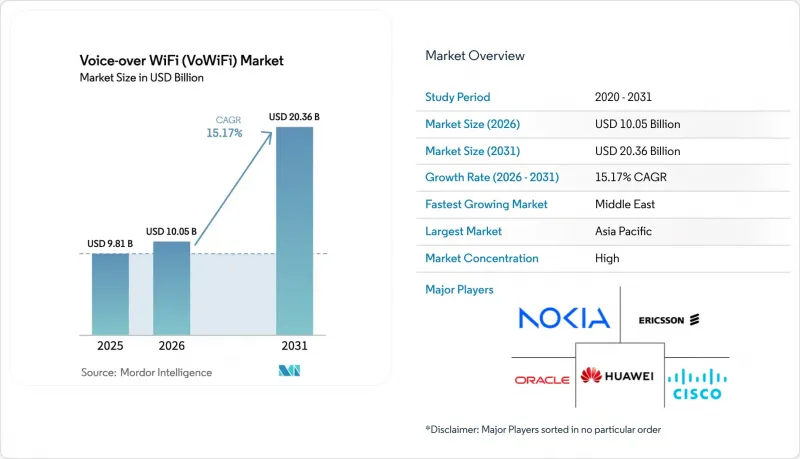
根據 Mordor Intelligence 預測,VoWiFi 市場規模預計將在 2026 年達到 100.5 億美元,到 2031 年將擴大到 203.6 億美元,2026 年至 2031 年的複合年成長率為 15.17%。
本報告按 VoWiFi 用戶端(整合 VoWiFi 用戶端、獨立 VoWiFi 用戶端等)、裝置類型(智慧型手機、平板電腦、筆記型電腦等)、部署模式(基於網路的 IMS 核心網路、雲端託管 VoWiFi、混合邊緣雲端)、最終用戶(個人用戶、中小企業等)和地區進行細分。市場預測以美元計價。
全球Wi-Fi語音(VoWiFi)市場趨勢與洞察
營運商級Wi-Fi漫遊協定的快速擴張
行動網路業者正將VoWiFi漫遊納入其批發協議,以降低國際終止費用並避免PSTN連網費用。 GSMA 2025年IR.92修正案規範了ePDG偵測,實現了在不同網路間無縫語音通話。沃達豐的泛歐試點計畫將語音傳輸成本降低了40%,鼓勵一級業者之間達成類似協議。東南亞通訊業者由於頻寬,如今將營運商級漫遊視為擴展覆蓋範圍的手段,而非一項加值服務。 Passpoint R3進一步簡化了憑證的提供,提升了終端使用者的便利性。這些變革共同作用,減少了授權頻寬的使用量,並提高了通訊業者的盈利。
5G NR部署期間室內覆蓋差距擴大
中頻段毫米波訊號在水泥建築物內衰減高達 20 dB,迫使通訊業者需要維護 LTE 網路覆蓋層以確保語音通話的連續性。 VoWiFi 無需部署新的小型基地台即可彌補此缺陷,使通訊業者能夠在城市中心逐步淘汰傳統網路。 Verizon 於 2025 年在曼哈頓推出的 C 頻段 VoWiFi 服務,在 90 天內將 60% 的室內通話重定向到 VoWiFi,從而將計劃部署的小型基地台密度降低了 30%。這種快速的投資回報 (ROI) 促使北美和歐洲各地紛紛效仿。
VoWiFi 到 VoLTE 切換過程中持續存在品質問題
IPsec隧道的即時重新協商會產生200-400毫秒的抖動,導致用戶聽到的可聽見的中斷,並感覺像是通話中斷。愛立信2025年的現場數據預測,在Wi-Fi向蜂窩網路過渡期間,通話中斷率將達到18%,遠超VoLTE的基準水準。擁有傳統核心網路的小規模通訊業者正努力爭取資金,用於升級預測認證以彌補這一差距。在網路品質穩定之前,部分用戶將停用VoWiFi,從而減緩整體流量成長。
細分市場分析
到2025年,整合客戶端將佔總收入的56.48%,這主要得益於作業系統級身分驗證功能提升了使用者便利性。基於瀏覽器的方案雖然規模較小,但以17.32%的複合年成長率成長。與瀏覽器用戶端相關的Wi-Fi語音(VoWiFi)市場正受益於WebRTC技術的成熟,使得免安裝語音通訊在自帶設備辦公室(BYOD)環境中極具吸引力。企業重視瀏覽器提供的策略控制和零信任隔離。整合客戶端在預測性切換和降低通訊區域切換時的延遲方面仍然表現出色,但瀏覽器技術的創新正在不斷縮小這一效能差距。
第二個促進因素是Passpoint R3,它可以自動為瀏覽器會話配置身份驗證憑證。思科的Webex Calling透過避免建置原生客戶端,降低了30%的開發成本,這種成本效益深受中型企業的青睞。在整個預測期內,整合客戶端預計將保持最大的市場佔有率,而瀏覽器解決方案預計將擴大其在Wi-Fi語音通訊(VoWiFi)市場的佔有率。
到2025年,智慧型手機將佔據80.36%的銷售佔有率,凸顯其在語音通訊領域的核心地位。其他連網設備雖然佔有率較小,但預計將以15.49%的複合年成長率成長。工業閘道器、車載資訊系統和醫療穿戴式裝置均受益於晶片組層面的ePDG整合,從而無需單獨的蜂窩模組。隨著這些新興終端出於成本和能源效率方面的考量而採用Wi-Fi通話,智慧型手機在Wi-Fi語音(VoWiFi)市場的佔有率將逐漸下降。
高通公司推出的售價低於5美元的VoWiFi物聯網晶片組,為在整個製造工廠部署語音感測器鋪平了道路。汽車製造商正在將VoWiFi整合到車載資訊服務控制單元中,即使在蜂窩網路連線不穩定的情況下,也能滿足eCall法規的要求。醫院也擴大採用VoWiFi進行患者監護儀,因為建築物內的蜂窩網路限制並不適用於Wi-Fi。雖然筆記型電腦和平板電腦的作用相對較小,但它們的大容量電池即使在長時間的會議中也能維持ePDG隧道的持續連接。
區域分析
到2025年,亞太地區將佔VoWiFi收入的45.16%。中國移動的Wi-Fi 6E網路和Reliance Jio的固定無線配套服務凸顯了解決該地區頻寬短缺問題的方案。 KT在地鐵隧道內提供Wi-Fi通話服務,有效降低了客戶流失率。日本通訊業者完成了互通性測試,而印度則強制要求新款智慧型手機具備VoWiFi功能,從而擴大了農村地區的設備覆蓋範圍。
預計中東地區的複合年成長率將達到15.33%,位居全球之首。沙烏地阿拉伯監管機構已下令在2025年中期前在全國部署VoWiFi。南非已將許可核准流程縮短至90天,使中小型業者能夠快速部署。在奈及利亞,企業Wi-Fi彌補了拉各斯行動電話普及率低的不足,預計到2025年,將有15%的行動用戶使用VoWiFi。阿拉伯聯合大公國通訊業者現已提供酋長國間漫遊服務,最大限度地減少了城際旅行期間的通話中斷。
在北美,VoWiFi正被用於滿足E911緊急呼叫需求,並降低提升室內網路密度所需的預算。 T-Mobile已將VoWiFi整合到其5G獨立網路核心網路中,使都市區的通話斷線率降低了35%。 Verizon的C頻段方案透過將室內通話引導至Wi-Fi網路,節省了2億美元的小型基地台相關成本。在加拿大,無需單獨授權的6GHz頻段VoWiFi的核准正在加速區域部署。在歐洲,由於跨國漫遊依賴自願協議,進展不一,但在德國,已有22%的通話時間透過Wi-Fi進行。南美洲仍以城市為中心,巴西強制要求在新許可證中包含VoWiFi功能,而阿根廷和智利則面臨基礎設施的限制。
其他好處:
- Excel格式的市場預測(ME)表
- 3個月的分析師支持
目錄
第1章:引言
- 研究假設和市場定義
- 調查範圍
第2章:調查方法
第3章執行摘要
第4章 市場狀況
- 市場概覽
- 市場促進因素
- 營運商級Wi-Fi漫遊協定的快速擴張
- 5G NR部署期間室內通訊區域覆蓋範圍差距日益擴大
- VoWiFi設備的廣泛應用
- 企業自備設備辦公室 (BYOD) 的安全需求正在推動支援 Wi-Fi 通話功能的防火牆的普及。
- 政府緊急服務部門關於室內Wi-Fi的強制性措施 E911
- 由於能源效率法規的限制,設備製造商被迫轉向使用 Wi-Fi 進行語音通訊。
- 市場限制因素
- 從 VoWiFi 切換到 VoLTE 時仍然存在品質問題。
- 行動通訊業者(MNO)獲利模式的局限性
- 6 GHz 免許可頻段中電信級Wi-Fi頻寬擁塞
- 區域市場對相容 Wi-Fi CERTIFIED 6 Release 2 的接入點的接受度較低。
- 產業價值鏈分析
- 監理情勢
- 技術展望
- 波特五力分析
第5章 市場規模與成長預測
- VoWiFi客戶端類型
- 整合 VoWi-Fi 用戶端
- 個人 VoWi-Fi 用戶端
- 基於瀏覽器的 VoWiFi 用戶端
- 依設備類型
- 智慧型手機
- 平板電腦和筆記型電腦
- 其他
- 按部署模式
- 基於網路(IMS核心網)
- 雲端託管 VoWiFi
- 混合(邊緣/雲)
- 最終用戶
- 個人消費者
- 小型企業
- 大公司
- 公共安全和政府機構
- 按地區
- 北美洲
- 美國
- 加拿大
- 墨西哥
- 南美洲
- 巴西
- 阿根廷
- 其他南美國家
- 歐洲
- 德國
- 英國
- 法國
- 義大利
- 西班牙
- 其他歐洲國家
- 亞太地區
- 中國
- 日本
- 印度
- 韓國
- ASEAN
- 其他亞太國家
- 中東
- 沙烏地阿拉伯
- 阿拉伯聯合大公國
- 其他中東國家
- 非洲
- 南非
- 奈及利亞
- 其他非洲國家
- 北美洲
第6章 競爭情勢
- 市場集中度
- 策略趨勢
- 市佔率分析
- 公司簡介
- Cisco Systems, Inc.
- Nokia Corporation
- Telefonaktiebolaget LM Ericsson
- Huawei Technologies Co., Ltd.
- Oracle Corporation
- Samsung Electronics Co., Ltd.
- Apple Inc.
- Xiaomi Corporation
- ZTE Corporation
- Mitel Networks Corporation
- Ribbon Communications Operating Company, Inc.
- KT Corporation
- Aptilo Networks AB
- D-Link Corporation
- Aruba Networks, Inc.
- Broadcom Inc.
- Qualcomm Incorporated
- Boingo Wireless, Inc.
- CommScope Holding Company, Inc.
- Reliance Jio Infocomm Limited
- T-Mobile US, Inc.
第7章 市場機會與未來展望
According to Mordor Intelligence, the voice-over wi-Fi (VoWiFi) market size reached USD 10.05 billion in 2026 and is forecast to climb to USD 20.36 billion by 2031, advancing at a 15.17% CAGR during 2026-2031.
This report is Segmented by Voice Client (Integrated VoWiFi Client, Separate VoWiFI Client, and More), Device Type (Smartphones, Tablets and Laptops, and More), Deployment Model (Network-Based IMS Core, Cloud-Hosted VoWiFi, and Hybrid Edge-Cloud), End-User (Residential Consumers, Small and Medium Enterprises, and More), and Geography. The Market Forecasts are Provided in Terms of Value (USD).
Global Voice-over Wi-Fi (VoWiFi) Market Trends and Insights
Rapid Expansion of Carrier-Grade Wi-Fi Roaming Agreements
Mobile network operators embed VoWiFi roaming in wholesale agreements to cut international termination fees and avoid PSTN interconnect charges. The GSMA 2025 IR.92 amendment standardized ePDG discovery, allowing seamless voice sessions across visited networks. Vodafone's pan-European trial cut voice delivery costs by 40% and spurred similar deals among tier-1 carriers. Operators in spectrum-constrained Southeast Asia now view carrier-grade roaming as a coverage extension tool rather than a premium service. Passpoint R3 further simplified credential provisioning, reducing friction for end-users. These shifts collectively lift traffic off licensed spectrum and improve operator economics.
Rising Indoor Coverage Gaps in 5G NR Deployments
Mid-band and millimeter-wave signals lose up to 20 dB within concrete structures, forcing operators to keep LTE overlays for voice continuity. VoWiFi fills those gaps without new small cells, letting carriers retire legacy layers in urban cores. Verizon's 2025 Manhattan C-band rollout redirected 60% of indoor calls to VoWiFi within 90 days, reducing planned small-cell density by 30%. The quick ROI encourages similar approaches across North America and Europe.
Persistent VoWiFi-to-VoLTE Handoff Quality Issues
Real-time IPsec tunnel renegotiation introduces 200-400 milliseconds of jitter, resulting in audible gaps that users perceive as dropped calls. Ericsson's 2025 field data showed 18% mid-call drop rates during Wi-Fi-to-cellular transitions, far exceeding VoLTE benchmarks. Smaller operators with legacy cores struggle to fund the predictive authentication upgrades required to close the gap. Until quality stabilizes, some consumers disable VoWiFi, slowing overall traffic growth.
Other drivers and restraints analyzed in the detailed report include:
- Growing Penetration of VoWiFi-Capable Handsets
- Government Emergency-Service Mandates for Wi-Fi E911 Indoors
- Limited Monetization Models for MNOs
For complete list of drivers and restraints, kindly check the Table Of Contents.
Segment Analysis
Integrated clients contributed 56.48% of 2025 revenue, powered by OS-level authentication that removes user friction. Browser-based options, though smaller, are growing at a 17.32% CAGR. The Voice-over Wi-Fi (VoWiFi) Market size attached to browser clients benefits from WebRTC maturity that makes installation-free voice attractive for bring-your-own-device environments. Enterprises value policy control and zero-trust separation that browsers deliver. Integrated clients still excel at predictive handoffs, reducing latency during coverage changes, yet browser innovations continue to narrow the performance gap.
A second driver is Passpoint R3, which automates credential provisioning for browser sessions. Cisco's Webex Calling realized 30% lower development costs by avoiding native client builds, and this spending efficiency appeals to mid-market enterprises. Over the forecast, integrated clients will retain the largest share, but browser solutions will account for an expanding slice of the Voice-over Wi-Fi (VoWiFi) Market.
Smartphones held 80.36% revenue share in 2025, underlining their central role in voice communication. Other connected devices, although smaller, are expected to rise at a 15.49% CAGR. Industrial gateways, telematics units, and medical wearables all gain from chipset-level ePDG integration, which removes the need for separate cellular modules. The Voice-over Wi-Fi (VoWiFi) Market share for smartphones will gradually erode as these emerging endpoints adopt Wi-Fi calling due to cost and energy considerations.
Qualcomm's sub-USD 5 VoWiFi-ready IoT chipset opened the door for voice-enabled sensors across manufacturing floors. Automotive makers embed VoWiFi in telematics control units to satisfy eCall regulations when cellular service is weak. Hospitals prefer VoWiFi for patient monitors because in-building cellular restrictions do not apply to Wi-Fi. Laptops and tablets play a secondary role, but larger batteries help them maintain continuous ePDG tunnels during long meetings.
Complete Report Scope:
- By Voice Client
- Integrated VoWiFI Client
- Separate VoWiFI Client
- Browser-based VoWiFi Client
- By Device Type
- Smartphones
- Tablets and Laptops
- Other Connected Device Types
- By Deployment Model
- Network-Based (IMS Core)
- Cloud-Hosted VoWiFi
- Hybrid (Edge-Cloud)
- By End-User
- Residential Consumers
- Small and Medium Enterprises
- Large Enterprises
- Public-Safety and Government Agencies
- By Geography
- North America
- United States
- Canada
- Mexico
- South America
- Brazil
- Argentina
- Rest of South America
- Europe
- Germany
- United Kingdom
- France
- Italy
- Spain
- Rest of Europe
- Asia-Pacific
- China
- Japan
- India
- South Korea
- ASEAN
- Rest of Asia-Pacific
- Middle East
- Saudi Arabia
- United Arab Emirates
- Rest of Middle East
- Africa
- South Africa
- Nigeria
- Rest of Africa
- North America
Geography Analysis
Asia-Pacific generated 45.16% of VoWiFi revenue in 2025. China Mobile's Wi-Fi 6E fabric and Reliance Jio's fixed-wireless bundles underline the region's spectrum scarcity workaround. KT covered subway tunnels with Wi-Fi calling, easing customer churn. Japan's carriers completed interoperability testing, and India mandated VoWiFi support on new smartphones, enlarging handset readiness across rural zones.
Middle East will post the fastest 15.33% CAGR. Saudi Arabia's regulator ordered nationwide VoWiFi by mid-2025. South Africa streamlined licensing to 90 days, letting smaller carriers deploy quickly. Nigeria saw adoption rise to 15% of mobile users in 2025 as enterprise Wi-Fi offset poor cellular penetration in Lagos. UAE operators now offer cross-emirate roaming, minimizing call drops during inter-city travel.
North America leans on VoWiFi to meet E911 mandates and shrink indoor densification budgets. T-Mobile integrated VoWiFi with its 5G standalone core, cutting urban call-drop rates by 35%. Verizon's C-band plan saved USD 200 million in small-cell costs by steering indoor calls to Wi-Fi. Canada cleared 6 GHz VoWiFi with no individual licenses, accelerating regional uptake. Europe shows mixed progress because cross-border roaming rests on voluntary agreements, yet Germany already records 22% of voice minutes over Wi-Fi. South America remains city-centric, with Brazil mandating VoWiFi in new licenses while Argentina and Chile face infrastructure constraints.
- Cisco Systems, Inc.
- Nokia Corporation
- Telefonaktiebolaget LM Ericsson
- Huawei Technologies Co., Ltd.
- Oracle Corporation
- Samsung Electronics Co., Ltd.
- Apple Inc.
- Xiaomi Corporation
- ZTE Corporation
- Mitel Networks Corporation
- Ribbon Communications Operating Company, Inc.
- KT Corporation
- Aptilo Networks AB
- D-Link Corporation
- Aruba Networks, Inc.
- Broadcom Inc.
- Qualcomm Incorporated
- Boingo Wireless, Inc.
- CommScope Holding Company, Inc.
- Reliance Jio Infocomm Limited
- T-Mobile US, Inc.
Additional Benefits:
- The market estimate (ME) sheet in Excel format
- 3 months of analyst support
TABLE OF CONTENTS
1 INTRODUCTION
- 1.1 Study Assumptions and Market Definition
- 1.2 Scope of the Study
2 RESEARCH METHODOLOGY
3 EXECUTIVE SUMMARY
4 MARKET LANDSCAPE
- 4.1 Market Overview
- 4.2 Market Drivers
- 4.2.1 Rapid Expansion of Carrier-Grade Wi-Fi Roaming Agreements
- 4.2.2 Rising Indoor-Coverage Gaps in 5G NR Deployments
- 4.2.3 Growing Penetration of VoWiFi-capable Handsets
- 4.2.4 Enterprise BYOD Security Mandates Favouring Wi-Fi Calling Firewalls
- 4.2.5 Government Emergency-service Mandates for Wi-Fi E911 Indoors
- 4.2.6 Energy-efficiency Regulations Pushing Device OEMs to Off-load Voice to Wi-Fi
- 4.3 Market Restraints
- 4.3.1 Persistent VoWiFi-to-VoLTE Hand-off Quality Issues
- 4.3.2 Limited Monetisation Models for MNOs
- 4.3.3 Carrier-Wi-Fi Spectrum Congestion in Unlicensed 6 GHz Bands
- 4.3.4 Slow Adoption of Wi-Fi CERTIFIED 6 Release 2 APs in Rural Markets
- 4.4 Industry Value Chain Analysis
- 4.5 Regulatory Landscape
- 4.6 Technological Outlook
- 4.7 Porter's Five Forces Analysis
- 4.7.1 Bargaining Power of Suppliers
- 4.7.2 Bargaining Power of Buyers
- 4.7.3 Threat of New Entrants
- 4.7.4 Threat of Substitutes
- 4.7.5 Intensity of Competitive Rivalry
5 MARKET SIZE AND GROWTH FORECASTS (VALUE)
- 5.1 By Voice Client
- 5.1.1 Integrated VoWiFI Client
- 5.1.2 Separate VoWiFI Client
- 5.1.3 Browser-based VoWiFi Client
- 5.2 By Device Type
- 5.2.1 Smartphones
- 5.2.2 Tablets and Laptops
- 5.2.3 Other Connected Device Types
- 5.3 By Deployment Model
- 5.3.1 Network-Based (IMS Core)
- 5.3.2 Cloud-Hosted VoWiFi
- 5.3.3 Hybrid (Edge-Cloud)
- 5.4 By End-User
- 5.4.1 Residential Consumers
- 5.4.2 Small and Medium Enterprises
- 5.4.3 Large Enterprises
- 5.4.4 Public-Safety and Government Agencies
- 5.5 By Geography
- 5.5.1 North America
- 5.5.1.1 United States
- 5.5.1.2 Canada
- 5.5.1.3 Mexico
- 5.5.2 South America
- 5.5.2.1 Brazil
- 5.5.2.2 Argentina
- 5.5.2.3 Rest of South America
- 5.5.3 Europe
- 5.5.3.1 Germany
- 5.5.3.2 United Kingdom
- 5.5.3.3 France
- 5.5.3.4 Italy
- 5.5.3.5 Spain
- 5.5.3.6 Rest of Europe
- 5.5.4 Asia-Pacific
- 5.5.4.1 China
- 5.5.4.2 Japan
- 5.5.4.3 India
- 5.5.4.4 South Korea
- 5.5.4.5 ASEAN
- 5.5.4.6 Rest of Asia-Pacific
- 5.5.5 Middle East
- 5.5.5.1 Saudi Arabia
- 5.5.5.2 United Arab Emirates
- 5.5.5.3 Rest of Middle East
- 5.5.6 Africa
- 5.5.6.1 South Africa
- 5.5.6.2 Nigeria
- 5.5.6.3 Rest of Africa
- 5.5.1 North America
6 COMPETITIVE LANDSCAPE
- 6.1 Market Concentration
- 6.2 Strategic Moves
- 6.3 Market Share Analysis
- 6.4 Company Profiles (includes Global level Overview, Market Level Overview, Core Segments, Financials as Available, Strategic Information, Market Rank/Share for Key Companies, Products and Services, and Recent Developments)
- 6.4.1 Cisco Systems, Inc.
- 6.4.2 Nokia Corporation
- 6.4.3 Telefonaktiebolaget LM Ericsson
- 6.4.4 Huawei Technologies Co., Ltd.
- 6.4.5 Oracle Corporation
- 6.4.6 Samsung Electronics Co., Ltd.
- 6.4.7 Apple Inc.
- 6.4.8 Xiaomi Corporation
- 6.4.9 ZTE Corporation
- 6.4.10 Mitel Networks Corporation
- 6.4.11 Ribbon Communications Operating Company, Inc.
- 6.4.12 KT Corporation
- 6.4.13 Aptilo Networks AB
- 6.4.14 D-Link Corporation
- 6.4.15 Aruba Networks, Inc.
- 6.4.16 Broadcom Inc.
- 6.4.17 Qualcomm Incorporated
- 6.4.18 Boingo Wireless, Inc.
- 6.4.19 CommScope Holding Company, Inc.
- 6.4.20 Reliance Jio Infocomm Limited
- 6.4.21 T-Mobile US, Inc.
7 MARKET OPPORTUNITIES AND FUTURE OUTLOOK
- 7.1 White-space and Unmet-Need Assessment

