


 |
市場調查報告書
商品編碼
2100539
智慧電網網路:市場佔有率分析、產業趨勢與統計及成長預測(2026-2031 年)Smart Grid Network - Market Share Analysis, Industry Trends & Statistics, Growth Forecasts (2026 - 2031) |
||||||

※ 本網頁內容可能與最新版本有所差異。詳細情況請與我們聯繫。
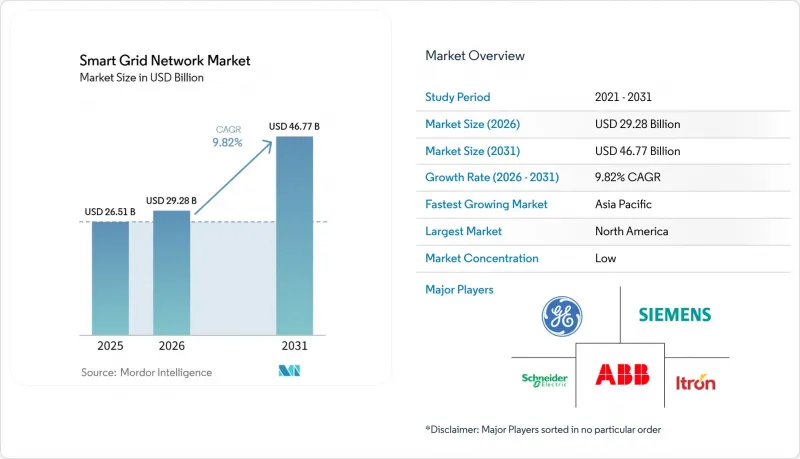
智慧電網網路市場預計將從 2025 年的 265.1 億美元成長到 2026 年的 292.8 億美元,到 2031 年達到 467.7 億美元,2026 年至 2031 年的複合年成長率預計為 9.82%。
本報告按組件(硬體、軟體、服務)、電網階段(發電、輸電、配電、產消者)、技術應用(高級計量基礎設施、自動化、需量反應、網路安全、分析)、通訊方式(有線、無線、混合)、最終用戶(住宅、商業、工業、公共產業/配電系統運營商)和地區(北美、歐洲、歐洲、歐洲、歐洲和非洲)進行分類。預測值以美元計價。
全球智慧電網市場趨勢及洞察
政府主導的強制性電網數位化
政府主導的電網支出正從政策訊號轉向直接採購支持,從而縮短智慧電網市場中電力營運商的決策週期。 2026年3月,美國能源局宣布了「Spark 舉措的19億美元資助機會,作為電網韌性與創新夥伴關係(GRIP)計畫的一部分,其中6.14億美元將用於智慧電網部署,8.62億美元將用於電網創新。在歐洲,隨著法國監管機構報告稱,2017年至2024年間智慧電網部署累積節省成本達到17億歐元,升級到數位電網的商業理由日益充分。德國TenneT公司計劃在2025年投資100.47億歐元(111億美元)用於擴建和現代化其電力基礎設施,也反映了所需投入的規模。這些項目正在推動對智慧電網的需求,因為它們使電力公司能夠更有信心地進行長期的自動化、通訊和軟體專案。此外,公共資金計畫越來越重視能夠連接整個網路中的變電站、現場設備和客戶資產的平台,這需要轉向可互通的數位系統。
整合可再生能源和分散式能源(DER)的壓力
電力結構正在快速變化,電力公司必須應對波動性更大、雙向性更強的電力流,因此智慧電網市場對控制的要求也日益提高。到2025年,全球可再生能源發電量將首次超過燃煤發電量,這標誌著電網供需平衡方式的重大轉折點。在德國,TenneT Germany已將投資增加至100.47億歐元(111億美元),以支持離岸風力發電和主要輸電走廊的併網建設,目標是在2025年前完成。這表明,可再生能源的擴張正在推動核心電網的建設支出。目前,壓力最大的環節出現在配電鏈末端,屋頂光伏發電、電動車充電、儲能和智慧逆變器等技術正在將用戶從被動負載轉變為電網的積極參與者。這種轉變提升了智慧電網市場中高階計量、分散式能源(DER)管理和需量反應的價值。這是因為營運商需要更詳細的數據和更快的控制迴路。此外,這使得發電削減、區域電壓管理和靈活的負載平衡成為真正的優先事項,而不是次要的規劃挑戰。
高資本支出(CapEx)需求
高資本密集度仍是智慧電網市場最明顯的限制因素之一。這是因為電力公司必須同時投資於硬體、通訊、軟體和系統整合。德國TenneT公司僅在2025年就投資了100.47億歐元(111億美元),這表明即使是成熟且資金充足的電網系統也需要如此龐大的規模。美國能源局SPARK計畫的資金籌措也表明,公共支持往往是加速那些在電力公司資本計畫中進展緩慢的計畫所必需的。在智慧電網市場,中型電力公司面臨的支出負擔更為沉重,因為它們的資金籌措選擇有限,成本回收速度也往往較慢。因此,許多營運商最終淘汰專案的速度低於系統實際需求,即使他們能夠從策略上證明電網數位化的合理性。在監管支持、透過電價進行成本回收或本地製造基礎設施尚未跟上現代化目標的市場中,這種限制尤為突出。
細分市場分析
預計到2025年,硬體銷售額將佔總銷售額的60.8%。這反映了智慧電網市場中電錶部署、饋線自動化、繼電器和變電站設備的實體規模。由於電力公司仍需要大規模的現場設備部署才能充分發揮軟體主導的編配和分析的價值,因此硬體需求仍然強勁。智慧電錶、自動化設備和保護系統在資本預算中仍佔據相當大的比例,因為許多電力公司正在升級第一代設備並將自動化擴展到網路的新領域。這確保了硬體在智慧電網市場中仍然佔據核心地位,即使競爭優勢進一步轉移到軟體層。此外,對硬體的需求與輸電、配電和用戶終端可靠感測和通訊的實際需求密切相關。
預計到2031年,軟體市場將以13.5%的複合年成長率成長,成為智慧電網網路市場中成長最快的細分市場。這一成長反映了市場對高階配電管理系統(ADMS)、分散式能源資源管理系統(DERMS)、停電分析以及其他平台的需求不斷成長,這些平台能夠幫助公用事業公司在更動態的電網環境下利用現場數據進行營運決策。這種轉變也體現在供應商的策略中;2025年8月,Honeywell收購了SparkMeter的軟體資產,包括Praxis、GridScan和GridFin,從而擴展了其面向公共產業的產品組合。公共產業公司越來越需要整合、網路安全保全行動和託管支持,以大規模連接OT和IT系統,服務正在為智慧電網網路市場的兩個細分市場提供支援。
預計到2025年,配電產業將佔銷售額的48.0%,顯示電力公司在智慧電網市場的實際現代化投資中,仍將最大佔有率集中於配電領域。這種分配反映了實際營運情況:與發電或長距離輸電資產相比,配電網路中的停電、功率損耗和可靠性問題通常更為突出,並直接影響用戶。因此,饋線自動化、停電管理、進階計量基礎設施(AMI)和電壓調節器仍然是智慧電網市場的關鍵採購領域。配電也扮演著至關重要的角色,它是電力公司系統與產消者資產、商業負荷以及交通和數位基礎設施等新興電氣化需求之間的連接點。這種結構性定位表明,在整個預測期內,配電的作用可能仍將大於電網的其他環節。
預計到2031年,消費者和產消者(生產者-消費者)細分市場將以12.6%的複合年成長率成長,成為智慧電網市場中成長最快的電網階段。原因顯而易見:屋頂太陽能、電動車充電樁、住宅儲能電池和智慧逆變器的普及,增加了電力雙向流動,也增加了電力公司必須監控和控制的本地決策點。在分散式能源普及率高的市場,這些用戶側資產不僅是需求面柔軟性的來源,也正在成為有用的電網感測器。輸電網現代化仍然至關重要,德國TenneT的2025年投資計畫表明,可再生能源的併網如何能同時促進骨幹的投資。然而,如今智慧電網市場中最具活力的部分在於電網邊緣,在那裡,用戶行為、分散式能源(DER)的參與以及本地控制需求正在改變電力公司的營運模式。
區域分析
到2025年,北美將佔智慧電網銷售額的35.5%,佔據智慧電網市場最大的區域佔有率。該地區受益於智慧電錶的大量安裝、正在進行的第二波高級計量基礎設施(AMI)現代化改造,以及電力公司對饋線自動化和數位控制的廣泛關注。 2026年3月,美國能源局透過SPARK計畫撥款19億美元,進一步推動了這項需求成長,其中6.14億美元將用於智慧電網部署,8.62億美元將用於電網創新。歐洲在智慧電網市場的發展路徑有所不同,它面臨著巨大的脫碳壓力,同時也受到更嚴格的資本約束,限制了營運商建設基礎設施的速度。法國監管機構報告稱,2017 年至 2024 年間,智慧電網累積節省成本達 17 億歐元。同時,德國 TenneT 計劃在 2025 年後投資 100.47 億歐元(111 億美元),這表明數位化和電網升級正逐漸納入電力營運商的主要支出計畫。
預計到2031年,亞太地區智慧電網市場將以14.8%的複合年成長率成長,成為智慧電網市場規模成長最快的地區。該地區正經歷大規模電網擴建項目和快速部署架構的雙重推動,既支持基礎電氣化升級,也支持新型數位電網層的建設。印度輸配電投資預計到2026年將達260億美元,過去五年年平均成長率達15%。印度正大力推動智慧電錶大規模部署,以支持電網的全面數位化。中國仍然是智慧電網市場的另一個主要成長動力,國家主導的基礎設施規劃持續推動對可再生能源併網和數位網路的投資。在全部區域,電力營運商正快速向光纖到戶(FTTM)、無線場區域網路和軟體控制轉型,這使得亞太地區的現代化進程相比其他地區漸進式的更新周期更為迅速。
南美洲在智慧電網市場仍具有巨大潛力,但普及率較低,亟需現代化改造,部署速度不一。墨西哥已宣布,將在2025年至2030年期間,根據一項戰略計劃,投資1635.4億披索(約95億美元)用於電網現代化項目。同時,巴西CEMIG公司與華為合作,建造一條450MHz頻段的專用LTE(長期演進)網路,以提升惡劣地形下電網的自動化水平。在中東和非洲,對數位化電網的投資更與能源多元化、遠端運維和跨越式部署模式相關,而非取代高密度傳統通訊網路。這導致在傳統有線網路擴展耗時更長、成本更高的地區,智慧電網市場對無線自動化、智慧變電站和遠端監控解決方案的需求日益成長。
其他好處:
- Excel格式的市場預測(ME)表
- 3個月的分析師支持
目錄
第1章:引言
- 研究假設和市場定義
- 調查範圍
第2章:調查方法
第3章執行摘要
第4章 市場狀況
- 市場概覽
- 市場促進因素
- 政府主導的電網強制性數位化
- 快速採用AMI進行需求面管理
- 整合可再生能源和分散式能源(DER)的壓力
- 引入人工智慧驅動的預測性維護
- 5G/LPWA 連線實現邊緣智慧
- 基於區塊鏈的交易型能源平台
- 市場限制因素
- 需要大量資金投入。
- 協定和系統互通性差距
- 網實整合領域人員短缺
- 地緣政治因素對供應鏈的限制
- 供應鏈分析
- 監理情勢
- 技術展望
- 波特五力模型
第5章 市場規模與成長預測
- 按組件
- 硬體
- 軟體
- 服務
- 網格舞台
- 發電
- 動力傳輸
- 分配
- 消費者/產消者
- 按技術/應用
- 先進計量基礎設施(AMI)
- 配電自動化
- 電網升級和FACTS
- 需量反應
- 電網網路安全
- 網格分析和軟體
- 其他新興領域
- 透過通訊技術
- 有線(光纖、PLC)
- 無線技術(射頻網狀網路、蜂巢式物聯網、5G、低功耗廣域網路)
- 混合架構
- 最終用戶
- 住宅
- 商業的
- 產業
- 公共產業和配電服務提供者 (DSO)
- 按地區
- 北美洲
- 美國
- 加拿大
- 墨西哥
- 歐洲
- 德國
- 法國
- 英國
- 西班牙
- 義大利
- 北歐國家
- 俄羅斯
- 其他歐洲國家
- 亞太地區
- 中國
- 日本
- 印度
- 韓國
- 東南亞國協
- 澳洲和紐西蘭
- 其他亞太國家
- 南美洲
- 巴西
- 阿根廷
- 哥倫比亞
- 其他南美國家
- 中東和非洲
- 沙烏地阿拉伯
- 阿拉伯聯合大公國
- 南非
- 埃及
- 其他中東和非洲國家
- 北美洲
第6章 競爭情勢
- 市場集中度
- 策略趨勢(併購、聯盟、購電協議)
- 市場佔有率分析(主要公司的市場排名和佔有率)
- 公司簡介
- ABB Ltd
- Cisco Systems Inc.
- Eaton Corporation plc
- General Electric Company
- Itron Inc.
- Osaki Electric Co. Ltd
- Hitachi Ltd
- Schneider Electric SE
- Siemens AG
- Honeywell International Inc.
- Landis+Gyr AG
- IBM Corporation
- Oracle Corporation
- Huawei Technologies Co. Ltd.
- Kamstrup A/S
- S&C Electric Company
- Toshiba Corporation
- Wipro Limited
- Johnson Controls International plc
第7章 市場機會與未來展望
According to Mordor Intelligence, the smart grid network market size is expected to increase from USD 26.51 billion in 2025 to USD 29.28 billion in 2026 and reach USD 46.77 billion by 2031, growing at a CAGR of 9.82% over 2026-2031.
This report is Segmented by Component (Hardware, Software, Services), Grid Stage (Generation, Transmission, Distribution, Prosumer), Technology Application (AMI, Automation, Demand Response, Cybersecurity, Analytics), Communication (Wired, Wireless, Hybrid), End User (Residential, Commercial, Industrial, Utilities/DSOs), Geography (North America, Europe, Asia-Pacific, South America, MEA). Forecasts in Value (USD).
Global Smart Grid Network Market Trends and Insights
Government-Funded Grid Digitization Mandates
Government-backed grid spending has moved from policy signaling into direct procurement support, which shortens utility decision cycles in the smart grid network market. In March 2026, the U.S. Department of Energy announced the USD 1.9 billion Spark Initiative funding opportunity under the Grid Resilience and Innovation Partnerships (GRIP) program, including USD 614 million for smart grid deployments and USD 862 million for grid innovation. In Europe, the business case for digital grid upgrades is stronger because France's regulator reported EUR 1.7 billion in cumulative savings from smart grid deployments between 2017 and 2024. Germany also showed the scale of commitment required, as TenneT Germany invested EUR 10.047 billion, or USD 11.1 billion, in 2025 to expand and modernize power infrastructure. These programs lift demand in the smart grid network market because utilities can commit to long-cycle automation, communications, and software projects with more confidence. They also push utilities toward interoperable digital systems, since public funding programs increasingly favor platforms that can connect substations, field devices, and customer-side assets across the full network.
Renewable & Distributed Energy Resources (DER) Integration Pressure
The generation mix is changing fast, and that raises control requirements across the smart grid network market because utilities must manage more variable and bidirectional power flows. Global renewable electricity generation exceeded coal-fired generation for the first time in 2025, which marked a major shift in how grids must balance supply and demand. In Germany, TenneT Germany raised investment to EUR 10.047 billion, or USD 11.1 billion, in 2025 to support offshore wind integration and major transmission corridors, showing how renewable buildout now drives core network spending. The pressure is now strongest at the distribution edge, where rooftop solar, EV charging, storage, and smart inverters turn customers into active grid participants rather than passive loads. That shift increases the value of advanced metering, DER management, and demand response in the smart grid network market because operators need more granular data and faster control loops. It also makes curtailment, local voltage management, and flexible load orchestration practical priorities rather than secondary planning topics.
High CapEx Requirements
High capital intensity remains one of the clearest limits on the smart grid network market because utilities must fund hardware, communications, software, and systems integration at the same time. TenneT Germany invested EUR 10.047 billion, or USD 11.1 billion, in 2025 alone, which shows the scale required even in mature and well-funded grid systems. The Department of Energy's (DOE's) SPARK funding round also shows that public support is often needed to accelerate projects that would otherwise move more slowly through utility capital plans. In the smart grid network market, this spending burden is heavier for mid-tier utilities because they often face narrower financing options and slower cost recovery. The result is that many operators can justify grid digitization strategically but still phase projects more slowly than system needs would suggest. That constraint is strongest in markets where regulatory support, rate recovery, or local manufacturing depth are still catching up with modernization targets.
Other drivers and restraints analyzed in the detailed report include:
- AI-Based Predictive Maintenance Adoption
- 5G/ Low-Power Wide-Area (LPWA) Connectivity Enabling Edge Intelligence
- Protocol & System Interoperability Gaps
For complete list of drivers and restraints, kindly check the Table Of Contents.
Segment Analysis
Hardware accounted for 60.8% of revenue in 2025, which reflects the physical scale of meter deployment, feeder automation, relays, and substation equipment across the smart grid network market. That position remains strong because utilities still need large installed bases of field devices before they can unlock the full value of software-led orchestration and analytics. Smart meters, automation devices, and protection systems continue to absorb a large share of capital budgets because many utilities are replacing first-generation installations or extending automation into new parts of their networks. This keeps hardware central to the smart grid network market even as competitive value moves further into software layers. Hardware demand also remains tied to the practical need for dependable sensing and communications across transmission, distribution, and customer endpoints.
Software is forecast to grow at 13.5% CAGR through 2031, which makes it the fastest-growing component in the smart grid network market. That growth reflects rising demand for Advanced Distribution Management System (ADMS), Distributed Energy Resource Management System (DERMS), outage analytics, and other platforms that help utilities turn field data into operating decisions across more dynamic grid conditions. The shift is visible in vendor strategy, because Honeywell expanded its utility portfolio in August 2025 by acquiring SparkMeter's Praxis, GridScan, and GridFin software assets. The hardware side is also facing price pressure, with Chinese manufacturers holding a 30%-to-40%-unit cost advantage in smart meters through vertical integration, which raises the need for margin protection through software and services. Services support both segments in the smart grid network market because utilities increasingly need integration, cybersecurity operations, and managed support to connect OT and IT systems at scale.
Distribution held 48.0% of revenue in 2025, which shows where utilities still concentrate the largest share of practical modernization spending in the smart grid network market. That allocation reflects the operational reality that outages, losses, and customer-facing reliability issues are often most visible on distribution networks rather than on generation or long-distance transmission assets. Feeder automation, outage management, Advanced Metering Infrastructure (AMI), and voltage control therefore remain central purchase areas in the smart grid network market. Distribution also serves as the connection point where utility systems meet prosumer assets, commercial loads, and new electrified demand from transport and digital infrastructure. This gives it a structural role that is likely to remain larger than other grid stages over the forecast period.
The consumption and prosumer segment is forecast to grow at 12.6% CAGR through 2031, making it the fastest-moving grid stage in the smart grid network market. The reason is clear: rooftop solar, EV chargers, residential batteries, and smart inverters are increasing the volume of two-way flows and local decision points that utilities must monitor and control. In markets with high distributed energy adoption, these customer-side assets are becoming useful grid sensors as well as sources of demand flexibility. Transmission modernization still matters, and TenneT Germany's 2025 investment program shows how renewable integration can lift backbone network spending at the same time. Even so, the most dynamic part of the smart grid network market now sits at the grid edge, where customer behavior, DER participation, and localized control requirements are changing the operating model of utilities.
Complete Report Scope:
- By Component
- Hardware
- Software
- Services
- By Grid Stage
- Generation
- Transmission
- Distribution
- Consumption/Prosumer
- By Technology Application Area
- Advanced Metering Infrastructure (AMI)
- Distribution Automation
- Transmission Upgrades and FACTS
- Demand Response
- Grid Cybersecurity
- Grid Analytics and Software
- Other Emerging Areas
- By Communication Technology
- Wired (Fiber, PLC)
- Wireless (RF Mesh, Cellular IoT, 5G, LPWA)
- Hybrid Architectures
- By End User
- Residential
- Commercial
- Industrial
- Utilities and DSOs
- By Geography
- North America
- United States
- Canada
- Mexico
- Europe
- Germany
- France
- United Kingdom
- Spain
- Italy
- NORDIC Countries
- Russia
- Rest of Europe
- Asia-Pacific
- China
- Japan
- India
- South Korea
- ASEAN Countries
- Australia and New Zealand
- Rest of Asia-Pacific
- South America
- Brazil
- Argentina
- Colombia
- Rest of South America
- Middle East and Africa
- Saudi Arabia
- United Arab Emirates
- South Africa
- Egypt
- Rest of Middle East and Africa
- North America
Geography Analysis
North America held 35.5% of revenue in 2025, which gave it the largest regional position in the smart grid network market. The region benefits from a large installed smart meter base, ongoing second-wave AMI replacement, and a broad utility focus on feeder automation and digital control. The U.S. Department of Energy strengthened that demand path in March 2026 by releasing USD 1.9 billion under SPARK, including USD 614 million for smart grid deployments and USD 862 million for grid innovation. Europe follows a different path in the smart grid network market, with strong decarbonization pressure but tighter capital discipline around how fast operators can build. France's regulator reported EUR 1.7 billion in cumulative smart grid savings between 2017 and 2024, while TenneT Germany invested EUR 10.047 billion, or USD 11.1 billion, in 2025, which shows that digital and transmission upgrades are both moving into core utility spending plans.
Asia-Pacific is forecast to expand at 14.8% CAGR through 2031, making it the fastest-growing region in the smart grid network market size. The region combines large network expansion programs with faster rollout architectures, which supports both basic electrification upgrades and newer digital grid layers. India's transmission and distribution investment reached USD 26 billion in 2026 after growing at 15% annually over the prior five years, and the country is pushing large smart meter targets that support broader grid digitization. China remains the other major volume engine in the smart grid network market because state-backed infrastructure planning continues to support renewable integration and digital network investment. Across the region, utilities are moving quickly toward fiber-to-the-meter, wireless field-area networks, and software-enabled control, which helps Asia-Pacific compress modernization timelines relative to more incremental replacement cycles elsewhere.
South America remains a high-potential but underpenetrated part of the smart grid network market, where modernization needs are clear but rollout speed is uneven. Mexico has announced 163,540 million pesos, or USD 9.5 billion, in transmission modernization projects under its 2025 to 2030 strategic plan, while Brazil's CEMIG partnered with Huawei on a private 450 MHz Long-Term Evolution (LTE) network to improve grid automation over challenging terrain. In the Middle East and Africa, digital grid investment is tied more closely to energy diversification, remote operations, and leapfrog deployment models than to replacement of dense legacy communication networks. That creates room in the smart grid network market for wireless automation, intelligent substations, and remote monitoring solutions where conventional wireline expansion would take longer or cost more.
- ABB Ltd
- Cisco Systems Inc.
- Eaton Corporation plc
- General Electric Company
- Itron Inc.
- Osaki Electric Co. Ltd
- Hitachi Ltd
- Schneider Electric SE
- Siemens AG
- Honeywell International Inc.
- Landis+Gyr AG
- IBM Corporation
- Oracle Corporation
- Huawei Technologies Co. Ltd.
- Kamstrup A/S
- S&C Electric Company
- Toshiba Corporation
- Wipro Limited
- Johnson Controls International plc
Additional Benefits:
- The market estimate (ME) sheet in Excel format
- 3 months of analyst support
TABLE OF CONTENTS
1 Introduction
- 1.1 Study Assumptions & Market Definition
- 1.2 Scope of the Study
2 Research Methodology
3 Executive Summary
4 Market Landscape
- 4.1 Market Overview
- 4.2 Market Drivers
- 4.2.1 Government-funded grid digitization mandates
- 4.2.2 Rapid AMI roll-outs for demand-side management
- 4.2.3 Renewable & DER integration pressure
- 4.2.4 AI-based predictive maintenance adoption
- 4.2.5 5G / LPWA connectivity enabling edge intelligence
- 4.2.6 Blockchain-enabled transactive energy platforms
- 4.3 Market Restraints
- 4.3.1 High capex requirements
- 4.3.2 Protocol & system interoperability gaps
- 4.3.3 Shortage of cyber-physical talent
- 4.3.4 Geopolitical supply-chain restrictions
- 4.4 Supply-Chain Analysis
- 4.5 Regulatory Landscape
- 4.6 Technological Outlook
- 4.7 Porter's Five Forces
- 4.7.1 Bargaining Power of Suppliers
- 4.7.2 Bargaining Power of Buyers
- 4.7.3 Threat of New Entrants
- 4.7.4 Threat of Substitutes
- 4.7.5 Competitive Rivalry
5 Market Size & Growth Forecasts
- 5.1 By Component
- 5.1.1 Hardware
- 5.1.2 Software
- 5.1.3 Services
- 5.2 By Grid Stage
- 5.2.1 Generation
- 5.2.2 Transmission
- 5.2.3 Distribution
- 5.2.4 Consumption/Prosumer
- 5.3 By Technology Application Area
- 5.3.1 Advanced Metering Infrastructure (AMI)
- 5.3.2 Distribution Automation
- 5.3.3 Transmission Upgrades and FACTS
- 5.3.4 Demand Response
- 5.3.5 Grid Cybersecurity
- 5.3.6 Grid Analytics and Software
- 5.3.7 Other Emerging Areas
- 5.4 By Communication Technology
- 5.4.1 Wired (Fiber, PLC)
- 5.4.2 Wireless (RF Mesh, Cellular IoT, 5G, LPWA)
- 5.4.3 Hybrid Architectures
- 5.5 By End User
- 5.5.1 Residential
- 5.5.2 Commercial
- 5.5.3 Industrial
- 5.5.4 Utilities and DSOs
- 5.6 By Geography
- 5.6.1 North America
- 5.6.1.1 United States
- 5.6.1.2 Canada
- 5.6.1.3 Mexico
- 5.6.2 Europe
- 5.6.2.1 Germany
- 5.6.2.2 France
- 5.6.2.3 United Kingdom
- 5.6.2.4 Spain
- 5.6.2.5 Italy
- 5.6.2.6 NORDIC Countries
- 5.6.2.7 Russia
- 5.6.2.8 Rest of Europe
- 5.6.3 Asia-Pacific
- 5.6.3.1 China
- 5.6.3.2 Japan
- 5.6.3.3 India
- 5.6.3.4 South Korea
- 5.6.3.5 ASEAN Countries
- 5.6.3.6 Australia and New Zealand
- 5.6.3.7 Rest of Asia-Pacific
- 5.6.4 South America
- 5.6.4.1 Brazil
- 5.6.4.2 Argentina
- 5.6.4.3 Colombia
- 5.6.4.4 Rest of South America
- 5.6.5 Middle East and Africa
- 5.6.5.1 Saudi Arabia
- 5.6.5.2 United Arab Emirates
- 5.6.5.3 South Africa
- 5.6.5.4 Egypt
- 5.6.5.5 Rest of Middle East and Africa
- 5.6.1 North America
6 Competitive Landscape
- 6.1 Market Concentration
- 6.2 Strategic Moves (M&A, Partnerships, PPAs)
- 6.3 Market Share Analysis (Market Rank/Share for key companies)
- 6.4 Company Profiles (includes Global level Overview, Market level overview, Core Segments, Financials as available, Strategic Information, Products & Services, and Recent Developments)
- 6.4.1 ABB Ltd
- 6.4.2 Cisco Systems Inc.
- 6.4.3 Eaton Corporation plc
- 6.4.4 General Electric Company
- 6.4.5 Itron Inc.
- 6.4.6 Osaki Electric Co. Ltd
- 6.4.7 Hitachi Ltd
- 6.4.8 Schneider Electric SE
- 6.4.9 Siemens AG
- 6.4.10 Honeywell International Inc.
- 6.4.11 Landis+Gyr AG
- 6.4.12 IBM Corporation
- 6.4.13 Oracle Corporation
- 6.4.14 Huawei Technologies Co. Ltd.
- 6.4.15 Kamstrup A/S
- 6.4.16 S&C Electric Company
- 6.4.17 Toshiba Corporation
- 6.4.18 Wipro Limited
- 6.4.19 Johnson Controls International plc
7 Market Opportunities & Future Outlook
- 7.1 White-space & Unmet-Need Assessment

 2026-2030年全球電網管理軟體市場
 全球電網加固技術市場:按技術、產品、應用、最終用戶和地區分類-市場規模、產業動態、機會分析和預測(2026-2035 年)
 模組化多電平變換器 (MMC) 市場預測至 2034 年:按變換器類型、電壓等級、額定功率、應用、最終用戶和地區分類的全球分析
 智慧電網通訊市場:按組件、網路類型、通訊技術、應用和最終用戶分類-2026-2032年全球市場預測智慧電網管理服務市場:2026-2032年全球市場預測(按服務類型、管理資產類型、通訊技術、服務交付方式、合約類型、合約模式、應用程式、最終用戶和部署模式分類)智慧電網市場:交付模式、技術、安裝模式、應用和最終用途—2026-2032年全球市場預測
 2026-2030年全球智慧電網市場
 2026-2030年全球智慧電網技術市場2034 年全球斷電管理與緊急解決方案市場預測-按解決方案類型分類的全球分析公共產業自動化市場預測至2034年-全球分析(按組件、公共產業類型、基礎設施類型、應用、最終用戶和地區分類)