


 |
市場調查報告書
商品編碼
2100517
雲端身分與存取管理 (IAM) 軟體:市場佔有率分析、產業趨勢與統計資料、成長預測(2026-2031 年)Cloud Identity and Access Management Software - Market Share Analysis, Industry Trends & Statistics, Growth Forecasts (2026 - 2031) |
||||||

※ 本網頁內容可能與最新版本有所差異。詳細情況請與我們聯繫。
據 Mordor Intelligence 稱,雲端 IAM 軟體市場預計到 2026 年價值將達到 109.1 億美元,高於 2025 年的 91.3 億美元,預計到 2031 年將達到 265.8 億美元。
預計 2026 年至 2031 年的複合年成長率為 19.52%。
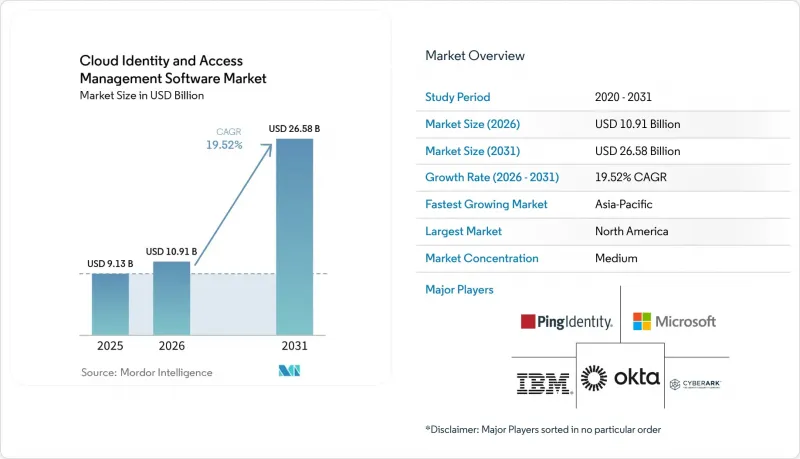
本報告按組件(軟體和服務)、部署模式(公共雲端、私有雲端、混合雲端)、組織規模(大型企業和中小企業)、行業(IT和電信、醫療保健、政府、零售和電子商務、製造業等)以及地區進行細分。市場預測以美元(USD)為單位。
全球雲端身分與存取管理 (IAM) 軟體市場趨勢與洞察
擴大零信任安全框架的應用
曾經信賴邊界防火牆的公司如今將每個請求視為潛在威脅。美國國家標準與技術研究院 (NIST) 在 SP 800-207A 中於 2024 年定義了零信任,促使全球 81% 的公司將這些原則納入其身分與存取管理 (IAM)藍圖。第 14028 號行政命令強制要求美國政府機構檢驗每一次訪問試驗,這推動了對特權存取管理 (PAM) 和基於策略的引擎的商業性需求,這些引擎可在混合環境中強制執行最小權限原則。金融機構已證明其優勢,例如,在將大部分內部應用程式遷移到零信任控制後,未授權存取顯著減少。 Istio 等服務網格技術現在在微服務之間整合了雙向 TLS,從而消除了靜態密碼並降低了橫向機芯的風險。 ISO/IEC 27001:2022 將身分驗證與可驗證的零信任實施連結起來,使該框架從可選的最佳實務轉變為採購要求。
雲端服務在企業中的普及
目前,企業平均使用 3.4 個公共雲端平台,每個平台都需要聯合身分驗證來防止憑證氾濫。去中心化身分 (DID) 解決方案的出現,使企業能夠增強整個雲端生態系中的安全身份驗證、隱私控制和數位信任管理。 2024 年,AWS、Azure 和 Google Cloud 每天處理 1.2 兆次經過驗證的 API 調用,其中大部分由集中式 IAM 中心頒發的 OAuth 2.0 令牌控制。容器工作負載需要每小時更新證書,因此自動化 SPIFFE 框架對於非人類身分至關重要。通訊業者將 5G 核心網路遷移到超大規模雲端平台,是大規模機器對機器身分驗證的典型例子;Verizon 在 2024 年將其 60% 的 5G 核心網路運作在 AWS 上。將於 2024 年 10 月生效的歐洲 NIS2 指令強制要求對雲端依賴項進行供應鏈風險評估,並將身分管治納入合規性檢查清單。
實施和整合高成本
根據德勤2024年的一項調查,員工人數少於500人的公司僅將8%的IT預算用於身分管理,僅為大型企業的一半。缺乏最新協議的舊有應用程式通常需要客製化連接器,而這可能佔到身分和存取管理(IAM)專案支出的40%。美國中小企業將網路安全成本(包括IAM)列為數位轉型的第三大障礙。金融機構報告稱,在ATM機、行動應用程式和核心銀行系統之間同步IAM需要18到24個月的時間,這導致過渡期間需要維護並行系統並增加營運風險。歐洲金融機構在42%的案例中因隱性培訓和技術支援成本而推遲了升級。
細分市場分析
2025年,軟體授權訂閱收入佔總收入的58.62%,而專業服務和託管服務在2031年之前將以19.61%的複合年成長率成長。這一成長的驅動力在於,企業意識到即使使用現成的平台,仍然需要為傳統薪資系統客製化連接器,為SaaS應用程式配置SCIM,以及舉辦角色工程研討會以使授權符合最小權限原則。專業服務目前佔總部署成本的45%,這一趨勢進一步印證了雲端IAM軟體市場中「專業知識比程式碼更重要」的訊息。此外,企業也簽訂多年支援協議,以跟上每季發布的新功能(例如微軟在2024年為Entra發布的14個關鍵更新)。
由於培訓、審計和合規性評估帶來的持續收入,我們的服務訂單管道始終保持穩健。 GDPR 第 30 條要求對所有處理活動進行全面記錄,這促使企業聘請顧問來建立審計日誌,將每項認證決定與相應的政策條款關聯起來。基於 ISO/IEC 27001 的滲透測試越來越需要自動撤銷權限的證據,這導致服務費用進一步納入營運預算。因此,我們的服務在雲端身分和存取管理 (IAM) 軟體市場的擴張中發揮著至關重要的作用。
到2025年,憑藉超大規模雲端服務商特有的超大規模資料中心業者管理(IAM)功能,公共雲端將佔據46.95%的市場佔有率,但隨著監管機構強制要求資料儲存在國內,混合雲解決方案正以19.84%的複合年成長率快速成長。例如,印度的資料保護法允許企業在海外處理敏感度較低的數據,但強制要求高度敏感的身份日誌必須儲存在國內,這使得採用雙棧架構勢在必行。中國也出現了類似的趨勢,該國嚴格禁止國內數據跨境流出。
邊緣環境中的延遲和應用場景也推動了混合方法的普及。對於工業感測器和POS終端的身份驗證,毫秒級的本地檢驗即可有效實現。目前,標準化機構建議使用本地頒發的基於憑證的設備ID,而雲端的中央策略引擎則負責維護管治的一致性。因此,以混合部署為導向的雲端身分與存取管理(IAM)軟體市場正保持兩位數的成長動能。
區域分析
預計到2025年,北美將佔全球收入的38.21%,這主要得益於身分與訪問管理(IAM)供應商的集中、強勁的創業融資以及聯邦政府的零信任政策。加拿大的《資料外洩通知法案》和墨西哥的金融科技許可計畫進一步推動了該地區的發展勢頭。競爭性津貼和FedRAMP認證預計將持續推動北美雲端IAM軟體市場的成長。
亞太地區以20.32%的複合年成長率領先。印度的生物識別計畫Aadhaar與私人身分與訪問管理機構(IAM)合作,實現了快速的電子身分驗證(e-KYC),同時,由於違規將面臨高達25億印度盧比(約3000萬美元)的罰款,合規性成為重中之重。在中國,未經安全許可,超過一百萬筆記錄的傳輸受到限制,這促使跨國公司在中國境內建立身分資訊庫。日本《個人資訊保護法》(APPI)關於域外適用性的修正案以及韓國的強制性審計也推動了這項需求。在澳大利亞,一項將罰款提高至5,000萬澳元(約3,300萬美元)的提案進一步凸顯了這個問題的重要性。
歐洲仍然是一個受GDPR監管的成熟市場,自2021年以來開出的2,154張罰單凸顯了其執行的嚴格性。德國聯邦資訊安全局(BSI)要求所有特權使用者使用基於硬體的多因素身份驗證,法國國家資訊與自由委員會(CNIL)限制了基於雲端的生物識別,而英國脫歐後的系統仍然實施嚴格的同意審核。中東和南美正在崛起為成長支柱,沙烏地阿拉伯和巴西都制定了類似GDPR的法規,這將確保雲端身分與存取管理(IAM)軟體市場走向全球規模。
其他好處:
- Excel格式的市場預測(ME)表
- 3個月的分析師支持
目錄
第1章:引言
- 研究假設和市場定義
- 調查範圍
第2章:調查方法
第3章執行摘要
第4章 市場狀況
- 市場概覽
- 市場促進因素
- 擴大零信任安全框架的應用
- 雲端服務在企業中的普及
- 嚴格的監管合規要求,例如 GDPR 和 CCPA。
- 疫情後遠距辦公人數激增
- CIAM與去中心化身分(區塊鏈)的整合正在推進中。
- 為了提升使用者體驗,人們對無密碼認證的需求日益成長。
- 市場限制因素
- 實施和整合成本高昂
- 熟練的身份與訪問管理 (IAM) 專業人員短缺
- 異質身分識別協定互通性面臨的挑戰
- 行為生物辨識技術引發的隱私問題
- 產業價值鏈分析
- 監理情勢
- 技術展望
- 波特五力分析
- 宏觀經濟因素的影響
第5章 市場規模與成長預測
- 按組件
- 軟體
- 服務
- 按部署模式
- 公共雲端
- 私有雲端
- 混合雲端
- 按組織規模
- 大公司
- 小型企業
- 按行業
- IT/通訊
- 銀行、金融服務和保險(BFSI)
- 衛生保健
- 政府
- 零售與電子商務
- 製造業
- 其他
- 按地區
- 北美洲
- 美國
- 加拿大
- 墨西哥
- 歐洲
- 德國
- 英國
- 法國
- 義大利
- 其他歐洲國家
- 亞太地區
- 中國
- 日本
- 印度
- 韓國
- 澳洲
- 其他亞太國家
- 中東和非洲
- 中東
- 沙烏地阿拉伯
- 阿拉伯聯合大公國
- 其他中東國家
- 非洲
- 南非
- 埃及
- 其他非洲國家
- 中東
- 南美洲
- 巴西
- 阿根廷
- 其他南美國家
- 北美洲
第6章 競爭情勢
- 市場集中度
- 策略趨勢
- 市佔率分析
- 公司簡介
- Okta Inc.
- Microsoft Corporation
- IBM Corporation
- Ping Identity Holding Corp.
- CyberArk Software Ltd.
- ForgeRock Inc.
- SailPoint Technologies Holdings Inc.
- One Identity LLC
- RSA Security LLC
- Duo Security LLC
- Broadcom Inc.(Symantec)
- Oracle Corporation
- JumpCloud Inc.
- Saviynt Inc.
- Centrify Corporation
- HID Global Corporation
- SecureAuth Corporation
- Auth0 Inc.
- Avatier Corporation
- MiniOrange Inc.
- WSO2 LLC
第7章 市場機會與未來展望
According to Mordor Intelligence, the cloud identity and access management software market size in 2026 is estimated at USD 10.91 billion, growing from 2025 value of USD 9.13 billion with 2031 projections showing USD 26.58 billion, growing at 19.52% CAGR over 2026-2031.
This report is Segmented by Component (Software and Services), Deployment Model (Public Cloud, Private Cloud, and Hybrid Cloud), Organization Size (Large Enterprises and Small and Medium Enterprises), Industry Vertical (IT and Telecom, Healthcare, Government, Retail and Ecommerce, Manufacturing, and More), and Geography. The Market Forecasts are Provided in Terms of Value (USD).
Global Cloud Identity and Access Management Software Market Trends and Insights
Growing Adoption of Zero Trust Security Frameworks
Enterprises that once trusted perimeter firewalls now regard every request as potentially hostile. NIST codified Zero Trust in SP 800-207A during 2024, prompting 81% of global businesses to embed these principles into IAM roadmaps. Federal Executive Order 14028 compels U.S. agencies to verify each access attempt, driving commercial demand for Privileged Access Management and policy-based engines that enforce least-privilege rules across hybrid environments. Financial institutions illustrate the payoff, for instance, it is estimated to be reported a decline in unauthorized access was reported after shifting most of internal apps to Zero Trust controls. Service-mesh technologies, such as Istio, now embed mutual TLS between microservices, eliminating static passwords and reducing lateral-movement risk. ISO/IEC 27001:2022 links certification to demonstrable Zero Trust enforcement, turning the framework from optional best practice into a procurement prerequisite.
Proliferation of Cloud Services Across Enterprises
Organizations now average 3.4 distinct public-cloud platforms, each requiring federated identity to prevent credential sprawl. The emergence of Decentralized Identity solutions is enabling enterprises to enhance secure authentication, privacy control, and digital trust management across cloud ecosystems. AWS, Azure, and Google Cloud processed 1.2 trillion authenticated API calls daily in 2024, most gated by OAuth 2.0 tokens issued by centralized IAM hubs. Container workloads rotate certificates hourly, making automated SPIFFE frameworks indispensable for non-human identities. Telecom operators migrating 5G cores to hyperscale clouds exemplify machine-to-machine authentication at massive volume, as Verizon ran 60% of its 5G core on AWS in 2024. Europe's NIS2 Directive, effective October 2024, now obligates supply-chain risk assessments for cloud dependencies, hard-wiring identity governance into compliance checklists.
High Cost of Implementation and Integration
Deloitte's 2024 survey shows firms under 500 staff devote only 8% of IT budgets to identity controls, half the enterprise allocation. Legacy applications that lack modern protocols often need bespoke connectors that can swallow 40% of IAM project expenditure. Smaller U.S. businesses list cybersecurity costs, including IAM, as their third-largest digital-transformation barrier. Financial institutions report 18-24-month timelines when synchronizing IAM across ATMs, mobile apps, and core banking, leaving parallel systems in place and inflating operational risk during cutover. European lenders postponed upgrades in 42% of cases because of hidden training and help-desk expenses.
Other drivers and restraints analyzed in the detailed report include:
- Strict Regulatory Compliance Requirements Such as GDPR and CCPA
- Surge in Remote Workforces Post-Pandemic
- Shortage of Skilled IAM Professionals
For complete list of drivers and restraints, kindly check the Table Of Contents.
Segment Analysis
Software licenses and subscriptions captured 58.62% of 2025 revenue, yet professional and managed services are accelerating at 19.61% CAGR through 2031. The growth stems from enterprises discovering that off-the-shelf platforms still need custom connectors for legacy payroll systems, SCIM provisioning for SaaS apps, and role-engineering workshops that align entitlements with least-privilege mandates. Professional services now absorb up to 45% of total implementation spending, a trend that reinforces the cloud identity and access management software market message that expertise often outweighs code. Businesses also lock in multi-year support to keep pace with quarterly feature drops, such as the 14 significant updates Microsoft issued for Entra in 2024.
Recurring revenue from training, audits, and compliance assessments keeps the services pipeline full. GDPR Article 30 demands exhaustive records of every processing activity, pushing firms to enlist consultants who can configure audit logs that map each authentication decision to a policy line item. ISO/IEC 27001-driven penetration tests increasingly require evidence that privileges expire automatically, further embedding service fees into operating budgets. As a result, services play a pivotal role in scaling the cloud identity and access management software market.
Public cloud garnered 46.95% share in 2025 thanks to hyperscaler-native IAM features, but hybrid solutions are expanding at a 19.84% CAGR as regulators insist on local data residency. India's data-protection act, for example, lets businesses process non-sensitive data abroad but forces sensitive identity logs to stay onshore, making dual-stack architectures unavoidable. A similar dynamic appears in China, where resident data must never leave national borders.
Latency and edge use cases reinforce the hybrid argument. Authentication for industrial sensors or point-of-sale terminals benefits from on-premise validation that executes in milliseconds. Standards bodies now recommend certificate-based device identities issued locally, while central policy engines in the cloud maintain governance consistency. The cloud identity and access management software market size for hybrid deployments is therefore on a double-digit trajectory.
Complete Report Scope:
- By Component
- Software
- Services
- By Deployment Model
- Public Cloud
- Private Cloud
- Hybrid Cloud
- By Organization Size
- Large Enterprises
- Small and Medium Enterprises
- By Industry Vertical
- IT and Telecom
- Banking, Financial Services and Insurance (BFSI)
- Healthcare
- Government
- Retail and Ecommerce
- Manufacturing
- Other Industry Vertical
- By Geography
- North America
- United States
- Canada
- Mexico
- Europe
- Germany
- United Kingdom
- France
- Italy
- Rest of Europe
- Asia-Pacific
- China
- Japan
- India
- South Korea
- Australia
- Rest of Asia-Pacific
- Middle East and Africa
- Middle East
- Saudi Arabia
- United Arab Emirates
- Rest of Middle East
- Africa
- South Africa
- Egypt
- Rest of Africa
- Middle East
- South America
- Brazil
- Argentina
- Rest of South America
- North America
Geography Analysis
North America generated 38.21% of 2025 revenue, fueled by a concentration of IAM vendors, robust venture funding, and federal Zero Trust mandates. Canada's breach-notification law and Mexico's fintech licensing regime adds further regional momentum. Competitive grants and FedRAMP authorizations position the cloud identity and access management software market for continued scale across the continent.
Asia Pacific delivers the fastest CAGR at 20.32%. India's biometric Aadhaar program integrates with private IAM for rapid e-KYC, while penalties of INR 2.5 billion (USD 30 million) for violations keep compliance top-of-mind. China restricts transfers of more than 1 million records without security clearance, prompting multinationals to deploy in-country identity vaults. Japan's extraterritorial APPI amendments and South Korea's mandatory audits sustain demand. Australia's draft bill raising fines to AUD 50 million (USD 33 million) further underscores the stakes.
Europe remains a mature arena governed by GDPR, where 2 154 fines since 2021 underscore enforcement vigor. Germany's BSI calls for hardware multi-factor for all privileged users, France's CNIL restricts cloud-based biometrics, and the U.K.'s post-Brexit regime still imposes strict consent audits. The Middle East and South America emerge as growth corridors through Saudi Arabia's and Brazil's GDPR-like statutes, ensuring that the cloud identity and access management software market achieves global span.
- Okta Inc.
- Microsoft Corporation
- IBM Corporation
- Ping Identity Holding Corp.
- CyberArk Software Ltd.
- ForgeRock Inc.
- SailPoint Technologies Holdings Inc.
- One Identity LLC
- RSA Security LLC
- Duo Security LLC
- Broadcom Inc. (Symantec)
- Oracle Corporation
- JumpCloud Inc.
- Saviynt Inc.
- Centrify Corporation
- HID Global Corporation
- SecureAuth Corporation
- Auth0 Inc.
- Avatier Corporation
- MiniOrange Inc.
- WSO2 LLC
Additional Benefits:
- The market estimate (ME) sheet in Excel format
- 3 months of analyst support
TABLE OF CONTENTS
1 INTRODUCTION
- 1.1 Study Assumptions and Market Definition
- 1.2 Scope of the Study
2 RESEARCH METHODOLOGY
3 EXECUTIVE SUMMARY
4 MARKET LANDSCAPE
- 4.1 Market Overview
- 4.2 Market Drivers
- 4.2.1 Growing Adoption of Zero Trust Security Frameworks
- 4.2.2 Proliferation of Cloud Services Across Enterprises
- 4.2.3 Strict Regulatory Compliance Requirements Such as GDPR and CCPA
- 4.2.4 Surge in Remote Workforces Post-Pandemic
- 4.2.5 Rising Integration of CIAM with Decentralized Identity (Blockchain)
- 4.2.6 Emerging Demand for Passwordless Authentication to Enhance User Experience
- 4.3 Market Restraints
- 4.3.1 High Cost of Implementation and Integration
- 4.3.2 Shortage of Skilled IAM Professionals
- 4.3.3 Interoperability Challenges Among Heterogeneous Identity Protocols
- 4.3.4 Privacy Concerns Around Behavioral Biometrics
- 4.4 Industry Value Chain Analysis
- 4.5 Regulatory Landscape
- 4.6 Technological Outlook
- 4.7 Porter's Five Forces Analysis
- 4.7.1 Threat of New Entrants
- 4.7.2 Bargaining Power of Suppliers
- 4.7.3 Bargaining Power of Buyers
- 4.7.4 Threat of Substitutes
- 4.7.5 Competitive Rivalry
- 4.8 Impact of Macroeconomic Factors
5 MARKET SIZE AND GROWTH FORECASTS (VALUE)
- 5.1 By Component
- 5.1.1 Software
- 5.1.2 Services
- 5.2 By Deployment Model
- 5.2.1 Public Cloud
- 5.2.2 Private Cloud
- 5.2.3 Hybrid Cloud
- 5.3 By Organization Size
- 5.3.1 Large Enterprises
- 5.3.2 Small and Medium Enterprises
- 5.4 By Industry Vertical
- 5.4.1 IT and Telecom
- 5.4.2 Banking, Financial Services and Insurance (BFSI)
- 5.4.3 Healthcare
- 5.4.4 Government
- 5.4.5 Retail and Ecommerce
- 5.4.6 Manufacturing
- 5.4.7 Other Industry Vertical
- 5.5 By Geography
- 5.5.1 North America
- 5.5.1.1 United States
- 5.5.1.2 Canada
- 5.5.1.3 Mexico
- 5.5.2 Europe
- 5.5.2.1 Germany
- 5.5.2.2 United Kingdom
- 5.5.2.3 France
- 5.5.2.4 Italy
- 5.5.2.5 Rest of Europe
- 5.5.3 Asia-Pacific
- 5.5.3.1 China
- 5.5.3.2 Japan
- 5.5.3.3 India
- 5.5.3.4 South Korea
- 5.5.3.5 Australia
- 5.5.3.6 Rest of Asia-Pacific
- 5.5.4 Middle East and Africa
- 5.5.4.1 Middle East
- 5.5.4.1.1 Saudi Arabia
- 5.5.4.1.2 United Arab Emirates
- 5.5.4.1.3 Rest of Middle East
- 5.5.4.2 Africa
- 5.5.4.2.1 South Africa
- 5.5.4.2.2 Egypt
- 5.5.4.2.3 Rest of Africa
- 5.5.4.1 Middle East
- 5.5.5 South America
- 5.5.5.1 Brazil
- 5.5.5.2 Argentina
- 5.5.5.3 Rest of South America
- 5.5.1 North America
6 COMPETITIVE LANDSCAPE
- 6.1 Market Concentration
- 6.2 Strategic Moves
- 6.3 Market Share Analysis
- 6.4 Company Profiles (includes Global Level Overview, Market Level Overview, Core Segments, Financials as Available, Strategic Information, Market Rank/Share for Key Companies, Products and Services, and Recent Developments)
- 6.4.1 Okta Inc.
- 6.4.2 Microsoft Corporation
- 6.4.3 IBM Corporation
- 6.4.4 Ping Identity Holding Corp.
- 6.4.5 CyberArk Software Ltd.
- 6.4.6 ForgeRock Inc.
- 6.4.7 SailPoint Technologies Holdings Inc.
- 6.4.8 One Identity LLC
- 6.4.9 RSA Security LLC
- 6.4.10 Duo Security LLC
- 6.4.11 Broadcom Inc. (Symantec)
- 6.4.12 Oracle Corporation
- 6.4.13 JumpCloud Inc.
- 6.4.14 Saviynt Inc.
- 6.4.15 Centrify Corporation
- 6.4.16 HID Global Corporation
- 6.4.17 SecureAuth Corporation
- 6.4.18 Auth0 Inc.
- 6.4.19 Avatier Corporation
- 6.4.20 MiniOrange Inc.
- 6.4.21 WSO2 LLC
7 MARKET OPPORTUNITIES AND FUTURE OUTLOOK
- 7.1 White-Space and Unmet-Need Assessment

 雲端識別及存取管理市場:按組件、部署模型、身分類型、定價模式、服務交付模型、產業和組織規模分類-2026-2032年全球市場預測
 雲端身分與存取管理 (IAM) 市場規模、佔有率、趨勢和預測:按服務、部署類型、企業規模、產業和地區分類 (2026–2034)
 全球雲端身分和存取管理市場規模、佔有率、趨勢和成長分析報告(2026-2034年)
 2026年全球雲端存取管理市場報告
 雲端身分與存取管理 (IAM) 市場分析及預測(至 2035 年):按類型、產品類型、服務、技術、元件、應用程式、部署類型、最終用戶和功能分類雲端身分和管理解決方案市場按解決方案類型、部署模式、組織規模和最終用戶分類 - 全球預測 2026-2032雲端身分安全與管理解決方案市場按元件、部署類型、組織規模和垂直產業分類 - 全球預測 2026-2032雲端身分和存取管理技術市場:按元件、部署類型、存取類型、身份驗證類型、組織規模和產業 - 2025-2030 年全球預測全球雲端身分存取管理市場規模(按雲端類型、部署模型、組織規模、最終用戶產業、區域範圍和預測)