


 |
市場調查報告書
商品編碼
2100486
異丙苯:市佔率分析、產業趨勢與統計、成長預測(2026-2031)Cumene - Market Share Analysis, Industry Trends & Statistics, Growth Forecasts (2026 - 2031) |
||||||

※ 本網頁內容可能與最新版本有所差異。詳細情況請與我們聯繫。
據 Mordor Intelligence 稱,2026 年異丙苯市場規模估計為 1994 萬噸,預計在預測期(2026-2031 年)內將以 4.88% 的複合年成長率成長,到 2031 年達到 2530 萬噸。
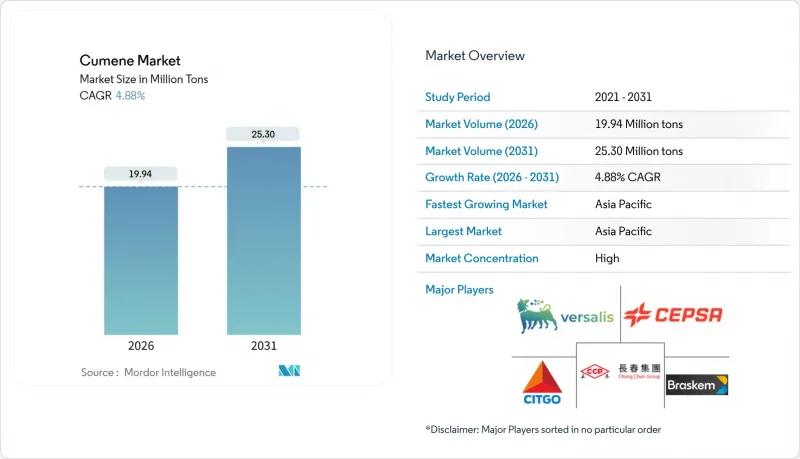
本報告按催化劑類型(氯化鋁、固體磷酸、沸石及其他)、應用領域(苯酚、丙酮及其他)和地區(亞太地區、北美地區、歐洲地區、南美地區、中東和非洲地區)進行細分。市場預測以噸為單位。
全球異丙苯市場趨勢與洞察
對酚醛聚碳酸酯和環氧樹脂的需求不斷成長
在電動車領域,聚碳酸酯玻璃的使用減輕了車輛重量,有助於實現延長續航里程的目標。隨著建築業整體需求趨於穩定,電子產品製造商擴大採用光學透明樹脂製造高解析度顯示器,從而推動了酚醛樹脂的需求。由於離岸風力發電葉片和航太領域關鍵結構對高抗疲勞性的需求,環氧樹脂的消耗量正在增加。在汽車煞車系統中,酚醛黏合劑正擴大取代金屬摩擦材料,從而實現減重和降噪的雙重目標。在中國,一些公司採取了後向整合策略,將異丙苯、苯酚和雙酚A的生產設施集中在同一地點,以降低供應風險,但這項策略卻無意中導致了區域性供應過剩。
煉油廠和石化聯合企業提高了異丙苯的經濟可行性。
在原油製化學品轉化專案中,將混合原料裂解裝置與芳烴裝置結合,可使業者以內部定價獲得不受現貨價格波動影響的苯和丙烯。沙烏地阿拉伯亞斯雷夫煉油廠的擴建預計將在2029年前為下游苯酚-丙酮生產鏈提供額外的苯。此外,卡達拉斯拉凡裂解裝置計畫於2026年運作,並計畫對丙烯脫氫裝置,以平衡輕質原料的裂解產率。此類一體化設施無需廠間物流,縮短了營運資金週轉週期,並可在利潤率變化時快速切換異丙苯和其他芳烴化合物。
原油、苯和丙烯的價格波動
2024年4月至5月,東北亞地區的苯-石腦油價差出現波動。相較之下,西歐同期價差顯著下降。這一下降是由於液化石油氣裂解取代了對Pigas制苯的需求。丙烯與布蘭特原油價格密切相關,基準原油價格上漲時,其利潤率會大幅下降。北美乙烷裂解裝置生產的丙烯量極少。因此,異丙苯生產商轉向專用丙烷脫氫(PDH)供應,但卻被迫以高價購買。由於高度依賴進口,亞洲的非一體化工廠最容易受到運費和外匯波動的影響,因此承受最大的壓力。
細分市場分析
到2025年,沸石體系將佔據異丙苯市場70.68%的佔有率,預計到2031年,其產量將以每年6.17%的速度成長。未來幾年,沸石技術可望進一步提升其在異丙苯市場的貢獻。在英力士(INEOS)的瑪珥湖煉油廠,沸石技術的引入顯著減少了不合格產品的產生,並降低了每噸異丙苯的二氧化碳排放量。同時,埃克森美孚(ExxonMobil)的MCM-22裝置的產率遠高於固體磷酸鹽體系,特別是考慮到苛性鹼中和帶來的額外成本。
目前,氯化鋁法僅佔總設備容量的一小部分,大部分集中在中國一些老舊的工廠,這些工廠要么計劃進行維修,要么即將關閉。為了響應在COP28之前宣布的國家低碳目標,中東地區的新計畫主要採用沸石催化劑。為了實現碳自給自足,中國的萬華化學成功改進了其沸石催化劑,並擴大了異丙苯的產能。然而,仍使用固態磷酸(SPA)設備的營運商仍然處於劣勢,因為美國環保署(EPA)的40 CFR 60.112c規定了嚴格的效率控制,這需要大量的資金投入用於蒸氣回收。
區域分析
預計到2025年,亞太地區將佔異丙苯市場61.26%的佔有率,並將在2031年之前保持5.97%的複合年成長率。 2025年至2027年間,中國大幅提升了苯酚和丙酮的產能,其中包括榮盛金塘生產線等項目。然而,由於苯供應過剩加劇,雙酚A的運轉率受到抑制。三井化學宣布,由於結構性供應過剩,將於2026會計年度關閉其位於市原的苯酚工廠。相較之下,印度正面臨苯酚供不應求。哈爾迪爾石化公司計劃於2026年擴大其苯酚產能,而迪帕克化學公司正在推進一個計劃於2027年運作的新計畫。同時,東南亞大型企業PTTGC為該地區的包裝和電子產業營運苯酚生產設施。
北美利用低成本乙烷實現了乙烯的高產率。然而,這一過程導致丙烯產率較低。因此,美國異丙苯市場依賴煉油廠FCC和PDH裝置的原料,而這些原料的價格往往偏高。 2024年,苯的價格反映了供應緊張的局面,尤其是在苯乙烯消費量增加的情況下。自2021年以來,美國墨西哥灣沿岸地區的丙烯一體化供應增加,這主要得益於Baystar和GCGV的產能擴張。然而,這種進展常常被價格波動所掩蓋,尤其是在煉油廠運作受到颶風影響時。
在歐洲,尤其是在歐盟排放交易體系(EU-ETS)和碳排放交易體系(CBAM)框架下,企業正面臨能源成本飆升和日益成長的碳排放責任。作為2024年的戰略舉措,BASF正在精簡其路德維希港工廠的運營,減少非核心中間體的生產,並將資源重新分配到綜合資產上。這項轉型凸顯了該公司傳統苯酚生產線面臨的日益成長的壓力。 2024年,西歐苯-石腦油價差的縮小導致中東地區異丙苯進口量激增。儘管該地區許多企業都面臨挑戰,但英力士先進的瑪珥礦裝置脫穎而出。其創新的沸石平台,加上接近性格拉德貝克苯酚生產設施的優勢,有助於緩解該地區不斷上漲的電力成本的影響。
中東正鞏固其作為異丙苯產業競爭性出口中心的地位。沙烏地阿美公司正大力投資,制定一項涵蓋液體到化學品的綜合策略。其雄心勃勃的藍圖設想整合裂解裝置、芳烴化合物裝置和甲醇烷基化裝置,目標是到2030年實現原油日轉化量大幅成長。卡達能源公司的拉斯拉凡計畫旨在專門生產用於異丙苯的丙烯。該項目預計於2026年竣工,主要目標市場為歐洲和南亞。在南美洲,異丙苯的產量較為有限。巴西和舉措都專注於滿足國內對酚醛樹脂的需求。同時,撒哈拉以南非洲地區的苯酚需求幾乎完全依賴進口。
其他好處:
- Excel格式的市場預測(ME)表
- 3個月的分析師支持
目錄
第1章:引言
- 研究假設和市場定義
- 調查範圍
第2章:調查方法
第3章執行摘要
第4章 市場狀況
- 市場概覽
- 市場促進因素
- 對酚醛聚碳酸酯和環氧樹脂的需求不斷成長
- 丙酮在溶劑和MMA中的應用日益廣泛
- 煉油廠和石化聯合體的整合提高了異丙苯的獲利能力。
- 高選擇性沸石催化劑的快速普及
- 塑膠產業對苯酚的需求增加
- 市場限制因素
- 異丙苯暴露的健康與環境風險
- 原油、苯和丙烯的價格波動
- 更嚴格的排放氣體法規增加了合規成本。
- 價值鏈分析
- 波特五力模型
- 價格分析
- 原料分析
- 貿易分析
第5章 市場規模與成長預測
- 按催化劑類型
- 氯化鋁基催化劑
- 固體磷酸(SPA)催化劑
- 沸石催化劑
- 其他類型的催化劑
- 透過使用
- 苯酚
- 丙酮
- 其他用途(油漆、搪瓷、航空燃料等)
- 按地區
- 亞太地區
- 中國
- 印度
- 日本
- 韓國
- 其他亞太國家
- 北美洲
- 美國
- 加拿大
- 墨西哥
- 歐洲
- 德國
- 法國
- 英國
- 義大利
- 俄羅斯
- 其他歐洲國家
- 南美洲
- 巴西
- 阿根廷
- 其他南美國家
- 中東和非洲
- 沙烏地阿拉伯
- 南非
- 其他中東和非洲國家
- 亞太地區
第6章 競爭情勢
- 市場集中度
- 策略趨勢
- 市佔率和排名分析
- 公司簡介
- BASF SE
- Braskem
- Cepsa
- Chang Chun Group
- CITGO Petroleum Corporation
- Dow
- ExxonMobil Corporation
- Formosa Chemical & Fibre Corp.
- INEOS
- Koch Industries Inc.
- Kumho P&B Chemicals Inc.
- Prasol Chemicals Pvt. Ltd.
- PTT Phenol
- SABIC
- Shell PLC
- Sumitomo Chemical Co., Ltd.
- Sunoco LP
- Versalis SpA
第7章 市場機會與未來展望
According to Mordor Intelligence, the cumene market size is estimated at 19.94 million tons in 2026, and is expected to reach 25.30 million tons by 2031, at a CAGR of 4.88% during the forecast period (2026-2031).
This report is Segmented by Catalyst Type (Aluminum Chloride, Solid Phosphoric Acid, Zeolite, and Other Types), Application (Phenol, Acetone, and Other Applications), and Geography (Asia-Pacific, North America, Europe, South America, and Middle-East and Africa). Market Forecasts are Provided in Terms of Volume (Tons).
Global Cumene Market Trends and Insights
Growing Demand for Phenol-Based Polycarbonates and Epoxy Resins
Electric vehicles are trimming their mass with the use of polycarbonate glazing, aiding in their range extension goals. As general construction demand levels off, electronics manufacturers are turning to optically clear resins for high-resolution displays, boosting phenol off-take. Offshore wind blades and primary structures in aerospace requiring high fatigue resistance are driving a rise in epoxy resin consumption. In automotive braking systems, phenolic binders are increasingly replacing metallic friction materials, leading to reductions in both weight and noise. While backward-integrated players in China have linked cumene, phenol, and bisphenol A units on single sites to mitigate supply risks, this strategy has inadvertently led to regional overcapacity.
Integrated Refinery-Petrochemical Complexes Improving Cumene Economics
Crude-to-chemicals projects pair mixed-feed crackers with aromatics units, giving operators internal benzene and propylene streams at transfer prices unaffected by spot swings. The Yasref refinery expansion in Saudi Arabia will add benzene for downstream phenol-acetone chains by 2029, and the Ras Laffan cracker in Qatar is scheduled to start up in 2026 with on-purpose propylene dehydrogenation to balance light-feed cracking yields. Such complexes eliminate inter-plant logistics, shorten working-capital cycles, and enable rapid swings between cumene and other aromatics when margin signals shift.
Crude Oil, Benzene, and Propylene Price Volatility
In April-May 2024, Northeast Asia saw benzene-naphtha spreads fluctuate. In contrast, Western Europe experienced a significant drop during the same period. This decline was driven by LPG cracking, which displaced pygas-derived benzene. Propylene, closely tied to Brent, sees its margins tighten sharply whenever benchmark crude prices rise. North American ethane crackers produce minimal propylene. As a result, cumene producers are turning to on-purpose PDH supplies, but at a premium. Asian plants that aren't integrated are feeling the brunt of the pressure, as their reliance on imports makes them vulnerable to fluctuations in freight and currency.
Other drivers and restraints analyzed in the detailed report include:
- Rapid Adoption of High-Selectivity Zeolite Catalysts
- Increasing Demand for Phenol in the Plastics Value Chain
- Stricter Emission Norms Raising Compliance Costs
For complete list of drivers and restraints, kindly check the Table Of Contents.
Segment Analysis
Zeolite systems captured 70.68% of the cumene market share in 2025, and their output is growing 6.17% yearly to 2031. Zeolite technology is poised to boost its contribution to the cumene market in the coming years. At INEOS's Marl complex, the adoption of zeolite technology has led to a notable reduction in off-spec streams and a decrease in CO2 emissions per ton. Meanwhile, ExxonMobil's MCM-22 units boast yields that solid phosphoric acid systems can't match, especially given their added caustic-neutralization costs.
Aluminum chloride methods now represent a small portion of the total installed capacity, predominantly in older Chinese facilities that are either set for retrofitting or imminent closure. In a nod to the national low-carbon targets unveiled before COP28, greenfield projects in the Middle East are predominantly opting for zeolite frameworks. Demonstrating a commitment to self-sufficiency, China's Wanhua Chemical has successfully enhanced its in-house zeolite catalyst, boosting cumene capacity. However, operators still using SPA units find themselves at a disadvantage: EPA 40 CFR 60.112c mandates a stringent control efficiency, leading to significant capital investments for vapor recovery.
Complete Report Scope:
- By Catalyst Type
- Aluminum Chloride Catalyst
- Solid Phosphoric Acid (SPA) Catalyst
- Zeolite Catalyst
- Other Catalyst Types
- By Application
- Phenol
- Acetone
- Other Applications (Paints, Enamels, Aviation Fuels, etc.)
- By Geography
- Asia-Pacific
- China
- India
- Japan
- South Korea
- Rest of Asia-Pacific
- North America
- United States
- Canada
- Mexico
- Europe
- Germany
- France
- United Kingdom
- Italy
- Russia
- Rest of Europe
- South America
- Brazil
- Argentina
- Rest of South America
- Middle-East and Africa
- Saudi Arabia
- South Africa
- Rest of Middle-East and Africa
- Asia-Pacific
Geography Analysis
Asia-Pacific retained 61.26% of the cumene market in 2025, and is expected to register a 5.97% CAGR through 2031. Between 2025 and 2027, China introduced significant phenol-acetone capacity to the market, including projects like Rongsheng's Jintang line. However, with benzene overcapacity increasing, bisphenol A run rates were curtailed. Mitsui Chemical announced the closure of its Ichihara phenol plant by FY 2026, attributing the decision to a structural oversupply. In contrast, India grapples with a phenol deficit. Haldia Petrochemicals ramped up its phenol output in 2026, and Deepak Chem Tech is pushing forward with new projects set to debut in 2027. Meanwhile, PTTGC, a key player in Southeast Asia, operates a phenol facility, catering to the region's packaging and electronics sectors.
North America capitalizes on its low-cost ethane, achieving high yields in ethylene production. However, this process yields weaker propylene streams. As a result, the US cumene market relies on feedstock sourced from refinery FCCs or PDH units, often at a premium price. In 2024, benzene prices reflected a tight supply scenario, especially with styrene's increasing consumption. Since 2021, capacity expansions on the US Gulf Coast, notably by Baystar and GCGV, have enhanced the availability of integrated propylene. Yet, this progress is often overshadowed by volatility, especially when hurricanes disrupt refinery operations.
Europe grapples with soaring energy costs and escalating carbon responsibilities, particularly under the EU-ETS and CBAM frameworks. In a strategic move for 2024, BASF is streamlining operations at its Ludwigshafen site, cutting back on non-core intermediates to reallocate resources towards integrated assets. This shift underscores the mounting pressures on its traditional phenol lines. In 2024, Western European benzene-naphtha spreads tightened, prompting a surge in cumene imports from the Middle East. While many in the region face challenges, INEOS's advanced Marl plant stands out. Its innovative zeolite platform, combined with its proximity to the Gladbeck phenol units, helps mitigate the impact of elevated regional power costs.
The Middle East is solidifying its position as a competitive export hub in the cumene industry. Saudi Aramco is making a significant bet, investing heavily in a comprehensive liquids-to-chemicals strategy. Their ambitious roadmap envisions the integration of crackers, aromatics, and alkylation complexes, with a target of converting large volumes of crude daily by 2030. QatarEnergy's Ras Laffan initiative is set to produce on-purpose propylene for cumene. With mechanical completion anticipated in 2026, the project eyes exports primarily to Europe and South Asia. In South America, production levels are modest. Both Brazil and Argentina are channeling efforts towards meeting their domestic phenolic resin needs. Meanwhile, Sub-Saharan Africa finds itself reliant on imports for nearly all its phenol demands.
- BASF SE
- Braskem
- Cepsa
- Chang Chun Group
- CITGO Petroleum Corporation
- Dow
- ExxonMobil Corporation
- Formosa Chemical & Fibre Corp.
- INEOS
- Koch Industries Inc.
- Kumho P&B Chemicals Inc.
- Prasol Chemicals Pvt. Ltd.
- PTT Phenol
- SABIC
- Shell PLC
- Sumitomo Chemical Co., Ltd.
- Sunoco LP
- Versalis S.p.A.
Additional Benefits:
- The market estimate (ME) sheet in Excel format
- 3 months of analyst support
TABLE OF CONTENTS
1 Introduction
- 1.1 Study Assumptions and Market Definition
- 1.2 Scope of the Study
2 Research Methodology
3 Executive Summary
4 Market Landscape
- 4.1 Market Overview
- 4.2 Market Drivers
- 4.2.1 Growing demand for phenol-based polycarbonates and epoxy resins
- 4.2.2 Expanding use of acetone in solvents and MMA
- 4.2.3 Integrated refinery-petchem complexes improving cumene economics
- 4.2.4 Rapid adoption of high-selectivity zeolite catalysts
- 4.2.5 Increasing Demand for Phenol from the Plastic Industry
- 4.3 Market Restraints
- 4.3.1 Health and environmental hazards of cumene exposure
- 4.3.2 Crude oil/benzene-propylene price volatility
- 4.3.3 Stricter emission norms raising compliance costs
- 4.4 Value Chain Analysis
- 4.5 Porter's Five Forces
- 4.5.1 Bargaining Power of Suppliers
- 4.5.2 Bargaining Power of Buyers
- 4.5.3 Threat of New Entrants
- 4.5.4 Threat of Substitutes
- 4.5.5 Degree of Competition
- 4.6 Pricing Analysis
- 4.7 Feedstock Analysis
- 4.8 Trade Analysis
5 Market Size and Growth Forecasts (Volume)
- 5.1 By Catalyst Type
- 5.1.1 Aluminum Chloride Catalyst
- 5.1.2 Solid Phosphoric Acid (SPA) Catalyst
- 5.1.3 Zeolite Catalyst
- 5.1.4 Other Catalyst Types
- 5.2 By Application
- 5.2.1 Phenol
- 5.2.2 Acetone
- 5.2.3 Other Applications (Paints, Enamels, Aviation Fuels, etc.)
- 5.3 By Geography
- 5.3.1 Asia-Pacific
- 5.3.1.1 China
- 5.3.1.2 India
- 5.3.1.3 Japan
- 5.3.1.4 South Korea
- 5.3.1.5 Rest of Asia-Pacific
- 5.3.2 North America
- 5.3.2.1 United States
- 5.3.2.2 Canada
- 5.3.2.3 Mexico
- 5.3.3 Europe
- 5.3.3.1 Germany
- 5.3.3.2 France
- 5.3.3.3 United Kingdom
- 5.3.3.4 Italy
- 5.3.3.5 Russia
- 5.3.3.6 Rest of Europe
- 5.3.4 South America
- 5.3.4.1 Brazil
- 5.3.4.2 Argentina
- 5.3.4.3 Rest of South America
- 5.3.5 Middle-East and Africa
- 5.3.5.1 Saudi Arabia
- 5.3.5.2 South Africa
- 5.3.5.3 Rest of Middle-East and Africa
- 5.3.1 Asia-Pacific
6 Competitive Landscape
- 6.1 Market Concentration
- 6.2 Strategic Moves
- 6.3 Market Share(%)/Ranking Analysis
- 6.4 Company Profiles (includes Global level Overview, Market level overview, Core Segments, Financials as available, Strategic Information, Products and Services, and Recent Developments)
- 6.4.1 BASF SE
- 6.4.2 Braskem
- 6.4.3 Cepsa
- 6.4.4 Chang Chun Group
- 6.4.5 CITGO Petroleum Corporation
- 6.4.6 Dow
- 6.4.7 ExxonMobil Corporation
- 6.4.8 Formosa Chemical & Fibre Corp.
- 6.4.9 INEOS
- 6.4.10 Koch Industries Inc.
- 6.4.11 Kumho P&B Chemicals Inc.
- 6.4.12 Prasol Chemicals Pvt. Ltd.
- 6.4.13 PTT Phenol
- 6.4.14 SABIC
- 6.4.15 Shell PLC
- 6.4.16 Sumitomo Chemical Co., Ltd.
- 6.4.17 Sunoco LP
- 6.4.18 Versalis S.p.A.
7 Market Opportunities and Future Outlook
- 7.1 White-space and Unmet-Need Assessment

 異丙苯市場-2026-2032年全球市場預測
 異丙苯市場報告:按生產流程、應用、終端用戶產業和地區分類(2026-2034 年)
 異丙苯市場:依原料、應用、終端用戶產業及地區分類
 2026 年異丙苯全球市場報告
 異丙苯市場規模、佔有率及成長分析(依原料、產量、製造流程、應用、最終用戶及地區分類)-2026-2033年產業預測
 異丙苯市場報告:趨勢、預測和競爭分析(至 2031 年)
 Cumen全球市場分析:工廠產能、地點、產量、營運效率、供需、最終用途、區域需求、銷售通路、技術授權人、公司份額、對外貿易、產業市場規模、製造流程(2015年2032-2032年) )