


 |
市場調查報告書
商品編碼
2100265
網站建立工具:市場佔有率分析、產業趨勢與統計、成長預測(2026-2031)Website Builders - Market Share Analysis, Industry Trends & Statistics, Growth Forecasts (2026 - 2031) |
||||||

※ 本網頁內容可能與最新版本有所差異。詳細情況請與我們聯繫。
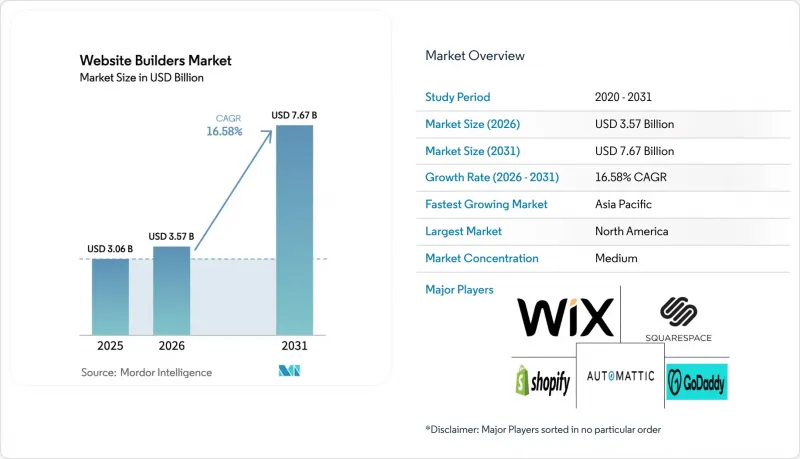
根據 Mordor Intelligence 估計,網站建立工具市場在 2026 年的價值將達到 35.7 億美元,高於 2025 年的 30.6 億美元,預計到 2031 年將達到 76.7 億美元。
預計從 2026 年到 2031 年,其複合年成長率將達到 16.58%。
本報告按網站架設工具類型(PC端建站工具和行動裝置建站工具)、部署模式(雲端和本地部署)、最終用戶(個人用戶和企業用戶)、價格範圍(免費增值模式、訂閱模式(低於15美元/月)等)和地區進行細分。市場預測以美元(USD)為單位。
全球網站建立市場趨勢與洞察
中小企業主導的電子商務商店數量正在迅速增加。
印度的GeM入口網站在2023會計年度融資額超過240億美元,顯示公共部門的強勁勢頭正在推動中小企業線上發展。線上食品雜貨和時尚產品的需求不斷成長,促使本地經銷商尋求承包方案,網站建立者也開始將支付、物流和稅務模組打包,以縮短搭建時間。 B2B買家也開始轉向自助服務入口網站,使平台的覆蓋範圍超越了純零售領域。 2022年,二、三線城市新增網站數量佔比高達41.5%,顯示目標市場需求遠不止於大都會圈。市場領導者正在調整網站模板,並與印刷公司合作,以最佳化語言、稅務和物流功能,更好地服務這些新興地區。
行動優先網路普及
行動網際網路的普及正在改變網站建立者的架構需求。截至2023年,亞太地區擁有18億行動用戶,佔該地區人口的63%。行動技術貢獻了該地區5.3%的GDP(8,800億美元),並支撐了約1,300萬個就業崗位,凸顯了行動最佳化網站的經濟必要性。向5G技術和開放閘道器API的過渡增強了連接解決方案,從而實現了更高級的行動網站功能。將生成式人工智慧整合到行動平台中,可以改善客戶服務和營運效率,為人工智慧驅動的行動網站建立者創造新的機會。行動生態系統在經濟成長和數位包容性方面的重要作用,使得行動優先的網站建立者成為新興市場企業不可或缺的基礎設施。
對資料隱私和網路安全的擔憂
GDPR 和 CCPA 要求進行精細化的同意管理,迫使網站建立者整合 Cookie 橫幅、資料保護協議 (DPA) 範本和資料外洩警報流程。像 Enzuzo 這樣的平台現在已將法律政策產生功能直接整合到其控制面板中。零信任架構的採用增加了中小企業在預算緊張的情況下滿足最低安全標準的成本,使得維持價格變得困難。隨著惡意攻擊者擴大將目標對準 SaaS 網站憑證,供應商正在添加多因素身份驗證 (MFA) 和人工智慧驅動的異常檢測。小規模、新參與企業可能難以資金籌措這些安全措施的費用,這可能會加速網站建立者市場的整合。
細分市場分析
預計到2025年,PC端建站工具將佔總銷售額的63.12%,憑藉其全面的功能、代理工具和多店鋪相容性,為建站工具市場奠定了基礎。然而,隨著智慧型手機在許多地區的使用量超過桌上型電腦,行動端建站工具的市佔率預計將在2031年之前以17.43%的複合年成長率成長。響應式模板現在已成為預設顯示,語音控制的設計精靈正在加速行動裝置企業的網站發布。光是Wegic一家公司就在230個國家建立了超過60萬個行動裝置網站,凸顯了新參與企業的快速成長。即使在傳統的PC平台上,自我調整畫布和一鍵式佈局切換也正被擴大採用,模糊了設備之間的界限,並顯示出向成熟的全通路環境融合的跡象。
對智慧型手機、平板電腦和筆記型電腦無縫編輯的需求正促使供應商轉向雲端編輯器,這些編輯器能夠持續保存編輯狀態,這項變革正在擴大整個網站建立器市場。多斷點即時預覽、自動圖像壓縮和腳本懶加載等功能使運營商能夠滿足谷歌的「核心網頁指標」(Core Web Vitals)標準。為了降低一般使用者的流失率,同時滿足對精細CSS控制要求的代理商的需求,平台需要兼具強大的功能和簡潔的使用者介面。這表明,產品兩極化的趨勢在未來仍將持續。
預計到2025年,雲端解決方案將佔網站建置市場收入的81.08%,佔據主導地位。 SaaS模式將託管、SSL、CDN和更新等服務打包在一起,減輕了中小企業的維護負擔。邊緣運算技術的進步使資源更靠近訪客,從而降低延遲並提升SEO排名。無伺服器後端支援在限時搶購期間實現經濟高效的擴展,這對電商用戶來說極具吸引力。雖然在受資料居住法規約束的行業中,本地部署仍然普遍存在,但未來的投資計畫顯然傾向於雲端協作。
正如Netlify收購Gatsby所表明的那樣,可組合式網頁設計正日益普及,它允許開發者根據需要替換電子商務、搜尋和身份驗證服務。這種模組化方法加快了功能交付速度,同時減少了技術債。那些簡化插件審核流程並進行全面安全掃描的供應商正在建立值得信賴的優勢,尤其是在那些不太懂技術的買家擔心專案範圍蔓延和隱藏成本的情況下。因此,雲端運算仍然是創新的核心,其在網站建立器市場的佔有率必將繼續擴大。
區域分析
北美地區預計在2025年將貢獻38.25%的收入,並繼續保持其在功能發布和合作夥伴生態系統方面的標竿地位。高信用卡普及率和強大的高速寬頻基礎設施為加值服務的提升銷售提供了有利條件。人工智慧部署通常先於全球發佈在該地區,進一步強化了該地區對藍圖方向的影響力。然而,由於微企業市場已趨於飽和,供應商正轉向專注於特定產業的細分市場,並採用基於績效的定價模式以維持成長。
亞太地區是未來擴張的驅動力,預計2031年將達到18.76%的複合年成長率。行動優先的消費習慣、51%的行動網際網路普及率以及政府主導的數位化政策正在推動其應用。新加坡的人工智慧津貼金和印度的國家數位轉型中心(ONDC)網路等公共計畫鼓勵企業快速轉型線上。本地付款閘道、多語言結帳流程以及即使在低頻寬下也能正常運作的主題,都在幫助國際供應商更好地適應市場,而區域新創公司則利用文化差異展開激烈競爭。這些趨勢使得亞太地區成為網站建立工具市場展現擴充性的關鍵舞台。
在歐洲,合規主導的需求佔了相當大的市場。隨著GDPR持續成為決定功能優先順序的關鍵因素,以及碳排放計算日益受到經營團隊的關注,生態託管計畫的重要性也日益凸顯。提供自動化工具以回應資料主體請求並運作可再生能源伺服器的建站服務商正在確立其高階市場地位。拉丁美洲、中東和非洲雖然規模較小,但由於網路普及率的提高和社交商務的蓬勃發展,這些地區正經歷兩位數的成長。與通訊業者和媒體公司的策略合作正在這些地區建立信任並促進用戶採納,從而確保網站建立工具市場在地理上的均衡成長。
其他好處:
- Excel格式的市場預測(ME)表
- 3個月的分析師支持
目錄
第1章:引言
- 研究假設和市場定義
- 調查範圍
第2章:調查方法
第3章執行摘要
第4章 市場狀況
- 市場概覽
- 市場促進因素
- 主導推出的電子商務網站數量正在迅速增加。
- 行動優先網路普及率
- 低程式碼/無程式碼技術在數位轉型中的應用現狀
- 人工智慧驅動的網站設計和內容創作
- 谷歌利用「核心網路指標」進行最佳化的努力
- 無頭/JAMstack 建構器的興起
- 市場限制因素
- 資料隱私和網路安全問題
- 開放原始碼管理系統之間的激烈競爭
- SaaS附加元件的總擁有成本正在上升。
- 成熟經濟體中微型企業用戶群的飽和
- 價值鏈分析
- 監理情勢
- 技術展望
- 波特五力分析
- 投資和資金籌措趨勢
第5章 市場規模及成長預測(價值,2020-2030 年)
- 由建築公司
- 適用於PC的網站建置工具
- 行動網站建構器
- 不同的發展
- 雲
- 現場
- 最終用戶
- 個人
- 公司
- 按價格範圍
- 免費增值
- 訂閱費用 <美元(15/月)
- 每月訂閱費用為 15 至 50 美元
- 企業版 > 美元(50/月)
- 按地區
- 北美洲
- 美國
- 加拿大
- 墨西哥
- 南美洲
- 巴西
- 阿根廷
- 其他南美國家
- 歐洲
- 英國
- 德國
- 法國
- 義大利
- 西班牙
- 俄羅斯
- 其他歐洲國家
- 亞太地區
- 中國
- 印度
- 日本
- 韓國
- 澳洲和紐西蘭
- 東南亞
- 其他亞太國家
- 中東和非洲
- 中東
- 沙烏地阿拉伯
- 阿拉伯聯合大公國
- 土耳其
- 其他中東國家
- 非洲
- 南非
- 奈及利亞
- 肯亞
- 其他非洲國家
- 中東
- 北美洲
第6章 競爭情勢
- 市場集中度
- 策略趨勢
- 市佔率分析
- 公司簡介
- Wix.com Inc.
- Automattic Inc.(WordPress.com)
- Squarespace, Inc.
- Shopify Inc.
- GoDaddy Inc.
- Weebly(Block, Inc.)
- Duda Inc.
- Webflow, Inc.
- Zyro(Hostinger)
- Strikingly, Inc.
- Jimdo GmbH
- Site123 Ltd.
- Webnode AG
- Yola Inc.
- IONOS SE(1and1)
- Ecwid Inc.
- BigCommerce Holdings Inc.(Page Builder)
- PageCloud Inc.
- HubSpot Inc.(CMS Hub)
- Mono Solutions ApS
第7章 市場機會與未來展望
According to Mordor Intelligence, website builders market size in 2026 is estimated at USD 3.57 billion, growing from 2025 value of USD 3.06 billion with 2031 projections showing USD 7.67 billion, growing at 16.58% CAGR over 2026-2031.
This report is Segmented by Builder Type (PC Website Builders and Mobile Website Builders), Deployment (cloud and On-Premises), End User (Individuals and Businesses), Pricing Tier (Freemium, Subscription (Less Than USD (15 / Month)), and More), and by Geography. The Market Forecasts are Provided in Terms of Value (USD).
Global Website Builders Market Trends and Insights
Surge in SMB-driven E-commerce Storefront Launches
India's GeM portal surpassed USD 24 billion in procurement value during FY 2023, signalling public-sector momentum that nudges SMBs online. Rising online grocery and fashion demand pushes regional merchants to seek turnkey stores, and website builders now package payment, shipping and tax modules to shorten setup time. B2B buyers also shift to self-service portals, expanding platform scope beyond pure retail. Tier-II and Tier-III cities contributed a sizeable 41.5% share of new sites in 2022, proving addressable demand extends well outside metros. Market leaders re-tool templates and partner presses to localize language, tax and logistics features for these growth pockets.
Mobile-first Internet Penetration
Mobile internet adoption transforms website builder architecture requirements, with the Asia-Pacific region hosting 1.8 billion mobile subscribers representing 63% of the population as of 2023. Mobile technologies contributed 5.3% to the region's GDP, amounting to USD 880 billion, while supporting approximately 13 million jobs, demonstrating the economic imperative for mobile-optimized web presence. The shift toward 5G technologies and Open Gateway APIs enhances connectivity solutions, enabling more sophisticated mobile website functionalities. Generative AI integration in mobile platforms improves customer service and operational efficiency, creating opportunities for AI-powered mobile website builders. The mobile ecosystem's role in economic growth and digital inclusion positions mobile-first website builders as critical infrastructure for emerging market businesses.
Data-privacy and cybersecurity concerns
GDPR and CCPA demand granular consent controls, driving builders to embed cookie banners, DPA templates and breach-alert flows. Platforms like Enzuzo now integrate legal policy generators directly into dashboards. Zero-Trust architecture adoption lifts baseline security spend just as SMB budgets tighten, making price points harder to defend. Malicious actors increasingly target SaaS site credentials, prompting vendors to add MFA and AI anomaly detection. Smaller entrants may struggle to fund these safeguards, amplifying consolidation forces inside the website builders market.
Other drivers and restraints analyzed in the detailed report include:
- Low-/No-Code Adoption in Digital Transformation
- AI-generated Site Design and Content Creation
- Intense competition from open-source CMS
For complete list of drivers and restraints, kindly check the Table Of Contents.
Segment Analysis
PC website builders retained 63.12% revenue in 2025, anchoring the website builders market through robust feature breadth, agency tools and multistore support. Yet mobile builders are carving share at an 17.43% CAGR through 2031 as smartphone usage eclipses desktop time in many regions. Responsive templates now open by default, and voice-led design wizards hasten launch for mobile-centric merchants. Wegic alone has created over 600,000 mobile-ready sites in 230 nations, highlighting crop growth among new entrants. Traditional PC platforms increasingly adopt adaptive canvases and one-tap layout swaps, foreshadowing a convergence where device labels fade and omnichannels remain.
Demand for seamless editing across phone, tablet and laptop steers vendors to cloud-hosted editors that save state continuously, a shift that reinforces the broader website builders market. Live preview on multiple breakpoints, auto-compress image handling, and lazy-load scripts help operators satisfy Google Core Web Vitals thresholds. Platform depth must now coexist with lean UIs to keep churn low among casual creators while satisfying agencies that demand granular CSS control, signaling product bifurcation ahead.
Cloud solutions held 81.08% of 2025 revenue, placing a commanding stamp on the website builders market. SaaS models bundle hosting, SSL, CDN and updates, relieving SMBs of upkeep tasks. Edge computing advances move assets closer to visitors, trimming latency and lifting SEO scores. Serverless back-ends unlock cost-efficient scaling during flash sales, a key draw for e-commerce users. On-premises installs linger in regulated sectors where data residency rules prevail, but roadmap investment tilts clearly toward cloud orchestration.
Composable web designs are gaining favor as Netlify's acquisition of Gatsby demonstrates, letting developers swap commerce, search and auth services on demand. This module approach accelerates feature delivery while curbing technical debt. Providers that streamline plug-in vetting and enforce security scans create trust advantages, especially for non-technical buyers wary of scope creep and hidden fees. Consequently, cloud remains the gravitational center of innovation, ensuring its share within the website builders market size continues to climb.
Complete Report Scope:
- By Builder Type
- PC Website Builders
- Mobile Website Builders
- By Deployment
- Cloud
- On-Premises
- By End User
- Individuals
- Businesses
- By Pricing Tier
- Freemium
- Subscription USD (50 / mo)
- By Geography
- North America
- United States
- Canada
- Mexico
- South America
- Brazil
- Argentina
- Rest of South America
- Europe
- United Kingdom
- Germany
- France
- Italy
- Spain
- Russia
- Rest of Europe
- Asia-Pacific
- China
- India
- Japan
- South Korea
- Australia and New Zealand
- Southeast Asia
- Rest of Asia-Pacific
- Middle East and Africa
- Middle East
- Saudi Arabia
- United Arab Emirates
- Turkey
- Rest of Middle East
- Africa
- South Africa
- Nigeria
- Kenya
- Rest of Africa
- Middle East
- North America
Geography Analysis
North America generated 38.25% of 2025 revenue and remains a benchmark for feature launches and partner ecosystems. Mature credit-card penetration and fast broadband create fertile ground for premium upsells. AI rollouts debut in this region before global release, reinforcing its influence on roadmap direction. Yet saturation among micro-businesses leads vendors to pursue vertical niches and performance-linked pricing to sustain growth.
Asia-Pacific is the engine of future expansion, posting a projected 18.76% CAGR to 2031. Mobile-first behavior, a 51% mobile internet share, and supportive government digital agendas fuel uptake. Public programs such as Singapore's AI grants and India's ONDC network incentivize merchants to get online swiftly. Local payment gateways, multilingual checkout flows and low-bandwidth themes help international vendors adapt, while regional startups leverage cultural nuance to compete head-to-head. These dynamics position Asia-Pacific as the pivotal theatre where the website builders market proves its scalability.
Europe occupies a large, compliance-driven slice of demand. GDPR continues to shape feature priorities, and eco-hosting commitments gain weight as carbon accounting gains board-room visibility. Builders that deliver automated data-subject request tools and renewable-powered servers earn premium positioning. Latin America and the Middle East and Africa, although smaller, clock double-digit uptake thanks to rising internet penetration and social-commerce spill-overs. Strategic alliances with telecom operators and media houses facilitate trust and distribution in these regions, ensuring a geographically balanced trajectory for the website builders market.
- Wix.com Inc.
- Automattic Inc. (WordPress.com)
- Squarespace, Inc.
- Shopify Inc.
- GoDaddy Inc.
- Weebly (Block, Inc.)
- Duda Inc.
- Webflow, Inc.
- Zyro (Hostinger)
- Strikingly, Inc.
- Jimdo GmbH
- Site123 Ltd.
- Webnode AG
- Yola Inc.
- IONOS SE (1and1)
- Ecwid Inc.
- BigCommerce Holdings Inc. (Page Builder)
- PageCloud Inc.
- HubSpot Inc. (CMS Hub)
- Mono Solutions ApS
Additional Benefits:
- The market estimate (ME) sheet in Excel format
- 3 months of analyst support
TABLE OF CONTENTS
1 INTRODUCTION
- 1.1 Study Assumptions and Market Definition
- 1.2 Scope of the Study
2 RESEARCH METHODOLOGY
3 EXECUTIVE SUMMARY
4 MARKET LANDSCAPE
- 4.1 Market Overview
- 4.2 Market Drivers
- 4.2.1 Surge in SMB-driven e-commerce storefront launches
- 4.2.2 Mobile-first internet penetration
- 4.2.3 Low-/no-code adoption in digital transformation
- 4.2.4 AI-generated site design and content creation
- 4.2.5 Google Core Web Vitals optimisation push
- 4.2.6 Rise of headless/JAMstack builders
- 4.3 Market Restraints
- 4.3.1 Data-privacy and cybersecurity concerns
- 4.3.2 Intense competition from open-source CMS
- 4.3.3 Rising total cost of ownership of SaaS add-ons
- 4.3.4 Saturation of micro-business user base in mature economies
- 4.4 Value Chain Analysis
- 4.5 Regulatory Landscape
- 4.6 Technological Outlook
- 4.7 Porter's Five Forces Analysis
- 4.7.1 Bargaining Power of Suppliers
- 4.7.2 Bargaining Power of Buyers
- 4.7.3 Threat of New Entrants
- 4.7.4 Threat of Substitutes
- 4.7.5 Intensity of Competitive Rivalry
- 4.8 Investment and Funding Trends
5 MARKET SIZE AND GROWTH FORECASTS (VALUE, 2020-2030)
- 5.1 By Builder Type
- 5.1.1 PC Website Builders
- 5.1.2 Mobile Website Builders
- 5.2 By Deployment
- 5.2.1 Cloud
- 5.2.2 On-Premises
- 5.3 By End User
- 5.3.1 Individuals
- 5.3.2 Businesses
- 5.4 By Pricing Tier
- 5.4.1 Freemium
- 5.4.2 Subscription <USD (15 / mo)
- 5.4.3 Subscription USD (15-50 / mo)
- 5.4.4 Enterprise >USD (50 / mo)
- 5.5 By Geography
- 5.5.1 North America
- 5.5.1.1 United States
- 5.5.1.2 Canada
- 5.5.1.3 Mexico
- 5.5.2 South America
- 5.5.2.1 Brazil
- 5.5.2.2 Argentina
- 5.5.2.3 Rest of South America
- 5.5.3 Europe
- 5.5.3.1 United Kingdom
- 5.5.3.2 Germany
- 5.5.3.3 France
- 5.5.3.4 Italy
- 5.5.3.5 Spain
- 5.5.3.6 Russia
- 5.5.3.7 Rest of Europe
- 5.5.4 Asia-Pacific
- 5.5.4.1 China
- 5.5.4.2 India
- 5.5.4.3 Japan
- 5.5.4.4 South Korea
- 5.5.4.5 Australia and New Zealand
- 5.5.4.6 Southeast Asia
- 5.5.4.7 Rest of Asia-Pacific
- 5.5.5 Middle East and Africa
- 5.5.5.1 Middle East
- 5.5.5.1.1 Saudi Arabia
- 5.5.5.1.2 United Arab Emirates
- 5.5.5.1.3 Turkey
- 5.5.5.1.4 Rest of Middle East
- 5.5.5.2 Africa
- 5.5.5.2.1 South Africa
- 5.5.5.2.2 Nigeria
- 5.5.5.2.3 Kenya
- 5.5.5.2.4 Rest of Africa
- 5.5.5.1 Middle East
- 5.5.1 North America
6 COMPETITIVE LANDSCAPE
- 6.1 Market Concentration
- 6.2 Strategic Moves
- 6.3 Market Share Analysis
- 6.4 Company Profiles (includes Global level Overview, Market level overview, Core Segments, Financials as available, Strategic Information, Market Rank/Share, Products and Services, Recent Developments)
- 6.4.1 Wix.com Inc.
- 6.4.2 Automattic Inc. (WordPress.com)
- 6.4.3 Squarespace, Inc.
- 6.4.4 Shopify Inc.
- 6.4.5 GoDaddy Inc.
- 6.4.6 Weebly (Block, Inc.)
- 6.4.7 Duda Inc.
- 6.4.8 Webflow, Inc.
- 6.4.9 Zyro (Hostinger)
- 6.4.10 Strikingly, Inc.
- 6.4.11 Jimdo GmbH
- 6.4.12 Site123 Ltd.
- 6.4.13 Webnode AG
- 6.4.14 Yola Inc.
- 6.4.15 IONOS SE (1and1)
- 6.4.16 Ecwid Inc.
- 6.4.17 BigCommerce Holdings Inc. (Page Builder)
- 6.4.18 PageCloud Inc.
- 6.4.19 HubSpot Inc. (CMS Hub)
- 6.4.20 Mono Solutions ApS
7 MARKET OPPORTUNITIES AND FUTURE OUTLOOK
- 7.1 White-space and Unmet-Need Assessment

 視覺內容市場-2026-2032年全球市場預測網站建置工具市場-2026-2032年全球市場預測
 視覺內容市場規模、佔有率和成長分析:按內容類型、交付方式、部署模式、企業規模、應用、最終用戶產業和地區分類-2026-2033年產業預測
 2026年全球新媒體與搜尋市場報告
 2026-2030年全球語意網路市場
 在地化雜貨價格比較應用程式市場預測至 2034 年—按平台類型、比較類型、資料類型、經營模式、技術整合、使用者類型和地區進行全球分析。2026年全球履歷製作工具市場報告2026年全球網路內容、搜尋入口網站和社群媒體市場報告價格比較應用市場:依平台類型、支付模式、應用程式、使用者類型和產業分類,全球預測,2026-2032年
 語意網市場:依產品、技術、應用和產業劃分 - 全球預測(~2036年)