


 |
市場調查報告書
商品編碼
2100262
OSS/BSS:市場佔有率分析、產業趨勢與統計、成長預測(2026-2031)OSS BSS - Market Share Analysis, Industry Trends & Statistics, Growth Forecasts (2026 - 2031) |
||||||

※ 本網頁內容可能與最新版本有所差異。詳細情況請與我們聯繫。
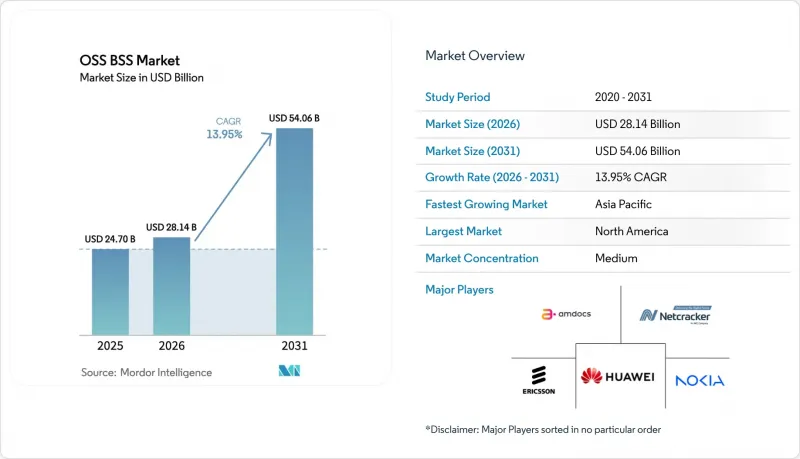
據 Mordor Intelligence 稱,2025 年 OSS BSS 市值為 247 億美元,預計到 2031 年將達到 540.6 億美元,而 2026 年為 281.4 億美元,預測期(2026-2031 年)的複合年成長率為 13.95%。
本報告按解決方案服務、部署類型(本地部署、雲端部署)、公司規模(大型企業、中小企業)、產業(IT 和電信、銀行、金融服務和保險、媒體和娛樂、零售和電子商務、其他)以及地區進行分類。
全球OSS/BSS市場趨勢與洞察
擴大雲端原生OSS/BSS平台的應用
微服務和容器化正在重新定義營運敏捷性,使通訊業者能夠在幾天內而非幾個月內推出新服務。 Gartner 預測,到 2025 年,95% 的數位工作負載將在雲端原生基礎架構上運作。領先採用者表示,由於橫向擴展叢集能夠應對需求激增而無需過度分配資源,整體擁有成本 (TCO) 有所降低。然而,57% 的通訊業者表示缺乏 DevOps 和 Kubernetes編配的技能,導致對託管服務和供應商培訓計畫的需求增加。
快速部署 5G 和網路切片商業化
通訊業者正尋求基於網路切片的差異化服務層級,旨在為低延遲、高吞吐量的應用場景提供高階定價。醫療保健、製造業和汽車產業是早期採用者,這進一步提升了整合式OSS/BSS市場解決方案對動態收費、策略制定和保障功能的需求。
從傳統技術棧遷移和整合成本高。
平台全面改造可能耗資數億美元,耗時五年以上。許多遺留工作流程都是硬編碼的,需要進行細緻的資料映射和員工再培訓。麥肯錫的研究表明,業績領先的公司正在推行端到端現代化,而非簡單的「遷移」方式,將IT轉型與流程重組相結合,從而獲得成本節約和敏捷性提升的雙重效益。
細分市場分析
到2025年,「解決方案」板塊將佔據OSS/BSS市場62.40%的佔有率,為通訊業者的營運提供核心目錄、收費和保障平台。然而,「服務」板塊預計將以高於OSS/BSS整體市場的速度成長,到2031年將實現14.85%的複合年成長率。實施融合計費、遷移到雲端原生架構以及調整AI模型都需要專業知識,而許多通訊業者缺乏這方面的內部資源。涵蓋策略、收費和分析的整合專案在OSS/BSS市場中所佔佔有率越來越大,而託管服務合約則可確保KPI的達成,並幫助通訊業者專注於產品創新。
專業服務提供者正在整合DevOps工具鏈、參考架構和基於結果的服務等級協定(SLA)。 Infovista與CSG於2025年2月宣佈建立合作夥伴關係,這表明供應商如何結合自身優勢——專案控制、自動化保障和客戶資料同步——來縮短部署時間並提高服務可靠性。隨著部署規模的擴大,持續最佳化和人工智慧訓練服務有望成為服務專家長期收入來源的基礎。
即使到了2025年,本地部署系統仍將佔OSS/BSS市場規模的57.65%,這反映了通訊業者嚴格管理關鍵業務堆疊的傳統。然而,由於靈活的計量收費模式可以將資本支出(Capex)轉化為營運支出(OpEx),預計到2031年,公共雲端和混合雲端的複合年成長率將達到17.55%。利用雲端資源的通訊業者表示,服務推出週期已從數月縮短至數週,而高彈性的叢集則可防止非尖峰時段出現資源閒置。
多重雲端策略透過將工作負載分佈在不同區域,降低了供應商鎖定風險,並滿足了有關資料主權的監管要求。基於 SaaS 的 BSS 套件預先整合了目錄、收費和 CRM 模組,無需大量前期整合成本即可提供企業級可靠性。雲端託管 OSS BSS 平台的早期採用者表示,開放 API 加速了合作夥伴的入駐流程,並促進了 5G 網路切片的商業化,進一步鞏固了雲端在 OSS BSS 市場中的策略地位。
區域分析
預計到2025年,北美將引領市場,佔據34.45%的收入佔有率,主要得益於5G的早期部署、強大的光纖骨幹網路以及鼓勵提升服務品質(QoS)的法規環境。許多區域通訊業者正在支援中心和網路營運中心部署人工智慧(AI),其中48%的營運商已在使用AI來提升客戶體驗。超大規模資料中心的部署和明確的安全框架正在加速向雲端遷移,使通訊業者能夠將網路切片貨幣化,用於醫療保健和物流等行業用途。
預計亞太地區將實現最快成長,到2031年複合年成長率將達到19.10%。中國、印度、日本和韓國正在雄心勃勃的數位經濟計畫下部署全國性的5G和光纖網路。雲端原生OSS/BSS架構將使通訊業者能夠管理龐大的用戶群,並開始提供分層企業服務。新興市場正在利用SaaS授權來克服資金限制,而已開發國家則專注於先進的網路切片編配和人工智慧驅動的品質保證。
歐洲憑藉嚴格的資料隱私法規和對自主雲端生態系的推動,在OSS/BSS市場保持著舉足輕重的地位。通訊業者面臨來自價格管制和競爭對手過度網路建設的利潤壓力,促使基礎設施共用和增值夥伴關係的興起。歐盟的「數位十年」計畫正在推廣互通的API優先解決方案,從而推動了對滿足跨境合規要求的靈活OSS/BSS協議堆疊的需求。隨著對遍遠地區寬頻和製造業專用5G網路的投資,平台部署預計將穩步推進。
其他好處
- Excel格式的市場預測(ME)表
- 3個月的分析師支持
目錄
第1章:引言
- 市場定義與研究假設
- 調查範圍
第2章:調查方法
第3章執行摘要
第4章 市場狀況
- 市場概覽
- 市場促進因素
- 擴大雲端原生OSS/BSS平台的應用
- 5G的快速普及正在推動網路切片的商業化。
- 對融合計費和物聯網貨幣化的需求日益成長
- 通訊業者(CSP) 正在投資客戶經驗分析。
- 利用人工智慧的自主網路運營
- 通訊業者向技術公司轉型所需的預算用於整合堆疊。
- 市場限制因素
- 從傳統堆疊遷移和整合的成本相對較高。
- 多重雲端中安全性和合規性的複雜性
- 通訊業者人工智慧/機器學習人才短缺
- 供應商整合帶來的供應商鎖定風險
- 價值供應鏈分析
- 重要法規結構的評估
- 技術展望
- 波特五力分析
- 對關鍵相關人員的影響評估
- 宏觀經濟因素的影響
第5章 市場規模與成長預測
- 按組件
- 解決方案
- 服務
- 按實現類型
- 現場
- 基於雲端的
- 按公司規模
- 大公司
- 小型企業
- 按行業
- IT/通訊
- BFSI
- 媒體與娛樂
- 零售與電子商務
- 政府/公共部門
- 其他行業領域
- 按地區
- 北美洲
- 美國
- 加拿大
- 墨西哥
- 南美洲
- 巴西
- 阿根廷
- 其他南美國家
- 歐洲
- 德國
- 英國
- 法國
- 義大利
- 西班牙
- 俄羅斯
- 其他歐洲國家
- 亞太地區
- 中國
- 日本
- 印度
- 韓國
- 澳洲和紐西蘭
- 其他亞太國家
- 中東和非洲
- 中東
- 沙烏地阿拉伯
- 阿拉伯聯合大公國
- 土耳其
- 其他中東國家
- 非洲
- 南非
- 奈及利亞
- 肯亞
- 其他非洲地區
- 中東
- 北美洲
第6章 競爭情勢
- 市場集中度
- 策略趨勢
- 市佔率分析
- 公司簡介
- Amdocs Limited
- Huawei Technologies Co., Ltd.
- Telefonaktiebolaget LM Ericsson
- Nokia Corporation
- Netcracker Technology Corporation
- Oracle Corporation
- IBM Corporation
- Cisco Systems, Inc.
- CSG Systems International, Inc.
- Accenture plc
- Comviva Technologies Ltd.
- Subex Limited
- Optiva Inc.
- Whale Cloud Technology Co., Ltd.
- NMSWorks Software Pvt. Ltd.
- Tridens doo
- TelcoDR Inc.
- AsiaInfo Technologies Limited
- Hewlett Packard Enterprise Company
- Tecnotree Corporation
- Sigma Systems(Hansen Technologies)
- Mavenir Systems, Inc.
第7章 市場機會與未來趨勢
- 對未開發市場和未滿足需求的評估
According to Mordor Intelligence, the OSS BSS market size was valued at USD 24.70 billion in 2025 and estimated to grow from USD 28.14 billion in 2026 to reach USD 54.06 billion by 2031, at a CAGR of 13.95% during the forecast period (2026-2031).
This report is Segmented by (Solutions, Services), Deployment (On-Premise, Cloud-Based), Enterprise Size (Large Enterprises, Small and Medium-Sized Enterprises), Industry Vertical (IT and Telecom, BFSI, Media and Entertainment, Retail and E-Commerce, and More), and Geography.
Global OSS BSS Market Trends and Insights
Growing adoption of cloud-native OSS/BSS platforms
Microservices and containerization are redefining operational agility, allowing operators to spin up new services in days rather than months. Gartner projects that 95% of digital workloads will reside on cloud-native foundations by 2025. Early movers report lower total cost of ownership as scale-out clusters handle demand spikes without overprovisioning. However, 57% of carriers cite skills gaps in DevOps and Kubernetes orchestration, prompting heightened demand for managed services and vendor training programs .
Rapid 5G rollout and network-slice monetization
Operators are banking on differentiated service tiers built on network slicing to unlock premium pricing for low-latency and high-throughput use cases. Healthcare, manufacturing, and automotive segments are early adopters, reinforcing the need for dynamic charging, policy, and assurance functions inside converged OSS BSS market solutions.
High migration and integration costs from legacy stacks
Full-scale platform renewal can reach hundreds of millions of USD and stretch over five years. Many legacy workflows are hard-coded, demanding painstaking data mapping and staff retraining. A McKinsey study finds top performers pursue end-to-end modernization instead of "lift-and-shift" moves, aligning IT transformation with process redesign to capture cost and agility benefits.
Other drivers and restraints analyzed in the detailed report include:
- Customer-experience analytics investments by CSPs
- AI-driven autonomous network operations
- Multi-cloud security and compliance complexities
For complete list of drivers and restraints, kindly check the Table Of Contents.
Segment Analysis
The Solutions tier generated 62.40% OSS BSS market share in 2025, supplying core catalog, charging, and assurance platforms essential for telco operations. However, Services are projected to log a 14.85% CAGR through 2031, outpacing the overall OSS BSS market. Convergent billing rollouts, cloud-native migrations, and AI-model tuning require specialised expertise that most carriers lack in-house. Integration projects that span policy, charging, and analytics now account for a growing slice of the OSS BSS market size, while managed-services contracts guarantee KPIs and free operators to focus on product innovation.
Professional-service providers bundle DevOps toolchains, reference architectures, and outcome-based SLAs. The Infovista-CSG partnership announced in February 2025 shows how vendors combine strengths-policy control, automated assurance, and customer-data synchronisation-to shorten deployment and improve service reliability. As implementations scale, recurring optimisation and AI training services will underpin long-term revenue streams for service specialists.
On-premise systems still held 57.65% of the OSS BSS market size in 2025, reflecting the telco tradition of maintaining tight control over mission-critical stacks. Yet public and hybrid clouds are forecast to post an 17.55% CAGR through 2031, thanks to flexible pay-as-you-go models that convert capex to opex. Operators leveraging cloud resources report launch cycles shrinking from months to weeks, while elastic clusters prevent idle capacity during off-peak hours.
Multi-cloud strategies mitigate vendor lock-in and address sovereignty mandates by distributing workloads across different regions. SaaS-based BSS suites with pre-integrated catalog, charging, and CRM modules deliver enterprise-grade reliability without heavy up-front integration fees. Early adopters of cloud-hosted OSS BSS platforms credit open APIs for faster partner onboarding and easier monetisation of 5G network slices, reinforcing the cloud's strategic role in the OSS BSS market.
Complete Report Scope:
- By Component
- Solutions
- Services
- By Deployment Mode
- On-Premise
- Cloud-Based
- By Enterprise Size
- Large Enterprises
- Small and Medium Enterprises
- By Industry Vertical
- IT and Telecom
- BFSI
- Media and Entertainment
- Retail and E-commerce
- Government and Public Sector
- Other Industry Verticals
- By Geography
- North America
- United States
- Canada
- Mexico
- South America
- Brazil
- Argentina
- Rest of South America
- Europe
- Germany
- United Kingdom
- France
- Italy
- Spain
- Russia
- Rest of Europe
- Asia-Pacific
- China
- Japan
- India
- South Korea
- Australia and New Zealand
- Rest of Asia-Pacific
- Middle East and Africa
- Middle East
- Saudi Arabia
- UAE
- Turkey
- Rest of Middle East
- Africa
- South Africa
- Nigeria
- Kenya
- Rest of Africa
- Middle East
- North America
Geography Analysis
North America led with 34.45% revenue in 2025, driven by early 5G rollouts, deep fibre backbones, and a regulatory climate rewarding quality-of-service improvements. Many regional carriers deploy AI in support centres and network-operations hubs-48% already leverage AI for better customer experiences . Cloud migrations are accelerated by hyperscale data-centre footprints and well-defined security frameworks, allowing operators to monetise slices for industries such as healthcare and logistics.
Asia-Pacific is poised to deliver the fastest growth, with a 19.10% CAGR through 2031. China, India, Japan, and South Korea are deploying nationwide 5G and fibre networks under ambitious digital-economy plans. Cloud-native OSS BSS architectures help carriers manage massive subscriber bases and launch tiered enterprise offerings. Emerging markets leverage SaaS licensing to overcome capital constraints, while developed nations focus on advanced network-slice orchestration and AI-driven assurance.
Europe maintains meaningful influence in the OSS BSS market owing to strict data-privacy rules and a push for sovereign cloud ecosystems. Operators face profit-pressure from price regulation and competitive overbuilds, prompting infrastructure-sharing and value-added partnerships. The EU Digital Decade policy promotes interoperable, API-first solutions, driving demand for flexible OSS BSS stacks that satisfy cross-border compliance. Investments in rural broadband and private-5G for manufacturing will sustain steady platform adoption.
- Amdocs Limited
- Huawei Technologies Co., Ltd.
- Telefonaktiebolaget LM Ericsson
- Nokia Corporation
- Netcracker Technology Corporation
- Oracle Corporation
- IBM Corporation
- Cisco Systems, Inc.
- CSG Systems International, Inc.
- Accenture plc
- Comviva Technologies Ltd.
- Subex Limited
- Optiva Inc.
- Whale Cloud Technology Co., Ltd.
- NMSWorks Software Pvt. Ltd.
- Tridens d.o.o.
- TelcoDR Inc.
- AsiaInfo Technologies Limited
- Hewlett Packard Enterprise Company
- Tecnotree Corporation
- Sigma Systems (Hansen Technologies)
- Mavenir Systems, Inc.
Additional Benefits:
- The market estimate (ME) sheet in Excel format
- 3 months of analyst support
TABLE OF CONTENTS
1 INTRODUCTION
- 1.1 Market Definition and Study Assumptions
- 1.2 Scope of the Study
2 RESEARCH METHODOLOGY
3 EXECUTIVE SUMMARY
4 MARKET LANDSCAPE
- 4.1 Market Overview
- 4.2 Market Drivers
- 4.2.1 Growing adoption of cloud-native OSS/BSS platforms
- 4.2.2 Rapid 5G rollout driving network-slicing monetization
- 4.2.3 Rising demand for convergent billing and IoT monetization
- 4.2.4 Customer-experience analytics investments by CSPs
- 4.2.5 AI-driven autonomous network operations
- 4.2.6 Telco-to-TechCo transformation budgets for unified stacks
- 4.3 Market Restraints
- 4.3.1 High migration and integration costs from legacy stacks
- 4.3.2 Multi-cloud security and compliance complexities
- 4.3.3 Shortage of telco-grade AI/ML talent
- 4.3.4 Vendor lock-in risk from supplier consolidation
- 4.4 Value / Supply-Chain Analysis
- 4.5 Evaluation of Critical Regulatory Framework
- 4.6 Technological Outlook
- 4.7 Porter's Five Forces Analysis
- 4.7.1 Bargaining Power of Suppliers
- 4.7.2 Bargaining Power of Consumers
- 4.7.3 Threat of New Entrants
- 4.7.4 Threat of Substitutes
- 4.7.5 Intensity of Competitive Rivalry
- 4.8 Impact Assessment of Key Stakeholders
- 4.9 Impact of Macroeconomic Factors
5 MARKET SIZE AND GROWTH FORECASTS (VALUE)
- 5.1 By Component
- 5.1.1 Solutions
- 5.1.2 Services
- 5.2 By Deployment Mode
- 5.2.1 On-Premise
- 5.2.2 Cloud-Based
- 5.3 By Enterprise Size
- 5.3.1 Large Enterprises
- 5.3.2 Small and Medium Enterprises
- 5.4 By Industry Vertical
- 5.4.1 IT and Telecom
- 5.4.2 BFSI
- 5.4.3 Media and Entertainment
- 5.4.4 Retail and E-commerce
- 5.4.5 Government and Public Sector
- 5.4.6 Other Industry Verticals
- 5.5 By Geography
- 5.5.1 North America
- 5.5.1.1 United States
- 5.5.1.2 Canada
- 5.5.1.3 Mexico
- 5.5.2 South America
- 5.5.2.1 Brazil
- 5.5.2.2 Argentina
- 5.5.2.3 Rest of South America
- 5.5.3 Europe
- 5.5.3.1 Germany
- 5.5.3.2 United Kingdom
- 5.5.3.3 France
- 5.5.3.4 Italy
- 5.5.3.5 Spain
- 5.5.3.6 Russia
- 5.5.3.7 Rest of Europe
- 5.5.4 Asia-Pacific
- 5.5.4.1 China
- 5.5.4.2 Japan
- 5.5.4.3 India
- 5.5.4.4 South Korea
- 5.5.4.5 Australia and New Zealand
- 5.5.4.6 Rest of Asia-Pacific
- 5.5.5 Middle East and Africa
- 5.5.5.1 Middle East
- 5.5.5.1.1 Saudi Arabia
- 5.5.5.1.2 UAE
- 5.5.5.1.3 Turkey
- 5.5.5.1.4 Rest of Middle East
- 5.5.5.2 Africa
- 5.5.5.2.1 South Africa
- 5.5.5.2.2 Nigeria
- 5.5.5.2.3 Kenya
- 5.5.5.2.4 Rest of Africa
- 5.5.5.1 Middle East
- 5.5.1 North America
6 COMPETITIVE LANDSCAPE
- 6.1 Market Concentration
- 6.2 Strategic Moves
- 6.3 Market Share Analysis
- 6.4 Company Profiles (includes Global level Overview, Market level overview, Core Segments, Financials as available, Strategic Information, Market Rank/Share for key companies, Products and Services, and Recent Developments)
- 6.4.1 Amdocs Limited
- 6.4.2 Huawei Technologies Co., Ltd.
- 6.4.3 Telefonaktiebolaget LM Ericsson
- 6.4.4 Nokia Corporation
- 6.4.5 Netcracker Technology Corporation
- 6.4.6 Oracle Corporation
- 6.4.7 IBM Corporation
- 6.4.8 Cisco Systems, Inc.
- 6.4.9 CSG Systems International, Inc.
- 6.4.10 Accenture plc
- 6.4.11 Comviva Technologies Ltd.
- 6.4.12 Subex Limited
- 6.4.13 Optiva Inc.
- 6.4.14 Whale Cloud Technology Co., Ltd.
- 6.4.15 NMSWorks Software Pvt. Ltd.
- 6.4.16 Tridens d.o.o.
- 6.4.17 TelcoDR Inc.
- 6.4.18 AsiaInfo Technologies Limited
- 6.4.19 Hewlett Packard Enterprise Company
- 6.4.20 Tecnotree Corporation
- 6.4.21 Sigma Systems (Hansen Technologies)
- 6.4.22 Mavenir Systems, Inc.
7 MARKET OPPORTUNITIES AND FUTURE TRENDS
- 7.1 White-space and Unmet-need Assessment

 電信業AI研究服務
 商業支援軟體市場 - 全球預測(2026-2032)
 商業支撐系統市場預測至2034年-按組件、部署類型、企業規模、功能、最終用戶和地區分類的全球分析
 OSS和BSS市場規模、佔有率、趨勢和預測:按組件、OSS和BSS解決方案類型、部署模式、組織規模、產業和地區分類(2026-2034年)電信OSS/BSS工具市場預測至2034年:按組件、部署模式、網路類型、營運商類型、應用、最終用戶和地區分類的全球分析
 2026年全球5G營運支撐系統(OSS)或業務支撐系統(BSS)市場報告2026年全球營運支援系統和業務支撐系統(OSS和BSS)市場報告
 OSS/BSS市場-全球產業規模、佔有率、趨勢、機會、預測:按組件、部署模式、組織規模、產業垂直領域、地區和競爭格局分類,2021-2031年OSS/BSS解決方案市場:依解決方案、網路技術、整合類型、最終用戶產業、公司規模和部署模式分類,全球預測(2026-2032年)農業保險業務支援平台市場(按保險類型、部署模式、農場類型、公司規模和應用分類),全球預測(2026-2032年)