

 |
市場調查報告書
商品編碼
2100033
HDMI:市場佔有率分析、產業趨勢與統計數據、成長預測(2026-2031)HDMI - Market Share Analysis, Industry Trends & Statistics, Growth Forecasts (2026 - 2031) |
||||||

※ 本網頁內容可能與最新版本有所差異。詳細情況請與我們聯繫。
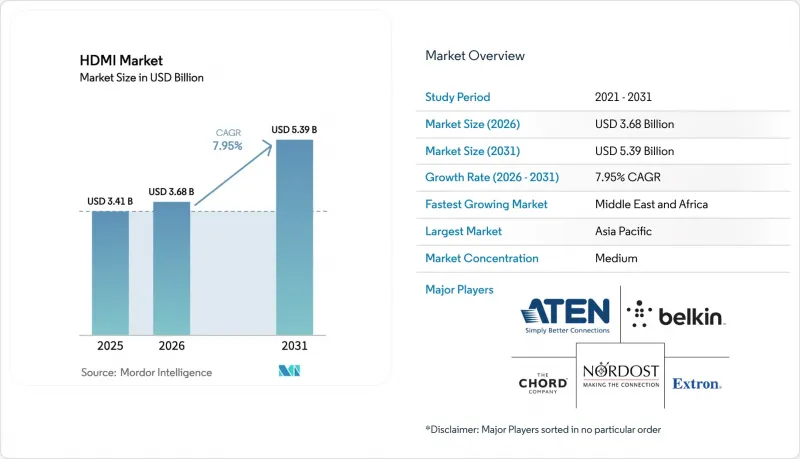
據 Mordor Intelligence 稱,2025 年 HDMI 市值為 34.1 億美元,預計到 2031 年將達到 53.9 億美元,而 2026 年為 36.8 億美元,預測期(2026-2031 年)的複合年成長率為 7.95%。
本報告按線纜類型(標準型、高速型等)、連接器類型(A型標準型、B型雙鏈路型等)、HDMI版本(1.4及更早版本等)、應用領域(電視和投影機等)、終端用戶行業(消費性電子OEM廠商等)、分銷通路(直接銷售給OEM廠商、零售和電廠)以及地區進行細分。市場預測以美元計價。
全球HDMI市場趨勢與洞察
隨著 8K 電視越來越受歡迎,對超高速 HDMI 2.1 線的需求也激增。
隨著顯示器製造商將介面數量從兩個增加到四個全頻寬介面,超高速線纜在普通零售通路中也越來越普及。聯發科的Pentonic 800系統晶片甚至使中階電視品牌也能支援四個HDMI 2.1輸入,從而消除了多設備連接方面的傳統瓶頸。據美國消費科技協會(CTA)稱,美國家庭4K電視普及率已超過50%,為向8K電視的更換週期奠定了基礎,這將推動對高階線纜的需求。海信宣布其2025年推出的機型將配備四個HDMI 2.1介面,這表明高階I/O功能正在向大眾市場滲透。
汽車製造商正在整合先進的資訊娛樂和ADAS互聯功能。
汽車製造商正在整合多種4K車載顯示器、手勢操作介面和擴增實境(AR)抬頭顯示器,每項都需要多Gigabit鏈路。耐環境的E型HDMI連接器符合汽車產業的振動和溫度標準,推動此介面的複合年成長率達到8.7%。雖然MIPI A-PHY具有更強的電磁干擾抑制能力,但廣泛的HDMI生態系統和向下相容性正在推動該聯盟致力於提升汽車應用的可靠性規格。
行動裝置和筆記型電腦中 USB-C Alt-Mode 的普及應用日益廣泛。
USB-C Alt-Mode 透過可正反插拔的連接器傳輸 4K影像,從而在更輕薄的設備中省去了單獨的 HDMI 介面。然而,由於它佔用了全部四條高速 USB 通道,因此無法同時進行多個 USB 資料傳輸,限制了其效能超越 HDMI 1.4 的擴展性。業內人士預測,它將與 HDMI 2.1 並存,而不是取代後者,尤其是在需要全頻寬HDMI 2.1 輸出的遊戲本和創作本中。
細分市場分析
到2025年,高速線將在HDMI市場保持40.65%的最大市場佔有率,為4K電視和遊戲機的大規模部署提供支援。同時,超高速線正以9.28%的複合年成長率成長,主要得益於8K60和4K144遊戲的需求。隨著OEM廠商探索無需擴大機即可實現超過10公尺傳輸距離的方法,混合主動光設計正進入量產階段,這預示著光纖密集型架構將迎來質的飛躍。
主動光技術的創新將傳輸容量提升至 48 Gbps 以上,同時降低了電磁干擾。這對於醫療影像實驗室和廣播骨幹網路至關重要。安費諾的 100 公尺 HDMI 2.0 主動光電纜 (AOC) 展示了其在長距離、零延遲傳輸方面的商業性可行性。隨著組件成本的降低,主動光技術可望逐步削弱銅纜的優勢,並擴大 HDMI 在企業和國防領域的應用範圍。
到2025年,A型介面將佔據HDMI市場75.92%的佔有率,反映出其在電視、機上盒、PC等設備中的近乎普及。汽車級E型介面採用密封結構,可防止振動和液體滲入,預計到2031年將保持最高的成長率,複合年成長率(CAGR)將達到8.32%,這主要得益於駕駛座數位化進程的加速。 Mini(C型)和Micro(D型)介面在運動攝影機和單板電腦中仍然很常見,但正面臨來自USB-C Alt-Mode整合帶來的競爭壓力。
汽車製造商要求連接器能夠經得起 125°C 的環境溫度和 1000 小時的週期性振動測試,而大多數消費級 HDMI 介面都無法滿足此要求。因此,能夠滿足 AEC-Q100 和 ISO 16750 測試要求的供應商擁有價格優勢,競爭格局也因此向在該領域擁有良好口碑的互連專家傾斜。此外,E 型介面的獨特特性降低了被替代的風險,鞏固了其在更廣泛的 HDMI 市場中作為具有巨大成長潛力的細分市場的地位。
區域分析
預計到2025年,亞太地區將佔全球銷售額的38.12%,這主要得益於中國的大規模製造業、日本先進的顯示器製造工廠以及韓國領先的電視品牌。儘管聯發科等區域半導體製造商正在加速採用HDMI介面,但本地標準化舉措正在探索下一代192Gbps介面,以避免依賴外國智慧財產權。一體化的供應鏈正在縮短開發週期並支持具有競爭力的價格,從而幫助亞洲保持在HDMI市場的領先地位。
在北美,高階家庭劇院、電競場館和汽車業的人均創新支出很高。這推高了48Gbps超高速線和專業矩陣切換器的平均售價。在歐洲,合規性至關重要,一項價值2.1億歐元的智慧教室影音解決方案採購計畫正式強制要求採用單線纜部署,從而確保對認證供應商的穩定需求。
在中東和非洲地區,智慧城市、飯店和教育計畫中超高清指示牌和遠距學習平台的應用預計到2031年將達到9.41%的複合年成長率。波灣合作理事會(GCC)的投資正在加速大型場館中顯示器的部署,而非洲通訊基礎設施的擴展則促進了機上盒的普及。在南美洲,以巴西為首,超高清標牌和遠距學習平台的應用正在穩步成長,儘管外匯波動有時會限制消費性電子產品的進口。
其他好處:
- Excel格式的市場預測(ME)表
- 3個月的分析師支持
目錄
第1章:引言
- 研究假設和市場定義
- 調查範圍
第2章:調查方法
第3章執行摘要
第4章 市場狀況
- 市場概覽
- 市場促進因素
- 在東亞,8K 電視的普及率正在迅速提高,推動了對超高速 HDMI 2.1 線的需求。
- 汽車製造商正在整合先進的資訊娛樂和ADAS系統,這些系統需要高頻寬的車載連接。
- 北美電子競技場館的成長推動了對專業級 HDMI 切換器和延長器的需求。
- 歐盟政府強制要求智慧教室採用單線纜音視訊基礎設施
- 南亞地區OTT機上盒的快速普及,對低成本HDMI轉接器的需求日益成長。
- 半導體技術的進步使得主動光纖HDMI線成為可能,從而實現了遠距離無損傳輸。
- 市場限制因素
- USB-C Alt-Mode 的日益普及正在威脅 HDMI 連接埠在行動裝置和筆記型電腦領域的主導地位。
- 銅和稀土元素材料供應鏈的波動推高了電纜的平均售價。
- 與 MIPI A-PHY 相比,汽車產業極端環境條件下的熱可靠性問題限制了 HDMI 的採用。
- HDMI 2.1 FRL 技術的智慧財產權授權費阻礙了中小型 OEM 製造商採用該技術。
- 產業生態系分析
- 技術展望
- 波特五力分析
第5章 市場規模與成長預測
- 按電纜類型
- 標準
- 高速
- 高速
- 超快
- 活動燈
- 依連接器類型
- A型(標準型)
- B型(雙連桿)
- C型(迷你)
- D型(微型)
- E型(汽車用)
- HDMI版本
- 1.4 及更早版本
- 2
- 2.1
- 透過使用
- 遊戲機
- 電視機和投影儀
- 智慧型手機和平板電腦
- 汽車資訊娛樂系統
- 個人電腦和筆記型電腦
- 數位電子看板和商用顯示器
- 其他用途
- 按最終用戶行業分類
- 消費性電子產品OEM製造商
- 汽車原始設備製造商和一級供應商
- 媒體及娛樂設施
- IT/通訊
- 衛生保健
- 工業及其他
- 透過分銷管道
- OEM 直銷
- 零售與電子商務
- 按地區
- 北美洲
- 美國
- 加拿大
- 墨西哥
- 歐洲
- 德國
- 英國
- 法國
- 北歐的
- 其他歐洲國家
- 南美洲
- 巴西
- 其他南美國家
- 亞太地區
- 中國
- 日本
- 印度
- 東南亞
- 其他亞太國家
- 中東和非洲
- 中東
- 波灣合作理事會(GCC)成員國
- 土耳其
- 其他中東國家
- 非洲
- 南非
- 其他非洲國家
- 中東
- 北美洲
第6章 競爭情勢
- 市場集中度
- 策略趨勢
- 市佔率分析
- 公司簡介
- Amphenol Corp.
- Aten International Co. Ltd.
- Belkin International Inc.
- CE-Link Ltd.
- Cheng Uei Precision(Foxlink)
- Extron Electronics
- Foxconn Interconnect Technology
- Eaton Corp. plc
- Honeywell Connection(Honeywell Intl.)
- Kramer Electronics
- Koninklijke Philips NV
- Nordost Cables
- PureFi Inc.
- Shenzhen DNS Industries Co. Ltd.
- The Chord Company
- Sony Group Corp.
- Luxshare ICT
- Molex LLC
- Legrand AV
- Bizlink Tech.
- Wireworld Cable Tech.
第7章 市場機會與未來展望
According to Mordor Intelligence, the HDMI market size was valued at USD 3.41 billion in 2025 and estimated to grow from USD 3.68 billion in 2026 to reach USD 5.39 billion by 2031, at a CAGR of 7.95% during the forecast period (2026-2031).
This report is Segmented by Cable Type (Standard, High-Speed, and More), Connector Type (Type A Standard, Type B Dual-Link, and More), HDMI Version (1. 4 and Earlier, and More), Application (Televisions and Projectors, and More), End-User Industry (Consumer Electronics OEMs, and More), Distribution Channel (OEM Direct, and Retail and E-Commerce), and Geography. The Market Forecasts are Provided in Terms of Value (USD).
Global HDMI Market Trends and Insights
Surge in 8K television adoption requiring Ultra High-Speed HDMI 2.1 cables
Ultra High-Speed cabling is moving into mainstream retail channels as display makers upgrade port counts from two to four full-bandwidth interfaces. MediaTek's Pentonic 800 system-on-chip allows mid-tier TV brands to support four HDMI 2.1 inputs, eliminating prior multi-device bottlenecks. The Consumer Technology Association confirms that 4K sets now exceed 50% penetration in US households, laying the groundwork for an 8K replacement cycle that will reinforce premium cable demand. Hisense has committed to ship 2025 models with four HDMI 2.1 ports, underscoring how high-end I/O is cascading into mass-market segments.
Automakers integrating advanced infotainment and ADAS connectivity
Automotive OEMs are embedding multiple 4K interior displays, gesture interfaces and augmented-reality head-up units that each require multi-gigabit links. Type E ruggedized HDMI connectors meet automotive vibration and temperature standards, propelling an 8.7% CAGR for this form-factor. While MIPI A-PHY offers stronger EMI immunity, HDMI's broad ecosystem and backward compatibility motivate consortium initiatives to tighten reliability specs for in-vehicle deployments.
Rising adoption of USB-C Alt-Mode in mobile & laptop segments
USB-C Alt-Mode transports 4K video over a reversible connector, permitting thinner devices to drop a discrete HDMI jack. Yet it commandeers all four high-speed lanes, precluding simultaneous USB data throughput and capping scalability beyond HDMI 1.4 performance levels. Industry observers expect coexistence rather than replacement, particularly in gaming laptops and creator notebooks that need full-bandwidth HDMI 2.1 outputs.
Other drivers and restraints analyzed in the detailed report include:
- Expansion of e-sports arenas demanding low-latency switchers
- EU mandates for single-cable smart-classroom AV infrastructure
- Copper and rare-earth volatility elevating average selling prices
For complete list of drivers and restraints, kindly check the Table Of Contents.
Segment Analysis
High-Speed cables retained the largest 40.65% share of the HDMI market in 2025, underpinning a sizeable installed base of 4K televisions and consoles. Ultra High-Speed, however, leads growth at a 9.28% CAGR, propelled by 8K60 and 4K144 gaming requirements. Hybrid active-optical designs are entering volume as OEMs seek to exceed 10 m runs without amplifiers, signalling a qualitative shift toward fiber-rich architectures.
Active optical innovation elevates carrying capacity to 48 Gbps and beyond while mitigating electromagnetic interference, essential in medical imaging theatres and broadcast back-bones. Amphenol's 100 m HDMI 2.0 AOC validates the commercial case for long-distance, zero-latency transport. As component costs fall, active optical is expected to erode copper's dominance and broaden the addressable HDMI market across enterprise and defense installations.
Type A connectors accounted for 75.92% of the HDMI market size in 2025, reflecting near-universal integration across TVs, set-top boxes and PCs. Automotive-grade Type E variants, sealed against vibration and fluid ingress, are forecast to record the fastest 8.32% CAGR through 2031 as cockpit digitization accelerates. Mini (Type C) and Micro (Type D) footprints remain common in action cameras and single-board computers but confront pressure from USB-C Alt-Mode convergence.
Vehicle OEMs demand connectors validated to 125 °C ambient and 1,000 h cyclic vibration, hurdles that most consumer-grade HDMI sockets cannot meet. Suppliers capable of meeting AEC-Q100 and ISO 16750 test regimens therefore command pricing premiums, tilting competitive balance toward entrenched interconnect specialists. The specialized nature of Type E also reduces substitution risk, underpinning a defensible growth niche within the broader HDMI market.
Complete Report Scope:
- By Cable Type
- Standard
- High-Speed
- Premium High-Speed
- Ultra High-Speed
- Active Optical
- By Connector Type
- Type A (Standard)
- Type B (Dual-link)
- Type C (Mini)
- Type D (Micro)
- Type E (Automotive)
- By HDMI Version
- 1.4 and Earlier
- 2
- 2.1
- By Application
- Gaming Consoles
- Televisions and Projectors
- Smartphones and Tablets
- Automotive Infotainment Systems
- PCs and Laptops
- Digital Signage and Commercial Displays
- Other Applications
- By End-user Industry
- Consumer Electronics OEMs
- Automotive OEMs and Tier-1s
- Media and Entertainment Venues
- IT and Telecom
- Healthcare
- Industrial and Others
- By Distribution Channel
- OEM Direct
- Retail and E-commerce
- By Geography
- North America
- United States
- Canada
- Mexico
- Europe
- Germany
- United Kingdom
- France
- Nordics
- Rest of Europe
- South America
- Brazil
- Rest of South America
- Asia-Pacific
- China
- Japan
- India
- South-East Asia
- Rest of Asia-Pacific
- Middle East and Africa
- Middle East
- Gulf Cooperation Council Countries
- Turkey
- Rest of Middle East
- Africa
- South Africa
- Rest of Africa
- Middle East
- North America
Geography Analysis
Asia-Pacific contributed 38.12% of global revenue in 2025 on the back of China's scale manufacturing, Japan's advanced display fabs and South Korea's leading TV brands. Regional chip houses such as MediaTek accelerate HDMI port proliferation, while local standards initiatives explore next-generation 192 Gbps interfaces to hedge against foreign IP reliance. Integrated supply chains compress development cycles and underpin competitive pricing, helping Asia maintain leadership in the HDMI market.
North America exhibits high per-capita spending on premium home theater, e-sports arenas and automotive innovation. This translates into above-average ASPs for 48 Gbps Ultra High-Speed cables and professional-grade matrix switchers. Europe prioritizes regulatory compliance; a EUR 210 million procurement for smart-classroom AV solutions formalizes single-cable mandates, ensuring predictable demand for certified vendors.
The Middle East & Africa is projected to chart a 9.41% CAGR through 2031 as smart-city, hospitality and education projects roll out UHD signage and distance-learning platforms. Gulf Cooperation Council investments catalyze large-venue display deployments, while African telecoms expansion stimulates set-top uptake. South America shows steady uptake led by Brazil, although currency volatility occasionally tempers consumer electronics imports.
- Amphenol Corp.
- Aten International Co. Ltd.
- Belkin International Inc.
- CE-Link Ltd.
- Cheng Uei Precision (Foxlink)
- Extron Electronics
- Foxconn Interconnect Technology
- Eaton Corp. plc
- Honeywell Connection (Honeywell Intl.)
- Kramer Electronics
- Koninklijke Philips N.V.
- Nordost Cables
- PureFi Inc.
- Shenzhen DNS Industries Co. Ltd.
- The Chord Company
- Sony Group Corp.
- Luxshare ICT
- Molex LLC
- Legrand AV
- Bizlink Tech.
- Wireworld Cable Tech.
Additional Benefits:
- The market estimate (ME) sheet in Excel format
- 3 months of analyst support
TABLE OF CONTENTS
1 INTRODUCTION
- 1.1 Study Assumptions and Market Definition
- 1.2 Scope of the Study
2 RESEARCH METHODOLOGY
3 EXECUTIVE SUMMARY
4 MARKET LANDSCAPE
- 4.1 Market Overview
- 4.2 Market Drivers
- 4.2.1 Surge in 8K Television Adoption Driving Demand for Ultra-High-Speed HDMI 2.1 Cables in East Asia
- 4.2.2 Automakers' Integration of Advanced Infotainment and ADAS Systems Requiring High-Bandwidth In-vehicle Connectivity
- 4.2.3 Proliferation of eSports Arenas in North America Boosting Professional-grade HDMI Switchers and Extenders
- 4.2.4 Government Mandates in EU for Single-Cable AV Infrastructure in Smart Classrooms
- 4.2.5 Rapid Growth of OTT Set-Top Boxes in South Asia Necessitating Low-cost HDMI Dongles
- 4.2.6 Semiconductor Advancements Enabling Active Optical HDMI Cables for Long-Distance Loss-less Transmission
- 4.3 Market Restraints
- 4.3.1 Rising Adoption of USB-C Alt-Mode Threatening HDMI Ports in Mobile and Laptop Segments
- 4.3.2 Supply-chain Volatility for Copper and Rare-earth Materials Elevating Cable ASPs
- 4.3.3 Thermal Reliability Issues in Automotive Extremes Limiting HDMI Penetration vs MIPI A-PHY
- 4.3.4 IP Royalty Costs for HDMI 2.1 FRL Technology Constraining Small OEM Adoption
- 4.4 Industry Ecosystem Analysis
- 4.5 Technological Outlook
- 4.6 Porter's Five Forces Analysis
- 4.6.1 Bargaining Power of Suppliers
- 4.6.2 Bargaining Power of Consumers
- 4.6.3 Threat of New Entrants
- 4.6.4 Threat of Substitutes
- 4.6.5 Intensity of Competitive Rivalry
5 MARKET SIZE AND GROWTH FORECASTS (VALUES)
- 5.1 By Cable Type
- 5.1.1 Standard
- 5.1.2 High-Speed
- 5.1.3 Premium High-Speed
- 5.1.4 Ultra High-Speed
- 5.1.5 Active Optical
- 5.2 By Connector Type
- 5.2.1 Type A (Standard)
- 5.2.2 Type B (Dual-link)
- 5.2.3 Type C (Mini)
- 5.2.4 Type D (Micro)
- 5.2.5 Type E (Automotive)
- 5.3 By HDMI Version
- 5.3.1 1.4 and Earlier
- 5.3.2 2
- 5.3.3 2.1
- 5.4 By Application
- 5.4.1 Gaming Consoles
- 5.4.2 Televisions and Projectors
- 5.4.3 Smartphones and Tablets
- 5.4.4 Automotive Infotainment Systems
- 5.4.5 PCs and Laptops
- 5.4.6 Digital Signage and Commercial Displays
- 5.4.7 Other Applications
- 5.5 By End-user Industry
- 5.5.1 Consumer Electronics OEMs
- 5.5.2 Automotive OEMs and Tier-1s
- 5.5.3 Media and Entertainment Venues
- 5.5.4 IT and Telecom
- 5.5.5 Healthcare
- 5.5.6 Industrial and Others
- 5.6 By Distribution Channel
- 5.6.1 OEM Direct
- 5.6.2 Retail and E-commerce
- 5.7 By Geography
- 5.7.1 North America
- 5.7.1.1 United States
- 5.7.1.2 Canada
- 5.7.1.3 Mexico
- 5.7.2 Europe
- 5.7.2.1 Germany
- 5.7.2.2 United Kingdom
- 5.7.2.3 France
- 5.7.2.4 Nordics
- 5.7.2.5 Rest of Europe
- 5.7.3 South America
- 5.7.3.1 Brazil
- 5.7.3.2 Rest of South America
- 5.7.4 Asia-Pacific
- 5.7.4.1 China
- 5.7.4.2 Japan
- 5.7.4.3 India
- 5.7.4.4 South-East Asia
- 5.7.4.5 Rest of Asia-Pacific
- 5.7.5 Middle East and Africa
- 5.7.5.1 Middle East
- 5.7.5.1.1 Gulf Cooperation Council Countries
- 5.7.5.1.2 Turkey
- 5.7.5.1.3 Rest of Middle East
- 5.7.5.2 Africa
- 5.7.5.2.1 South Africa
- 5.7.5.2.2 Rest of Africa
- 5.7.5.1 Middle East
- 5.7.1 North America
6 COMPETITIVE LANDSCAPE
- 6.1 Market Concentration
- 6.2 Strategic Moves
- 6.3 Market Share Analysis
- 6.4 Company Profiles (includes Global level Overview, Market level overview, Core Segments, Financials as available, Strategic Information, Market Rank/Share, Products and Services, Recent Developments)
- 6.4.1 Amphenol Corp.
- 6.4.2 Aten International Co. Ltd.
- 6.4.3 Belkin International Inc.
- 6.4.4 CE-Link Ltd.
- 6.4.5 Cheng Uei Precision (Foxlink)
- 6.4.6 Extron Electronics
- 6.4.7 Foxconn Interconnect Technology
- 6.4.8 Eaton Corp. plc
- 6.4.9 Honeywell Connection (Honeywell Intl.)
- 6.4.10 Kramer Electronics
- 6.4.11 Koninklijke Philips N.V.
- 6.4.12 Nordost Cables
- 6.4.13 PureFi Inc.
- 6.4.14 Shenzhen DNS Industries Co. Ltd.
- 6.4.15 The Chord Company
- 6.4.16 Sony Group Corp.
- 6.4.17 Luxshare ICT
- 6.4.18 Molex LLC
- 6.4.19 Legrand AV
- 6.4.20 Bizlink Tech.
- 6.4.21 Wireworld Cable Tech.
7 MARKET OPPORTUNITIES AND FUTURE OUTLOOK
- 7.1 White-space and Unmet-need Assessment


