


 |
市場調查報告書
商品編碼
2100030
醫藥電商:市場佔有率分析、產業趨勢與統計、成長預測(2026-2031)Pharmaceutical E-commerce - Market Share Analysis, Industry Trends & Statistics, Growth Forecasts (2026 - 2031) |
||||||

※ 本網頁內容可能與最新版本有所差異。詳細情況請與我們聯繫。
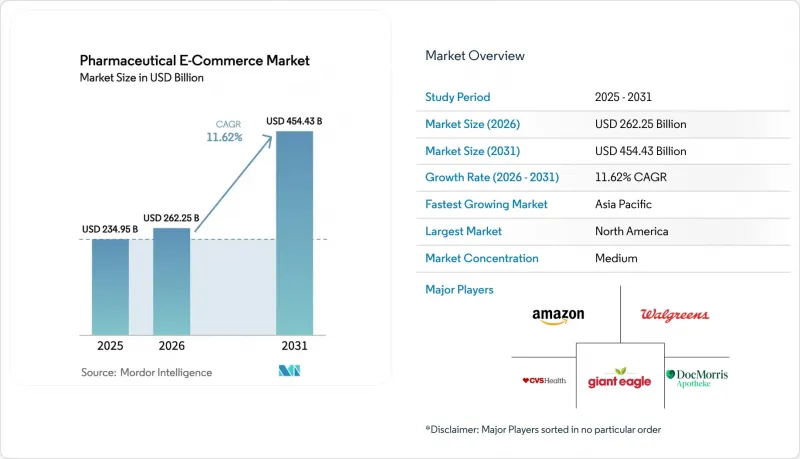
根據 Mordor Intelligence 估計,到 2026 年,醫藥電子商務市場規模將達到 2,622.5 億美元,高於 2025 年的 2,349.5 億美元,預計到 2031 年將達到 4,544.3 億美元。
預計從 2026 年到 2031 年,其複合年成長率將達到 11.62%。
本報告按類型(處方藥和非處方藥)、產品類型(疫苗等)、治療領域(糖尿病等)、市場類型(B2B、B2B2B、B2B2C、B2C)、平台(廠商營運的電器平台等)和地區(北美、歐洲、亞太、中東和非洲、南美)進行細分。市場預測以美元計價。
全球醫藥電商市場趨勢及洞察
數位醫療基礎設施的快速擴張
如今,數位醫療基礎設施即時整合了電子健康記錄、付款閘道和雲端庫存管理系統,從而簡化了處方箋檢驗和配藥流程。亞馬遜計劃在2025年開設20家新的店內藥房,屆時美國45%的家庭將享受到當日送達服務,這表明對基礎設施的投資能夠迅速擴大市場進入。 UPS Healthcare等全球物流供應商正在220個國家擴展符合GDP/GMP標準的低溫運輸能力,簡化了對溫度敏感的生技藥品的跨境運輸。互聯互通的改善減少了配藥錯誤,縮短了前置作業時間,並將專科藥物的覆蓋範圍擴大到以前依賴不規則配送的偏遠地區。因此,一個生態系統正在形成,領先建立的供應鏈效率難以被後進企業複製。
遠端醫療和電子處方箋服務的普及
遠端醫療平台透過將電子處方箋直接傳輸給合作的線上藥房,彌合了諮詢和配藥之間的鴻溝。美國緝毒局 (DEA) 修訂後的法規允許在特殊註冊框架下透過遠端醫療開立管制藥品處方,這消除了數位化配藥的一大障礙。禮來公司的「LillyDirect」將線上諮詢與透過亞馬遜藥房配送糖尿病、肥胖症和偏頭痛藥物的家庭服務相結合,提供統一的就診體驗,從而提高患者的用藥依從性並減少門診就診次數。在醫療專業人員長期短缺的農村地區,遠端醫療與線上藥局的合作消除了諮詢延誤,確保及時啟動治療。這種綜效還能最大限度地減少因停藥導致的急診就診,進而降低保險公司的成本。
嚴格且分散的法律規範
當州、聯邦和超國家層級的法規以不同的速度變化時,合規性問題就變得更加複雜。 2024年11月,美國食品藥物管理局(FDA)結束了旨在加強藥品分銷安全性的穩定期,強制要求所有大型藥局實施端到端可追溯性標準,而小規模藥局則可豁免至2026年底。同時,歐盟實施了20年來首次對藥品法的全面修訂,引入了新的數位化配藥要求,這對在多個成員國運營的平台構成了挑戰。這些監管差異推高了法律成本,減緩了跨國擴張,並使那些擁有足夠財力承擔文件編制、審計和序列化成本的企業更具優勢。
細分市場分析
到2025年,處方藥將佔醫藥電商市場佔有率的67.62%,這反映了與醫生核准掛鉤的完善的臨床監管和報銷機制。同時,非處方藥(OTC)的年複合成長率(CAGR)預計到2031年將達到14.12%,顯示消費者傾向於在不就醫的情況下自行治療常見疾病。美國食品藥物管理局(FDA)將於2025年1月生效的最終版「非處方藥使用附加條件(ACNU)」規則,將為數位化自助選擇工具鋪平道路,這些工具可能會將某些慢性病藥物重新歸類為非處方藥,從而加速向非處方藥的轉變。
根據該領域的展望,隨著消費者在購買前擴大諮詢應用程式,能夠將決策支援演算法整合到產品頁面的平台運營商有望推動成長。與非處方維生素、抗過敏藥物和止痛藥相關的定期訂閱服務將進一步豐富收入來源,並抵消季節性銷售下滑的影響。同時,在保險公司要求事先核准的領域,處方藥仍然佔據主導地位,但遠距醫療正透過從遠端醫療諮詢轉向即時電子處方,減少流程上的摩擦。這種融合模糊了不同品類之間的界限,使醫藥電商市場不再是兩個孤立的細分市場,而是一個整體。
到2025年,非處方藥(OTC)將佔藥品銷售額的43.71%,其中包括降血壓藥和抗生素等高銷售量類別。雖然疫苗的基數較低,但在mRNA技術創新和成人免疫接種工作不斷擴大的推動下,預計將以15.32%的複合年成長率成長。研究團隊已成功展示了一種能夠生產耐熱COVID-19 mRNA疫苗的微針印表機,預計將減少對低溫運輸的依賴,並擴大郵購配送範圍。
隨著全球疫苗接種計劃中帶狀皰疹、HPV 和肺炎球菌疫苗的補種計劃不斷擴大,提供預約上門或居家接種服務的在線藥房正逐漸獲得優勢。專業的低溫運輸配送公司不斷改進其逐箱溫度追蹤系統,該系統能夠將溫度維持在 2-8°C 長達 35 小時,這一突破性進展顯著延長了配送時間。雖然非處方藥仍然是重要的收入來源,但平台品牌推廣越來越強調疫苗接種的便利性,從而在季節性流感疫苗接種宣傳活動期間吸引更多用戶。
區域分析
預計到2025年,北美將佔全球銷售額的39.71%,這得益於高寬頻普及率、廣泛的強制性電子處方箋以及消費者對宅配服務的熟悉程度。亞馬遜即將開設的20家實體藥局以及沃爾瑪在49個州提供的當日處方配送服務,凸顯了現有物流網路如何助力製藥業的壟斷地位。以美國緝毒局(DEA)對遠端醫療。然而,產業整合的壓力依然存在。沃爾格林計劃斥資237億美元進行槓桿收購,旨在加速其數位業務的重組,使其擺脫公開市場的監管。
亞太地區是成長最快的市場,預計到2031年將以13.12%的複合年成長率成長。中國已取消對線上處方藥銷售的試點限制,印度正在擴展其統一支付介面(UPI)以促進安全的衛生署舉措正在推動電子醫療的大規模應用,預計這將帶動鄰近的波灣合作理事會(GCC)成員國對線上藥局的需求。
在歐洲,由於消費者對註冊線上藥局通用識別的信任度不斷提高,醫藥電商市場保持穩定的中等個位數成長。然而,各國在低溫運輸運輸和廣告方面的監管差異仍是限制成長的因素。在南美洲和非洲部分地區,早期商業機會依然可見。巴西的電商友善支付創新和奈及利亞的末端物流新創公司提供了成功的模式,但基礎設施和監管方面的挑戰仍然存在。總而言之,這些趨勢表明,醫藥電商市場正以不同的速度在不同地區發展,因此需要製定符合區域需求的合規措施和服務模式。
其他好處:
- Excel格式的市場預測(ME)表
- 3個月的分析師支持
目錄
第1章:引言
- 研究假設和市場定義
- 調查範圍
第2章:調查方法
第3章執行摘要
第4章 市場狀況
- 市場概覽
- 市場促進因素
- 數位醫療基礎設施的快速擴張
- 遠端醫療和電子處方箋服務的普及
- 消費者對便利性宅配服務的偏好日益成長
- 慢性病負擔加重和人口老化
- 政府促進網路藥品銷售的舉措
- 創業投資支持電子藥局平台
- 市場限制因素
- 嚴格且分散的法律規範
- 假冒偽劣藥品的蔓延
- 缺乏溫控藥品低溫運輸物流能力。
- 老年人和農村居民的數位素養差距
- 監理情勢
- 波特五力分析
第5章 市場規模與成長預測
- 按類型
- 處方
- 非處方藥(OTC)
- 依產品類型
- 疫苗
- 專科護理
- 非處方藥
- 舒默醫療保健
- 按治療區域
- 糖尿病
- 免疫系統疾病
- 癌症
- 神經退化性疾病
- 心血管疾病
- 其他治療領域
- 依市場類型
- B2B
- B2B2B
- B2B2C
- B2C
- 按平台
- 製造商營運的數位商務
- 由經銷商/批發商擁有的數位商務
- 製造商直銷市場
- 第三方市場
- 零售
- 地區
- 北美洲
- 美國
- 加拿大
- 墨西哥
- 歐洲
- 德國
- 英國
- 法國
- 義大利
- 西班牙
- 其他歐洲國家
- 亞太地區
- 中國
- 日本
- 印度
- 澳洲
- 韓國
- 其他亞太國家
- 中東和非洲
- GCC
- 南非
- 其他中東和非洲國家
- 南美洲
- 巴西
- 阿根廷
- 其他南美國家
- 北美洲
第6章 競爭情勢
- 市場集中度
- 市佔率分析
- 公司簡介
- Amazon Pharmacy
- DocMorris(Zur Rose Group)
- CVS Health
- Walgreens Boots Alliance
- Express Scripts
- Rite Aid
- Giant Eagle, Inc
- OptumRx
- NetMeds
- Tata 1mg
- PharmEasy
- Apollo Pharmacy
- Alibaba Health
- JD Health
- Chemist Warehouse
- E-MedStore
- Shop-Apotheke
- Apoteket
- Clicks Group
- Flipkart Health+
第7章 市場機會與未來展望
According to Mordor Intelligence, pharmaceutical e-commerce market size in 2026 is estimated at USD 262.25 billion, growing from 2025 value of USD 234.95 billion with 2031 projections showing USD 454.43 billion, growing at 11.62% CAGR over 2026-2031.
This report is Segmented by Type (Prescription and Over-The-Counter), Product Type (Vaccines, and More), Therapeutic Area (Diabetes, and More), Market Type (B2B, B2B2B, B2B2C, and B2C), Platform (Manufacturer-Owned Digital Commerce, and More), and Geography (North America, Europe, Asia-Pacific, Middle East & Africa, South America). The Market Forecasts are Provided in Terms of Value (USD).
Global Pharmaceutical E-commerce Market Trends and Insights
Rapid Expansion of Digital Health Infrastructure
Digital health infrastructure now links electronic medical records, payment gateways, and cloud-based inventory systems in real time, enabling frictionless prescription validation and fulfillment. Amazon's plan to open 20 additional on-site pharmacies in 2025 will extend same-day delivery to 45% of U.S. households, demonstrating how infrastructure spending quickly scales market access. Global logistics providers such as UPS Healthcare have added GDP/GMP-compliant cold-chain capacity across 220 countries, simplifying cross-border shipments of temperature-sensitive biologics. Improved connectivity cuts dispensing errors, reduces lead times, and expands specialty drug coverage to rural zones that previously relied on infrequent deliveries. The net result is an ecosystem where early movers lock in supply-chain efficiencies that are difficult for late entrants to replicate.
Rising Adoption of Telemedicine and E-Prescription Services
Telemedicine platforms eliminate the gap between consultation and dispensing by routing e-prescriptions directly to partnered online pharmacies. Updated DEA regulations now permit controlled-substance prescribing via telehealth under a Special Registration framework, removing a major barrier to digital fulfilment. Eli Lilly's LillyDirect integrates virtual visits with direct-to-home shipment of diabetes, obesity, and migraine drugs through Amazon Pharmacy, offering a unified experience that boosts adherence and reduces travel time. In rural areas where clinician shortages persist, telemedicine-e-pharmacy linkages reduce clinical inertia and ensure timely therapy initiation. This synergy also lowers payer costs by minimizing emergency visits tied to medication lapses.
Stringent and Fragmented Regulatory Frameworks
Compliance complexity rises when state, federal, and supranational rules evolve at different speeds. The FDA ended its stabilization period for enhanced drug-distribution security in November 2024, compelling all large pharmacies to meet end-to-end traceability standards, while small outlets remain exempt until late 2026. Simultaneously, the European Union's first sweeping pharmaceutical-legislation overhaul in two decades introduces new digital-dispensing requirements, challenging platforms that operate across multiple member states. Such divergence inflates legal costs and slows cross-border scaling, favoring well-capitalized players that can absorb documentation, auditing, and serialization expenses.
Other drivers and restraints analyzed in the detailed report include:
- Growing Consumer Preference for Convenient Home Delivery
- Increasing Burden of Chronic Diseases and Aging Population
- Prevalence of Counterfeit and Substandard Medicines Online
For complete list of drivers and restraints, kindly check the Table Of Contents.
Segment Analysis
Prescription drugs held 67.62% of Pharmaceutical E-commerce Market share in 2025, reflecting entrenched clinical oversight and reimbursement pathways tied to physician authorization. Over-the-counter items, however, expand at a 14.12% CAGR through 2031, signaling consumer willingness to self-treat common ailments without clinician visits. The FDA's Additional Conditions for Nonprescription Use (ACNU) Final Rule, effective January 2025, creates a pathway for digital self-selection tools that could reclassify select chronic-disease therapies as nonprescription, accelerating OTC substitution.
The segment outlook suggests that platform operators able to layer decision-support algorithms on product pages will capture growth as consumers consult apps before checkout. Subscription refills tied to OTC vitamins, allergy treatments, and pain relievers further diversify revenue and offset seasonal revenue dips. Meanwhile, prescription dominance persists where insurance mandates prior authorization, yet telehealth reduces friction by converting video consultations into instant electronic prescribing. The resulting convergence blurs categorical lines, reinforcing the Pharmaceutical E-commerce Market as a single continuum rather than two siloed segments.
General medicines contributed 43.71% of revenue in 2025, encompassing high-volume categories such as antihypertensives and antibiotics. Vaccines, though lower in base revenue, are set to climb at a 15.32% CAGR, driven by mRNA innovation and expanded adult-immunization initiatives. Lab teams have demonstrated microneedle printers capable of producing thermostable COVID-19 mRNA doses, potentially reducing cold-chain dependence and unlocking wider postal delivery.
As national immunization programs widen catch-up schedules for shingles, HPV, and pneumococcal shots, online pharmacies that integrate appointment booking with doorstep delivery or in-home administration gain an edge. Specialty cold-chain couriers continue to refine box-level temperature trackers that maintain 2-8 °C for 35 hours, a milestone that broadens viable shipping windows. General medicines remain the revenue anchor, but platform branding increasingly highlights immunization convenience, enhancing user acquisition during seasonal flu campaigns.
Complete Report Scope:
- By Type
- Prescription
- Over-The-Counter (OTC)
- By Product Type
- Vaccines
- Specialty Care
- General Medicines
- Consumer Healthcare
- By Therapeutic Area
- Diabetes
- Immune-System Diseases
- Cancer
- Neurodegenerative Diseases
- Cardiovascular Diseases
- Other Therapeutic Areas
- By Market Type
- B2B
- B2B2B
- B2B2C
- B2C
- By Platform
- Manufacturer-Owned Digital Commerce
- Distributor/Wholesaler-Owned Digital Commerce
- Manufacturer-Owned Marketplace
- Third-Party Marketplace
- Retail
- Geography
- North America
- United States
- Canada
- Mexico
- Europe
- Germany
- United Kingdom
- France
- Italy
- Spain
- Rest of Europe
- Asia-Pacific
- China
- Japan
- India
- Australia
- South Korea
- Rest of Asia-Pacific
- Middle East & Africa
- GCC
- South Africa
- Rest of Middle East & Africa
- South America
- Brazil
- Argentina
- Rest of South America
- North America
Geography Analysis
North America held 39.71% of global revenue in 2025, benefiting from mature broadband penetration, widespread e-prescription mandates, and consumer familiarity with doorstep delivery. Amazon's forthcoming 20 brick-and-mortar pharmacies and Walmart's same-day Rx coverage across 49 states highlight how existing logistics grids translate into pharma dominance. Policy harmonization-illustrated by the DEA's Special Registration for telehealth prescribing-further reduces friction for cross-state dispensing. Yet consolidation pressures remain: Walgreens' pending USD 23.7 billion leveraged buy-out aims to accelerate digital rebuilding outside public market scrutiny.
Asia-Pacific is the fastest-growing territory, forecast at a 13.12% CAGR through 2031. China lifted pilot restrictions on online prescription drug sales, India expanded its Unified Payments Interface to facilitate secure health-service payments, and Japan is legalizing most OTC e-sales by 2025, establishing fertile regulatory soil. Rising middle-class income and mobile-first habits speed adoption. Health-ministry drives in Saudi Arabia and the UAE back large-scale e-health implementations, suggesting spill-over demand for e-pharmacy in neighboring Gulf Cooperation Council states.
Europe maintains steady, mid-single-digit momentum as the common logo for registered online pharmacies improves consumer confidence. National rules still diverge on cold-chain shipping and advertising, however, moderating upside. South America and parts of Africa present earlier-stage opportunities; Brazil's e-commerce-friendly payment innovations and Nigeria's last-mile logistics start-ups offer templates but infrastructure and regulatory gaps persist. Collectively, these trends ensure the Pharmaceutical E-commerce Market evolves at different speeds, requiring region-specific compliance and service models.
- Amazon Pharmacy
- DocMorris (Zur Rose Group)
- CVS Health
- Walgreens Boots Alliance
- Express Scripts
- Rite Aid
- Giant Eagle, Inc
- OptumRx
- NetMeds
- Tata 1mg
- PharmEasy
- Apollo Pharmacy
- Alibaba Health
- JD Health
- Chemist Warehouse
- E-MedStore
- Shop-Apotheke
- Apoteket
- Clicks Group
- Flipkart Health+
Additional Benefits:
- The market estimate (ME) sheet in Excel format
- 3 months of analyst support
TABLE OF CONTENTS
1 Introduction
- 1.1 Study Assumptions & Market Definition
- 1.2 Scope of the Study
2 Research Methodology
3 Executive Summary
4 Market Landscape
- 4.1 Market Overview
- 4.2 Market Drivers
- 4.2.1 Rapid Expansion of Digital Health Infrastructure
- 4.2.2 Rising Adoption of Telemedicine and E-Prescription Services
- 4.2.3 Growing Consumer Preference for Convenient Home Delivery
- 4.2.4 Increasing Burden of Chronic Diseases and Aging Population
- 4.2.5 Government Initiatives Promoting Online Pharmaceutical Sales
- 4.2.6 Venture Capital Investment Fueling E-Pharmacy Platforms
- 4.3 Market Restraints
- 4.3.1 Stringent and Fragmented Regulatory Frameworks
- 4.3.2 Prevalence of Counterfeit and Substandard Medicines Online
- 4.3.3 Limited Cold-Chain Logistics Capability for Temperature-Sensitive Drugs
- 4.3.4 Digital Literacy Gaps Among Elderly and Rural Populations
- 4.4 Regulatory Landscape
- 4.5 Porter's Five Forces Analysis
- 4.5.1 Threat Of New Entrants
- 4.5.2 Bargaining Power Of Buyers
- 4.5.3 Bargaining Power Of Suppliers
- 4.5.4 Threat Of Substitutes
- 4.5.5 Intensity Of Competitive Rivalry
5 Market Size & Growth Forecasts (Value, USD)
- 5.1 By Type
- 5.1.1 Prescription
- 5.1.2 Over-The-Counter (OTC)
- 5.2 By Product Type
- 5.2.1 Vaccines
- 5.2.2 Specialty Care
- 5.2.3 General Medicines
- 5.2.4 Consumer Healthcare
- 5.3 By Therapeutic Area
- 5.3.1 Diabetes
- 5.3.2 Immune-System Diseases
- 5.3.3 Cancer
- 5.3.4 Neurodegenerative Diseases
- 5.3.5 Cardiovascular Diseases
- 5.3.6 Other Therapeutic Areas
- 5.4 By Market Type
- 5.4.1 B2B
- 5.4.2 B2B2B
- 5.4.3 B2B2C
- 5.4.4 B2C
- 5.5 By Platform
- 5.5.1 Manufacturer-Owned Digital Commerce
- 5.5.2 Distributor/Wholesaler-Owned Digital Commerce
- 5.5.3 Manufacturer-Owned Marketplace
- 5.5.4 Third-Party Marketplace
- 5.5.5 Retail
- 5.6 Geography
- 5.6.1 North America
- 5.6.1.1 United States
- 5.6.1.2 Canada
- 5.6.1.3 Mexico
- 5.6.2 Europe
- 5.6.2.1 Germany
- 5.6.2.2 United Kingdom
- 5.6.2.3 France
- 5.6.2.4 Italy
- 5.6.2.5 Spain
- 5.6.2.6 Rest of Europe
- 5.6.3 Asia-Pacific
- 5.6.3.1 China
- 5.6.3.2 Japan
- 5.6.3.3 India
- 5.6.3.4 Australia
- 5.6.3.5 South Korea
- 5.6.3.6 Rest of Asia-Pacific
- 5.6.4 Middle East & Africa
- 5.6.4.1 GCC
- 5.6.4.2 South Africa
- 5.6.4.3 Rest of Middle East & Africa
- 5.6.5 South America
- 5.6.5.1 Brazil
- 5.6.5.2 Argentina
- 5.6.5.3 Rest of South America
- 5.6.1 North America
6 Competitive Landscape
- 6.1 Market Concentration
- 6.2 Market Share Analysis
- 6.3 Company Profiles (includes Global level Overview, Market level overview, Core Business Segments, Financials, Headcount, Key Information, Market Rank, Market Share, Products and Services, and analysis of Recent Developments)
- 6.3.1 Amazon Pharmacy
- 6.3.2 DocMorris (Zur Rose Group)
- 6.3.3 CVS Health
- 6.3.4 Walgreens Boots Alliance
- 6.3.5 Express Scripts
- 6.3.6 Rite Aid
- 6.3.7 Giant Eagle, Inc
- 6.3.8 OptumRx
- 6.3.9 NetMeds
- 6.3.10 Tata 1mg
- 6.3.11 PharmEasy
- 6.3.12 Apollo Pharmacy
- 6.3.13 Alibaba Health
- 6.3.14 JD Health
- 6.3.15 Chemist Warehouse
- 6.3.16 E-MedStore
- 6.3.17 Shop-Apotheke
- 6.3.18 Apoteket
- 6.3.19 Clicks Group
- 6.3.20 Flipkart Health+
7 Market Opportunities & Future Outlook
- 7.1 White-Space & Unmet-Need Assessment

