

 |
市場調查報告書
商品編碼
2099995
燒結鋼:市場佔有率分析、產業趨勢與統計、成長預測(2026-2031)Sintered Steel - Market Share Analysis, Industry Trends & Statistics, Growth Forecasts (2026 - 2031) |
||||||

※ 本網頁內容可能與最新版本有所差異。詳細情況請與我們聯繫。
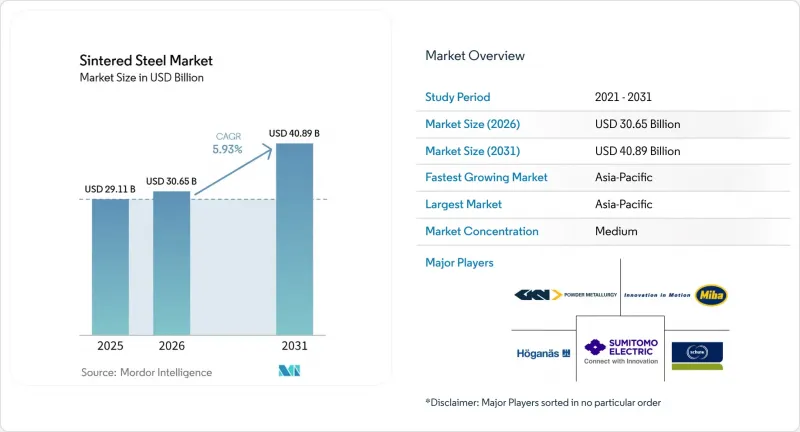
根據 Mordor Intelligence 預測,燒結鋼市場規模將從 2025 年的 291.1 億美元成長到 2026 年的 306.5 億美元,到 2031 年達到 408.9 億美元,2026 年至 2031 年的複合年成長率為 5.93%。
本報告按類型(例如,不銹鋼)、工藝(例如,傳統粉末冶金、粉末鍛造)、應用(例如,齒輪和傳動部件、軸承和襯套)、終端用戶行業(例如,汽車行業)以及地區(亞太地區、北美地區、歐洲地區、南美地區、中東和非洲地區)進行細分。市場預測以美元計價。
全球燒結鋼市場趨勢與洞察
汽車應用領域對燒結鋼的需求不斷成長
鑑於粉末冶金部件在動力傳動系統和底盤項目中的持續應用,汽車製造業仍然是燒結鋼最大的終端市場。 2024年,汽車產業佔北美鐵粉出貨量的70%以上,凸顯了汽車生產對燒結鋼市場訂單趨勢的密切影響。 2024年,北美新車銷量達到1,590萬輛,其中混合動力汽車銷量成長近37%。儘管OEM動力傳動系統配置有所變化,但粉末冶金的需求仍然強勁。齒輪、連桿、軸承蓋和同步器輪轂由於其高度可重複的公差和大規模生產中卓越的效率,仍然是重要的批量生產產品。 2026年發布的一項研究表明,與單速變速箱相比,雙速電動車變速箱在高速行駛循環中可將馬達效率提高5-7%,這將進一步推動燒結行星架和差速器零件在未來車輛架構中的應用。這一轉變意味著,即使對內燃機 (ICE) 專用零件的需求逐漸下降,燒結鋼市場仍將繼續佔據重要地位。
電動車對燒結零件的需求不斷成長
電動車 (EV) 的普及正在擴大燒結鋼的潛在市場。這是因為新型電動車平台需要馬達、變速箱和轉向部件,以支援緊湊高效的設計。 2024 年全球電動車銷量超過 1,700 萬輛,比 2023 年成長 25%。這推動了對軟磁複合材料 (SMC) 馬達鐵芯、電驅動橋行星架和電動方向盤泵浦轉子的需求。 2024 年發表在《金屬》(Metals) 雜誌上的一項研究表明,用於電動汽車電機的 SMC 材料可將鐵芯損耗降低 20% 以上,從而促進 SMC 材料在緊湊型電機佈局中的應用,而效率提昇在這些佈局中至關重要。 2024 年的另一篇論文表明,燒結 SMC 馬達鐵芯的效率可與 0.35 毫米無取向矽鋼片疊層相當,並且能夠實現疊層方法難以實現的3D磁通路徑。印度的生產連結獎勵計畫計畫(PLIS)已撥款10,000億印度盧比(約12億美元)用於汽車及零件的生產,包括與粉末冶金技術引進相關的技術。這些舉措意味著燒結鋼市場將在汽車轉型中發揮更大的作用,超越其在引擎零件領域的傳統角色。
需要大量資金投入。
先進燒結爐、壓縮系統和模具的高昂資本需求,需要在穩定產量之前進行大量前期投資,這持續阻礙燒結鋼市場的發展。真空燒結爐的價格差異巨大,單價從 5 萬美元到 20 萬美元以上不等,而建立一條整合式壓制燒結生產線通常需要數百萬美元的投入。如果零件設計需要複雜的多層模具,財務負擔將進一步加重,因為這些模具必須透過大規模生產來攤銷,才能證明投資的合理性。對於新興的粉末冶金 (PM) 地區而言,這項挑戰尤其突出,因為這些地區低成本資金籌措、熟練的燒結爐操作人員以及穩定、長期的 OEM(原始設備製造商)合約仍然十分有限。當製造商採用工業黏著劑噴塗成型或粉末床系統時,負擔會進一步加重,因為這些技術需要在標準燒結生產線的基礎上進行額外的資本投資。因此,新興地區的燒結鋼市場持續擴張,不是透過獨立的待開發區工廠,而是透過生產能力許可和與供應商的合作來實現。
細分市場分析
2025年,碳鋼繼續保持其在材料類型中的領先地位,佔據燒結鋼市場佔有率的46.82%。這一地位源於其低廉的原料成本、與傳統模具的廣泛兼容性以及在汽車和工業大批量應用領域長期積累的良好口碑。合金鋼透過添加鎳、鉬和銅等元素,在價值鏈中的地位高於碳鋼,在嚴苛條件下使用的零件中具有更高的抗張強度和更優異的抗疲勞性能。工具鋼雖然產量仍較小,但廣泛應用於精密嵌件和特殊機械,在這些應用中,耐磨性比產量更為重要。不銹鋼是成長最快的材料類型,預計到2031年將以6.84%的複合年成長率成長,因為醫療設備、對腐蝕敏感的電氣組件和食品加工設備等需要碳鋼無法提供的材料性能。
這一轉變表明,燒結鋼市場不再僅僅由成本最低的材料路線構成,因為新的終端用途認證標準正在改變買家的驗收標準。當小型化和表面清潔度成為優先考慮因素時,不銹鋼也非常適合金屬射出成型(MIM) 生產。這種組合使供應商能夠進軍更高價值的項目,即使其總產量低於碳鋼。此外,隨著原始設備製造商 (OEM) 買家越來越關注目的地供應鏈中的範圍 3 排放,材料選擇與客戶的永續發展目標之間的連結也日益緊密。例如,Höganhas 公司報告稱,其持續投資於低碳粉末生產,並透露與 2018 年相比,範圍 1 和範圍 2 的排放量減少了 55%,這表明材料供應商正在超越機械性能來實現差異化。在此背景下,燒結鋼市場可能會更青睞那些能夠將可靠的冶金技術與更佳的永續發展記錄相結合的製造商。
預計到2025年,傳統粉末冶金將佔據50.89%的市場佔有率,成為燒結鋼市場的主導製造流程。這一地位反映了大規模汽車和工業項目的高經濟效益,在這些項目中,固定的模具成本可以透過大規模生產分攤。與全機加工零件相比,此製程還具有材料利用率高的優勢,預計接近95%。金屬射出成型緊隨其後,在醫療、國防、電子和精密消費品應用領域,其公差要求比標準壓制燒結製程更為嚴格。粉末鍛造在需要近乎完美密度的高密度結構件(例如連桿和同步器環)的製造中繼續發揮至關重要的作用。積層製造是成長最快的工藝,預計到2031年將以7.36%的複合年成長率成長。這表明,在燒結鋼市場,小批量生產的設計複雜性和柔軟性變得越來越重要。
這並不意味著積層製造將在大規模生產項目中取代傳統的粉末冶金(PM),因為隨著產量的增加,傳統的模壓成型仍然更具成本效益。然而,隨著航太、國防和醫療產業的買家從原型製作階段過渡到大規模生產認證階段,燒結鋼市場的製造流程組合趨於多元化。金屬射出成型(MIM)也受益於這一轉變,因為它介於大規模生產和精密加工之間,對於那些過於複雜而無法採用傳統沖壓工藝加工,但純機械加工成本又過高的零件來說,MIM 是一個極具吸引力的選擇。印度金屬注射成型協會(Indo-MIM)於 2025 年 9 月申請 1000 卡羅來納印度盧比(約 1.13 億美元)的資金籌措,用於擴大產能和投資先進的黏著劑噴塗成型系統,這表明製造商仍然認為這些製造程序存在戰略投資空間。隨著越來越多的供應商將設計檢驗、先進粉末和高度可重複的燒結技術相結合,燒結鋼市場有望開闢以前傳統製程鏈無法實現的新應用領域。
區域分析
預計到2025年,亞太地區將佔據燒結鋼市場48.32%的佔有率,並將成為成長最快的地區,到2031年複合年成長率將達到6.78%。這一地位反映了該地區龐大的汽車組裝規模、不斷擴張的電動車供應鏈以及其製造成本的競爭力。中國仍然是該地區最大的單一國家需求中心,這得益於其龐大的汽車產業和精密製造業基礎。印度是一個政策主導的活躍成長市場,這得益於印度重工業部根據「生產連結獎勵計畫(PLI)」計畫撥款10,000億印度盧比(約12億美元)用於汽車零件。該計劃也涵蓋相關的粉末冶金技術。日本憑藉住友電工和寶麗特株式會社等公司,在高精度金屬射出成型(MIM)和先進燒結零件領域發揮著關鍵的技術作用;韓國則憑藉其汽車和電子製造業基地,為市場增添了深度。亞太地區燒結鋼市場兼具現有規模及未來產品多角化的發展前景。
北美仍然是燒結鋼的第二大區域市場,這得益於其汽車供應鏈和成熟的粉末冶金 (PM) 供應商基礎。預計到 2024 年,該地區超過 70% 的鐵粉出貨量將用於汽車產業,證實了區域需求與汽車生產趨勢之間的密切關聯。 2024 年新車銷量將達到 1590 萬輛,其中混合動力汽車銷量成長近 37%,這有助於維持短期需求,因為汽車製造商 (OEM) 正在尋求平衡其內燃機 (ICE)、混合動力和電動車 (EV) 戰略。歐洲已成為第三大區域市場,主要由德國和瑞典推動。在這些國家,材料供應商和汽車 OEM 之間的密切合作正在支持新的粉末冶金規範的共同開發。此外,歐洲的採購活動越來越受到對低碳原料期望的影響,Höganhas 公司報告稱,由於其低碳粉末策略,其範圍 1 和範圍 2 的排放量與 2018 年相比減少了 55%。
南美洲是燒結鋼市場中一個規模雖小但持續成長的區域,其中巴西是主要驅動力,這主要得益於汽車組裝廠和工業機械的需求。阿根廷及其鄰國的貢獻較小,並且仍然高度依賴進口零件,而非本地粉末冶金生產。中東和非洲是最小的區域市場,沙烏地阿拉伯與下游工業需求密切相關,而南非則受益於成熟的汽車組裝業。儘管這兩個區域都具有成長潛力,但這些地區的燒結鋼市場仍依賴從亞太地區和歐洲的進口,國內粉末冶金(PM)產能有限。
其他好處:
- Excel格式的市場預測(ME)表
- 3個月的分析師支持
目錄
第1章:引言
- 研究假設和市場定義
- 調查範圍
第2章:調查方法
第3章執行摘要
第4章 市場狀況
- 市場概覽
- 市場促進因素
- 汽車產業對輕量化、高強度零件的需求日益成長。
- 電動車和先進動力傳動系統系統對燒結鋼部件的需求不斷成長。
- 在工業自動化和精密工程領域不斷拓展應用。
- 人們對永續和材料高效的粉末冶金製造程序越來越感興趣。
- 擴大近淨成形製造技術的應用,以提高材料利用率和生產效率。
- 市場限制因素
- 粉末冶金生產設備需要大量的資金投入。
- 原物料價格波動和特殊金屬粉末的供應狀況
- 透過替代金屬成形和製造技術展開競爭
- 價值鏈分析
- 波特五力分析
第5章 市場規模與成長預測
- 按類型
- 不銹鋼
- 碳鋼
- 合金鋼
- 工具鋼
- 透過流程
- 傳統粉末冶金
- 金屬射出成型(MIM)
- 粉末鍛造
- 積層製造
- 透過使用
- 齒輪和傳動部件
- 軸承和襯套
- 引擎部件
- 結構構件
- 煞車部件
- 電氣和磁性元件
- 感測器和精密零件
- 其他用途
- 按最終用戶行業分類
- 汽車產業
- 產業
- 電氣和電子設備
- 衛生保健
- 航太/國防
- 按地區
- 亞太地區
- 中國
- 印度
- 日本
- 韓國
- 其他亞太國家
- 北美洲
- 美國
- 加拿大
- 墨西哥
- 歐洲
- 德國
- 英國
- 法國
- 義大利
- 俄羅斯
- 其他歐洲國家
- 南美洲
- 巴西
- 阿根廷
- 其他南美國家
- 中東和非洲
- 沙烏地阿拉伯
- 南非
- 其他中東和非洲國家
- 亞太地區
第6章 競爭情勢
- 市場集中度
- 策略趨勢
- 市佔率和排名分析
- 公司簡介
- Allied Sinterings, Inc.
- AMES Group Sintering, SA
- ASCO Sintering Co.
- Atlas Pressed Metals
- Fine Sinter Co., Ltd.
- GKN Powder Metallurgy
- Hitachi Metals, Ltd.
- Hoganas AB
- Indo-MIM
- Keystone Powdered Metal Company
- Kobe Steel, Ltd.
- Miba AG
- PMG Holding GmbH
- Porite Corporation
- Schunk Group
- Sintercom India Ltd.
- Stackpole International
- Sumitomo Electric Industries, Ltd.
第7章 市場機會與未來展望
According to Mordor Intelligence, the sintered steel market size is expected to increase from USD 29.11 billion in 2025 to USD 30.65 billion in 2026 and reach USD 40.89 billion by 2031, and is expected to grow at a CAGR of 5.93% over 2026-2031.
This report is Segmented by Type (Stainless Steel and More), Process (Conventional Powder Metallurgy, Powder Forging, and More), Application (Gears & Transmission Components, Bearings & Bushings, and More), End-User Industry (Automotive Industry and More), and Geography (Asia-Pacific, North America, Europe, South America, and Middle-East and Africa). The Market Forecasts are Provided in Terms of Value (USD).
Global Sintered Steel Market Trends and Insights
Increasing Demand for Sintered Steel in Automotive Applications
Automotive manufacturing remains the largest end market for sintered steel, as drivetrain and chassis programs continue to absorb high volumes of powder metal parts. The automotive sector accounted for more than 70% of iron powder shipments in North America in 2024, highlighting how closely vehicle output shapes order flow in the sintered steel market. North American new-vehicle sales reached 15.9 million units in 2024, and hybrid sales rose by nearly 37%, keeping powder metal demand firm even as OEM powertrain mixes began to shift. Gears, connecting rods, bearing caps, and synchronizer hubs remain core volume products, as they offer repeatable tolerances and strong throughput economics at scale. Research published in 2026 found that two-speed EV gearboxes can improve highway-cycle motor efficiency by 5% to 7% compared to single-speed hardware, supporting further use of sintered planet carriers and differential components in future vehicle architectures. This shift helps the sintered steel market remain relevant even as demand for Internal Combustion Engine (ICE)-only parts eases over time.
Rising Demand for Sintered Components in Electric Vehicles
Electric vehicle (EV) adoption is expanding the addressable market for sintered steel, as new EV platforms require motor, gearbox, and steering components that support compact, efficient designs. Global electric car sales exceeded 17 million units in 2024, up 25% from 2023, lifting demand for soft magnetic composite (SMC) motor cores, e-axle planetary carriers, and electric power steering pump rotors. A 2024 study published in Metals reported that SMC materials for EV motors can reduce core losses by more than 20%, strengthening the case for their use in compact motor layouts where efficiency gains are critical. Another 2024 paper showed that sintered SMC motor cores can deliver efficiency comparable to 0.35 mm non-oriented silicon steel laminations while enabling three-dimensional flux paths that are difficult to achieve with stacked laminations. India's Production Linked Incentive Scheme allocated INR 10,000 crore (USD 1.2 billion) for automobile and auto component manufacturing, including technologies relevant to powder metallurgy adoption. These developments give the sintered steel market a larger role in the vehicle transition, rather than limiting it to legacy engine content.
High Capital Investment Requirements
High capital requirements continue to restrain the sintered steel market, as advanced furnaces, compaction systems, and tooling demand substantial upfront investment before stable program volumes are secured. Vacuum sintering furnaces range from USD 55,000 to more than USD 200,000 per unit, while complete press-and-sinter lines often require multi-million-dollar expenditure. The financial burden increases further when part designs require complex multi-level dies, as those tools must be amortized across large production runs to justify the investment. This challenge is more pronounced in newer Powder Metallurgy (PM) geographies, where low-cost financing, skilled furnace operators, and stable, long-term Original Equipment Manufacturer (OEM) contracts remain limited. The burden grows further when producers add industrial binder jetting or powder bed systems, as these technologies create a second capital layer on top of the standard sintering line. As a result, the sintered steel market in emerging regions continues to expand through licensed capacity or supplier partnerships rather than independent greenfield plants.
Other drivers and restraints analyzed in the detailed report include:
- Expansion of the Industrial Manufacturing Sector
- Growing Adoption of Metal Injection Molding
- Volatility In Raw Material Prices
For complete list of drivers and restraints, kindly check the Table Of Contents.
Segment Analysis
Carbon steel held 46.82% of the sintered steel market share in 2025, maintaining its lead among material types. Its position is based on low input costs, broad compatibility with conventional tooling, and a long track record of performance in high-volume automotive and industrial applications. Alloy steel sits above it in the value chain because nickel, molybdenum, and copper additions support higher tensile strength and better fatigue resistance in demanding components. Tool steel remains smaller in volume, but it serves precision insert applications and specialized machinery where wear performance matters more than tons. Stainless steel is the fastest-growing type, with a 6.84% CAGR through 2031, because medical devices, corrosion-sensitive electrical assemblies, and food processing equipment require material properties that carbon grades cannot provide.
This shift indicates that the sintered steel market is no longer shaped only by the lowest-cost material route, as qualification standards in newer end uses are changing what buyers accept. Stainless grades also lend themselves well to metal injection molding (MIM) production when miniaturization and clean-surface requirements are priorities. That combination gives suppliers room to move into higher-value programs even when total volume remains lower than carbon steel. Material decisions are also increasingly tied to customer sustainability goals, as original equipment manufacturer (OEM) buyers are paying closer attention to Scope 3 emissions in the upstream supply chain. Hoganas reported continued investment in lower-carbon powder production and disclosed a 55% reduction in Scope 1 and 2 emissions versus 2018, demonstrating how material suppliers are differentiating beyond mechanical performance alone. In this context, the sintered steel market is likely to reward producers that can pair reliable metallurgy with stronger sustainability credentials.
Conventional powder metallurgy accounted for 50.89% of the market in 2025, making it the leading process route in the sintered steel market. That position reflects strong economics in large automotive and industrial programs where fixed tooling costs can be spread over high production volumes. The process also benefits from high material utilization, estimated at near 95%, compared with much lower yields for fully machined equivalents. Metal injection molding is the next tier, serving medical, defense, electronics, and precision consumer goods applications with tighter tolerances than standard press-and-sinter operations typically provide. Powder forging remains important for high-density structural parts such as connecting rods and synchronizer rings, where near-full density is required. Additive manufacturing is the fastest-growing process, with a 7.36% CAGR through 2031, indicating that design complexity and low-volume flexibility are becoming increasingly important in the sintered steel market.
This does not mean additive routes will displace conventional powder metallurgy (PM) in bulk programs, as the cost logic still favors traditional tooling once volumes scale. It does mean that the process mix within the sintered steel market is broadening as aerospace, defense, and medical buyers move from prototyping toward production qualification. Metal injection molding (MIM) also benefits from this shift because it sits between scale manufacturing and precision machining, making it attractive for parts that are too intricate for conventional pressing but too costly for pure machining. Indo-MIM's September 2025 filing for INR 1,000 crore (USD 113 million) to fund capacity expansion and advanced binder jetting systems indicates that manufacturers still see room for strategic investment in these routes. As more suppliers combine design validation, advanced powders, and repeatable sintering, the sintered steel market is expected to add applications previously out of reach for older process chains.
Complete Report Scope:
- By Type
- Stainless Steel
- Carbon Steel
- Alloy Steel
- Tool Steel
- By Process
- Conventional Powder Metallurgy
- Metal Injection Molding (MIM)
- Powder Forging
- Additive Manufacturing
- By Application
- Gears & Transmission Components
- Bearings & Bushings
- Engine Components
- Structural Components
- Brake Components
- Electrical & Magnetic Components
- Sensors & Precision Components
- Other Applications
- By End-User Industry
- Automotive Industry
- Industrial
- Electrical and Electronics
- Healthcare
- Aerospace and Defense
- By Geography
- Asia-Pacific
- China
- India
- Japan
- South Korea
- Rest of Asia-Pacific
- North America
- United States
- Canada
- Mexico
- Europe
- Germany
- United Kingdom
- France
- Italy
- Russia
- Rest of Europe
- South America
- Brazil
- Argentina
- Rest of South America
- Middle-East and Africa
- Saudi Arabia
- South Africa
- Rest of Middle-East and Africa
- Asia-Pacific
Geography Analysis
Asia-Pacific held 48.32% of the sintered steel market share in 2025 and is projected to register the fastest regional CAGR of 6.78% through 2031. This position reflects the region's scale in vehicle assembly, growing EV supply chains, and manufacturing cost competitiveness. China remains the largest country-level demand center in the region due to its broad automotive and precision manufacturing base. India is an active policy-driven growth market, supported by the Ministry of Heavy Industries' allocation of INR 10,000 crore (USD 1.2 billion) under the Production Linked Incentive (PLI) scheme for auto components, which includes relevant powder metallurgy technologies. Japan holds an important technology role in high-precision Metal Injection Molding (MIM) and advanced sintered components through companies such as Sumitomo Electric Industries and Porite Corporation, while South Korea adds depth through its automotive and electronics manufacturing base. The Asia-Pacific sintered steel market combines present scale with future product diversification.
North America remained the second-largest regional market for sintered steel, supported by its automotive supply chain and an established powder metallurgy (PM) vendor base. More than 70% of regional iron powder shipments went to the automotive sector in 2024, confirming that regional demand closely follows vehicle production trends. New-vehicle sales of 15.9 million units in 2024 and hybrid sales growth of nearly 37% helped sustain near-term demand, even as OEMs balanced ICE, hybrid, and EV strategies. Europe ranked as the third-largest regional market, led by Germany and Sweden, where close ties between material suppliers and automotive OEMs support the co-development of newer PM specifications. European procurement is also being increasingly shaped by expectations for low-carbon inputs, and Hoganas reported a 55% reduction in Scope 1 and 2 emissions versus 2018 as it advanced its lower-carbon powder strategy.
South America remained a smaller but expanding part of the sintered steel market, with Brazil as the primary regional anchor due to its vehicle assembly base and industrial machinery demand. Argentina and neighboring countries contributed lower volumes and remained more dependent on imported components than on local PM production. The Middle East and Africa represented the smallest regional segment, with Saudi Arabia linked to downstream industrial demand and South Africa supported by established vehicle assembly activity. Growth potential exists in both areas, but the sintered steel market in these regions remains dependent on imports from Asia-Pacific and Europe, while domestic PM capacity remains limited.
- Allied Sinterings, Inc.
- AMES Group Sintering, S.A.
- ASCO Sintering Co.
- Atlas Pressed Metals
- Fine Sinter Co., Ltd.
- GKN Powder Metallurgy
- Hitachi Metals, Ltd.
- Hoganas AB
- Indo-MIM
- Keystone Powdered Metal Company
- Kobe Steel, Ltd.
- Miba AG
- PMG Holding GmbH
- Porite Corporation
- Schunk Group
- Sintercom India Ltd.
- Stackpole International
- Sumitomo Electric Industries, Ltd.
Additional Benefits:
- The market estimate (ME) sheet in Excel format
- 3 months of analyst support
TABLE OF CONTENTS
1 Introduction
- 1.1 Study Assumptions and Market Definition
- 1.2 Scope of the Study
2 Research Methodology
3 Executive Summary
4 Market Landscape
- 4.1 Market Overview
- 4.2 Market Drivers
- 4.2.1 Increasing Demand for Lightweight and High-Strength Components in the Automotive Industry
- 4.2.2 Rising Demand for Sintered Steel Components in Electric Vehicles and Advanced Powertrain Systems
- 4.2.3 Expansion of Industrial Automation and Precision Engineering Applications
- 4.2.4 Increasing Preference for Sustainable and Material-Efficient Powder Metallurgy Manufacturing Processes
- 4.2.5 Growing Adoption of Near-Net-Shape Manufacturing for Improved Material Utilization and Production Efficiency
- 4.3 Market Restraints
- 4.3.1 High Capital Investment Required for Powder Metallurgy Production Facilities
- 4.3.2 Volatility in Raw Material Prices and Supply of Specialty Metal Powders
- 4.3.3 Competition from Alternative Metal Forming and Manufacturing Technologies
- 4.4 Value Chain Analysis
- 4.5 Porter's Five Forces Analysis
- 4.5.1 Threat of New Entrants
- 4.5.2 Bargaining Power of Suppliers
- 4.5.3 Bargaining Power of Buyers
- 4.5.4 Threat of Substitutes
- 4.5.5 Competitive Rivalry
5 Market Size and Growth Forecasts (Value)
- 5.1 By Type
- 5.1.1 Stainless Steel
- 5.1.2 Carbon Steel
- 5.1.3 Alloy Steel
- 5.1.4 Tool Steel
- 5.2 By Process
- 5.2.1 Conventional Powder Metallurgy
- 5.2.2 Metal Injection Molding (MIM)
- 5.2.3 Powder Forging
- 5.2.4 Additive Manufacturing
- 5.3 By Application
- 5.3.1 Gears & Transmission Components
- 5.3.2 Bearings & Bushings
- 5.3.3 Engine Components
- 5.3.4 Structural Components
- 5.3.5 Brake Components
- 5.3.6 Electrical & Magnetic Components
- 5.3.7 Sensors & Precision Components
- 5.3.8 Other Applications
- 5.4 By End-User Industry
- 5.4.1 Automotive Industry
- 5.4.2 Industrial
- 5.4.3 Electrical and Electronics
- 5.4.4 Healthcare
- 5.4.5 Aerospace and Defense
- 5.5 By Geography
- 5.5.1 Asia-Pacific
- 5.5.1.1 China
- 5.5.1.2 India
- 5.5.1.3 Japan
- 5.5.1.4 South Korea
- 5.5.1.5 Rest of Asia-Pacific
- 5.5.2 North America
- 5.5.2.1 United States
- 5.5.2.2 Canada
- 5.5.2.3 Mexico
- 5.5.3 Europe
- 5.5.3.1 Germany
- 5.5.3.2 United Kingdom
- 5.5.3.3 France
- 5.5.3.4 Italy
- 5.5.3.5 Russia
- 5.5.3.6 Rest of Europe
- 5.5.4 South America
- 5.5.4.1 Brazil
- 5.5.4.2 Argentina
- 5.5.4.3 Rest of South America
- 5.5.5 Middle-East and Africa
- 5.5.5.1 Saudi Arabia
- 5.5.5.2 South Africa
- 5.5.5.3 Rest of Middle-East and Africa
- 5.5.1 Asia-Pacific
6 Competitive Landscape
- 6.1 Market Concentration
- 6.2 Strategic Moves
- 6.3 Market Share (%)/Ranking Analysis
- 6.4 Company Profiles (includes Global Overview, Market Overview, Core Segments, Financials as available, Strategic Information, Products and Services, and Recent Developments)
- 6.4.1 Allied Sinterings, Inc.
- 6.4.2 AMES Group Sintering, S.A.
- 6.4.3 ASCO Sintering Co.
- 6.4.4 Atlas Pressed Metals
- 6.4.5 Fine Sinter Co., Ltd.
- 6.4.6 GKN Powder Metallurgy
- 6.4.7 Hitachi Metals, Ltd.
- 6.4.8 Hoganas AB
- 6.4.9 Indo-MIM
- 6.4.10 Keystone Powdered Metal Company
- 6.4.11 Kobe Steel, Ltd.
- 6.4.12 Miba AG
- 6.4.13 PMG Holding GmbH
- 6.4.14 Porite Corporation
- 6.4.15 Schunk Group
- 6.4.16 Sintercom India Ltd.
- 6.4.17 Stackpole International
- 6.4.18 Sumitomo Electric Industries, Ltd.
7 Market Opportunities and Future Outlook
- 7.1 White-Space and Unmet-Need Assessment

 燒結鋼市場:2026-2032年全球市場預測(按產品類型、材料類型、製造流程、燒結方法、分銷管道和最終用途行業分類)
 燒結鋼市場規模、佔有率和趨勢分析報告:按應用、地區、主要參與者和競爭對手分析以及細分市場預測(2026-2033 年)
 2026年全球燒結鋼市場報告
 燒結鋼市場規模、佔有率和成長分析(按鋼材類型、製造流程、應用、最終用途產業和地區分類)-2026-2033年產業預測
 燒結鋼全球市場報告:趨勢、預測與競爭分析(至 2031 年)燒結石材市場:按表面處理、厚度、產品應用、最終用途和銷售管道- 2025-2030 年全球預測
 燒結鋼市場機會、成長動力、產業趨勢分析與預測 2024 - 2032