


 |
市場調查報告書
商品編碼
2099986
南美洲塑膠袋包裝:市場佔有率分析、產業趨勢與統計及成長預測(2026-2031 年)South America Plastic Pouch Packaging - Market Share Analysis, Industry Trends & Statistics, Growth Forecasts (2026 - 2031) |
||||||

※ 本網頁內容可能與最新版本有所差異。詳細情況請與我們聯繫。
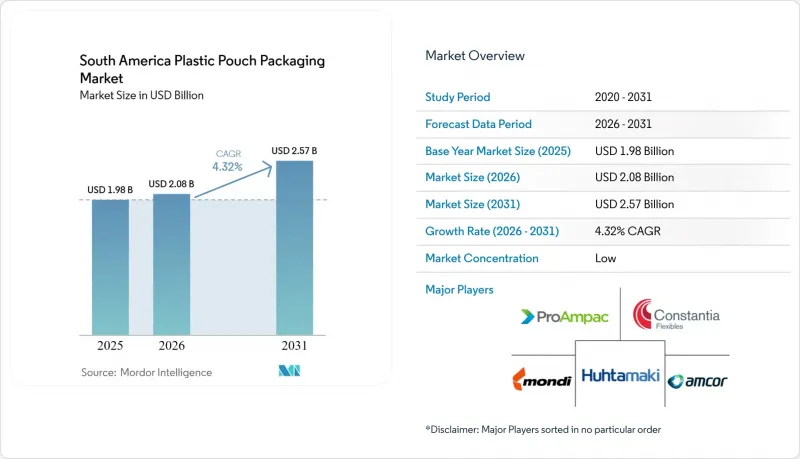
據 Mordor Intelligence 稱,2025 年南美塑膠袋包裝市場價值為 19.8 億美元,預計到 2031 年將從 2026 年的 20.8 億美元成長至 25.7 億美元,預測期(2026-2031 年)複合年成長率為 4.32%。
本報告按材料(聚乙烯 (PE)、聚丙烯 (PP)、聚對苯二甲酸乙二醇酯 (PET)、乙烯 - 乙烯醇共聚物 (EVOH)、聚氯乙烯(PVC) 等)、產品類型(平口袋和立式袋)、終端用戶行業(食品、飲料、個人護理和家居護理等)以及地區進行細分。市場預測以美元 (USD) 為單位。
南美塑膠袋包裝市場趨勢與洞察
從硬質包裝過渡到軟性塑膠袋解決方案
南美洲塑膠袋包裝市場持續受益於包裝方式的轉變,即從玻璃瓶、馬口鐵罐和高密度聚乙烯(HDPE)容器轉向輕質軟袋,用於包裝乾貨零食、醬料、乳製品和冷凍蛋白產品。預計到2025年,巴西的軟塑膠產業將處理232.1萬噸,這顯示軟包裝形式在主流包裝需求中佔據了越來越重要的地位。低密度聚乙烯(LDPE)和線性低密度聚乙烯(LLDPE)將佔巴西2025年處理量的73%,凸顯了聚乙烯(PE)主導的軟袋加工在食品、農業和消費品領域的穩固基礎。預計2025年,農業領域對軟包裝的需求將成長9.7%,達到31.6萬噸。這表明,為了保持食品新鮮度並降低物流成本,出口相關食品供應鏈將採用多層軟袋。與硬質包裝系統相比,中小食品製造商可以採用袋裝填充和加工,所需資本投入較少,因此這種需求模式仍然很重要,即使區域經濟狀況惡化,也有助於加工商保持穩定的累積訂單。
有組織的零售和現代分銷管道的擴張
南美塑膠袋包裝市場的發展也得益於大都會圈和區域城市中超級市場、現金取貨和現代零售業態的蓬勃發展。有組織的零售業擴張提高了貨架上包裝產品的比例,進而直接推動了對輕便、可重複密封且便於展示的包裝袋的需求。 Cencosud累計到 2026 年,其資本支出將達到 6 億美元,其中 70% 將用於南美市場的門市擴張和新店分店。如此大幅度的投資意義重大,因為零售網路的擴張將增加包裝食品、家居用品和填充用產品的採購量,而這些產品都高度依賴軟包裝袋。此外,這也有利於能夠處理小批量生產和頻繁包裝更新周期的加工商,尤其是在現代零售連鎖店不斷拓展產品線的情況下。
加強對塑膠包裝和生產者延伸責任(EPR)政策的監管
更嚴格的監管是限制南美洲塑膠包裝袋加工商盈利的最明顯短期阻礙因素之一。巴西第12688號法令立即規定了使用回收和再利用材料的義務,這些規定增加了依賴多層結構的加工商的合規、採購和報告成本。 PET、PA和EVOH複合材料受到的壓力尤其巨大,因為這些結構難以適應該地區大部分地區現有的機械回收系統。因此,擁有成熟技術能力、認證能力和客戶支援系統的大型供應商在合規方面具有優勢。這種限制不僅源自於塑膠需求的下降,也源自於訂單迅速轉向那些能夠在不損害食品安全和性能標準的前提下滿足監管要求的加工商。
細分市場分析
2025年,聚乙烯(PE)在南美洲塑膠包裝袋市場佔據46.01%的佔有率。這主要歸功於其加工成本低,且與區域加工商使用的吹膜和流延擠出生產線具有廣泛的兼容性。巴西境內PE樹脂的充足供應,以及其在食品、農業和消費品行業各種包裝袋中的廣泛適用性,進一步鞏固了PE的主導地位。在巴西,光是LDPE和LLDPE就佔2025年軟包裝產量的73%,凸顯了PE樹脂在常規包裝袋加工活動中的核心作用。聚丙烯由於其適用於熱填充和蒸餾工藝,佔據了重要的第二位,而PET和PVC則繼續用於某些透明和熱成型包裝袋的應用。
預計到2031年,EVOH將以7.59%的複合年成長率成長,在南美塑膠袋包裝市場,這一細分市場的成長主要受食品安全和藥品包裝領域對阻隔性能日益成長的需求驅動。食品加工商和製藥企業擴大指定使用含有EVOH層的共擠出結構,因為這種結構可以延長保存期限並滿足更嚴格的包裝要求。KURARAY CO. LTD.公司在2026年「Interpack」展會上發布的「EVAL EVOH」產品,旨在為高性能包裝袋應用提供符合最新合規要求的可回收單材料包裝設計。層級構造可以將氧氣穿透率(OTR)降低到0.05 cm³/(m²·day)以下,使肉類加工商能夠將保存期限從7天延長至21天,並減少整個供應鏈中的廢棄物。
其他好處:
- Excel格式的市場預測(ME)表
- 3個月的分析師支持
目錄
第1章:引言
- 研究假設和市場定義
- 調查範圍
第2章:調查方法
第3章執行摘要
第4章 市場狀況
- 市場概覽
- 市場促進因素
- 從硬質包裝過渡到軟性塑膠袋解決方案
- 有組織的零售和現代分銷管道的擴張
- 擴大永續和可回收包裝袋的使用範圍。
- 高阻隔薄膜和包裝袋製造技術的進步
- 透過輕量化和節約材料的包裝實現成本最佳化。
- 該地區製造業和出口導向產業的擴張
- 市場限制因素
- 加強對塑膠包裝和生產者延伸責任(EPR)政策的監管
- 缺乏軟質塑膠收集和回收的基礎設施
- 石油化學樹脂價格和原料成本的波動
- 來自紙張和替代性永續包裝材料的競爭日益激烈。
- 產業供應鏈分析
- 永續性和監管展望
- 技術展望
- 波特五力分析
- 宏觀經濟因素對市場的影響
第5章 市場規模與成長預測
- 材料
- 聚乙烯(PE)
- 聚丙烯(PP)
- 聚對苯二甲酸乙二醇酯(PET)
- 乙烯乙烯醇(EVOH)
- 聚氯乙烯(PVC)
- 其他材料
- 依產品類型
- 扁平袋
- 立式袋
- 按最終用戶行業分類
- 食物
- 糖果和糖果甜點
- 冷凍食品
- 生鮮食品
- 乳製品
- 乾糧
- 肉類、雞肉、魚貝類
- 寵物食品
- 其他食物
- 飲料
- 醫療和製藥
- 個人護理和居家護理
- 其他終端用戶產業
- 食物
- 按地區
- 巴西
- 阿根廷
- 哥倫比亞
- 其他南美國家
第6章 競爭情勢
- 市場集中度
- 策略動向與發展
- 市場排名分析
- 公司簡介
- Amcor plc
- ZARAPLAST SA
- ProAmpac Holdings, Inc.
- Finpak Flexibles, SA de CV
- SIG Group AG
- Mondi plc
- Constantia Flexibles Group GmbH
- Guala Pack Spa
- Huhtamaki Oyj
- Bolsafilm SA
- BOLSAS DELTA SA DE CV
第7章 市場機會與未來展望
According to Mordor Intelligence, the South America plastic pouch packaging market size was valued at USD 1.98 billion in 2025 and estimated to grow from USD 2.08 billion in 2026 to reach USD 2.57 billion by 2031, at a CAGR of 4.32% during the forecast period (2026-2031).
This report is Segmented by Material (Polyethylene (PE), Polypropylene (PP), Polyethylene Terephthalate (PET), Ethylene Vinyl Alcohol (EVOH), Polyvinyl Chloride (PVC), and More), Product Type (Flat Pouch and Stand Up Pouch), End User Industry (Food Products, Beverage, Personal Care and Household Care, and More), and Geography. The Market Forecasts are Provided in Terms of Value (USD).
South America Plastic Pouch Packaging Market Trends and Insights
Transition from Rigid Packaging to Flexible Plastic Pouch Solutions
The South America plastic pouch packaging market continues to benefit from a broad shift away from glass jars, tin cans, and HDPE containers toward lighter pouch formats across dry snacks, sauces, dairy, and frozen proteins. Brazil's flexible plastic packaging industry processed 2.321 million tons in 2025, which shows how deeply flexible formats are embedded in mainstream packaging demand. LDPE and LLDPE grades accounted for 73% of that Brazilian volume in 2025, reinforcing the strong operating base for PE-led pouch conversion across food, agro-industrial, and consumer goods uses. Agro-sector demand for flexible packaging rose 9.7% in 2025 to 316,000 tons, which shows that export-linked food chains are using multilayer pouch formats for freshness protection and lower logistics costs. This demand pattern remains important because smaller and mid-sized food manufacturers can adopt pouch filling and conversion with lower capital requirements than rigid packaging systems, keeping converter order books active even when regional economic conditions weaken.
Expansion of Organized Retail and Modern Trade Channels
The South America plastic pouch packaging market is also being supported by the spread of supermarket, cash-and-carry, and modern trade formats across large urban centers and secondary cities. Organized retail expansion increases the share of packaged products on shelves, which directly raises demand for lightweight, resealable, and display-ready pouch formats. Cencosud allocated USD 600 million in capital expenditure for 2026, with 70% directed to store growth and greenfield development across South American markets. That investment pace matters because a broader retail footprint strengthens procurement volumes for packaged foods, household products, and refill formats that rely heavily on flexible pouch packaging. It also favors converters that can respond to shorter product runs and more frequent packaging refresh cycles, especially as modern trade chains continue to expand product assortments.
Strengthening Plastic Packaging Regulations and Extended Producer Responsibility Policies
Regulatory tightening is one of the clearest near-term constraints on converter economics in the South America plastic pouch packaging market. Brazil's Decree No. 12,688 created immediate obligations on recovery and recycled content, and those rules raise qualification, sourcing, and reporting costs for converters that depend on multilayer structures. The pressure is strongest for laminates that combine PET, PA, and EVOH because these structures do not fit easily into current mechanical recycling systems used across much of the region. Compliance, therefore, favors larger suppliers that already have technical, certification, and customer support capabilities in place. The restraint is not simply about lower demand for plastic, but about a faster shift in orders toward converters that can meet regulatory requirements without disrupting food safety and performance standards.
Other drivers and restraints analyzed in the detailed report include:
- Rising Adoption of Sustainable and Recyclable Pouch Packaging
- Advancements In High-Barrier Films and Pouch Manufacturing Technologies
- Underdeveloped Collection and Recycling Infrastructure for Flexible Plastics
For complete list of drivers and restraints, kindly check the Table Of Contents.
Segment Analysis
Polyethylene held 46.01% of the South America plastic pouch packaging market share in 2025 because it combines low processing costs with wide compatibility across blown-film and cast-extrusion lines used by regional converters. Its leadership is reinforced by domestic resin availability in Brazil and by its broad fit across food, agro-industrial, and consumer goods pouch formats. In Brazil, LDPE and LLDPE alone accounted for 73% of the flexible packaging volume produced in 2025, underscoring the PE family's centrality to everyday pouch conversion activity. Polypropylene holds an important secondary position because it is better suited to hot-fill and retort applications, while PET and PVC continue to serve selected transparent and thermoformed pouch uses.
EVOH is projected to expand at a 7.59% CAGR through 2031, and this segment of the South America plastic pouch packaging market is being driven by higher demand for barrier performance in food safety and pharmaceutical packaging. Food processors and pharmaceutical manufacturers are increasingly specifying co-extruded structures with EVOH layers because they extend shelf life and support stricter packaging requirements. Kuraray's EVAL EVOH, presented at Interpack 2026, was positioned for recyclable mono-material packaging designs that align with emerging compliance needs in high-performance pouch applications. Nine-layer PE/EVOH/PE structures can reduce OTR to below 0.05 cm3/(m2*day), helping meat processors extend shelf life from 7 to 21 days and reduce waste across the supply chain.
Complete Report Scope:
- By Material
- Polyethylene (PE)
- Polypropylene (PP)
- Polyethylene Terephthalate (PET)
- Ethylene Vinyl Alcohol (EVOH)
- Polyvinyl Chloride (PVC)
- Other Materials
- By Product Type
- Flat Pouch
- Stand Up Pouch
- By End User Industry
- Food Products
- Candy and Confectionery
- Frozen Foods
- Fresh Produce
- Dairy Products
- Dry Foods
- Meat, Poultry, and Seafood
- Pet Food
- Other Food Products
- Beverage
- Medical and Pharmaceutical
- Personal Care and Household Care
- Other End User Industries
- Food Products
- By Geography
- Brazil
- Argentina
- Colombia
- Rest of South America
List of Companies Covered in this Report:
- Amcor plc
- ZARAPLAST S.A.
- ProAmpac Holdings, Inc.
- Finpak Flexibles, S.A. de C.V.
- SIG Group AG
- Mondi plc
- Constantia Flexibles Group GmbH
- Guala Pack S.p.a.
- Huhtamaki Oyj
- Bolsafilm SA
- BOLSAS DELTA S.A. DE C.V
Additional Benefits:
- The market estimate (ME) sheet in Excel format
- 3 months of analyst support
TABLE OF CONTENTS
1 INTRODUCTION
- 1.1 Study Assumptions and Market Definition
- 1.2 Scope of The Study
2 RESEARCH METHODOLOGY
3 EXECUTIVE SUMMARY
4 MARKET LANDSCAPE
- 4.1 Market Overview
- 4.2 Market Drivers
- 4.2.1 Transition from Rigid Packaging to Flexible Plastic Pouch Solutions
- 4.2.2 Expansion of Organized Retail and Modern Trade Channels
- 4.2.3 Rising Adoption of Sustainable and Recyclable Pouch Packaging
- 4.2.4 Advancements in High-Barrier Films and Pouch Manufacturing Technologies
- 4.2.5 Cost Optimization Through Lightweight and Material-Efficient Packaging
- 4.2.6 Expansion of Regional Manufacturing and Export-Oriented Industries
- 4.3 Market Restraints
- 4.3.1 Strengthening Plastic Packaging Regulations and Extended Producer Responsibility (EPR) Policies
- 4.3.2 Underdeveloped Collection and Recycling Infrastructure for Flexible Plastics
- 4.3.3 Volatility in Petrochemical Resin Prices and Raw Material Costs
- 4.3.4 Rising Competition from Paper-Based and Alternative Sustainable Packaging Materials
- 4.4 Industry Supply Chain Analysis
- 4.5 Sustainability and Regulatory Outlook
- 4.6 Technological Outlook
- 4.7 Porter's Five Forces Analysis
- 4.7.1 Bargaining Power of Buyers
- 4.7.2 Bargaining Power of Suppliers
- 4.7.3 Threat of New Entrants
- 4.7.4 Threat of Substitutes
- 4.7.5 Intensity of Competitive Rivalry
- 4.8 Impact of Macroeconomic Factors on the Market
5 MARKET SIZE AND GROWTH FORECASTS (VALUE)
- 5.1 By Material
- 5.1.1 Polyethylene (PE)
- 5.1.2 Polypropylene (PP)
- 5.1.3 Polyethylene Terephthalate (PET)
- 5.1.4 Ethylene Vinyl Alcohol (EVOH)
- 5.1.5 Polyvinyl Chloride (PVC)
- 5.1.6 Other Materials
- 5.2 By Product Type
- 5.2.1 Flat Pouch
- 5.2.2 Stand Up Pouch
- 5.3 By End User Industry
- 5.3.1 Food Products
- 5.3.1.1 Candy and Confectionery
- 5.3.1.2 Frozen Foods
- 5.3.1.3 Fresh Produce
- 5.3.1.4 Dairy Products
- 5.3.1.5 Dry Foods
- 5.3.1.6 Meat, Poultry, and Seafood
- 5.3.1.7 Pet Food
- 5.3.1.8 Other Food Products
- 5.3.2 Beverage
- 5.3.3 Medical and Pharmaceutical
- 5.3.4 Personal Care and Household Care
- 5.3.5 Other End User Industries
- 5.3.1 Food Products
- 5.4 By Geography
- 5.4.1 Brazil
- 5.4.2 Argentina
- 5.4.3 Colombia
- 5.4.4 Rest of South America
6 COMPETITIVE LANDSCAPE
- 6.1 Market Concentration
- 6.2 Strategic Moves and Development
- 6.3 Market Ranking Analysis
- 6.4 Company Profiles (includes Global Level Overview, Market Level Overview, Core Segments, Financials as available, Strategic Information, Market Rank/Share, Products and Services, Recent Developments)
- 6.4.1 Amcor plc
- 6.4.2 ZARAPLAST S.A.
- 6.4.3 ProAmpac Holdings, Inc.
- 6.4.4 Finpak Flexibles, S.A. de C.V.
- 6.4.5 SIG Group AG
- 6.4.6 Mondi plc
- 6.4.7 Constantia Flexibles Group GmbH
- 6.4.8 Guala Pack S.p.a.
- 6.4.9 Huhtamaki Oyj
- 6.4.10 Bolsafilm SA
- 6.4.11 BOLSAS DELTA S.A. DE C.V
7 MARKET OPPORTUNITIES AND FUTURE OUTLOOK
- 7.1 White-Space and Unmet-Need Assessment


