


 |
市場調查報告書
商品編碼
2099985
滅菌袋:市場佔有率分析、產業趨勢與統計、成長預測(2026-2031)Sterilization Pouches - Market Share Analysis, Industry Trends & Statistics, Growth Forecasts (2026 - 2031) |
||||||

※ 本網頁內容可能與最新版本有所差異。詳細情況請與我們聯繫。
2025 年無菌包裝袋市場價值為 394.9 億美元,預計到 2031 年將達到 560.1 億美元,而 2026 年為 418.4 億美元,預測期(2026-2031 年)複合年成長率為 6%。
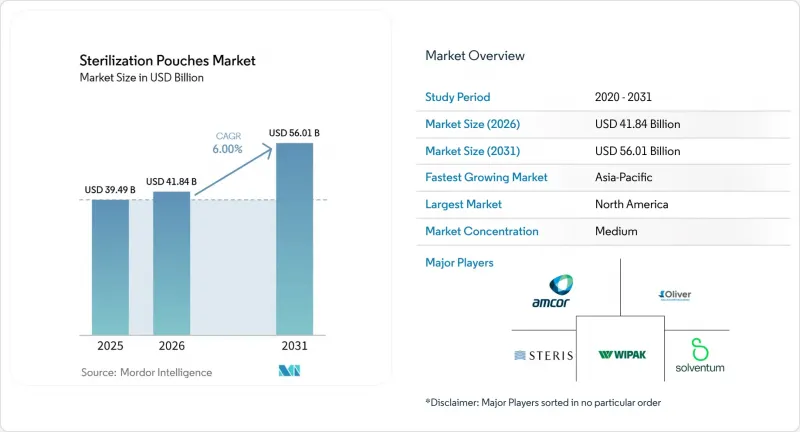
本報告按產品類型(自封袋、熱封袋等)、材料類型(紙/塑膠、Tyvek、不織布等)、應用領域(醫療設備包裝等)、最終用戶(醫院等)和地區(北美、歐洲、亞太、中東和非洲、南美)進行細分。市場預測以美元計價。
全球滅菌袋市場趨勢與洞察
手術數量增加及門診手術範圍擴大
無菌袋市場持續受益於一個基本事實:在任何外科手術中,器械和試劑盒到達手術部位之前都需要無菌屏障。根據世界衛生組織 (WHO) 統計,全球每年進行超過 3 億例手術,為無菌袋市場提供了龐大且穩定的手術使用者基礎。此外,市場需求正在轉變,門診和日間護理機構更傾向於使用體積更小、處理速度更快的無菌袋,而非大規模醫院部門使用的體積較大的無菌袋。這種轉變具有重要的商業性意義,因為門診中心通常按手術次數採購,這有利於分銷商主導的分銷管道,並提高單位盈利。此外,泰國、印度和土耳其等國的醫療旅遊進一步增加了對無菌耗材的地理集中需求,為無菌袋市場在高成長的醫療保健地區提供了新的分銷機會。
監管促進滅菌屏障檢驗
無菌包裝袋市場的發展不僅受基礎包裝材料供應的影響,也受到監管機構對經驗證的無菌屏障系統日益成長的關注。 ISO 11607-1 標準更強調包裝系統設計中的風險管理,這增加了醫療設備製造商及其包裝合作夥伴的文件工作量。
在歐洲,修訂後的EN ISO 11607標準已納入歐盟醫療器材法規(EU MDR)下的協調架構。這意味著在該地區銷售產品的製造商必須確保其包裝合格符合最新版本。因此,整個產品系列的驗證週期正在縮短,商業計畫中的包裝審核也正在提前。因此,在無菌包裝袋市場,能夠提供更快捷的測試支援、更全面的技術文件以及在合格週期中提供更佳指導的供應商將擁有顯著優勢。
成本受限的醫療保健採購中的價格敏感性
在依賴最低價競標公共醫療體系中,無菌包裝袋市場仍面臨價格上限。這種情況在南亞、東南亞、中東和非洲以及南美洲的部分地區尤為突出,這些地區的醫院即使需要標準化包裝,仍然主要以成本為主要合約決策依據。因此,同一國家內部形成了雙重層級構造:高品質、經過驗證的包裝袋供應給私人醫院和跨國醫療設備製造商,而低成本產品則被迫參與公開競標。
因此,服務於市場兩端的供應商都面臨利潤率壓力,因為公共部門的低價已成為更廣泛談判的基準。除非基於ISO 11607標準的文件和驗證品質在採購評估中得到更廣泛的重視,否則無菌包裝袋市場將繼續面臨新興醫療保健系統中價格不均的挑戰。
細分市場分析
到2025年,自封袋的銷售額佔比將達到39.11%,成為無菌包裝袋市場中最大的產品類型。這一地位得益於其顯著的工作流程優勢,例如無需單獨的熱封設備,以及能夠加快醫院、診所和消毒部門的器械週轉速度。扁平包裝袋繼續滿足廣泛的日常包裝需求,仍然是常用器械和套裝的標準選擇。而折疊式包裝袋則發揮不同的作用,用於包裝體積較大的套裝和多成分包裝,這些包裝如果採用扁平設計可能無法完全密封或外觀不佳。
預計到2031年,熱封袋的複合年成長率將達到8.11%,成為無菌包裝袋市場中按產品類型分類成長最快的形式。這一成長反映了熱封袋更強、更穩定的密封強度,使其對實施監控式密封流程的醫院系統和依賴自動化包裝線的醫療設備製造商極具吸引力。鋁箔袋的市場仍然較為狹窄,但在對濕度敏感、需要零滲透屏障(紙質包裝無法提供)的產品中仍扮演著重要角色。捲筒式包裝袋的需求一直穩定,牙科診所和小規模醫療機構需要柔軟性選擇包裝袋長度,而無需大量儲備標準尺寸。總而言之,這些趨勢表明,無菌包裝袋市場正在努力平衡臨床環境中對便利性的需求與基於大規模醫療機構和OEM環境檢驗的、更可控的密封形式。
到2025年,紙塑複合材料將佔無菌包裝袋銷售額的54.30%,在材料層面佔據市場領先地位。其主導地位歸功於其與多種滅菌方法的兼容性,包括蒸氣、環氧乙烷滅菌和伽馬射線滅菌,以及其價格優勢,在許多國家的公共採購預算範圍內。這種材料組合將繼續成為無菌包裝袋市場的主流,滿足大量使用需求,且不會使用戶承擔過高的價格。不織布材料繼續用於需要不同微生物阻隔性能的特定應用,而鋁箔和層壓材料則繼續在對濕度和光線敏感的包裝領域發揮重要作用。
預計到2031年, Tyvek的複合年成長率將達到8.16%,成為無菌包裝袋市場中成長最快的材料。其主要原因在於其結構與低溫滅菌製程的兼容性,尤其是在纖維素紙不適用於過氧化氫蒸氣系統的情況下。杜邦公司在「Tyvek醫療包裝轉型計畫」中投資超過3,000萬美元,顯示其對該材料長期需求的信心。Olympus也將從2026年開始,在其位於日本和越南的工廠中,使用杜邦公司「可再生」認證的Tyvek進行100多種醫療設備類別的無菌包裝,並在採購決策中將阻隔性能與降低二氧化碳排放強度聯繫起來。這一趨勢表明,在無菌包裝袋市場,尤其是在OEM醫療設備包裝專案中,材料的選擇開始從「滅菌相容性」和「永續性」兩個角度進行評估。
區域分析
到2025年,北美將佔全球銷售額的38.80%,成為無菌包裝袋市場最大的區域佔有率。該地區受益於完善的外科醫療基礎設施、成熟的監管執法以及優先考慮已驗證包裝系統的採購慣例流程。大部分需求來自美國,美國嚴格的醫療設備標籤法規和既定的感染控制標準使得未經驗證的包裝形式在醫療採購中幾乎沒有立足之地。加拿大透過其省級政府採購系統持續做出雖小但穩定的貢獻,而墨西哥作為醫療設備製造中心也為市場提供了支持。此外,北美門診手術中心數量的不斷成長也推動了市場成長,因為這些中心創造了越來越多的需要可靠無菌包裝的手術場所,尤其是在高容量環境下。
預計到2031年,亞太地區將以8.06%的複合年成長率成長,成為無菌包裝袋市場成長最快的區域市場。這一成長主要得益於全部區域醫療設備產量的增加,以及中國、印度、日本、韓國和東南亞等地醫院的投資。隨著醫院容量的擴大和對在地採購無菌醫療設備包裝要求的日益嚴格,印度市場的重要性尤其突出。安姆科公司在馬來西亞投資發展局的支持下,於2026年4月在馬來西亞投資3,500萬美元興建醫療包裝塗層工廠,並於2026年6月在印度進行投資。這些投資表明,供應商正在向區域醫療設備製造群靠攏。
歐洲在無菌包裝袋市場中繼續佔有重要的結構性地位,因為歐盟醫療設備法規 (MDR) 強制要求無菌醫療設備包裝必須符合修訂後的 EN ISO 11607 標準。德國和英國憑藉其龐大的醫療手術量和醫療設備製造活動的集中度,成為主要的國內市場。此外,歐盟的包裝和包裝廢棄物法規正在影響材料的長期選擇,引導包裝設計朝著可回收性方向發展,並加強對材料的審查,儘管醫療領域獨特的實際應用情況仍然至關重要。中東、非洲和南美洲仍然是重要的市場,儘管規模較小。海灣合作理事會 (GCC) 國家對醫院的投資支撐了對高級產品的需求,而巴西和阿根廷儘管對採購成本高度敏感,但仍保持著成長動能。
其他好處:
- Excel格式的市場預測(ME)表
- 3個月的分析師支持
目錄
第1章:引言
- 研究假設和市場定義
- 調查範圍
第2章:調查方法
第3章執行摘要
第4章 市場狀況
- 市場概覽
- 市場促進因素
- 手術數量增加及門診手術範圍擴大
- 監管機構促進無菌屏障的驗證
- 醫療設備製造和合約滅菌業務的擴張
- 過渡到一次性、可追溯、無菌包裝
- 擴大低溫滅菌相容包裝袋的使用
- 批次數位化追溯和召回響應準備的要求
- 市場限制因素
- 成本受限的醫療保健採購中的價格敏感性
- 跨多個司法管轄區醫療包裝標準合規負擔
- 由於強制性可回收性和減少廢棄物的要求,替代材料的壓力日益增大。
- 與新型滅菌方法的兼容性限制
- 供應鏈分析
- 監理情勢
- 技術展望
- 波特五力模型
第5章 市場規模與成長預測
- 依產品類型
- 自封袋
- 熱封袋
- 扁平袋
- 有側縫的收納袋
- 鋁箔袋
- 滅菌捲軸和捲筒
- 其他產品類型
- 材料類型
- 紙和塑膠
- Tyvek
- 不織布
- 箔材和層壓材料
- 其他材料類型
- 透過使用
- 醫療設備包裝
- 手術器械包裝
- 牙科器械包裝
- 實驗室耗材包裝
- 藥品包裝
- 獸用器械包裝
- 其他用途
- 最終用戶
- 醫院
- 中央消毒室
- 門診手術中心
- 牙科診所和牙科辦公室
- 醫療設備製造商
- 其他最終用戶
- 按地區
- 北美洲
- 美國
- 加拿大
- 墨西哥
- 歐洲
- 德國
- 英國
- 法國
- 義大利
- 西班牙
- 其他歐洲國家
- 亞太地區
- 中國
- 日本
- 印度
- 澳洲
- 韓國
- 其他亞太國家
- 中東和非洲
- GCC
- 南非
- 其他中東和非洲國家
- 南美洲
- 巴西
- 阿根廷
- 其他南美國家
- 北美洲
第6章 競爭情勢
- 市場集中度
- 市佔率分析
- 公司簡介
- Amcor plc
- Anqing Yipak Packaging Material Co., Ltd.
- Bischof+Klein SE and Co. KG
- Cardinal Health, Inc.
- DuPont de Nemours, Inc.
- Dynarex Corporation
- Euronda SpA
- Getinge AB
- GuardDent
- Hubei Cfull Medical Technology Co., Ltd.
- Konkore Packaging Private Limited
- Oliver Healthcare Packaging
- PMS Healthcare Technologies
- Propper Manufacturing Company, Inc.
- Shanghai Jianzhong Medical Packaging Co., Ltd.
- Solventum Corporation
- Sterimed
- STERIS plc
- Technipaq Inc.
- V-Dent Enterprise
- Wipak Group
第7章 市場機會與未來展望
According to Mordor Intelligence, the sterilization pouches market size was valued at USD 39.49 billion in 2025 and is estimated to grow from USD 41.84 billion in 2026 to reach USD 56.01 billion by 2031, at a CAGR of 6% during the forecast period (2026-2031).
This report is Segmented by Product Type (Self-Seal Pouches, Heat-Seal Pouches, and More), Material Type (Paper and Plastic, Tyvek, Non-Woven Materials, and More), Application (Medical Device Packaging, and More), End-User (Hospitals, and More), and Geography (North America, Europe, Asia-Pacific, Middle East and Africa, South America). The Market Forecasts are Provided in Terms of Value (USD).
Global Sterilization Pouches Market Trends and Insights
Rising Surgical Volumes and Outpatient Procedure Growth
The sterilization pouches market continues to benefit from the basic fact that every surgical procedure needs a sterile barrier before an instrument or kit reaches the point of use. The World Health Organization places annual global surgical volume above 300 million procedures, which gives the sterilization pouches market a large and recurring procedural base. Demand is also shifting in format, because outpatient and ambulatory settings often prefer smaller and faster pouch configurations over bulkier options used in large hospital departments. That shift matters commercially because ambulatory centers tend to buy for per-procedure use, which supports distributor-led channels and stronger unit economics. Medical tourism in countries such as Thailand, India, and Turkey adds another layer of geographically concentrated demand for sterile consumables, which gives the sterilization pouches market new distribution opportunities in high-growth treatment corridors.
Regulatory Push for Sterile Barrier Validation
The sterilization pouches market is also being shaped by a stronger regulatory focus on validated sterile barrier systems rather than basic packaging supply alone. ISO 11607-1 now gives more explicit weight to risk management within packaging system design, which raises the documentation burden for device companies and their packaging partners.
In Europe, amended EN ISO 11607 standards were added to the harmonized framework under the EU MDR, which means manufacturers selling into the region must align packaging qualification with the updated versions. This is compressing validation timelines across product portfolios and bringing packaging review forward in commercial planning. The sterilization pouches market, therefore, favors suppliers that can provide faster test support, stronger technical files, and better guidance during requalification cycles.
Price Sensitivity in Cost-Constrained Healthcare Procurement
The sterilization pouches market still runs into price ceilings in public healthcare systems that rely on lowest-bid tendering. This is especially visible across South Asia, Southeast Asia, the Middle East, Africa, and parts of South America, where hospitals may need compliant packaging but still award contracts mainly on cost. That creates a two-tier structure inside the same country, with premium validated pouches serving private hospitals and multinational device manufacturers, while lower-cost products compete for public tenders.
The result is margin pressure for suppliers that serve both ends of the market, because cheap public-sector pricing becomes a reference point in wider negotiations. Until procurement scoring gives more weight to ISO 11607 documentation and validation quality, the sterilization pouches market will continue to face uneven pricing discipline across emerging healthcare systems.
Other drivers and restraints analyzed in the detailed report include:
- Expansion of Medical Device Manufacturing and Contract Sterilization
- Shift Toward Single-Use, Traceable Sterile Packaging
- Compliance Burden Across Multi-Jurisdiction Medical Packaging Standards
For complete list of drivers and restraints, kindly check the Table Of Contents.
Segment Analysis
Self-seal pouches held 39.11% of revenue in 2025, which made them the largest product category in the sterilization pouches market. Their position rested on clear workflow advantages because they do not require separate heat-sealing equipment, and they support fast instrument turnaround in hospitals, clinics, and sterile processing departments. Flat pouches continued to serve the broad base of routine packaging demand and remained the standard option for common instruments and kits. Gusseted pouches filled a different role by supporting bulkier sets and multi-component packs where flat structures may not seal or present well.
Heat-seal pouches are projected to grow at an 8.11% CAGR through 2031, which makes them the fastest-rising format in the sterilization pouches market size by product type. Their growth reflects stronger and more repeatable seal integrity, which appeals to hospital systems that are adopting monitored sealing workflows and to device manufacturers that rely on automated packaging lines. Foil pouches stayed limited to a narrower niche, but they remained important where moisture-sensitive products need a zero-permeability barrier that paper-based formats cannot provide. Reels and rolls kept steady demand from dental clinics and small healthcare facilities that need flexibility in pouch length without managing a large inventory of pre-made sizes. Together, these patterns show that the sterilization pouches market is balancing convenience-led demand in clinical settings with validation-led adoption of more controlled sealing formats in larger institutions and OEM environments.
Paper and plastic composites accounted for 54.30% of revenue in 2025 and led the sterilization pouches market share at the material level. Their leadership came from broad modality compatibility across steam, ethylene oxide, and gamma sterilization, along with pricing that still fits public procurement budgets in many countries. This material mix remains the workhorse of the sterilization pouches market because it supports high-volume use cases without pushing users into premium cost bands. Non-woven materials continued to serve selected applications where different microbial barrier properties are preferred, while foil and laminated materials kept a specialized role in moisture- and light-sensitive packaging.
Tyvek is forecast to grow at an 8.16% CAGR through 2031, which makes it the fastest-rising material in the sterilization pouches market size by material segment. The main reason is structural compatibility with low-temperature sterilization processes, especially where cellulosic paper is not suitable for vaporized hydrogen peroxide systems. DuPont's investment of more than USD 30 million in its Tyvek Medical Packaging Transition Project underlined the company's confidence in long-term demand for this substrate. Olympus also began incorporating DuPont Tyvek with Renewable Attribution into sterile packaging for more than 100 device categories at facilities in Japan and Vietnam in 2026, linking barrier performance with lower CO2 intensity in procurement decisions. That move suggests the sterilization pouches market is starting to judge material choice on both sterilization compatibility and sustainability credentials, especially in OEM device packaging programs.
Complete Report Scope:
- By Product Type
- Self-Seal Pouches
- Heat-Seal Pouches
- Flat Pouches
- Gusseted Pouches
- Foil Pouches
- Sterilization Reels and Rolls
- Other Product Types
- By Material Type
- Paper and Plastic
- Tyvek
- Non-Woven Materials
- Foil and Laminated Materials
- Other Material Types
- By Application
- Medical Device Packaging
- Surgical Instruments Packaging
- Dental Instruments Packaging
- Laboratory Supplies Packaging
- Pharmaceutical Packaging
- Veterinary Instruments Packaging
- Other Applications
- By End-User
- Hospitals
- Central Sterile Services Departments
- Ambulatory Surgical Centers
- Dental Clinics and Practices
- Medical Device Manufacturers
- Other End-Users
- By Geography
- North America
- United States
- Canada
- Mexico
- Europe
- Germany
- United Kingdom
- France
- Italy
- Spain
- Rest of Europe
- Asia-Pacific
- China
- Japan
- India
- Australia
- South Korea
- Rest of Asia-Pacific
- Middle East and Africa
- GCC
- South Africa
- Rest of Middle East and Africa
- South America
- Brazil
- Argentina
- Rest of South America
- North America
Geography Analysis
North America held 38.80% of global revenue in 2025, which gave it the largest regional position in the sterilization pouches market. The region benefits from dense surgical infrastructure, mature regulatory enforcement, and purchasing practices that place a high value on validated packaging systems. The United States drives most of that demand, supported by strict device labeling rules and established infection-control expectations that leave little room for non-validated formats in institutional purchasing. Canada remained a smaller but stable contributor through provincial procurement systems, while Mexico added support as a medical device manufacturing hub. North America also continues to benefit from an expanding ambulatory surgical center base, which adds new procedural sites that need reliable sterile packaging in high-throughput settings.
Asia-Pacific is forecast to grow at an 8.06% CAGR through 2031, making it the fastest-growing regional segment in the sterilization pouches market. Growth is being supported by hospital investment in China, India, Japan, South Korea, and Southeast Asia, along with rising medical device output across the region. India is also moving higher in importance as hospital capacity grows and sterile medical device packaging requirements tighten in local procurement. Amcor's April 2026 opening of a USD 35 million healthcare packaging coating facility in Malaysia, supported by the Malaysian Investment Development Authority, and its June 2026 investment in India both show how suppliers are building closer to regional device manufacturing clusters.
Europe remained a structurally important part of the sterilization pouches market because the EU MDR ties sterile device packaging to amended EN ISO 11607 compliance. Germany and the United Kingdom stood out as major national markets due to procedure volumes and concentrated medical device manufacturing activity. The EU Packaging and Packaging Waste Regulation is also shaping long-run material choices by pushing packaging design toward recyclability and closer material scrutiny, even though healthcare-specific application realities remain important. Middle East and Africa and South America remained smaller but meaningful, with GCC hospital investment supporting premium demand while Brazil and Argentina continued to grow despite persistent procurement price sensitivity.
- Amcor plc
- Anqing Yipak Packaging Material Co., Ltd.
- Bischof+Klein SE and Co. KG
- Cardinal Health
- DuPont
- Dynarex
- Euronda S.p.A.
- Getinge
- GuardDent
- Hubei Cfull Medical Technology Co., Ltd.
- Konkore Packaging Private Limited
- Oliver Healthcare Packaging
- PMS Healthcare Technologies
- Propper Manufacturing Company, Inc.
- Shanghai Jianzhong Medical Packaging Co., Ltd.
- Solventum Corporation
- Sterimed
- STERIS
- Technipaq Inc.
- V-Dent Enterprise
- Wipak Group
Additional Benefits:
- The market estimate (ME) sheet in Excel format
- 3 months of analyst support
TABLE OF CONTENTS
1 Introduction
- 1.1 Study Assumptions & Market Definition
- 1.2 Scope of the Study
2 Research Methodology
3 Executive Summary
4 Market Landscape
- 4.1 Market Overview
- 4.2 Market Drivers
- 4.2.1 Rising Surgical Volumes and Outpatient Procedure Growth
- 4.2.2 Regulatory Push for Sterile Barrier Validation
- 4.2.3 Expansion of Medical Device Manufacturing and Contract Sterilization
- 4.2.4 Shift Toward Single-Use, Traceable Sterile Packaging
- 4.2.5 Increased Adoption of Low-Temperature Sterilization Compatible Pouches
- 4.2.6 Digitized Lot Traceability and Recall Readiness Requirements
- 4.3 Market Restraints
- 4.3.1 Price Sensitivity in Cost-Constrained Healthcare Procurement
- 4.3.2 Compliance Burden Across Multi-Jurisdiction Medical Packaging Standards
- 4.3.3 Material Substitution Pressure From Recyclability and Waste-Reduction Mandates
- 4.3.4 Compatibility Constraints With Emerging Sterilization Modalities
- 4.4 Supply-Chain Analysis
- 4.5 Regulatory Landscape
- 4.6 Technological Outlook
- 4.7 Porter's Five Forces
- 4.7.1 Threat of New Entrants
- 4.7.2 Bargaining Power of Suppliers
- 4.7.3 Bargaining Power of Buyers
- 4.7.4 Threat of Substitutes
- 4.7.5 Competitive Rivalry
5 Market Size & Growth Forecasts (Value in USD)
- 5.1 By Product Type
- 5.1.1 Self-Seal Pouches
- 5.1.2 Heat-Seal Pouches
- 5.1.3 Flat Pouches
- 5.1.4 Gusseted Pouches
- 5.1.5 Foil Pouches
- 5.1.6 Sterilization Reels and Rolls
- 5.1.7 Other Product Types
- 5.2 By Material Type
- 5.2.1 Paper and Plastic
- 5.2.2 Tyvek
- 5.2.3 Non-Woven Materials
- 5.2.4 Foil and Laminated Materials
- 5.2.5 Other Material Types
- 5.3 By Application
- 5.3.1 Medical Device Packaging
- 5.3.2 Surgical Instruments Packaging
- 5.3.3 Dental Instruments Packaging
- 5.3.4 Laboratory Supplies Packaging
- 5.3.5 Pharmaceutical Packaging
- 5.3.6 Veterinary Instruments Packaging
- 5.3.7 Other Applications
- 5.4 By End-User
- 5.4.1 Hospitals
- 5.4.2 Central Sterile Services Departments
- 5.4.3 Ambulatory Surgical Centers
- 5.4.4 Dental Clinics and Practices
- 5.4.5 Medical Device Manufacturers
- 5.4.6 Other End-Users
- 5.5 By Geography
- 5.5.1 North America
- 5.5.1.1 United States
- 5.5.1.2 Canada
- 5.5.1.3 Mexico
- 5.5.2 Europe
- 5.5.2.1 Germany
- 5.5.2.2 United Kingdom
- 5.5.2.3 France
- 5.5.2.4 Italy
- 5.5.2.5 Spain
- 5.5.2.6 Rest of Europe
- 5.5.3 Asia-Pacific
- 5.5.3.1 China
- 5.5.3.2 Japan
- 5.5.3.3 India
- 5.5.3.4 Australia
- 5.5.3.5 South Korea
- 5.5.3.6 Rest of Asia-Pacific
- 5.5.4 Middle East and Africa
- 5.5.4.1 GCC
- 5.5.4.2 South Africa
- 5.5.4.3 Rest of Middle East and Africa
- 5.5.5 South America
- 5.5.5.1 Brazil
- 5.5.5.2 Argentina
- 5.5.5.3 Rest of South America
- 5.5.1 North America
6 Competitive Landscape
- 6.1 Market Concentration
- 6.2 Market Share Analysis
- 6.3 Company Profiles {(includes Global level Overview, Market level overview, Core Segments, Financials as available, Strategic Information, Market Rank/Share for key companies, Products & Services, and Recent Developments)}
- 6.3.1 Amcor plc
- 6.3.2 Anqing Yipak Packaging Material Co., Ltd.
- 6.3.3 Bischof+Klein SE and Co. KG
- 6.3.4 Cardinal Health, Inc.
- 6.3.5 DuPont de Nemours, Inc.
- 6.3.6 Dynarex Corporation
- 6.3.7 Euronda S.p.A.
- 6.3.8 Getinge AB
- 6.3.9 GuardDent
- 6.3.10 Hubei Cfull Medical Technology Co., Ltd.
- 6.3.11 Konkore Packaging Private Limited
- 6.3.12 Oliver Healthcare Packaging
- 6.3.13 PMS Healthcare Technologies
- 6.3.14 Propper Manufacturing Company, Inc.
- 6.3.15 Shanghai Jianzhong Medical Packaging Co., Ltd.
- 6.3.16 Solventum Corporation
- 6.3.17 Sterimed
- 6.3.18 STERIS plc
- 6.3.19 Technipaq Inc.
- 6.3.20 V-Dent Enterprise
- 6.3.21 Wipak Group
7 Market Opportunities & Future Outlook
- 7.1 White-space & unmet-need assessment

 2026年全球熱封滅菌袋市場報告
 全球自封袋市場規模、佔有率、成長和行業分析:按材料類型、應用和地區分類,預測至2034年
 機上消毒技術市場-2026-2032年全球市場預測
 氣化過氧化氫傳遞箱市場:按類型、應用、最終用戶、分銷管道、國家和地區分類-全球產業分析、市場規模、市場佔有率及2026年至2033年預測電子束滅菌市場:依加速器類型、服務供應商、設施模式、最終用戶產業和應用分類-2026-2032年全球市場預測
 無菌包裝袋市場規模、佔有率和成長分析:按產品類型、材料類型、應用、最終用途產業和地區分類-2026-2033年產業預測2026年全球臭氧滅菌系統市場報告
 細菌過濾器市場:按設備類型、應用、技術、最終用戶和地區分類2026年全球噴霧消毒機器人市場報告細菌過濾器市場:按產品類型、材料類型、應用和最終用戶分類-2026-2032年全球市場預測