


 |
市場調查報告書
商品編碼
2099949
玻璃纖維隔板:市場佔有率分析、行業趨勢和統計數據、成長預測(2026-2031 年)Glass Mat - Market Share Analysis, Industry Trends & Statistics, Growth Forecasts (2026 - 2031) |
||||||

※ 本網頁內容可能與最新版本有所差異。詳細情況請與我們聯繫。
根據 Mordor Intelligence 預測,玻璃纖維隔板市場規模將從 2025 年的 15.3 億美元成長到 2026 年的 16.2 億美元,到 2031 年達到 20.7 億美元,2026 年至 2031 年的複合年成長率為 5.02%。
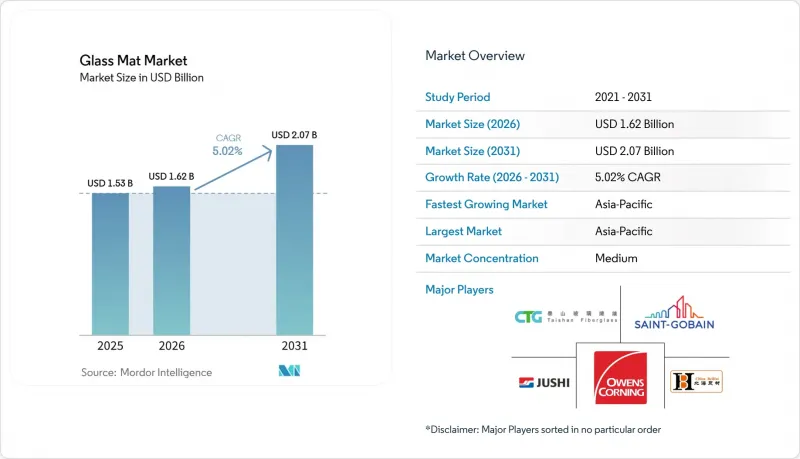
本報告按氈類型(切股氈和連續纖維絲氈)、黏合劑類型(例如,粉末黏合玻璃纖維氈)、製造流程(例如,濕法成網成網)、終端用戶產業(例如,風力發電)以及地區(亞太地區、北美地區、歐洲地區、南美地區以及中東和非洲地區)進行細分。市場預測以美元計價。
全球玻璃纖維隔板市場趨勢及洞察
建築和基礎設施擴建
建築業仍然是玻璃纖維氈市場最大的需求領域。這種材料用於石膏板加固、屋頂防水卷材基材以及玻璃纖維增強混凝土板。在美國,基礎設施投資持續推動對輕質高耐久性加強板的需求,即使在嚴苛的使用條件下也能維持性能穩定。這一需求趨勢意義重大,因為玻璃纖維氈市場不僅依賴高階結構複合材料,也受益於對更穩定、更廣泛用途的建材的持續需求。建築和板材應用領域的買家越來越重視表面光潔度、單位面積重量和纖維均勻性,這使得部分需求轉向了可控性更高的產品等級。對於玻璃纖維氈市場而言,建築業銷售量的成長正促使企業改進產品組合,而非僅依賴低價值的通用產品。這也鞏固了重視產品連續性、品質穩定和可靠本地供應鏈的建材製造商以及能夠調整玻璃纖維氈產量的供應商的地位。
風力發電設施擴建
風電是玻璃纖維氈市場中成長最快的終端應用領域,這主要得益於大型葉片的普及,而大型葉片對每颱風力發電機的加固需求也更高。連續長絲型玻璃纖維氈最能受益於葉片應用中對尺寸穩定性、結構一致性和可重複層壓性能的需求。這進一步凸顯了長期產品品質的重要性,而不僅僅是名目產能,因為葉片製造商所需的產品能夠滿足更嚴格的認證和製程要求。玻璃纖維氈市場的需求正在轉向更傾向於擁有專業製造能力、認證記錄和可靠生產線管理的製造商的供應合約。在歐洲,擴大風電部署的政策支持持續推動複合材料在葉片製造領域的應用。在各個地區,玻璃纖維氈市場不僅受益於風力發電機安裝數量的增加,還受益於大型葉片帶來的材料用量增加以及離岸風力發電設計更嚴格的要求。
玻璃纖維原料價格波動
原料價格波動仍是玻璃纖維氈市場面臨的一大壓力。這是因為,如果生產商不能有效管理上游纖維產能,加工利潤率就會受到影響。在客戶預期價格與大宗商品價格持平,而纖維投入成本波動速度卻快於合約續約週期的領域,這個問題尤其突出。不同供應商受到的影響並不相同,垂直整合的製造商比獨立加工商更能有效吸收和管理價格波動。實際上,當採購條件趨於嚴格或庫存積壓高成本時,小規模、整合程度較低的企業所面臨的市場環境將會更加嚴峻。這會降低客戶的定價柔軟性,削弱企業增加銷售量的動力,並可能使那些與熔爐關係密切或擁有長期供應合約的供應商佔據優勢。即使下游需求強勁,策略性地管理原料採購仍是玻璃纖維氈市場競爭的關鍵因素。
細分市場分析
到2025年,切股氈將佔纖維氈總需求的62.70%,成為建築、船舶和一般工業應用領域玻璃纖維氈市場的主要組成部分。其強勁的市場地位源自於其與常用聚酯和乙烯基酯樹脂體系的兼容性,以及其經濟的生產特性,使其能夠滿足各種產品規格要求。加工商在優先考慮開模加工、成本控制和材料熟悉度而非精確結構性能的場合,仍然依賴短切纖維產品。這使得短切纖維氈在屋面板、管道組件、船舶部件和通用增強塑膠組件等領域擁有根深蒂固的地位。這種大規模的應用為玻璃纖維氈市場提供了韌性,確保了即使在高成長應用領域日益突出的情況下,替換週期和持續加工需求仍然存在。
預計到2031年,連續纖維絲氈的複合年成長率將達到8.33%,使其成為玻璃纖維氈行業中結構和機械驅動成型工藝領域成長最快的產品形式。這種成長在風力渦輪機葉片和汽車結構面板領域將最為顯著,因為纖維的連續性和尺寸控制直接影響層壓板的性能和製程可靠性。由於客戶的認證和批准要求以及長期的製程穩定性,經認證的供應商與客戶保持著牢固的合作關係,因此該領域的需求受現貨價格日常波動的影響較小。此外,與通用替代品相比,這些產品需要更嚴格的製程窗口、更高的成型一致性和更嚴格的品管,這限制了供應商的選擇。隨著玻璃纖維氈市場不斷向自動化和結構複合材料應用領域轉型,預計在預測期內,連續長絲氈的重要性將進一步提升,儘管切股氈仍將佔據最大的收入基礎。
預計到2025年,乳液黏合玻璃纖維氈將在黏合劑領域佔據58.72%的市場。這反映了其在船舶、建築和麵板應用領域的手工積層工藝中長期應用。其優勢地位源於其柔軟性和良好的懸垂性,這有助於製造商將材料貼合到複雜形狀,同時降低氣泡產生的風險。因此,乳液黏合產品尤其適用於那些手工操作仍是製程選擇關鍵因素的形狀,例如船體和曲面面板。此外,客戶的熟悉度也是該領域的一大利好,因為許多成熟的製造商已經採用了針對這種規格最佳化的樹脂系統和製程。在玻璃纖維氈市場,即使新的製造流程不斷發展,現有的加工基礎也將繼續支撐對乳液黏合產品的需求。
由於粉末黏結玻璃纖維氈與閉模成型和連續生產系統具有高度相容性,預計到2031年,其複合年成長率將達到7.84%。這種形式尤其適用於需要快速潤濕和更高樹脂滲透性的應用,從而能夠嚴格遵守生產週期,例如樹脂轉注成形、壓縮模塑和連續板材生產。此外,粉末黏結劑的化學性質使其具有優異的水解穩定性,因此非常適合化學品儲存以及需要在水下使用且具有抗濕劣化的應用。減少排放和更嚴格控制成型條件的趨勢也進一步推動了這一成長,因為這些優先事項與粉末黏結劑產品的特性比傳統開模成型方法更為契合。因此,預計玻璃纖維氈市場的黏結配方將持續發展以適應製造流程的變化,而不是簡單地在所有應用中取代舊產品。
區域分析
預計到2025年,亞太地區將佔全球玻璃纖維氈需求的46.94%,並在2031年之前以8.22%的複合年成長率成長,成為全球最大且成長最快的玻璃纖維氈區域市場。該地區受益於其密集的複合材料製造生態系統、強大的風電基礎設施以及玻璃纖維供應與下游加工之間的緊密協調。中國在這一市場中佔據核心地位,憑藉其一體化的供應鏈和大規模的增強材料製造地,為該地區的成本效益和供應穩定性提供了保障。中國玻璃纖維生產商不斷提升的產能和投資活動進一步鞏固了該地區在下游玻璃纖維氈供應穩定性和產品開發方面的重要性。日本和韓國則憑藉其技術密集型生產和特種材料製造能力,為該地區高性能行業的需求做出了貢獻。
北美仍然是一個穩定且具有重要戰略意義的區域市場,石膏板、屋頂瓦和增強型建築板材等建材繼續佔據玻璃纖維氈出貨量的很大一部分。該地區市場也受益於為確保本地供應鏈所做的努力,從而減少了對關鍵增強材料長途採購的依賴。 2026年4月,隨著歐文斯科寧公司將其玻璃纖維增強業務轉讓給普拉納集團,商業環境發生了變化。該業務現以Original Composites & Fibers的名義運營,在北美地區誕生了一家新的獨立競爭對手。這項變更可能會影響客戶對該全部區域供應連續性、產品系列方向和未來投資的評估。風電仍然是一個不斷成長的區域市場,儘管規模較小,但國內供應商已做好準備,滿足未來葉片和離岸風力發電項目對高性能複合材料的需求。
歐洲憑藉在風力渦輪機葉片、建築複合材料製造領域的領先地位,以及日益重視流程管理和永續性的法規環境,在玻璃纖維氈市場佔有舉足輕重的地位。該地區的採購組合正變得更加精細化,尤其是在風能相關複合材料領域,因為可回收性和使用後處置在工業決策中變得越來越重要。儘管南美和中東及非洲的市場規模仍然小規模,但受基礎設施建設、產業多元化和可再生能源項目推動的複合材料使用量增加的驅動,這三個地區都擁有巨大的成長空間。因此,玻璃纖維氈市場的地域構成以亞太地區為中心,同時北美和歐洲主導的特種市場也保持著穩定的需求,這些市場正日益受到永續性要求和技術資質標準的限制。
其他好處:
- Excel格式的市場預測(ME)表
- 3個月的分析師支持
目錄
第1章:引言
- 研究假設和市場定義
- 調查範圍
第2章:調查方法
第3章執行摘要
第4章 市場狀況
- 市場概覽
- 市場促進因素
- 對建築和基礎設施發展的需求
- 汽車和運輸領域輕質複合材料的廣泛應用
- 擴大風能和可再生能源的引入
- 向高性能應用過渡到連續纖維絲氈
- 對經濟高效的複合材料增強材料的需求日益成長
- 市場限制因素
- 玻璃纖維和黏合劑原料價格的波動
- 在價格敏感型應用中替換增強材料
- 複合材料的回收和使用後管理有其限制。
- 價值鏈分析
- 波特五力分析
第5章 市場規模與成長預測
- 按墊子類型
- 切股氈
- 連續纖維絲氈
- 按黏合劑類型
- 粉末黏合玻璃纖維
- 乳液黏合玻璃纖維
- 透過製造程序
- 濕成型法
- 連續絲法
- 短切法
- 按最終用戶行業分類
- 建築和基礎設施
- 汽車和運輸業
- 風力
- 海上
- 運動和休閒用品
- 產業
- 其他用途
- 按地區
- 亞太地區
- 中國
- 印度
- 日本
- 韓國
- 其他亞太國家
- 北美洲
- 美國
- 加拿大
- 墨西哥
- 歐洲
- 德國
- 英國
- 法國
- 義大利
- 俄羅斯
- 其他歐洲國家
- 南美洲
- 巴西
- 阿根廷
- 其他南美國家
- 中東和非洲
- 沙烏地阿拉伯
- 南非
- 其他中東和非洲國家
- 亞太地區
第6章 競爭情勢
- 市場集中度
- 策略趨勢
- 市佔率和排名分析
- 公司簡介
- 3B-the fibreglass company
- Ahlstrom
- China Beihai Fiberglass Co., Ltd.
- China Jushi Co., Ltd.
- Chongqing Polycomp International Corporation
- Fibretech Industries
- Jiangsu Changhai Composite Materials Co., Ltd.
- Johns Manville
- Nippon Electric Glass Co., Ltd.
- Nittobo
- Owens Corning
- Saint-Gobain
- Superior Huntingdon Composites Co., LLC
- Taishan Fiberglass Inc.(CTG)
- Taiwan Glass Ind Corp.
第7章 市場機會與未來展望
According to Mordor Intelligence, the glass mat market size is expected to increase from USD 1.53 billion in 2025 to USD 1.62 billion in 2026 and reach USD 2.07 billion by 2031, and is expected to grow at a CAGR of 5.02% over 2026-2031.
This report is Segmented by Mat Type (Chopped Strand Mat and Continuous Filament Mat), Binder Type (Powder Bonded Glass Mat and More), Manufacturing Process (Wet-Laid Process and More), End-User Industry (Wind Energy and More), and Geography (Asia-Pacific, North America, Europe, South America, and Middle-East and Africa). The Market Forecasts are Provided in Terms of Value (USD).
Global Glass Mat Market Trends and Insights
Construction and Infrastructure Expansion
Construction remains the largest demand segment for the glass mat market. The material is used in gypsum board reinforcement, roofing membrane substrates, and glass fiber-reinforced concrete panels. In the United States, infrastructure spending has continued to support applications that require lighter reinforced panels with strong durability in demanding service conditions. This demand profile is significant because the glass mat market does not rely solely on high-visibility structural composites; it also benefits from recurring building product demand that tends to be more stable and widely distributed. Buyers in architectural and panel applications are placing greater emphasis on surface finish, lower areal weight, and tighter fiber uniformity, which shifts part of the demand base toward better-controlled product grades. For the glass mat market, volume growth in construction can increasingly support product mix improvement rather than relying solely on low-value commodity sales. This also strengthens the position of suppliers that can align mat output with building product manufacturers that value continuity, quality consistency, and localized supply reliability.
Expansion of Wind Energy Installations
Wind energy is the fastest-growing end-use segment in the glass mat market, driven directly by larger blade formats that require more reinforcement material per installed turbine. Continuous filament formats benefit the most, as blade applications require dimensional stability, structural consistency, and repeatable laminate performance. This raises the importance of long-run production quality, not just nominal capacity, because blade manufacturers require products that meet tighter approval and process requirements. The glass mat market is seeing demand shift toward supply agreements that favor producers with specialty capability, established qualification history, and reliable line control. In Europe, policy support for expanded wind deployment continues to reinforce sustained composite consumption in blade manufacturing. Across regions, the glass mat market benefits not only from higher turbine installation volumes, but also from the greater material intensity associated with blade scaling and more demanding offshore designs.
Volatility in Glass Fiber Feedstock Prices
Feedstock price movements remain an immediate pressure point for the glass mat market, as conversion margins are exposed when producers do not control upstream fiber capacity. This issue is particularly relevant in segments where customers expect commodity pricing, but fiber input costs move faster than contract reset cycles. The effect is not uniform across suppliers, as integrated manufacturers can absorb or manage volatility more effectively than independent converters. In practical terms, market conditions become more challenging for smaller and non-integrated participants when buying conditions tighten or when inventory must be built at elevated cost. This can narrow flexibility in customer pricing, reduce willingness to pursue volume, and favor suppliers with stronger furnace linkages or long-term supply arrangements. Strategic control of raw material access remains a central competitive factor in the glass mat market, even when downstream demand conditions are supportive.
Other drivers and restraints analyzed in the detailed report include:
- Rising Adoption of Lightweighting in Automotive and Transportation
- Shift Toward Continuous Filament Production and Automation-Compatible Mat Formats
- Substitution by Alternative Composite Materials
For complete list of drivers and restraints, kindly check the Table Of Contents.
Segment Analysis
Chopped strand mat retained 62.70% of mat-type demand in 2025, making it the volume foundation of the glass mat market across construction, marine, and general industrial uses. Its established position stems from compatibility with common polyester and vinyl ester resin systems, as well as production economics that support broad output across many product specifications. Fabricators continue to rely on chopped strand products where open-mold processing, cost control, and material familiarity matter more than precision structural performance. This keeps the segment deeply embedded in roofing panels, pipe sections, boat components, and general-purpose reinforced plastic parts. Within the glass mat market, this large installed base provides resilience, as replacement cycles and recurring fabrication needs persist even as higher-growth applications receive more attention.
Continuous filament mat is projected to grow at an 8.33% CAGR through 2031, making it the fastest-growing product format in the glass mat industry for structural and machine-driven fabrication routes. Its gains are strongest in wind blades and automotive structural panels, where fiber continuity and dimensional control directly affect laminate behavior and process reliability. Demand in this segment is less exposed to daily spot pricing because customer qualification, certification requirements, and long-run process stability give approved suppliers a stronger hold on accounts. The supplier pool is also narrower, since these products require tighter process windows, better forming consistency, and more disciplined quality control than commodity alternatives. As the glass mat market continues to shift toward automation and structural composite use, continuous filament formats are expected to gain further importance, even if chopped strand mat remains the larger revenue base over the forecast period.
Emulsion-bonded glass mat led the binder segment with 58.72% share in 2025, reflecting its long-standing use in hand lay-up processes across marine, construction, and panel applications. Its established position stems from its softness and drapeability, which help fabricators conform the material to complex shapes without increasing the risk of air entrapment. This makes emulsion-bonded products a practical fit for boat hulls, curved panels, and other geometries where manual handling still drives process choice. The segment also benefits from customer familiarity, as many established fabrication shops already run resin systems and workflows optimized for this format. In the glass mat market, the installed processing base helps protect emulsion-bonded demand even as newer process routes expand.
Powder-bonded glass mat is projected to grow at a 7.84% CAGR through 2031, supported by a better fit with closed-mold and continuous production systems. The format is favored where faster wet-out and higher resin permeability support cycle-time discipline, particularly in resin transfer molding, compression molding, and continuous panel production. Powder binder chemistry also offers greater hydrolytic stability, which is beneficial in chemical storage and submerged-service applications that require resistance to moisture-related degradation. The broader shift toward lower emissions and more controlled molding conditions provides additional support, as those priorities align more closely with the characteristics of powder-bonded products than with traditional open-mold methods. As a result, the binder mix in the glass mat market is likely to evolve in line with manufacturing methods rather than through a straightforward replacement of older products across all applications.
Complete Report Scope:
- By Mat Type
- Chopped Strand Mat
- Continuous Filament Mat
- By Binder Type
- Powder Bonded Glass Mat
- Emulsion Bonded Glass Mat
- By Manufacturing Process
- Wet-Laid Process
- Continuous Filament Process
- Chopped Strand Process
- By End-User Industry
- Construction and Infrastructure
- Automotive and Transportation
- Wind Energy
- Marine
- Sports and Leisure Goods
- Industrial
- Other End-Use
- By Geography
- Asia-Pacific
- China
- India
- Japan
- South Korea
- Rest of Asia-Pacific
- North America
- United States
- Canada
- Mexico
- Europe
- Germany
- United Kingdom
- France
- Italy
- Russia
- Rest of Europe
- South America
- Brazil
- Argentina
- Rest of South America
- Middle-East and Africa
- Saudi Arabia
- South Africa
- Rest of Middle-East and Africa
- Asia-Pacific
Geography Analysis
Asia-Pacific accounted for 46.94% of global demand in 2025 and is projected to grow at an 8.22% CAGR through 2031, making it the largest and fastest-growing regional market for glass mats. The region benefits from a dense composite manufacturing ecosystem, a strong wind equipment base, and close linkages between glass fiber supply and downstream fabrication. China remains central to this position, as its integrated supply chain and large-scale reinforcement manufacturing footprint support both cost efficiency and regional availability. Capacity additions and investment activity by Chinese glass fiber producers reinforce the region's importance for downstream mat availability and product development. Japan and South Korea contribute through more technology-intensive production and specialty-material capabilities, supporting the higher-performance end of regional demand.
North America remains a stable and strategically important regional market, as building products continue to absorb a meaningful share of glass mat volumes through gypsum board, shingles, and reinforced construction panels. The regional market also benefits from efforts to secure local supply, reducing reliance on long-distance sourcing for critical reinforcement inputs. The April 2026 transfer of Owens Corning's glass reinforcements business to Praana Group has changed the operating landscape; the business now operates as Original Composites and Fibers, creating a new standalone competitor with North American assets. This change may influence how customers evaluate supply continuity, portfolio direction, and future investment across the region. Wind energy remains a smaller but expanding regional outlet, and domestic suppliers are positioning for higher-performance composite demand tied to future blade and offshore project requirements.
Europe holds a meaningful position in the glass mat market through wind blade manufacturing, construction composites, and a regulatory environment that increasingly values process control and sustainability. The region's procurement mix is becoming more selective as recyclability and end-of-life handling gain visibility in industrial decision-making, particularly for wind-related composites. South America, the Middle East, and Africa remain smaller markets, but all three regions offer room for expansion where infrastructure activity, industrial diversification, and renewable energy projects are increasing composite use. The geographic profile of the glass mat market therefore combines a dominant Asia-Pacific core with steady North American demand and a Europe-led specialty base that is increasingly shaped by sustainability requirements and technical qualification standards.
- 3B - the fibreglass company
- Ahlstrom
- China Beihai Fiberglass Co., Ltd.
- China Jushi Co., Ltd.
- Chongqing Polycomp International Corporation
- Fibretech Industries
- Jiangsu Changhai Composite Materials Co., Ltd.
- Johns Manville
- Nippon Electric Glass Co., Ltd.
- Nittobo
- Owens Corning
- Saint-Gobain
- Superior Huntingdon Composites Co., LLC
- Taishan Fiberglass Inc.(CTG)
- Taiwan Glass Ind Corp.
Additional Benefits:
- The market estimate (ME) sheet in Excel format
- 3 months of analyst support
TABLE OF CONTENTS
1 Introduction
- 1.1 Study Assumptions and Market Definition
- 1.2 Scope of the Study
2 Research Methodology
3 Executive Summary
4 Market Landscape
- 4.1 Market Overview
- 4.2 Market Drivers
- 4.2.1 Construction and Infrastructure Reinforcement Demand
- 4.2.2 Rising Adoption of Lightweight Composites in Automotive and Transportation
- 4.2.3 Expansion of Wind Energy and Renewable Energy Installations
- 4.2.4 Shift Toward Continuous Filament Mat in High-Performance Uses
- 4.2.5 Growing Demand for Cost-Effective Composite Reinforcement Materials
- 4.3 Market Restraints
- 4.3.1 Volatility in Glass Fiber and Binder Raw Material Prices
- 4.3.2 Substitution by Alternative Reinforcement Materials in Price-Sensitive Applications
- 4.3.3 Limited Recycling and End-of-Life Management of Composite Materials
- 4.4 Value Chain Analysis
- 4.5 Porter's Five Forces Analysis
- 4.5.1 Threat of New Entrants
- 4.5.2 Bargaining Power of Suppliers
- 4.5.3 Bargaining Power of Buyers
- 4.5.4 Threat of Substitutes
- 4.5.5 Competitive Rivalry
5 Market Size and Growth Forecasts (Value)
- 5.1 By Mat Type
- 5.1.1 Chopped Strand Mat
- 5.1.2 Continuous Filament Mat
- 5.2 By Binder Type
- 5.2.1 Powder Bonded Glass Mat
- 5.2.2 Emulsion Bonded Glass Mat
- 5.3 By Manufacturing Process
- 5.3.1 Wet-Laid Process
- 5.3.2 Continuous Filament Process
- 5.3.3 Chopped Strand Process
- 5.4 By End-User Industry
- 5.4.1 Construction and Infrastructure
- 5.4.2 Automotive and Transportation
- 5.4.3 Wind Energy
- 5.4.4 Marine
- 5.4.5 Sports and Leisure Goods
- 5.4.6 Industrial
- 5.4.7 Other End-Use
- 5.5 By Geography
- 5.5.1 Asia-Pacific
- 5.5.1.1 China
- 5.5.1.2 India
- 5.5.1.3 Japan
- 5.5.1.4 South Korea
- 5.5.1.5 Rest of Asia-Pacific
- 5.5.2 North America
- 5.5.2.1 United States
- 5.5.2.2 Canada
- 5.5.2.3 Mexico
- 5.5.3 Europe
- 5.5.3.1 Germany
- 5.5.3.2 United Kingdom
- 5.5.3.3 France
- 5.5.3.4 Italy
- 5.5.3.5 Russia
- 5.5.3.6 Rest of Europe
- 5.5.4 South America
- 5.5.4.1 Brazil
- 5.5.4.2 Argentina
- 5.5.4.3 Rest of South America
- 5.5.5 Middle-East and Africa
- 5.5.5.1 Saudi Arabia
- 5.5.5.2 South Africa
- 5.5.5.3 Rest of Middle-East and Africa
- 5.5.1 Asia-Pacific
6 Competitive Landscape
- 6.1 Market Concentration
- 6.2 Strategic Moves
- 6.3 Market Share (%)/Ranking Analysis
- 6.4 Company Profiles (includes Global Overview, Market Overview, Core Segments, Financials as available, Strategic Information, Products and Services, and Recent Developments)
- 6.4.1 3B - the fibreglass company
- 6.4.2 Ahlstrom
- 6.4.3 China Beihai Fiberglass Co., Ltd.
- 6.4.4 China Jushi Co., Ltd.
- 6.4.5 Chongqing Polycomp International Corporation
- 6.4.6 Fibretech Industries
- 6.4.7 Jiangsu Changhai Composite Materials Co., Ltd.
- 6.4.8 Johns Manville
- 6.4.9 Nippon Electric Glass Co., Ltd.
- 6.4.10 Nittobo
- 6.4.11 Owens Corning
- 6.4.12 Saint-Gobain
- 6.4.13 Superior Huntingdon Composites Co., LLC
- 6.4.14 Taishan Fiberglass Inc.(CTG)
- 6.4.15 Taiwan Glass Ind Corp.
7 Market Opportunities and Future Outlook
- 7.1 White-Space and Unmet-Need Assessment

 玻璃纖維氈材料市場-2026-2032年全球市場預測玻璃纖維隔板市場:2026-2032年全球市場預測(按材料、產品類型、黏合劑、應用和分銷管道分類)
 玻璃纖維氈市場規模、佔有率和成長分析(按氈類型、黏合劑類型、製造流程、應用、最終用途產業和地區分類)-2026-2033年產業預測玻璃纖維防水氈市場按類型、產品形式、等級、應用和最終用途產業分類,全球預測(2026-2032年)
 全球玻璃纖維氈市場:預測至2032年-按產品類型、黏合劑類型、基重、製造技術、應用、最終用戶和地區進行分析
 玻璃墊市場-全球產業規模、佔有率、趨勢、機會及預測,按類型、應用、最終用戶、地區及競爭情況細分,2020-2030 年
 玻璃墊市場機會、成長動力、產業趨勢分析及 2025 - 2034 年預測