

 |
市場調查報告書
商品編碼
2099930
網路和通訊設備用DRAM:市場佔有率分析、行業趨勢和統計數據以及成長預測(2026-2031年)DRAM For Networking and Telecom Equipment - Market Share Analysis, Industry Trends & Statistics, Growth Forecasts (2026 - 2031) |
||||||

※ 本網頁內容可能與最新版本有所差異。詳細情況請與我們聯繫。
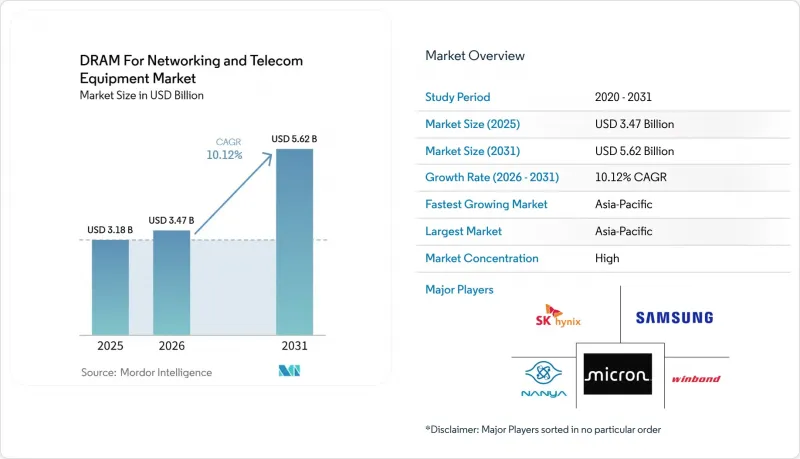
根據 Mordor Intelligence 預測,網路和通訊設備中 DRAM 的市場規模預計將在 2025 年達到 32 億美元,2026 年達到 35 億美元,到 2031 年達到 56 億美元,2026 年至 2031 年的複合年成長率為 10.1%。
本報告按類型(SDRAM、DDR、DDR2、DDR3、DDR4、DDR5)、產品形式(DRAM IC、DRAM 模組(UDIMM、RDIMM/LRDIMM))、外形尺寸(嵌入式 DRAM、記憶體模組)、功能(標準 DRAM、低功耗 DRAM)和地區(北美、歐洲、亞太地區及其他地區)進行細分。市場預測以美元(USD)為單位。
網路和通訊設備DRAM的全球趨勢與洞察
擴大5G和先進網路的部署
隨著5G的擴展和先進網路部署的推進,網路和通訊設備DRAM市場中,路由器、交換器、基頻單元和邊緣運算節點的記憶體需求都在不斷成長。由於Open RAN和虛擬化功能對伺服器架構的依賴性增強,通訊基礎架構中DRAM的密度也隨之提高,因此這種變化比以往的行動通訊技術更為顯著。這種變化正在推動商用平台採用新型內存,這些平台必須同時支援軟體工作負載和傳輸功能,即使在出貨量全面擴展之前,也能提升內容價值。 KDDI於2025年2月完成了分散式解耦骨幹路由器叢集的技術檢驗,並將於2026年開始大規模商用部署。這表明,通訊業者的骨幹網路升級正在增加每個節點的記憶體需求。 3GPP和ETSI等標準化組織正在持續制定平台要求,確保網路和通訊設備DRAM市場的供應商認證與長期網路投資週期緊密相關。隨著通訊業者大力推動 5G 覆蓋範圍擴大和網路智慧化,擁有通訊業DDR4 和 DDR5產品系列的供應商將處於有利地位,以確保在整個預測期內獲得更穩定的設計採用。
路由器和交換器對記憶體密度的需求日益成長
路由器和交換器對記憶體密度日益成長的需求,推動了網路和通訊設備DRAM市場中高容量配置的價值。如今,網路設備必須在硬體平台上容納大規模的路由表、更強大的軟體控制功能以及基於人工智慧的流量管理,而這些硬體平台仍然面臨嚴格的可靠性和散熱限制。這種壓力迫使供應商同時支援多代DRAM,因為即使新平台在頻寬和容量方面不斷發展,客戶仍需要現有系統的連續性。 2026年6月,博通推出了BCM677x系列,支援DDR4、DDR5、LPDDR4和LPDDR5,反映了下一代路由器和5G固定無線存取設備對靈活記憶體選擇的需求。因此,網路和通訊設備DRAM市場不僅受益於出貨量的成長,也受益於容量的擴展和架構的柔軟性。能夠在不影響現場可靠性的前提下獲得高密度模組和嵌入式設計認證的供應商,在產品更新換代週期中,由於運作和兼容性比最高速度更為重要,很可能會繼續受到青睞。
優先保障 HBM 和 AI 伺服器的資源供應。
儘管市場基本面強勁,但由於優先供應HBM和AI伺服器,網路和通訊設備DRAM市場的供應速度受到限制。問題不在於網路相關支出疲軟,而是先進製造資源被重新分配到價格更高、預期短期成長較慢的AI記憶體產品。三星於2026年2月開始量產HBM4,導致業界更加關注高頻寬記憶體項目,而此時通訊設備買家仍需要傳統的DRAM產品線。隨著最先進的產能進一步朝這一方向轉移,通訊設備買家在網路和通訊設備DRAM市場中面臨傳統DDR4和DDR5系列產品日益緊張的供應局面。因此,規劃週期不斷延長,確保早期供應的壓力越來越大,對擁有廣泛產品藍圖和強大分配管理能力的大型供應商的依賴性也越來越強。對於需要跨多個平台世代穩定供應的設備製造商而言,這項限制是一個關鍵問題。因為每次記憶體供應緊張時,重新設計已認證的系統並非易事。
細分市場分析
2025年,DDR4在網路和通訊設備DRAM市場中佔據58.2%的佔有率。這反映了基於DDR4供應和成本控制的認證路由器、交換器和基地台平台的部署規模。其主導地位源自於生態系統的成熟、較低的遷移風險,以及許多通訊業者的平台仍然優先考慮連續性而非激進的架構變更。老一代產品,例如SDRAM、DDR、DDR2和DDR3,仍僅限於維護計畫和生命週期延長,與2026年平台規劃中的新設計項目關聯甚微。預計到2031年,DDR5將以11.3%的複合年成長率成長,這表明隨著供應商為更廣泛的軟體工作負載、更快的緩衝速度和更高級的控制功能做好準備,新產品開發的方向正在發生變化。因此,儘管未來的設計趨勢將朝著更複雜的方向發展,但網路和通訊設備DRAM市場的結構仍主要依賴DDR4的出貨量。
美光於2026年5月開始提供其9200 MT/s 256 GB DDR5 RDIMM的樣品。此次發佈為設備設計人員提供了下一代控制平面和伺服器通訊工作負載的明確指南。 SK海力士於2025年12月獲得的認證也進一步增強了人們對企業級DDR5在通訊相關平台部署的信心,這些平台需要漫長的認證流程和高密度擴展。然而,由於通訊業者設定了更長的設備運作,並在批准平台遷移之前進行徹底的測試,因此該領域的轉型落後於超大規模伺服器。因此,在較長的重疊期內,能夠同時支援DDR4和DDR5的供應商將繼續在網路和通訊設備的DRAM市場中保持有利地位。此外,就已部署的硬體和採購策略而言,有序過渡仍然優於快速替換,因此市場佔有率的更迭將比主導活動所顯示的更為緩慢。
到2025年,DRAM IC將佔據74.2%的市場佔有率,這意味著直接晶片整合仍將是DRAM市場中大多數網路和通訊設備硬體設計的基礎。這些分立晶片非常適合用於路由ASIC、交換SoC和線路卡,因為這些應用對基板佈局、延遲控制、散熱特性和較長的檢驗週期都有嚴格的要求。 DRAM模組雖然市佔率較小,但在通訊能力正從完全客製化的營運商平台轉向商用伺服器硬體的領域,其重要性日益凸顯。預計到2031年,RDIMM/LRDIMM的複合年成長率將達到10.5%,而這部分DRAM市場規模與開放式RAN、NFV和虛擬路由器的普及密切相關。因此,產品配置呈現出明顯的兩極化:傳統裝置中的固定嵌入式設計與新型軟體主導架構中的模組化伺服器記憶體。
在2026年台北國際電腦展(COMPUTEX 2026)上,Innodisk展示了DDR5 8000 RDIMM、CUDIMM、CSODIMM和MRDIMM 12800,展現了其面向邊緣人工智慧和通訊領域部署的更廣泛的模組藍圖,這些領域需要靈活的容量選擇。此外,該公司於2026年2月發布的CXL擴充卡表明,模組主導的成長正在從標準DIMM插槽擴展到易於升級的邊緣格式,從而減少了平台重新設計的需求。這為專業供應商提供了更大的差異化空間,不僅體現在晶圓層面,也體現在認證、生命週期支援和託管配置方面。隨著基於伺服器的通訊架構日益普及,網路和通訊設備市場對DRAM產品形式的需求將繼續從固定基板整合轉向更靈活的記憶體配置。雖然這種轉變是漸進的,但顯然有利於那些既了解工業模組設計又了解通訊業者採購規則的供應商。
區域分析
預計到2025年,亞太地區將佔據網路和通訊設備DRAM市場48.2%的佔有率,並有望保持最高的成長率,到2031年複合年成長率將達到11.3%。該地區擁有強大的製造業基礎和大規模通訊網路的部署,使得產品系列和通訊設備DRAM市場的供需關係緊密交織。韓國仍然是該地區的主導力量,三星和SK海力士憑藉豐富的產品組合和積極的技術藍圖,繼續在為通訊業者和邊緣硬體提供區域記憶體方面發揮核心作用。日本的需求也不斷成長,KDDI計劃於2026年部署分散式、解耦式骨幹路由器,這表明通訊業者的升級改造正在提高整個骨幹基礎設施中每個節點的記憶體需求。強大的本地生產能力和積極的網路現代化將確保亞太地區在整個預測期內繼續保持其在網路和通訊設備DRAM市場中的中心地位。
北美仍然是全球第二大區域市場,這得益於對人工智慧網路的投資以及對軟體主導通訊架構的持續關注,這些架構需要更高密度和更快的記憶體配置。此外,由於供應彈性對通訊業者和設備製造商而言是一項戰略挑戰,他們不希望因記憶體分配風險而導致網路部署延誤,因此北美在該地區也佔據著至關重要的地位。美光推出的 2026 年 DDR5 RDIMM 樣品和 LPDRAM SOCAMM2 的發布,顯示北美在網路和邊緣平台基礎設施記憶體產品開發方面仍然佔據著重要地位。此外,關於出口限制和供應連續性的擔憂,促使區域採購計畫更加謹慎,這反過來又提升了網路和通訊設備 DRAM 市場中長期供應商關係的重要性。
即使到了2025年,歐洲和世界其他地區的市場佔有率仍然相對較小,但隨著5G部署的擴展和企業網路升級的推進,它們在網路和通訊設備DRAM市場仍將佔據重要地位。歐洲的需求主要受通訊業者現代化以及大規模的通訊設備生態系統的驅動,這些系統需要的是長壽命、經過認證的記憶體組件,而非週期短的通用型產品。在世界其他地區,由於部署尚處於早期階段,需求更與成本、供應時間和項目訂單相關,而非直接的銷售。因此,這些地區為網路和通訊設備DRAM市場提供了中期發展機遇,尤其是在分散式網路環境中,模組化和低功耗配置的認證和部署越來越便捷。
其他好處:
- Excel格式的市場預測(ME)表
- 3個月的分析師支持
目錄
第1章:引言
- 研究假設和市場定義
- 調查範圍
第2章:調查方法
第3章執行摘要
第4章 市場狀況
- 市場概覽
- 市場促進因素
- 擴大5G和先進網路的部署
- 路由器和交換器對記憶體密度的需求日益成長
- 通訊基礎設施平台向DDR5的遷移
- 利用人工智慧擴展邊緣和微型資料中心
- 網路設備設計中提高能源效率的壓力日益增大
- 通訊邊緣架構中的 CXL 和記憶體池
- 市場限制因素
- 優先保障 HBM 和 AI 伺服器的資源供應。
- 運營商級記憶體認證週期長
- 現有的 DDR4 部署基礎架構正在減緩過渡週期。
- 出口限制和供應鏈集中風險
- 產業供應鏈分析
- 監理情勢
- 技術展望
- 宏觀經濟因素對市場的影響
- 波特五力分析
第5章 市場規模與成長預測
- 按類型
- SDRAM
- DDR
- DDR2
- DDR3
- DDR4
- DDR5
- 按產品形式
- DRAM IC(分立晶片)
- DRAM模組
- UDIMM
- RDIMM/LRDIMM
- 按外形規格
- 嵌入式DRAM
- 記憶體模組
- 功能性別
- 標準DRAM
- 低功耗DRAM
- 按地區
- 北美洲
- 歐洲
- 亞太地區
- 中國
- 日本
- 韓國
- 台灣
- 其他亞太國家
- 世界其他地區
第6章 競爭情勢
- 市場集中度
- 策略趨勢
- 市佔率分析
- 公司簡介
- Samsung Electronics Co., Ltd.
- SK Hynix Inc.
- Micron Technology, Inc.
- Nanya Technology Corporation
- Winbond Electronics Corporation
- Etron Technology, Inc.
- Kingston Technology Company, Inc.
- Transcend Information, Inc.
- Kingston Technology Corporation
- Integrated Silicon Solution Inc.
- Powerchip Technology Corporation
- ATP Electronics, Inc.
- AP Memory Technology Corporation
- GigaDevice Semiconductor Inc.
- Elite Semiconductor Microelectronics Technology Inc.
- ProMOS Technologies Inc.
- Adata Technology Co., Ltd.
- Team Group Inc.
- Apacer Technology Inc.
- Innodisk Corporation
- Smart Modular Technologies, Inc.
第7章 市場機會與未來展望
According to Mordor Intelligence, the DRAM for networking and telecom equipment market size is projected to be USD 3.2 billion in 2025, USD 3.5 billion in 2026, and reach USD 5.6 billion by 2031, growing at a CAGR of 10.1% from 2026 to 2031.
This report is Segmented by Type (SDRAM, DDR, DDR2, DDR3, DDR4, and DDR5), Product Form (DRAM IC, and DARM Modules (UDIMM, RDIMM/LRDIMM)), Form Factor (Embedded DRAM, and Memory Modules), Functionality (Standard DRAM, and Low-Power DRAM), and Geography (North America, Europe, Asia-Pacific, Rest of the World). The Market Forecasts are Provided in Terms of Value (USD).
Global DRAM For Networking and Telecom Equipment Market Trends and Insights
Growing 5G And Advanced Network Rollouts
Growing 5G and advanced network rollouts are increasing memory demand across routers, switches, baseband units, and edge compute nodes in the DRAM for networking and telecom equipment market. The change is greater than in earlier mobile generations because Open RAN and virtualized functions rely more heavily on server-style architectures, bringing higher DRAM density into telecom deployments. That shift moves more memory into commercial platforms that must support both software workloads and transport functions simultaneously, which lifts content value even before unit volume fully scales. KDDI completed technical validation of its distributed disaggregated backbone router cluster in February 2025 and began large-scale commercial deployment in 2026, showing how carrier backbone upgrades are increasing memory needs per node. Standards bodies such as 3GPP and ETSI continue to shape platform requirements, and that keeps supplier qualification closely tied to long network investment cycles across the DRAM for networking and telecom equipment market. As operators push wider 5G coverage and more network intelligence, suppliers with telecom-ready DDR4 and DDR5 portfolios are positioned to capture steadier design wins over the forecast period.
Rising Memory Density Requirements In Routers And Switches
Rising memory density requirements in routers and switches are increasing the value of higher-capacity configurations in the DRAM for networking and telecom equipment market. Network equipment now has to handle larger routing tables, more software control functions, and more AI-assisted traffic management inside hardware platforms that still face strict reliability and thermal limits. That pressure is pushing vendors to support multiple DRAM generations simultaneously, because customers still need continuity in fielded systems even as newer platforms move higher in bandwidth and capacity. Broadcom launched its BCM677x family in June 2026, supporting DDR4, DDR5, LPDDR4, and LPDDR5, reflecting the need for flexible memory choices in next-generation routers and 5G fixed wireless access equipment. The DRAM for networking and telecom equipment market is therefore benefiting from both capacity growth and architectural flexibility, rather than from shipment growth alone. Vendors that can qualify denser modules or embedded designs without disrupting field reliability are likely to remain favored in refresh cycles where uptime and compatibility still matter more than headline speed alone.
Supply Prioritization Toward HBM And AI Servers
Supply prioritization toward HBM and AI servers is limiting the pace at which the DRAM for networking and telecom equipment market can be served, even though demand fundamentals remain firm. The issue is not weak network spending, but the reallocation of advanced manufacturing attention toward AI memory products that offer stronger pricing and faster near-term growth. Samsung began mass production of HBM4 in February 2026, reinforcing the industry's focus on high-bandwidth memory programs at a time when telecom buyers still needed conventional DRAM lines. As more leading-edge capacity shifts in that direction, telecom buyers face tighter availability of conventional DDR4 and DDR5 families across the DRAM for networking and telecom equipment market. The result is longer planning cycles, more pressure to secure supply early, and greater dependence on large vendors with broad product roadmaps and stronger allocation control. This restraint matters most for equipment makers that need stable sourcing across several platform generations, because they cannot easily redesign qualified systems every time memory availability tightens.
Other drivers and restraints analyzed in the detailed report include:
- DDR5 Transition In Telecom Infrastructure Platforms
- AI-Driven Edge And Micro Data Center Expansion
- Long Qualification Cycles For Carrier-Grade Memory
For complete list of drivers and restraints, kindly check the Table Of Contents.
Segment Analysis
DDR4 held 58.2% of the DRAM for networking and telecom equipment market share in 2025, reflecting the size of the installed base across routers, switches, and base station platforms that were qualified based on DDR4 availability and cost discipline. Its lead remained tied to ecosystem maturity, lower transition risk, and the fact that many carrier platforms still prioritize continuity over aggressive architecture change. Older generations, such as SDRAM, DDR, DDR2, and DDR3, stayed limited to maintenance programs and lifecycle extensions, with little relevance to fresh design wins in 2026 platform planning. DDR5 is forecast to expand at a 11.3% CAGR through 2031, indicating where new product development is heading as vendors prepare for broader software workloads, faster buffering, and richer control functions. The result is a structure where the DRAM for networking and telecom equipment market still earns much of its value from DDR4 volume, even while future design momentum shifts higher.
Micron sampled its 256 GB DDR5 RDIMM at 9,200 MT/s in May 2026, and that release provided equipment designers with a clear reference point for next-generation control-plane and server-based telecom workloads. SK Hynix's certification milestone in December 2025 also supported broader confidence around enterprise-grade DDR5 readiness for telecom-adjacent platforms that need long qualification paths and high-density scaling. Even so, the transition is slower here than in hyperscale servers because operators keep equipment in the field longer and test more extensively before a platform shift is approved. That creates a long overlap period in which suppliers that can serve both DDR4 and DDR5 remain best placed in the DRAM for networking and telecom equipment market. It also means type leadership will change more gradually than design activity suggests, because installed hardware and procurement discipline still favor orderly migration over rapid replacement.
DRAM IC commanded a 74.2% share in 2025, indicating that direct chip integration still anchors most hardware designs in the DRAM for networking and telecom equipment market. Those discrete chips fit well in routing ASICs, switching SoCs, and line cards where board layout, latency control, thermal behavior, and long validation cycles remain tightly managed. DRAM Modules held the smaller position, but they became more relevant where telecom functions moved onto commercial server hardware rather than fully custom carrier platforms. RDIMM/LRDIMM is forecast to grow at a 10.5% CAGR through 2031, and that part of the DRAM for networking and telecom equipment market size is tied to Open RAN, NFV, and virtual router deployments. The product-form mix, therefore, shows a clear split between fixed-embedded designs in traditional equipment and modular server memory in newer software-led architectures.
Innodisk showcased DDR5 8000 RDIMM, CUDIMM, CSODIMM, and MRDIMM 12800 at COMPUTEX 2026, signaling a broader module roadmap for edge AI and telecom deployments that require flexible capacity options. Its February 2026 CXL Add-In Card also showed that module-led growth is expanding beyond standard DIMM slots into upgrade-friendly edge formats with fewer platform redesign demands. This gives specialist suppliers more room to differentiate on qualification, lifecycle support, and controlled configurations rather than on wafer scale alone. As server-based telecom architecture spreads, product-form demand should keep shifting from fixed board integration toward more flexible memory arrangements within the DRAM for networking and telecom equipment market. That change should be gradual, but it clearly favors vendors that understand both industrial module design and carrier procurement discipline.
Complete Report Scope:
- By Type
- SDRAM
- DDR
- DDR2
- DDR3
- DDR4
- DDR5
- By Product Form
- DRAM IC (Discrete Chips)
- DRAM Modules
- UDIMM
- RDIMM/LRDIMM
- By Form Factor
- Embedded DRAM
- Memory Modules
- By Functionality
- Standard DRAM
- Low-Power DRAM
- By Geography
- North America
- Europe
- Asia-Pacific
- China
- Japan
- South Korea
- Taiwan
- Rest of Asia-Pacific
- Rest of the World
Geography Analysis
Asia-Pacific held 48.2% of the DRAM for networking and telecom equipment market share in 2025, and it is also expected to post the fastest 11.3% CAGR through 2031. The region combines a strong manufacturing base with large-scale telecom network rollouts, which keeps supply and demand closely linked inside the DRAM for networking and telecom equipment market. South Korea remains central because Samsung and SK Hynix continue to anchor regional memory supply for carrier and edge hardware with broad product portfolios and active technology roadmaps. Japan also adds demand depth, and KDDI's 2026 rollout of distributed, disaggregated backbone routers shows how advanced carrier upgrades are increasing per-node memory requirements across backbone infrastructure. This combination of local production strength and active network modernization keeps Asia-Pacific at the center of the DRAM for networking and telecom equipment market over the full forecast period.
North America remained the second-largest regional market, supported by AI-ready network investments and ongoing interest in software-driven telecom architecture that requires denser, faster memory configurations. The region also matters because supply resilience has become a strategic issue for operators and equipment makers that do not want memory allocation risk to delay network rollouts. Micron's 2026 DDR5 RDIMM sampling and LPDRAM SOCAMM2 launch show that North America remains important in product development for infrastructure memory serving networking and edge platforms. Export control discussions and supply continuity concerns are also making regional procurement planning more cautious, which increases the value of long-term supplier relationships in the DRAM for networking and telecom equipment market.
Europe and the rest of the world remained smaller positions in 2025, but both still matter to the DRAM for networking and telecom equipment market as 5G coverage and enterprise network upgrades continue. European demand is supported by carrier modernization and by large telecom equipment ecosystems that need long-life, qualified memory components rather than short-cycle commodity supply. In the rest of the world, deployments are earlier in the cycle, so demand is more closely tied to cost, supply timing, and project sequencing than to immediate volume scale. That leaves these regions as medium-term opportunities for the DRAM for networking and telecom equipment market, especially as modular and lower-power configurations become easier to qualify and deploy in distributed network settings.
- Samsung Electronics Co., Ltd.
- SK Hynix Inc.
- Micron Technology, Inc.
- Nanya Technology Corporation
- Winbond Electronics Corporation
- Etron Technology, Inc.
- Kingston Technology Company, Inc.
- Transcend Information, Inc.
- Kingston Technology Corporation
- Integrated Silicon Solution Inc.
- Powerchip Technology Corporation
- ATP Electronics, Inc.
- AP Memory Technology Corporation
- GigaDevice Semiconductor Inc.
- Elite Semiconductor Microelectronics Technology Inc.
- ProMOS Technologies Inc.
- Adata Technology Co., Ltd.
- Team Group Inc.
- Apacer Technology Inc.
- Innodisk Corporation
- Smart Modular Technologies, Inc.
Additional Benefits:
- The market estimate (ME) sheet in Excel format
- 3 months of analyst support
TABLE OF CONTENTS
1 INTRODUCTION
- 1.1 Study Assumptions and Market Definition
- 1.2 Scope of the Study
2 RESEARCH METHODOLOGY
3 EXECUTIVE SUMMARY
4 MARKET LANDSCAPE
- 4.1 Market Overview
- 4.2 Market Drivers
- 4.2.1 Growing 5G and Advanced Network Rollouts
- 4.2.2 Rising Memory Density Requirements in Routers and Switches
- 4.2.3 DDR5 Transition in Telecom Infrastructure Platforms
- 4.2.4 AI-Driven Edge and Micro Data Center Expansion
- 4.2.5 Power Efficiency Pressure in Network Equipment Design
- 4.2.6 CXL and Memory Pooling for Telecom Edge Architectures
- 4.3 Market Restraints
- 4.3.1 Supply Prioritization Toward HBM and AI Servers
- 4.3.2 Long Qualification Cycles for Carrier-Grade Memory
- 4.3.3 Legacy DDR4 Installed Base Delaying Migration Cycles
- 4.3.4 Export Controls and Supply Chain Concentration Risk
- 4.4 Industry Supply Chain Analysis
- 4.5 Regulatory Landscape
- 4.6 Technological Outlook
- 4.7 Impact of Macroeconomic Factors on the Market
- 4.8 Porter's Five Forces Analysis
- 4.8.1 Bargaining Power of Suppliers
- 4.8.2 Bargaining Power of Buyers
- 4.8.3 Threat of New Entrants
- 4.8.4 Threat of Substitutes
- 4.8.5 Intensity of Competitive Rivalry
5 MARKET SIZE AND GROWTH FORECASTS (VALUE)
- 5.1 By Type
- 5.1.1 SDRAM
- 5.1.2 DDR
- 5.1.3 DDR2
- 5.1.4 DDR3
- 5.1.5 DDR4
- 5.1.6 DDR5
- 5.2 By Product Form
- 5.2.1 DRAM IC (Discrete Chips)
- 5.2.2 DRAM Modules
- 5.2.2.1 UDIMM
- 5.2.2.2 RDIMM/LRDIMM
- 5.3 By Form Factor
- 5.3.1 Embedded DRAM
- 5.3.2 Memory Modules
- 5.4 By Functionality
- 5.4.1 Standard DRAM
- 5.4.2 Low-Power DRAM
- 5.5 By Geography
- 5.5.1 North America
- 5.5.2 Europe
- 5.5.3 Asia-Pacific
- 5.5.3.1 China
- 5.5.3.2 Japan
- 5.5.3.3 South Korea
- 5.5.3.4 Taiwan
- 5.5.3.5 Rest of Asia-Pacific
- 5.5.4 Rest of the World
6 COMPETITIVE LANDSCAPE
- 6.1 Market Concentration
- 6.2 Strategic Moves
- 6.3 Market Share Analysis
- 6.4 Company Profiles (includes Global Level Overview, Market Level Overview, Core Segments, Financials as available, Strategic Information, Products and Services, Recent Developments)
- 6.4.1 Samsung Electronics Co., Ltd.
- 6.4.2 SK Hynix Inc.
- 6.4.3 Micron Technology, Inc.
- 6.4.4 Nanya Technology Corporation
- 6.4.5 Winbond Electronics Corporation
- 6.4.6 Etron Technology, Inc.
- 6.4.7 Kingston Technology Company, Inc.
- 6.4.8 Transcend Information, Inc.
- 6.4.9 Kingston Technology Corporation
- 6.4.10 Integrated Silicon Solution Inc.
- 6.4.11 Powerchip Technology Corporation
- 6.4.12 ATP Electronics, Inc.
- 6.4.13 AP Memory Technology Corporation
- 6.4.14 GigaDevice Semiconductor Inc.
- 6.4.15 Elite Semiconductor Microelectronics Technology Inc.
- 6.4.16 ProMOS Technologies Inc.
- 6.4.17 Adata Technology Co., Ltd.
- 6.4.18 Team Group Inc.
- 6.4.19 Apacer Technology Inc.
- 6.4.20 Innodisk Corporation
- 6.4.21 Smart Modular Technologies, Inc.
7 MARKET OPPORTUNITIES AND FUTURE OUTLOOK
- 7.1 White-space and Unmet-Need Assessment

 通訊設備市場預測至2034年-按設備類型、網路技術、部署模式、最終用戶和地區分類的全球分析
 通訊設備市場-全球產業規模、佔有率、趨勢、競爭格局、機會及預測:基礎設施、產品類型、產品供應、最終用戶、地區及競爭格局,2021-2031年
 2026年全球通訊設備市場報告
 全球電信設備市場,2026-2030年
 電信設備市場規模、佔有率和成長分析(按組件、技術、基礎設施、最終用途和地區分類)-2026-2033年產業預測
 全球通訊設備市場規模:按類型、應用、地區和預測
 印度的通訊設備市場評估:各零件,網路變速箱,各技術,各終端用戶產業,各流通管道,不同商業模式,各地區,機會及預測,2018~2032年
 電信設備市場機會、成長動力、產業趨勢分析與 2025 - 2034 年預測
 通訊設備市場報告:至2030年的趨勢、預測與競爭分析
 全球通訊設備市場