


 |
市場調查報告書
商品編碼
2099928
褐煤:市場佔有率分析、產業趨勢與統計、成長預測(2026-2031)Leonardite - Market Share Analysis, Industry Trends & Statistics, Growth Forecasts (2026 - 2031) |
||||||

※ 本網頁內容可能與最新版本有所差異。詳細情況請與我們聯繫。
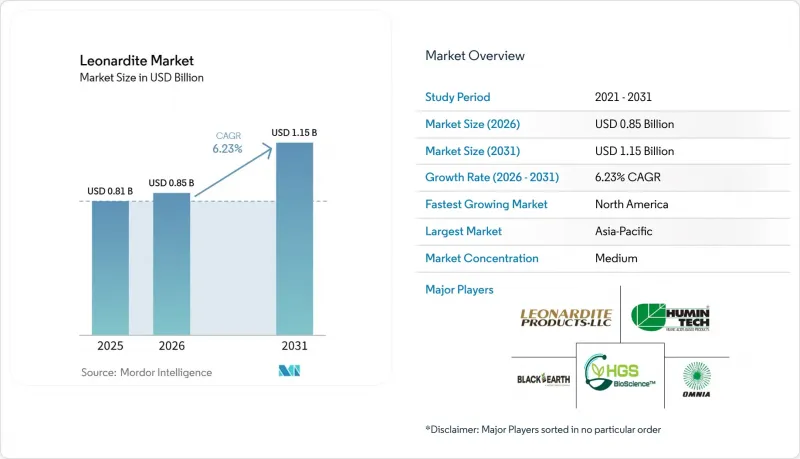
根據 Mordor Intelligence 預測,到 2031 年,褐煤的市場規模預計將達到 11.5 億美元,而 2025 年為 8.1 億美元,2026 年為 8.5 億美元,2026 年至 2031 年的複合年成長率為 6.23%。
本報告按產品形態(固體和液態褐煤)、應用領域(土壤改良劑、肥料添加劑等)、最終用途(田間作物、園藝等)和地區(北美、南美等)進行細分。市場預測以美元計價。
全球褐煤市場趨勢與洞察
在永續農業中擴大使用褐煤基土壤改良劑
萊昂納德石市場正受益於土壤改良劑需求的普遍轉變,這種轉變不再僅僅關注短期養分供應,而是轉向能夠改善農田物理和生物狀況的改良劑。種植者越來越重視根系發育、保水性和土壤團聚,因為這些因素會影響作物在連續種植週期中的產量穩定性。萊昂納德石非常適合這些需求,因為其腐殖質含量能夠促進陽離子交換,從而將養分長期保留在根際土壤中。這使得在田間作物系統中引入該產品更具合理性,因為田間作物的採購決策往往基於重複試驗的結果,而非單季的反應。類似的趨勢也推動了園藝和溫室種植領域對萊昂納德石的需求成長,因為土壤品質問題會直接影響作物生長。另一個利好因素是,土壤健康產品能夠支持土壤系統本身,即使施肥計畫發生變化,它們的重要性仍然存在。這使得萊昂納德石能夠與傳統的施肥方案並行運作,而不是完全依賴後者。因此,對於那些將土壤結構和養分保持能力作為直接業務重點的生產者而言,萊昂納德石市場的需求持續成長。
擴大有機農業和再生農業項目
萊昂納德石市場也受益於全部區域有機和再生農業計畫的穩定擴張。根據有機農業研究所 (FiBL) 的數據顯示,到 2024 年,全球有機農地面積將達到 9,890 萬公頃,約 190 個國家將有 480 萬家獲得認證的有機生產者。這表明,獲得認證的土壤改良劑的使用者群體比以往更加廣泛。這一點意義重大,因為許多認證體系對可接受的土壤改良劑種類有限,因此,符合有機或低殘留來源標準的萊昂納德石產品將佔據更有利的地位。非洲有機認證農地的大幅成長也表明,在土壤修復和投入效率都至關重要的地區,新的需求正在湧現。美國農業部自然資源保護局於 2025 年 12 月啟動了“再生農業試驗計畫”,並在 2026 會計年度撥款 7 億美元,用於將土壤保護相關的耕作方式納入農業津貼計畫。這一轉變將對市場產生正面影響。這是因為,與純粹的自願購買相比,由津貼的保護措施往往能促使消費者養成更穩定的購買習慣。此外,它還能將目標客戶群中那些先前缺乏動力持續使用土壤改良劑的中小生產者納入其中。從長遠來看,這將降低市場對小眾有機農業管道的依賴,並加強其與主流保護支出之間的連結。
褐煤礦床間原料品質的差異
褐煤市場面臨的主要限制因素之一是原料品質因礦床和礦區而異。買家不僅從特定來源購買褐煤,還會考慮腐殖質含量、氧化程度、均勻性以及在下游製程的混合性能。當生產商更換原料來源或混合來自不同礦區的原料時,成品批次間的性能難以預測。這給期望獲得可重複田間試驗結果的經銷商和生產商帶來了難題,尤其是在液體配方和高階農業項目中。 Omnia集團對高氧化澳洲原料的重視表明,礦床特性可以成為商業性差異化的關鍵因素,而不僅僅是背景資訊。將於2025年生效的中國GB/T 34765-2024標準也強調了對肥料和土壤改良劑中富裡酸進行更精確測量的必要性,這反映了品質差異對整個腐植酸產品市場的影響。當進口監管體係不一致且買家缺乏獨立的檢測支援時,市場風險會進一步加劇。在這種情況下,品質的不確定性會導致採購決策延遲,削弱產品聲明的說服力,並損害消費者對無法證明原料品質穩定的供應商的信心。
細分市場分析
截至2025年,固體褐煤將佔褐煤市場規模的58.2%,這主要得益於其在田間作物面積噴灑和行間施肥項目中的長期應用。顆粒和粉末狀褐煤因其優異的儲存性、高效的散裝運輸以及適用於現有銷售管道,仍然是銷售量的主要來源。這使得褐煤市場在面積穀物和油籽種子種植系統中佔據了穩固的地位。液體產品雖然規模較小,但在需要清潔施用和快速田間混合的場合更受歡迎。目前,褐煤市場仍在物流效率、配方相容性和農地施用實踐之間保持平衡。
預計到2031年,液態褐煤的複合年成長率將達到8.1%,成為市場上成長最快的產品形式。成長最顯著的領域包括果園、保護地蔬菜種植、溫室系統和可控環境農業,這些領域的生產者能夠快速評估產品效果,並證明引入高附加價值配方的合理性。 Humintech GmbH公司正積極應對這一轉變,開發出與肥料和灌溉系統相容的產品系列,例如“Liqhumus Liquid 18”,該產品專為灌溉而設計,而非直接施用於土壤。 Omnia集團憑藉其沉積品質和配方穩定性,在以出口為導向的液態腐植酸市場也具有競爭力。在整個褐煤產業,這一趨勢表明,生產方式正逐步從簡單的批量供應轉向高附加價值、針對特定應用的配方。
區域分析
2025年,北美佔據褐煤市場52.5%的佔有率,並持續保持其最大區域市場的地位。該地區在新墨西哥州、懷俄明州和亞伯達擁有優質礦床,同時農業領域也擁有成熟的分銷網路和技術應用模式。美國農業部自然資源保護局於2025年12月啟動的“再生農業試驗計畫”,為2026會計年度撥款7億美元,進一步強化了對以土壤為中心的農業實踐的資金需求訊號。加拿大透過在亞伯達省生產富馬石來支持區域供應,這些富馬石既供應國內農業市場,也供應出口市場。在南美洲,特別是巴西和阿根廷,大規模的作物輪作系統和土壤劣化為土壤再生中重複投入的重要性提供了具體例證。
由於相關法規和永續性政策的支持,歐洲仍然是褐煤市場結構相對完善的地區之一,這些政策保障了產品的有序流通。歐盟2019/1009號法規為土壤改良劑和非微生物植物生物促效劑的生產商提供了一個通用框架,有助於獲批產品在成員國之間更有效率地流通。中東地區仍是腐植酸用於土壤穩定化農業應用的活躍市場,而非洲雖然起步規模仍然小規模,但隨著有機認證農地的擴大,其市場正獲得長期支持。
預計到2031年,亞太地區褐煤市場將以7.8%的複合年成長率(CAGR)實現最高成長。中國是主要驅動力,因為化肥減量計畫和國內腐植酸產品供應使得提高效率的投入品轉型不再僅僅停留在像徵層面,而是切實可行。該地區的成長也反映出集約化農業系統中對農業化學品的強勁需求,而土壤狀況和化學肥料效率仍然是人們關注的重點。日本、韓國和澳洲則為該地區的需求增添了成熟層,它們更加重視用於保護性耕作和特種作物的精準配方投入品。
其他好處:
- Excel格式的市場預測(ME)表
- 3個月的分析師支持
目錄
第1章:引言
- 研究假設和市場定義
- 調查範圍
第2章:調查方法
第3章執行摘要
第4章 市場狀況
- 市場概覽
- 市場促進因素
- 在永續農業中擴大使用褐煤基土壤改良劑
- 擴大有機和再生農業項目
- 精準施肥與液態腐植酸協同作用的優勢
- 在投入成本壓力下,人們對提高養分利用效率的需求日益成長。
- 土壤碳恢復和引入韌性農業
- 需求由認證驅動,以有機農業和種植系統為基礎,並具有嚴格的殘留物標準。
- 市場限制因素
- 褐煤礦床之間原料的差異
- 本產品的有效性取決於土壤類型、pH值和施用方法。
- 農民對腐植酸的性能認知仍然有限。
- 引入替代富馬酸鹽、生物促效劑和堆肥,正在產生替代壓力。
- 監理情勢
- 技術展望
- 波特五力分析
第5章 市場規模與成長預測
- 按產品形式
- 固體褐鐵礦
- 液態褐煤
- 透過使用
- 土壤改良劑
- 肥料添加物
- 種子處理
- 施肥和灌溉
- 其他農業用途
- 按最終用途
- 田間作物
- 園藝
- 草坪和觀賞植物
- 溫室和可控制環境農業
- 按地區
- 北美洲
- 美國
- 加拿大
- 墨西哥
- 其他北美國家
- 南美洲
- 巴西
- 阿根廷
- 其他南美國家
- 歐洲
- 德國
- 法國
- 英國
- 西班牙
- 義大利
- 俄羅斯
- 其他歐洲國家
- 亞太地區
- 中國
- 印度
- 日本
- 韓國
- 澳洲
- 其他亞太國家
- 中東
- 沙烏地阿拉伯
- 阿拉伯聯合大公國
- 其他中東國家
- 非洲
- 南非
- 埃及
- 其他非洲國家
- 北美洲
第6章 競爭情勢
- 市場集中度
- 策略趨勢
- 市佔率分析
- 公司簡介
- HGS BioScience
- Leonardite Products LLC
- Leonardita del Ebro
- Black Earth Humic(WestMET)
- Humintech GmbH
- Huma, Inc.
- Biorex LLC
- Shandong Chuangxin Humic Acid Technology Co., Ltd
- Omnia Specialities Australia Pty Ltd(Omnia Group)
- Canadian Humalite International Inc.
- Humate International
- Daymsa(Samca Group)
第7章 市場機會與未來展望
According to Mordor Intelligence, the leonardite market size is anticipated to increase from USD 0.81 billion in 2025 and USD 0.85 billion in 2026, to reach USD 1.15 billion by 2031, growing at a CAGR of 6.23% over 2026-2031.
This report is Segmented by Product Form (Solid Leonardite and Liquid Leonardite), by Application (Soil Conditioner, Fertilizer Additive, and More), by End-Use (Field Crops, Horticulture, and More), and Geography (North America, South America, and More). Market Forecasts are Provided in Terms of Value (USD).
Global Leonardite Market Trends and Insights
Rising Adoption of Leonardite-Based Soil Conditioners in Sustainable Agriculture
The leonardite market is benefiting from a wider move toward soil conditioners that improve the physical and biological condition of farmland, not only short-term nutrient supply. Growers are paying closer attention to root development, water retention, and soil aggregation because those factors shape yield stability across repeated crop cycles. Leonardite fits this requirement well because its humic content supports cation exchange and helps retain nutrients in the root zone for longer use. This makes the product easier to justify in field crop systems where purchase decisions are often tied to repeat performance rather than one-season response. The same pattern supports stronger demand in horticulture and greenhouse production, where soil quality issues show up quickly in crop performance. The market also gains from the fact that soil health products can stay relevant even when fertilizer plans change, since they support the soil system itself. This gives leonardite a role that is adjacent to standard fertilizer programs rather than fully dependent on them. As a result, the leonardite market is seeing repeat demand from growers who now measure soil structure and nutrient retention as direct operating priorities.
Expansion of Organic and Regenerative Farming Programs
The leonardite market is also supported by the steady expansion of organic and regenerative farming programs across major producing regions. According to the Research Institute of Organic Agriculture (FiBL), global organic farmland reached 98.9 million hectares in 2024, while certified organic producers totaled 4.8 million across nearly 190 countries, which shows that approved soil inputs now serve a much larger user base than before. This matters because many certified systems narrow the range of acceptable soil amendments, which strengthens the position of leonardite products that meet organic or low-residue procurement rules. Africa's significant increase in certified organic farmland also points to the emergence of new demand in regions where soil restoration and input efficiency are both important. The United States Department of Agriculture Natural Resources Conservation Service launched the Regenerative Pilot Program in December 2025, allocating USD 700 million for fiscal year 2026 to bring soil-supportive practices into funded farm programs. The market benefits from this shift because funded conservation adoption usually creates more stable buying behavior than purely discretionary purchases. It also broadens the addressable base to small and mid-sized growers who previously had less reason to commit to repeated soil amendment use. Over time, this makes the market less dependent on niche organic channels and more connected to mainstream conservation spending.
Feedstock Variability Across Leonardite Deposits
A major restraint for the leonardite market is the wide variation in raw material quality across deposits and mining regions. Buyers do not purchase leonardite only by origin, they also judge it by humic content, oxidation level, consistency, and downstream formulation performance. When producers switch sources or blend material from different mines, finished product performance can become less predictable from batch to batch. That creates difficulty for distributors and growers who expect repeatable field response, especially in liquid formulations and premium agricultural programs. Omnia Group's positioning around high-oxidation Australian feedstock shows that the deposit profile can be a commercial differentiator rather than a background detail. China's GB/T 34765-2024 standard, implemented in 2025, also underscores the need for clearer measurement of fulvic acid in fertilizers and soil conditioners, reflecting how quality dispersion affects the wider humic products space. The market is more exposed, with uneven import oversight and buyers lacking independent testing support. In those settings, quality uncertainty can delay procurement decisions, weaken product claims, and reduce trust in suppliers that cannot prove stable source quality.
Other drivers and restraints analyzed in the detailed report include:
- Precision Fertigation and Liquid Humate Compatibility Gains
- Demand for Higher Nutrient Use Efficiency Under Input Cost Pressure
- Product Efficacy Sensitivity to Soil Type, pH, and Application Practice
For complete list of drivers and restraints, kindly check the Table Of Contents.
Segment Analysis
Solid leonardite held 58.2% of the leonardite market size in 2025, supported by its long-standing use in broadcast and in-furrow programs across field crops. Granules and powders remain the volume base because they store well, move efficiently in bulk, and fit established dealer channels. This gives the leonardite market a dependable foundation in large-acre cereal and oilseed systems. Liquid material remained smaller, but it gained favor where cleaner delivery and faster field integration mattered most. The segment mix still reflects a balance between logistics efficiency, formulation fit, and farm application practice.
Liquid leonardite is estimated to grow at an 8.1% CAGR through 2031, making it the fastest-moving product form in the market. Growth is strongest in orchards, protected vegetables, greenhouse systems, and controlled environment agriculture, where growers can quickly measure responses and justify premium formulations. Humintech GmbH has aligned with this shift through fertigation-ready lines such as Liqhumus Liquid 18, which are designed for irrigation-based delivery rather than bulk soil spreading. Omnia Group also uses deposit quality and formulation consistency to compete in the export-oriented liquid humate market. Across the leonardite industry, this pattern shows a gradual move from simple bulk supply toward higher-value application-specific formulations.
Complete Report Scope:
- By Product Form
- Solid Leonardite
- Liquid Leonardite
- By Application
- Soil Conditioner
- Fertilizer Additive
- Seed Treatment
- Fertigation
- Other Agricultural Applications
- By End-Use
- Field Crops
- Horticulture
- Turf and Ornamentals
- Greenhouse and Controlled Environment Agriculture
- By Geography
- North America
- United States
- Canada
- Mexico
- Rest of North America
- South America
- Brazil
- Argentina
- Rest of South America
- Europe
- Germany
- France
- United Kingdom
- Spain
- Italy
- Russia
- Rest of Europe
- Asia-Pacific
- China
- India
- Japan
- South Korea
- Australia
- Rest of Asia-Pacific
- Middle East
- Saudi Arabia
- United Arab Emirates
- Rest of Middle East
- Africa
- South Africa
- Egypt
- Rest of Africa
- North America
Geography Analysis
North America accounted for 52.5% of the leonardite market in 2025 and remained the largest regional contributor. The region combines high-quality deposits in New Mexico, Wyoming, and Alberta with mature agricultural distribution and technical usage patterns. The United States Department of Agriculture Natural Resources Conservation Service Regenerative Pilot Program, launched in December 2025 with USD 700 million for fiscal year 2026, adds a funded demand signal for soil-focused agricultural practices. Canada supports regional supply through Alberta humalite production, which serves both domestic agriculture and export markets. South America is becoming more relevant, especially in Brazil and Argentina, where large row-crop systems and degraded soils provide a practical case for repeated soil-restoration inputs.
Europe remained one of the more structured regions in the leonardite market, thanks to regulatory and sustainability policies that support orderly product access. Regulation (European Union) 2019/1009 provides producers with a common framework for soil improvers and non-microbial plant biostimulants, helping approved products move across member states more efficiently. The Middle East remains an active agricultural use market for humic soil stabilization, while Africa still starts from a smaller base but gains long-term support from expanding certified organic area.
Asia-Pacific is anticipated to record the fastest regional CAGR at 7.8% through 2031 in the leonardite market. China is a central driver because fertilizer reduction programs and domestic humic product supply have made the shift toward efficiency-oriented inputs more operational than symbolic. Regional growth also reflects strong agronomic need in intensive farming systems where soil condition and fertilizer efficiency remain persistent concerns. Japan, South Korea, and Australia add a more mature layer to regional demand, with stronger emphasis on precision-formulated inputs for protected horticulture and specialty crops.
- HGS BioScience
- Leonardite Products LLC
- Leonardita del Ebro
- Black Earth Humic (WestMET)
- Humintech GmbH
- Huma, Inc.
- Biorex LLC
- Shandong Chuangxin Humic Acid Technology Co., Ltd
- Omnia Specialities Australia Pty Ltd (Omnia Group)
- Canadian Humalite International Inc.
- Humate International
- Daymsa (Samca Group)
Additional Benefits:
- The market estimate (ME) sheet in Excel format
- 3 months of analyst support
TABLE OF CONTENTS
1 INTRODUCTION
- 1.1 Study Assumptions and Market Definition
- 1.2 Scope of the Study
2 RESEARCH METHODOLOGY
3 EXECUTIVE SUMMARY
4 MARKET LANDSCAPE
- 4.1 Market Overview
- 4.2 Market Drivers
- 4.2.1 Rising adoption of leonardite-based soil conditioners in sustainable agriculture
- 4.2.2 Expansion of organic and regenerative farming programs
- 4.2.3 Precision fertigation and liquid humate compatibility gains
- 4.2.4 Demand for higher nutrient use efficiency under input cost pressure
- 4.2.5 Soil carbon restoration and resilience farming adoption
- 4.2.6 Certification-driven demand from organic and residue-constrained crop systems
- 4.3 Market Restraints
- 4.3.1 Feedstock variability across leonardite deposits
- 4.3.2 Product efficacy depends on soil type, pH, and application practice
- 4.3.3 Farmer awareness of humic acid performance remains limited
- 4.3.4 Alternative humates, biostimulants, and compost inputs create substitution pressure
- 4.4 Regulatory Landscape
- 4.5 Technological Outlook
- 4.6 Porter's Five Forces Analysis
- 4.6.1 Bargaining Power of Suppliers
- 4.6.2 Bargaining Power of Buyers
- 4.6.3 Threat of New Entrants
- 4.6.4 Threat of Substitutes
- 4.6.5 Intensity of Competitive Rivalry
5 MARKET SIZE AND GROWTH FORECASTS (VALUE)
- 5.1 By Product Form
- 5.1.1 Solid Leonardite
- 5.1.2 Liquid Leonardite
- 5.2 By Application
- 5.2.1 Soil Conditioner
- 5.2.2 Fertilizer Additive
- 5.2.3 Seed Treatment
- 5.2.4 Fertigation
- 5.2.5 Other Agricultural Applications
- 5.3 By End-Use
- 5.3.1 Field Crops
- 5.3.2 Horticulture
- 5.3.3 Turf and Ornamentals
- 5.3.4 Greenhouse and Controlled Environment Agriculture
- 5.4 By Geography
- 5.4.1 North America
- 5.4.1.1 United States
- 5.4.1.2 Canada
- 5.4.1.3 Mexico
- 5.4.1.4 Rest of North America
- 5.4.2 South America
- 5.4.2.1 Brazil
- 5.4.2.2 Argentina
- 5.4.2.3 Rest of South America
- 5.4.3 Europe
- 5.4.3.1 Germany
- 5.4.3.2 France
- 5.4.3.3 United Kingdom
- 5.4.3.4 Spain
- 5.4.3.5 Italy
- 5.4.3.6 Russia
- 5.4.3.7 Rest of Europe
- 5.4.4 Asia-Pacific
- 5.4.4.1 China
- 5.4.4.2 India
- 5.4.4.3 Japan
- 5.4.4.4 South Korea
- 5.4.4.5 Australia
- 5.4.4.6 Rest of Asia-Pacific
- 5.4.5 Middle East
- 5.4.5.1 Saudi Arabia
- 5.4.5.2 United Arab Emirates
- 5.4.5.3 Rest of Middle East
- 5.4.6 Africa
- 5.4.6.1 South Africa
- 5.4.6.2 Egypt
- 5.4.6.3 Rest of Africa
- 5.4.1 North America
6 COMPETITIVE LANDSCAPE
- 6.1 Market Concentration
- 6.2 Strategic Moves
- 6.3 Market Share Analysis
- 6.4 Company Profiles (Includes Global Level Overview, Market Level Overview, Core Segments, Financials as Available, Strategic Information, Market Rank/Share, Products and Services, Recent Developments)
- 6.4.1 HGS BioScience
- 6.4.2 Leonardite Products LLC
- 6.4.3 Leonardita del Ebro
- 6.4.4 Black Earth Humic (WestMET)
- 6.4.5 Humintech GmbH
- 6.4.6 Huma, Inc.
- 6.4.7 Biorex LLC
- 6.4.8 Shandong Chuangxin Humic Acid Technology Co., Ltd
- 6.4.9 Omnia Specialities Australia Pty Ltd (Omnia Group)
- 6.4.10 Canadian Humalite International Inc.
- 6.4.11 Humate International
- 6.4.12 Daymsa (Samca Group)


