


 |
市場調查報告書
商品編碼
2099897
體育賽事直播:市場佔有率分析、產業趨勢與統計及成長預測(2026-2031)Live Sports Streaming - Market Share Analysis, Industry Trends & Statistics, Growth Forecasts (2026 - 2031) |
||||||

※ 本網頁內容可能與最新版本有所差異。詳細情況請與我們聯繫。
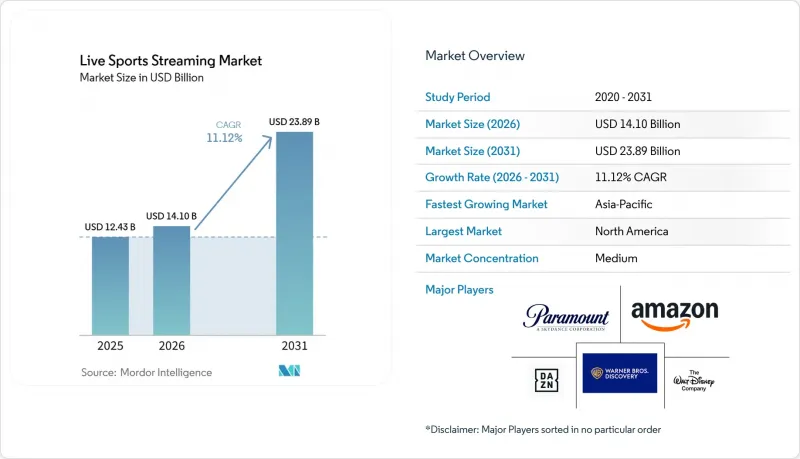
根據 Mordor Intelligence 預測,體育直播市場預計將從 2025 年的 124.3 億美元成長到 2026 年的 141 億美元,到 2031 年達到 238.9 億美元,2026 年至 2031 年的複合年成長率預計為 11.12%。
本報告按設備類型(智慧型手機和平板電腦、智慧型電視、筆記型電腦和桌上型電腦)、運動項目(足球、棒球、籃球、板球、賽車、網球)和地區(北美、南美、歐洲、亞太、中東和非洲)進行細分。市場預測以美元計價。
全球體育賽事直播市場趨勢及洞察
「停掉有線電視服務」的增加以及從付費電視轉向直接髮送類型消費者的體育串流媒體的轉變。
隨著體育賽事轉播權逐漸從傳統電視廣播轉向直接數位發行,體育直播市場正在蓬勃發展。大規模的轉播權套餐如今已成為平台策略的核心,因為實況活動有助於維持觀眾的參與度,並在重要比賽安排期間降低用戶流失的風險。這一趨勢在整個體育直播市場中都十分明顯,各大聯盟、聯賽和媒體集團紛紛推出或拓展直接面對消費者(DTC)的產品,而不再僅依賴傳統的廣播模式。例如,山地西部聯盟於2026年7月推出了其DTC平台“MW+”,這表明即使是大學體育組織也在建立自己的數位管道,並為球迷開闢新的收入來源。 CW電視網和ESPN也透過2026年4月簽署的一項協議擴大了大學體育的數位覆蓋範圍,該協議將在ESPN應用程式上提供超過800小時的CW體育直播節目。隨著版權擁有者認知到與球迷建立直接聯繫的價值,體育直播市場正在為訂閱、廣告和受眾數據建立更強大的基礎,而這些數據在過去很難透過傳統的電視合約獲得。
擴展低延遲 5G 和光纖連接
直播體育賽事市場也受惠於網路效能的提升,這些提升增強了直播的可靠性和互動性。 5G 和光纖網路的普及不僅減少了緩衝,還實現了即時疊加、鏡頭切換和同步觀看體驗,而這些在低品質網路中難以實現。 T-Mobile 在 2025 年 PGA 錦標賽上利用其「5G 先進網路」提供了即時擴增實境(AR) 視覺化層,在直播過程中疊加了球員擊球資料。這些發展對直播體育賽事市場至關重要,因為它們將網路品質從一項隱藏的技術特性轉變為一項可見的產品要素。它們也支援未來在依賴低延遲和穩定傳輸的領域(例如廣告支援的觀看、賽中投注和更全面的統計數據顯示)的成長。隨著這些功能的普及,擁有強大傳輸架構的平台將能夠更長時間地留住觀眾,並在爭奪優質轉播權方面更具競爭力。
體育賽事轉播權成本飆升,導致利潤率面臨壓力。
儘管優質運動內容的價格持續上漲,但各平台的用戶數量和廣告收入成長速度並不均衡,飆升的轉播權價格仍是體育直播市場的主要限制因素。 NBA近760億美元的交易提高了頂級體育賽事套餐的財務門檻,也印證了未來續約談判將面臨更高標準的觀點。對於大規模科技和媒體生態系統而言,體育賽事更容易承受這種壓力,因為它們可以支撐包括零售、廣告、硬體和雲端服務在內的廣泛目標。相較之下,純粹專注於體育賽事的直播服務則更直接地依賴能否在每個版權週期內透過訂閱、贊助和與賽事本身相關的廣告來獲利。因此,專業業者在高階體育直播市場中生存變得越來越困難。這種不平衡可能會影響未來的競標趨勢,並可能導致最有價值的版權集中在財力雄厚的公司手中。
細分市場分析
到2025年,智慧型手機和平板電腦將佔據體育賽事直播市場42.31%的佔有率,行動裝置仍將是亞太、非洲和南美洲地區觀眾觸達的核心管道。這種在體育賽事直播市場的主導地位源於便捷的觀看方式,許多觀眾選擇透過價格實惠的行動資料方案和行動裝置螢幕觀看直播,而不是使用專用的家庭娛樂系統。此外,行動端的優勢也持續推動著體育賽事直播市場的發展,例如本地語言支援、靈活的觀看時間以及方便球迷在通勤或同時處理多項任務時觀看。 JioStar發布的2026年印度板球超級聯賽(IPL)數據充分展現了這一模式的強大影響力:賽季期間數位影片觀看量達到250億次,本地語言的數位觀看時長成長了33%。報告也指出,體育賽事直播的數位覆蓋範圍並不限於大城市,在觀眾人數眾多的地區,行動端用戶群也為體育賽事直播市場提供了有力支撐。
同時,智慧電視預計到2031年將以11.34%的複合年成長率成長,顯示隨著體育賽事直播市場的日趨成熟,在客廳觀看直播變得越來越重要。 2026年5月,JioStar宣布,在2026年TATA IPL聯賽期間,聯網電視聯網電視的覆蓋率年增了26%,觀看時長成長了20%。他們也表示,到賽季第45場比賽時,聯網電視已與上賽季持平。這項轉變意義重大,因為更大的螢幕可以支援更多優質廣告版位和更高的影像質量,促使人們養成更接近傳統「定時觀看電視」的觀看習慣。 2026年6月,福斯宣布以220億美元收購Roku,顯示在體育賽事直播產業中,設備軟體和發行管理的重要性幾乎與版權所有權不相上下。雖然筆記型電腦、桌上型電腦、遊戲機和可攜式串流媒體設備仍然發揮著重要的作用,但直播體育賽事串流行業正日益受到行動規模和透過聯網電視實現盈利之間的平衡的影響。
區域分析
2025年,北美繼續保持其領先地位,佔據32.53%的體育直播市場佔有率,這主要得益於高用戶收入以及優質轉播權在觀眾習慣中根深蒂固。北美體育直播市場也受益於豐富的優質轉播權資源,NFL、NBA、大學體育賽事和其他重要內容透過多個大型數位平台進行分發。亞馬遜透過與NBA和WNBA達成串流協議,進一步鞏固了其市場地位,為其體育內容組合增添了全年不間斷的重要內容,此前該組合已擁有NFL和歐洲主要足球賽事的轉播權。 2026年5月,Netflix擴大了與NFL的合作,將協議延長至2029-30賽季,增加了比賽播出時間,並新增了NFL榮譽頒獎典禮的轉播。 2026年4月,CW電視網和ESPN進一步擴大了其數位影響力,將ESPN應用程式設為所有CW體育實況活動的獨家串流平台,每年提供超過800小時的直播內容。
預計到2031年,亞太地區的複合年成長率將達到11.46%,成為直播體育賽事串流市場成長最快的區域驅動力。該地區的優勢在於擁有龐大的板球觀眾群、行動優先的訪問環境,以及大規模平台能夠以多種語言和價格區間觸達受眾的能力。 JioHotstar在2026年ICC男子T20世界盃決賽中創下的7250萬同時在線觀看人數峰值,樹立了全球標桿,充分展現了當基礎設施和受眾集中度相匹配時,直播體育賽事流媒體市場能夠達到多麼巨大的規模。在南美洲,CazeTV已獲得巴西西甲聯賽的獨家轉播權,涵蓋2026-27賽季至2031-32賽季的全部380場比賽。該公司計劃透過YouTube及其合作夥伴的串流服務免費直播這些比賽,在價格敏感的市場中採用廣告主導的存取模式。
儘管歐洲在體育直播市場仍佔據重要地位,但其轉播權結構日益分散,球迷往往需要在多個服務平台之間切換才能觀看所有重大賽事。這種分散性促進了競爭,但如果訪問過於複雜或成本過高,則可能導致解約率上升,並使非法替代方案更具吸引力。 2025年11月,西甲聯賽宣布,在歐盟智慧財產局認定針對日益複雜的盜版網路的自願措施已失效後,西甲已強烈敦促制定具有法律約束力的反盜版立法。在中東,beIN媒體集團仍然是海灣地區和北非市場的主要版權擁有者,但非洲體育直播市場仍處於成長初期,主要由南非、埃及和奈及利亞等國的都市區需求所驅動。在這些市場中,支付系統和內容傳送基礎設施的建設與用戶需求同等重要;換言之,區域業務擴張取決於需求和執行力。
其他好處:
- Excel格式的市場預測(ME)表
- 3個月的分析師支持
目錄
第1章:引言
- 研究假設和市場定義
- 調查範圍
第2章:調查方法
第3章執行摘要
第4章 市場狀況
- 市場概覽
- 市場促進因素
- 「停掉有線電視服務」的增加以及從付費電視到面向消費者的直接體育串流媒體的轉變。
- 擴展低延遲 5G 和光纖連接
- 獨家體育賽事轉播權的價值日益成長
- 行動優先體育消費的擴張
- 在體育直播中透過廣告支援實現盈利
- 互動觀看功能、投注功能與粉絲互動功能。
- 市場限制因素
- 體育賽事轉播權費用上漲,利潤率面臨壓力
- 未經授權分發和盜版實況活動
- 與延遲、尖峰負載和網路品質相關的挑戰
- 權利持有者的分散性和視窗期設定的複雜性
- 產業價值鏈分析
- 監理情勢
- 技術展望
- 宏觀經濟因素對市場的影響
- 波特五力分析
第5章 市場規模與成長預測
- 依設備類型
- 智慧型手機和平板電腦
- 智慧電視
- 筆記型電腦和桌上型電腦
- 其他設備類型
- 按運動類型
- 足球
- 棒球
- 籃球
- 蟋蟀
- 賽車運動
- 網球
- 其他運動
- 按地區
- 北美洲
- 美國
- 加拿大
- 墨西哥
- 南美洲
- 巴西
- 阿根廷
- 智利
- 其他南美國家
- 歐洲
- 德國
- 英國
- 法國
- 義大利
- 西班牙
- 其他歐洲國家
- 亞太地區
- 中國
- 日本
- 印度
- 韓國
- 澳洲
- 其他亞太國家
- 中東
- 沙烏地阿拉伯
- 阿拉伯聯合大公國
- 卡達
- 其他中東國家
- 非洲
- 南非
- 埃及
- 奈及利亞
- 其他非洲國家
- 北美洲
第6章 競爭情勢
- 市場集中度
- 策略趨勢
- Vendor Positioning Analysis
- 公司簡介
- Amazon.com, Inc.
- The Walt Disney Company
- DAZN Group Limited
- Warner Bros. Discovery, Inc.
- Paramount Skydance Corporation
- Fox Corporation
- Comcast Corporation
- Apple Inc.
- Alphabet Inc.
- Tencent Holdings Limited
- TelevisaUnivision, Inc.
- beIN Media Group LLC
- JioStar India Private Limited
- FloSports, Inc.
- Sony Group Corporation
- CANAL+SA
- Viaplay Group AB
- Liberty Media Corporation
- NFL Enterprises LLC
- Major League Baseball
第7章 市場機會與未來展望
According to Mordor Intelligence, the live sports streaming market size is expected to increase from USD 12.43 billion in 2025 to USD 14.1 billion in 2026 and reach USD 23.89 billion by 2031, growing at a CAGR of 11.12% over 2026-2031.
This report is Segmented by Device Type (Smartphones and Tablets, Smart TVs, and Laptops and Desktops), Sport Type (Football/Soccer, Baseball, Basketball, Cricket, Motorsports, and Tennis), and Geography (North America, South America, Europe, Asia-Pacific, Middle East, and Africa). The Market Forecasts are Provided in Terms of Value (USD).
Global Live Sports Streaming Market Trends and Insights
Rising Cord-Cutting And Shift From Pay TV To Direct-To-Consumer Sports
The live sports streaming market is being pushed forward by the steady movement of sports rights from traditional television structures into direct digital distribution. Large rights packages now sit at the center of platform strategy because live events keep viewers engaged and reduce the risk of subscriber churn when major games are on the schedule. The pattern is visible across the live sports streaming market in the way conferences, leagues, and media groups are launching or expanding direct access products instead of depending only on older broadcast models. The Mountain West Conference launched MW+ in July 2026 as a direct-to-consumer platform, which showed that even collegiate properties are building their own digital route to fans and new revenue streams. The CW Network and ESPN also widened digital availability for college sports through their April 2026 agreement to place more than 800 hours of live CW Sports events on the ESPN App. As more rights holders see the value of direct fan relationships, the live sports streaming market gains a stronger base for subscriptions, advertising, and audience data that was harder to capture in legacy television arrangements.
Expansion Of Low-Latency 5G And Fiber Connectivity
The live sports streaming market is also benefiting from network improvements that make live delivery more reliable and more interactive. Better 5G and fiber access do more than reduce buffering because they support real-time overlays, camera switching, and synchronized viewing experiences that are harder to deliver on weaker networks. T-Mobile used its 5G Advanced Network at the 2025 PGA Championship to support a real-time augmented reality visualization layer that overlaid player shot data during the broadcast. That kind of deployment matters to the live sports streaming market because it turns network quality into a visible part of the product instead of a hidden technical feature. It also supports future growth in ad-supported viewing, in-play betting, and richer statistics displays that depend on low delay and stable transmission. As these capabilities become more common, platforms with stronger delivery architecture are likely to hold audiences for longer periods and compete more effectively for premium rights.
High Sports Rights Inflation And Margin Pressure
Rights inflation remains a major constraint on the live sports streaming market because premium properties are getting more expensive while subscriber and advertising returns do not rise at the same pace for every platform. The NBA's approximately USD 76 billion agreement raised the financial bar for top-tier sports packages and reinforced the view that future renewals will be negotiated from a higher base. This pressure is easier for large technology and media ecosystems to absorb because sports can support broader goals in retail, advertising, hardware, or cloud services. In contrast, pure-play sports services in the live sports streaming market depend more directly on whether each rights cycle can be monetized through subscriptions, sponsorships, and advertising around the events themselves. As a result, the live sports streaming market is becoming harder for narrowly focused operators to navigate at the premium end. That imbalance is likely to shape future bidding behavior and could further concentrate the most valuable rights among companies with deeper financial support.
Other drivers and restraints analyzed in the detailed report include:
- Escalating Value Of Exclusive Sports Rights
- Growth Of Mobile-First Sports Consumption
- Piracy And Unauthorized Restreaming Of Live Events
For complete list of drivers and restraints, kindly check the Table Of Contents.
Segment Analysis
Smartphones and tablets held 42.31% of the live sports streaming market share in 2025, which kept mobile at the center of audience reach across Asia-Pacific, Africa, and South America. In the live sports streaming market, that lead came from practical access patterns because many viewers entered live viewing through affordable mobile data plans and handheld screens rather than through dedicated home entertainment systems. The live sports streaming market also continues to benefit from mobile's ability to support regional languages, flexible viewing windows, and simpler access for fans who watch while commuting or multitasking. JioStar's IPL 2026 results showed how powerful that model remains because digital video views reached 25 billion and regional-language watch time on digital increased 33% during the season. The same release made clear that digital reach in live sports is not limited to major cities, which supports the mobile foundation of the live sports streaming market in high-volume regions.
Smart TVs, however, are expected to grow at 11.34% CAGR through 2031, which shows that living-room viewing is becoming more important as the live sports streaming market matures. JioStar stated in May 2026 that connected TV reach during TATA IPL 2026 grew 26% year over year, and that connected TV consumption rose 20%, with the season matching the previous season's full connected TV reach by game 45. That shift matters because larger screens support more premium ad placements, better picture quality, and a viewing habit that looks closer to traditional appointment television. Fox Corporation's announced USD 22 billion acquisition of Roku in June 2026 showed that device software and distribution control now matter almost as much as rights ownership in the live sports streaming industry. Laptops, desktops, gaming consoles, and portable streaming devices still serve important use cases, but the live sports streaming industry is increasingly defined by the balance between mobile scale and connected television monetization.
Complete Report Scope:
- By Device Type
- Smartphones and Tablets
- Smart TVs
- Laptops and Desktops
- Other Device Type
- By Sport Type
- Football Soccer
- Baseball
- Basketball
- Cricket
- Motorsports
- Tennis
- Other Sport Types
- By Geography
- North America
- United States
- Canada
- Mexico
- South America
- Brazil
- Argentina
- Chile
- Rest of South America
- Europe
- Germany
- United Kingdom
- France
- Italy
- Spain
- Rest of Europe
- Asia-Pacific
- China
- Japan
- India
- South Korea
- Australia
- Rest of Asia-Pacific
- Middle East
- Saudi Arabia
- United Arab Emirates
- Qatar
- Rest of Middle East
- Africa
- South Africa
- Egypt
- Nigeria
- Rest of Africa
- North America
Geography Analysis
North America held 32.53% of the live sports streaming market share in 2025, which kept it in the leading regional position because revenue per user is high and premium rights are deeply embedded in viewer habits. The live sports streaming market in North America is also shaped by a dense pipeline of high-value rights, with the NFL, NBA, college sports, and other major properties spread across several large digital platforms. Amazon strengthened that position through its NBA and WNBA streaming agreement, which added a major year-round property to a sports portfolio that already included the NFL and important European football rights. Netflix widened its NFL relationship in May 2026 by extending the deal through the 2029-30 season and adding more game windows and the NFL Honors awards show. The CW Network and ESPN added another layer of digital reach in April 2026 by making the ESPN App the exclusive streaming home for all CW Sports live events, which expanded access to more than 800 hours of live coverage each year.
Asia-Pacific is expected to grow at 11.46% CAGR through 2031, which makes it the fastest-growing regional engine in the live sports streaming market. The region's strength comes from a combination of mass cricket audiences, mobile-first access, and the ability of large platforms to reach viewers in multiple languages and price points. JioHotstar's 72.5 million peak concurrent viewers during the ICC Men's T20 World Cup 2026 final set a global benchmark and showed how large the live sports streaming market can become when infrastructure and audience concentration align. In South America, CazeTV secured an exclusive six-season LaLiga agreement in Brazil for all 380 matches from 2026-27 through 2031-32 and will distribute them live and free through YouTube and partner streaming services, which supports ad-led access models in price-sensitive markets.
Europe remains important to the live sports streaming market, but its rights structure is more fragmented and often requires fans to move across several services to follow all major competitions. That fragmentation can support competition, but it can also increase churn and make illegal alternatives more attractive when access becomes too complex or too expensive. LALIGA stated in November 2025 that it pressed for binding anti-piracy legislation after the European Union Intellectual Property Office found that voluntary measures had lost effectiveness against increasingly sophisticated pirate networks. In the Middle East, beIN Media Group remains a key rights holder across Gulf and North Africa markets, while Africa's live sports streaming market is still in an early growth phase led by urban demand in countries such as South Africa, Egypt, and Nigeria. Across those markets, payment systems and content delivery build-out still matter as much as audience appetite, which means regional expansion depends on both demand and execution.
- Amazon.com, Inc.
- The Walt Disney Company
- DAZN Group Limited
- Warner Bros. Discovery, Inc.
- Paramount Skydance Corporation
- Fox Corporation
- Comcast Corporation
- Apple Inc.
- Alphabet Inc.
- Tencent Holdings Limited
- TelevisaUnivision, Inc.
- beIN Media Group LLC
- JioStar India Private Limited
- FloSports, Inc.
- Sony Group Corporation
- CANAL+ S.A.
- Viaplay Group AB
- Liberty Media Corporation
- NFL Enterprises LLC
- Major League Baseball
Additional Benefits:
- The market estimate (ME) sheet in Excel format
- 3 months of analyst support
TABLE OF CONTENTS
1 INTRODUCTION
- 1.1 Study Assumptions and Market Definition
- 1.2 Scope of the Study
2 RESEARCH METHODOLOGY
3 EXECUTIVE SUMMARY
4 MARKET LANDSCAPE
- 4.1 Market Overview
- 4.2 Market Drivers
- 4.2.1 Rising Cord-Cutting and Shift From Pay TV to Direct-To-Consumer Sports
- 4.2.2 Expansion of Low-Latency 5G and Fiber Connectivity
- 4.2.3 Escalating Value of Exclusive Sports Rights
- 4.2.4 Growth of Mobile-First Sports Consumption
- 4.2.5 Ad-Supported Streaming Monetization for Live Sports
- 4.2.6 Interactive Viewing, Betting, and Fan Engagement Features
- 4.3 Market Restraints
- 4.3.1 High Sports Rights Inflation and Margin Pressure
- 4.3.2 Piracy and Unauthorized Restreaming of Live Events
- 4.3.3 Latency, Peak Load, and Network Quality Challenges
- 4.3.4 Fragmented Rights Holders and Windowing Complexity
- 4.4 Industry Value Chain Analysis
- 4.5 Regulatory Landscape
- 4.6 Technological Outlook
- 4.7 Impact of Macroeconomic Factors on the Market
- 4.8 Porter's Five Forces Analysis
- 4.8.1 Bargaining Power of Suppliers
- 4.8.2 Bargaining Power of Buyers
- 4.8.3 Threat of New Entrants
- 4.8.4 Threat of Substitutes
- 4.8.5 Competitive Rivalry
5 MARKET SIZE AND GROWTH FORECASTS (VALUE)
- 5.1 By Device Type
- 5.1.1 Smartphones and Tablets
- 5.1.2 Smart TVs
- 5.1.3 Laptops and Desktops
- 5.1.4 Other Device Type
- 5.2 By Sport Type
- 5.2.1 Football Soccer
- 5.2.2 Baseball
- 5.2.3 Basketball
- 5.2.4 Cricket
- 5.2.5 Motorsports
- 5.2.6 Tennis
- 5.2.7 Other Sport Types
- 5.3 By Geography
- 5.3.1 North America
- 5.3.1.1 United States
- 5.3.1.2 Canada
- 5.3.1.3 Mexico
- 5.3.2 South America
- 5.3.2.1 Brazil
- 5.3.2.2 Argentina
- 5.3.2.3 Chile
- 5.3.2.4 Rest of South America
- 5.3.3 Europe
- 5.3.3.1 Germany
- 5.3.3.2 United Kingdom
- 5.3.3.3 France
- 5.3.3.4 Italy
- 5.3.3.5 Spain
- 5.3.3.6 Rest of Europe
- 5.3.4 Asia-Pacific
- 5.3.4.1 China
- 5.3.4.2 Japan
- 5.3.4.3 India
- 5.3.4.4 South Korea
- 5.3.4.5 Australia
- 5.3.4.6 Rest of Asia-Pacific
- 5.3.5 Middle East
- 5.3.5.1 Saudi Arabia
- 5.3.5.2 United Arab Emirates
- 5.3.5.3 Qatar
- 5.3.5.4 Rest of Middle East
- 5.3.6 Africa
- 5.3.6.1 South Africa
- 5.3.6.2 Egypt
- 5.3.6.3 Nigeria
- 5.3.6.4 Rest of Africa
- 5.3.1 North America
6 COMPETITIVE LANDSCAPE
- 6.1 Market Concentration
- 6.2 Strategic Moves
- 6.3 Vendor Positioning Analysis
- 6.4 Company Profiles (includes Global Level Overview, Market Level Overview, Core Segments, Financials as available, Strategic Information, Market Rank/Share, Products and Services, Recent Developments)
- 6.4.1 Amazon.com, Inc.
- 6.4.2 The Walt Disney Company
- 6.4.3 DAZN Group Limited
- 6.4.4 Warner Bros. Discovery, Inc.
- 6.4.5 Paramount Skydance Corporation
- 6.4.6 Fox Corporation
- 6.4.7 Comcast Corporation
- 6.4.8 Apple Inc.
- 6.4.9 Alphabet Inc.
- 6.4.10 Tencent Holdings Limited
- 6.4.11 TelevisaUnivision, Inc.
- 6.4.12 beIN Media Group LLC
- 6.4.13 JioStar India Private Limited
- 6.4.14 FloSports, Inc.
- 6.4.15 Sony Group Corporation
- 6.4.16 CANAL+ S.A.
- 6.4.17 Viaplay Group AB
- 6.4.18 Liberty Media Corporation
- 6.4.19 NFL Enterprises LLC
- 6.4.20 Major League Baseball
7 MARKET OPPORTUNITIES AND FUTURE OUTLOOK
- 7.1 White-Space and Unmet-Need Assessment

 體育串流服務及技術市場規模、佔有率及趨勢分析報告:按收入類型、體育類型、地區及細分市場分類的預測(2026-2033 年)
 2026-2030年全球線上串流服務市場
 美國線上串流媒體市場(2026):消費者使用趨勢、獲利模式與競爭趨勢
 視訊PaaS市場:按部署類型、應用、最終用途和區域分類
 全球線上串流服務市場FAST 頻道(免費廣告支援的電影片道)的全球市場FAST Channel 全球市場
 全球體育串流平台市場規模、佔有率、趨勢分析報告:2024 年至 2031 年按設備類型、運動類型和地區分類的展望和預測體育串流平台市場規模、佔有率、趨勢分析報告:按設備類型、運動類型、地區、細分預測,2025-2030 年
 視訊串流服務市場:未來預測(2025-2030)