


 |
市場調查報告書
商品編碼
2099869
中東和非洲人工智慧副駕駛市場:市場佔有率分析、行業趨勢和統計數據以及成長預測(2026-2031 年)Middle East and Africa AI Copilot - Market Share Analysis, Industry Trends & Statistics, Growth Forecasts (2026 - 2031) |
||||||

※ 本網頁內容可能與最新版本有所差異。詳細情況請與我們聯繫。
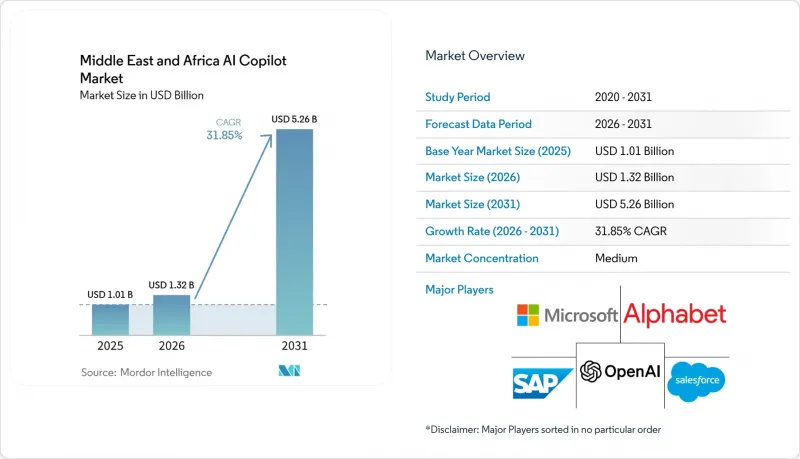
根據 Mordor Intelligence 預測,中東和非洲的 AI 副駕駛市場規模將從 2025 年的 10.1 億美元和 2026 年的 13.2 億美元成長到 2031 年的 52.6 億美元,2026 年至 2031 年的複合年成長率為 31.85%。
本報告按副駕駛類型(例如,通用生產力副駕駛)、部署模式(雲端、混合、本地部署)、組織規模(大型企業、中小企業)、應用領域(例如,知識工作和生產力支援)、最終用戶行業(例如,銀行、金融服務和保險業)以及地區進行細分。市場預測以美元計價。
中東和非洲人工智慧副駕駛市場的趨勢和洞察
沙烏地阿拉伯和阿拉伯聯合大公國政府主導的人工智慧主權計畫的興起
政府措施正在中東和非洲地區人工智慧副駕駛市場創造直接需求。 2026年5月,阿拉伯聯合大公國批准了一項聯邦框架,用於部署基於代理的人工智慧。該計劃包括對8萬名聯邦僱員進行系統培訓,目標是在2028年前將基於代理的人工智慧應用於50%的政府服務。隨後,阿布達比從政策階段邁向全面部署,透過其“前沿員工計劃”,將Microsoft 365 Copilot推廣至27個政府機構的3.5萬名公務員。這些舉措表明,該地區的公共部門採購人員將副駕駛視為行政現代化的一部分,而非僅僅是一項隨意的實驗。這種採購態度正在蔓延至整個中東和非洲的人工智慧副駕駛市場,供應商現在需要更強大的管治控制、本地託管選項和企業級部署能力才能贏得大規模機構合約。
企業正迅速從聊天機器人轉向情境感知副駕駛工作流程
隨著企業從簡單的聊天介面轉向整合到業務系統的工具,中東和非洲的人工智慧助理市場正在加速發展。 2026年5月,杜拜控股宣布與微軟建立企業人工智慧夥伴關係關係,並計劃在其酒店、房地產、電信、投資和娛樂等業務部門的大量員工中部署 Microsoft 365 Copilot。阿布達比的方案也遵循類似的路徑,其部署與一個已支援每日超過1100萬次數位互動的獨立雲端環境整合。這表明該工具已連接到實際的生產環境,而非孤立的先導計畫。紅海全球部署的 SAP Joule 也印證了這一轉變,該產品被部署在面向大規模員工群的人才管理職能部門中,而非作為獨立的聊天機器人。這一趨勢對中東和非洲的人工智慧助理市場意義重大,因為整合工作流程的使用增加了切換成本,並促使企業在初始部署後增加許可證規模。
公共和受監管部門的資料居住要求和主權限制
由於許多買家無法自由地跨境和跨雲端遷移高度敏感的工作負載,資料居住要求仍然是中東和非洲人工智慧輔助駕駛市場發展的一大障礙。阿布達比的「前沿員工計畫」(Frontier Employee Program)基於自主雲端環境構建,每天支援超過1100萬次數位互動,這表明在規模化之前,本地管理的基礎設施對於可靠部署至關重要。此外,阿拉伯聯合大公國的自主人工智慧聯邦框架將管治和受控的分階段部署置於實施的核心,進一步提高了對合規營運模式的需求。這些因素導致公共部門和受監管領域的供應商認證、架構設計和部署核准延誤。因此,儘管中東和非洲的人工智慧輔助駕駛市場正在快速成長,但買家仍傾向於選擇能夠就託管、存取控制和營運課責提供明確解答的供應商。
細分市場分析
到2025年,「通用生產力輔助駕駛」將佔據中東和非洲人工智慧輔助駕駛市場44.82%的佔有率,成為該地區最大的類別。這一地位主要歸功於現有職場軟體的部署,在這些軟體中,人工智慧可以作為一套熟悉的生產力工具的一部分啟用,而不是作為整個平台的替代方案。這種配置減少了變更管理的阻力,並促進了政府機構和大型企業大規模的首批部署。這也表明,中東和非洲人工智慧輔助駕駛市場的初期擴張是由現有軟體部署以及純粹的模式偏好共同推動的。
預計2026年至2031年間,產業專用的人工智慧輔助駕駛工具的複合年成長率將達到34.24%,成為中東和非洲人工智慧輔助駕駛工具市場成長最快的細分領域。買家對能夠處理特定產業規則、正式文件結構、核准流程和專業術語,且無需大量人工調整的工具表現出越來越濃厚的興趣。 SAP於2025年7月在Red Sea Global的整個人力資本管理職能部門(涵蓋10,500名員工)部署了「Joule」系統,這表明,如果能夠根據既定的運作環境進行調整,更專業的輔助駕駛工具可以多麼迅速地部署到生產環境中。雖然技術和工程輔助駕駛工具目前的市場佔有率較小,但隨著企業需要能夠幫助他們執行具體任務(而不僅僅是粗略起草和總結)的工具,它們的作用正在日益增強。未來,中東和非洲人工智慧輔助駕駛工具市場的更大佔有率預計將從通用生產力功能轉向垂直工作流程,在這些工作流程中,準確性、可審計性和上下文相關性至關重要。
到2025年,基於雲端的部署將佔據中東和非洲人工智慧副駕駛市場75.16%的佔有率,顯著超越其他部署方式。原因很簡單:大多數主流副駕駛系統都透過企業已用於通訊、儲存和工作流程管理的雲端軟體環境交付。這使得雲端成為許多部署的預設入口,尤其適用於監管較少的營運和尋求更快部署的組織。這也解釋了中東和非洲人工智慧副駕駛市場的快速擴張,其主要驅動力是與標準辦公室和商業軟體相關的用例。
預計2026年至2031年間,混合部署將以33.91%的複合年成長率成長,顯示在日益嚴格的資料管理法規下,買家的偏好正在轉變。阿布達比的自主雲端架構和公共部門的大規模協同駕駛部署清晰地表明,為什麼許多機構都在尋求將強大的本地管治與可擴展的人工智慧存取相結合的模式。阿拉伯聯合大公國的聯邦自主人工智慧框架也強化了這個方向,將管治和託管部署置於其推廣的核心。由於本地部署的擴展速度可能較慢且成本較高,因此它仍然是最小的部署模式,但對於高度敏感的工作負載而言,它仍然發揮著至關重要的作用。因此,預計中東和非洲的人工智慧協同駕駛市場在部署規模方面仍將以雲端主導,而混合部署將成為在受法規環境下進行託管擴展的首選策略模式。
其他好處:
- Excel格式的市場預測(ME)表
- 3個月的分析師支持
目錄
第1章:引言
- 研究假設和市場定義
- 調查範圍
第2章:調查方法
第3章執行摘要
第4章 市場狀況
- 市場概覽
- 市場促進因素
- 沙烏地阿拉伯和阿拉伯聯合大公國正在擴大政府主導的人工智慧主權計畫。
- 企業從聊天機器人轉向情境感知副駕駛工作流程的快速轉變
- 需要一款以阿拉伯語為第一語言且支援多語言的副駕駛介面。
- 在基於雲端的SaaS和CRM套件中,Copilot的採用情況
- 利用 Copilot搜尋內部知識並提高員工生產力
- 金融服務業 (BFSI) 在受監管行業(包括政府和醫療保健行業)的應用案例不斷擴大。
- 市場限制因素
- 公共和受監管部門的資料居住要求和主權限制
- 用於模型調優的高品質阿拉伯語域資料供應有限。
- 與傳統企業系統和本地工作流程的高階整合。
- 快速工程、人工智慧管治和副駕駛管理方面的人才短缺。
- 宏觀經濟因素對市場的影響
- 產業價值鏈分析
- 科技趨勢
- 監理情勢
- 波特五力分析
第5章 市場規模與成長預測
- 副駕駛型
- 通用生產力副駕駛
- 功能性工作流程副駕駛
- 技術/工程副駕駛
- 產業專用的副駕駛
- 不同的發展
- 基於雲端的
- 混合
- 現場
- 按組織規模
- 大公司
- 小型企業
- 透過使用
- 知識工作和生產力支持
- 軟體工程和技術運營
- 客戶和員工服務營運
- 銷售、行銷和產生收入
- 業務流程和公司運營
- 受監管行業工作流程
- 按最終用戶行業分類
- IT/通訊
- BFSI
- 醫療保健和生命科學
- 零售與電子商務
- 工業製造
- 教育和研究機構
- 媒體與娛樂
- 政府/行政部門
- 能源公用事業
- 其他終端用戶產業
- 按地區
- 中東
- 沙烏地阿拉伯
- 阿拉伯聯合大公國
- 土耳其
- 卡達
- 其他中東國家
- 非洲
- 南非
- 埃及
- 奈及利亞
- 其他非洲國家
- 中東
第6章 競爭情勢
- 市場集中度
- 策略趨勢
- 市佔率分析
- 公司簡介
- Microsoft Corporation
- Alphabet Inc.
- Salesforce, Inc.
- ServiceNow, Inc.
- SAP SE
- Oracle Corporation
- Workday, Inc.
- Adobe Inc.
- IBM Corporation
- Amazon Web Services, Inc.
- Naver Corporation
- Samsung SDS Co., Ltd.
- HUMAIN
- e& UAE
- G42
- Core42
- NVIDIA Corporation
- OpenAI, LLC
- Anthropic PBC
- Notion Labs, Inc.
第7章 市場機會與未來展望
According to Mordor Intelligence, the Middle East and Africa AI copilot market size is projected to expand from USD 1.01 billion in 2025 and USD 1.32 billion in 2026 to USD 5.26 billion by 2031, registering a CAGR of 31.85% between 2026 and 2031.
This report is Segmented by Copilot Type (Horizontal Productivity Copilots, and More), Deployment (Cloud-Based, Hybrid, and On-Premises), Organization Size (Large Enterprises, and Small and Medium Enterprises), Application (Knowledge Work and Productivity Assistance, and More), End-User Industry (BFSI, and More), and Geography. The Market Forecasts are Provided in Terms of Value (USD).
Middle East and Africa AI Copilot Market Trends and Insights
Rising Government-Led AI Sovereignty Programs in Saudi Arabia and the UAE
Government action is creating a direct demand base for the Middle East and Africa AI copilot market. The UAE approved a federal framework for the deployment of agentic AI in May 2026, and the program includes structured training for 80,000 federal employees while targeting agentic AI across 50% of government services by 2028. Abu Dhabi then moved from policy to scale deployment by extending Microsoft 365 Copilot to 35,000 civil servants across 27 government entities through the Frontier Employee Program. These moves show that public buyers in the region are treating copilots as part of administrative modernization rather than optional experimentation. That procurement stance spills over into the wider Middle East and Africa AI copilot market, as vendors now need stronger governance controls, local hosting options, and enterprise implementation capacity to compete for large institutional contracts.
Rapid Enterprise Shift From Chatbots to Context-Aware Copilot Workflows
The Middle East and Africa AI copilot market is also advancing as enterprises move beyond simple chat interfaces toward tools embedded in work systems. Dubai Holding announced an enterprise AI partnership with Microsoft in May 2026 to deploy Microsoft 365 Copilot across large employee populations in hospitality, real estate, telecom, investment, and entertainment operations. Abu Dhabi's program followed the same direction because the deployment was tied to a sovereign cloud environment that already supports more than 11 million daily digital interactions, which shows that the tool is being connected to real operating environments rather than isolated pilots. SAP's Joule rollout at Red Sea Global also supports this shift, as the product was deployed within human capital management functions across a large workforce rather than positioned as a stand-alone chatbot. This pattern matters for the Middle East and Africa AI copilot market because embedded workflow use raises switching costs and improves the case for larger seat expansions after early deployment.
Data Residency and Sovereignty Constraints Across Public and Regulated Sectors
Data residency remains a practical brake on the Middle East and Africa AI copilot market because many buyers cannot move sensitive workloads freely across borders or clouds. Abu Dhabi's Frontier Employee Program was built on a sovereign cloud environment supporting more than 11 million daily digital interactions, demonstrating that trusted deployment often depends on locally governed infrastructure before scale can occur. The UAE's federal framework for agentic AI also makes governance and controlled rollout central to implementation, which reinforces the need for compliance-ready operating models. These conditions add time to vendor qualification, architecture design, and rollout approval in public and regulated settings. As a result, the Middle East and Africa AI copilot market is growing quickly, but buyers still favor providers that can provide clear answers on hosting, access control, and operational accountability.
Other drivers and restraints analyzed in the detailed report include:
- Growth of Regulated Industry Use Cases in BFSI, Government, and Healthcare
- Demand for Arabic-First and Multilingual Copilot Interfaces
- Limited Availability of High-Quality Arabic Domain Data for Model Tuning
For complete list of drivers and restraints, kindly check the Table Of Contents.
Segment Analysis
Horizontal Productivity Copilots held 44.82% of the Middle East and Africa AI copilot market share in 2025, which made them the largest type in the region. Their position stems from existing workplace software deployments where AI can be activated as part of a familiar productivity stack rather than through a full platform replacement. This setup lowers change management friction and makes broad first-wave adoption easier across government entities and large enterprises. It also means that the early expansion of the Middle East and Africa AI copilot market has been shaped by installed software footprints as much as by pure model preference.
Industry-Specific Copilots are projected to grow at a CAGR of 34.24% during 2026-2031, making them the fastest-growing segment in the Middle East and Africa AI copilot market. Buyers are showing more interest in tools that can work with sector rules, formal document structures, approval paths, and domain language without heavy manual adjustment. SAP's July 2025 deployment of Joule at Red Sea Global across human capital management functions for 10,500 employees shows how a more specialized copilot can move into production once it fits a defined operating environment. Technical and engineering copilots remain smaller in current share, but their role is strengthening as enterprises look for tools that can support task-specific execution instead of only broad drafting and summarization. Over time, this should shift a larger part of the Middle East and Africa AI copilot market toward vertical workflows where accuracy, auditability, and contextual fit matter more than general productivity features alone.
Cloud-based deployment accounted for 75.16% of the Middle East and Africa AI copilot market in 2025, keeping it well ahead of other deployment modes. The reason is simple because most leading copilots are delivered through cloud software environments that enterprises already use for communication, storage, and workflow management. This makes the cloud the default entry point for many deployments, especially in non-regulated functions and among organizations seeking faster activation. It also explains why the Middle East and Africa AI copilot market has expanded rapidly, driven by use cases tied to standard office and business software.
Hybrid deployment is projected to expand at a CAGR of 33.91% during 2026-2031, which shows where buyer preference is moving as data controls become stricter. Abu Dhabi's sovereign cloud architecture and large public-sector copilot rollout illustrate why many institutions want a model that combines strong local governance with scalable access to AI. The UAE federal framework for agentic AI also supports this direction by placing governance and managed implementation at the center of deployment. On-Premises remains the smallest mode because it can be slower and more expensive to scale, but it still has a place in highly sensitive workloads. For that reason, the Middle East and Africa AI copilot market is likely to remain cloud-led in volume while hybrid becomes the preferred strategic model for controlled expansion in regulated environments.
Complete Report Scope:
- By Copilot Type
- Horizontal Productivity Copilots
- Functional Workflow Copilots
- Technical and Engineering Copilots
- Industry-Specific Copilots
- By Deployment
- Cloud-Based
- Hybrid
- On-Premises
- By Organization Size
- Large Enterprises
- Small and Medium Enterprises
- By Application
- Knowledge Work and Productivity Assistance
- Software Engineering and Technical Operations
- Customer and Employee Service Operations
- Sales, Marketing and Revenue Enablement
- Business Process and Enterprise Operations
- Regulated Industry Workflows
- By End-User Industry
- IT and Telecommunication
- BFSI
- Healthcare and Life Sciences
- Retail and E-Commerce
- Industrial Manufacturing
- Education and Research Institutions
- Media and Entertainment
- Government and administration
- Energy and Utilities
- Other End-User industries
- By Geography
- Middle East
- Saudi Arabia
- United Arab Emirates
- Turkey
- Qatar
- Rest of Middle East
- Africa
- South Africa
- Egypt
- Nigeria
- Rest of Africa
- Middle East
List of Companies Covered in this Report:
- Microsoft Corporation
- Alphabet Inc.
- Salesforce, Inc.
- ServiceNow, Inc.
- SAP SE
- Oracle Corporation
- Workday, Inc.
- Adobe Inc.
- IBM Corporation
- Amazon Web Services, Inc.
- Naver Corporation
- Samsung SDS Co., Ltd.
- HUMAIN
- e& UAE
- G42
- Core42
- NVIDIA Corporation
- OpenAI, L.L.C.
- Anthropic PBC
- Notion Labs, Inc.
Additional Benefits:
- The market estimate (ME) sheet in Excel format
- 3 months of analyst support
TABLE OF CONTENTS
1 INTRODUCTION
- 1.1 Study Assumptions and Market Definition
- 1.2 Scope of the Study
2 RESEARCH METHODOLOGY
3 EXECUTIVE SUMMARY
4 MARKET LANDSCAPE
- 4.1 Market Overview
- 4.2 Market Drivers
- 4.2.1 Rising Government-Led AI Sovereignty Programs in Saudi Arabia and the UAE
- 4.2.2 Rapid Enterprise Shift From Chatbots to Context-Aware Copilot Workflows
- 4.2.3 Demand for Arabic-First and Multilingual Copilot Interfaces
- 4.2.4 Copilot Adoption Inside Cloud-Based SaaS and CRM Suites
- 4.2.5 Use of Copilots for Internal Knowledge Retrieval and Employee Productivity
- 4.2.6 Growth of Regulated Industry Use Cases in BFSI, Government, and Healthcare
- 4.3 Market Restraints
- 4.3.1 Data Residency and Sovereignty Constraints Across Public and Regulated Sectors
- 4.3.2 Limited Availability of High-Quality Arabic Domain Data for Model Tuning
- 4.3.3 High Integration Effort With Legacy Enterprise Systems and Local Workflows
- 4.3.4 Talent Gaps in Prompt Engineering, AI Governance, and Copilot Administration
- 4.4 Impact of Macroeconomic Factors on the Market
- 4.5 Industry Value Chain Analysis
- 4.6 Technology Outlook
- 4.7 Regulatory Landscape
- 4.8 Porter's Five Forces Analysis
- 4.8.1 Threat of New Entrants
- 4.8.2 Bargaining Power of Suppliers
- 4.8.3 Bargaining Power of Buyers
- 4.8.4 Threat of Substitutes
- 4.8.5 Intensity of Competitive Rivalry
5 MARKET SIZE AND GROWTH FORECASTS (VALUE)
- 5.1 By Copilot Type
- 5.1.1 Horizontal Productivity Copilots
- 5.1.2 Functional Workflow Copilots
- 5.1.3 Technical and Engineering Copilots
- 5.1.4 Industry-Specific Copilots
- 5.2 By Deployment
- 5.2.1 Cloud-Based
- 5.2.2 Hybrid
- 5.2.3 On-Premises
- 5.3 By Organization Size
- 5.3.1 Large Enterprises
- 5.3.2 Small and Medium Enterprises
- 5.4 By Application
- 5.4.1 Knowledge Work and Productivity Assistance
- 5.4.2 Software Engineering and Technical Operations
- 5.4.3 Customer and Employee Service Operations
- 5.4.4 Sales, Marketing and Revenue Enablement
- 5.4.5 Business Process and Enterprise Operations
- 5.4.6 Regulated Industry Workflows
- 5.5 By End-User Industry
- 5.5.1 IT and Telecommunication
- 5.5.2 BFSI
- 5.5.3 Healthcare and Life Sciences
- 5.5.4 Retail and E-Commerce
- 5.5.5 Industrial Manufacturing
- 5.5.6 Education and Research Institutions
- 5.5.7 Media and Entertainment
- 5.5.8 Government and administration
- 5.5.9 Energy and Utilities
- 5.5.10 Other End-User industries
- 5.6 By Geography
- 5.6.1 Middle East
- 5.6.1.1 Saudi Arabia
- 5.6.1.2 United Arab Emirates
- 5.6.1.3 Turkey
- 5.6.1.4 Qatar
- 5.6.1.5 Rest of Middle East
- 5.6.2 Africa
- 5.6.2.1 South Africa
- 5.6.2.2 Egypt
- 5.6.2.3 Nigeria
- 5.6.2.4 Rest of Africa
- 5.6.1 Middle East
6 COMPETITIVE LANDSCAPE
- 6.1 Market Concentration
- 6.2 Strategic Moves
- 6.3 Market Share Analysis
- 6.4 Company Profiles (includes Global Level Overview, Market Level Overview, Core Segments, Financials as available, Strategic Information, Market Rank/Share, Products and Services, Recent Developments)
- 6.4.1 Microsoft Corporation
- 6.4.2 Alphabet Inc.
- 6.4.3 Salesforce, Inc.
- 6.4.4 ServiceNow, Inc.
- 6.4.5 SAP SE
- 6.4.6 Oracle Corporation
- 6.4.7 Workday, Inc.
- 6.4.8 Adobe Inc.
- 6.4.9 IBM Corporation
- 6.4.10 Amazon Web Services, Inc.
- 6.4.11 Naver Corporation
- 6.4.12 Samsung SDS Co., Ltd.
- 6.4.13 HUMAIN
- 6.4.14 e& UAE
- 6.4.15 G42
- 6.4.16 Core42
- 6.4.17 NVIDIA Corporation
- 6.4.18 OpenAI, L.L.C.
- 6.4.19 Anthropic PBC
- 6.4.20 Notion Labs, Inc.
7 MARKET OPPORTUNITIES AND FUTURE OUTLOOK
- 7.1 White-Space and Unmet-Need Assessment

 土壤碳資訊市場:預測(至2034年)-按碳測量方法、技術、深度、頻率、最終用戶和地區分類的全球分析
 AI智慧建議一體化設備市場:全球市場預測,2026-2032年
 2026年全球人工智慧(AI)交易市場報告2026年全球人工智慧(AI)個人化旅行體驗市場報告2026年全球大規模人工智慧語言模型市場報告2026年體外診斷(IVD)人工智慧(AI)全球市場報告
 全球文件人工智慧市場:按產品/服務、文件類型、用例、產業和地區分類-預測至2031年
 全球人工智慧市場規模、佔有率、趨勢和成長分析報告(病患管理方向,2026-2034年)2026年全球生成式人工智慧(AI)伺服器市場報告
 人工智慧市場分析及至2035年森林火災預測預測:按類型、產品、服務、技術、組件、應用、部署、最終用戶和解決方案分類