


 |
市場調查報告書
商品編碼
2099866
CXL 記憶體模組:市佔率分析、產業趨勢與統計資料、成長預測(2026-2031 年)CXL Memory Module - Market Share Analysis, Industry Trends & Statistics, Growth Forecasts (2026 - 2031) |
||||||

※ 本網頁內容可能與最新版本有所差異。詳細情況請與我們聯繫。
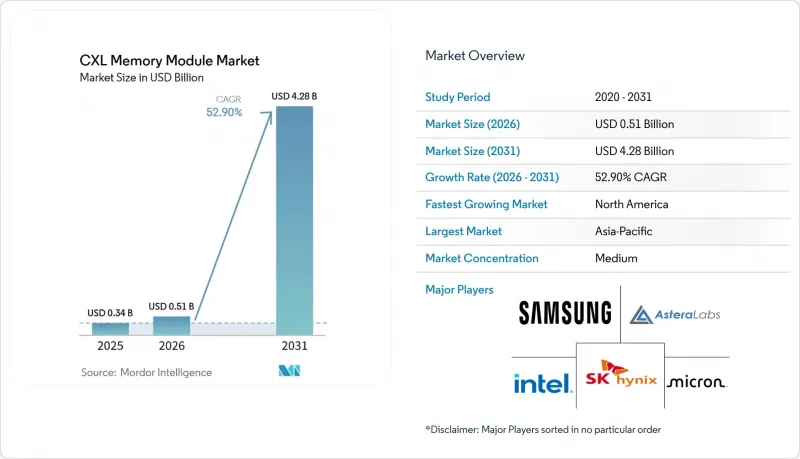
根據 Mordor Intelligence 預測,CXL 儲存模組市場規模預計將在 2025 年達到 3.4 億美元,2026 年達到 5.1 億美元,到 2031 年達到 42.8 億美元,2026 年至 2031 年的複合年成長率為 52.90%。
本報告按產品類型(CXL 2.0 記憶體模組、CXL 3.0 記憶體模組)、記憶體技術(基於 DRAM 的 CXL 記憶體模組等)、外形尺寸(E3.S 模組、擴充卡(AIC) 模組等)、應用領域(人工智慧和機器學習等)、最終用戶(雲端服務供應商等)和地區進行細分。市場預測以美元計價。
全球CXL儲存模組市場趨勢與洞察
人工智慧伺服器對記憶體密度的需求日益成長
CXL記憶體模組市場的發展主要受人工智慧伺服器記憶體需求快速成長的驅動,尤其是在大規模語言模型的推理和搜尋密集型工作負載方面。現代推理環境需要大容量、低延遲的記憶體池來實現啟動儲存和鍵值快取,但許多雙路伺服器設計僅靠DIMM插槽無法滿足這些需求。 2026年發表的一項研究表明,在SGLang推理叢集,池化CXL記憶體的效能在條件記憶體搜尋接近本地DRAM,並且在對建議和搜尋擴展生成(RAG)任務至關重要的稀疏存取模式下優於RDMA。這使得CXL記憶體模組市場的重要性日益凸顯,不僅體現在效能提升方面,也體現在成本控制方面,因為它允許營運商在不增加每個節點加速器數量的情況下增加記憶體容量。因此,雲端平台和推理服務供應商希望在購買額外的GPU系統之前提高每個伺服器的記憶體密度,而CXL記憶體模組市場正獲得他們的支援。微軟 Azure 在 2025 年 11 月發布了支援 CXL 的 M 系列虛擬機預覽版,該虛擬機使用 Astera Labs 控制器,用於記憶體密集型企業工作負載,從而確認了這一方向。
從僅使用DDR進行容量擴展過渡到CXL池化
此外,隨著工作負載達到數Terabyte級,傳統的記憶體擴展方式(例如高密度DIMM和伺服器擴容)成本過高,從而推動了CXL記憶體模組市場的發展。三星表示,其CMM-D 2.0設計可提供36 GB/s的頻寬,容量分別為128 GB和256 GB,使負責人能夠透過現有伺服器平台上的PCIe插槽連接更多記憶體。這種方法意義重大,因為CXL記憶體模組市場解決了「閒置容量」的難題。正如2026年的一項研究所強調的那樣,資料中心存在一個根深蒂固的低效率問題,即大量已安裝的記憶體長期處於未充分利用狀態。記憶體池化改變了維運模式,使管理員能夠根據工作負載行為更精確地分配「熱」記憶體和「冷」內存,而不是固定每台伺服器的記憶體容量。這種模式有利於CXL記憶體模組市場的發展,因為它支援提高記憶體利用率、減少過度配置,並最佳化大規模伺服器叢集的擴展管理。隨著越來越多的營運商將總體擁有成本 (TCO) 置於伺服器總數之上,採用記憶體池作為更廣泛的基礎設施現代化週期的一部分變得越來越容易。
與插槽式DDR5記憶體相比,延遲差異
由於擴充記憶體無法在所有工作負載下達到本地DDR5的延遲水平,CXL記憶體模組市場持續面臨阻力。 2026年的一項研究發現,在英特爾至強6平台上,CXL 2.0擴充設備的標稱存取延遲為100至160奈秒,而本地DDR5的存取延遲僅為75奈秒。這導致最佳化後的應用程式效能通常會下降10%至18%,而在延遲更高的「指標追蹤」場景下,效能下降幅度甚至可能高達45%。這項發現意義重大,因為它表明效能下降並非在整個CXL記憶體模組市場中普遍存在,而是因工作負載而異。研究也揭示,CXL互連本身並非延遲的主要原因,CPU端NUMA仲裁和刷新操作才是造成大部分延遲的關鍵。簡而言之,部署的成功並非取決於假設單一的記憶體行為適用於所有用例,而是取決於對應用程式進行細緻的效能分析,並將熱資料和冷資料放置在適當的層級中。 2026年,Meta透過「Equilibria」框架調整了其發展方向,該框架實現了公平的多租戶CXL記憶體分層。據報道,在接近生產環境的工作負載下,該框架可將端對端效能提升高達52%。
細分市場分析
2025年,CXL 2.0記憶體模組佔據了該產品類型細分市場的88.79%,顯示在商業化初期,已部署的伺服器基數仍然是CXL記憶體模組市場的核心。這一領先地位反映了2024年至2025年間相容CPU平台在資料中心的加速部署,導致在認證週期內,市場更傾向於選擇與當前伺服器世代相符的產品。因此,CXL記憶體模組市場仍以CXL 2.0為基礎。這是因為買家優先考慮縮短從檢驗到量產的時間,尤其是在大規模雲端和超大規模環境已經圍繞著相容基礎設施建構的情況下。預計到2031年,CXL 3.0模組的複合年成長率將達到53.29%,顯示隨著對共用記憶體的需求日益成長,協議差異正成為商業性差異化的關鍵因素。 CXL記憶體模組市場正處於一個轉折點,因為CXL 3.0將可用用例的範圍從簡單的記憶體擴展擴展到更廣泛的機架級資源共用。
這種轉變與多主機快取一致性、基於交換器的池化以及更高的有效頻寬等特性密切相關,隨著部署方式從單一伺服器升級轉向記憶體架構設計,這些特性的價值也日益凸顯。 Marvell 計劃於 2026 年 3 月推出交換機,這表明擴展 CXL 3.x 所需的生態系統正在逐步成型,這也解釋了為什麼 CXL 記憶體模組市場的未來成長曲線會隨著每一代新協議的推出而更加強勁。買家也越來越關注互通性,因為即使擁有豐富的協定特性,如果控制器、主機和架構管理器無法保持與供應商無關的一致性,那麼這些特性帶來的優勢也無法真正實現。在 CXL 記憶體模組市場,CXL 2.0 將繼續在短期部署中發揮重要作用,而 CXL 3.x 預計將在大規模池化架構中佔據主導地位。這將帶來漸進式的過渡,而非突然的切換,因此,在預測期內,這兩代協議都將保持商業性重要性。
預計到2025年,基於DRAM的CXL模組將佔記憶體技術需求的92.14%,使其成為目前週期CXL記憶體模組市場的核心。這種集中度反映了製造方面的實際情況,因為現有記憶體製造商已經擁有人工智慧、高效能運算和雲端環境所需的生產基礎設施和效能,這些環境將CXL視為快速容量擴展。目前CXL記憶體模組市場對DRAM的偏好也源自於超大規模資料中心業者和主要雲端服務供應商對其主要延伸層的可預測性要求,而DRAM仍是滿足這項要求的最佳選擇。同時,基於SCM和持久記憶體的CXL模組預計將以53.47%的複合年成長率成長,顯示CXL記憶體模組市場正在超越揮發性記憶體擴展的應用場景。此細分市場的成長與那些不僅重視容量,還重視重新啟動速度、查核點、容錯性和資料保存的工作負載密切相關。
2026年1月,Penguin Solutions宣布其「SMART Modular NV-CMM E3.S 2T」模組已通過CXL合規性測試。設計融合了易失性DRAM、NAND備份、板載電源模組和AES-256加密技術,適用於企業資料中心應用。 CXL聯盟也指出,Type 3裝置可以直接在主機記憶體映射中暴露持久容量,從而實現位元組尋址的持久化,而無需區塊儲存工作流程的額外開銷。這為CXL記憶體模組市場記憶體內、重新啟動敏感型虛擬化系統以及無需將所有資料都保存在高階DRAM層級的分析工作負載打開了大門。此外,基於NAND和快閃記憶體的設計將構成中階,在這個層級中,每GB成本比峰值存取速度更為重要,尤其適用於存取頻率較低的分析資料。隨著基於軟體的分層記憶體策略處理能力的提升,持久化方案預計將從專用產品轉向CXL記憶體模組市場中更重要的策略層級。
區域分析
預計到2025年,北美將佔全球CXL記憶體模組需求的45.37%,並在本週期內繼續保持其作為CXL記憶體模組市場最大區域貢獻者的地位。這一主導地位主要得益於美國擁有眾多超大規模雲端服務供應商,這些供應商在初始認證工作、伺服器平台部署和生產級部署規劃中發揮了核心作用。北美CXL記憶體模組市場也受益於其強大的控制器和平台生態系統,促進了記憶體供應商、半導體廠商和雲端基礎設施供應商之間的商業檢驗。微軟Azure於2025年11月發布的CXL M系列虛擬機器預覽版表明,該地區已超越實驗室測試階段,正逐步過渡到面向客戶的部署,以滿足記憶體密集型企業工作負載的需求。加拿大受益於與美國供應商的跨境雲端基礎設施合作,而墨西哥目前更多地透過物流和伺服器組裝合作而非直接需求發揮重要作用。
預計到2031年,亞太地區將以53.78%的複合年成長率成長,成為CXL記憶體模組市場成長最快的區域市場。韓國是這一成長趨勢的主要驅動力,三星和SK海力士在CXL記憶體產品的供應中繼續發揮核心作用。他們的產品活動使該地區的生態系統始終處於商業化的核心地位。亞太地區在組件製造、系統整合和控制器開發方面的優勢也使該地區的CXL記憶體模組市場受益匪淺,使其在供應和部署準備方面都具有影響力。在日本,商業產品的分銷管道已經建立,例如Tekwind計劃於2025年7月在日本市場推出其「SMART Modular CXL」擴充卡產品。雖然印度的CXL記憶體模組市場仍處於起步階段,但對大規模超大規模資料中心園區的投資正在為下一代伺服器奠定基礎,這將使CXL在未來得到更廣泛的應用。
儘管歐洲目前在CXL記憶體模組市場中所佔佔有率較小,但企業遷移需求、超大規模資料中心擴張以及大規模雲端和應用程式環境中對更高記憶體效率日益成長的需求正在推動市場需求成長。德國、英國和法國很可能成為這項需求的中心,這主要得益於資料中心投資、企業軟體規模以及對高記憶體密度需求的不斷成長。隨著買家從試點評估轉向經過檢驗的多供應商配置,從而降低採購的不確定性,歐洲CXL記憶體模組市場預計將進一步擴張。南美、中東和非洲仍處於早期應用階段,短期內對CXL基礎設施的存取很可能是透過雲端區域而非廣泛的本地部署來實現的。隨著雲端服務供應商擴展其基於CXL的服務,這些地區將能夠在建立大規模本地硬體環境之前,透過服務利用參與CXL記憶體模組市場。
其他好處:
- Excel格式的市場預測(ME)表
- 3個月的分析師支持
目錄
第1章:引言
- 研究假設和市場定義
- 調查範圍
第2章:調查方法
第3章執行摘要
第4章 市場狀況
- 市場概覽
- 市場促進因素
- 人工智慧伺服器對記憶體密度的需求日益成長
- 從僅使用DDR進行容量擴展過渡到CXL池方法
- CXL 2.0 和 CXL 3.0 生態系的快速商業化
- 超大規模資料中心對可組合記憶體架構的需求。
- 由於設備安裝過多,傳統的電力和機架安裝面積受到限制。
- 為引入軟體定義記憶體分層和編配。
- 市場限制因素
- 延遲差異:與插槽上的 DDR5 記憶體相比
- CXL相容伺服器和模組的初始成本較高
- 生態系統互通性和檢驗複雜性
- 記憶體管理和分層軟體堆疊尚不成熟。
- 供應鏈分析
- 宏觀經濟因素對市場的影響
- 監理情勢
- 技術展望
- 波特五力分析
第5章 市場規模與成長預測
- 依產品類型
- CXL 2.0 記憶體模組
- CXL 3.0 記憶體模組
- 透過儲存技術
- 基於DRAM的CXL記憶體模組
- 基於NAND/快閃記憶體的CXL儲存模組
- SCM/持久記憶體型CXL模組
- 按外形規格
- E3.S 模組
- 擴充卡(AIC)模組
- U.2/U.3 及其他外形規格
- 透過使用
- 人工智慧和機器學習
- 高效能運算
- 資料庫和分析
- 虛擬化和雲端運算
- 企業應用
- 最終用戶
- 雲端服務供應商
- 超大規模資料中心
- 企業資料中心
- OEM/ODM 伺服器製造商
- 用於科學研究和管理的計算
- 其他最終用戶
- 按地區
- 北美洲
- 美國
- 加拿大
- 墨西哥
- 歐洲
- 德國
- 英國
- 法國
- 義大利
- 其他歐洲國家
- 亞太地區
- 中國
- 日本
- 韓國
- 台灣
- 印度
- 其他亞太國家
- 南美洲
- 中東和非洲
- 北美洲
第6章 競爭情勢
- 市場集中度
- 策略趨勢
- 市佔率分析
- 公司簡介
- Samsung Electronics Co., Ltd.
- SK hynix Inc.
- Micron Technology, Inc.
- Intel Corporation
- Astera Labs, Inc.
- Marvell Technology, Inc.
- Rambus Inc.
- Microchip Technology Incorporated
- Montage Technology Co., Ltd.
- SMART Modular Technologies, Inc.
- Super Micro Computer, Inc.
- Dell Technologies Inc.
- Lenovo Group Limited
- Hewlett Packard Enterprise Company
- MemVerge, Inc.
- Advanced Micro Devices, Inc.
- Broadcom Inc.
- Synopsys, Inc.
- Cadence Design Systems, Inc.
- Teledyne LeCroy, Inc.
第7章 市場機會與未來展望
According to Mordor Intelligence, the CXL memory module market size is projected to be USD 0.34 billion in 2025, USD 0.51 billion in 2026, and reach USD 4.28 billion by 2031, growing at a CAGR of 52.90% from 2026 to 2031.
This report is Segmented by Product Type (CXL 2. 0 Memory Modules, and CXL 3. 0 Memory Modules), Memory Technology (DRAM-Based CXL Memory Modules, and More), Form Factor (E3. S Modules, Add-In Card (AIC) Modules, and More), Application (Artificial Intelligence and Machine Learning, and More), End User (Cloud Service Providers, and More), and Geography. The Market Forecasts are Provided in Terms of Value (USD).
Global CXL Memory Module Market Trends and Insights
Rising AI Server Memory Density Requirements
The CXL memory module market is being driven by the rapid increase in memory demand from artificial intelligence servers, especially for large language model inference and retrieval-heavy workloads. Modern inference environments require large, low-latency memory pools for activation storage and KV cache, and many dual-socket server designs cannot meet those needs solely through DIMM slots. Research published in 2026 showed that pooled CXL memory in SGLang inference clusters delivered performance close to local DRAM for conditional memory retrieval and demonstrated stronger performance than RDMA on sparse access patterns that matter for recommendation and retrieval-augmented generation tasks. This makes the CXL memory module market relevant not only for performance expansion but also for cost control, as operators can add memory headroom without multiplying the accelerator count across every node. The CXL memory module market is therefore gaining support from cloud platforms and inference providers that want more memory density per server before they buy more GPU systems. Microsoft Azure validated that direction in November 2025 when it previewed CXL-backed M-series virtual machines using Astera Labs controllers for memory-intensive enterprise workloads.
Shift from DDR-Only Capacity Scaling to CXL Pooling
The CXL memory module market is also expanding because the older path of scaling memory only through denser DIMMs or more servers becomes increasingly expensive when workloads move into multi-terabyte territory. Samsung stated that its CMM-D 2.0 design delivered 36 GB/s of bandwidth across 128 GB and 256 GB capacities, giving operators a way to attach more memory via PCIe slots on existing server platforms. That path matters because the CXL memory module market addresses stranded capacity, a persistent inefficiency in data centers where a meaningful share of installed memory remains underused at any given time, as research in 2026 described. Memory pooling changes the operating model by letting administrators match hot and cold memory placement more closely to workload behavior, rather than locking capacity inside each server. The CXL memory module market benefits because that model supports higher utilization, lower overprovisioning, and better scaling discipline across larger fleets. As more operators prioritize total cost of ownership over raw server counts, pooled memory becomes easier to justify as part of a broader infrastructure refresh cycle.
Latency Gap Versus On-Socket DDR5 Memory
The CXL memory module market still faces resistance because expanded memory does not match the latency of local DDR5 across all workloads. Research in 2026 found that CXL 2.0 expansion devices on Intel Xeon 6 platforms delivered nominal access latencies of 100 ns to 160 ns, compared with 75 ns for local DDR5, and the resulting slowdown was usually 10% to 18% for tuned applications but could reach 45% in pointer chasing cases at much higher latency levels. That finding matters because it shows the penalty is workload-specific rather than uniform across the CXL memory module market. The same research also showed that the CXL interconnect itself was not the main source of delay, because CPU-side NUMA arbitration and refresh behavior contributed much of the observed overhead. This means deployment success depends on carefully profiling applications and then placing hot and cold data on the right tiers, rather than assuming one memory behavior fits every use case. Meta aligned with that direction in 2026 through its Equilibria framework for fair multi-tenant CXL memory tiering, which reported end-to-end performance gains of up to 52% in production-style workloads.
Other drivers and restraints analyzed in the detailed report include:
- Rapid Commercialization of CXL 2.0 and CXL 3.0 Ecosystems
- Hyperscale Data Center Demand for Composable Memory Architectures
- High Upfront Cost of CXL-Capable Servers and Modules
For complete list of drivers and restraints, kindly check the Table Of Contents.
Segment Analysis
CXL 2.0 memory modules held 88.79% of the product type segment in 2025, which kept the installed base at the center of the CXL memory module market during the early commercialization phase. That lead reflected the fact that data center deployment of compatible CPU platforms accelerated through 2024 and 2025, so qualification cycles favored products that fit active server generations. The CXL memory module market, therefore, remained anchored in CXL 2.0 because buyers preferred a shorter path from validation to production, especially when large cloud and hyperscale fleets were already building around compatible infrastructure. CXL 3.0 modules are projected to grow at a 53.29% CAGR through 2031, indicating that the protocol gap is becoming a commercial differentiator as shared memory needs become more demanding. The CXL memory module market is shifting here because CXL 3.0 expands the addressable use case set beyond simple memory expansion and into broader rack-level resource sharing.
That transition is tied to capabilities such as multi-host cache coherence, switch-based pooling, and higher effective bandwidth, which become more valuable as deployments move from single-server upgrades to memory fabric designs. Marvell's March 2026 switch launch showed that the ecosystem needed for CXL 3.x scaling is taking shape, which helps explain why the future growth curve in the CXL memory module market is stronger for the newer protocol generation. Buyers are also paying closer attention to interoperability because a richer protocol is only useful if controllers, hosts, and fabric managers behave consistently across vendors. The CXL memory module market is likely to see CXL 2.0 remain important for near-term deployments while CXL 3.x becomes the preferred path for larger-scale pooling architectures. This creates a phased transition rather than a sudden handoff, which is why both protocol generations remain commercially relevant across the forecast period.
DRAM-based CXL modules accounted for 92.14% of 2025 memory technology demand, making them the core of the CXL memory module market in the current cycle. That concentration reflects manufacturing reality, because established memory makers already have the production base and performance profile needed for AI, HPC, and cloud environments that treat CXL as a high-speed capacity extension. The CXL memory module market also favors DRAM today because hyperscalers and major cloud operators want predictable behavior from a primary expansion tier, and DRAM still aligns best with that requirement. At the same time, SCM and persistent memory-based CXL modules are projected to expand at a 53.47% CAGR, which shows that the CXL memory module market is broadening beyond volatile expansion use cases. Growth in this segment is tied to workloads that value restart speed, checkpointing, resilience, and data retention alongside capacity.
Penguin Solutions stated in January 2026 that its SMART Modular NV-CMM E3.S 2T module had passed CXL compliance testing, and the design combined volatile DRAM, NAND backup, an onboard energy source module, and AES-256 encryption for enterprise data center use. The CXL Consortium also noted that Type 3 devices can expose persistent capacity directly in the host memory map, enabling byte-addressable persistence without the overhead of a block storage workflow. That gives the CXL memory module market a path into in-memory databases, restart-sensitive virtualized systems, and analytical workloads that do not need all data on premium DRAM tiers. NAND and flash-based designs also create a middle layer where cost per gigabyte matters more than peak access speed, especially for colder analytics data. As software improves at handling tiered memory policies, the CXL memory module market should see persistent options shift from specialized products into a more visible strategic tier.
Complete Report Scope:
- By Product Type
- CXL 2.0 Memory Modules
- CXL 3.0 Memory Modules
- By Memory Technology
- DRAM-Based CXL Memory Modules
- NAND/Flash-Based CXL Memory Modules
- SCM/Persistent Memory-Based CXL Modules
- By Form Factor
- E3.S Modules
- Add-in Card (AIC) Modules
- U.2/U.3 and Other Form Factors
- By Application
- Artificial Intelligence and Machine Learning
- High Performance Computing
- Database and Analytics
- Virtualization and Cloud
- Enterprise Applications
- By End User
- Cloud Service Providers
- Hyperscale Data Centers
- Enterprise Data Centers
- OEM/ODM Server Manufacturers
- Research and Government Computing
- Other End Users
- By Geography
- North America
- United States
- Canada
- Mexico
- Europe
- Germany
- United Kingdom
- France
- Italy
- Rest of Europe
- Asia-Pacific
- China
- Japan
- South Korea
- Taiwan
- India
- Rest of Asia-Pacific
- South America
- Middle East and Africa
- North America
Geography Analysis
North America accounted for 45.37% of 2025 demand and remained the largest regional contributor to the CXL memory module market in the current cycle. The region leads because the United States hosts the largest hyperscale cloud operators, and those firms were central to early qualification work, server platform rollout, and production-style deployment planning. The CXL memory module market in North America also benefits from a strong controller and platform ecosystem, which makes commercial validation easier across memory suppliers, silicon vendors, and cloud infrastructure operators. Microsoft Azure's November 2025 preview of CXL-backed M-series virtual machines showed that the region had already moved beyond lab testing into customer-facing deployment for enterprise memory-intensive workloads. Canada benefits from cross-border alignment of cloud infrastructure with US operators, while Mexico remains more relevant through logistics and server assembly linkages than through direct demand at this stage.
Asia-Pacific is projected to expand at a 53.78% CAGR through 2031, making it the fastest-growing regional market for CXL memory modules. South Korea anchors that trajectory because Samsung and SK Hynix remain central to the supply of CXL-capable memory products, and their product activity keeps the regional ecosystem close to the core of commercialization. The CXL memory module market in Asia-Pacific also benefits from its role in component manufacturing, system integration, and controller development, which gives the region influence on both supply and deployment readiness. Japan is building a clear distribution channel for commercial products, including Tekwind's July 2025 rollout of SMART Modular CXL add-in card products for the local market. India remains an early-stage opportunity in the CXL memory module market, but large hyperscale campus investments lay the groundwork for future generations of servers that can adopt CXL more broadly over time.
Europe holds a smaller share of the CXL memory module market today, but demand is forming around enterprise migration needs, hyperscale data center buildouts, and the search for better memory efficiency in larger cloud and application environments. Germany, the United Kingdom, and France are the most likely demand centers because they combine data center investment, enterprise software scale, and a growing need for higher memory density. The CXL memory module market in Europe should strengthen as buyers move from pilot evaluations toward validated multi-vendor configurations that reduce procurement uncertainty. South America, the Middle East, and Africa remain earlier in the adoption curve, and most near-term access to CXL-enabled infrastructure is likely to come through cloud regions rather than broad on-premises deployments. As cloud service providers widen their CXL-based offerings, these regions can still participate in the CXL memory module market through service consumption before large local hardware fleets emerge.
- Samsung Electronics Co., Ltd.
- SK hynix Inc.
- Micron Technology, Inc.
- Intel Corporation
- Astera Labs, Inc.
- Marvell Technology, Inc.
- Rambus Inc.
- Microchip Technology Incorporated
- Montage Technology Co., Ltd.
- SMART Modular Technologies, Inc.
- Super Micro Computer, Inc.
- Dell Technologies Inc.
- Lenovo Group Limited
- Hewlett Packard Enterprise Company
- MemVerge, Inc.
- Advanced Micro Devices, Inc.
- Broadcom Inc.
- Synopsys, Inc.
- Cadence Design Systems, Inc.
- Teledyne LeCroy, Inc.
Additional Benefits:
- The market estimate (ME) sheet in Excel format
- 3 months of analyst support
TABLE OF CONTENTS
1 INTRODUCTION
- 1.1 Study Assumptions and Market Definition
- 1.2 Scope of the Study
2 RESEARCH METHODOLOGY
3 EXECUTIVE SUMMARY
4 MARKET LANDSCAPE
- 4.1 Market Overview
- 4.2 Market Drivers
- 4.2.1 Rising AI Server Memory Density Requirements
- 4.2.2 Shift From DDR-Only Capacity Scaling to CXL Pooling
- 4.2.3 Rapid Commercialization of CXL 2.0 and CXL 3.0 Ecosystems
- 4.2.4 Hyperscale Data Center Demand for Composable Memory Architectures
- 4.2.5 Power and Rack Footprint Pressure From Conventional Overprovisioning
- 4.2.6 Software-Defined Memory Tiering and Orchestration Readiness
- 4.3 Market Restraints
- 4.3.1 Latency Gap Versus On-Socket DDR5 Memory
- 4.3.2 High Upfront Cost of CXL-Capable Servers and Modules
- 4.3.3 Ecosystem Interoperability and Validation Complexity
- 4.3.4 Immature Software Stack for Memory Management and Tiering
- 4.4 Supply Chain Analysis
- 4.5 Impact of Macroeconomic Factors on the Market
- 4.6 Regulatory Landscape
- 4.7 Technological Outlook
- 4.8 Porter's Five Forces Analysis
- 4.8.1 Bargaining Power of Suppliers
- 4.8.2 Bargaining Power of Buyers
- 4.8.3 Threat of New Entrants
- 4.8.4 Threat of Substitutes
- 4.8.5 Intensity of Competitive Rivalry
5 MARKET SIZE AND GROWTH FORECASTS (VALUE)
- 5.1 By Product Type
- 5.1.1 CXL 2.0 Memory Modules
- 5.1.2 CXL 3.0 Memory Modules
- 5.2 By Memory Technology
- 5.2.1 DRAM-Based CXL Memory Modules
- 5.2.2 NAND/Flash-Based CXL Memory Modules
- 5.2.3 SCM/Persistent Memory-Based CXL Modules
- 5.3 By Form Factor
- 5.3.1 E3.S Modules
- 5.3.2 Add-in Card (AIC) Modules
- 5.3.3 U.2/U.3 and Other Form Factors
- 5.4 By Application
- 5.4.1 Artificial Intelligence and Machine Learning
- 5.4.2 High Performance Computing
- 5.4.3 Database and Analytics
- 5.4.4 Virtualization and Cloud
- 5.4.5 Enterprise Applications
- 5.5 By End User
- 5.5.1 Cloud Service Providers
- 5.5.2 Hyperscale Data Centers
- 5.5.3 Enterprise Data Centers
- 5.5.4 OEM/ODM Server Manufacturers
- 5.5.5 Research and Government Computing
- 5.5.6 Other End Users
- 5.6 By Geography
- 5.6.1 North America
- 5.6.1.1 United States
- 5.6.1.2 Canada
- 5.6.1.3 Mexico
- 5.6.2 Europe
- 5.6.2.1 Germany
- 5.6.2.2 United Kingdom
- 5.6.2.3 France
- 5.6.2.4 Italy
- 5.6.2.5 Rest of Europe
- 5.6.3 Asia-Pacific
- 5.6.3.1 China
- 5.6.3.2 Japan
- 5.6.3.3 South Korea
- 5.6.3.4 Taiwan
- 5.6.3.5 India
- 5.6.3.6 Rest of Asia-Pacific
- 5.6.4 South America
- 5.6.5 Middle East and Africa
- 5.6.1 North America
6 COMPETITIVE LANDSCAPE
- 6.1 Market Concentration
- 6.2 Strategic Moves
- 6.3 Market Share Analysis
- 6.4 Company Profiles (includes Global Level Overview, Market Level Overview, Core Segments, Financials as available, Strategic Information, Market Rank/Share, Products and Services, Recent Developments)
- 6.4.1 Samsung Electronics Co., Ltd.
- 6.4.2 SK hynix Inc.
- 6.4.3 Micron Technology, Inc.
- 6.4.4 Intel Corporation
- 6.4.5 Astera Labs, Inc.
- 6.4.6 Marvell Technology, Inc.
- 6.4.7 Rambus Inc.
- 6.4.8 Microchip Technology Incorporated
- 6.4.9 Montage Technology Co., Ltd.
- 6.4.10 SMART Modular Technologies, Inc.
- 6.4.11 Super Micro Computer, Inc.
- 6.4.12 Dell Technologies Inc.
- 6.4.13 Lenovo Group Limited
- 6.4.14 Hewlett Packard Enterprise Company
- 6.4.15 MemVerge, Inc.
- 6.4.16 Advanced Micro Devices, Inc.
- 6.4.17 Broadcom Inc.
- 6.4.18 Synopsys, Inc.
- 6.4.19 Cadence Design Systems, Inc.
- 6.4.20 Teledyne LeCroy, Inc.
7 MARKET OPPORTUNITIES AND FUTURE OUTLOOK
- 7.1 White-Space and Unmet-Need Assessment


