


 |
市場調查報告書
商品編碼
2099853
寵物食品加工機械:市場佔有率分析、產業趨勢與統計、成長預測(2026-2031)Pet Food Machinery - Market Share Analysis, Industry Trends & Statistics, Growth Forecasts (2026 - 2031) |
||||||

※ 本網頁內容可能與最新版本有所差異。詳細情況請與我們聯繫。
根據 Mordor Intelligence 預測,寵物食品機械市場規模將從 2025 年的 45 億美元和 2026 年的 47.5 億美元成長到 2031 年的 62 億美元,2026 年至 2031 年的複合年成長率為 5.47%。
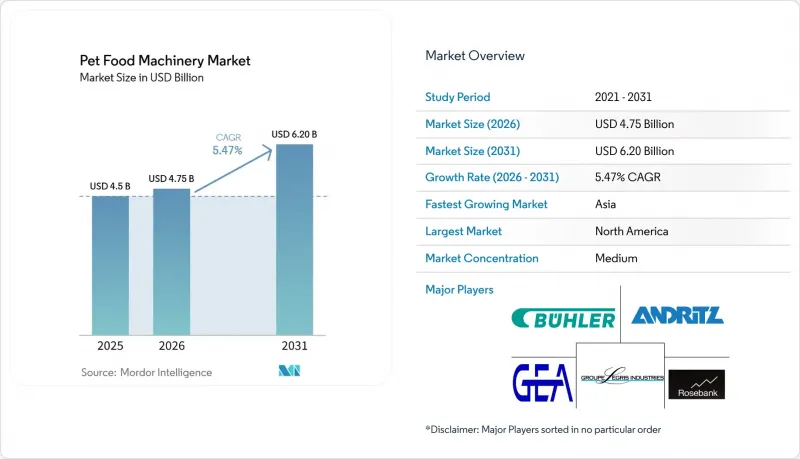
本報告按設備類型(擠壓、混合等)、生產流程(乾法、濕法等)、產品形式(乾糧、罐頭食品等)、寵物類型(犬、貓)和地區(北美、南美等)進行細分。市場預測以美元計價。
全球寵物食品機械市場趨勢及洞察
寵物食品生產的優質化
寵物食品機械市場正受到各大寵物食品類別向高階和超高級產品轉型趨勢的推動。與標準乾糧生產線相比,高級產品線需要更嚴格的製程控制、更頻繁的配方調整以及更高的衛生標準。因此,製造商正在升級生產流程各個環節的設備規格:從原料輸入、混合、擠壓、乾燥到塗層。寵物食品協會在其2025年生產和原料分析報告中指出,2019年至2024年間,海鮮原料的需求成長了95.0%,肉類和家禽原料的需求成長了34.0%,這反映出寵物食品製造設備市場對原料處理的要求日益複雜。這項變更不僅影響原料成本和產品定位,也影響工廠調整的頻率和批次分離管理。隨著高級產品線的不斷擴展,寵物食品加工市場對高度柔軟性的生產線越來越感興趣,這些生產線即使在小批量生產和頻繁換線的情況下也能維持產品品質。
擴大功能性和治療性寵物食品的生產
此外,功能性和治療性產品的興起,對生產條件提出了更高的要求,也推動了市場成長。獸用治療性飼料和營養特製產品正從狹窄的細分市場轉向更廣泛的零售和獸醫管道,這增加了對精密包衣、可控乾燥和隔離生產環境的需求。這些產品通常需要在擠壓後添加熱敏性原料,並且需要在生產過程加強文件記錄和驗證。這種轉變也影響資本投資計劃,製造商越來越需要專用或半專用生產線,而不是共享基礎設施。在寵物食品機械市場,這促使企業投資於旨在提高每個庫存管理單元 (SKU) 的設備密集度並確保配方準確性和污染控制的系統。
整合加工生產線的初始成本較高
整套加工生產線的高成本仍是寵物食品機械市場的一大障礙。集混合、擠壓、乾燥、塗層和包裝於一體的整合系統需要大量的資本投入,這使得許多中型製造商難以企及,尤其是在高級產品需求仍在發展中的地區和銷售管道。對於濕式和對衛生要求極高的產品而言,這項挑戰更為突出,因為清潔系統、材料選擇和佈局設計都會顯著增加專案成本。因此,在價格敏感的市場中,整套生產線的普及速度較為緩慢,新興品牌被迫選擇外包生產,而非自建工廠。在市場上,這個成本壁壘正在延長銷售週期,導致許多專案專注於分階段升級,而不是整個生產線的更換。
細分市場分析
到2025年,擠出成型設備將佔寵物食品機械市場佔有率的29.5%,成為最大的設備類別。這一地位反映了乾糧生產設備的裝機量,而乾糧生產仍然是全球寵物食品生產的基礎,推動了設備的更新換代、業務收益和升級改造活動。擠出成型仍然是市場上的核心製作流程,決定著整體主流產品形式的密度、質地、加熱性能和產品均勻性。儘管產品系列不斷演變,但大多數製造商仍然認為,在控制和衛生方面進行改進,對下游製程的性能影響最為直接,因此擠出成型製程的改進至關重要。
預計2026年至2031年間,包裝設備將以8.5%的複合年成長率成長,成為成長最快的設備細分市場。濕食品、高階食品、鮮食產品和單份包裝產品的成長推動了對各種密封類型、物料輸送系統和最終包裝配置的需求。到2025年,混合和攪拌設備仍將是第二大細分市場,為濕食品的製備和功能性產品的精確原料配製提供支援。隨著製造商越來越重視可追溯性、可重複性和減少換型損失,自動化和控制系統正從小規模不斷擴展。研磨和粉碎設備也繼續發揮至關重要的作用,因為在熱處理之前,需要對顆粒製備進行更嚴格的控制,以適應新型蛋白質和不同尺寸的原料。
預計到2025年,乾寵物食品加工生產線將佔寵物食品機械市場規模的41.2%,反映了全球乾寵物食品生產能力的規模和成熟度。這一地位得益於已安裝乾式生產線的較長運作,因為生產商傾向於維修和零件升級,而不是完全改造為其他製程配置。在乾式加工領域,生產線的熟悉度、穩定的加工能力以及與各種產品的兼容性仍然至關重要,市場也保持著穩固的裝置基礎。此外,鑑於乾式系統在該領域的核心地位,它們仍然是許多服務和售後市場關係的基礎。
預計2026年至2031年間,獸用飼料生產線將以9.4%的複合年成長率成長,成為成長最快的加工類型。與使用標準共享設施的生產線相比,這些生產線需要更嚴格的製程分離、可控的塗層製程以及更完善的衛生管理。寵物濕食生產線也在成長,儘管乾式加工在裝置容量方面仍佔據主導地位,但由於優質化的推進,對濕式寵物食品的需求正在增加。特殊加工生產線構成一個獨立的採購領域,因為其在成型、烘焙、冷卻和質地方面的要求與主要乾糧(顆粒狀食品)的生產流程有顯著差異。在整個寵物食品機械市場中,專用生產線的成長提高了能夠在同一廠址滿足不同熱處理流程和產品品質要求的工廠的價值。
區域分析
到2025年,北美將佔據33.0%的市場佔有率,成為最大的區域市場。該地區受益於大規模的高階寵物食品市場、完善的生產基礎設施以及對設備升級、擴建和現代化改造的持續投資。北美市場也得益於與供應商的緊密合作關係,大規模工廠不僅需要設備交付,還需要服務支援、數位化控制和合規性設計。與商業發展仍處於起步階段的地區相比,這些因素使得北美能夠實現更高附加價值的設備配置。
預計2026年至2031年,亞太地區將以7.4%的複合年成長率成長,成為成長最快的地區。這一成長主要得益於中國、日本、印度和東南亞地區商業寵物食品製造業的擴張,這些地區寵物數量的增加正促使消費者轉向購買品牌化產品。泰國正在崛起為區域寵物食品製造出口中心,以滿足對先進的濕式和乾式加工系統日益成長的需求。 2026年,CPM控股有限公司為河北省盛萌公司運作了一套TwinTech擠壓系統,標誌著這家中國製造商正式進軍商業寵物食品製造領域。這些項目表明,亞太地區的寵物食品機械市場不僅透過國內消費成長,也透過滿足出口和高級產品需求而建立的新增工業產能來實現擴張。
歐洲仍然是寵物食品加工設備的重要市場,其發展趨勢主要集中在設備升級、衛生水平提升以及面向出口的OEM(目的地設備製造商)生產。該地區的買家高度重視衛生工程、可追溯性和耐用性設計,這推動了平均設備規格的日益複雜化。在南美洲,巴西是區域生產需求的主要驅動力,隨著供應商在該地區建立業務基地,其重要性日益凸顯。中東和非洲雖然絕對規模仍然較小,但隨著第一代大型工廠的湧現,正吸引越來越多的關注。整體而言,寵物食品機械市場正在地域上不斷擴張,成熟地區的重點是設備升級,而新興地區的重點則是擴大基礎生產能力。
其他好處:
- Excel格式的市場預測(ME)表
- 3個月的分析師支持
目錄
第1章:引言
- 研究假設和市場定義
- 調查範圍
第2章:調查方法
第3章執行摘要
第4章 市場狀況
- 市場概覽
- 市場促進因素
- 寵物食品生產的優質化
- 功能性和治療性寵物食品產量成長
- 需要透過自動化來減少配方切換造成的損失
- 能源和水資源密集產業在永續性方面面臨的壓力。
- 拓展自有品牌產品及契約製造。
- 對衛生、可追溯、低污染的加工流程的需求。
- 市場限制因素
- 一體化加工生產線的初始投資成本相對較高。
- 缺乏能夠管理先進自動化系統的熟練工程師
- 改造和格式切換期間存在工廠停機風險。
- 原料的差異會使設備校準變得複雜。
- 技術展望
- 監理情勢
- 波特五力分析
第5章 市場規模與成長預測
- 依設備類型
- 擠出成型設備
- 混合攪拌設備
- 成型/模塑設備
- 乾燥/冷卻設備
- 塗層和調味裝置
- 研磨和銑削設備
- 包裝設備
- 自動化和控制系統
- 其他設備類型
- 依工藝類型
- 乾燥寵物食品加工生產線
- 寵物濕食加工生產線
- 零食加工生產線
- 獸用飼料加工生產線
- 營養補充品和膳食補充品加工生產線
- 寵物食品的生產方法
- 乾糧
- 罐裝和濕食品
- 冷凍乾燥產品和肉乾產品
- 軟糯耐嚼的零食
- 牙齒護理
- 粉末和補充劑
- 其他類型的寵物食品
- 寵物護理
- 狗
- 貓
- 其他寵物
- 按地區
- 北美洲
- 美國
- 加拿大
- 墨西哥
- 其他北美國家
- 南美洲
- 巴西
- 阿根廷
- 其他南美國家
- 歐洲
- 法國
- 德國
- 義大利
- 荷蘭
- 波蘭
- 俄羅斯
- 西班牙
- 英國
- 其他歐洲國家
- 亞太地區
- 澳洲
- 中國
- 印度
- 印尼
- 日本
- 馬來西亞
- 菲律賓
- 台灣
- 泰國
- 越南
- 其他亞太國家
- 中東
- 沙烏地阿拉伯
- 阿拉伯聯合大公國
- 其他中東國家
- 非洲
- 南非
- 埃及
- 其他非洲國家
- 北美洲
第6章 競爭情勢
- 市場集中度
- 策略趨勢
- 市佔率分析
- 公司簡介
- ANDRITZ AG
- Baker Perkins Ltd.(Coperion GmbH)
- Buhler AG(Buhler Group)
- Clextral SAS(Legris Industries Group)
- Coperion GmbH(Hillenbrand Inc.)
- CPM Holdings, Inc.(Rosebank Industries plc)
- FAMSUN Group
- GEA Group Aktiengesellschaft
- Hosokawa Micron Corporation(Hosokawa Micron Group)
- JBT Marel Corporation
- Mepaco Group(Apache Stainless Equipment Corporation)
- Reading Bakery Systems(Markel Food Group)
- The Middleby Corporation
- Fragola SpA
- Triott Group
第7章 市場機會與未來展望
According to Mordor Intelligence, the pet food machinery market is projected to grow from USD 4.50 billion in 2025 and USD 4.75 billion in 2026 to USD 6.20 billion by 2031, registering a CAGR of 5.47% between 2026 and 2031.
This report is Segmented by Equipment Type (Extrusion, Mixing, and More), by Process Type (Dry, Wet, and More), by Output Format (Kibbles, Canned, and More), by Pet Type (Dogs and Cats), and by Geography (North America, South America, and More). The Market Forecasts are Provided in Terms of Value (USD).
Global Pet Food Machinery Market Trends and Insights
Premiumization of Pet Food Production
The pet food machinery market is being driven by the shift toward premium and super-premium products across major pet food categories. Premium lines require tighter process control, more frequent recipe changes, and stricter hygiene standards than standard kibble lines. As a result, producers are upgrading equipment specifications across intake, mixing, extrusion, drying, and coating stages. The Pet Food Institute reported in its 2025 production and ingredient analysis that demand for marine ingredients rose 95.0% and meat and poultry ingredients rose 34.0% between 2019 and 2024, reflecting the increasingly complex ingredient handling requirements in the pet food machinery market. This shift affects not only ingredient costs and product positioning, but also the frequency of plant recalibration and lot separation management. As premium portfolios expand, the pet food processing market is seeing growing interest in flexible lines that can maintain quality during shorter production runs and more frequent changeovers.
Growth in Functional and Therapeutic Pet Food Output
The market is also gaining support from the rise of functional and therapeutic products that require more controlled manufacturing conditions. Veterinary diets and nutritionally targeted products are moving from a narrow specialty position into broader retail and veterinary channels, lifting demand for precision coating, controlled drying, and segregated production environments. These formats often require post-extrusion application of heat-sensitive ingredients, along with improved documentation and validation at each production step. This shift affects capital planning, as producers increasingly need dedicated or semi-dedicated lines rather than shared-use infrastructure. In the pet food machinery market, this raises equipment intensity per stock-keeping unit and supports spending on systems designed for consistent formulation accuracy and contamination control.
High Upfront Cost of Integrated Processing Lines
The high cost of complete processing lines remains a significant barrier in the pet food machinery market. Integrated systems that combine mixing, extrusion, drying, coating, and packaging require capital commitments that many mid-sized producers cannot easily approve, particularly in regions or channels where premium demand is still developing. This challenge is more pronounced in wet and hygienic formats, where cleaning systems, material selection, and layout design can substantially increase project costs. As a result, adoption slows in price-sensitive markets, pushing early-stage brands toward outsourced manufacturing rather than direct ownership. In the market, this cost barrier extends sales cycles and keeps many projects focused on staged upgrades rather than full-line replacements.
Other drivers and restraints analyzed in the detailed report include:
- Automation Demand to Reduce Recipe Changeover Losses
- Sustainability Pressures on Energy and Water Intensive Lines
- Skilled Technician Shortage for Advanced Automation Systems
For complete list of drivers and restraints, kindly check the Table Of Contents.
Segment Analysis
Extrusion equipment held 29.5% of the pet food machinery share in 2025, making it the largest equipment category. This position reflects the installed base supporting dry kibble production, which continues to anchor global pet food production and drives replacement demand, service revenue, and upgrade activity. Extrusion remains a central processing step in the market because it determines density, texture, cooking performance, and product consistency across mainstream formats. Even as product portfolios evolve, most manufacturers continue to view extrusion as the process stage where improvements in control and hygiene most directly influence downstream performance.
Packaging equipment is projected to grow at an 8.5% CAGR between 2026 and 2031, making it the fastest-growing equipment sub-segment. Growth in wet, premium, fresh-like, and single-serve products is driving demand for different seal types, material handling systems, and final pack configurations. Mixing and blending equipment remained the second-largest category in 2025, supporting both wet food preparation and precise ingredient incorporation for functional products. Automation and control systems are expanding from a smaller base as manufacturers place greater emphasis on traceability, repeatability, and reduced changeover losses. Grinding and milling equipment also remains relevant, as novel proteins and varied ingredient sizes require more controlled particle preparation before thermal processing.
Dry pet food processing lines accounted for 41.2% of the pet food machinery market size in 2025, reflecting the size and maturity of global kibble capacity. This position is supported by the long operating life of installed dry lines, as producers often prefer retrofits and component upgrades over full conversion to other process configurations. The market retains a strong installed-base logic in dry processing, where line familiarity, throughput stability, and broad product compatibility remain relevant. Dry systems also continue to anchor many service and aftermarket relationships, given their central role in the category.
Veterinary diet processing lines are anticipated to expand at a 9.4% CAGR between 2026 and 2031, making them the fastest-growing process type. These lines require tighter process segregation, controlled coating steps, and more rigorous hygiene discipline than standard shared-use operations. Wet pet food processing lines are also growing, as premiumization is expanding demand for moist formats, even though dry processing remains dominant by installed capacity. Treats processing lines form a separate procurement stream, as forming, baking, cooling, and texture requirements differ materially from core kibble operations. Across the pet food machinery market, the growth of specialized lines is increasing the value of plants that can support different thermal profiles and product integrity requirements within the same site.
Complete Report Scope:
- By Equipment Type
- Extrusion Equipment
- Mixing and Blending Equipment
- Forming and Shaping Equipment
- Drying and Cooling Equipment
- Coating and Flavoring Equipment
- Grinding and Milling Equipment
- Packaging Equipment
- Automation and Control Systems
- Other Equipment Types
- By Process Type
- Dry Pet Food Processing Lines
- Wet Pet Food Processing Lines
- Treats Processing Lines
- Veterinary Diet Processing Lines
- Nutraceutical and Supplement Processing Lines
- By Pet Food Output Format
- Kibbles
- Canned and Wet Food
- Freeze-Dried and Jerky Products
- Soft and Chewy Treats
- Dental Treats
- Powders and Supplements
- Other Pet Food Output Formats
- By Pet Type
- Dogs
- Cats
- Other Pets
- By Geography
- North America
- United States
- Canada
- Mexico
- Rest of North America
- South America
- Brazil
- Argentina
- Rest of South America
- Europe
- France
- Germany
- Italy
- Netherlands
- Poland
- Russia
- Spain
- United Kingdom
- Rest of Europe
- Asia-Pacific
- Australia
- China
- India
- Indonesia
- Japan
- Malaysia
- Philippines
- Taiwan
- Thailand
- Vietnam
- Rest of Asia-Pacific
- Middle East
- Saudi Arabia
- United Arab Emirates
- Rest of Middle East
- Africa
- South Africa
- Egypt
- Rest of Africa
- North America
Geography Analysis
North America accounted for 33.0% of the market share in 2025, making it the largest regional market. The region benefits from a large premium pet food base, established manufacturing infrastructure, and consistent spending on replacement, expansion, and modernization. The North American market also benefits from deep supplier relationships, where large plants require not only equipment delivery but also service support, digital controls, and compliance-ready designs. These factors support a higher-value equipment mix compared to regions that are still in earlier stages of commercial development.
Asia-Pacific is anticipated to expand at a 7.4% CAGR between 2026 and 2031, making it the fastest-growing geography. Growth is driven by expanding commercial pet food manufacturing across China, Japan, India, and Southeast Asia, where rising pet ownership is shifting demand toward organized and branded formats. Thailand is emerging as a regional export base for pet food manufacturing, supporting stronger demand for modern wet and dry processing systems. In 2026, CPM Holdings, Inc.commissioned a TwinTech extrusion system for Shengmeng in Hebei Province, marking the Chinese producer's entry into commercial pet food manufacturing. This type of project indicates that the pet food machinery market in Asia-Pacific is expanding not only through local consumption, but also through new industrial capacity built around export and premium product requirements.
Europe remains an important market for pet food processing equipment, with activity largely tied to replacement, hygiene upgrades, and export-oriented original equipment manufacturers (OEM) manufacturing. Buyers in the region place significant emphasis on sanitary engineering, traceability, and durable design, which supports higher average equipment specifications. South America is gaining relevance as Brazil anchors regional production demand and suppliers establish commercial presence in the region. The Middle East and Africa remain smaller in absolute value but are attracting attention as first-generation large-scale facilities begin to appear. Overall, the pet food machinery market is expanding geographically, with mature regions focused on upgrades and emerging regions focused on foundational capacity buildouts.
- ANDRITZ AG
- Baker Perkins Ltd. (Coperion GmbH)
- Buhler AG (Buhler Group)
- Clextral SAS (Legris Industries Group)
- Coperion GmbH (Hillenbrand Inc.)
- CPM Holdings, Inc. (Rosebank Industries plc )
- FAMSUN Group
- GEA Group Aktiengesellschaft
- Hosokawa Micron Corporation (Hosokawa Micron Group)
- JBT Marel Corporation
- Mepaco Group (Apache Stainless Equipment Corporation)
- Reading Bakery Systems (Markel Food Group)
- The Middleby Corporation
- Fragola S.p.A.
- Triott Group
Additional Benefits:
- The market estimate (ME) sheet in Excel format
- 3 months of analyst support
TABLE OF CONTENTS
1 INTRODUCTION
- 1.1 Study Assumptions and Market Definition
- 1.2 Scope of the Study
2 RESEARCH METHODOLOGY
3 EXECUTIVE SUMMARY
4 MARKET LANDSCAPE
- 4.1 Market Overview
- 4.2 Market Drivers
- 4.2.1 Premiumization of pet food production
- 4.2.2 Growth in functional and therapeutic pet food output
- 4.2.3 Automation demand to reduce recipe changeover losses
- 4.2.4 Sustainability pressures on energy and water intensive lines
- 4.2.5 Expansion of high-mix private label and contract manufacturing
- 4.2.6 Demand for hygienic, traceable, and low-contamination processing
- 4.3 Market Restraints
- 4.3.1 High upfront cost of integrated processing lines
- 4.3.2 Skilled technician shortage for advanced automation systems
- 4.3.3 Plant downtime risk during retrofitting and format switching
- 4.3.4 Ingredient variability increases equipment calibration complexity
- 4.4 Technological Outlook
- 4.5 Regulatory Landscape
- 4.6 Porter's Five Forces Analysis
- 4.6.1 Bargaining Power of Suppliers
- 4.6.2 Bargaining Power of Buyers
- 4.6.3 Threat of New Entrants
- 4.6.4 Threat of Substitutes
- 4.6.5 Intensity of Competitive Rivalry
5 MARKET SIZE AND GROWTH FORECASTS (VALUE)
- 5.1 By Equipment Type
- 5.1.1 Extrusion Equipment
- 5.1.2 Mixing and Blending Equipment
- 5.1.3 Forming and Shaping Equipment
- 5.1.4 Drying and Cooling Equipment
- 5.1.5 Coating and Flavoring Equipment
- 5.1.6 Grinding and Milling Equipment
- 5.1.7 Packaging Equipment
- 5.1.8 Automation and Control Systems
- 5.1.9 Other Equipment Types
- 5.2 By Process Type
- 5.2.1 Dry Pet Food Processing Lines
- 5.2.2 Wet Pet Food Processing Lines
- 5.2.3 Treats Processing Lines
- 5.2.4 Veterinary Diet Processing Lines
- 5.2.5 Nutraceutical and Supplement Processing Lines
- 5.3 By Pet Food Output Format
- 5.3.1 Kibbles
- 5.3.2 Canned and Wet Food
- 5.3.3 Freeze-Dried and Jerky Products
- 5.3.4 Soft and Chewy Treats
- 5.3.5 Dental Treats
- 5.3.6 Powders and Supplements
- 5.3.7 Other Pet Food Output Formats
- 5.4 By Pet Type
- 5.4.1 Dogs
- 5.4.2 Cats
- 5.4.3 Other Pets
- 5.5 By Geography
- 5.5.1 North America
- 5.5.1.1 United States
- 5.5.1.2 Canada
- 5.5.1.3 Mexico
- 5.5.1.4 Rest of North America
- 5.5.2 South America
- 5.5.2.1 Brazil
- 5.5.2.2 Argentina
- 5.5.2.3 Rest of South America
- 5.5.3 Europe
- 5.5.3.1 France
- 5.5.3.2 Germany
- 5.5.3.3 Italy
- 5.5.3.4 Netherlands
- 5.5.3.5 Poland
- 5.5.3.6 Russia
- 5.5.3.7 Spain
- 5.5.3.8 United Kingdom
- 5.5.3.9 Rest of Europe
- 5.5.4 Asia-Pacific
- 5.5.4.1 Australia
- 5.5.4.2 China
- 5.5.4.3 India
- 5.5.4.4 Indonesia
- 5.5.4.5 Japan
- 5.5.4.6 Malaysia
- 5.5.4.7 Philippines
- 5.5.4.8 Taiwan
- 5.5.4.9 Thailand
- 5.5.4.10 Vietnam
- 5.5.4.11 Rest of Asia-Pacific
- 5.5.5 Middle East
- 5.5.5.1 Saudi Arabia
- 5.5.5.2 United Arab Emirates
- 5.5.5.3 Rest of Middle East
- 5.5.6 Africa
- 5.5.6.1 South Africa
- 5.5.6.2 Egypt
- 5.5.6.3 Rest of Africa
- 5.5.1 North America
6 COMPETITIVE LANDSCAPE
- 6.1 Market Concentration
- 6.2 Strategic Moves
- 6.3 Market Share Analysis
- 6.4 Company Profiles (Includes Global Level Overview, Market Level Overview, Core Segments, Financials as Available, Strategic Information, Market Rank, Share, Products and Services, Recent Developments)
- 6.4.1 ANDRITZ AG
- 6.4.2 Baker Perkins Ltd. (Coperion GmbH)
- 6.4.3 Buhler AG (Buhler Group)
- 6.4.4 Clextral SAS (Legris Industries Group)
- 6.4.5 Coperion GmbH (Hillenbrand Inc.)
- 6.4.6 CPM Holdings, Inc. (Rosebank Industries plc )
- 6.4.7 FAMSUN Group
- 6.4.8 GEA Group Aktiengesellschaft
- 6.4.9 Hosokawa Micron Corporation (Hosokawa Micron Group)
- 6.4.10 JBT Marel Corporation
- 6.4.11 Mepaco Group (Apache Stainless Equipment Corporation)
- 6.4.12 Reading Bakery Systems (Markel Food Group)
- 6.4.13 The Middleby Corporation
- 6.4.14 Fragola S.p.A.
- 6.4.15 Triott Group
7 MARKET OPPORTUNITIES AND FUTURE OUTLOOK

 2026-2030年全球寵物自動餵食系統市場
 自動化飼餵系統市場:依動物種類、飼餵器類型、自動化程度、控制技術、銷售管道和最終用戶分類-2026-2032年全球市場預測
 2026年全球自動化擠乳系統市場報告
 水產養殖技術市場預測至2034年-按技術類型、組件、水產養殖環境、應用、最終用戶和地區分類的全球分析
 自動化飼餵系統市場 - 全球產業規模、佔有率、趨勢、機會、預測:畜牧業、類型、技術、功能、地區和競爭格局,2021-2031年
 全球自動化送料系統市場規模、佔有率、趨勢及成長分析報告(2026-2034)2026年全球自動化送料系統市場報告
 自動餵料系統市場規模、佔有率和成長分析(按類型、畜種、技術、整合度、功能和地區分類)-2026-2033年產業預測
 全球自動餵料系統市場:市場規模、佔有率、趨勢分析(按組件、系統、牲畜和地區)、細分市場預測(2025-2033)
 自動給餌系統的全球市場:市場規模·佔有率·趨勢,產業分析 (各零件·各系統·家畜·各地區),未來預測 (2025年~2034年)