


 |
市場調查報告書
商品編碼
2099816
新戊二醇:市場佔有率分析、行業趨勢和統計數據、成長預測(2026-2031)Neopentyl Glycol - Market Share Analysis, Industry Trends & Statistics, Growth Forecasts (2026 - 2031) |
||||||

※ 本網頁內容可能與最新版本有所差異。詳細情況請與我們聯繫。
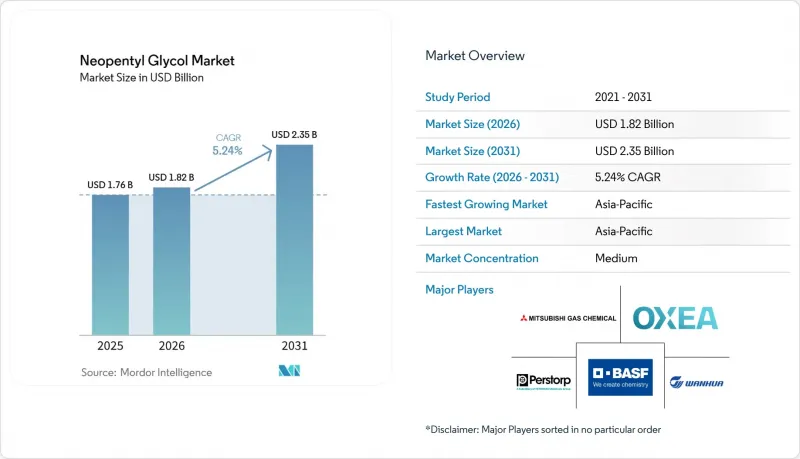
根據 Mordor Intelligence 預測,新戊二醇市場規模將從 2025 年的 17.6 億美元成長到 2026 年的 18.2 億美元,然後在 2031 年達到 23.5 億美元,2026 年至 2031 年的複合年成長率為 5.24%。
本報告按形態(片狀、熔融材料、漿料)、應用(潤滑劑、塑化劑等)和地區(亞太地區、北美地區、歐洲地區、南美地區、中東和非洲地區)進行細分。市場預測以美元計價。
全球新戊二醇市場趨勢與洞察
來自油漆和樹脂製造業的旺盛需求。
塗料和樹脂製造業仍然是新戊二醇 (NPG) 市場最大的需求來源。在該行業中,NPG 仍然是用於製造耐用表面塗層的飽和聚酯和醇酸樹脂的關鍵成分。其化學結構使樹脂配混商能夠提高耐候性、光澤保持性和耐水解性,而 NPG 市場與那些不允許塗層過早劣化的應用密切相關。隨著中國將於 2026 年實施更嚴格的塗料法規,化合物開發商正進一步推動向低 VOC 體系轉型,從而提振了中國大規模的建築和工業塗料市場對粉末和水性樹脂的需求。BASF表示,與液體塗料相比,粉末塗料樹脂體係可將 VOC 排放量降低高達 50%,這進一步提升了 NPG 基聚酯系統在優先考慮法規合規性的配方中的重要性。在該行業,穩定的供應和製程相容性與價格同等重要,這使得在塗料樹脂產地附近運作的製造商具有優勢。這種定位確保了油漆和樹脂在NPG市場中仍然佔據核心地位,即使下游買家繼續更加密切地關注成本和碳排放強度。
汽車輕量化和高性能潤滑油
NPG市場也受惠於汽車和工業潤滑油的需求。 NPG衍生的酯類具有熱穩定性好、揮發性低和優異的低溫性能。中化指出,NPG基合成酯潤滑油是高性能應用的理想選擇,例如電動車變速箱油、電池溫度控管液和高速馬達潤滑油。這一點意義重大,因為NPG市場不僅受益於汽車產量的整體成長,也受益於潤滑油規格的變化。在塗料領域,類似的汽車平臺轉型持續推動耐用型OEM和修補漆系統的發展,這些系統需要穩定的樹脂化學性質和在長使用週期內優異的表面性能。因此,NPG市場受惠於汽車產業的兩大相關需求:更輕更耐用的塗裝零件和更高性能的合成潤滑油。這種雙重優勢使得NPG市場的需求結構比依賴單一運輸應用的特種化學品市場更為均衡。
原物料價格波動
新戊二醇 (NPG) 市場極易受到原物料價格波動的影響。這是因為 NPG 的生產依賴異丁醛和甲醛,而這兩種原料都來自波動性較大的上游石化產業鏈。根據 ChemNet 數據顯示,2025 年 3 月的一周內,中國異丁醛價格上漲了 17.1%,國內價格從每噸 6,433 元人民幣上漲至 7,533 元人民幣,原因是供應緊張和下游需求增加。當原料成本波動如此劇烈時,生產商被迫在接受較低的利潤率或將價格上漲轉嫁給客戶之間做出選擇。這給價格敏感應用領域的買家帶來了風險,採購團隊可能會推遲採購、減少庫存或重新評估配方的獲利能力。與下游產業相比,新戊二醇市場在對性能要求極高的塗料和潤滑油領域更為穩定,因為下游產業的採購行為會因成本波動而發生更快速的變化。這種趨勢不會完全消除需求,但在原料供應緊張時期,訂單可能會延遲或盈利可能會下降。
細分市場分析
2025年,熔融態新戊二醇佔了52.78%的市場。這反映了其適用於日消耗量巨大的連續樹脂生產線。大規模工廠更傾向於使用熔融態新戊二醇,因為它省去了片狀新戊二醇所需的重熔工序,可以直接交付加熱系統。這項製程優勢降低了高通量縮聚製程的能量損失,並有助於穩定塗料樹脂生產商的生產計畫。此外,熔融態新戊二醇也適用於供應網路支援加熱槽、管道運輸以及在綜合化工廠快速卸料的地區。這些營運優勢確保了熔融態新戊二醇在亞洲和部分歐洲地區的大型生產基地中繼續保持其市場地位。
在片狀新戊二醇市場,片狀新戊二醇仍然佔據重要地位,因為其易於包裝和儲存的特性對於大量生產、小規模樹脂廠或出口物流至關重要。在印度和東南亞等地區,由於加熱運輸網路不發達,且工廠配置無法容納連續熔融狀態的原料,小規模買家仍繼續使用片狀新戊二醇。然而,隨著下游用戶對其處理系統進行現代化改造,並要求降低樹脂生產的轉化成本,片狀新戊二醇正逐漸面臨競爭壓力。漿狀新戊二醇是新戊二醇市場中成長最快的形式,預計到2031年將以5.82%的複合年成長率成長。由於漿狀新戊二醇可以在常溫下運輸,因此減輕了與溫度控制相關的物流負擔。對於那些不僅從採購價格和純度,而且從碳足跡和安全性等方面評估交付形式的買家來說,漿狀新戊二醇也極具吸引力。
區域分析
預計到2025年,亞太地區將佔全球新戊二醇需求的44.83%,並在2031年之前以5.93%的複合年成長率持續成長,成為新戊二醇市場的主要區域成長引擎。該地區擁有大規模的生產基地和顯著的下游消費,最佳化了物流,並促進了上游新戊二醇工廠與耐腐蝕樹脂用戶之間的緊密合作。中國作為新戊二醇相關樹脂和塗料的最大生產國和消費國,在新戊二醇市場仍佔據主導地位。預計2026年中國更嚴格的塗料標準將進一步推動採用新戊二醇相容樹脂化學技術的粉末塗料和水性塗料系統的發展。韓國、日本、印度和東南亞也透過對電子塗料、汽車供應鏈、基礎設施材料和特殊樹脂的需求,為新戊二醇市場做出貢獻。
北美是新戊二醇市場的高價值細分市場,買家不僅關注成本,還重視等級一致性、技術服務和供應可靠性。伊士曼和BASF仍然是該地區供應結構的核心,2026年3月在北美和拉丁美洲實施的價格上漲表明,在以規格為導向的基本客群中,市場紀律仍然強勁。該地區對低碳等級和可回收/循環原料供應管道的興趣日益濃厚,這與塗料和先進材料領域向更高採購透明度轉變的趨勢相一致。加拿大和墨西哥對新戊二醇市場的貢獻主要來自跨國汽車和工業製造合作,而非其自身獨特的成長模式。
在歐洲,新戊二醇市場依然青睞那些優先考慮可追溯性和合規性的供應商。需求仍然集中在汽車和建築塗料領域,尤其是在德國、英國、法國和義大利。BASF在2026年3月將新戊二醇的價格上調了350歐元/噸(406美元/噸),這表明歐洲買家仍然在一個有利於技術合格供應商定價的市場環境中運作。低碳等級和碳足跡認證在歐洲比在大多數其他地區更為重要,這鞏固了優質供應商在新戊二醇市場的地位。南美洲、中東和非洲的市場規模仍然小規模,但在需要高耐久性樹脂體系的工業、建築和基礎設施塗料領域,這些市場蘊藏著長期的商業機會。
其他好處:
- Excel格式的市場預測(ME)表
- 3個月的分析師支持
目錄
第1章:引言
- 研究假設和市場定義
- 調查範圍
第2章:調查方法
第3章執行摘要
第4章 市場狀況
- 市場概覽
- 市場促進因素
- 工業應用中對油漆和樹脂的需求不斷成長
- 汽車產業對更輕盈、更耐用的塗料的需求
- 過渡到低揮發性有機化合物和環保配方
- 擴大 BioBalance 和循環化學產品的供應
- 市場限制因素
- 石油化工產業鏈原物料價格波動
- 替代多元醇和酯類化學的替代風險
- 特定等級物料的處理和儲存複雜性
- 價值鏈分析
- 波特五力分析
第5章 市場規模與成長預測
- 按形式
- 薄片
- 融化
- 泥
- 透過使用
- 油漆和樹脂
- 潤滑劑
- 塑化劑
- 黏合劑和密封劑
- 聚氨酯泡棉和隔熱材料
- 其他用途
- 按地區
- 亞太地區
- 中國
- 印度
- 日本
- 韓國
- 其他亞太國家
- 北美洲
- 美國
- 加拿大
- 墨西哥
- 歐洲
- 德國
- 英國
- 法國
- 義大利
- 俄羅斯
- 其他歐洲國家
- 南美洲
- 巴西
- 阿根廷
- 其他南美國家
- 中東和非洲
- 沙烏地阿拉伯
- 南非
- 其他中東和非洲國家
- 亞太地區
第6章 競爭情勢
- 市場集中度
- 策略趨勢
- 市佔率和排名分析
- 公司簡介
- BASF
- Dongsung Chemical
- Eastman Chemical Company
- Hubei Longxin Chemical Industry Co., Ltd.
- LG Chem
- MITSUBISHI GAS CHEMICAL COMPANY, INC.
- OXEA GmbH
- Perstorp
- Shandong Dongchen New Technology Co., Ltd.
- Wanhua
- Zhejiang Guanghua Technology Co., Ltd.
- Zibo Ruibao Chemical Co., Ltd.
第7章 市場機會與未來展望
According to Mordor Intelligence, the neopentyl glycol market size is expected to grow from USD 1.76 billion in 2025 to USD 1.82 billion in 2026 and is forecast to reach USD 2.35 billion by 2031 at 5.24% CAGR over 2026-2031.
This report is Segmented by Form (Flakes, Molten, and Slurry), Application (Lubricants, Plasticizers, and More), and Geography (Asia-Pacific, North America, Europe, South America, and Middle-East and Africa). The Market Forecasts are Provided in Terms of Value (USD).
Global Neopentyl Glycol Market Trends and Insights
High Demand from Coatings and Resins Manufacturing
The neopentyl glycol (NPG) market continues to draw its largest demand from coatings and resins manufacturing, where NPG remains integral to saturated polyester and alkyd systems used in durable surface finishes. Its chemical structure enables resin formulators to improve weatherability, gloss retention, and hydrolytic resistance, keeping the NPG market closely tied to applications where early coating breakdown is not acceptable. China's tighter coating regulations in 2026 added further pressure on formulators to shift toward low-VOC systems, supporting demand for powder and waterborne resins in the country's large construction and industrial coatings base. BASF stated that powder coating resin systems can reduce VOC emissions by up to 50% compared with liquid coating alternatives, reinforcing the relevance of NPG-based polyester systems in compliance-driven formulations. Producers operating close to coating resin clusters hold an advantage, as reliable supply and process compatibility are as important as price in this segment. This positioning keeps coatings and resins at the center of the NPG market, even as downstream buyers continue to monitor costs and carbon intensity more closely.
Automotive Lightweighting and High-Performance Lubricants
The NPG market is also supported by automotive and industrial lubricant demand, where NPG-derived esters offer thermal stability, low volatility, and strong low-temperature performance. Sinochem noted that NPG-based synthetic ester lubricants are well-suited to high-performance applications such as electric vehicle gearbox oils, battery thermal management fluids, and high-speed motor lubricants. This is relevant because the NPG market is benefiting from a shift in lubricant specifications, not just from broader automotive output growth. In coatings, the same vehicle platform transition continues to support durable OEM and refinish systems that require stable resin chemistry and strong surface performance over long operating cycles. The NPG market therefore benefits from two linked automotive needs: lighter and more durable coated parts on one side, and higher-performance synthetic lubricants on the other. This dual exposure gives the NPG market a more balanced demand mix compared with specialty chemicals that depend on a single transportation end use.
Feedstock Price Volatility
The neopentyl glycol market remains exposed to feedstock price swings because NPG production depends on isobutyraldehyde and formaldehyde, both derived from volatile upstream petrochemical chains. ChemNet reported that isobutyraldehyde prices in China rose 17.1% over one week in March 2025, with domestic prices increasing to CNY 7,533 per ton from CNY 6,433 per ton, as supply tightened and downstream demand improved. When feedstock costs move this quickly, producers must either accept lower margins or pass the increase on to customers. This creates risk for buyers in price-sensitive applications, where procurement teams may delay purchases, reduce inventory, or reassess formulation economics. The neopentyl glycol market is more stable in performance-critical coatings and lubricants than in downstream categories where cost swings can alter buying behavior more rapidly. This dynamic does not eliminate demand, but it can slow order timing and weaken profitability during periods of tight feedstock supply.
Other drivers and restraints analyzed in the detailed report include:
- Shift Toward Low-VOC and Sustainable Formulations
- Growth in Bio-Based Neopentyl Glycol (NPG) Production
- Substitution Risk from Alternative Glycols
For complete list of drivers and restraints, kindly check the Table Of Contents.
Segment Analysis
Molten accounted for 52.78% of the neopentyl glycol market share in 2025, reflecting its compatibility with continuous resin production lines that consume large daily volumes of NPG. Large plants prefer molten deliveries because the product moves directly into heated systems without the additional re-melting step required for flakes. This process advantage reduces energy loss in high-throughput polycondensation operations and helps stabilize production scheduling for coatings resin manufacturers. Molten form also suits regions where supply networks support heated tanks, pipeline handling, and rapid unloading at integrated chemical sites. These operational benefits explain why the neopentyl glycol market continues to favor molten form in large-scale production centers across Asia and parts of Europe.
Flakes remain relevant in the neopentyl glycol market where batch operations, smaller resin plants, or export logistics favor easier packaging and storage. Smaller buyers in India and Southeast Asia continue to use flakes where heated transport networks are less developed and plant configurations are not built around continuous molten input. However, flakes face gradual pressure as downstream users modernize handling systems and seek lower conversion costs in resin manufacturing. Slurry is the fastest-growing form in the neopentyl glycol market and is expected to expand at a 5.82% CAGR through 2031. It can be transported at ambient temperature, reducing the logistics burden associated with thermal maintenance. This form also appeals to buyers that evaluate delivery formats on the basis of carbon footprint and safety considerations, not only purchase price and purity.
Complete Report Scope:
- By Form
- Flakes
- Molten
- Slurry
- By Application
- Coatings and Resins
- Lubricants
- Plasticizers
- Adhesives and Sealants
- Polyurethane Foams and Insulation
- Other Applications
- By Geography
- Asia-Pacific
- China
- India
- Japan
- South Korea
- Rest of Asia-Pacific
- North America
- United States
- Canada
- Mexico
- Europe
- Germany
- United Kingdom
- France
- Italy
- Russia
- Rest of Europe
- South America
- Brazil
- Argentina
- Rest of South America
- Middle-East and Africa
- Saudi Arabia
- South Africa
- Rest of Middle-East and Africa
- Asia-Pacific
Geography Analysis
Asia-Pacific accounted for 44.83% of global demand in 2025 and is projected to expand at a 5.93% CAGR through 2031, making it the primary regional growth engine of the neopentyl glycol market. The region combines large production clusters with substantial downstream consumption, which tightens logistics and supports strong integration between upstream NPG plants and coating resin users. China remains the dominant force in the neopentyl glycol market, as both the largest producer and consumer of NPG-linked resins and coatings. Tighter Chinese coating standards in 2026 provide additional support for powder and waterborne systems that use NPG-compatible resin chemistry. South Korea, Japan, India, and Southeast Asia also contribute to the neopentyl glycol market through electronics coatings, automotive supply chains, infrastructure materials, and specialty resin demand.
North America represents a high-value segment of the neopentyl glycol market, where buyers often prioritize grade consistency, technical service, and supply reliability over cost alone. Eastman and BASF remain central to the regional supply landscape, and the March 2026 price increase across North and Latin America indicated that market discipline held firm within a specification-driven customer base. The region is also notable for growing interest in lower-carbon grades and documented recycled or circular feedstock pathways, which align with the broader shift toward procurement transparency in coatings and advanced materials. Canada and Mexico contribute to the neopentyl glycol market primarily through cross-border automotive and industrial manufacturing links rather than independent growth patterns.
Europe continues to favor traceable, compliance-oriented supply in the neopentyl glycol market, particularly in Germany, the UK, France, and Italy, where demand from automotive and architectural coatings remains concentrated. BASF's March 2026 price increase of EUR 350 per metric ton (USD 406 per metric ton) indicates that European buyers continue to operate in a market that supports pricing for technically qualified supply. Lower-carbon grades and carbon footprint documentation carry greater weight in Europe than in most other regions, which strengthens the position of premium suppliers in the neopentyl glycol market. South America, the Middle East, and Africa remain smaller markets, but offer longer-cycle opportunities in industrial, architectural, and infrastructure coatings that require durable resin systems.
- BASF
- Dongsung Chemical
- Eastman Chemical Company
- Hubei Longxin Chemical Industry Co., Ltd.
- LG Chem
- MITSUBISHI GAS CHEMICAL COMPANY, INC.
- OXEA GmbH
- Perstorp
- Shandong Dongchen New Technology Co., Ltd.
- Wanhua
- Zhejiang Guanghua Technology Co., Ltd.
- Zibo Ruibao Chemical Co., Ltd.
Additional Benefits:
- The market estimate (ME) sheet in Excel format
- 3 months of analyst support
TABLE OF CONTENTS
1 Introduction
- 1.1 Study Assumptions and Market Definition
- 1.2 Scope of the Study
2 Research Methodology
3 Executive Summary
4 Market Landscape
- 4.1 Market Overview
- 4.2 Market Drivers
- 4.2.1 High Demand for Coatings and Resins in Industrial Applications
- 4.2.2 Automotive Light Weighting and Durable Coating Demand
- 4.2.3 Shift Toward Low-VOC and Eco-Friendly Formulations
- 4.2.4 Growth in Bio-Balanced and Circular Chemistry Offerings
- 4.3 Market Restraints
- 4.3.1 Feedstock Price Volatility in Petrochemical Chains
- 4.3.2 Substitution Risk from Alternative Polyols and Ester Chemistries
- 4.3.3 High Handling and Storage Complexity for Certain Grades
- 4.4 Value Chain Analysis
- 4.5 Porter's Five Forces Analysis
- 4.5.1 Threat of New Entrants
- 4.5.2 Bargaining Power of Suppliers
- 4.5.3 Bargaining Power of Buyers
- 4.5.4 Threat of Substitutes
- 4.5.5 Competitive Rivalry
5 Market Size and Growth Forecasts (Value)
- 5.1 By Form
- 5.1.1 Flakes
- 5.1.2 Molten
- 5.1.3 Slurry
- 5.2 By Application
- 5.2.1 Coatings and Resins
- 5.2.2 Lubricants
- 5.2.3 Plasticizers
- 5.2.4 Adhesives and Sealants
- 5.2.5 Polyurethane Foams and Insulation
- 5.2.6 Other Applications
- 5.3 By Geography
- 5.3.1 Asia-Pacific
- 5.3.1.1 China
- 5.3.1.2 India
- 5.3.1.3 Japan
- 5.3.1.4 South Korea
- 5.3.1.5 Rest of Asia-Pacific
- 5.3.2 North America
- 5.3.2.1 United States
- 5.3.2.2 Canada
- 5.3.2.3 Mexico
- 5.3.3 Europe
- 5.3.3.1 Germany
- 5.3.3.2 United Kingdom
- 5.3.3.3 France
- 5.3.3.4 Italy
- 5.3.3.5 Russia
- 5.3.3.6 Rest of Europe
- 5.3.4 South America
- 5.3.4.1 Brazil
- 5.3.4.2 Argentina
- 5.3.4.3 Rest of South America
- 5.3.5 Middle-East and Africa
- 5.3.5.1 Saudi Arabia
- 5.3.5.2 South Africa
- 5.3.5.3 Rest of Middle-East and Africa
- 5.3.1 Asia-Pacific
6 Competitive Landscape
- 6.1 Market Concentration
- 6.2 Strategic Moves
- 6.3 Market Share (%)/Ranking Analysis
- 6.4 Company Profiles (includes Global Overview, Market Overview, Core Segments, Financials as available, Strategic Information, Products and Services, and Recent Developments)
- 6.4.1 BASF
- 6.4.2 Dongsung Chemical
- 6.4.3 Eastman Chemical Company
- 6.4.4 Hubei Longxin Chemical Industry Co., Ltd.
- 6.4.5 LG Chem
- 6.4.6 MITSUBISHI GAS CHEMICAL COMPANY, INC.
- 6.4.7 OXEA GmbH
- 6.4.8 Perstorp
- 6.4.9 Shandong Dongchen New Technology Co., Ltd.
- 6.4.10 Wanhua
- 6.4.11 Zhejiang Guanghua Technology Co., Ltd.
- 6.4.12 Zibo Ruibao Chemical Co., Ltd.
7 Market Opportunities and Future Outlook
- 7.1 White-Space and Unmet-Need Assessment
- 7.2 Commercialization Pathways for Bio-Based NPG


