


 |
市場調查報告書
商品編碼
2099786
柑橘青檸產品:市場佔有率分析、行業趨勢和統計數據、成長預測(2026-2031)Citrus Lime Products - Market Share Analysis, Industry Trends & Statistics, Growth Forecasts (2026 - 2031) |
||||||

※ 本網頁內容可能與最新版本有所差異。詳細情況請與我們聯繫。
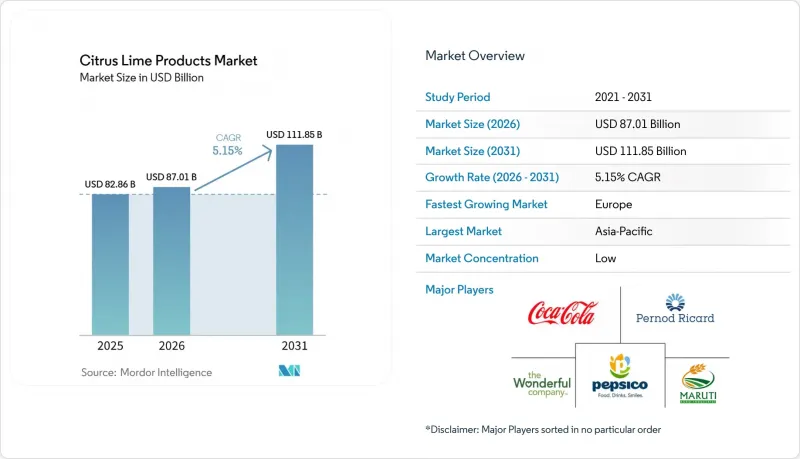
根據 Mordor Intelligence 預測,柑橘青檸產品市場規模預計將在 2025 年達到 828.6 億美元,2026 年達到 870.1 億美元,到 2031 年達到 1118.5 億美元,2026 年至 2031 年的複合年成長率為 5.15%。
本報告按產品類型(青檸飲料、青檸粉、青檸濃縮液、青檸精油和提取物、青檸加工產品)、包裝類型(罐裝、玻璃/ 寶特瓶、其他)、配銷通路(零售和餐飲服務)以及地區進行細分。市場預測以價值(美元)和銷售兩種形式呈現。
全球柑橘青檸產品市場趨勢與洞察
消費者對新鮮天然飲品的需求日益成長
消費者需求正日益轉向口感和感官特性更接近新鮮水果的柑橘類產品,而對添加濃重人工香料的柑橘類產品的興趣則持續下降。這種轉變導致消費者對非濃縮果汁、鮮榨酒吧飲品以及其他注重成分標籤透明、與天然柑橘原料緊密聯繫的產品形式提出了更高的品質要求。 2024年10月,多勒集團(Dohler Group)和FGF Trapani宣布成立合資企業,共同開發直接由新鮮柑橘皮加工而成的柑橘纖維解決方案。這凸顯了供應商如何調整產品開發策略,以支援天然、加工最少且易於識別的成分定位。這種需求模式使得高階產品能夠比主要依靠口味濃郁度、折扣和促銷活動來競爭的低價柑橘飲料更有效地維持和提升價值。因此,柑橘青檸產品市場在高階飲料、濃縮液以及整個原料體系中創造的價值遠超銷售量成長所顯示的水平。
健康飲品的日益普及
隨著消費者對健康飲品的需求日益成長,青檸的應用範圍也從單純的軟性飲料擴展到了功能性飲品領域。與新鮮水果相比,青檸濃縮液的酸度和風味更加穩定,且易於配製,因此越來越適用於補水產品、增強免疫力的飲品以及其他相關健康產品。 2026年4月推出的「GHOST Energy x 7UP 檸檬青檸」表明,柑橘青檸口味正透過成熟的分銷網路,逐步打入功能性能量飲料市場。這不僅拓展了零售貨架上產品的需求基礎,也為飲料生產商的加工商和原料供應商帶來了更多選擇。因此,柑橘青檸產品市場正受惠於品類擴張以及傳統飲料產品線的重複需求。
季節性供應波動會影響原料的供應。
2024年,墨西哥占美國青檸進口總量的88.70%以上,哥倫比亞佔8.40%,顯示北美青檸來源高度集中。根據美國農業部青檸產業網路(USDA GAIN)的數據顯示,主要產區的乾旱導致墨西哥城主要產區青檸的批發價格從2023年1月的每公斤27.50墨西哥披索上漲至2024年1月的每公斤50.00墨西哥披索。巴西在2024年也遭遇了天氣影響,USDA GAIN指出,2025年第一季柑橘青檸的行業平均價格比2024年第一季高出55.00%。這些價格波動很大程度上取決於新鮮青檸的供應,對加工商的利潤率帶來壓力,因為他們無法透過規模經濟或靈活的採購方式來抵消這些變化的影響。因此,柑橘青檸產品市場要求大規模買家實現採購來源多元化,並制定更細緻的採購計畫。
細分市場分析
到2025年,青檸飲料將佔80.45%的市場佔有率,成為最大的產品類型,遙遙領先。這一領先地位反映了青檸飲料在各種酒精和非酒精飲料(包括碳酸飲料、果汁和即飲雞尾酒)中的高滲透率。預計到2031年,青檸濃縮液的複合年成長率將達到6.92%,成為柑橘類青檸產品市場中成長最快的細分市場。其吸引力在於全年口味穩定、便於運輸,並且可以以單一成分的形式供應給飲料生產商、餐飲服務商和工業調味劑使用者。
儘管青檸粉、精油和萃取物以及加工柑橘類青檸產品的市場規模仍然較小,但它們各自發揮著獨特的商業性作用。精油在調味、香氛和個人護理應用領域具有很高的價值,而加工柑橘類青檸產品則為商用餐飲服務業提供了便利性和份量控制。根據美國農業部 (USDA) 的 GAIN 報告,墨西哥用於加工的青檸供應量預計將從 2023/24 銷售年度的 43 萬噸增加到 2024/25 銷售年度的 50 萬噸,從而擴大了原料加工商可用的原料基礎。這種供應變化將促進濃縮物和萃取物的生產,隨著加工能力與不斷成長的需求更加匹配,柑橘類青檸產品市場也將得到加強。
區域分析
到2025年,亞太地區將佔柑橘類青檸產品市場38.32%的佔有率,成為該地區最大的銷售貢獻者。該地區受益於青檸在家庭烹飪、街頭飲品和餐飲服務菜單中的長期使用,以及印度、中國、越南、泰國和印尼等國對包裝飲料日益成長的需求。印度和越南透過對消費和加工活動的貢獻,進一步鞏固了該地區的地位。在中國,瓶裝和即飲柑橘飲料在現代零售商店和電子商務通路的拓展,正在創造更大的需求。此外,印度和巴西於2025年4月簽署的進口塔希提青檸的雙邊協議,預計將在未來拓寬區域加工商的供應選擇。
預計到2031年,歐洲柑橘青檸產品市場將以6.79%的複合年成長率成長,成為成長最快的區域市場。根據美國農業部全球農業創新網路(GAIN)報告,歐盟吸收了巴西柑橘青檸出口總量的76.00%至80.00%,這表明該供應管道對歐洲濃縮果汁和即飲飲料製造地的重要性不言而喻。英國、德國、西班牙和荷蘭等國推出的絕對伏特加和雪碧等新產品,正在推動以罐裝即飲飲料為特色的柑橘青檸消費場景的形成。因此,優質化、雞尾酒文化和包裝最佳化正在該地區創造協同效應。
南美洲在柑橘青檸產品市場中扮演著雙重角色,既是主要的生產中心,也日益成為重要的需求中心。預計到2023年,巴西塔希提青檸的產量將達到172萬噸,出口量也將從2020年的118,866噸增至2024年的175,837噸,這顯示巴西與全球原料供應鏈的融合程度進一步提高。哥倫比亞的市佔率也不斷擴大,其在美國青檸進口中所佔的佔有率在一年內從5.10%上升至8.40%。這在一定程度上降低了北美對單一來源的依賴。在中東和非洲,隨著低溫運輸和現代零售業的不斷發展,都市區對即飲飲料的需求日益成長,預計將進一步推動柑橘青檸風味體系在這些地區的應用。
其他好處:
- Excel格式的市場預測(ME)表
- 3個月的分析師支持
目錄
第1章:引言
- 研究假設和市場定義
- 調查範圍
第2章:調查方法
第3章執行摘要
第4章 市場狀況
- 市場概覽
- 市場促進因素
- 消費者對新鮮天然飲品的需求日益成長
- 健康飲品的日益普及
- 擴大青檸在一般家庭和餐飲服務業烹飪中的應用。
- 青檸、維生素 C 及其增強免疫力的功效之間存在著密切聯繫。
- 消費者越來越傾向選擇潔淨標示、加工工序最少的產品。
- 濃縮果汁、果汁粉、果汁飲料和萃取物的產品創新
- 市場限制因素
- 季節性供應波動會影響原料的供應。
- 另有其他柑橘口味如柳橙和葡萄柚可供選擇。
- 新鮮青檸產品的保存期限很短。
- 新鮮青檸和加工用青檸的原料價格波動。
- 消費行為分析
- 監理情勢
- 技術展望
- 波特五力模型
第5章 市場規模與成長預測
- 依產品類型
- 青檸飲料
- 酒精飲料
- 青檸味烈酒
- 即飲雞尾酒
- 其他
- 不含酒精的飲料
- 碳酸飲料
- 運動飲料和能量飲料
- 果汁飲料
- 其他
- 酒精飲料
- 石灰粉
- 濃縮液石灰
- 青檸精油和萃取物
- 加工過的青檸製品(冷凍青檸珠、青檸片、食物泥)
- 青檸飲料
- 按包裝類型
- 坎
- 玻璃/ 寶特瓶
- 其他
- 透過分銷管道
- 零售
- 超級市場和大賣場
- 便利商店/雜貨店
- 專賣店
- 線上零售通路
- 其他分銷管道
- 食品服務
- 零售
- 按地區
- 北美洲
- 美國
- 加拿大
- 墨西哥
- 其他北美國家
- 歐洲
- 德國
- 英國
- 法國
- 義大利
- 西班牙
- 荷蘭
- 瑞典
- 波蘭
- 比利時
- 其他歐洲國家
- 亞太地區
- 中國
- 印度
- 日本
- 澳洲
- 韓國
- 越南
- 印尼
- 泰國
- 新加坡
- 其他亞太國家
- 南美洲
- 巴西
- 阿根廷
- 智利
- 秘魯
- 哥倫比亞
- 其他南美國家
- 中東和非洲
- 阿拉伯聯合大公國
- 沙烏地阿拉伯
- 南非
- 奈及利亞
- 埃及
- 摩洛哥
- 土耳其
- 其他中東和非洲國家
- 北美洲
第6章 競爭情勢
- 市場集中度
- 策略趨勢
- 市場排名分析
- 公司簡介
- PepsiCo Inc.
- The Coca-Cola Company
- Pernod Ricard
- Louis Dreyfus Company BV
- Sunkist Growers, Inc.
- Limoneira Company
- Del Monte Foods, Inc.
- Keurig Dr. Pepper Inc.
- The Wonderful Company LLC
- Archer Daniels Midland Company
- Real Juice Company
- Maruti Agro Products
- Sensient Technologies
- SunOpta Inc.
- Constellation Brands Inc.
- Dohler Group
- Britvic Plc
- Lemon Concentrate SL
- Citromax Group
- Givaudan SA
第7章 市場機會與未來展望
According to Mordor Intelligence, the citrus lime products market size is projected to be USD 82.86 billion in 2025, USD 87.01 billion in 2026, and reach USD 111.85 billion by 2031, growing at a CAGR of 5.15% from 2026 to 2031.
This report is Segmented by Product Type (Lime Beverages, Lime Powder, Lime Concentrates, Lime Essential Oils and Extracts, and Processed Lime Products), Packaging Type (Cans, Glass/PET Bottles, and Others), Distribution Channel (Retail and Foodservice), and Geography. The Market Forecasts are Provided in Terms of Value (USD) and Volume.
Global Citrus Lime Products Market Trends and Insights
Rising Consumer Demand For Fresh And Natural Drinks
Consumer demand is increasingly shifting toward citrus products that deliver a taste and sensory profile closer to fresh fruit, while interest in heavily artificial citrus profiles continues to weaken. This shift is raising quality expectations for not-from-concentrate juices, fresh-squeezed bar programs, and other formats that rely on transparent ingredient recognition and a clear connection to natural citrus inputs. In October 2024, Dohler Group and FGF Trapani announced a joint venture to develop citrus fiber solutions processed directly from fresh citrus peels, underscoring how suppliers are adapting product development strategies to support natural, minimally processed, and recognizable ingredient positioning. This demand pattern is enabling premium formats to protect and capture value more effectively than lower-priced citrus drinks that compete primarily on flavor intensity, discounting, and promotional activity. As a result, the citrus lime products market is generating stronger value capture across premium beverages, concentrates, and ingredient systems than headline volume growth alone suggests.
Growing Popularity Of Health-Oriented Drinks
Health-oriented beverage demand is widening the role of lime beyond refreshment and into functional consumption occasions. Lime concentrates are increasingly suitable for hydration products, immunity-positioned drinks, and adjacent wellness formats because they offer consistent acidity, flavor intensity, and easier formulation than fresh fruit. The April 2026 launch of GHOST Energy x 7UP Lemon Lime shows that citrus lime flavor is also moving into the functional energy segment through established distribution networks. This creates a more diversified demand base for processors and ingredient suppliers that serve beverage companies rather than only retail shelf products. The citrus lime products market is therefore gaining from category expansion as much as from repeat demand in traditional beverage lines.
Seasonal Supply Fluctuations Affecting Raw Material Availability
Mexico accounted for more than 88.70% of U.S. lime import volumes in 2024, while Colombia held 8.40%, which shows how concentrated North American sourcing remains. USDA GAIN reported that wholesale key lime prices in Mexico City rose from MXN 27.50 per kg in January 2023 to MXN 50.00 per kg in January 2024 after drought conditions affected major producing states. Brazil also faced weather disruption in 2024, and USDA GAIN noted that average industry lime prices in Q1 2025 were 55.00% higher than in Q1 2024. These shifts create margin pressure for processors that depend heavily on fresh lime inputs and cannot offset the change through scale or flexible sourcing. The citrus lime products market is therefore pushing larger buyers toward origin diversification and tighter procurement planning.
Other drivers and restraints analyzed in the detailed report include:
- Product Innovation In Juice Concentrates, Powders, Cordials, And Extracts
- Strong Association Of Lime With Vitamin C And Immunity Benefits
- Price Volatility In Fresh Lime And Processed Lime Inputs
For complete list of drivers and restraints, kindly check the Table Of Contents.
Segment Analysis
Lime beverages held 80.45% of the product type market in 2025, which made them the largest product category by a wide margin. This lead reflects strong penetration across alcoholic and non-alcoholic formats, including carbonated drinks, juices, and ready-to-drink cocktails. Lime concentrates are projected to grow at a 6.92% CAGR through 2031, and that makes them the strongest expansion area within the citrus lime products market. Their appeal comes from year-round flavor consistency, easier transport, and the ability to serve beverage manufacturers, foodservice operators, and industrial flavor users through one ingredient format.
Lime powder, essential oils and extracts, and processed lime products remain smaller in value but serve distinct commercial roles. Essential oils carry premium relevance in flavor, fragrance, and personal care applications, while processed lime formats support convenience and portion control in institutional foodservice. USDA GAIN reported that Mexico's lime volumes allocated for processing rose from 430,000 metric tons in MY 2023/24 to a forecast 500,000 metric tons in MY 2024/25, which expands the raw material base available to ingredient processors. That supply shift supports concentrate and extract output and strengthens the citrus lime products market as processing capacity becomes more aligned with demand growth.
Complete Report Scope:
- By Product Type
- Lime Beverages
- Alcoholic Beverages
- Lime-Infused Spirits
- Ready-To-Drink Cocktails
- Others
- Non-Alcoholic Beverages
- Carbonated Drinks
- Sports and Energy Drinks
- Juices
- Others
- Alcoholic Beverages
- Lime Powder
- Lime Concentrates
- Lime Essential Oils and Extracts
- Processed Lime Products (frozen pearls, slices, puree)
- Lime Beverages
- By Packaging Type
- Cans
- Glass/PET Bottles
- Others
- By Distribution Channels
- Retail
- Supermarkets/Hypermarkets
- Convenience/Grocery Stores
- Specialty Stores
- Online Retail Channels
- Other Distribution Channels
- Foodservice
- Retail
- By Geography
- North America
- United States
- Canada
- Mexico
- Rest of North America
- Europe
- Germany
- United Kingdom
- France
- Italy
- Spain
- Netherlands
- Sweden
- Poland
- Belgium
- Rest of Europe
- Asia-Pacific
- China
- India
- Japan
- Australia
- South Korea
- Vietnam
- Indonesia
- Thailand
- Singapore
- Rest of Asia-Pacific
- South America
- Brazil
- Argentina
- Chile
- Peru
- Colombia
- Rest of South America
- Middle East and Africa
- United Arab Emirates
- Saudi Arabia
- South Africa
- Nigeria
- Egypt
- Morocco
- Turkey
- Rest of Middle East and Africa
- North America
Geography Analysis
Asia-Pacific held 38.32% of the citrus lime products market share in 2025, which made it the largest regional revenue contributor. The region benefits from the long-standing role of lime in household cooking, street beverages, foodservice menus, and growing packaged drink demand across India, China, Vietnam, Thailand, and Indonesia. India and Vietnam also strengthen the regional position because they contribute to both consumption and processing activity. China adds further demand through expanding modern retail and e-commerce access for bottled and ready-to-drink citrus beverages. India's April 2025 bilateral agreement with Brazil for Tahiti lime access should also broaden supply options for regional processors over time.
Europe is projected to grow at a 6.79% CAGR through 2031, which makes it the fastest-growing regional block in the citrus lime products market. USDA GAIN reported that the European Union absorbed 76.00% to 80.00% of Brazil's total lime export volumes, which shows how important the supply corridor already is for the region's concentrate and ready-to-drink manufacturing base. Product launches such as Absolut Vodka and Sprite across the UK, Germany, Spain, and the Netherlands are helping create new lime-led consumption occasions in canned ready to drink formats. Premiumization, cocktail culture, and packaging alignment are therefore reinforcing one another in this region.
South America plays a dual role in the citrus lime products market because it is both a major producing base and an increasingly formalized demand center. Brazil's Tahiti lime production reached 1.72 million metric tons in 2023, and exports rose from 118,866 metric tons in 2020 to 175,837 metric tons in 2024, which shows stronger integration with global ingredient supply chains. Colombia is also gaining relevance, with its share of U.S. lime imports rising from 5.10% to 8.40% in one year, which modestly reduces single-origin dependence in North America. In the Middle East and Africa, urban demand for ready to drink beverage formats is rising, which should support additional use of lime-based flavor systems where cold chain and modern retail continue to expand.
- PepsiCo Inc.
- The Coca-Cola Company
- Pernod Ricard
- Louis Dreyfus Company B.V.
- Sunkist Growers, Inc.
- Limoneira Company
- Del Monte Foods, Inc.
- Keurig Dr. Pepper Inc.
- The Wonderful Company LLC
- Archer Daniels Midland Company
- Real Juice Company
- Maruti Agro Products
- Sensient Technologies
- SunOpta Inc.
- Constellation Brands Inc.
- Dohler Group
- Britvic Plc
- Lemon Concentrate S.L.
- Citromax Group
- Givaudan SA
Additional Benefits:
- The market estimate (ME) sheet in Excel format
- 3 months of analyst support
TABLE OF CONTENTS
1 INTRODUCTION
- 1.1 Study Assumptions & Market Definition
- 1.2 Scope of the Study
2 RESEARCH METHODOLOGY
3 EXECUTIVE SUMMARY
4 MARKET LANDSCAPE
- 4.1 Market Overview
- 4.2 Market Drivers
- 4.2.1 Rising Consumer Demand For Fresh And Natural Drinks
- 4.2.2 Growing Popularity Of Health-Oriented Drinks
- 4.2.3 Increasing Use Of Lime In Culinary Applications Across Households And Foodservice
- 4.2.4 Strong Association Of Lime With Vitamin C And Immunity Benefits
- 4.2.5 Rising Preference For Clean-Label And Minimally Processed Products
- 4.2.6 Product Innovation In Juice Concentrates, Powders, Cordials, And Extracts
- 4.3 Market Restraints
- 4.3.1 Seasonal Supply Fluctuations Affecting Raw Material Availability
- 4.3.2 Availability Of Substitute Citrus Flavors Such As Orange, Grapefruit, And Others
- 4.3.3 Short Shelf Life Of Fresh Lime Products
- 4.3.4 Price Volatility In Fresh Lime And Processed Lime Inputs
- 4.4 Consumer Behavior Analysis
- 4.5 Regulatory Landscape
- 4.6 Technological Outlook
- 4.7 Porter's Five Forces
- 4.7.1 Threat of New Entrants
- 4.7.2 Bargaining Power of Buyers/Consumers
- 4.7.3 Bargaining Power of Suppliers
- 4.7.4 Threat of Substitute Products
- 4.7.5 Intensity of Competitive Rivalry
5 MARKET SIZE AND GROWTH FORECASTS (VALUE AND VOLUME)
- 5.1 By Product Type
- 5.1.1 Lime Beverages
- 5.1.1.1 Alcoholic Beverages
- 5.1.1.1.1 Lime-Infused Spirits
- 5.1.1.1.2 Ready-To-Drink Cocktails
- 5.1.1.1.3 Others
- 5.1.1.2 Non-Alcoholic Beverages
- 5.1.1.2.1 Carbonated Drinks
- 5.1.1.2.2 Sports and Energy Drinks
- 5.1.1.2.3 Juices
- 5.1.1.2.4 Others
- 5.1.1.1 Alcoholic Beverages
- 5.1.2 Lime Powder
- 5.1.3 Lime Concentrates
- 5.1.4 Lime Essential Oils and Extracts
- 5.1.5 Processed Lime Products (frozen pearls, slices, puree)
- 5.1.1 Lime Beverages
- 5.2 By Packaging Type
- 5.2.1 Cans
- 5.2.2 Glass/PET Bottles
- 5.2.3 Others
- 5.3 By Distribution Channels
- 5.3.1 Retail
- 5.3.1.1 Supermarkets/Hypermarkets
- 5.3.1.2 Convenience/Grocery Stores
- 5.3.1.3 Specialty Stores
- 5.3.1.4 Online Retail Channels
- 5.3.1.5 Other Distribution Channels
- 5.3.2 Foodservice
- 5.3.1 Retail
- 5.4 By Geography
- 5.4.1 North America
- 5.4.1.1 United States
- 5.4.1.2 Canada
- 5.4.1.3 Mexico
- 5.4.1.4 Rest of North America
- 5.4.2 Europe
- 5.4.2.1 Germany
- 5.4.2.2 United Kingdom
- 5.4.2.3 France
- 5.4.2.4 Italy
- 5.4.2.5 Spain
- 5.4.2.6 Netherlands
- 5.4.2.7 Sweden
- 5.4.2.8 Poland
- 5.4.2.9 Belgium
- 5.4.2.10 Rest of Europe
- 5.4.3 Asia-Pacific
- 5.4.3.1 China
- 5.4.3.2 India
- 5.4.3.3 Japan
- 5.4.3.4 Australia
- 5.4.3.5 South Korea
- 5.4.3.6 Vietnam
- 5.4.3.7 Indonesia
- 5.4.3.8 Thailand
- 5.4.3.9 Singapore
- 5.4.3.10 Rest of Asia-Pacific
- 5.4.4 South America
- 5.4.4.1 Brazil
- 5.4.4.2 Argentina
- 5.4.4.3 Chile
- 5.4.4.4 Peru
- 5.4.4.5 Colombia
- 5.4.4.6 Rest of South America
- 5.4.5 Middle East and Africa
- 5.4.5.1 United Arab Emirates
- 5.4.5.2 Saudi Arabia
- 5.4.5.3 South Africa
- 5.4.5.4 Nigeria
- 5.4.5.5 Egypt
- 5.4.5.6 Morocco
- 5.4.5.7 Turkey
- 5.4.5.8 Rest of Middle East and Africa
- 5.4.1 North America
6 COMPETITIVE LANDSCAPE
- 6.1 Market Concentration
- 6.2 Strategic Moves
- 6.3 Market Ranking Analysis
- 6.4 Company Profiles (includes Global level Overview, Market level overview, Core Segments, Financials as available, Strategic Information, Market Rank/Share for key companies, Products & Services, and Recent Developments)
- 6.4.1 PepsiCo Inc.
- 6.4.2 The Coca-Cola Company
- 6.4.3 Pernod Ricard
- 6.4.4 Louis Dreyfus Company B.V.
- 6.4.5 Sunkist Growers, Inc.
- 6.4.6 Limoneira Company
- 6.4.7 Del Monte Foods, Inc.
- 6.4.8 Keurig Dr. Pepper Inc.
- 6.4.9 The Wonderful Company LLC
- 6.4.10 Archer Daniels Midland Company
- 6.4.11 Real Juice Company
- 6.4.12 Maruti Agro Products
- 6.4.13 Sensient Technologies
- 6.4.14 SunOpta Inc.
- 6.4.15 Constellation Brands Inc.
- 6.4.16 Dohler Group
- 6.4.17 Britvic Plc
- 6.4.18 Lemon Concentrate S.L.
- 6.4.19 Citromax Group
- 6.4.20 Givaudan SA
7 MARKET OPPORTUNITIES AND FUTURE OUTLOOK

 木纖維石膏板市場:2026-2032年全球市場預測(按板材類型、厚度、尺寸、應用、最終用途和分銷管道分類)
 2026年全球石膏板市場報告
 石膏市場規模、佔有率和趨勢分析報告:按類型、應用、地區和細分市場分類(2026-2033 年)
 全球石膏市場規模、佔有率、趨勢和成長分析報告(2026-2034年)2026年全球石膏市場報告2026年全球石灰和石膏產品市場報告阿爾法石膏市場按形態、等級、應用、最終用戶和分銷管道分類,全球預測,2026-2032年全球石膏市場-2025年至2030年預測美國石膏市場規模、佔有率和趨勢分析報告:按類型、應用、地區和細分市場預測,2025-2033 年
 石膏的全球市場:市場規模·佔有率·趨勢,產業分析 (不同形狀·各產品·各終端用戶·各地區),未來預測 (2025年~2034年)