


 |
市場調查報告書
商品編碼
2099763
HBM在FPGA加速的應用:市佔率分析、產業趨勢與統計及成長預測(2026-2031年)HBM For FPGA Acceleration - Market Share Analysis, Industry Trends & Statistics, Growth Forecasts (2026 - 2031) |
||||||

※ 本網頁內容可能與最新版本有所差異。詳細情況請與我們聯繫。
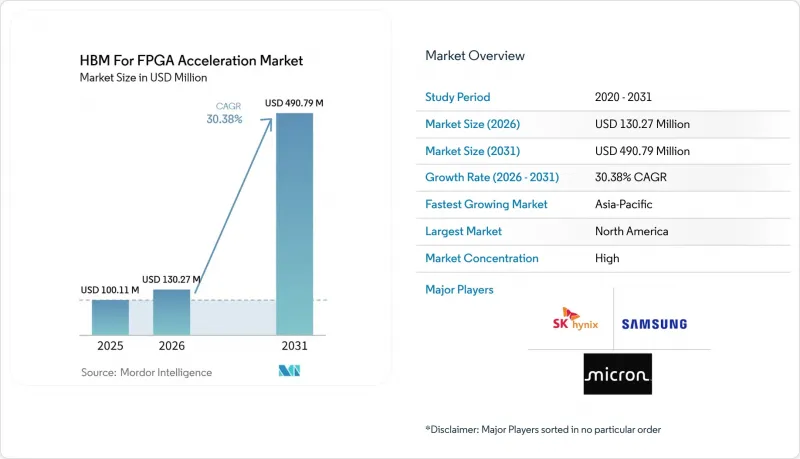
據 Mordor Intelligence 稱,用於 FPGA 加速的 HBM 市場規模預計將從 2025 年的 1.0011 億美元成長到 2026 年的 1.3027 億美元,到 2031 年達到 4.9079 億美元,預計 2026 億美元,到 2031 年達到 4.9079 億美元,預計 2026 億美元,到 2031 年的複合年成長率為 30.38%。
本報告按記憶體類型(HBM2E、HBM3、HBM3E、HBM4)、整合類型(例如,整合HBM的FPGA SoC)、應用(例如,AI推理加速、高效能運算)、最終用戶(例如,超大規模資料中心業者和雲端服務供應商)以及地區(北美、亞太、中東和非洲)進行細分。市場預測以美元(USD)計價。
HBM在FPGA加速領域的全球趨勢與洞察
擴大配備 HBM 的 FPGA 卡在雲端和邊緣加速器中的應用。
隨著雲端和邊緣系統向更高密度的資料路徑遷移,這種轉變正在降低基於DDR的FPGA設計在頻寬頻寬環境中的吸引力。 2025年9月,DYNANIC和Silicom展示了一個基於400G FPGA的AI網路配置,該配置結合了Altera的Agilex 7 M系列晶片和HBM2e,從而在AI架構中實現低延遲封包處理。 Silicom的ThunderFjord卡表明,配備HBM的闆卡可以在專為高速資料中心網路設計的外形尺寸中支援高達32GB的HBM2e和2 x 2.6Tbps的頻寬。 Altera也將Agilex系列定位為適用於資料中心加速用例,這些用例需要可程式邏輯、高記憶體吞吐量以及在雲端基礎架構中柔軟性部署。這使得HBM市場對FPGA加速的依賴性日益增強,而不僅僅依賴提供晶片的卡片和模組供應商。此外,這意味著網路和推理領域的設計採用可能會對需要類似頻寬特性的相鄰邊緣應用產生連鎖反應。
即時工作負載對確定性和低延遲記憶體存取的需求日益成長。
用於 FPGA 加速的 HBM 市場正受益於那些將時序一致性與吞吐量同等重視的工作負載。基於 FPGA 的設計允許硬體分配記憶體通道,與共用運算環境相比,能夠帶來更可預測的回應行為。 AMD 宣布其 Alveo UL3422 加速器在電子交易工作負載中實現了低於 3 奈秒的延遲,這表明即使在極低延遲的環境中,基於 FPGA 的加速仍然發揮著至關重要的作用。此外,一篇發表於 arXiv 的論文(2025 年)介紹了 RoCE BALBOA 協議棧,該論文展示了在資料中心 FPGA 中直接使用 HBM 通道進行有效載荷分階段傳輸,並報告實現了與商用網卡相當的 100G 吞吐量。因此,目標需求群體正在從傳統的交易應用擴展到 AI 架構控制、資料包偵測以及其他抖動會對系統效能產生負面影響的服務。隨著這些應用場景的擴展,願意為一致的時序行為支付更高價格的買家正在為用於 FPGA 加速的 HBM 市場提供支援。
FPGA-HBM整合中先進封裝能力的局限性
用於 FPGA 加速的 HBM 市場仍然依賴先進的封裝工藝,而這些工藝的規模化難度遠高於標準板級記憶體設計。由於 HBM 整合需要計算晶片、記憶體堆疊和互連結構之間的緊密協調,即使邏輯需求強勁,產品上市時間也可能受到封裝供應狀況的影響。 2026 年 5 月,AMD 宣布向其台灣生態系統投資超過 100 億美元,以擴大用於 AI 基礎設施的先進封裝製造能力。這凸顯了封裝產能在整個加速器供應鏈中日益成長的重要性。此外,三星和美光在 HBM4 量產方面的進展表明,記憶體和封裝的準備工作不再是獨立的採購步驟,而是相互關聯的。對於 FPGA 供應商而言,這增加了早期規劃的重要性,並縮小了快速擴大產能的空間。因此,市場形成了一種局面:認證供應量在較長時間內超過終端用戶需求。
細分市場分析
預計到 2025 年,HBM2E 將佔據 FPGA 加速 HBM 市場 65.83% 的佔有率。這反映了目前已部署平台的強勁實力以及認證加速器設計相對緩慢的更新換代週期。 Altera 的 Agilex 7 M 系列產品透過在單一裝置中整合高達 32GB 的 HBM2E 容量,並提供高達 820GB/s 的峰值頻寬,協助 HBM2E 成為出貨產品的實用標準。這項部署基礎至關重要,因為網路、通訊和基礎設施領域的買家往往比超大規模運算領域的買家更長時間地使用同一代硬體。 HBM3 在該領域仍處於“過渡階段”,因為供應和平台規劃已迅速推進到記憶體藍圖的下一階段。預計到 2031 年,HBM3E 將以 31.18% 的複合年成長率成長,這反映了供應商對 HBM3E 的關注度提高、數據傳輸速率的提升以及與下一代加速器需求的更緊密契合。
JEDEC 的 JESD235規格系列持續支援不同代 HBM 之間的互通性,幫助廠商在通用設計規則下更換記憶體供應商時縮短認證時間。西門子表示,HBM3E 已在整個 AI 加速器生態系統中實現量產,並指出基於 HBM4 的客製化晶片方案是未來產品差異化的一個方向。三星 HBM4 出貨量的里程碑式進展表明,內存藍圖的推進速度快於許多 FPGA 產品週期,這可能會使擁有更完善過渡計劃的廠商獲得更大的價值。儘管短期內 FPGA 加速用 HBM 市場仍以 HBM2E 出貨量為主導,但未來的平台藍圖正日益受到 HBM3E 的成熟度和 HBM4 初期設計路徑的影響。
預計到 2025 年,配備 HBM 的獨立式 FPGA 加速卡將佔據 FPGA 加速 HBM 市場佔有率的 53.18%,這反映了基於 PCIe 的部署在企業和託管環境中的成熟度。基於卡片的設計具有許多優勢,例如更容易獲得認證、更容易替換現有伺服器,以及為闆卡合作夥伴提供針對特定工作負載的更大自訂選項。 Silicom 的「ThunderFjord」產品展示了目前的卡片設計如何將 HBM2e、高連接埠吞吐量和資料中心網路功能整合到熟悉的加速器格式中。這解釋了為什麼即使新的模組化格式越來越受到關注,獨立式卡片仍繼續支撐著 FPGA 加速 HBM 市場的商業基礎。此外,採用 PCIe 卡也符合系統整合商的採購模式,他們需要分階段升級而不是徹底重新設計機架。
隨著超大規模資料中心業者資料中心環境向共用底盤和更靈活的加速器池轉型,OCP/OAM FPGA加速器模組預計到2031年將以31.08%的複合年成長率成長。 Altera的資料中心策略正推動這一趨勢,它將可程式加速與機架級AI系統和開放模組部署模型結合。 Altera與Arm於2026年3月達成的合作也預示著系統將朝著緊密整合的方向發展,在這種系統中,CPU、FPGA和記憶體資源從一開始就進行協同規劃。雖然在某些設計中,整合HBM的FPGA SoC和小型PCIe模組仍然很重要,但HBM在FPGA加速市場的長期發展方向是針對大規模的AI和網路架構進行基於模組的部署。
區域分析
到2025年,北美將佔據FPGA加速HBM市場佔有率的44.94%,成為目前收入貢獻最大的區域市場。該地區受益於FPGA設計團隊的高度集中、對人工智慧基礎設施的投資以及系統級整合能力。 Altera在資料中心領域的佈局及其與Arm的合作,都進一步鞏固了北美作為人工智慧伺服器環境中可程式加速中心的地位。 AMD承諾2026年5月在整個台灣生態系統投資超過100億美元,也反映了北美加速器需求與亞洲上游工程封裝和記憶體生產能力之間的直接連結。金融服務和低延遲基礎設施的普及正在美國創造一個高階需求市場,從而推動基於FPGA的加速技術在特定工作負載中的持續應用。
預計到2031年,亞太地區將以31.36%的複合年成長率成長,成為FPGA加速用HBM市場成長最快的地區。該地區將記憶體製造、深度封裝、電子產品生產以及日益成長的AI資料中心需求整合到一個龐大的供應鏈生態系統中。 SK海力士預計,到2026年,HBM3E將佔HBM總出貨量的近三分之二;三星宣布已於2026年2月開始量產HBM4。這兩家公司都凸顯了韓國在供應端的重要性。美光在HBM4生產方面的進展也進一步鞏固了亞太地區在下一階段先進加速器平台記憶體供應中的地位。台灣仍然至關重要,因為其先進的封裝能力直接影響基於HBM的系統從設計到商業出貨的速度。日本致力於擴大半導體產能,並在記憶體擴展領域發揮重要作用,這進一步凸顯了該地區在FPGA加速用HBM市場中的長期重要性。
歐洲、南美洲以及中東和非洲地區雖然目前銷售額佔比不高,但在特定部署管道中仍佔有重要地位。歐洲在國防、通訊和工業電子應用領域發揮著至關重要的作用,這些領域對可程式設計和安全處理的要求仍然很高。鑑於歐盟目前對先進封裝技術的依賴程度,歐盟的「晶片法」計畫在2030年投資430億歐元(約486億美元),預計在未來提升該地區的半導體能力。南美和中東及非洲地區仍處於發展初期,這些地區的成長更與更廣泛的雲端投資和各國主導的人工智慧基礎設施建設相關,而非直接取決於HBM平台的銷售量。因此,儘管這些地區目前對銷售額的貢獻較小,但它們代表著HBM在FPGA加速市場中不斷擴大的未來商機。
其他好處:
- Excel格式的市場預測(ME)表
- 3個月的分析師支持
目錄
第1章:引言
- 研究假設和市場定義
- 調查範圍
第2章:調查方法
第3章執行摘要
第4章 市場狀況
- 市場概覽
- 市場促進因素
- 擴大配備 HBM 的 FPGA 卡在雲端和邊緣加速器中的應用。
- 即時工作負載對確定性、低延遲記憶體存取的需求日益成長。
- 對於某些工作負載,超大規模資料中心業者正在轉向基於 FPGA 的客製化加速。
- 高階FPGA平台中HBM3和HBM3E的採用率不斷提高。
- 與簡單地提高運算能力相比,以節能的方式擴展頻寬的重要性日益凸顯。
- 異構AI推理管線中FPGA和HBM的聯合最佳化
- 市場限制因素
- FPGA和HBM整合缺乏先進的封裝能力
- 與基於 GDDR 和 DDR 的 FPGA 設計相比,組件成本更高。
- HBM加速器系統中熱設計與電路板級設計的複雜性。
- HBM製造與中介層生態系的供應集中
- 產業價值鏈分析
- 宏觀經濟因素對市場的影響
- 監理情勢
- 技術展望
- 波特五力分析
第5章 市場規模與成長預測
- 按記憶體類型
- HBM2E
- HBM3
- HBM3E
- HBM4
- FPGA整合類型
- 附HBM的獨立FPGA加速卡
- 整合 HBM 的 FPGA SoC
- PCIe FPGA加速器模組
- OCP/OAM FPGA加速器模組
- 透過使用
- 加速人工智慧推理
- 高效能運算
- 網路加速
- 金融服務和低延遲交易
- 國防、航太和安全系統
- 科學與工業模擬
- 最終用戶
- 超大規模資料中心業者和雲端服務供應商
- 企業OEM廠商及系統整合商
- 電信和網路營運商
- 國防和政府機構
- 金融機構
- 研究機構和實驗室
- 按地區
- 北美洲
- 美國
- 加拿大
- 墨西哥
- 歐洲
- 德國
- 英國
- 法國
- 義大利
- 其他歐洲國家
- 亞太地區
- 中國
- 日本
- 韓國
- 台灣
- 印度
- 其他亞太國家
- 南美洲
- 中東和非洲
- 北美洲
第6章 競爭情勢
- 市場集中度
- 策略趨勢
- 市佔率分析
- 公司簡介
- SK hynix Inc.
- Samsung Electronics Co., Ltd.
- Micron Technology, Inc.
- Other Ecosystem Players
- Advanced Micro Devices, Inc.
- Intel Corporation
- Lattice Semiconductor Corporation
- Microchip Technology Incorporated
- Achronix Semiconductor Corporation
- QuickLogic Corporation
- Efinix, Inc.
- GOWIN Semiconductor Corporation
- Flex Logix Technologies, Inc.
- NVIDIA Corporation
- Xilinx, Inc.
- TSMC
- Amkor Technology, Inc.
- ASE Technology Holding Co., Ltd.
- Cadence Design Systems, Inc.
- Synopsys, Inc.
- Broadcom Inc.
第7章 市場機會與未來展望
According to Mordor Intelligence, the HBM for FPGA acceleration market size is expected to increase from USD 100.11 million in 2025 to USD 130.27 million in 2026 and reach USD 490.79 million by 2031, growing at a CAGR of 30.38% over 2026-2031.
This report is Segmented by Memory Type (HBM2E, HBM3, HBM3E, and HBM4), Integration Type (FPGA SoCs With Integrated HBM, and More), Application (AI Inference Acceleration, High-Performance Computing, and More), End User (Hyperscalers and Cloud Service Providers, and More), and Geography (North America, Asia-Pacific, and Middle East and Africa). The Market Forecasts are Provided in Terms of Value (USD).
Global HBM For FPGA Acceleration Market Trends and Insights
Rising Deployment of HBM-Enabled FPGA Cards in Cloud and Edge Accelerators
Cloud and edge systems are moving toward denser data paths, and that shift is making DDR-based FPGA designs less attractive in the most bandwidth-heavy environments. DYNANIC and Silicom demonstrated a 400G FPGA-based AI networking setup in September 2025 that paired Altera Agilex 7 M-Series silicon with HBM2e for low-latency packet handling in AI fabrics. Silicom's ThunderFjord card demonstrated how an HBM-equipped board can support up to 32GB of HBM2e and 2 X 2.6Tbps of bandwidth in a form factor designed for high-speed data center networking. Altera also positions the Agilex family for data center acceleration use cases that need programmable logic, high memory throughput, and deployment flexibility across cloud infrastructure. This makes the HBM for FPGA acceleration market more dependent on card and module vendors that can package complete solutions rather than only supply chips. It also means that design wins in networking and inference can carry over into adjacent edge applications that require similar bandwidth behavior.
Growing Need for Deterministic, Low-Latency Memory Access in Real-Time Workloads
The HBM for FPGA acceleration market is benefiting from workloads that value timing consistency as much as throughput. In FPGA-based designs, memory channels can be assigned in hardware, which helps keep response behavior more predictable than in shared compute environments. AMD stated that its Alveo UL3422 accelerator achieved latency below 3 ns for electronic trading workloads, demonstrating that FPGA-based acceleration still plays a strong role in extremely low-latency settings. A 2025 arXiv paper on the RoCE BALBOA stack also showed direct HBM channel use for payload staging on data center FPGAs, achieving 100G throughput comparable to commercial NICs. The addressable demand base is therefore widening beyond classic trading applications into AI fabric control, packet inspection, and other services where jitter can hurt system performance. As these use cases expand, the HBM for FPGA acceleration market gains support from buyers willing to pay more for consistent timing behavior.
Limited Advanced Packaging Capacity for FPGA-HBM Integration
The HBM for FPGA acceleration market still depends on advanced packaging flows that are harder to scale than standard board-level memory designs. HBM integration requires close coupling between the compute die, the memory stack, and the interconnect structure, so product timing can be affected by packaging availability even when logic demand is strong. AMD announced more than USD 10 billion in investments in Taiwan's ecosystem in May 2026 to expand advanced packaging manufacturing for AI infrastructure, underscoring how central packaging capacity has become across accelerator supply chains. Samsung's HBM4 ramp and Micron's HBM4 production progress also show that memory and packaging readiness now move together rather than as separate procurement steps. For FPGA vendors, this raises the importance of early planning and narrows the room for short-cycle volume expansion. The result is a market where qualified supply can remain tighter than end-user interest for longer periods.
Other drivers and restraints analyzed in the detailed report include:
- Hyperscaler Shift Toward FPGA-Based Custom Acceleration for Select Workloads
- Wider Availability of HBM3 and HBM3E in High-End FPGA Platforms
- High Bill-of-Materials Cost Compared With GDDR- and DDR-Based FPGA Designs
For complete list of drivers and restraints, kindly check the Table Of Contents.
Segment Analysis
HBM2E held 65.83% of the HBM for FPGA acceleration market share in 2025, reflecting the strength of current installed platforms and the slower replacement cycle for qualified accelerator designs. Altera's Agilex 7 M-Series integrates up to 32GB of HBM2e in a single device and provides up to 820GB/s of peak bandwidth, helping make HBM2E the practical baseline for shipping products. That installed base matters because buyers in network, telecom, and infrastructure roles often keep the same hardware generation in service longer than hyperscale compute buyers. HBM3 remained a bridge tier in the segment because supply and platform planning moved quickly toward the next step in the memory roadmap. HBM3E is projected to grow at a 31.18% CAGR through 2031, reflecting stronger supplier focus, higher data rates, and better alignment with next-wave accelerator requirements.
JEDEC's JESD235 standard family continues to support interoperability across HBM generations and helps shorten qualification work when vendors move between memory sources within shared design rules. Siemens said HBM3E has entered high-volume production across the AI accelerator ecosystem, and it also pointed to custom HBM4 base-die approaches as a future area of product differentiation. Samsung's HBM4 shipment milestone and Micron's HBM4 production progress show that the memory roadmap is moving faster than many FPGA product cycles, potentially shifting value toward vendors with stronger transition planning. The near-term HBM for FPGA acceleration market still centers on HBM2E shipments, but future platform roadmaps are increasingly being shaped by HBM3E readiness and the first HBM4 design paths.
Standalone FPGA Accelerator Cards with HBM held 53.18% of the HBM for FPGA acceleration market share in 2025, reflecting the maturity of PCIe-based deployment in enterprise and colocation environments. Card-based designs remain easier to qualify, easier to swap into existing servers, and easier for board partners to tailor around specific workloads. Silicom's ThunderFjord product shows how current card designs can package HBM2e, high port throughput, and data center networking features into a familiar accelerator format. This is why standalone cards still anchor the commercial base of the HBM for FPGA acceleration market, even as newer module formats gather attention. PCIe card deployments also fit the procurement style of system integrators that need incremental upgrades rather than full rack redesigns.
OCP/OAM FPGA Accelerator Modules are projected to expand at 31.08% CAGR through 2031 as hyperscaler environments shift toward shared chassis and more flexible accelerator pools. Altera's data center positioning supports this path by aligning programmable acceleration with rack-scale AI systems and open module deployment models. The March 2026 Altera and Arm collaboration also points to tightly integrated systems in which CPU, FPGA, and memory resources are planned together from the start. FPGA SoCs with integrated HBM and smaller PCIe modules will remain important in select designs, but the long-term direction for HBM in the FPGA acceleration market is toward module-based deployment in larger AI and networking fabrics.
Complete Report Scope:
- By Memory Type
- HBM2E
- HBM3
- HBM3E
- HBM4
- By FPGA Integration Type
- Standalone FPGA Accelerator Cards with HBM
- FPGA SoCs with Integrated HBM
- PCIe FPGA Accelerator Modules
- OCP/OAM FPGA Accelerator Modules
- By Application
- AI Inference Acceleration
- High-Performance Computing
- Network Acceleration
- Financial Services and Low-Latency Trading
- Defense, Aerospace, and Secure Systems
- Scientific and Industrial Simulation
- By End User
- Hyperscalers and Cloud Service Providers
- Enterprise OEMs and System Integrators
- Telecom and Networking Operators
- Defense and Government Organizations
- Financial Institutions
- Research Institutes and Laboratories
- By Geography
- North America
- United States
- Canada
- Mexico
- Europe
- Germany
- United Kingdom
- France
- Italy
- Rest of Europe
- Asia-Pacific
- China
- Japan
- South Korea
- Taiwan
- India
- Rest of Asia-Pacific
- South America
- Middle East and Africa
- North America
Geography Analysis
North America held 44.94% of the HBM for FPGA acceleration market share in 2025, making it the largest regional contributor to current revenue. The region benefits from a dense concentration of FPGA design teams, AI infrastructure spending, and system-level integration capabilities. Altera's data center positioning and its collaboration with Arm both reinforce North America's role as a base for programmable acceleration in AI server environments. AMD's May 2026 commitment of more than USD 10 billion across the Taiwan ecosystem also reflected how North American accelerator demand is directly linked to upstream packaging and memory capacity in Asia. Financial services and low-latency infrastructure deployments add a premium demand layer in the United States, supporting continued use of FPGA-based acceleration for specialized workloads.
Asia-Pacific is projected to expand at a 31.36% CAGR through 2031, making it the fastest-growing geography in the HBM for FPGA acceleration market. The region combines memory manufacturing, deep packaging, electronics production, and rising AI data center demand within a single broad supply ecosystem. SK hynix said HBM3E was expected to account for nearly two-thirds of total HBM shipments in 2026, and Samsung reported HBM4 mass production shipment in February 2026, both of which underline South Korea's importance in supply availability. Micron's progress in HBM4 production also strengthens Asia-Pacific's role in the next stage of memory supply for advanced accelerator platforms. Taiwan remains critical because advanced packaging capacity there affects how quickly HBM-enabled systems can move from design to commercial shipment. Japan's focus on semiconductor capacity and its role in memory expansion further support the region's long-term weight in the HBM for FPGA acceleration market.
Europe, South America, and Middle East and Africa together account for a smaller share of current revenue, but each remains relevant for selected deployment paths. Europe matters most for defense, telecom, and industrial electronics applications, where programmability and secure processing remain important. The EU Chips Act commitment of EUR 43 billion (USD 48.6 billion) through 2030 could improve regional semiconductor capabilities over time, even though dependence on advanced packaging remains high today. South America, the Middle East, and Africa are still early-stage opportunities, and growth there is more closely tied to broader cloud investment and sovereign AI buildouts than to immediate HBM platform volume. These regions, therefore, contribute less to current sales, but they still expand the future opportunity set for HBM in the FPGA acceleration market.
- SK hynix Inc.
- Samsung Electronics Co., Ltd.
- Micron Technology, Inc.
Additional Benefits:
- The market estimate (ME) sheet in Excel format
- 3 months of analyst support
TABLE OF CONTENTS
1 INTRODUCTION
- 1.1 Study Assumptions and Market Definition
- 1.2 Scope of the Study
2 RESEARCH METHODOLOGY
3 EXECUTIVE SUMMARY
4 MARKET LANDSCAPE
- 4.1 Market Overview
- 4.2 Market Drivers
- 4.2.1 Rising Deployment of HBM-Enabled FPGA Cards In Cloud And Edge Accelerators
- 4.2.2 Growing Need For Deterministic, Low-Latency Memory Access In Real-Time Workloads
- 4.2.3 Hyperscaler Shift Toward FPGA-Based Custom Acceleration For Select Workloads
- 4.2.4 Wider Availability Of HBM3 And HBM3E In High-End FPGA Platforms
- 4.2.5 Increasing Importance Of Power-Efficient Bandwidth Scaling Versus Pure Compute Scaling
- 4.2.6 Co-Optimization Of FPGA And HBM In Heterogeneous AI Inference Pipelines
- 4.3 Market Restraints
- 4.3.1 Limited Advanced Packaging Capacity For FPGA-HBM Integration
- 4.3.2 High Bill-Of-Materials Cost Compared With GDDR- And DDR-Based FPGA Designs
- 4.3.3 Thermal And Board-Level Design Complexity In HBM-Enabled Accelerator Systems
- 4.3.4 Supply Concentration In HBM Manufacturing And Interposer Ecosystems
- 4.4 Industry Value Chain Analysis
- 4.5 Impact Of Macroeconomic Factors On The Market
- 4.6 Regulatory Landscape
- 4.7 Technological Outlook
- 4.8 Porter's Five Forces Analysis
- 4.8.1 Bargaining Power Of Suppliers
- 4.8.2 Bargaining Power Of Buyers
- 4.8.3 Threat Of New Entrants
- 4.8.4 Threat Of Substitutes
- 4.8.5 Intensity of Competitive Rivalry
5 MARKET SIZE AND GROWTH FORECASTS (VALUE)
- 5.1 By Memory Type
- 5.1.1 HBM2E
- 5.1.2 HBM3
- 5.1.3 HBM3E
- 5.1.4 HBM4
- 5.2 By FPGA Integration Type
- 5.2.1 Standalone FPGA Accelerator Cards with HBM
- 5.2.2 FPGA SoCs with Integrated HBM
- 5.2.3 PCIe FPGA Accelerator Modules
- 5.2.4 OCP/OAM FPGA Accelerator Modules
- 5.3 By Application
- 5.3.1 AI Inference Acceleration
- 5.3.2 High-Performance Computing
- 5.3.3 Network Acceleration
- 5.3.4 Financial Services and Low-Latency Trading
- 5.3.5 Defense, Aerospace, and Secure Systems
- 5.3.6 Scientific and Industrial Simulation
- 5.4 By End User
- 5.4.1 Hyperscalers and Cloud Service Providers
- 5.4.2 Enterprise OEMs and System Integrators
- 5.4.3 Telecom and Networking Operators
- 5.4.4 Defense and Government Organizations
- 5.4.5 Financial Institutions
- 5.4.6 Research Institutes and Laboratories
- 5.5 By Geography
- 5.5.1 North America
- 5.5.1.1 United States
- 5.5.1.2 Canada
- 5.5.1.3 Mexico
- 5.5.2 Europe
- 5.5.2.1 Germany
- 5.5.2.2 United Kingdom
- 5.5.2.3 France
- 5.5.2.4 Italy
- 5.5.2.5 Rest of Europe
- 5.5.3 Asia-Pacific
- 5.5.3.1 China
- 5.5.3.2 Japan
- 5.5.3.3 South Korea
- 5.5.3.4 Taiwan
- 5.5.3.5 India
- 5.5.3.6 Rest of Asia-Pacific
- 5.5.4 South America
- 5.5.5 Middle East and Africa
- 5.5.1 North America
6 COMPETITIVE LANDSCAPE
- 6.1 Market Concentration
- 6.2 Strategic Moves
- 6.3 Market Share Analysis
- 6.4 Company Profiles (includes Global Level Overview, Market Level Overview, Core Segments, Financials as available, Strategic Information, Products and Services, Recent Developments)
- 6.4.1 SK hynix Inc.
- 6.4.2 Samsung Electronics Co., Ltd.
- 6.4.3 Micron Technology, Inc.
- 6.5 Other Ecosystem Players
- 6.5.1 Advanced Micro Devices, Inc.
- 6.5.2 Intel Corporation
- 6.5.3 Lattice Semiconductor Corporation
- 6.5.4 Microchip Technology Incorporated
- 6.5.5 Achronix Semiconductor Corporation
- 6.5.6 QuickLogic Corporation
- 6.5.7 Efinix, Inc.
- 6.5.8 GOWIN Semiconductor Corporation
- 6.5.9 Flex Logix Technologies, Inc.
- 6.5.10 NVIDIA Corporation
- 6.5.11 Xilinx, Inc.
- 6.5.12 TSMC
- 6.5.13 Amkor Technology, Inc.
- 6.5.14 ASE Technology Holding Co., Ltd.
- 6.5.15 Cadence Design Systems, Inc.
- 6.5.16 Synopsys, Inc.
- 6.5.17 Broadcom Inc.
7 MARKET OPPORTUNITIES AND FUTURE OUTLOOK
- 7.1 White-Space and Unmet-Need Assessment

 2026年高效能現場可程式閘陣列(FPGA)全球市場報告
 FPGA配置記憶體市場規模、佔有率和成長分析:按記憶體類型、FPGA類型、應用、最終用戶、介面和地區分類-2026-2033年產業預測
 現場可程式閘陣列(FPGA) 市場規模、佔有率、成長、全球產業分析、區域趨勢及 2026-2034 年預測
 現場可程式閘陣列(FPGA)市場-2026-2032年全球市場預測
 全球FPGA市場預測至2034年:依配置、架構、製程節點、邏輯密度、應用、最終用戶及地區分類現場可程式閘陣列(FPGA)全球市場規模、佔有率、趨勢和成長分析報告(2026-2034)現場可程式閘陣列 (FPGA) 市場預測至 2034 年——按配置、技術、節點尺寸、邏輯密度、應用、最終用戶、產業和地區分類的全球分析
 可程式矽市場:依元件類型、應用程式和最終用戶產業分類
 嵌入式FPGA市場報告:按技術、應用和地區分類(2026-2034年)現場可程式閘陣列 (FPGA) 市場報告:按架構、配置、最終用途產業和地區分類,2026-2034 年