


 |
市場調查報告書
商品編碼
2099742
甲基丙烯酸甲酯:市場佔有率分析、行業趨勢和統計數據、成長預測(2026-2031 年)Methyl Methacrylate - Market Share Analysis, Industry Trends & Statistics, Growth Forecasts (2026 - 2031) |
||||||

※ 本網頁內容可能與最新版本有所差異。詳細情況請與我們聯繫。
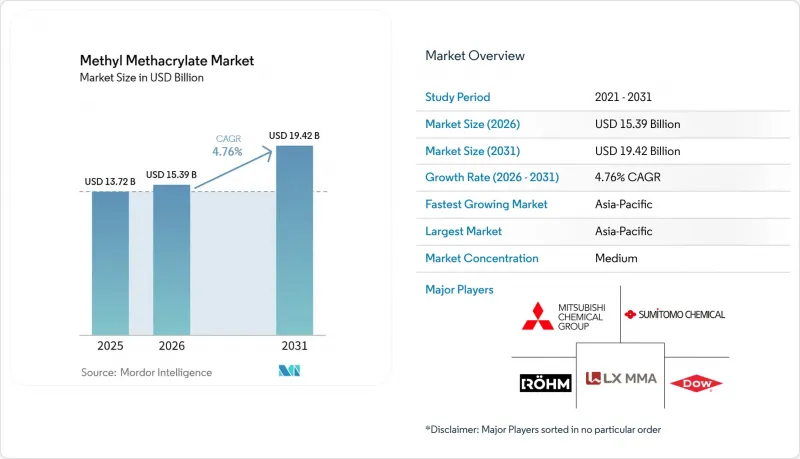
根據 Mordor Intelligence 預測,甲基丙烯酸甲酯市場規模將從 2025 年的 137.2 億美元成長到 2026 年的 153.9 億美元,然後在 2031 年達到 194.2 億美元,2026 年至 2031 年的複合年成長率為 4.76%。
本報告按應用領域(PMMA和丙烯酸樹脂、表面塗料等)、終端用戶行業(建築、汽車和交通運輸等)、生產流程(ACH工藝、C4和異丁烯工藝等)以及地區(亞太地區、北美地區、歐洲地區、南美地區、中東和非洲地區)進行細分。市場預測以美元計價。
全球甲基丙烯酸甲酯市場趨勢及洞察
建築與施工:基礎設施發展和數位化進步正在擴大MMA的消費。
建築業仍然是甲基丙烯酸甲酯(MMA)最廣泛的需求領域。 MMA基材料廣泛應用於商業建築和基礎設施的玻璃帷幕牆、覆材、混凝土修復以及其他需要耐久性的應用。如今,MMA的需求不再局限於標準丙烯酸玻璃幕牆;高分子量甲基丙烯酸酯材料也被用於需要快速固化和裂縫橋接的基礎設施維修項目。在商業項目中,PMMA基幕牆和玻璃幕牆越來越受歡迎,因為這些項目對使用壽命長、結構重量輕以及在長期運行週期內保持良好的耐候性要求極高。此外,資料基礎設施領域也湧現新的需求。三菱化學集團在其2026年戰略規劃中,已將PMMA應用於光纖和水冷資料中心的組件。這一點意義重大,因為甲基丙烯酸甲酯市場既受益於實體建築,也受益於數位基礎設施的擴展,從而降低了其對單一建設週期的依賴。這也解釋了為什麼在那些優先考慮耐久性、透明度和生命週期性能而非低初始材料成本的項目中,甲基丙烯酸甲酯市場仍然發揮著至關重要的作用。
汽車輕量化:MMA基黏合劑和PMMA正在滲透到電動車的結構中。
隨著電動車 (EV) 的發展,傳統裝飾應用逐漸被淘汰,甲基丙烯酸甲酯 (MMA) 市場格局也隨之變化,黏合劑和光學聚甲基丙烯酸甲酯 (PMMA) 的重要性日益凸顯。結構型 MMA黏合劑廣泛應用於製造商需要連接鋁、碳纖維增強聚合物、玻璃纖維複合複合材料以及其他不適用於傳統焊接方法的異種材料時。 ITW Performance Polymers 的報告闡述了 MMA 在多材料連接中的作用,並指出 MMA 的需求正日益與設計架構而非單純的產量掛鉤。電池組組裝也需要能夠適應不同材料熱膨脹係數差異的黏合線,這提高了電動車平台對黏合劑的性能要求。隨著電動車的普及,由於某些組裝工藝中每輛車的 MMA 使用量成長速度可能超過汽車產量本身的成長速度,甲基丙烯酸甲酯市場正從中受益。因此,即使成熟的 PMMA 裝飾應用帶來的增量成長不如特種黏合劑系統那麼顯著,汽車產業的需求仍然佔據著重要地位。
原料與能源成本波動:ACH生產者面臨的結構性投入成本風險
原料和能源成本的波動仍然是甲基丙烯酸甲酯市場面臨的阻礙因素。這是因為與其它生產路線相比,ACH(氨-氰化氫)製程的生產商依賴更難平衡的原料供應鏈。此生產流程依賴丙酮和氰化氫,但這兩種原料的價格並非總是同步波動,也未必與成品甲基丙烯酸甲酯的銷售價格完全一致。因此,即使原物料供應鏈中某一環節出現短缺,也會對生產商的利潤率造成壓力,而在能源成本居高不下的地區,生產規劃將變得更加複雜。此外,與硫酸銨相關的廢棄物處理義務也為傳統工廠增加了額外的成本負擔,因為傳統工廠的生產流程與C2製程不同。因此,甲基丙烯酸甲酯市場正在轉向投資那些能夠減少對原料依賴和降低環境影響的技術。那些未能及時適應這些變化的生產商不僅可能面臨短期挫折,還可能面臨利潤率的持續壓力。
細分市場分析
預計到2025年,PMMA和丙烯酸樹脂將佔甲基丙烯酸甲酯市場佔有率的52.44%,證實了下游聚合物產業鏈仍然是最大的應用領域。人造石和實體面材預計到2031年將以5.62%的複合年成長率成長,代表傳統樹脂領域之外的更快成長的應用場景。這一轉變值得關注,因為醫院和實驗室的負責人正在指定使用PMMA複合材料檯面和設備,以滿足對無縫表面和衛生性能的要求。這種採購模式比典型的住宅裝修週期更能維持穩定的需求。它還為能夠滿足離胺酸的高需求以及對具有更嚴格性能要求的特殊表面應用需求的供應商創造了新的機會。
表面塗料和乳化聚合物仍然十分重要,為甲基丙烯酸甲酯 (MMA) 在建築和工業領域的廣泛應用提供了重要的輔助基礎。水性塗料和高固態塗料的興起推動了黏合劑中甲基丙烯酸酯含量的成長,尤其是在需要保持光澤和耐候性的應用領域,這使得該領域在甲基丙烯酸甲酯市場中持續佔據重要地位。來自塗料排放法規的壓力也促使基於 MMA 的化學技術轉化為適用性更強的配方。黏合劑和密封劑是高價值品類,因為電動車 (EV) 和可再生能源相關組裝的結構黏合需要超越標準大宗應用的專用化學技術。雖然乳化聚合物仍然與廣泛的工業生產有關,但甲基丙烯酸甲酯行業最強勁的需求動力並非來自成熟的通用領域,而是來自固體表面材料和先進黏合劑領域。甲基丙烯酸甲酯市場基於純度的細分市場意味著,優質等級的產品越來越集中在一體化供應商手中,而標準等級的產品則面臨更大的價格壓力。
區域分析
截至2025年,亞太地區將佔據甲基丙烯酸甲酯46.85%的市場佔有率,預計到2031年,該地區市場規模將以5.34%的複合年成長率成長。該地區在需求和供應方面均佔最大佔有率,對定價、貿易流動和投資重點有顯著影響。中國仍然是該地區最大的市場,但在供應鏈的某些環節,供應成長超過了國內吸收能力。這種供需失衡持續對標準等級甲基丙烯酸甲酯的價格構成壓力,隨著國內市場狀況的緩和,生產商正在尋求開發出口市場。在都市化、汽車行業的擴張以及受丙烯酸標誌需求驅動的穩定消費成長的推動下,印度和東南亞在甲基丙烯酸甲酯市場中的地位日益重要。三菱化學集團也已將印度列為以夥伴關係為主導的供應擴張目標,這進一步印證了該地區的成長正在超越其傳統的東北亞市場。
在北美,隨著本地產能的增強和低碳製造方案的商業性化,供應格局正在改變。 ROHM位於貝城(Bay City)的工廠已將其C2路線的產能提高了25萬噸,並於2026年6月作為新的國內供應來源投入運作。這使得汽車、電子、建築和醫療行業的客戶能夠獲得符合採購標準的本地供應商,這些標準著重於生產路線的效率和產品對環境的影響。北美甲基丙烯酸甲酯市場受益於與揮發性有機化合物(VOC)相關的配方持續轉變,同時也受益於對塗料及其衍生物的需求。歐洲的情況則有所不同,其需求成長較多是由採購路線的轉變而非產量的增加所驅動。與REACH法規相關的廢棄物處理義務以及對更廣泛的永續發展報告的要求,正推動歐洲甲基丙烯酸甲酯市場向經認證的、低碳的和可追溯的供應路線轉型。
儘管南美和中東/非洲地區甲基丙烯酸甲酯(MMA)的市場佔有率總和較小,但這兩個地區都扮演著獨特的戰略角色。南美憑藉其國內MMA生產能力支撐區域供應,並與大規模基礎設施和商業開發項目緊密相連,因此脫穎而出。全部區域地區持續不斷的建設項目支撐著商業和酒店建築對PMMA玻璃、幕牆、塗料和實體面材的需求。南美的需求仍然較為溫和,主要由塗料、黏合劑和消費品驅動,但其對進口的依賴以及外匯波動限制了其短期擴張。
其他好處:
- Excel格式的市場預測(ME)表
- 3個月的分析師支持
目錄
第1章:引言
- 研究假設和市場定義
- 調查範圍
第2章:調查方法
第3章執行摘要
第4章 市場狀況
- 市場概覽
- 市場促進因素
- 建築業對壓克力板材和壓克力表面材料的需求。
- 汽車輕量化和照明需求
- 電子和顯示器對光學設備的需求
- 油漆、塗料、黏合劑和工程表面材料的成長
- 轉向C2路線運輸能力及其在成本和碳排放方面的優勢。
- PMMA轉化為MMA的商業化回收
- 市場限制因素
- 原料和能源成本波動
- 使用聚碳酸酯和其他透明聚合物的替代壓力
- 中國產能過剩及其對商品市場利潤率造成的壓力
- ACH廢棄物的負擔以及氰化物化合物法規的嚴格性
- 價值鏈分析
- 監理情勢
- 技術展望
- 波特五力分析
第5章 市場規模與成長預測
- 透過使用
- PMMA和丙烯酸樹脂
- 表面塗層
- 乳化聚合物和乳膠
- 黏合劑和密封劑
- 人造石和實體表面
- 其他用途
- 產業最終用途
- 建築/施工
- 汽車和運輸業
- 電氣和電子設備
- 醫療保健
- 消費品
- 其他終端用戶產業
- 透過生產過程
- ACH流程
- C4 和異丁烯途徑
- 乙烯和C2路線
- 按地區
- 亞太地區
- 中國
- 印度
- 日本
- 韓國
- ASEAN
- 澳洲和紐西蘭
- 其他亞太國家
- 北美洲
- 美國
- 加拿大
- 墨西哥
- 歐洲
- 德國
- 英國
- 法國
- 義大利
- 西班牙
- 俄羅斯
- 其他歐洲國家
- 南美洲
- 巴西
- 阿根廷
- 其他南美國家
- 中東和非洲
- 沙烏地阿拉伯
- 阿拉伯聯合大公國
- 南非
- 其他中東和非洲國家
- 亞太地區
第6章 競爭情勢
- 市場集中度
- 策略趨勢
- 市佔率和排名分析
- 公司簡介
- Dow
- Formosa Plastics Corporation
- Heilongjiang Zhongmeng Longxin Chemical Co., Ltd.
- Jiangsu Sierbang Petrochemical Co., Ltd.
- Kaohsiung Monomer Company
- Kuraray Co., Ltd.
- LOTTE MCC
- Lucite International
- LX MMA
- Mitsubishi Chemical Group Corporation
- Mitsubishi Gas Chemical Company, Inc.
- PTT Asahi Chemical Company Limited
- Rohm GmbH
- SABIC
- Saudi Methacrylates Company(SAMAC)
- Shandong Longze Chemical Co., Ltd.
- Sumitomo Chemical Co., Ltd.
- Wanhua Chemical Group
第7章 市場機會與未來展望
According to Mordor Intelligence, the methyl methacrylate market size is expected to grow from USD 13.72 billion in 2025 to USD 15.39 billion in 2026 and is forecast to reach USD 19.42 billion by 2031 at 4.76% CAGR over 2026-2031.
This report is Segmented by Application (PMMA and Acrylic Resins, Surface Coatings, and More), End-Use Industry (Building and Construction, Automotive and Transportation, and More), Production Process (ACH Process, C4 and Isobutylene Route, and More), and Geography (Asia-Pacific, North America, Europe, South America, and Middle-East and Africa). The Market Forecasts are Provided in Terms of Value (USD).
Global Methyl Methacrylate Market Trends and Insights
Building and Construction: Infrastructure and Digital Build-Out Extend MMA Consumption
Building and construction remains the broadest demand base for the methyl methacrylate market. MMA-based materials serve glazing, cladding, concrete repair, and other durable applications across commercial and infrastructure assets. Demand is no longer limited to standard acrylic glazing; high-molecular-weight methacrylate systems are also being used in infrastructure rehabilitation where rapid curing and crack bridging are required. PMMA-based facade and glazing specifications are advancing in commercial projects that prioritize long service life, lower structural weight, and weather resistance over long operating cycles. Additional demand is emerging from data infrastructure, where Mitsubishi Chemical Group identified PMMA use in optical fiber and water-cooled data center components as part of its FY2026 strategic direction. This is significant because the methyl methacrylate market draws support from both physical construction and digital build-out, reducing dependence on a single construction cycle. It also helps explain why the methyl methacrylate market remains relevant in projects where durability, transparency, and lifecycle performance carry more weight than low upfront material cost.
Automotive Lightweighting: MMA Adhesives and PMMA Penetrate EV Architecture
The shift toward electric vehicles is changing the methyl methacrylate market by increasing the importance of adhesives and optical PMMA, rather than relying on older trim applications. Structural MMA adhesives are being used where manufacturers need to bond aluminum, carbon fiber-reinforced polymer, glass fiber composites, and other dissimilar materials that are not suited to conventional welding methods. ITW Performance Polymers documented this role in multi-material bonding, supporting the view that MMA demand is becoming more tied to design architecture than to unit output alone. Battery pack assemblies also require bond lines that can manage thermal expansion differences across materials, raising adhesive performance requirements in EV platforms. As EV penetration increases, the methyl methacrylate market benefits because MMA use per vehicle can grow faster than vehicle production itself in selected assemblies. This keeps automotive demand relevant even as mature PMMA trim applications contribute less incremental growth than specialty adhesive systems.
Raw Material and Energy Cost Volatility: ACH Producers Face a Structural Input Risk
Raw material and energy cost volatility remains a restraint for the methyl methacrylate market, as ACH-based producers depend on a feedstock chain that is more difficult to balance than alternative routes. The process relies on acetone and hydrogen cyanide, which do not necessarily move in line with each other or with finished MMA selling conditions. This exposes producers to margin pressure even when only one part of the input chain tightens, and complicates planning in regions where energy costs remain elevated. Waste handling obligations tied to ammonium bisulfate add another cost layer for legacy plants that do not share the same route profile as C2 operations. As a result, the methyl methacrylate market is seeing investment redirect toward technologies that reduce feedstock exposure and environmental burden. Producers that delay these changes are more likely to face persistent margin compression rather than a short-term setback.
Other drivers and restraints analyzed in the detailed report include:
- Electronics and Displays: Optical-Grade PMMA Demand Tightens Supply Specifications
- PMMA-to-MMA Chemical Recycling: Circular Economy Pressure Reshapes Procurement
- China Overcapacity: Export-Led Pricing Pressure Redraws the Competitive Map
For complete list of drivers and restraints, kindly check the Table Of Contents.
Segment Analysis
PMMA and acrylic resins held 52.44% of the methyl methacrylate market share in 2025, confirming that the largest application base remains within the downstream polymer chain. Artificial stone and solid surfaces are projected to grow at a 5.62% CAGR through 2031, representing a faster-growing use case beyond the traditional resin segment. This shift is notable because hospital and laboratory planners are specifying PMMA composite countertops and fixtures where seamless surfaces and hygiene performance are required. That procurement pattern supports a more stable demand stream than a standard residential remodeling cycle. It also creates opportunities for suppliers that can serve both volume resin demand and more specialized surface applications with tighter performance requirements.
Surface coatings and emulsion polymers remain important, providing a broad secondary base for MMA consumption across architectural and industrial uses. The move toward waterborne and high-solids coatings is supporting methacrylate loading in binders that require gloss retention and weathering performance, giving this segment durable relevance in the methyl methacrylate market. Regulatory pressure on emissions in coatings is also supporting conversion toward formulations where MMA-based chemistry remains applicable. Adhesives and sealants represent a higher-value category, as structural bonding in electric vehicle (EV) and renewable energy assemblies requires specialized chemistries beyond standard bulk applications. Emulsion polymers continue to track broad industrial production, but the strongest application momentum in the methyl methacrylate industry is centered on solid surfaces and advanced adhesives rather than on the more mature commodity segments. The purity split within the methyl methacrylate market also means premium grades are becoming more concentrated with integrated suppliers, while standard grades face stronger price pressure.
Complete Report Scope:
- By Application
- PMMA and Acrylic Resins
- Surface Coatings
- Emulsion Polymers and Latex
- Adhesives and Sealants
- Artificial Stone and Solid Surface
- Other Applications
- By End-use Industry
- Building and Construction
- Automotive and Transportation
- Electrical and Electronics
- Healthcare and Medical
- Consumer Goods
- Other End-use Industries
- By Production Process
- ACH Process
- C4 and Isobutylene Route
- Ethylene and C2 Route
- By Geography
- Asia-Pacific
- China
- India
- Japan
- South Korea
- ASEAN
- Australia and New Zealand
- Rest of Asia-Pacific
- North America
- United States
- Canada
- Mexico
- Europe
- Germany
- United Kingdom
- France
- Italy
- Spain
- Russia
- Rest of Europe
- South America
- Brazil
- Argentina
- Rest of South America
- Middle-East and Africa
- Saudi Arabia
- United Arab Emirates
- South Africa
- Rest of Middle-East and Africa
- Asia-Pacific
Geography Analysis
Asia-Pacific held 46.85% of the methyl methacrylate market share in 2025, and the region's market size is projected to expand at a CAGR of 5.34% through 2031. The region accounts for the largest share of both demand and supply, giving it significant influence over pricing, trade flows, and investment priorities. China remains the largest market within the region, though supply additions have outpaced local absorption in parts of the chain. This imbalance keeps standard-grade pricing under pressure and encourages producers to seek export markets when domestic conditions soften. India and Southeast Asia are becoming more important to the methyl methacrylate market, as urbanization, automotive expansion, and acrylic signage demand support steady incremental consumption. Mitsubishi Chemical Group has also identified India as a target for partnership-led supply development, reinforcing the view that regional growth is spreading beyond the traditional Northeast Asia base.
North America is moving into a different supply position as local production capability strengthens and lower-carbon route options become commercially available. Rohm's Bay City facility added 250,000 tons of C2 route capacity and brought a new domestic supply option into operation in June 2026. This gives automotive, electronics, construction, and medical customers a regional source that aligns with procurement criteria focused on route efficiency and product footprint. The methyl methacrylate market in North America also benefits from coatings and derivative demand supported by ongoing VOC-related formulation shifts. Europe presents a different picture, as demand growth is tied less to volume expansion and more to sourcing conversion. REACH-related waste handling obligations and broader sustainability reporting expectations are pushing the European methyl methacrylate market toward certified, lower-carbon, and more traceable supply pathways.
South America, the Middle East, and Africa together account for a smaller share of the methyl methacrylate market, but each carries a distinct strategic role. Saudi Arabia stands out because domestic MMA production supports regional supply and connects to large-scale infrastructure and commercial development plans. The broader Middle East construction pipeline continues to support demand for PMMA glazing, facades, coatings, and solid surfaces across commercial and hospitality projects. South American demand remains more modest and is centered on coatings, adhesives, and consumer goods, with import exposure and currency conditions limiting near-term expansion.
- Dow
- Formosa Plastics Corporation
- Heilongjiang Zhongmeng Longxin Chemical Co., Ltd.
- Jiangsu Sierbang Petrochemical Co., Ltd.
- Kaohsiung Monomer Company
- Kuraray Co., Ltd.
- LOTTE MCC
- Lucite International
- LX MMA
- Mitsubishi Chemical Group Corporation
- Mitsubishi Gas Chemical Company, Inc.
- PTT Asahi Chemical Company Limited
- Rohm GmbH
- SABIC
- Saudi Methacrylates Company (SAMAC)
- Shandong Longze Chemical Co., Ltd.
- Sumitomo Chemical Co., Ltd.
- Wanhua Chemical Group
Additional Benefits:
- The market estimate (ME) sheet in Excel format
- 3 months of analyst support
TABLE OF CONTENTS
1 Introduction
- 1.1 Study Assumptions & Market Definition
- 1.2 Scope of the Study
2 Research Methodology
3 Executive Summary
4 Market Landscape
- 4.1 Market Overview
- 4.2 Market Drivers
- 4.2.1 Building and construction demand for acrylic sheets and surfaces
- 4.2.2 Automotive lightweighting and lighting demand
- 4.2.3 Electronics and display optics demand
- 4.2.4 Growth in paints, coatings, adhesives, and engineered surfaces
- 4.2.5 Shift toward C2 route capacity and cost-carbon advantage
- 4.2.6 PMMA-to-MMA recycling commercialization
- 4.3 Market Restraints
- 4.3.1 Raw material and energy cost volatility
- 4.3.2 Substitute pressure from polycarbonate and other transparent polymers
- 4.3.3 China overcapacity and merchant-market margin squeeze
- 4.3.4 ACH waste burden and cyanide compliance intensity
- 4.4 Value Chain Analysis
- 4.5 Regulatory Landscape
- 4.6 Technological Outlook
- 4.7 Porter's Five Forces Analysis
- 4.7.1 Bargaining Power of Suppliers
- 4.7.2 Bargaining Power of Buyers
- 4.7.3 Threat of New Entrants
- 4.7.4 Threat of Substitutes
- 4.7.5 Industry Rivalry
5 Market Size & Growth Forecasts (Value)
- 5.1 By Application
- 5.1.1 PMMA and Acrylic Resins
- 5.1.2 Surface Coatings
- 5.1.3 Emulsion Polymers and Latex
- 5.1.4 Adhesives and Sealants
- 5.1.5 Artificial Stone and Solid Surface
- 5.1.6 Other Applications
- 5.2 By End-use Industry
- 5.2.1 Building and Construction
- 5.2.2 Automotive and Transportation
- 5.2.3 Electrical and Electronics
- 5.2.4 Healthcare and Medical
- 5.2.5 Consumer Goods
- 5.2.6 Other End-use Industries
- 5.3 By Production Process
- 5.3.1 ACH Process
- 5.3.2 C4 and Isobutylene Route
- 5.3.3 Ethylene and C2 Route
- 5.4 By Geography
- 5.4.1 Asia-Pacific
- 5.4.1.1 China
- 5.4.1.2 India
- 5.4.1.3 Japan
- 5.4.1.4 South Korea
- 5.4.1.5 ASEAN
- 5.4.1.6 Australia and New Zealand
- 5.4.1.7 Rest of Asia-Pacific
- 5.4.2 North America
- 5.4.2.1 United States
- 5.4.2.2 Canada
- 5.4.2.3 Mexico
- 5.4.3 Europe
- 5.4.3.1 Germany
- 5.4.3.2 United Kingdom
- 5.4.3.3 France
- 5.4.3.4 Italy
- 5.4.3.5 Spain
- 5.4.3.6 Russia
- 5.4.3.7 Rest of Europe
- 5.4.4 South America
- 5.4.4.1 Brazil
- 5.4.4.2 Argentina
- 5.4.4.3 Rest of South America
- 5.4.5 Middle-East and Africa
- 5.4.5.1 Saudi Arabia
- 5.4.5.2 United Arab Emirates
- 5.4.5.3 South Africa
- 5.4.5.4 Rest of Middle-East and Africa
- 5.4.1 Asia-Pacific
6 Competitive Landscape
- 6.1 Market Concentration
- 6.2 Strategic Moves
- 6.3 Market Share/Ranking Analysis
- 6.4 Company Profiles {(includes Global level Overview, Market level overview, Core Segments, Financials as available, Strategic Information, Market Rank/Share for key companies, Products & Services, and Recent Developments)}
- 6.4.1 Dow
- 6.4.2 Formosa Plastics Corporation
- 6.4.3 Heilongjiang Zhongmeng Longxin Chemical Co., Ltd.
- 6.4.4 Jiangsu Sierbang Petrochemical Co., Ltd.
- 6.4.5 Kaohsiung Monomer Company
- 6.4.6 Kuraray Co., Ltd.
- 6.4.7 LOTTE MCC
- 6.4.8 Lucite International
- 6.4.9 LX MMA
- 6.4.10 Mitsubishi Chemical Group Corporation
- 6.4.11 Mitsubishi Gas Chemical Company, Inc.
- 6.4.12 PTT Asahi Chemical Company Limited
- 6.4.13 Rohm GmbH
- 6.4.14 SABIC
- 6.4.15 Saudi Methacrylates Company (SAMAC)
- 6.4.16 Shandong Longze Chemical Co., Ltd.
- 6.4.17 Sumitomo Chemical Co., Ltd.
- 6.4.18 Wanhua Chemical Group
7 Market Opportunities & Future Outlook
- 7.1 White-space and Unmet-need Assessment


