


 |
市場調查報告書
商品編碼
2099521
凍乾設備及服務:市場佔有率分析、產業趨勢及統計、成長預測(2026-2031 年)Freeze Drying Equipment and Services - Market Share Analysis, Industry Trends & Statistics, Growth Forecasts (2026 - 2031) |
||||||

※ 本網頁內容可能與最新版本有所差異。詳細情況請與我們聯繫。
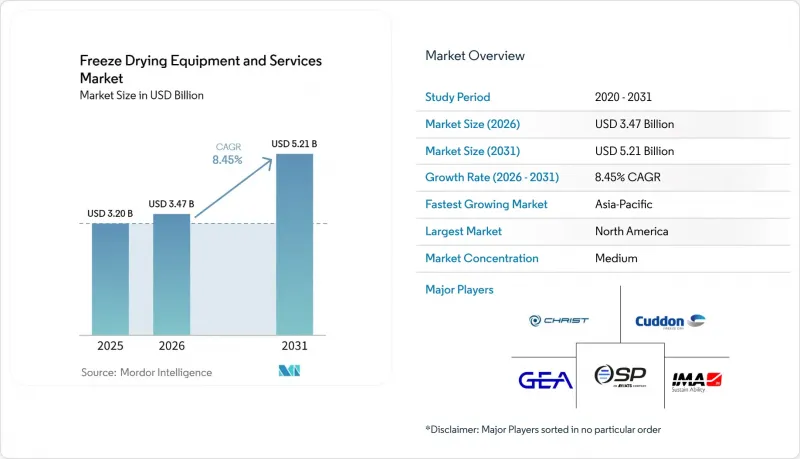
根據 Mordor Intelligence 預測,冷凍乾燥設備和服務市場將從 2025 年的 32 億美元成長到 2026 年的 34.7 億美元,然後在 2031 年達到 52.1 億美元,2026 年至 2031 年的複合年成長率為 8.45%。
本報告按模式(設備、服務)、業務規模(實驗室、中試、工業)、應用領域(製藥、生物技術、食品加工、營養保健品、其他)、最終用戶(製藥和生物技術公司、食品加工商、學術機構、合約研發生產機構、其他)以及地區(北美、歐洲、亞太、中東和非洲、南美)進行細分。預測以以金額為準。
全球冷凍乾燥設備及服務市場趨勢與洞察
擴大生物製藥、疫苗和注射劑的生產。
在凍乾設備和服務市場,隨著冷凍乾燥技術從輔助工藝轉變為核心生產流程,生物製藥行業的需求正在穩步成長。單株抗體、抗體藥物複合體(ADC) 療法和基於傳訊RNA(mRNA) 的疫苗通常需要冷凍乾燥,因為液體製劑在室溫下穩定性不足。傳訊RNA脂質奈米顆粒的冷凍乾燥正成為下一代治療藥物的關鍵製劑技術,而品質源自於設計 (QbD) 和製程分析技術 (PAT) 在監管審查中的應用也日益廣泛。在符合良好生產規範 (GMP) 的環境下,設備後製改造難度較大,因此越來越多的買家在採購時就指定整合製程分析技術 (PAT)。因此,訂單聚合物專案競標的合約研發生產機構 (CDMO) 更傾向於選擇第三方製程分析技術 (PAT) 工具和開放式架構系統,以滿足更廣泛的製程控制需求。
冷凍乾燥食品和營養保健品配方的拓展
冷凍乾燥設備和服務市場正受惠於高階食品和營養保健品領域日益成長的需求。凍乾食品的應用範圍已不再局限於軍事和生存領域,如今已成為主流高階零售市場的一部分。在營養保健品領域,益生菌、植物萃取物和熱敏性蛋白質通常需要採用冷凍乾燥工藝,因為加熱方法可能會破壞決定產品價值的活性成分。 「潔淨標示」零食和功能性營養食品的趨勢正在擴大食品級冷凍乾燥機的應用範圍,使其不再局限於傳統的果蔬加工。與製藥業相比,食品業的採購模式有所不同,其無塵室要求相對寬鬆,但價格壓力更大,對加工能力的需求也更高。
與傳統乾燥方法相比,初始投資成本較高
高昂的初始投資成本仍是凍乾設備和服務市場擴張的主要障礙。大型製藥級生產用冷凍乾燥機的成本可能在100萬美元到500萬美元以上,這還不包括安裝、合格和確認費用。這一成本遠高於處理能力要求相當的噴霧乾燥機或流體化床系統。對於新興市場的非專利藥注射劑生產商和合約研發生產機構(CDMO)而言,這種成本結構會延長投資回收期,並使投資決策延後數年。預計2022年至2025年資金籌措成本將持續上升,小規模企業的採購難度預計將進一步增加。對於那些生產價格敏感型最終產品的企業而言,這一趨勢將特別明顯,因為這將限制他們選擇高品質加工方法的範圍。
細分市場分析
預計到2025年,設備將佔凍乾設備和服務市場的78.12%。這反映了凍乾設施建設的資本密集特性。由於托盤式系統能夠確保批次均勻性和實現自動化裝載,因此仍然是製藥和食品應用領域的首選配置。歧管式和旋轉式系統則繼續用於實驗室和營養補充劑應用領域,在這些領域,柔軟性比最大處理能力更為重要。
在歐洲,由於老舊設備面臨符合冷媒相關法規的壓力,設備更新換代的需求也推動了設備採購。老舊設備的維修成本高達 8 萬歐元(約 91,498.80 美元),一些業者選擇徹底更換設備,而不是進行局部升級。受驗證、校準、維護、培訓和冷凍乾燥等外包支援的長期需求驅動,預計到 2031 年,服務業的複合年成長率將達到 9.53%,增速將高於行業平均水平。
預計到2025年,工業規模系統將佔冷凍乾燥設備和服務市場48.45%的佔有率,這主要得益於商業製藥和食品企業對大規模批量處理能力和穩定加工能力的需求。領先的生物製藥公司、合約研發生產力機構(CDMO)和食品加工商通常會購買這些系統,以提高設備運轉率和加工效率。中試規模的設備仍然十分重要,因為它在連接研發營運和商業化生產方面發揮橋樑作用。
預計供應商的投資將持續推動大規模需求。 GEA計劃於2026年2月在德國埃爾斯多夫開設一座價值8,000萬歐元(約9,150萬美元)的製藥技術中心。該中心將整合研發、生產和數位化工作流程,佔地超過4萬平方公尺,是碳中和的園區。在合約研究機構(CRO)、學術機構和製藥公司研發團隊的支持下,實驗室規模的冷凍乾燥機預計將以10.67%的複合年成長率成長,用於製劑開發和規模化生產,預計到2031年,其市場需求將持續成長。
區域分析
預計到2025年,北美將佔凍乾設備和服務市場42.56%的佔有率,成為該市場最大的區域。該地區受益於美國生物製藥製造地的規模以及對冷凍乾燥注射劑的強勁需求。美國食品藥物管理局(FDA)對製程驗證和冷凍乾燥控制的監管持續支撐著對先進設備、製程分析技術(PAT)整合和再驗證服務的需求。 PCI Pharma Services計劃於2026年4月在新罕布夏州貝德福德運作一條生產線,該生產線包含兩台40平方公尺的凍乾機,年產能達3,300萬管瓶,凸顯了該地區持續的投資。
歐洲仍然是凍乾設備和服務的第二大區域市場,也是製藥級設備供應商最集中的地區。該地區的主要企業包括GEA集團、Syntegon、Martin Christ、IMA SpA、OPTIMA和ZIRBUS。德國既是製造地,也是重要的終端用戶基地。 GEA投資8,000萬歐元(9,150萬美元)的埃爾斯多夫工廠計畫於2026年2月投產,將成為該市場的基礎。遵守歐盟藥品生產品質管理規範(EU GMP)附件1的要求,正在推動歐洲各地工廠對滅菌驗證和自動化裝載系統的投資。
亞太地區是凍乾設備和服務市場成長最快的地區,預計到2031年複合年成長率將達到12.56%。在中國,隨著生物相似藥、抗體藥物複合體(ADC)和信使核糖核酸(mRNA)產量的擴大,國內需求仍然強勁。國內製造商正在鞏固其在標準製藥系統領域的地位,而進口品牌則繼續在高階生物製藥領域佔據領先地位。印度受益於出口導向合約研發產量機構(CDMO)的擴張、無菌製劑的成長以及生產製造的持續現代化。同時,中東、非洲和南美洲市場規模仍然較小,但巴西、南非、沙烏地阿拉伯和阿拉伯聯合大公國等國的本地疫苗生產以及對低溫運輸依賴性的降低,正在湧現出新的機會。
其他好處:
- Excel格式的市場預測(ME)表
- 3個月的分析師支持
目錄
第1章:引言
- 研究假設和市場定義
- 調查範圍
第2章:調查方法
第3章執行摘要
第4章 市場狀況
- 市場概覽
- 市場促進因素
- 擴大生物製藥、疫苗和注射的生產規模
- 冷凍乾燥食品和營養保健品的擴張
- 自動化、物聯網和流程分析技術的實施
- 附錄 1:升級驅動無菌與污染控制系統
- 節能低碳維修的需求
- 低溫運輸脆弱性和產品穩定性要求
- 市場限制因素
- 與傳統乾燥方法相比,初始投資成本較高
- 較長的周期時間和吞吐量限制
- 能源強度和電力需求
- 熟練的操作人員和驗證的負擔
- 價值/供應鏈分析
- 監理情勢
- 技術展望
- 波特五力分析
第5章 市場規模與成長預測
- 按模式
- 裝置
- 托盤式冷凍乾燥機
- 歧管式冷凍乾燥機
- 旋轉式冷凍乾燥機
- 桌上型冷凍乾燥機
- 工業冷凍乾燥機
- 實驗室冷凍乾燥機
- 其他
- 服務
- 安裝和試運行
- 檢驗和合格
- 維護/修理
- 校準和升級
- 合約凍乾服務
- 培訓和技術支援
- 裝置
- 按企業規模
- 實驗室規模
- 中試規模
- 產業規模
- 透過使用
- 製藥
- 生物技術
- 食品加工
- 外科手術
- 營養保健品
- 其他
- 最終用戶
- 製藥和生物技術公司
- 食品加工公司
- 學術研究機構
- 合約研發生產組織(CDMO)
- 醫院和外科中心
- 其他
- 按地區
- 北美洲
- 美國
- 加拿大
- 墨西哥
- 歐洲
- 德國
- 英國
- 法國
- 義大利
- 西班牙
- 其他歐洲國家
- 亞太地區
- 中國
- 印度
- 日本
- 澳洲
- 韓國
- 其他亞太國家
- 中東和非洲
- GCC
- 南非
- 其他中東和非洲國家
- 南美洲
- 巴西
- 阿根廷
- 其他南美國家
- 北美洲
第6章 競爭情勢
- 市場集中度
- 市佔率分析
- 公司簡介
- Azbil Corporation
- Biopharma Process Systems Ltd.
- BUCHI Labortechnik AG
- Christ Freeze Dryers GmbH
- Cuddon Freeze Dry
- GEA Group Aktiengesellschaft
- Harvest Right, LLC
- HOF Sonderanlagenbau GmbH
- IMA SpA
- Kyowa Vacuum Engineering Co., Ltd.
- Labconco Corporation
- Martin Christ Gefriertrocknungsanlagen GmbH
- Millrock Technology, Inc.
- OPTIMA packaging group GmbH
- Shanghai Tofflon Science and Technology Co., Ltd.
- SP Industries, Inc.
- SPX Technologies, Inc.
- Syntegon Technology GmbH
- Thermo Fisher Scientific Inc.
- ULVAC, Inc.
- Yamato Scientific Co., Ltd.
- ZIRBUS technology GmbH
第7章 市場機會與未來展望
According to Mordor Intelligence, the freeze drying equipment and services market size is expected to grow from USD 3.20 billion in 2025 to USD 3.47 billion in 2026 and is forecast to reach USD 5.21 billion by 2031 at 8.45% CAGR over 2026-2031.
This report is Segmented by Modality (Equipment, Services), Scale of Operation (Laboratory, Pilot, Industrial), Application (Pharmaceuticals, Biotechnology, Food Processing, Nutraceuticals, Others), End User (Pharma/Biotech Companies, Food Processors, Academic Institutes, Cdmos, Others), and Geography (North America, Europe, Asia-Pacific, MEA, South America). Forecasts in Value (USD).
Global Freeze Drying Equipment and Services Market Trends and Insights
Rising Biologics, Vaccines, and Injectable Manufacturing
The freeze drying equipment and services market is recording stronger demand from biologics, as lyophilization is shifting from a supporting process step to a core production requirement. Monoclonal antibodies, antibody-drug conjugate therapies, and messenger RNA-based vaccines often require freeze drying when liquid formats do not provide sufficient ambient-temperature stability. Lyophilization of messenger RNA lipid nanoparticles is becoming a critical formulation route for next-generation therapeutics, with growing use of Quality by Design and Process Analytical Technology in regulatory work. Buyers are increasingly specifying Process Analytical Technology integration at the purchase stage because retrofitting a unit later is difficult in a Good Manufacturing Practice setting. As a result, contract development and manufacturing organizations competing for large-molecule programs are favoring open-architecture systems that support third-party Process Analytical Technology tools and broader process control requirements.
Expansion of Freeze-Dried Food and Nutraceutical Formulations
The freeze drying equipment and services market is benefiting from wider adoption in premium food and nutraceutical products. Freeze-dried food has moved beyond military and survival applications and is now part of mainstream premium retail demand. In nutraceuticals, probiotics, botanical extracts, and sensitive proteins often require freeze drying because heat-based methods can damage the active compounds that define product value. Clean-label snacking and functional nutrition trends are expanding the installation base for food-grade lyophilizers beyond traditional fruit and vegetable processing. This segment follows a different buying pattern than pharmaceutical demand, as cleanroom requirements are lower, while price pressure and throughput requirements are higher.
High Upfront Capital Cost Versus Conventional Drying
High capital costs remain a key barrier to expansion in the freeze drying equipment and services market. A large pharmaceutical-grade production freeze dryer can cost USD 1 million to more than USD 5 million before installation, qualification, and validation costs. This cost is significantly higher than that of spray dryers or fluidized bed systems with similar throughput requirements. For generic injectable manufacturers and emerging-market contract development and manufacturing organizations (CDMOs), this cost profile extends return periods and can delay investment decisions by several years. Higher financing costs from 2022 through 2025 are expected to make procurement more difficult for smaller operators, especially where price-sensitive end products limit the scope for premium processing choices.
Other drivers and restraints analyzed in the detailed report include:
- Automation, IoT, and Process Analytical Technology Adoption
- Annex 1 Driven Sterility and Contamination Control Upgrades
- Skilled Operator and Validation Burden
For complete list of drivers and restraints, kindly check the Table Of Contents.
Segment Analysis
Equipment is expected to hold 78.12% of the freeze drying equipment and services market in 2025, reflecting the capital-intensive nature of lyophilization build-outs. Tray-style systems remain the preferred configuration across pharmaceutical and food applications because they support batch uniformity and automated loading. Manifold and rotary systems continue to serve laboratory and nutraceutical applications, where flexibility is more important than maximum throughput.
Replacement demand is also supporting equipment purchases, as older units in Europe face refrigerant-related compliance pressure. Retrofit costs of up to EUR 80,000 (USD 91,498.80) for older units have encouraged some operators to choose full replacement over partial upgrades. Services are projected to grow faster, at a CAGR of 9.53% through 2031, driven by long-term requirements for validation, calibration, maintenance, training, and outsourced lyophilization support.
Industrial-scale systems are expected to account for 48.45% of the freeze drying equipment and services market size in 2025, as commercial pharmaceutical and food facilities require large batch capacity and consistent throughput. Major biopharma companies, contract development and manufacturing organizations (CDMOs), and food processors typically purchase these systems to improve shelf utilization and turnaround time. Pilot-scale units remain important because they connect development work with commercial manufacturing.
Large-scale demand remains visible through supplier investments. GEA is expected to inaugurate its EUR 80 million (USD 91.50 million) pharmaceutical technology center in Elsdorf, Germany, in February 2026, combining research, production, and digital workflows in a 40,000+m2 CO2-neutral site. Laboratory-scale freeze dryers are projected to grow at a CAGR of 10.67% through 2031, supported by contract research organizations (CROs), academic institutes, and pharmaceutical research and development (R&D) teams working on formulation and scale-up.
Complete Report Scope:
- By Modality
- Equipment
- Tray Style Freeze Dryers
- Manifold Freeze Dryers
- Rotary Freeze Dryers
- Bench Top Freeze Dryers
- Industrial Freeze Dryers
- Laboratory Freeze Dryers
- Others
- Services
- Installation and Commissioning
- Validation and Qualification
- Maintenance and Repair
- Calibration and Upgrades
- Contract Freeze Drying Services
- Training and Technical Support
- Equipment
- By Scale of Operation
- Laboratory Scale
- Pilot Scale
- Industrial Scale
- By Application
- Pharmaceuticals
- Biotechnology
- Food Processing
- Surgical Procedures
- Nutraceuticals
- Others
- By End User
- Pharmaceutical and Biotechnology Companies
- Food Processing Companies
- Academic and Research Institutes
- Contract Development and Manufacturing Organizations
- Hospitals and Surgical Centers
- Others
- By Geography
- North America
- United States
- Canada
- Mexico
- Europe
- Germany
- United Kingdom
- France
- Italy
- Spain
- Rest of Europe
- Asia-Pacific
- China
- India
- Japan
- Australia
- South Korea
- Rest of Asia-Pacific
- Middle East and Africa
- GCC
- South Africa
- Rest of Middle East and Africa
- South America
- Brazil
- Argentina
- Rest of South America
- North America
Geography Analysis
North America is expected to hold 42.56% of the freeze drying equipment and services market in 2025, making it the largest regional contributor. The region benefits from the scale of the US biopharmaceutical manufacturing base and strong demand for lyophilized injectables. FDA oversight of process validation and freeze drying control continues to support demand for advanced equipment, process analytical technology (PAT) integration, and revalidation services. PCI Pharma Services' planned commissioning in April 2026 of a twin 40 m2 lyophilizer line in Bedford, New Hampshire, with an annual capacity of 33 million vials, highlights sustained regional investment.
Europe remains the second-largest regional market in the freeze drying equipment and services market and has the deepest concentration of pharmaceutical-grade equipment suppliers. The region includes major companies such as GEA Group, Syntegon, Martin Christ, IMA S.p.A., OPTIMA, and ZIRBUS. Germany serves as both a manufacturing hub and a major end-user center, supported by GEA's EUR 80 million (USD 91.50 million) Elsdorf facility, scheduled to open in February 2026. Compliance with European Union Good Manufacturing Practice (EU GMP) Annex 1 is driving investment in sterilization validation and automated loading systems across European facilities.
Asia-Pacific is the fastest-growing region in the freeze drying equipment and services market, with a projected CAGR of 12.56% through 2031. China is recording strong local demand as biosimilar, antibody-drug conjugate (ADC), and messenger ribonucleic acid (mRNA) manufacturing scale up. Domestic manufacturers are strengthening their position in standard pharmaceutical systems, while imported brands continue to lead the higher-end biopharmaceutical tier. India is benefiting from export-focused contract development and manufacturing organization (CDMO) expansion, sterile dosage growth, and continued manufacturing modernization, while the Middle East, Africa, and South America remain smaller but are seeing opportunities from local vaccine manufacturing and lower cold-chain dependence in Brazil, South Africa, Saudi Arabia, and the UAE.
- Azbil
- Biopharma Process Systems Ltd.
- BUCHI Labortechnik AG
- Christ Freeze Dryers GmbH
- Cuddon Freeze Dry
- GEA Group
- Harvest Right, LLC
- HOF Sonderanlagenbau
- IMA S.p.A.
- Kyowa Vacuum Engineering Co., Ltd.
- Labconco
- Martin Christ Gefriertrocknungsanlagen
- Millrock Technology, Inc.
- OPTIMA packaging group GmbH
- Shanghai Tofflon Science and Technology Co., Ltd.
- SP Industries, Inc.
- SPX Technologies, Inc.
- Syntegon Technology
- Thermo Fisher Scientific
- ULVAC, Inc.
- Yamato Scientific Co., Ltd.
- ZIRBUS technology
Additional Benefits:
- The market estimate (ME) sheet in Excel format
- 3 months of analyst support
TABLE OF CONTENTS
1 INTRODUCTION
- 1.1 Study Assumptions and Market Definition
- 1.2 Scope of the Study
2 RESEARCH METHODOLOGY
3 EXECUTIVE SUMMARY
4 MARKET LANDSCAPE
- 4.1 Market Overview
- 4.2 Market Drivers
- 4.2.1 Rising Biologics, Vaccines, and Injectable Manufacturing
- 4.2.2 Expansion of Freeze-Dried Food and Nutraceutical Formulations
- 4.2.3 Automation, IoT, and Process Analytical Technology Adoption
- 4.2.4 Annex 1 Driven Sterility and Contamination Control Upgrades
- 4.2.5 Energy-Efficient and Low-Carbon Retrofit Demand
- 4.2.6 Cold Chain Fragility and Product Stability Requirements
- 4.3 Market Restraints
- 4.3.1 High Upfront Capital Cost Versus Conventional Drying
- 4.3.2 Long Cycle Times and Throughput Constraints
- 4.3.3 Energy Intensity and Utility Load Requirements
- 4.3.4 Skilled Operator and Validation Burden
- 4.4 Value/Supply Chain Analysis
- 4.5 Regulatory Landscape
- 4.6 Technological Outlook
- 4.7 Porter's Five Forces Analysis
- 4.7.1 Bargaining Power of Suppliers
- 4.7.2 Bargaining Power of Buyers
- 4.7.3 Threat of New Entrants
- 4.7.4 Threat of Substitutes
- 4.7.5 Intensity of Competitive Rivalry
5 MARKET SIZE AND GROWTH FORECASTS (VALUE, USD)
- 5.1 By Modality
- 5.1.1 Equipment
- 5.1.1.1 Tray Style Freeze Dryers
- 5.1.1.2 Manifold Freeze Dryers
- 5.1.1.3 Rotary Freeze Dryers
- 5.1.1.4 Bench Top Freeze Dryers
- 5.1.1.5 Industrial Freeze Dryers
- 5.1.1.6 Laboratory Freeze Dryers
- 5.1.1.7 Others
- 5.1.2 Services
- 5.1.2.1 Installation and Commissioning
- 5.1.2.2 Validation and Qualification
- 5.1.2.3 Maintenance and Repair
- 5.1.2.4 Calibration and Upgrades
- 5.1.2.5 Contract Freeze Drying Services
- 5.1.2.6 Training and Technical Support
- 5.1.1 Equipment
- 5.2 By Scale of Operation
- 5.2.1 Laboratory Scale
- 5.2.2 Pilot Scale
- 5.2.3 Industrial Scale
- 5.3 By Application
- 5.3.1 Pharmaceuticals
- 5.3.2 Biotechnology
- 5.3.3 Food Processing
- 5.3.4 Surgical Procedures
- 5.3.5 Nutraceuticals
- 5.3.6 Others
- 5.4 By End User
- 5.4.1 Pharmaceutical and Biotechnology Companies
- 5.4.2 Food Processing Companies
- 5.4.3 Academic and Research Institutes
- 5.4.4 Contract Development and Manufacturing Organizations
- 5.4.5 Hospitals and Surgical Centers
- 5.4.6 Others
- 5.5 By Geography
- 5.5.1 North America
- 5.5.1.1 United States
- 5.5.1.2 Canada
- 5.5.1.3 Mexico
- 5.5.2 Europe
- 5.5.2.1 Germany
- 5.5.2.2 United Kingdom
- 5.5.2.3 France
- 5.5.2.4 Italy
- 5.5.2.5 Spain
- 5.5.2.6 Rest of Europe
- 5.5.3 Asia-Pacific
- 5.5.3.1 China
- 5.5.3.2 India
- 5.5.3.3 Japan
- 5.5.3.4 Australia
- 5.5.3.5 South Korea
- 5.5.3.6 Rest of Asia-Pacific
- 5.5.4 Middle East and Africa
- 5.5.4.1 GCC
- 5.5.4.2 South Africa
- 5.5.4.3 Rest of Middle East and Africa
- 5.5.5 South America
- 5.5.5.1 Brazil
- 5.5.5.2 Argentina
- 5.5.5.3 Rest of South America
- 5.5.1 North America
6 COMPETITIVE LANDSCAPE
- 6.1 Market Concentration
- 6.2 Market Share Analysis
- 6.3 Company Profiles (includes Global Level Overview, Market Level Overview, Core Segments, Financials as available, Strategic Information, Market Rank/Share, Products and Services, Recent Developments)
- 6.3.1 Azbil Corporation
- 6.3.2 Biopharma Process Systems Ltd.
- 6.3.3 BUCHI Labortechnik AG
- 6.3.4 Christ Freeze Dryers GmbH
- 6.3.5 Cuddon Freeze Dry
- 6.3.6 GEA Group Aktiengesellschaft
- 6.3.7 Harvest Right, LLC
- 6.3.8 HOF Sonderanlagenbau GmbH
- 6.3.9 IMA S.p.A.
- 6.3.10 Kyowa Vacuum Engineering Co., Ltd.
- 6.3.11 Labconco Corporation
- 6.3.12 Martin Christ Gefriertrocknungsanlagen GmbH
- 6.3.13 Millrock Technology, Inc.
- 6.3.14 OPTIMA packaging group GmbH
- 6.3.15 Shanghai Tofflon Science and Technology Co., Ltd.
- 6.3.16 SP Industries, Inc.
- 6.3.17 SPX Technologies, Inc.
- 6.3.18 Syntegon Technology GmbH
- 6.3.19 Thermo Fisher Scientific Inc.
- 6.3.20 ULVAC, Inc.
- 6.3.21 Yamato Scientific Co., Ltd.
- 6.3.22 ZIRBUS technology GmbH
7 MARKET OPPORTUNITIES AND FUTURE OUTLOOK
- 7.1 White-Space and Unmet Need Assessment
