


 |
市場調查報告書
商品編碼
2099515
德國機器人數控車床:市場佔有率分析、行業趨勢和統計數據以及成長預測(2026-2031 年)Germany Robotics CNC Turning Centers - Market Share Analysis, Industry Trends & Statistics, Growth Forecasts (2026 - 2031) |
||||||

※ 本網頁內容可能與最新版本有所差異。詳細情況請與我們聯繫。
據 Mordor Intelligence 稱,2025 年德國機器人數控車床市場價值為 1.496 億美元,預計到 2031 年將達到 2.5611 億美元,而 2026 年為 1.6269 億美元,預測期(2026-2031 年)複合年成長率為 9.5%。
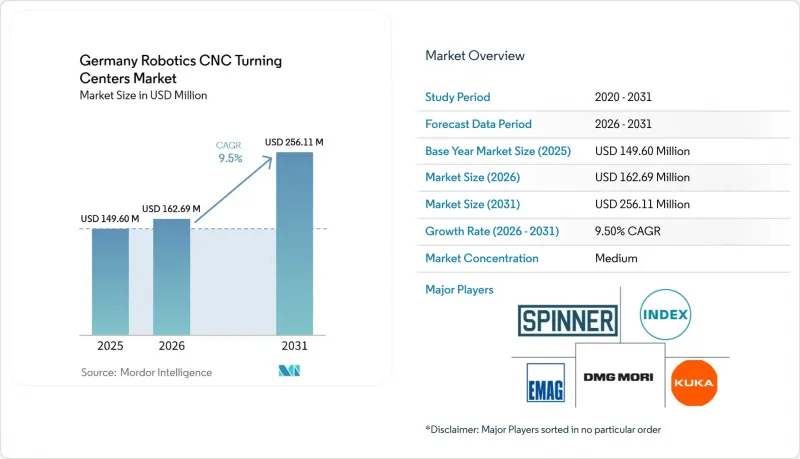
本報告按機器類型(臥式機器人車床、立式機器人車床等)、機器人類型(關節型機器人等)、機器人整合類型(OEM、改裝/售後市場機器人自動化)以及終端用戶產業(石油、天然氣和能源、航太和國防等)進行細分。市場預測以價值(美元)和數量(台)兩種形式呈現。
德國機器人CNC車床市場趨勢及洞察
汽車產業對電動車動力傳動系統。
汽車動力傳動系統設計向電動驅動系統的轉變正在推動德國市場對機器人CNC車床的需求。如今,配備機器人功能的CNC車床在電動汽車馬達軸、轉子鐵芯和變速箱總成的生產中發揮核心作用。寶馬集團在投資2億歐元(約2.353億美元)後,於2024年10月在其蘭斯圖特工廠啟動了「Neue Klasse」中央電力驅動殼體的預生產。自2020年以來,該工廠已累計投資10億歐元(約12億美元),其中5億歐元(約5.882億美元)用於電氣化改造。採埃孚腓特烈港也正在擴建其薩爾布呂肯工廠,以適應更多種類的電動橋驅動裝置,計畫於2025年開始量產。這些項目提高了公差要求,機器人裝載不僅成為提高效率的選項,更成為生產的必要條件。這種影響不僅限於一級供應商;巴登-符騰堡州和巴伐利亞州的二級精密車床零件製造商也在引入機器人單元,以滿足其與電動車相關的產量和品質目標。
強大的製造業基礎推動了對先進數控自動化技術的投資。
德國的機器人CNC車床市場依賴全球最強大的工具機生產基地之一。 2024年,德國持續維持全球第二大工具機生產國的地位,總產值達148億歐元(174億美元),產業從業人員總數達65,500人。德國擁有超過1,200家工具機及相關企業,以及50多家知名大學研究機構,形成使用者需求與OEM創新之間良性循環的局面。德國工具機製造商將年銷售額的4%以上投入研發,其中15%的銷售額來自新產品。這促成了德國機器人CNC車床市場高度的流程整合自動化。此外,國際化的生產網路也是關鍵因素。目前,12家主要的德國工具機製造商在海外設有生產基地,其國內工程中心也與全球自動化部署緊密對接。即使實際生產基地分散在各個地點,這種合作也加強了德國在控制設計、軟體整合和單元架構方面的作用。
嚴格的永續性和監管合規要求增加了投資的複雜性。
隨著歐盟機械框架法規於2027年逐步實施,德國的機器人數控車削中心市場將面臨更嚴格的合規要求。將於2027年1月20日起強制執行的(EU) 2023/1230號法規對進入歐盟市場的機器提出了新的要求,包括網路安全風險評估、人工智慧相關的合格評定以及數位化技術文件。這對整合機器人的車削單元影響巨大,因為這些單元擴大採用自適應控制、視覺引導定位和基於軟體的製程智慧等技術。此外,德國於2025年12月6日透過「MaschinenDG」實施了國家實施框架,建立了市場監管機構並制定了相應的製裁條款。永續性義務將透過環境管理、能源效率目標和減少流體廢物等要求進一步增加成本負擔。這些因素將延長採購週期,並使中期設備升級難以進行,尤其對於資金柔軟性有限的中小型製造商而言更是如此。
細分市場分析
到2025年,臥式機器人車床將佔據德國機器人CNC車床市場49.71%的佔有率。這一主導地位歸功於其在汽車軸和軸承滾道批量生產中的廣泛應用。在該領域,臥式主軸結構與棒料送料器和龍門機器人上料系統配合良好。這些成功的應用表明,水平系統在優先考慮重複性、產量和穩定自動化佈局的生產項目中繼續發揮核心作用。該細分市場將繼續受益於其在大規模工業加工環境中確立的地位。
多功能機器人車床是德國機器人CNC車床市場成長最快的機型,預計2026年至2031年複合年成長率將達到11.24%。這一成長主要得益於航太和醫療設備製造業需求的不斷成長,在這些行業中,一次裝夾即可完成加工的能力能夠減少零件搬運誤差、最大限度地降低尺寸偏差並縮短生產過程。 OEM產品開發也推動了向更高效能平台的轉型。 DMG MORI於2026年1月推出的「CTX 450 4A」正是這種向高價值、節省空間的車床平台發展的趨勢的體現,它擁有36個刀位、6μm的定位精度以及僅10平方米的緊湊面積。
預計到2025年,關節型機器人將佔據56.2%的市場佔有率,成為德國機器人CNC車床市場的主導機器人類型。關節型機器人憑藉其寬廣的承重能力範圍、卓越的作業臂展以及與直接主軸裝載和龍門輔助工件搬運的高度兼容性,仍然是首選。此外,由於關節型機器人在德國汽車產業的長期廣泛應用,其程式設計環境也已相當成熟。這種成熟度降低了新自動化單元的工程風險,使關節型機器人能夠在大規模部署中繼續保持核心地位。龍門機器人和笛卡爾機器人也保持著穩定的地位,尤其是在對吞吐量要求極高的零件生產線上,因為在這些生產線上,線性加載速度至關重要。
在德國的機器人CNC車床市場,協作機器人(cobot)的成長速度超過其他任何類型的機器人,預計到2031年將以12.6%的複合年成長率成長。它們在低風險裝載任務以及檢測輔助和刀具更換輔助等相關功能中的應用正在不斷擴展。換句話說,協作機器人並沒有取代核心生產單元中的關節型機器人,而是擴大了目標市場。根據德國工業機器人聯合會(IFR)預測,到2024年,德國將安裝26,982台工業機器人,數量位居歐洲之首,凸顯了工廠中持續的機器人配置調整和混合應用趨勢。因此,德國的機器人數控車床市場正在演變為一種層級式機器人配置,其中關節型機器人主導主要的車削工序,而協作機器人則填補了其他柔軟性的空白。
其他好處:
- Excel格式的市場預測(ME)表
- 3個月的分析師支持
目錄
第1章:引言
- 研究假設和市場定義
- 調查範圍
第2章:調查方法
第3章執行摘要
第4章 市場狀況
- 市場概覽
- 市場促進因素
- 汽車產業對基於機器人的電動車動力傳動系統總成加工流程有著強勁的需求。
- 強大的製造業基礎正在推動對先進數控自動化技術的投資。
- 世界一流的機器人密度支援成熟的整合。
- 政府為人類機器人互動提供的研究和開發津貼
- 德國工具機製造商將自動化技術融入產品設計
- UMATI 降低了機器人和CNC工具機整合的複雜性。
- 市場限制因素
- 嚴格的永續性和監管合規要求增加了投資的複雜性。
- 整合和部署先進自動化系統的成本。
- 亞洲製造商正在蠶食德國的國際市場佔有率。
- 整合機器人解決方案的高成本阻礙了中小企業的普及。
- 價值供應鏈分析
- 零件和原料供應
- 製造和系統整合
- 分發和交付給最終用戶
- 售後服務和生命週期支持
- 監理情勢
- 技術展望
- 人工智慧驅動的視覺引導
- 預測性維護的整合
- 數位孿生與模擬技術
- 產業特定自動化成熟度評估
- 數控加工數位化發展趨勢
- 機器人CNC車床單元的投資與採購模式
- 價格分析
- 主要市場參與企業的平均售價 (ASP) 基準
- 以自動化程度分類的平均售價 (ASP) 基準
- 區域平均售價 (ASP) 基準
- 五力分析-評估產業的吸引力
- 新進入者的威脅
- 供應商的議價能力
- 買方的議價能力
- 替代品的威脅
- 產業競爭
- 產業案例研究
- 地緣政治事件對市場的影響
第5章 市場規模與成長預測
- 按機器類型
- 臥式機器人車床
- 直立式機器人車床
- 多功能機器人車床
- 其他
- 按機器人類型
- 關節機器人
- 協作機器人(cobots)
- 龍門/笛卡兒機器人
- 機器人整合方法
- OEM整合機器人車床單元
- 用於改裝/售後市場的機器人自動化應用
- 按最終用戶行業分類
- 汽車和商用車輛
- 航太/國防
- 醫療設備及手術器械
- 石油、天然氣和能源
- 電氣、電子和半導體製造設備
- 通用工業機械
- 其他
第6章 競爭情勢
- 市場集中度
- 策略趨勢
- 市佔率分析
- Competitive Technology Benchmarking
- 公司簡介
- DMG MORI AG
- SPINNER Werkzeugmaschinenfabrik GmbH
- EMAG GmbH & Co. KG
- KUKA AG
- INDEX-Werke GmbH & Co. KG
- GROB-WERKE GmbH & Co. KG
- Siemens AG
- HELLER Maschinenfabrik GmbH
- WFL Millturn Technologies GmbH
- CHIRON Group SE
- Nakamura-Tome Precision Industry Co., Ltd.
- Yamazaki Mazak Corporation
- FANUC Corporation
- Yaskawa Electric Corporation
- ABB Ltd
- Citizen Machinery Co., Ltd.
- EMCO GmbH
- Okuma Corporation
- DN Solutions Co., Ltd.
- Hyundai WIA Corporation
第7章 市場機會與未來展望
According to Mordor Intelligence, the Germany robotics CNC turning centers market size was valued at USD 149.60 million in 2025 and is estimated to grow from USD 162.69 million in 2026 to reach USD 256.11 million by 2031, at a CAGR of 9.5% during the forecast period (2026-2031).
This report is Segmented by Machine Type (Horizontal Robotic Turning Centers, Vertical Robotic Turning Centers, and More), by Robot Type (Articulated Robots, and More), by Robot Integration Type (OEM, Retrofit/Aftermarket Robotic Automation), and by End-User Industry (Oil, Gas, & Energy, Aerospace & Defense, and More). The Market Forecasts are Provided in Terms of Value (USD) and Volume (Units).
Germany Robotics CNC Turning Centers Market Trends and Insights
Strong Automotive Demand for Robot-Tended EV Powertrain Turning
The shift in automotive powertrain design toward electric drivetrains is lifting the Germany robotics CNC turning centers market. CNC turning centers with robotic loading are now central to the production of EV motor shafts, rotor cores, and gearbox assemblies. BMW Group launched pre-series production of the Neue Klasse central e-drive housing at Plant Landshut in October 2024 after a EUR 200 million (USD 235.3 million) investment, and the site had already received EUR 1 billion (USD 1.2 billion), since 2020, with EUR 500 million (USD 588.2 million) directed to electromobility. ZF Friedrichshafen also expanded its Saarbrucken plant for additional electric axle drive variants, with series production beginning in 2025. These programs are raising tolerance requirements and making robotic loading less of an efficiency option and more of a production requirement. The effect is spreading beyond Tier 1 suppliers, as Tier 2 precision turned parts manufacturers in Baden-Wurttemberg and Bavaria are also retrofitting robot cells to meet EV-related volume and quality targets.
Strong Manufacturing Base Driving Investment in Advanced CNC Automation
The Germany robotics CNC turning centers market is supported by one of the world's deepest machine tool production bases. Germany remained the second-largest machine tool producer in 2024, with a total output of EUR 14.8 billion (USD 17.4 billion) and a workforce of 65,500 across the sector. The country's base of more than 1,200 machine tool and related companies, together with more than 50 recognized university research institutes, creates a self-reinforcing cycle between user demand and OEM innovation. German machine tool builders invest more than 4% of annual turnover in research and development, and 15% of turnover comes from newly developed products, which helps explain the strong level of process-integrated automation seen in the Germany robotics CNC turning centers market. A further layer comes from international production networks, as 12 larger German machine tool manufacturers now produce abroad, keeping domestic engineering centers closely linked to global automation rollouts. That linkage strengthens Germany's role in control design, software integration, and cell architecture even when physical output is distributed across regions.
Stringent Sustainability and Regulatory Compliance Requirements Increasing Investment Complexity
The Germany robotics CNC turning centers market faces a more stringent compliance burden as the EU Machinery Framework moves toward implementation in 2027. Regulation (EU) 2023/1230 will become mandatory from January 20, 2027, and adds new requirements around cybersecurity risk assessment, AI-related conformity evaluation, and digital technical documentation for machinery placed on the EU market. This matters for robot-integrated turning cells because more of them now include adaptive control, vision-guided positioning, and software-based process intelligence. Germany also brought its national implementation framework into force through MaschinenDG on December 6, 2025, which established market surveillance powers and sanction provisions. Sustainability obligations add another cost layer through environmental management, energy-efficiency targets, and reduced fluid-disposal requirements. These factors stretch procurement timelines and make mid-cycle equipment replacement harder to justify, especially for smaller manufacturers with limited capital flexibility.
Other drivers and restraints analyzed in the detailed report include:
- World-Leading Robot Density Supporting Mature Integration
- Government R&D Funding Targeting Human-Robot Interaction
- High Automation System Integration and Implementation Costs
For complete list of drivers and restraints, kindly check the Table Of Contents.
Segment Analysis
Horizontal robotic turning centers held 49.71% of the Germany robotics CNC turning centers market share in 2025. Their lead came from strong use in high-volume automotive shaft and bearing race production, where horizontal spindle architecture aligns well with bar feeders and gantry robot loading systems. This installed base keeps horizontal systems central to production programs that depend on repeatability, throughput, and stable automation layouts. The segment continues to benefit from its established role in large-scale industrial machining environments.
Multi-tasking robotic turning centers are the fastest-growing machine type in the Germany robotics CNC turning centers market, with a projected 11.24% CAGR during 2026-2031. Growth is being driven by rising demand in aerospace and medical device manufacturing, where complete machining in a single setup helps reduce part-handling errors, lower dimensional variation, and shorten the production sequence. OEM product development is also supporting this shift toward more capable platforms. DMG MORI's January 2026 launch of the CTX 450 4A, with 36 tool positions, 6 μm positioning accuracy, and a compact 10 m2 footprint, reflects this move toward higher-value and space-efficient turning platforms.
Articulated robots held a 56.2% share in 2025, making them the leading robot type in the Germany robotics CNC turning centers market. They remain the default choice because they offer broad payload coverage, strong reach, and high compatibility with both direct spindle loading and gantry-assisted part presentation. Their programming environment is also mature because Germany's automotive sector has used articulated robots at scale for many years. That maturity lowers engineering risk for new automation cells and keeps articulated robots central to large-volume installations. Gantry and Cartesian robots also retain a steady place where linear loading speed matters most, especially in throughput-driven component lines.
Cobots are expanding faster than any other robot type in the Germany robotics CNC turning centers market, with a forecast CAGR of 12.6% through 2031. Their adoption is rising in lower-risk loading tasks and in adjacent functions such as inspection support and tool-change assistance. That means cobots are widening the addressable base rather than replacing articulated robots in core production cells. IFR confirmed that Germany installed 26,982 industrial robots in 2024, the highest total in Europe, which supports ongoing reconfiguration and mixed robot deployment across plants. The German robotics CNC turning centers market is therefore evolving toward a layered robot mix where articulated units lead the main turning process, and cobots fill the flexibility gaps around it.
Complete Report Scope:
- By Machine Type
- Horizontal Robotic Turning Centers
- Vertical Robotic Turning Centers
- Multi-Tasking Robotic Turning Centers
- Others
- By Robot Type
- Articulated Robots
- Collaborative Robots (Cobots)
- Gantry/Cartesian Robots
- By Robot Integration Type
- OEM-Integrated Robotic Turning Cells
- Retrofit/Aftermarket Robotic Automation
- By End-User Industry
- Automotive & Commercial Vehicles
- Aerospace & Defense
- Medical Devices & Surgical Instruments
- Oil, Gas, & Energy
- Electrical, Electronics & Semiconductor Equipment
- General Industrial Machinery
- Others
List of Companies Covered in this Report:
- DMG MORI AG
- SPINNER Werkzeugmaschinenfabrik GmbH
- EMAG GmbH & Co. KG
- KUKA AG
- INDEX-Werke GmbH & Co. KG
- GROB-WERKE GmbH & Co. KG
- Siemens AG
- HELLER Maschinenfabrik GmbH
- WFL Millturn Technologies GmbH
- CHIRON Group SE
- Nakamura-Tome Precision Industry Co., Ltd.
- Yamazaki Mazak Corporation
- FANUC Corporation
- Yaskawa Electric Corporation
- ABB Ltd
- Citizen Machinery Co., Ltd.
- EMCO GmbH
- Okuma Corporation
- DN Solutions Co., Ltd.
- Hyundai WIA Corporation
Additional Benefits:
- The market estimate (ME) sheet in Excel format
- 3 months of analyst support
TABLE OF CONTENTS
1 Introduction
- 1.1 Study Assumptions & Market Definition
- 1.2 Scope of the Study
2 Research Methodology
3 Executive Summary
4 Market Landscape
- 4.1 Market Overview
- 4.2 Market Drivers
- 4.2.1 Strong Automotive Demand for Robot-Tended EV Powertrain Turning
- 4.2.2 Strong Manufacturing Base Driving Investment in Advanced CNC Automation
- 4.2.3 World-Leading Robot Density Supporting Mature Integration
- 4.2.4 Government R&D Funding Targeting Human-Robot Interaction
- 4.2.5 German Machine Tool Builders Embedding Automation in Product Design
- 4.2.6 UMATI Reducing Robot-CNC Integration Complexity
- 4.3 Market Restraints
- 4.3.1 Stringent Sustainability and Regulatory Compliance Requirements Increasing Investment Complexity
- 4.3.2 High Automation System Integration and Implementation Costs
- 4.3.3 Asian Manufacturers Erode Germany's International Market Share
- 4.3.4 High Robot-Integrated Solution Costs Limit Mittelstand Adoption
- 4.4 Value / Supply-Chain Analysis
- 4.4.1 Component & Raw Material Supply
- 4.4.2 Manufacturing & System Integration
- 4.4.3 Distribution & End-User Delivery
- 4.4.4 Aftermarket Services & Lifecycle Support
- 4.5 Regulatory Landscape
- 4.6 Technological Outlook
- 4.6.1 AI-Enabled Vision Guidance
- 4.6.2 Predictive Maintenance Integration
- 4.6.3 Digital Twin and Simulation Technologies
- 4.7 Automation Maturity Assessment by Industry
- 4.8 Digitalization Trends in CNC Machining
- 4.9 Investment and Procurement Models for Robotic CNC Turning Cells
- 4.10 Pricing Analysis
- 4.10.1 Average Selling Price (ASP) Benchmarking of Key Market Participants
- 4.10.2 Average Selling Price (ASP) Benchmarking by Automation Level
- 4.10.3 Average Selling Price (ASP) Benchmarking by Geography
- 4.11 Porter's Five Forces - Industry Attractiveness Scoring
- 4.11.1 Threat of New Entrants
- 4.11.2 Bargaining Power of Suppliers
- 4.11.3 Bargaining Power of Buyers
- 4.11.4 Threat of Substitutes
- 4.11.5 Industry Rivalry
- 4.12 Industry Case Studies
- 4.13 Impact of Geopolitical Events on the Market
5 Market Size & Growth Forecasts
- 5.1 By Machine Type
- 5.1.1 Horizontal Robotic Turning Centers
- 5.1.2 Vertical Robotic Turning Centers
- 5.1.3 Multi-Tasking Robotic Turning Centers
- 5.1.4 Others
- 5.2 By Robot Type
- 5.2.1 Articulated Robots
- 5.2.2 Collaborative Robots (Cobots)
- 5.2.3 Gantry/Cartesian Robots
- 5.3 By Robot Integration Type
- 5.3.1 OEM-Integrated Robotic Turning Cells
- 5.3.2 Retrofit/Aftermarket Robotic Automation
- 5.4 By End-User Industry
- 5.4.1 Automotive & Commercial Vehicles
- 5.4.2 Aerospace & Defense
- 5.4.3 Medical Devices & Surgical Instruments
- 5.4.4 Oil, Gas, & Energy
- 5.4.5 Electrical, Electronics & Semiconductor Equipment
- 5.4.6 General Industrial Machinery
- 5.4.7 Others
6 Competitive Landscape
- 6.1 Market Concentration
- 6.2 Strategic Moves
- 6.3 Market Share Analysis
- 6.4 Competitive Technology Benchmarking
- 6.5 Company Profiles (Includes Global Level Overview, Market Level Overview, Core Segments, Financials as Available, Strategic Information, Products & Services, and Recent Developments)
- 6.5.1 DMG MORI AG
- 6.5.2 SPINNER Werkzeugmaschinenfabrik GmbH
- 6.5.3 EMAG GmbH & Co. KG
- 6.5.4 KUKA AG
- 6.5.5 INDEX-Werke GmbH & Co. KG
- 6.5.6 GROB-WERKE GmbH & Co. KG
- 6.5.7 Siemens AG
- 6.5.8 HELLER Maschinenfabrik GmbH
- 6.5.9 WFL Millturn Technologies GmbH
- 6.5.10 CHIRON Group SE
- 6.5.11 Nakamura-Tome Precision Industry Co., Ltd.
- 6.5.12 Yamazaki Mazak Corporation
- 6.5.13 FANUC Corporation
- 6.5.14 Yaskawa Electric Corporation
- 6.5.15 ABB Ltd
- 6.5.16 Citizen Machinery Co., Ltd.
- 6.5.17 EMCO GmbH
- 6.5.18 Okuma Corporation
- 6.5.19 DN Solutions Co., Ltd.
- 6.5.20 Hyundai WIA Corporation
7 Market Opportunities & Future Outlook
- 7.1 White-Space & Unmet-Need Assessment

 電腦數值控制(CNC) 雕刻機市場規模、佔有率和成長分析:按產品類型、軸數、加工材料、最終用戶和地區分類-2026-2033 年產業預測
 CNC工具機市場規模、佔有率、成長、全球產業分析、區域趨勢及2026年至2034年預測。
 精密契約製造市場預測至2034年-按合約類型、服務類型、材料、最終用戶和地區分類的全球分析
 全球電腦數值控制(CNC) 工具機市場:機會與策略展望(至 2035 年)2026年全球電腦數值控制(CNC) EtherCAT 控制器市場報告
 電腦數值控制(CNC) 市場報告:按機器類型、最終用途行業和地區分類 (2026–2034)
 電腦數值控制(CNC)工具機市場:按類型、最終用途和地區分類
 電腦數值控制(CNC) 機械市場分析及預測(至 2035 年):依類型、產品類型、服務、技術、組件、應用、材質、製程及最終使用者分類
 電腦數值控制(CNC):市場佔有率分析、產業趨勢與統計資料、成長預測 (2026-2031)全球電腦數值控制(CNC) 市場規模、佔有率、趨勢和成長分析報告(2026-2034 年)