


 |
市場調查報告書
商品編碼
2099514
印度機器人數控車床:市場佔有率分析、產業趨勢與統計及成長預測(2026-2031 年)India Robotics CNC Turning Centers - Market Share Analysis, Industry Trends & Statistics, Growth Forecasts (2026 - 2031) |
||||||

※ 本網頁內容可能與最新版本有所差異。詳細情況請與我們聯繫。
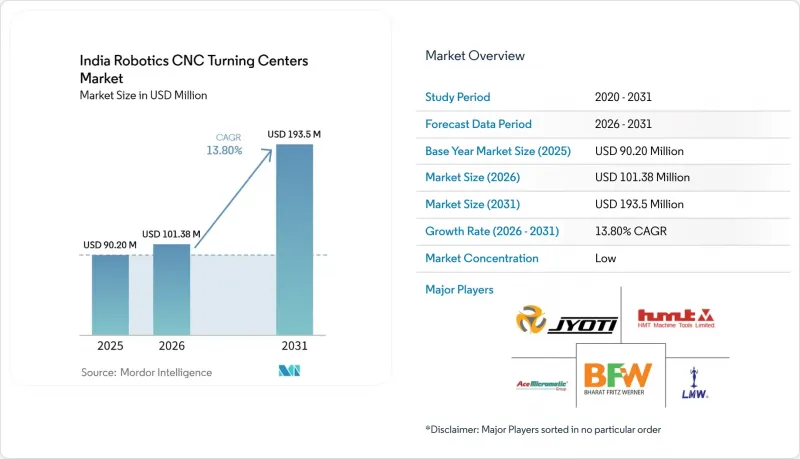
根據 Mordor Intelligence 預測,印度機器人CNC車床市場規模將從 2025 年的 9,020 萬美元成長到 2026 年的 1.0138 億美元,然後在 2031 年達到 1.935 億美元,2026 年至 2031 年的複合成長率為 13.80%。
本報告按機器類型(臥式機器人車床、立式機器人車床等)、機器人類型(關節型機器人等)、機器人整合類型(OEM、改裝/售後市場機器人自動化)以及終端用戶產業(石油、天然氣和能源、航太和國防等)進行細分。市場預測以價值(美元)和數量(台)兩種形式呈現。
印度機器人CNC車床市場趨勢及洞察
「印度製造」和生產連結獎勵計畫(PLI)正在促進CNC工具機和機器人製造業的發展。
政策支援正在積極改變印度機器人CNC車床中心市場自動化投資的成本結構。 「加強印度資本財產業競爭力(第二階段)」的總預算為12.07億印度盧比(約1.343億美元),其中9.75億印度盧比(約1.085億美元)為預算支持。截至2024年8月,已有33個項目獲得批准。這些項目包括工具機和機器人領域的卓越中心、工業4.0測試平台和技能培訓設施,有助於建立數控和機器人技術更廣泛應用所需的營運基礎設施。此外,第一階段的「技術購置基金計畫」已完成車銑複合加工中心和四導軌數控車床的國內採購,這些設備正在支援本地多功能車床平台的開發。此外,與生產連結獎勵計畫(PLI) 相關的電子、汽車和醫療設備產業的投資正在推動對精密製造的需求,而2025-2026會計年度汽車及零件產業的撥款增加進一步增強了對自動化車床的需求。 「SAMARTH Udyog Bharat 4.0」計畫也朝著類似的方向發展,其示範模式使智慧製造的整合對印度製造商而言既直覺又實用。
汽車產業正在推動機器人技術的應用。
在印度機器人CNC車床市場,汽車產業仍是最強的需求支柱。 2024年,汽車業的裝置總量達到4,070台,佔印度工業機器人總裝置量的45%。光是汽車零件供應商就新增了2,100台,增幅達40%,用於加工軸、輪轂、法蘭和變速箱零件的車床系統採購管道依然活躍。向電動車(EV)生產的轉型也改變了對工具機的需求,因為電動車零件需要更嚴格的公差和更高的單次裝夾加工整合度。 Jyoti CNC Automation公司開發了用於電動車零件加工的「VST 160立式軸車床」。該公司整合了自動化上下料系統,展示了供應商如何調整產品以滿足這一需求。由於需求集中在浦那、清奈、古爾格拉姆和薩南德,在這些叢集擁有強大服務網路的供應商在印度的機器人數控車床市場具有明顯的商業優勢。
核心機器人零件高度依賴進口
由於印度對核心機器人零件的進口依賴程度較高,其機器人CNC車床市場仍面臨結構性成本問題。印度仍然是關鍵電子元件和子系統的淨進口國,印度國家轉型委員會(NITI Aayog)2025-2026會計年度第二季「貿易觀察」報告證實,其出口結構仍高度集中於最終組裝產品。類似的依賴性也影響著用於數控和機器人應用的半導體、積體電路、控制器和運動系統。這使得系統價格易受外匯波動的影響,如果關鍵子系統無法實現本地化,本地工具機製造商能夠承受成本波動的程度將受到限制。儘管印度重工業部已支援車銑複合中心和四導軌數控車床的在地化生產,但伺服馬達和諧波驅動器的在地化進程仍未完成。
細分市場分析
到2025年,臥式機器人車床中心將佔據印度機器人CNC車床市場46.7%的佔有率,成為市場主導機種。它們仍然是汽車、通用機械以及石油天然氣行業批量生產圓柱形零件的標準選擇。其寬廣的工件夾持範圍以及與標準龍門機器人和關節型機器人裝載機的兼容性,使其能夠滿足新安裝和改裝專案的需求。因此,對於那些仍然優先考慮生產線穩定性、熟悉的工具和全面售後服務的買家而言,它們仍然是最實用的選擇。
立式機器人車床繼續用於加工能源設備、大直徑配件和大型汽車鑄件等大直徑、重型工件。多功能機器人車床是成長最快的工具機類型,預計到2031年,印度機器人數控車床市場中該細分市場的規模將以14.1%的複合年成長率成長。由於製程整合減少了單次裝夾中的二次銑削、鑽孔和攻絲工序,買家正轉向這些系統。這種轉變在航太、醫療設備和電動車動力傳動系統總成領域尤其重要,因為多次裝夾會導致尺寸偏差。 「其他」類別包括倒置式和瑞士型車削中心,它們在微精密加工領域也越來越受到關注。 Jyoti CNC Automation和AceMicromatic最近的產品開發也表明,國內原始設備製造商正在擴展其車削產品線,以應對複雜的加工流程。
預計到2025年,關節型機器人將佔據印度機器人CNC車床市場56.2%的佔有率,成為所有機器人類型中市佔率最大的。其六軸運動能力使其能夠實現複雜的裝載路徑、工件翻轉以及在汽車和重工業環境中進行單元內檢測。因此,關節型機器人非常適合在要求嚴苛的生產線上進行高速零件搬運和精確定位。此外,越來越多的大型製造商在其工廠的其他區域已經使用傳統工業機器人,這也凸顯了關節型機器人的高度親和性。
由於其線性軸的特性,龍門機器人或笛卡爾機器人能夠在簡單的取放任務中實現高重複性和低成本,因此在單件系列產品的大量生產中繼續發揮穩定的作用。協作機器人是印度機器人CNC車床市場中成長最快的機器人類型,預計到2031年將以15.8%的複合年成長率成長。它們對微型、中小型微企業(MSME)代工製造商極具吸引力,因為它們減少了對固定安全防護裝置的需求,並允許更靈活的佈局以進行多品種生產。這一趨勢得到了印度一般工業領域機器人應用廣泛擴展的支持,國際機器人聯合會(IFR)的全球數據也顯示協作機器人的應用呈上升趨勢。在浦那舉行的印度工具機製造商協會(IMTMA)自動化研討會重點關注智慧工廠中的協作機器人,表明該行業已為在數控環境中引入協作機器人做好準備。
其他好處:
- Excel格式的市場預測(ME)表
- 3個月的分析師支持
目錄
第1章:引言
- 研究假設和市場定義
- 調查範圍
第2章:調查方法
第3章執行摘要
第4章 市場狀況
- 市場概覽
- 市場促進因素
- 「印度製造」和「生產關聯激勵計畫」(PLI)正在推動CNC工具機和機器人製造業的發展。
- 汽車產業正在推動機器人技術的應用。
- 機器人應用正在迅速擴展。
- 對微企業的自動化補貼正在擴大機器人的應用。
- 業界主導的促進先進製造技術發展的舉措
- 國內數控車床OEM廠商正在加強自動化能力建置。
- 市場限制因素
- 對主要機器人零件進口的依賴程度很高
- 引入機器人整合式CNC車床單元的初始成本較高。
- 數控和機器人整合系統領域熟練人員短缺
- 與其他同行業國家的製造業經濟體相比,機器人採用率較低。
- 價值供應鏈分析
- 零件和原料供應
- 製造和系統整合
- 分發和交付給最終用戶
- 售後服務和生命週期支持
- 監理情勢
- 技術展望
- 人工智慧驅動的視覺引導
- 預測性維護的整合
- 數位孿生與模擬技術
- 產業特定自動化成熟度評估
- 數控加工數位化發展趨勢
- 機器人CNC車床單元的投資與採購模式
- 價格分析
- 主要市場參與企業的平均售價 (ASP) 基準
- 以自動化程度分類的平均售價 (ASP) 基準
- 區域平均售價 (ASP) 基準
- 五力分析-評估產業的吸引力
- 新進入者的威脅
- 供應商的議價能力
- 買方的議價能力
- 替代品的威脅
- 產業競爭
- 產業案例研究
- 地緣政治事件對市場的影響
第5章 市場規模與成長預測
- 按機器類型
- 臥式機器人車床
- 直立式機器人車床
- 多功能機器人車床
- 其他
- 按機器人類型
- 關節機器人
- 協作機器人(cobots)
- 龍門/笛卡兒機器人
- 機器人整合方法
- OEM整合機器人車床單元
- 用於改裝/售後市場的機器人自動化應用
- 按最終用戶行業分類
- 汽車和商用車輛
- 航太/國防
- 醫療設備及手術器械
- 石油、天然氣和能源
- 電氣、電子和半導體製造設備
- 通用工業機械
- 其他
第6章 競爭情勢
- 市場集中度
- 策略趨勢
- 市佔率分析
- Competitive Technology Benchmarking
- 公司簡介
- Jyoti CNC Automation Limited
- Ace Micromatic Group
- Bharat Fritz Werner Ltd.(BFW)
- HMT Machine Tools Limited
- LMW Limited(Lakshmi Machine Works)
- Macpower CNC Machines Limited
- DMG MORI Co., Ltd.
- Yamazaki Mazak Corporation
- Okuma Corporation
- DN Solutions Co., Ltd.
- Hyundai WIA Corporation
- EMAG GmbH & Co. KG
- Nakamura-Tome Precision Industry Co., Ltd.
- Murata Machinery, Ltd.(Muratec)
- FANUC Corporation
- ABB Ltd
- KUKA AG
- Yaskawa Electric Corporation
- Kawasaki Heavy Industries, Ltd.
- Mitsubishi Electric Corporation
第7章 市場機會與未來展望
According to Mordor Intelligence, the India robotics CNC turning centers market size is expected to grow from USD 90.20 million in 2025 to USD 101.38 million in 2026 and is forecast to reach USD 193.5 million by 2031 at 13.80% CAGR over 2026-2031.
This report is Segmented by Machine Type (Horizontal Robotic Turning Centers, Vertical Robotic Turning Centers, and More), by Robot Type (Articulated Robots, and More), by Robot Integration Type (OEM, Retrofit/Aftermarket Robotic Automation), and by End-User Industry (Oil, Gas, & Energy, Aerospace & Defense, and More), The Market Forecasts are Provided in Terms of Value (USD) and Volume (Units).
India Robotics CNC Turning Centers Market Trends and Insights
Make in India and PLI (Production-Linked Incentive) Incentivizing CNC and Robotics Manufacturing
Policy support is actively changing the cost structure of automation investment in the India robotics CNC turning centers market. The Scheme for Enhancement of Competitiveness in the Indian Capital Goods Sector Phase II has a total outlay of INR 1,207 crore (USD 134.3 million), of which INR 975 crore (USD 108.5 million) is budgetary support. As of August 2024, 33 projects have been sanctioned. These projects span centers of excellence in machine tool robotics, Industry 4.0 testbeds, and skilling facilities, helping build the operating base needed for broader adoption of CNC and robotics. The Technology Acquisition Fund Program under Phase I also completed domestic acquisitions of a Turn Mill Center and a Four-Guideway CNC Lathe, which support local development of multi-tasking turning platforms. PLI-linked investment in electronics, automotive, and medical devices is also driving demand for precision manufacturing, and the larger 2025-26 allocation for automobiles and auto components further strengthens this pull on automated turning demand. SAMARTH Udyog Bharat 4.0 reinforces the same direction because its demonstration model keeps smart manufacturing integration visible and practical for Indian manufacturers.
Automotive Sector Driving Robot Adoption
The automotive sector remains the clearest demand anchor for the India robotics CNC turning centers market. Automotive installations totaled 4,070 units in 2024, representing 45% of all industrial robot deployments in India. Automotive parts suppliers alone added 2,100 units and grew by 40%, keeping the procurement channel active for turning systems used in shafts, hubs, flanges, and transmission elements. The shift toward electric vehicle production is also changing machine requirements, as EV components require tighter tolerances and greater process consolidation within a single setup. Jyoti CNC Automation developed its VST 160 Vertical Shaft Turning Center for EV component machining. It integrated an automated loading and unloading system, demonstrating how suppliers are aligning their products with this demand. Demand is concentrated in Pune, Chennai, Gurugram, and Sanand, so vendors with stronger service networks in these clusters hold a clear operating advantage in the India robotics CNC turning centers market.
High Import Dependency for Core Robotics Components
The India robotics CNC turning centers market still faces a structural cost problem because core robotics components are largely imported. India remains a net importer of critical electronic components and subsystems, and NITI Aayog's Trade Watch for Q2 FY 2025-26 confirmed that the export profile remains concentrated in final-assembly products. The same dependency affects semiconductors, integrated circuits, controllers, and motion systems used in CNC and robotic applications. This keeps system pricing exposed to currency movements and limits how far local machine builders can absorb cost swings when key subsystems are not localized. The Ministry of Heavy Industries supported local technology acquisition for a Turn Mill Center and a Four-Guideway CNC Lathe, but localization of servo motors and harmonic drives remains incomplete.
Other drivers and restraints analyzed in the detailed report include:
- Rapid Robot Installation Growth
- MSME Automation Subsidies Expanding Robot Adoption
- High Upfront Cost of Robot-Integrated CNC Turning Cells
For complete list of drivers and restraints, kindly check the Table Of Contents.
Segment Analysis
Horizontal robotic turning centers held 46.7% of the India robotics CNC turning centers market share in 2025, making them the leading machine type. They remain the default choice for high-volume cylindrical part production across automotive, general engineering, and oil and gas applications. Their wide workholding range and compatibility with standard gantry and articulated robot loaders support both new installations and retrofit projects. This makes them the most practical choice for buyers who still prioritize line stability, familiar tooling, and broad service support.
Vertical robotic turning centers continue to serve large-diameter and heavy-workpiece jobs in energy equipment, large-bore fittings, and heavy automotive castings. Multi-tasking robotic turning centers are the fastest-growing machine type, and the India robotics CNC turning centers market size for this segment is projected to expand at a 14.1% CAGR through 2031. Buyers are shifting toward these systems because process consolidation reduces secondary milling, drilling, and tapping steps within a single setup. That change is especially relevant in aerospace, medical devices, and EV powertrains, where multiple setups can introduce unwanted dimensional variation. The others category, which includes inverted and Swiss-type turning centers, is also gaining traction in miniature precision applications, and recent product moves from Jyoti CNC Automation and AceMicromatic show that domestic OEMs are broadening their complex-process turning portfolios.
Articulated robots accounted for 56.2% of the India robotics CNC turning centers market size in 2025, giving them the largest share among robot types. Their six-axis motion supports complex loading paths, workpiece flipping, and in-cell inspection in automotive and heavy engineering settings. This makes them the preferred setup for high-speed part transfer and precision placement in demanding production lines. Their installed base also benefits from stronger familiarity among large manufacturers that already operate conventional industrial robots elsewhere on the shop floor.
Gantry or cartesian robots still hold a steady role in high-volume single-part-family production because their linear axes offer repeatability and lower cost for simple pick-and-place tasks. Collaborative robots are the fastest-growing robot type with a 15.8% CAGR through 2031 in the India robotics CNC turning centers market. Their appeal is strongest in MSME job shops because they reduce the need for fixed safety guarding and allow more flexible layouts for high-mix production. The broader rise of general industry robot use in India supports this pattern, and global IFR data also points to stronger cobot adoption trends. IMTMA's (India Machine Tool Manufacturers' Association) automation symposium in Pune devoted dedicated attention to collaborative robotics in smart factories, which shows rising industry readiness for cobot use in CNC environments.
Complete Report Scope:
- By Machine Type
- Horizontal Robotic Turning Centers
- Vertical Robotic Turning Centers
- Multi-Tasking Robotic Turning Centers
- Others
- By Robot Type
- Articulated Robots
- Collaborative Robots (Cobots)
- Gantry/Cartesian Robots
- By Robot Integration Type
- OEM-Integrated Robotic Turning Cells
- Retrofit/Aftermarket Robotic Automation
- By End-User Industry
- Automotive & Commercial Vehicles
- Aerospace & Defense
- Medical Devices & Surgical Instruments
- Oil, Gas, & Energy
- Electrical, Electronics & Semiconductor Equipment
- General Industrial Machinery
- Others
List of Companies Covered in this Report:
- Jyoti CNC Automation Limited
- Ace Micromatic Group
- Bharat Fritz Werner Ltd. (BFW)
- HMT Machine Tools Limited
- LMW Limited (Lakshmi Machine Works)
- Macpower CNC Machines Limited
- DMG MORI Co., Ltd.
- Yamazaki Mazak Corporation
- Okuma Corporation
- DN Solutions Co., Ltd.
- Hyundai WIA Corporation
- EMAG GmbH & Co. KG
- Nakamura-Tome Precision Industry Co., Ltd.
- Murata Machinery, Ltd. (Muratec)
- FANUC Corporation
- ABB Ltd
- KUKA AG
- Yaskawa Electric Corporation
- Kawasaki Heavy Industries, Ltd.
- Mitsubishi Electric Corporation
Additional Benefits:
- The market estimate (ME) sheet in Excel format
- 3 months of analyst support
TABLE OF CONTENTS
1 Introduction
- 1.1 Study Assumptions & Market Definition
- 1.2 Scope of the Study
2 Research Methodology
3 Executive Summary
4 Market Landscape
- 4.1 Market Overview
- 4.2 Market Drivers
- 4.2.1 Make in India and PLI Incentivizing CNC and Robotics Manufacturing
- 4.2.2 Automotive Sector Driving Robot Adoption
- 4.2.3 Rapid Robot Installation Growth
- 4.2.4 MSME Automation Subsidies Expanding Robot Adoption
- 4.2.5 Industry-Led Initiatives Promoting Advanced Manufacturing Technologies
- 4.2.6 Domestic CNC Turning OEMs Adding Automation Readiness
- 4.3 Market Restraints
- 4.3.1 High Import Dependency for Core Robotics Components
- 4.3.2 High Upfront Cost of Robot-Integrated CNC Turning Cells
- 4.3.3 Shortage of Skilled Manpower for CNC and Robotics-Integrated Systems
- 4.3.4 Low Robot Density Compared to Peer Manufacturing Economies
- 4.4 Value / Supply-Chain Analysis
- 4.4.1 Component & Raw Material Supply
- 4.4.2 Manufacturing & System Integration
- 4.4.3 Distribution & End-User Delivery
- 4.4.4 Aftermarket Services & Lifecycle Support
- 4.5 Regulatory Landscape
- 4.6 Technological Outlook
- 4.6.1 AI-Enabled Vision Guidance
- 4.6.2 Predictive Maintenance Integration
- 4.6.3 Digital Twin and Simulation Technologies
- 4.7 Automation Maturity Assessment by Industry
- 4.8 Digitalization Trends in CNC Machining
- 4.9 Investment and Procurement Models for Robotic CNC Turning Cells
- 4.10 Pricing Analysis
- 4.10.1 Average Selling Price (ASP) Benchmarking of Key Market Participants
- 4.10.2 Average Selling Price (ASP) Benchmarking by Automation Level
- 4.10.3 Average Selling Price (ASP) Benchmarking by Geography
- 4.11 Porter's Five Forces - Industry Attractiveness Scoring
- 4.11.1 Threat of New Entrants
- 4.11.2 Bargaining Power of Suppliers
- 4.11.3 Bargaining Power of Buyers
- 4.11.4 Threat of Substitutes
- 4.11.5 Industry Rivalry
- 4.12 Industry Case Studies
- 4.13 Impact of Geopolitical Events on the Market
5 Market Size & Growth Forecasts
- 5.1 By Machine Type
- 5.1.1 Horizontal Robotic Turning Centers
- 5.1.2 Vertical Robotic Turning Centers
- 5.1.3 Multi-Tasking Robotic Turning Centers
- 5.1.4 Others
- 5.2 By Robot Type
- 5.2.1 Articulated Robots
- 5.2.2 Collaborative Robots (Cobots)
- 5.2.3 Gantry/Cartesian Robots
- 5.3 By Robot Integration Type
- 5.3.1 OEM-Integrated Robotic Turning Cells
- 5.3.2 Retrofit/Aftermarket Robotic Automation
- 5.4 By End-User Industry
- 5.4.1 Automotive & Commercial Vehicles
- 5.4.2 Aerospace & Defense
- 5.4.3 Medical Devices & Surgical Instruments
- 5.4.4 Oil, Gas, & Energy
- 5.4.5 Electrical, Electronics & Semiconductor Equipment
- 5.4.6 General Industrial Machinery
- 5.4.7 Others
6 Competitive Landscape
- 6.1 Market Concentration
- 6.2 Strategic Moves
- 6.3 Market Share Analysis
- 6.4 Competitive Technology Benchmarking
- 6.5 Company Profiles (Includes Global Level Overview, Market Level Overview, Core Segments, Financials as Available, Strategic Information, Products & Services, and Recent Developments)
- 6.5.1 Jyoti CNC Automation Limited
- 6.5.2 Ace Micromatic Group
- 6.5.3 Bharat Fritz Werner Ltd. (BFW)
- 6.5.4 HMT Machine Tools Limited
- 6.5.5 LMW Limited (Lakshmi Machine Works)
- 6.5.6 Macpower CNC Machines Limited
- 6.5.7 DMG MORI Co., Ltd.
- 6.5.8 Yamazaki Mazak Corporation
- 6.5.9 Okuma Corporation
- 6.5.10 DN Solutions Co., Ltd.
- 6.5.11 Hyundai WIA Corporation
- 6.5.12 EMAG GmbH & Co. KG
- 6.5.13 Nakamura-Tome Precision Industry Co., Ltd.
- 6.5.14 Murata Machinery, Ltd. (Muratec)
- 6.5.15 FANUC Corporation
- 6.5.16 ABB Ltd
- 6.5.17 KUKA AG
- 6.5.18 Yaskawa Electric Corporation
- 6.5.19 Kawasaki Heavy Industries, Ltd.
- 6.5.20 Mitsubishi Electric Corporation
7 Market Opportunities & Future Outlook
- 7.1 White-Space & Unmet-Need Assessment

 花崗岩數控切割機市場:全球市場預測,2026-2032年多軸螺紋加工服務市場:全球市場預測,2026-2032年瑞士螺紋加工服務市場:全球市場預測,2026-2032年多軸自動化工具機市場:全球市場預測(2026-2032年)數控蝸輪蝸桿研磨市場:全球市場預測,2026-2032年切削液冷卻設備市場:全球市場預測,2026-2032年
 精密加工刀具市場:按類型、材質、精度等級、分銷管道、應用、國家和地區分類-全球產業分析、市場規模、市場佔有率及2026年至2033年預測
 2026年全球鋼筋矯正機市場報告自動多軸攻牙機市場:依驅動類型、機器方向、軸類型、通路、最終用途產業分類,全球預測(2026-2032年)工業分板銑床市場(按銑床類型、切割技術、軸配置、自動化程度和最終用途行業分類)-全球預測,2026-2032年