

 |
市場調查報告書
商品編碼
2099505
零售媒體網路(RMN)技術平台:市場佔有率分析、產業趨勢與統計、成長預測(2026-2031)Retail Media Network (RMN) Technology Platform - Market Share Analysis, Industry Trends & Statistics, Growth Forecasts (2026 - 2031) |
||||||

※ 本網頁內容可能與最新版本有所差異。詳細情況請與我們聯繫。
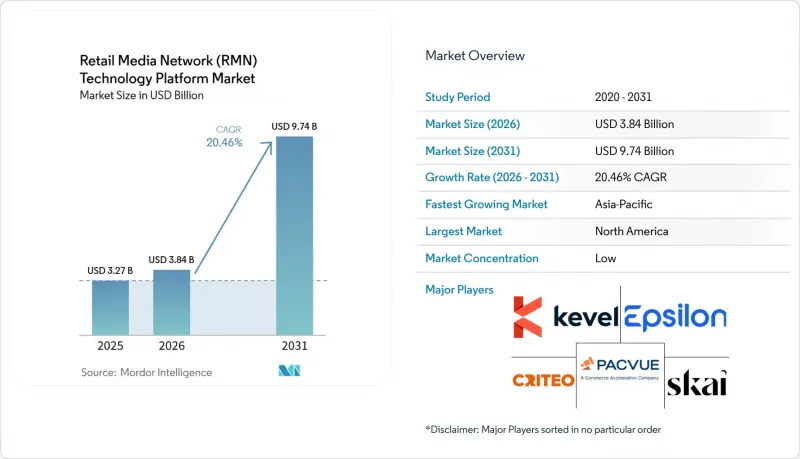
根據 Mordor Intelligence 預測,零售媒體網路 (RMN) 技術平台市場規模將從 2025 年的 32.7 億美元和 2026 年的 38.4 億美元成長到 2031 年的 97.4 億美元,2026 年至 2031 年的複合年成長率為 20.46%。
本報告依平台類型(例如,零售商自有媒體平台)、廣告形式(例如,展示廣告、搜尋廣告)、部署模式(雲端、本地部署、混合模式)、公司規模(大型企業、中小企業)、終端用戶產業(例如,消費品/快速消費品)和地區進行細分。市場預測以美元計價。
全球零售媒體網路(RMN)技術平台市場趨勢與洞察
第三方 Cookie 的衰落和第一方資料的興起
隨著第三方受眾資料的可信度下降和隱私法規日益嚴格,零售媒體網路 (RMN) 技術平台市場越來越依賴來自已同意的消費者的資料。已建立忠誠度計畫、POS(銷售點)記錄和認證帳戶系統的零售商,可以基於檢驗的購買行為而非外部購買群體進行定向投放。這改變了媒體分配方式,因為品牌可以投資於一個受眾識別、交易數據和轉換報告已整合在同一商業系統中的環境。此外,由於啟動與選擇加入的客戶記錄緊密相關,從而避免了高風險的資料共用模式,這也加強了廣告主的合規性。隨著這一趨勢擴展到主要市場,零售媒體網路 (RMN) 技術平台市場將青睞那些將受眾激活與零售商的數據堆疊緊密結合,並將其置於更清晰的同意框架內的平台。
人工智慧驅動的受眾活化和自動化宣傳活動管理
隨著宣傳活動設定、競標、細分和報告等環節都受益於快速自動化,人工智慧正從零售媒體網路 (RMN) 技術平台市場的輔助工具轉變為營運層面的重要環節。因此,零售商不再需要像以前那樣依賴大規模的人工團隊來啟動和維護跨多種形式的複雜宣傳活動。沃爾瑪互聯 (Walmart Connect) 推出的 Luminate Bid Intelligence 進一步強化了這一趨勢。該解決方案將來自其每週消費者資料庫的第一方購買訊號與展示廣告、影片廣告和贊助廣告位的即時定向相結合。 Criteo 和電通 (Dentsu) 也展示了人工智慧介面如何透過在零售媒體執行中實現自然語言編配來變革宣傳活動管理,他們於 2026 年 5 月推出了一項完全整合的 MCP宣傳活動。隨著這些工具的實施變得更加便捷,此前一直苦於經營複雜性的中型零售商和小規模廣告商也更容易進入零售媒體網路 (RMN) 技術平台市場。
測量方法的碎片化和增量性證明的不足
衡量指標仍然是一個重要的限制因素,因為每個網路仍然傾向於以自己的方式定義提升、歸因視窗和測試設計,這使得直接的效果比較變得困難。儘管IAB和IAB Europe在2025年11月聯合發布了關於增量指標的指南,但僅僅擁有通用的定義並不能保證跨網路的統一運作。品牌顯然在尋求更有力的結果證明,而Skai在2026年進行的一項關於衡量指標和增量指標的調查表明,這仍然是增加預算的核心要求。零售媒體網路(RMN)科技平台市場的問題在於,較差的可比性會損害可信度,即使單一網路內的宣傳活動效果看起來不錯,也可能導致廣告主抑制支出。在跨平台衡量結果的可審計性提高之前,零售媒體網路(RMN)技術平台市場可能會面臨廣告主的預算阻力,因為他們需要能夠跨零售商公平比較的證據。
細分市場分析
到2025年,零售商自有媒體平台將佔據42.31%的市場。這反映了在單一商業環境中管理消費者身分、庫存和歸因分析的優勢。在零售媒體網路(RMN)技術平台市場,這種模式使大型零售商受益匪淺,使他們能夠直接實現流量變現,同時將受眾和轉換數據保持在交易層面附近。亞馬遜廣告和沃爾瑪互聯展示了這種架構如何大規模擴展,廣告需求、零售流量和閉合迴路報告相互促進。這也解釋了為什麼品牌在尋求清晰的購買關聯衡量指標和更廣泛的品類覆蓋範圍時,通常會優先考慮大型零售商運營的平台。因此,零售商自有媒體平台的主導地位不僅源自於其龐大的媒體庫存,也源自於將資料深度、管理能力和衡量功能整合到單一作業系統中。
第三方零售媒體平台仍然發揮著至關重要的作用,因為廣告主可以透過單一管道與多家零售商建立聯繫,而無需單獨管理每個網路。這減輕了需要觸及眾多中型零售商(而這些零售商本身的平台仍在發展中)的品牌的工作流程負擔。零售媒體網路 (RMN) 技術平台產業也為那些能夠聚合需求並簡化執行流程的專家留下了空間,尤其是在零售商自身規模尚不足以滿足需求的情況下。隨著零售商對能夠整合線上廣告、線下促銷、店內廣告媒體和效果衡量的整合系統的需求日益成長,全通路平台預計到 2031 年將以 24.83% 的複合年成長率成長。 Mirakl 推出的 MCP 原生廣告投放和 Pacvue Prism 的推出表明,市場正在從孤立的點解決方案轉向更廣泛的編配。
到2025年,搜尋廣告將佔據31.24%的市場佔有率,證實了贊助商品仍將是零售媒體網路(RMN)科技平台市場中以效果為導向的核心廣告形式。其優勢在於使用者購買意願高、與購買流程接近性,以及廣告主能夠輕鬆地將競標決策與可衡量的商業性結果掛鉤。此外,搜尋廣告能夠無縫整合到零售商的網站和應用程式中,因為它可以融入發現流程,而不會從根本上改變購物體驗。雖然展示廣告和贊助內容持續提升品牌知名度和購買意願,但預算的重點仍傾向於高轉換率的廣告資源。原生廣告形式的市佔率仍然較小,但其重要性依然不變,因為零售商需要的是即使在變現水準提高的情況下也能保持易用性的廣告單元。
預計到2031年,影片廣告將以26.47%的複合年成長率成長,成為零售媒體網路(RMN)技術平台市場中成長最快的廣告形式。這一轉變與聯網電視的普及、更豐富的產品故事講述以及將曝光與銷售漏斗上游的最終結果聯繫起來的趨勢密切相關。根據IAB發布的《2026年數位影片研究報告》,影片仍然是一個成長領域,自助式工具降低了廣告主探索更廣泛媒體策略的門檻。 Mirakl和Walmart Connect等案例也表明,影片、贊助電商和受眾數據正開始在各種媒體中更緊密地結合。因此,儘管搜尋仍然是獲利的基礎,但零售媒體網路(RMN)技術平台市場對單一漏斗底部廣告形式的依賴程度正在降低。
區域分析
到2025年,北美將佔整體市場佔有率的36.42%,成為零售媒體網路(RMN)技術平台市場中最大的區域板塊。該地區受益於最大的零售商主導廣告業務、廣告商對電商媒體的深刻理解,以及與大規模的數位商務生態系統緊密相連的廣泛可用的購物者數據。規模在該地區仍然至關重要,因為大型業者能夠提供比許多小規模網路更廣泛的廣告資源、基於購買行為的報告以及更成熟的啟動工具。沃爾瑪互聯(Walmart Connect)對人工智慧的持續投入以及廣泛的多格式部署表明,北美領先企業正在尋求深化其為廣告商提供的價值,而不僅僅依賴流量。同時,人們對效果衡量的期望也不斷提高,平台提供者持續面臨提升其零售媒體專案可比較性和可審計性的壓力。
預計到2031年,亞太地區將以24.19%的複合年成長率成長,成為零售媒體網路(RMN)技術平台市場成長最快的地區。在該地區,數位商務已深深融入多個主要經濟體的消費行為,並已形成密集的第一方訊號池,從而推動了快速擴張。此外,行動端主導的用戶互動模式使得透過贊助廣告位、影片和整合宣傳活動活動來實現電商平台獲利變得更加容易。該地區的許多零售商和市場平台已達到相當規模,用戶互動和閉合迴路衡量已發展到可以成為有效收入來源而非僅僅是輔助服務的階段。有鑑於這些因素,隨著零售媒體網路(RMN)科技市場日益全球化,亞太地區仍將維持吸引平台投資的優勢地位。
歐洲仍是零售媒體網路(RMN)技術平台市場的核心區域,GDPR相關的資料處理需求和跨國資料傳輸限制對其發展路徑有著更直接的影響。這種情況推動了對支援使用者許可管理、資料最小化和更本地化激活工作流程的架構的需求。在南美,市場正從試點階段轉向更有系統的部署,與零售媒體擴張相關的供應商合作表明,該地區正獲得平台供應商的策略關注。中東和非洲仍處於早期市場階段,但對數位商務的投資和消費者數據基礎設施的擴展表明,該地區在零售媒體網路(RMN)技術平台市場具有長期成長潛力。
其他好處:
- Excel格式的市場預測(ME)表
- 3個月的分析師支持
目錄
第1章:引言
- 研究假設和市場定義
- 調查範圍
第2章:調查方法
第3章執行摘要
第4章 市場狀況
- 市場概覽
- 市場促進因素
- 第三方 Cookie 的衰落和第一方資料的興起
- 高利潤的媒體收入給零售商帶來了壓力,迫使他們實現業務獲利。
- 實現線上、異地和店內庫存的全通路編配。
- 一個自助式廣告平台,旨在擴大小規模廣告商的廣告管道。
- 人工智慧驅動的受眾互動和自動化宣傳活動管理
- 零售媒體作為商業內容作業系統
- 市場限制因素
- 測量碎片化和增量性弱的證據
- 整個傳統零售技術棧的整合非常複雜。
- 隱私、同意和資料在地化方面的合規負擔。
- 廣告投放量與消費者體驗之間的權衡
- 宏觀經濟因素對市場的影響
- 產業價值鏈分析
- 科技趨勢
- 監理情勢
- 波特五力分析
第5章 市場規模與成長預測
- 依平台類型
- 零售商自有媒體平台
- 第三方零售媒體平台
- 全通路零售媒體平台
- 廣告格式
- 展示廣告
- 搜尋廣告
- 贊助內容
- 影片廣告
- 原生廣告
- 部署模式
- 基於雲端的
- 現場
- 混合
- 按公司規模
- 大公司
- 小型企業
- 按最終用戶行業分類
- 零售與電子商務
- CPG/FMCG
- 家用電子產品
- BFSI
- 衛生保健
- 車
- 旅行
- 溝通
- 其他終端用戶產業
- 按地區
- 北美洲
- 美國
- 加拿大
- 墨西哥
- 南美洲
- 巴西
- 阿根廷
- 其他南美國家
- 歐洲
- 德國
- 英國
- 法國
- 義大利
- 西班牙
- 俄羅斯
- 其他歐洲國家
- 亞太地區
- 中國
- 印度
- 日本
- 韓國
- 澳洲
- 其他亞太國家
- 中東和非洲
- 中東
- 沙烏地阿拉伯
- 阿拉伯聯合大公國
- 其他中東國家
- 非洲
- 南非
- 奈及利亞
- 其他非洲國家
- 中東
- 北美洲
第6章 競爭情勢
- 市場集中度
- 策略趨勢
- 市佔率分析
- 公司簡介
- Kevel, Inc.
- Epsilon Data Management, LLC
- Criteo SA
- Pacvue, Inc.
- Skai Inc.
- Pentaleap, Inc.
- Zitcha Pty Ltd
- Topsort, Inc.
- Koddi, Inc.
- Mirakl SAS
- Rokt Pte. Ltd.
- Inmar Intelligence LLC
- Moloco, Inc.
- The Trade Desk, Inc.
- Amazon.com, Inc.
- Walmart Inc.
- LiveRamp Holdings, Inc
- CitrusAd Pty Ltd
- Xnurta Inc.
- Vantage
第7章 市場機會與未來展望
According to Mordor Intelligence, the retail media network (RMN) technology platform market size is projected to expand from USD 3.27 billion in 2025 and USD 3.84 billion in 2026 to USD 9.74 billion by 2031, registering a CAGR of 20.46% between 2026 to 2031.
This report is Segmented by Platform Type (Retailer-Owned Media Platforms, and More), Ad Format (Display Ads, Search Ads, and More), Deployment Mode (Cloud-Based, On-Premise, and Hybrid), Enterprise Size (Large Enterprises, and Small and Medium Enterprises), End-User Industry (CPG/FMCG, and More), and Geography. The Market Forecasts are Provided in Terms of Value (USD).
Global Retail Media Network (RMN) Technology Platform Market Trends and Insights
Third-Party Cookie Depreciation and First-Party Data Acceleration
The retail media network (RMN) technology platform market now relies more on consented shopper data because third-party audience access is becoming less reliable and privacy obligations are becoming stricter. Retailers that built loyalty programs, point-of-sale records, and authenticated account systems can offer targeting based on verified purchase behavior rather than rented external segments. That changes media allocation because brands can place spend inside environments where audience identity, transaction data, and conversion reporting already sit within the same commercial system. It also improves the compliance posture for advertisers because activation stays closer to opted-in customer records and away from more exposed data-sharing models. As those conditions spread across major markets, the retail media network (RMN) technology platform market is likely to favor platforms that keep audience activation close to the retailer data stack and inside clearer consent boundaries.
AI-Driven Audience Activation and Automated Campaign Operations
AI is moving from a support tool to an operating layer within the retail media network (RMN) technology platform market, as campaign setup, bidding, segmentation, and reporting all benefit from faster automation. The practical effect is that retailers do not need to rely as heavily on large manual teams to launch and maintain more sophisticated campaigns across formats. Walmart Connect strengthened that direction with Luminate Bid Intelligence, which links first-party purchase signals from its weekly shopper base to real-time targeting across display, video, and sponsored placements. Criteo and Dentsu also showed how AI interfaces are changing campaign management by enabling natural-language orchestration for retail media execution through a fully orchestrated MCP campaign launch in May 2026. As these tools become easier to deploy, the retail media network (RMN) technology platform market becomes more accessible to mid-tier retailers and smaller advertisers that previously struggled with operational complexity.
Measurement Fragmentation and Weak Incrementality Proof
Measurement remains a real constraint because each network still tends to define lift, attribution windows, and test design in its own way, making direct performance comparisons difficult. The IAB and IAB Europe released joint incrementality guidance in November 2025, but a shared definition alone does not ensure uniform execution across networks. Brands are clearly asking for stronger proof of outcome, and Skai's 2026 work on measurement and incrementality shows that this remains one of the central conditions for budget expansion. The problem for the retail media network (RMN) technology platform market is that weak comparability lowers confidence, which can cap spending even when campaign results look strong within a single network. Until measurement becomes more auditable across platforms, the retail media network (RMN) technology platform market is likely to face budget friction from advertisers that want proof they can compare across retailers on a fair basis.
Other drivers and restraints analyzed in the detailed report include:
- Retailer Monetization Pressure from High-Margin Media Revenue
- Omnichannel Orchestration Across On-Site, Off-Site, and In-Store Inventory
- Integration Complexity Across Legacy Retail Tech Stacks
For complete list of drivers and restraints, kindly check the Table Of Contents.
Segment Analysis
Retailer-owned media platforms held a 42.31% share in 2025, reflecting the advantage of controlling shopper identity, inventory, and attribution within a single commercial environment. In the retail media network (RMN) technology platform market, that model benefits the largest merchants by enabling them to monetize traffic directly while keeping audience and conversion data close to the transaction layer. Amazon Ads and Walmart Connect illustrate how far this structure can scale when ad demand, retail traffic, and closed-loop reporting reinforce one another. It also explains why brands often prioritize the biggest retailer-operated platforms first when they want clearer purchase-linked measurement and broad category reach. The retailer-owned segment, therefore, led not just because of media inventory, but because it packaged data depth, control, and measurement into a single operating system.
Third-party retail media platforms still play an important role because they let advertisers access multiple retailer relationships from a single buying point rather than managing each network independently. That reduces workflow strain for brands that need broader reach across mid-market merchants whose proprietary platforms are still developing. The retail media network (RMN) technology platform industry also leaves room for specialists that can aggregate demand and simplify execution where retailer scale is not yet sufficient on its own. Omnichannel platforms are projected to grow at a 24.83% CAGR through 2031, as retailers seek unified systems that connect on-site ads, off-site activations, in-store surfaces, and measurement without separate tools. Mirakl's MCP-native ad serving launch and Pacvue Prism both demonstrate how the market is moving toward broader orchestration rather than isolated point solutions.
Search ads held a 31.24% share in 2025, which confirms that sponsored products remain the core performance format for the retail media network (RMN) technology platform market. Their strength comes from intent, proximity to purchase, and the ease with which advertisers can connect bidding decisions to measurable commercial outcomes. Search placements also fit naturally into retailer websites and apps because they can be embedded in discovery flows without radically changing the shopping experience. Display and sponsored content continue to support awareness and consideration, but the budget center of gravity still sits closer to conversion-oriented placements. Native formats remain smaller, yet they matter because retailers need ad units that preserve usability as monetization intensity rises.
Video ads are projected to grow at a 26.47% CAGR through 2031, which makes them the fastest-growing format in the retail media network (RMN) technology platform market. That shift is closely tied to connected TV adoption, richer product storytelling, and the growing effort to link upper-funnel exposure with commerce outcomes. The IAB's 2026 digital video work shows that video remains a growth area, while self-serve tools are lowering entry barriers for advertisers that want to test broader media strategies. Mirakl and Walmart Connect also show how video, sponsored commerce, and audience data are moving into tighter operational alignment across surfaces. As a result, the retail media network (RMN) technology platform market is becoming less dependent on a single bottom-funnel format, even though search still anchors monetization.
Complete Report Scope:
- By Platform Type
- Retailer-Owned Media Platforms
- Third-Party Retail Media Platforms
- Omnichannel Retail Media Platforms
- By Ad Format
- Display Ads
- Search Ads
- Sponsored Content
- Video Ads
- Native Ads
- By Deployment Mode
- Cloud-Based
- On-Premise
- Hybrid
- By Enterprise Size
- Large Enterprises
- Small And Medium Enterprises
- By End-User Industry
- Retail & E-Commerce
- CPG/FMCG
- Consumer Electronics
- BFSI
- Healthcare
- Automotive
- Travel
- Telecom
- Other End-user Industries
- By Geography
- North America
- United States
- Canada
- Mexico
- South America
- Brazil
- Argentina
- Rest of South America
- Europe
- Germany
- United Kingdom
- France
- Italy
- Spain
- Russia
- Rest of Europe
- Asia-Pacific
- China
- India
- Japan
- South Korea
- Australia
- Rest of Asia-Pacific
- Middle East and Africa
- Middle East
- Saudi Arabia
- United Arab Emirates
- Rest of Middle East
- Africa
- South Africa
- Nigeria
- Rest of Africa
- Middle East
- North America
Geography Analysis
North America accounted for 36.42% of the market in 2025, making it the largest regional block in the retail media network (RMN) technology platform market. The region benefits from the presence of the biggest retailer-led advertising businesses, deep advertiser familiarity with commerce media, and broad availability of shopper data tied to large digital commerce ecosystems. Scale still matters here because large operators can offer inventory breadth, purchase-linked reporting, and more mature activation tools than most smaller networks. Walmart Connect's continued AI investment and broad multi-format activation show how North American leaders are trying to deepen advertiser value rather than rely only on traffic scale. At the same time, measurement expectations are rising, which continues to pressure platform providers to improve comparability and auditability across retail media programs.
Asia-Pacific is projected to grow at a 24.19% CAGR through 2031, which makes it the fastest-growing region in the retail media network (RMN) technology platform market. The region supports faster expansion because digital commerce is already deeply embedded in shopping behavior across several large economies, which creates dense first-party signal pools. Mobile-led engagement patterns also make commerce surfaces easier to monetize through sponsored placements, video, and integrated campaign journeys. Many retailers and marketplaces in the region already operate at a scale where audience activation and closed-loop measurement can become viable revenue engines rather than side offerings. That combination leaves Asia-Pacific well positioned to continue attracting platform investment as the retail media network (RMN) technology market becomes increasingly global.
Europe remained a core region within the retail media network (RMN) technology platform market, and GDPR-linked data-handling requirements and cross-border transfer constraints more directly shape its development path. Those conditions create a stronger demand for architectures that support consent control, data minimization, and more localized activation workflows. South America is moving from pilot activity toward more structured adoption, and provider partnerships around retail media scaling show that the region is gaining strategic attention from platform vendors. Middle East and Africa remain earlier-stage opportunities, but digital commerce investment and expanding shopper data infrastructure give the region a longer runway within the retail media network (RMN) technology platform market.
- Kevel, Inc.
- Epsilon Data Management, LLC
- Criteo S.A.
- Pacvue, Inc.
- Skai Inc.
- Pentaleap, Inc.
- Zitcha Pty Ltd
- Topsort, Inc.
- Koddi, Inc.
- Mirakl SAS
- Rokt Pte. Ltd.
- Inmar Intelligence LLC
- Moloco, Inc.
- The Trade Desk, Inc.
- Amazon.com, Inc.
- Walmart Inc.
- LiveRamp Holdings, Inc
- CitrusAd Pty Ltd
- Xnurta Inc.
- Vantage
Additional Benefits:
- The market estimate (ME) sheet in Excel format
- 3 months of analyst support
TABLE OF CONTENTS
1 INTRODUCTION
- 1.1 Study Assumptions and Market Definition
- 1.2 Scope of the Study
2 RESEARCH METHODOLOGY
3 EXECUTIVE SUMMARY
4 MARKET LANDSCAPE
- 4.1 Market Overview
- 4.2 Market Drivers
- 4.2.1 Third-Party Cookie Depreciation and First-Party Data Acceleration
- 4.2.2 Retailer Monetization Pressure From High-Margin Media Revenue
- 4.2.3 Omnichannel Orchestration Across On-Site, Off-Site, and In-Store Inventory
- 4.2.4 Self-Service Ad Platforms Expanding Access to Smaller Advertisers
- 4.2.5 AI-Driven Audience Activation and Automated Campaign Operations
- 4.2.6 Retail Media as a Commerce Content Operating System
- 4.3 Market Restraints
- 4.3.1 Measurement Fragmentation and Weak Incrementality Proof
- 4.3.2 Integration Complexity Across Legacy Retail Tech Stacks
- 4.3.3 Privacy, Consent, and Data Localization Compliance Burden
- 4.3.4 Ad Load Versus Shopper Experience Trade-Off
- 4.4 Impact of Macroeconomic Factors on the Market
- 4.5 Industry Value Chain Analysis
- 4.6 Technology Outlook
- 4.7 Regulatory Landscape
- 4.8 Porter's Five Forces Analysis
- 4.8.1 Threat of New Entrants
- 4.8.2 Bargaining Power of Suppliers
- 4.8.3 Bargaining Power of Buyers
- 4.8.4 Threat of Substitutes
- 4.8.5 Intensity of Competitive Rivalry
5 MARKET SIZE AND GROWTH FORECASTS (VALUE)
- 5.1 By Platform Type
- 5.1.1 Retailer-Owned Media Platforms
- 5.1.2 Third-Party Retail Media Platforms
- 5.1.3 Omnichannel Retail Media Platforms
- 5.2 By Ad Format
- 5.2.1 Display Ads
- 5.2.2 Search Ads
- 5.2.3 Sponsored Content
- 5.2.4 Video Ads
- 5.2.5 Native Ads
- 5.3 By Deployment Mode
- 5.3.1 Cloud-Based
- 5.3.2 On-Premise
- 5.3.3 Hybrid
- 5.4 By Enterprise Size
- 5.4.1 Large Enterprises
- 5.4.2 Small And Medium Enterprises
- 5.5 By End-User Industry
- 5.5.1 Retail & E-Commerce
- 5.5.2 CPG/FMCG
- 5.5.3 Consumer Electronics
- 5.5.4 BFSI
- 5.5.5 Healthcare
- 5.5.6 Automotive
- 5.5.7 Travel
- 5.5.8 Telecom
- 5.5.9 Other End-user Industries
- 5.6 By Geography
- 5.6.1 North America
- 5.6.1.1 United States
- 5.6.1.2 Canada
- 5.6.1.3 Mexico
- 5.6.2 South America
- 5.6.2.1 Brazil
- 5.6.2.2 Argentina
- 5.6.2.3 Rest of South America
- 5.6.3 Europe
- 5.6.3.1 Germany
- 5.6.3.2 United Kingdom
- 5.6.3.3 France
- 5.6.3.4 Italy
- 5.6.3.5 Spain
- 5.6.3.6 Russia
- 5.6.3.7 Rest of Europe
- 5.6.4 Asia-Pacific
- 5.6.4.1 China
- 5.6.4.2 India
- 5.6.4.3 Japan
- 5.6.4.4 South Korea
- 5.6.4.5 Australia
- 5.6.4.6 Rest of Asia-Pacific
- 5.6.5 Middle East and Africa
- 5.6.5.1 Middle East
- 5.6.5.1.1 Saudi Arabia
- 5.6.5.1.2 United Arab Emirates
- 5.6.5.1.3 Rest of Middle East
- 5.6.5.2 Africa
- 5.6.5.2.1 South Africa
- 5.6.5.2.2 Nigeria
- 5.6.5.2.3 Rest of Africa
- 5.6.5.1 Middle East
- 5.6.1 North America
6 COMPETITIVE LANDSCAPE
- 6.1 Market Concentration
- 6.2 Strategic Moves
- 6.3 Market Share Analysis
- 6.4 Company Profiles (includes Global Level Overview, Market Level Overview, Core Segments, Financials as available, Strategic Information, Market Rank/Share, Products and Services, Recent Developments)
- 6.4.1 Kevel, Inc.
- 6.4.2 Epsilon Data Management, LLC
- 6.4.3 Criteo S.A.
- 6.4.4 Pacvue, Inc.
- 6.4.5 Skai Inc.
- 6.4.6 Pentaleap, Inc.
- 6.4.7 Zitcha Pty Ltd
- 6.4.8 Topsort, Inc.
- 6.4.9 Koddi, Inc.
- 6.4.10 Mirakl SAS
- 6.4.11 Rokt Pte. Ltd.
- 6.4.12 Inmar Intelligence LLC
- 6.4.13 Moloco, Inc.
- 6.4.14 The Trade Desk, Inc.
- 6.4.15 Amazon.com, Inc.
- 6.4.16 Walmart Inc.
- 6.4.17 LiveRamp Holdings, Inc
- 6.4.18 CitrusAd Pty Ltd
- 6.4.19 Xnurta Inc.
- 6.4.20 Vantage
7 MARKET OPPORTUNITIES AND FUTURE OUTLOOK
- 7.1 White-Space and Unmet-Need Assessment
