


 |
市場調查報告書
商品編碼
2099478
技術SEO服務:市場佔有率分析、產業趨勢與統計、成長預測(2026-2031年)Technical SEO Services - Market Share Analysis, Industry Trends & Statistics, Growth Forecasts (2026 - 2031) |
||||||

※ 本網頁內容可能與最新版本有所差異。詳細情況請與我們聯繫。
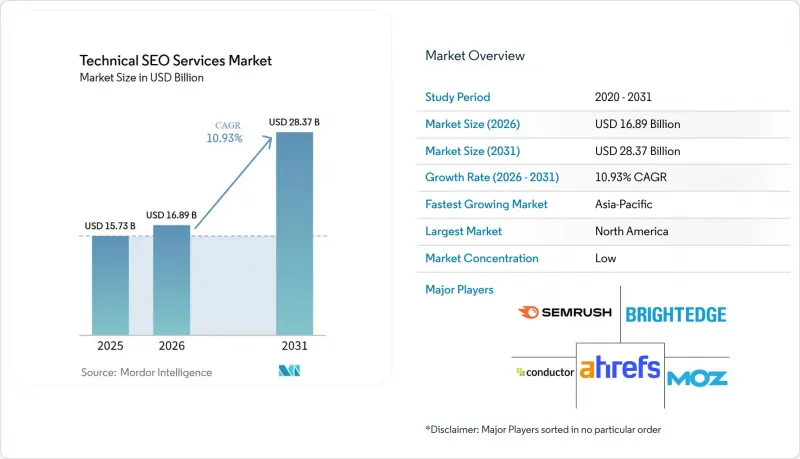
據 Mordor Intelligence 稱,2025 年技術 SEO 服務市值為 157.3 億美元,預計到 2031 年將達到 283.7 億美元,而 2026 年為 168.9 億美元,預測期(2026-2031 年)的複合年成長率為 10.93%。
本報告按服務類型(站內SEO、站外SEO、技術SEO、本地及超本地SEO)、公司規模(大型企業、中小企業)、終端用戶行業(零售及電商、銀行、金融服務及保險、醫療保健及生命科學、IT及電信、媒體及娛樂等)及地區進行細分。市場預測以美元計價。
全球技術SEO服務市場趨勢與洞察
自然流量效率的需求日益成長
企業負責人如今看待SEO服務,不僅關注品牌知名度,更關注客戶獲取效率與收入穩定性。在科技SEO服務市場,這種轉變支撐著提升大型數位資產的抓取存取、頁面效能、結構化資料和網站清晰度等服務的持續需求。自然搜尋管道依然具有吸引力,因為技術改進能夠帶來持續穩定的高品質流量,而無需像付費管道那樣投入大規模媒體成本。因此,買家正從一次性清理服務轉向涵蓋監控、測試和糾正措施的定期維護協議。能夠從商業角度解釋技術工作,並將網站健康狀況與轉換率和搜尋穩定性聯繫起來的服務商也更具優勢。
搜尋演算法的變革正在加速。
2025年,Google持續推出多項核心演算法更新,導致排名波動,技術準備成為出版商、零售商和企業品牌營運的首要任務。技術SEO服務市場正受益於此,因為企業現在將搜尋波動視為持續存在的風險,而非偶爾發生的干擾。隨著排名系統日趨嚴格,渲染延遲、頁面體驗不穩定和抓取路徑不佳等技術缺陷的成本也隨之增加。谷歌已聲明,核心網頁指標仍然是搜尋排名的一部分,這意味著效能提升工作與可見性管理密切相關。這促使代理商和平台提供更長期的服務,透過監控大規模網站並快速回應搜尋格局的變化來實現這一目標。
搜尋引擎最佳化效果與收入歸因衡量之間的差距
科技SEO服務市場面臨的最大挑戰仍是提升網站曝光度與營收報告之間的脫節。儘管SEO通常會在購買流程的早期階段就對客戶發現產生影響,但許多企業仍然只在較短的歸因期內評估通路效果。零點擊行為加劇了這個問題,因為使用者無需訪問網站或進行可衡量的會話即可在搜尋結果中找到答案。當財務部門未能理解技術投入與累計收入之間的簡單關聯時,合約審核和審核流程就會變得更加耗時。雖然在這種情況下需求不會消失,但報告壓力卻會增加,採購流程也會因此放緩。
細分市場分析
到2025年,技術SEO將佔據技術SEO服務市場32.41%的佔有率,反映出現代網站管理背後日益成長的工程負擔。網站渲染、結構化資料、重新導向、模式識別和頁面效能如今決定著內容能否被大規模地找到和檢索,因此這個類別至關重要。站內SEO和站外SEO仍然重要,但當網站使用大規模模板、動態框架或多層導航時,所有這些都依賴於堅實的技術基礎。在整個技術SEO服務產業,隨著人工智慧搜尋越來越重視機器可讀的內容和穩定的架構,技術工作仍然是公司業務範圍的核心。
預計到2031年,本地和超本地SEO將以14.82%的複合年成長率成長,成為技術SEO服務市場中成長最快的服務類別。這一成長反映了在購買決策附近進行搜尋發現的商業性價值,用戶希望獲得即時且在地化的答案。據Rio SEO稱,到2025年,儘管美國超過23.9萬個商業場所的總列表瀏覽量有所下降,但直接點擊量同比成長了6.4%。服務格局也向捆綁式服務轉變,將技術審核、清單管理和人工智慧驅動的可見性追蹤整合到單一的營運範圍內。
區域分析
到2025年,北美將佔據技術SEO服務市場34.62%的佔有率,成為全球最大的區域收入來源。該地區受益於企業強勁的需求、成熟的數位化預算以及強大的平台供應商網路。在美國,大規模多站點部署需要持續的監控和實施支持,這是支出的主要來源。加拿大和墨西哥也透過跨境貿易和日益複雜的多語言網站架構,為區域需求做出貢獻。歐洲仍是第二大市場,其服務需求主要體現在使用者授權管理、分析控制和多語言內容管治等。
預計到2031年,亞太地區將以14.27%的複合年成長率成長,成為技術SEO服務市場成長最快的地區。印度是主要的成長要素,因為中小企業和新創企業主導的數位業務高度依賴自然搜尋發現來擴大業務。中國憑藉其龐大的電子商務基礎和不斷成長的企業數位行銷投入,正在創造大規模的市場需求。日本和韓國透過需要精準實施和健全技術管治的企業專案為市場做出貢獻。東南亞也蘊藏著巨大的成長空間,印尼、越南和泰國的企業正在系統化地制定其數位獲客策略。
儘管南美洲市場規模相對較小,但巴西憑藉其國內電子商務和正規數位團隊的擴張,已成為技術SEO服務市場的主要成長中心。阿根廷儘管宏觀經濟情勢依然不穩定,但正透過人才引進提升區域競爭力。中東和非洲市場規模也小規模,但沙烏地阿拉伯和阿拉伯聯合大公國正透過在公共和私營部門進行廣泛的數位化投資來支撐市場需求。在非洲,奈及利亞和南非引領SEO的普及,因為對於行動優先的電商和出口導向中小企業而言,自然成長仍然至關重要。
其他好處:
- Excel格式的市場預測(ME)表
- 3個月的分析師支持
目錄
第1章:引言
- 研究假設和市場定義
- 調查範圍
第2章:調查方法
第3章執行摘要
第4章 市場狀況
- 市場概覽
- 市場促進因素
- 自然流量效率的需求日益成長
- 搜尋演算法波動性加劇
- 企業正擴大轉向人工智慧驅動的搜尋引擎最佳化工作流程。
- 大規模技術站點對穩健性的需求日益成長。
- 數位商務領域的競爭日益激烈,消費者的購買意願也很高。
- 為了提高品牌知名度,人們對「零點擊搜尋」的需求日益成長。
- 市場限制因素
- SEO效果與收入歸因之間的衡量差距
- 對搜尋引擎策略和介面變化的依賴
- 內部SEO技術實施人員短缺
- SEO回報週期的不斷延長導致顧客疲勞感加劇。
- 宏觀經濟因素對市場的影響
- 產業價值鏈分析
- 科技趨勢
- 監理情勢
- 波特五力分析
第5章 市場規模與成長預測
- 按服務類型
- 頁面內SEO
- 站外SEO
- 技術搜尋引擎最佳化
- 本地和超本地搜尋引擎最佳化
- 按公司規模
- 大公司
- 小型企業
- 按最終用戶行業分類
- 零售與電子商務
- BFSI
- 醫療保健和生命科學
- 資訊科技/通訊
- 媒體與娛樂
- 工業製造
- 政府和公共行政
- 其他終端用戶產業
- 按地區
- 北美洲
- 美國
- 加拿大
- 墨西哥
- 南美洲
- 巴西
- 阿根廷
- 其他南美國家
- 歐洲
- 德國
- 英國
- 法國
- 義大利
- 西班牙
- 俄羅斯
- 其他歐洲國家
- 亞太地區
- 中國
- 印度
- 日本
- 韓國
- 澳洲
- 其他亞太國家
- 中東和非洲
- 中東
- 沙烏地阿拉伯
- 阿拉伯聯合大公國
- 其他中東國家
- 非洲
- 南非
- 奈及利亞
- 其他非洲國家
- 中東
- 北美洲
第6章 競爭情勢
- 市場集中度
- 策略趨勢
- 市佔率分析
- 公司簡介
- Semrush Holdings, Inc.
- BrightEdge Technologies, Inc.
- Conductor, Inc.
- Botify SAS
- seoClarity, Inc.
- Lumar Group Ltd.
- Ahrefs Pte. Ltd.
- Screaming Frog Ltd.
- Moz, Inc.
- Similarweb Ltd.
- Searchmetrics GmbH
- Market Brew, Inc.
- OnCrawl SAS
- Siteimprove A/S
- DeepCrawl Limited
- Surfer Sp. z oo
- Yoast BV
- Bruce Clay, Inc.
- Delante sp. z oo
- Ignite Visibility, LLC
- OuterBox, Inc.
第7章 市場機會與未來展望
According to Mordor Intelligence, the technical SEO services market size was valued at USD 15.73 billion in 2025 and estimated to grow from USD 16.89 billion in 2026 to reach USD 28.37 billion by 2031, at a CAGR of 10.93% during the forecast period (2026-2031).
This report is Segmented by Service Type (On-Page SEO, Off-Page SEO, Technical SEO, and Local and Hyperlocal SEO), Enterprise Size (Large Enterprises, and Small and Medium Enterprises), End-User Industry (Retail and E-Commerce, BFSI, Healthcare and Life Sciences, IT and Telecom, Media and Entertainment, and More), and Geography. The Market Forecasts are Provided in Terms of Value (USD).
Global Technical SEO Services Market Trends and Insights
Rising Demand for Organic Traffic Efficiency
Enterprise buyers now view SEO services more through acquisition efficiency and revenue stability than through brand awareness alone. In the Technical SEO Services Market, this change supports steady demand for work that improves crawl access, page performance, structured data, and site clarity across large digital properties. Organic channels remain attractive because technical improvements can support durable traffic quality without the same ongoing media spend required in paid channels. This is pushing buyers away from one-time cleanups and toward recurring retainers that cover monitoring, testing, and remediation. It also favors providers that can explain technical work in commercial terms and tie site health to conversion quality and search resilience.
Accelerating Search Algorithm Volatility
Ranking conditions remained unstable in 2025 as Google rolled out multiple broad core updates, keeping technical preparedness high on the operating agenda for publishers, retailers, and enterprise brands. The Technical SEO Services Market benefits from this pressure because companies now treat search volatility as an ongoing risk rather than as an occasional disruption. Technical weaknesses such as slow rendering, unstable page experience, and weak crawl paths become more costly when ranking systems tighten. Google states that Core Web Vitals remain part of search evaluation, which keeps performance work tied to visibility management. This supports longer service scopes for agencies and platforms that can monitor large site estates and respond quickly when search conditions change.
Measurement Gaps Between SEO Effort and Revenue Attribution
The largest friction point in the Technical SEO Services Market remains the gap between visibility work and revenue reporting. Many organizations still assess channels through short attribution windows, even though SEO often influences discovery much earlier in the buying path. Zero-click behavior exacerbates this problem because users can consume answers within search results without generating a visit or a measurable session. When finance teams cannot see a simple link between technical work and booked revenue, contract reviews and approvals take longer. Demand does not disappear under these conditions, but reporting pressure rises and procurement moves more slowly.
Other drivers and restraints analyzed in the detailed report include:
- Rising Enterprise Migration to AI-Assisted SEO Workflows
- Expanding Need for Technical Site Health at Scale
- Dependence on Search Engine Policy and Interface Changes
For complete list of drivers and restraints, kindly check the Table Of Contents.
Segment Analysis
Technical SEO held 32.41% of the Technical SEO Services Market share in 2025, which reflected the heavier engineering load behind modern site management. The category remains central because rendering, site structure, redirects, schema, and page performance now shape whether content can be found and retrieved at scale. On-page and off-page SEO still matter, but both depend on a stable technical foundation when sites run on large templates, dynamic frameworks, or multi-layered navigation. Across the technical SEO services industry, this kept technical work at the center of enterprise scopes as AI search placed more weight on machine-readable content and stable architecture.
Local and Hyperlocal SEO is projected to expand at a 14.82% CAGR through 2031, making it the fastest-growing service category in the Technical SEO Services Market. That rise reflects the commercial value of discovery closer to the point of purchase, where users want immediate and location-specific answers. Rio SEO reported that direction clicks rose 6.4% year over year across more than 239,000 U.S. enterprise locations in 2025, even as broader listing views declined. The service mix is also moving toward bundled offerings that combine technical auditing, listing control, and AI visibility tracking under one operating scope.
Complete Report Scope:
- By Service Type
- On-Page SEO
- Off-Page SEO
- Technical SEO
- Local And Hyperlocal SEO
- By Enterprise Size
- Large Enterprises
- Small And Medium Enterprises
- By End-User Industry
- Retail and E-Commerce
- BFSI
- Healthcare and Life Sciences
- IT and Telecom
- Media and Entertainment
- Industrial Manufacturing
- Government and Public Administration
- Other End-User Industries
- By Geography
- North America
- United States
- Canada
- Mexico
- South America
- Brazil
- Argentina
- Rest of South America
- Europe
- Germany
- United Kingdom
- France
- Italy
- Spain
- Russia
- Rest of Europe
- Asia-Pacific
- China
- India
- Japan
- South Korea
- Australia
- Rest of Asia-Pacific
- Middle East and Africa
- Middle East
- Saudi Arabia
- United Arab Emirates
- Rest of Middle East
- Africa
- South Africa
- Nigeria
- Rest of Africa
- Middle East
- North America
Geography Analysis
North America held 34.62% of the Technical SEO Services Market share in 2025, which made it the largest regional revenue base. The region benefits from dense enterprise demand, mature digital budgets, and a strong platform vendor presence. The United States anchors spending in large, multi-site deployments that require constant monitoring and implementation support. Canada and Mexico also contribute to regional demand through cross-border commerce and multilingual site structures, which increase technical complexity. Europe remained the second-largest region, where consent management, analytics controls, and multilingual content governance shape service requirements.
Asia-Pacific is projected to expand at a 14.27% CAGR through 2031, making it the fastest-growing region in the Technical SEO Services Market. India is a major driver because SMEs and startup-led digital businesses rely heavily on organic discovery during scaling. China adds large-volume demand through its wide e-commerce base and rising investment in corporate digital marketing operations. Japan and South Korea contribute through enterprise programs that require precise implementation and stable technical governance. Southeast Asia extends the growth runway as businesses in Indonesia, Vietnam, and Thailand formalize digital acquisition strategies.
South America remains smaller, but Brazil is the key growth center in the Technical SEO Services Market as domestic e-commerce and formal digital teams expand. Argentina adds regional capability through agency talent, even though macro conditions remain less stable. The Middle East and Africa also represent a smaller base, with Saudi Arabia and the UAE supporting demand through broad digital investment across public and private sectors. Nigeria and South Africa lead adoption in Africa because mobile-first commerce and export-oriented SMEs keep organic acquisition relevant.
- Semrush Holdings, Inc.
- BrightEdge Technologies, Inc.
- Conductor, Inc.
- Botify SAS
- seoClarity, Inc.
- Lumar Group Ltd.
- Ahrefs Pte. Ltd.
- Screaming Frog Ltd.
- Moz, Inc.
- Similarweb Ltd.
- Searchmetrics GmbH
- Market Brew, Inc.
- OnCrawl SAS
- Siteimprove A/S
- DeepCrawl Limited
- Surfer Sp. z o.o.
- Yoast B.V.
- Bruce Clay, Inc.
- Delante sp. z o.o.
- Ignite Visibility, LLC
- OuterBox, Inc.
Additional Benefits:
- The market estimate (ME) sheet in Excel format
- 3 months of analyst support
TABLE OF CONTENTS
1 INTRODUCTION
- 1.1 Study Assumptions and Market Definition
- 1.2 Scope of the Study
2 RESEARCH METHODOLOGY
3 EXECUTIVE SUMMARY
4 MARKET LANDSCAPE
- 4.1 Market Overview
- 4.2 Market Drivers
- 4.2.1 Rising Demand for Organic Traffic Efficiency
- 4.2.2 Accelerating Search Algorithm Volatility
- 4.2.3 Rising Enterprise Migration to AI-Assisted SEO Workflows
- 4.2.4 Expanding Need For Technical Site Health At Scale
- 4.2.5 Growing Competition in High-Intent Digital Commerce Categories
- 4.2.6 Increasing Zero-Click Search Pressure On Brand Visibility
- 4.3 Market Restraints
- 4.3.1 Measurement Gaps Between SEO Effort and Revenue Attribution
- 4.3.2 Dependence On Search Engine Policy And Interface Changes
- 4.3.3 In-House SEO Talent Scarcity For Technical Implementation
- 4.3.4 Rising Client Fatigue From Long SEO Payback Cycles
- 4.4 Impact of Macroeconomic Factors on the Market
- 4.5 Industry Value Chain Analysis
- 4.6 Technology Outlook
- 4.7 Regulatory Landscape
- 4.8 Porter's Five Forces Analysis
- 4.8.1 Threat of New Entrants
- 4.8.2 Bargaining Power of Suppliers
- 4.8.3 Bargaining Power of Buyers
- 4.8.4 Threat of Substitutes
- 4.8.5 Intensity of Competitive Rivalry
5 MARKET SIZE AND GROWTH FORECASTS (VALUE)
- 5.1 By Service Type
- 5.1.1 On-Page SEO
- 5.1.2 Off-Page SEO
- 5.1.3 Technical SEO
- 5.1.4 Local And Hyperlocal SEO
- 5.2 By Enterprise Size
- 5.2.1 Large Enterprises
- 5.2.2 Small And Medium Enterprises
- 5.3 By End-User Industry
- 5.3.1 Retail and E-Commerce
- 5.3.2 BFSI
- 5.3.3 Healthcare and Life Sciences
- 5.3.4 IT and Telecom
- 5.3.5 Media and Entertainment
- 5.3.6 Industrial Manufacturing
- 5.3.7 Government and Public Administration
- 5.3.8 Other End-User Industries
- 5.4 By Geography
- 5.4.1 North America
- 5.4.1.1 United States
- 5.4.1.2 Canada
- 5.4.1.3 Mexico
- 5.4.2 South America
- 5.4.2.1 Brazil
- 5.4.2.2 Argentina
- 5.4.2.3 Rest of South America
- 5.4.3 Europe
- 5.4.3.1 Germany
- 5.4.3.2 United Kingdom
- 5.4.3.3 France
- 5.4.3.4 Italy
- 5.4.3.5 Spain
- 5.4.3.6 Russia
- 5.4.3.7 Rest of Europe
- 5.4.4 Asia-Pacific
- 5.4.4.1 China
- 5.4.4.2 India
- 5.4.4.3 Japan
- 5.4.4.4 South Korea
- 5.4.4.5 Australia
- 5.4.4.6 Rest of Asia-Pacific
- 5.4.5 Middle East and Africa
- 5.4.5.1 Middle East
- 5.4.5.1.1 Saudi Arabia
- 5.4.5.1.2 United Arab Emirates
- 5.4.5.1.3 Rest of Middle East
- 5.4.5.2 Africa
- 5.4.5.2.1 South Africa
- 5.4.5.2.2 Nigeria
- 5.4.5.2.3 Rest of Africa
- 5.4.5.1 Middle East
- 5.4.1 North America
6 COMPETITIVE LANDSCAPE
- 6.1 Market Concentration
- 6.2 Strategic Moves
- 6.3 Market Share Analysis
- 6.4 Company Profiles (includes Global Level Overview, Market Level Overview, Core Segments, Financials as available, Strategic Information, Market Rank/Share, Products and Services, Recent Developments)
- 6.4.1 Semrush Holdings, Inc.
- 6.4.2 BrightEdge Technologies, Inc.
- 6.4.3 Conductor, Inc.
- 6.4.4 Botify SAS
- 6.4.5 seoClarity, Inc.
- 6.4.6 Lumar Group Ltd.
- 6.4.7 Ahrefs Pte. Ltd.
- 6.4.8 Screaming Frog Ltd.
- 6.4.9 Moz, Inc.
- 6.4.10 Similarweb Ltd.
- 6.4.11 Searchmetrics GmbH
- 6.4.12 Market Brew, Inc.
- 6.4.13 OnCrawl SAS
- 6.4.14 Siteimprove A/S
- 6.4.15 DeepCrawl Limited
- 6.4.16 Surfer Sp. z o.o.
- 6.4.17 Yoast B.V.
- 6.4.18 Bruce Clay, Inc.
- 6.4.19 Delante sp. z o.o.
- 6.4.20 Ignite Visibility, LLC
- 6.4.21 OuterBox, Inc.
7 MARKET OPPORTUNITIES AND FUTURE OUTLOOK
- 7.1 White-Space and Unmet-Need Assessment

 生成式引擎最佳化 (GEO) 服務市場:按服務類型、企業規模、應用程式、最終用戶和地區分類搜尋引擎最佳化 (SEO) 軟體和工具市場:按 SEO 功能、公司規模、部署類型、應用程式、最終用戶和地區分類答案引擎最佳化 (AEO) 平台市場:按部署類型、組織規模、功能、答案引擎、應用程式、最終用戶和地區分類搜尋引擎最佳化 (SEO) 服務市場:按服務類型、服務供應商、定價模式、最終用戶和地區分類答案引擎最佳化 (AEO) 服務市場:按服務類型、人工智慧搜尋管道、應用和地區分類
 2026-2030年全球搜尋引擎最佳化(SEO)軟體市場
 2026年全球多重雲端最佳化工具市場報告
 基於人工智慧的SEO工具市場:按組件、組織規模、部署類型、應用和行業分類 - 全球預測(2026-2032年)2026年全球代理商SEO服務市場報告2026年全球搜尋引擎最佳化服務市場報告