


 |
市場調查報告書
商品編碼
2099459
安全、抗量子干擾的光纖骨幹網路:市場佔有率分析、產業趨勢和統計數據以及成長預測(2026-2031 年)Secure and Quantum-Safe Fiber Backbone Network - Market Share Analysis, Industry Trends & Statistics, Growth Forecasts (2026 - 2031) |
||||||

※ 本網頁內容可能與最新版本有所差異。詳細情況請與我們聯繫。
根據 Mordor Intelligence 預測,安全、抗量子干擾的光纖骨幹網路市場規模預計將從 2025 年的 24.1 億美元和 2026 年的 31.4 億美元成長到 2031 年的 115.2 億美元,2026 年至 2031 年的複合年成長率為 29.9%。
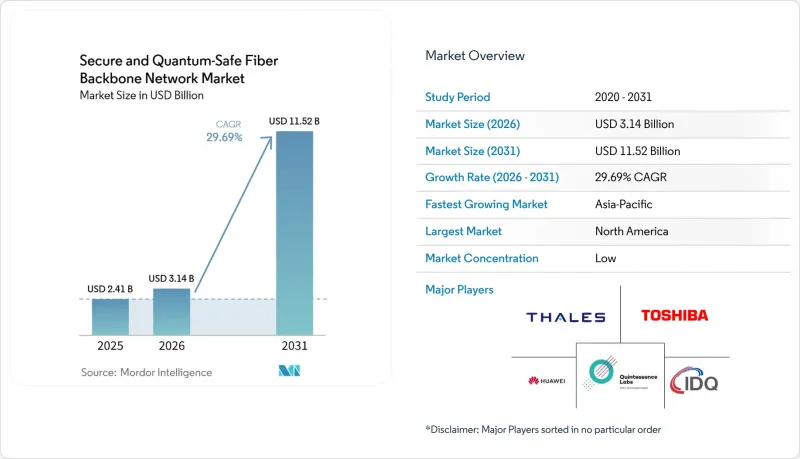
本報告按組件(硬體等)、技術(量子金鑰傳輸等)、應用(通訊、資料中心等)、終端用戶產業(通訊業者、城域光纖網路等)、網路類型(地面光纖網路、城域光纖網路等)和地區進行細分。市場預測以美元計價。
全球安全、抗量子干擾的光纖骨幹網路市場趨勢與洞察。
面臨「先收集,後解密」風險的風險增加。
「先收集後解密」模式不再是紙上談兵,它正在影響通訊業者和關鍵基礎設施營運商對安全、抗量子攻擊的光纖骨幹網路市場中骨幹網路安全風險的認知。一項發表於2026年的研究發現,即使僅儲存全球1%的截獲加密流量,假設採用保守的商業雲端定價,國家行為體每年也將花費約10億美元。對於高價值資訊收集而言,這是一個可以承受的水平。長距離光纖線路尤其脆弱,因為它們沿著可預測的實體路徑傳輸海量流量,使得透過光纖分路器進行大規模截獲和強制收集變得更加現實。存檔的5G和未來6G控制平面記錄(包含會話和認證資料)構成長期安全漏洞,因為如果未來出現與密碼學相關的量子系統,這些記錄可能會被解密。這種成本失衡——目前截獲成本低,解密延遲——正在縮短整個安全、抗量子攻擊的光纖骨幹網路市場的採購週期,即使在沒有正式過渡立法的國家也是如此。
美國國家標準與技術研究院 (NIST) 設定的後量子過渡期限
美國國家標準與技術研究院 (NIST) 的標準化工作已將安全、抗量子攻擊的光纖骨幹網路市場從初步評估階段推進到以截止日期主導的採購階段。 NIST 於 2024 年 8 月最終確定了 FIPS 203、FIPS 204 和 FIPS 205 標準,隨後於 2025 年 3 月採納了 HQC 標準,以擴展未來部署的關鍵密鑰建立選項。白宮隨後於 2026 年 6 月透過第 14412 號行政命令加快了這一進程,該命令要求聯邦機構在 2030 年 12 月 31 日前將高價值資產遷移到 PQC 金鑰建立方法,並在 2031 年 12 月 31 日前遷移到數位簽章。美國行政管理和預算辦公室 (OMB) 的 M-26-15 號備忘錄也要求各機構在 120 天內製定過渡計劃,並估計聯邦政府範圍內的過渡成本在 10 年內將達到 71 億美元。這為供應商和網路營運商提供了明確的預算指南。由於聯邦承包商和國防通訊供應商必須遵守這些規定,因此對安全、抗量子干擾的光纖骨幹網路市場的需求正在遠遠超出政府機構的範圍,涵蓋更廣泛的骨幹網路供應鏈。
引入可信任節點和量子金鑰分發需要大量資金投入。
在安全、量子容錯光纖骨幹網路市場,資本密集度仍是短期擴張最明顯的阻礙因素之一。目前的量子金鑰分發(QKD)設備單價高達20萬歐元(約22.8萬美元),點對點部署通常需要25萬至50萬美元的初始投資,這還不包括營運成本。如此高的價格水準導致早期採用者主要集中在國家主導的項目、一級運營商以及能夠撥出專項安全預算的受監管金融機構。在許多新興市場,QKD支出直接與現有的光纖安全和骨幹網路現代化預算競爭,減緩了中東、非洲和南美部分地區的部署速度。雖然隨著光子整合技術的進步,成本曲線有望改善,但對於安全、量子容錯光纖骨幹網路市場的大部分而言,這種改善仍需中期而非短期。
細分市場分析
到2025年,硬體將佔據安全、量子容錯光纖骨幹網路市場佔有率的56.29%,成為目前部署中最大的收入來源。這一主導地位源自於中國、歐洲、美國、韓國和中東等地骨幹網路計畫中對DWDM系統、光纖傳輸平台、QKD終端和可信任節點設備的直接採購。硬體的主導地位是結構性的,因為只有在實體量子鏈路和安全光節點安裝完畢後,這些路徑上的高階軟體層才能大規模運作。因此,公共部門和通訊業者的既定項目轉化訂單硬體訂單的速度比其他任何組件類別都快。在安全、量子容錯光纖骨幹網路市場,隨著通訊業者在硬體全面過渡前採用密碼學感知金鑰管理、符合FIPS標準的函式庫和量子容錯工具,預計到2031年,軟體市場將以34.33%的複合年成長率成長。
軟體之所以備受關注,是因為它降低了初始投資門檻,同時為未來的硬體整合留出了空間。因此,對於目前正在評估加密風險並尋求分階段投資的通訊業者和公司而言,軟體層是一個極具吸引力的選擇。隨著營運商尋求外部支援以進行遷移規劃、架構設計和系統整合,尤其是在內部量子密碼學人才有限的情況下,服務領域也在不斷擴展。安全、量子容錯的光纖骨幹網路市場的整體發展方向仍然是硬體和軟體的更緊密整合。在預測期內,由於光子設計的微型化和控制平台柔軟性,成本差距預計將會縮小。
預計到2025年,後量子密碼技術(PQC)將佔據51.10%的市場佔有率,成為目前部署規模下的主導技術路徑。其地位得益於NIST標準化演算法帶來的即時部署能力以及其成本結構——無需專用量子金鑰分發(QKD)硬體或專用光纖線路。這種軟體主導的方法也非常適合超大規模雲端環境,主要供應商已開始將PQC整合到其更廣泛的基礎設施安全堆疊中。對於需要快速應對長期儲存相關風險的買家而言,在實體量子網路成熟之前,PQC已成為一種實用的過渡工具。因此,在安全、抗量子攻擊的光纖骨幹網路市場中,PQC一直是早期採購的核心。
隨著政府和通訊業者的專案從試點階段過渡到全面骨幹網路部署,預計到2031年,量子金鑰分發(QKD)將以33.61%的複合年成長率成長。對QKD最強勁的需求集中在國家基礎設施、國防通訊和高價值金融走廊等領域,在這些領域,基於資訊理論的安全防護具有戰略吸引力。混合量子安全解決方案正日益受到關注,因為將專用或高優先光纖路徑上的QKD與更廣泛網路區段上的預量子通訊(PQC)相結合,可以降低在當前標準化週期中完全依賴單一方法的風險。展望2025年和2026年政府主導的部署速度,安全、抗量子攻擊的光纖骨幹網路市場不再處於一種技術絕對優於另一種技術的階段;在網路經濟條件允許的情況下,將兩者結合使用的趨勢日益明顯。
區域分析
到了2025年,北美佔32.12%的市場佔有率,成為安全、量子容錯光纖骨幹網路市場最大的地區。這一主導地位源自於其最強力的量子容錯(PQC)過渡法規結構,尤其是在美國。美國第14412號行政命令強制要求明確的採購計畫。該命令要求高價值聯邦資產在2030年12月31日前過渡到PQC密鑰部署,並在2031年12月31日前使用數位簽章。管理和預算辦公室(OMB)也制定了一項過渡計劃,預計未來10年將投入71億美元。這項監管政策的明確促使國防相關企業、聯邦網路營運商和受監管的金融機構在全部區域展開了積極的採購活動。加拿大也透過關鍵網路舉措和遠端通訊計畫推進了量子容錯基礎設施的發展。墨西哥雖然仍處於早期階段,但預計未來將受益於北美標準的統一。
在歐洲,透過 EuroQCI 及相關國家項目,安全、抗量子干擾的光纖骨幹網路市場中最具協調性的區域生態系統之一正在不斷建構。德國在柏林和波昂之間鋪設的 923 公里長的「DemoQuanDT」光纖網路,為歐洲通訊業者提供了一個用於運作中量子金鑰分發 (QKD) 部署的即時營運商級模型。隨後,在 2026 年 1 月,德國電信的 T-Labs 和 Qunnect 在柏林超過 30 公里的商用光纖線路上成功實現了量子隱形傳態,證明基於量子糾纏的功能正在進入實際的電信環境。英國進一步推動了這一進程,投資 1.25 億英鎊(1.59 億美元)用於量子網路建設,並於 2026 年 6 月啟動了“國家量子標準網路”,其中政府撥款 1000 萬英鎊(1322 萬美元)。這些橫跨歐洲的跨國計畫也表明,量子技術的應用不再局限於該地區最大的西方經濟體。
預計到2031年,亞太地區將以32.89%的複合年成長率成長,成為安全、抗量子攻擊的光纖骨幹網路市場成長最快的區域市場。中國正引領此成長趨勢,其涵蓋17個省份和80個城市的全國性量子金鑰分發(QKD)骨幹網路總長超過12,000公里,擁有145個光纖骨幹網路節點和20個大都會圈。印度在2026年4月實現了1000公里QKD部署的里程碑,這標誌著全國範圍內的部署已超越了最初的研究階段。同時,韓國通訊業者也積極推動量子安全技術在其未來6G計畫中的應用。在中東市場,面向政府和金融機構的暗纖商業部署正在穩步推進,市場正在崛起。而南美和非洲則仍處於部署初期,首先採用軟體疊加技術,之後才會進行大規模的硬體部署。
其他好處:
- Excel格式的市場預測(ME)表
- 3個月的分析師支持
目錄
第1章:引言
- 研究假設和市場定義
- 調查範圍
第2章:調查方法
第3章執行摘要
第4章 市場狀況
- 市場概覽
- 市場促進因素
- “Rising Harvest Now, Decrypt Later” 越來越受到關注。
- 美國國家標準與技術研究院(NIST)設定的向後量子技術過渡的最後期限
- 5G和6G通訊骨幹網路現代化
- 主權量子網路計劃
- 面向關鍵基礎設施的量子容錯資料存儲
- 混合量子金鑰分發和程序品質控制實施的經濟效益
- 市場限制因素
- 引入可信任節點和量子金鑰分發(QKD)需要高額的資本投入。
- 當可靠節點無法使用時,光纖傳輸距離會受到限制。
- 不同廠商技術堆疊之間的互通性差距
- 量子硬體供應鏈和測試平台的匱乏
- 產業價值鏈分析
- 監理情勢
- 波特五力分析
- 宏觀經濟因素對市場的影響
第5章 市場規模與成長預測
- 按組件
- 硬體
- 軟體
- 服務
- 透過技術
- 量子金鑰傳輸
- 後量子密碼學
- 混合量子抗性解決方案
- 透過使用
- 電訊
- 資料中心
- 政府/國防
- BFSI
- 衛生保健
- 能源公用事業
- 按最終用戶行業分類
- 通訊業者
- 超大規模資料中心業者和雲端服務供應商
- 金融機構
- 公共機構
- 關鍵基礎設施營運商
- 依網路類型
- 地面光纖網路
- 城域光纖網路
- 長距離光纖網路
- 水下和跨境光纖網路
- 按地區
- 北美洲
- 美國
- 加拿大
- 墨西哥
- 南美洲
- 巴西
- 阿根廷
- 其他南美國家
- 歐洲
- 德國
- 英國
- 法國
- 其他歐洲國家
- 亞太地區
- 中國
- 日本
- 印度
- 韓國
- 其他亞太國家
- 中東
- 沙烏地阿拉伯
- 阿拉伯聯合大公國
- 其他中東國家
- 非洲
- 南非
- 奈及利亞
- 其他非洲國家
- 北美洲
第6章 競爭情勢
- 市場集中度
- 策略趨勢
- 市佔率分析
- 公司簡介
- Toshiba Corporation
- ID Quantique SA
- Thales SA
- Huawei Technologies Co., Ltd.
- QuintessenceLabs Pty Ltd.
- SK Telecom Co., Ltd.
- Nokia Corporation
- Ciena Corporation
- Cisco Systems, Inc.
- Juniper Networks, Inc.(HPE Ltd.)
- NEC Corporation
- Fujitsu Limited
- Colt Technology Services Group Limited
- Orange SA
- BT Group plc
- Deutsche Telekom AG
- Telefonica, SA
- Adtran Holdings, Inc.
- LuxQuanta Technologies SL
- Quantum Xchange, Inc.
第7章 市場機會與未來展望
According to Mordor Intelligence, the secure and quantum-Safe fiber backbone network market size is projected to expand from USD 2.41 billion in 2025 and USD 3.14 billion in 2026 to USD 11.52 billion by 2031, registering a CAGR of 29.69% from 2026 to 2031.
This report is Segmented by Component (Hardware and More), Technology (Quantum Key Distribution, and More), Application (Telecommunications, Data Centers, and More), End-User Industry (Telecom Operators, Metro Fiber Networks, and More), Network Type (Terrestrial Fiber Networks, Metro Fiber Networks, and More), and Geography. The Market Forecasts are Provided in Value (USD).
Global Secure and Quantum-Safe Fiber Backbone Network Market Trends and Insights
Rising Harvest-Now, Decrypt-Later Exposure
The harvest-now, decrypt-later model has moved beyond theory and now shapes how carriers and critical infrastructure operators view backbone security risk in the secure and quantum-safe fiber backbone network market. Research published in 2026 found that storing even 1% of intercepted global encrypted traffic could cost nation-state actors around USD 1 billion per year under conservative commercial cloud pricing, which is a manageable level for high-value intelligence collection. Long-haul fiber routes are especially vulnerable because they carry heavy traffic along predictable physical paths, making bulk interception more practical through fiber taps or collection mandates. Archived 5G and future 6G control-plane records create a lasting vulnerability because they preserve session and authentication data that could be decrypted later if cryptographically relevant quantum systems emerge. This cost imbalance, where interception is cheap today and decryption can wait, is shortening procurement cycles across the secure and quantum-safe fiber backbone network market even in countries without formal migration laws.
NIST Post-Quantum Migration Deadlines
The NIST standardization effort has shifted the secure and quantum-safe fiber backbone network market from early evaluation into deadline-driven procurement. NIST finalized FIPS 203, FIPS 204, and FIPS 205 in August 2024, and then selected HQC in March 2025 to widen key-establishment options for future deployments. The White House then accelerated the pace in June 2026 through Executive Order 14412, which required federal agencies to migrate high-value assets to PQC key establishment by December 31, 2030, and digital signatures by December 31, 2031. OMB Memorandum M-26-15 also required agency migration plans within 120 days and placed total federal transition costs at USD 7.1 billion over a decade, providing suppliers and network operators with a clear budget signal. Because federal contractors and defense communications vendors must align with these rules, the secure and quantum-safe fiber backbone network market is seeing demand spread well beyond government agencies into the broader backbone supply chain.
High CAPEX For Trusted-Node And QKD Rollouts
Capital intensity remains one of the clearest constraints on near-term expansion in the secure and quantum-safe fiber backbone network market. QKD devices currently cost EUR 200,000 (USD 228,000) per unit, and point-to-point deployments usually require USD 250,000 to USD 500,000 in initial spending before operating costs are added. That pricing keeps early adoption concentrated among sovereign programs, Tier-1 carriers, and regulated financial institutions that can justify dedicated security budgets. In many emerging markets, QKD spending competes directly with existing optical security and backbone modernization budgets, slowing deployment in parts of the Middle East, Africa, and South America. The cost curve should improve as photonic integration advances, but the relief is still medium-term rather than immediate for much of the secure and quantum-safe fiber backbone network market.
Other drivers and restraints analyzed in the detailed report include:
- Telecom Backbone Modernization For 5G And 6G
- Sovereign Quantum Network Programs
- Limited Fiber Reach Without Trusted Nodes
For complete list of drivers and restraints, kindly check the Table Of Contents.
Segment Analysis
Hardware held 56.29% of the secure and quantum-safe fiber backbone network market share in 2025, making it the largest revenue contributor across current deployments. That lead came from direct procurement of DWDM systems, optical transport platforms, QKD terminals, and trusted-node equipment across backbone programs in China, Europe, the United States, South Korea, and the Middle East. The hardware position is structural because physical quantum links and secure optical nodes must be installed before higher software layers can operate at scale on those routes. Confirmed public and carrier programs, therefore, converted more quickly into hardware bookings than into any other component category. Within the secure and quantum-safe fiber backbone network market, software is projected to expand at a 34.33% CAGR through 2031 as operators adopt crypto-agile key management, FIPS-compliant libraries, and quantum-readiness tools ahead of full hardware migration.
Software is gaining traction because it lowers the first spending threshold while preserving room for later hardware integration. That makes the software layer attractive for carriers and enterprises that want to map cryptographic exposure now and phase capital deployment over time. Services are also expanding as operators seek outside support for migration planning, architecture design, and system integration, especially where in-house quantum cryptography talent is limited. The broader direction of the secure and quantum-safe fiber backbone network market still points toward tighter hardware and software integration, with smaller photonic designs and more flexible control platforms expected to narrow the cost gap over the forecast period.
Post-quantum cryptography accounted for a 51.10% share in 2025, making it the leading technology path by current adoption volume. Its position came from immediate deployability enabled by NIST-standardized algorithms and a cost structure that does not depend on dedicated QKD hardware or special-purpose fiber routes. That software-led approach also fits well with hyperscale cloud environments, where large providers have already begun embedding PQC into broader infrastructure security stacks. For buyers who needed faster action against long-retention exposure, PQC offered a practical migration step while physical quantum networking matured. This kept PQC at the center of early procurement across the secure and quantum-safe fiber backbone network market.
QKD is projected to grow at a 33.61% CAGR through 2031 as sovereign and carrier programs move from pilot stages into live backbone deployments. The strongest QKD demand is tied to national infrastructure, defense communications, and high-value financial corridors where information-theoretic protection has strategic appeal. Hybrid quantum-safe solutions are becoming more common because they combine QKD on dedicated or high-priority fiber paths with PQC on wider network segments, thereby reducing the risk of relying entirely on a single approach during an active standards cycle. The pace of government-backed rollouts in 2025 and 2026 showed that the secure and quantum-safe fiber backbone network market is no longer choosing between PQC and QKD in absolute terms, and is increasingly using both where network economics permit.
Complete Report Scope:
- By Component
- Hardware (Includes Optical Transport Equipment (DWDM/CWDM Systems), Optical Transponders and Muxponders, ROADM (Reconfigurable Optical Add-Drop Multiplexer) Systems, Optical Line Systems (OLS), Coherent Optical Modules, Optical Amplifiers (EDFA/Raman))
- Software (Includes Post-Quantum Cryptography (PQC) Software, Quantum-Safe Key Management Systems (KMS), Network Encryption Management Platforms, SDN Controllers with Security Orchestration, Network Management Systems (NMS))
- Services (Includes Security Consulting, Quantum-Readiness Assessments, Cryptographic Risk Assessments, Network Security Architecture Design, Deployment and Integration of Quantum-Safe Solutions)
- By Technology
- Quantum Key Distribution
- Post-Quantum Cryptography
- Hybrid Quantum-Safe Solutions
- By Application
- Telecommunications
- Data Centers
- Government and Defense
- BFSI
- Healthcare
- Energy and Utilities
- By End-User Industry
- Telecom Operators
- Hyperscalers and Cloud Providers
- Financial Institutions
- Public Sector Agencies
- Critical Infrastructure Operators
- By Network Type
- Terrestrial Fiber Networks
- Metro Fiber Networks
- Long-Haul Fiber Networks
- Subsea and Cross-Border Fiber Links
- By Geography
- North America
- United States
- Canada
- Mexico
- South America
- Brazil
- Argentina
- Rest of South America
- Europe
- Germany
- United Kingdom
- France
- Rest of Europe
- Asia-Pacific
- China
- Japan
- India
- South Korea
- Rest of Asia-Pacific
- Middle East
- Saudi Arabia
- United Arab Emirates
- Rest of the Middle East
- Africa
- South Africa
- Nigeria
- Rest of Africa
- North America
Geography Analysis
North America held a 32.12% share in 2025, making it the largest region in the secure and quantum-safe fiber backbone network market. That lead came from the strongest regulatory framework for PQC migration, especially in the United States, where Executive Order 14412 mandated a defined procurement schedule for planning. The order required high-value federal assets to move to PQC key establishment by December 31, 2030, and to use digital signatures by December 31, 2031, while OMB also framed the transition around USD 7.1 billion in spending over 10 years. That regulatory clarity pulled defense contractors, federal network operators, and regulated financial institutions into active buying cycles across the region. Canada also advanced quantum-safe infrastructure work through critical network initiatives and long-distance communication planning, while Mexico remained at an earlier stage but stood to benefit from North American standards alignment over time.
Europe continued to build one of the most coordinated regional ecosystems in the secure and quantum-safe fiber backbone network market through EuroQCI and related national programs. Germany's 923 km DemoQuanDT deployment between Berlin and Bonn provided European operators with a live, carrier-grade model for long-distance QKD implementation. Deutsche Telekom T-Labs and Qunnect then achieved quantum teleportation over 30 km of commercial fiber in Berlin in January 2026, which showed that entanglement-based capabilities were moving into real operator environments. The United Kingdom added further weight by committing GBP 125 million (USD 159 million) to quantum networking and by launching a National Quantum Standards Network in June 2026, supported by GBP 10 million (USD 13.22 million) in government funding. Cross-border programs in broader Europe also showed that deployment was no longer limited to the region's largest western economies.
Asia-Pacific is projected to grow at a 32.89% CAGR through 2031, which makes it the fastest-expanding regional block in the secure and quantum-safe fiber backbone network market. China anchors that trajectory with a national QKD backbone of more than 12,000 km, 145 fiber backbone nodes, and 20 metropolitan networks across 17 provinces and 80 cities. India's 1,000 km QKD milestone in April 2026 confirmed that national-scale deployment had moved beyond the earliest research stage, while South Korean carriers also pushed quantum security closer to future 6G planning. Middle Eastern markets are emerging through live commercial dark-fiber deployments for sovereign and financial communications, while South America and Africa remain earlier-stage adopters, starting with software overlays before broader hardware rollout.
- Toshiba Corporation
- ID Quantique SA
- Thales S.A.
- Huawei Technologies Co., Ltd.
- QuintessenceLabs Pty Ltd.
- SK Telecom Co., Ltd.
- Nokia Corporation
- Ciena Corporation
- Cisco Systems, Inc.
- Juniper Networks, Inc. (HPE Ltd.)
- NEC Corporation
- Fujitsu Limited
- Colt Technology Services Group Limited
- Orange S.A.
- BT Group plc
- Deutsche Telekom AG
- Telefonica, S.A.
- Adtran Holdings, Inc.
- LuxQuanta Technologies S.L.
- Quantum Xchange, Inc.
Additional Benefits:
- The market estimate (ME) sheet in Excel format
- 3 months of analyst support
TABLE OF CONTENTS
1 INTRODUCTION
- 1.1 Study Assumptions and Market Definition
- 1.2 Scope of the Study
2 RESEARCH METHODOLOGY
3 EXECUTIVE SUMMARY
4 MARKET LANDSCAPE
- 4.1 Market Overview
- 4.2 Market Drivers
- 4.2.1 Rising Harvest Now, Decrypt Later Exposure
- 4.2.2 NIST Post-Quantum Migration Deadlines
- 4.2.3 Telecom Backbone Modernization for 5G and 6G
- 4.2.4 Sovereign Quantum Network Programs
- 4.2.5 Quantum-Safe Data Retention for Critical Infrastructure
- 4.2.6 Hybrid QKD and PQC Deployment Economics
- 4.3 Market Restraints
- 4.3.1 High CAPEX for Trusted-Node and QKD Rollouts
- 4.3.2 Limited Fiber Reach Without Trusted Nodes
- 4.3.3 Interoperability Gaps Across Vendor Stacks
- 4.3.4 Quantum Hardware Supply Chain and Testbed Scarcity
- 4.4 Industry Value Chain Analysis
- 4.5 Regulatory Landscape
- 4.6 Porter's Five Forces Analysis
- 4.6.1 Threat of New Entrants
- 4.6.2 Bargaining Power of Suppliers
- 4.6.3 Bargaining Power of Buyers
- 4.6.4 Threat of Substitutes
- 4.6.5 Competitive Rivalry
- 4.7 Impact of Macroeconomic Factors on the Market
5 MARKET SIZE AND GROWTH FORECASTS (VALUE)
- 5.1 By Component
- 5.1.1 Hardware (Includes Optical Transport Equipment (DWDM/CWDM Systems), Optical Transponders and Muxponders, ROADM (Reconfigurable Optical Add-Drop Multiplexer) Systems, Optical Line Systems (OLS), Coherent Optical Modules, Optical Amplifiers (EDFA/Raman))
- 5.1.2 Software (Includes Post-Quantum Cryptography (PQC) Software, Quantum-Safe Key Management Systems (KMS), Network Encryption Management Platforms, SDN Controllers with Security Orchestration, Network Management Systems (NMS))
- 5.1.3 Services (Includes Security Consulting, Quantum-Readiness Assessments, Cryptographic Risk Assessments, Network Security Architecture Design, Deployment and Integration of Quantum-Safe Solutions)
- 5.2 By Technology
- 5.2.1 Quantum Key Distribution
- 5.2.2 Post-Quantum Cryptography
- 5.2.3 Hybrid Quantum-Safe Solutions
- 5.3 By Application
- 5.3.1 Telecommunications
- 5.3.2 Data Centers
- 5.3.3 Government and Defense
- 5.3.4 BFSI
- 5.3.5 Healthcare
- 5.3.6 Energy and Utilities
- 5.4 By End-User Industry
- 5.4.1 Telecom Operators
- 5.4.2 Hyperscalers and Cloud Providers
- 5.4.3 Financial Institutions
- 5.4.4 Public Sector Agencies
- 5.4.5 Critical Infrastructure Operators
- 5.5 By Network Type
- 5.5.1 Terrestrial Fiber Networks
- 5.5.2 Metro Fiber Networks
- 5.5.3 Long-Haul Fiber Networks
- 5.5.4 Subsea and Cross-Border Fiber Links
- 5.6 By Geography
- 5.6.1 North America
- 5.6.1.1 United States
- 5.6.1.2 Canada
- 5.6.1.3 Mexico
- 5.6.2 South America
- 5.6.2.1 Brazil
- 5.6.2.2 Argentina
- 5.6.2.3 Rest of South America
- 5.6.3 Europe
- 5.6.3.1 Germany
- 5.6.3.2 United Kingdom
- 5.6.3.3 France
- 5.6.3.4 Rest of Europe
- 5.6.4 Asia-Pacific
- 5.6.4.1 China
- 5.6.4.2 Japan
- 5.6.4.3 India
- 5.6.4.4 South Korea
- 5.6.4.5 Rest of Asia-Pacific
- 5.6.5 Middle East
- 5.6.5.1 Saudi Arabia
- 5.6.5.2 United Arab Emirates
- 5.6.5.3 Rest of the Middle East
- 5.6.6 Africa
- 5.6.6.1 South Africa
- 5.6.6.2 Nigeria
- 5.6.6.3 Rest of Africa
- 5.6.1 North America
6 COMPETITIVE LANDSCAPE
- 6.1 Market Concentration
- 6.2 Strategic Moves
- 6.3 Market Share Analysis
- 6.4 Company Profiles (includes Global Level Overview, Market Level Overview, Core Segments, Financials as available, Strategic Information, Market Rank/Share, Products and Services, Recent Developments)
- 6.4.1 Toshiba Corporation
- 6.4.2 ID Quantique SA
- 6.4.3 Thales S.A.
- 6.4.4 Huawei Technologies Co., Ltd.
- 6.4.5 QuintessenceLabs Pty Ltd.
- 6.4.6 SK Telecom Co., Ltd.
- 6.4.7 Nokia Corporation
- 6.4.8 Ciena Corporation
- 6.4.9 Cisco Systems, Inc.
- 6.4.10 Juniper Networks, Inc. (HPE Ltd.)
- 6.4.11 NEC Corporation
- 6.4.12 Fujitsu Limited
- 6.4.13 Colt Technology Services Group Limited
- 6.4.14 Orange S.A.
- 6.4.15 BT Group plc
- 6.4.16 Deutsche Telekom AG
- 6.4.17 Telefonica, S.A.
- 6.4.18 Adtran Holdings, Inc.
- 6.4.19 LuxQuanta Technologies S.L.
- 6.4.20 Quantum Xchange, Inc.
7 MARKET OPPORTUNITIES AND FUTURE OUTLOOK
- 7.1 White-Space and Unmet-Need Assessment

 量子安全編碼工具市場規模、佔有率和成長分析:按產品、部署類型、組織規模、最終用戶和地區分類-2026-2033年產業預測
 通訊安全市場:全球市場預測,2026-2032年
 通訊安全市場規模、佔有率和成長分析:按部署類型、解決方案類型、企業規模、應用領域、最終用途、銷售管道和地區分類-2026年至2033年產業預測
 通訊安全市場 - 全球產業規模、佔有率、趨勢、機會、預測:按組件、部署方式、通訊模式、產業、地區和競爭對手分類,2021-2031 年
 2026年全球企業垃圾郵件過濾器市場報告
 通訊安全市場報告:按組件、通訊方式、部署類型、行業和地區分類(2026-2034 年)2026年全球通訊安全市場報告2026年全球量子安全編碼工具市場報告2026年全球量子安全訊息通訊軟體開發工具包(SDK)市場報告2026年全球量子容錯安全聊天軟體開發工具包市場報告