


 |
市場調查報告書
商品編碼
2099420
人工智慧網路規模化發展:市場佔有率分析、產業趨勢與統計、成長預測(2026-2031 年)Scale-Up AI Networking - Market Share Analysis, Industry Trends & Statistics, Growth Forecasts (2026 - 2031) |
||||||

※ 本網頁內容可能與最新版本有所差異。詳細情況請與我們聯繫。
據 Mordor Intelligence 稱,2025 年規模化 AI 網路市值為 187.6 億美元,預計到 2031 年將達到 824.3 億美元,而 2026 年為 286.4 億美元,預測期(2026-2031 年)的複合年成長率為 23.54%。
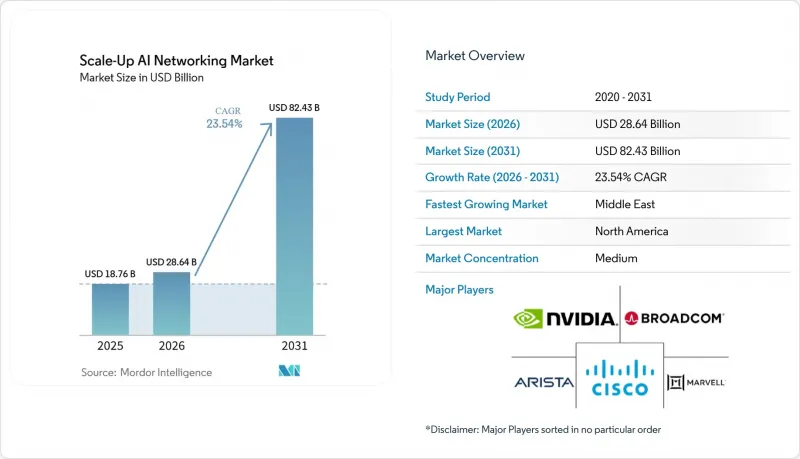
本報告按產品(硬體、軟體、服務)、架構技術(專有加速器擴展架構、開放式擴展架構等)、擴展域規模(8 個或更少加速器、9-72 個加速器、其他)、工作負載(AI 訓練、AI 推理等)、最終用戶(超大規模雲端供應商等)和地區進行細分。市場預測以美元 (USD) 為單位。
全球人工智慧網路規模化市場趨勢與洞察
人工智慧訓練叢集的快速擴張
人工智慧網路規模的快速擴張正推動著人工智慧訓練叢集規模的快速成長。這是因為,在大規模同步工作負載中,網路可靠性正從次要因素轉變為核心設計要求。 OpenAI宣布已在NVIDIA GB200系列超級電腦上部署了其「多路徑可靠連接」(Multipath Reliable Connection)協議,以解決訓練期間因網路中斷而導致的叢集級重新啟動問題。 OpenAI決定將協議捐贈給開放運算專案(Open Compute Project),顯示隨著最先進的訓練系統日益複雜,人工智慧網路規模的擴張正朝著確保可靠性的通用方法轉變。這也改變了供應商的市場定位,能夠提供縱向擴展、橫向擴展和維運軟體整合支援的供應商,在叢集架構擴展到機架、機架柱甚至整個站點時,將佔據更有利的地位。因此,人工智慧網路規模的擴張正從單純的組件銷售轉向全端基礎設施決策。
從專有鏈路標準遷移到開放式乙太網路架構
此外,隨著買家對加速器、交換器和控制軟體之間更廣泛的互通性提出更高要求,向開放式乙太網路架構的轉變也推動了大規模人工智慧網路市場的發展。開放運算計畫(OCP)推出了ESUN舉措,將面向大規模人工智慧基礎設施的乙太網路定義為一個基於標準的社群計劃,該計劃匯集了領先的半導體、雲端和系統供應商。超乙太網路聯盟(Ultra Ethernet Consortium)正式定義了以人工智慧和高效能運算(HPC)工作負載的基於以乙太網路為基礎的通訊協定棧,並將其更新至2026年。這有助於將開放式乙太網路從一個概念轉變為一個以合規性為導向的路徑。這對大規模人工智慧網路市場意義重大,因為採用AMD、客製化晶片或混合環境的客戶需要不限於單一加速器藍圖的架構。這也意味著差異化的重點正在從單純的封閉連接轉向展示整合品質、自動化和大規模互通性的能力。
放大層中的高功率和冷卻負荷
在規模化人工智慧網路市場中,電力和冷卻壓力是最明顯的阻礙因素之一,因為網路設備如今部署在比傳統資料盲區密度高得多的人工智慧基礎設施環境中。 《應用熱工程》和IEEE ITherm都指出液冷是關鍵的發展方向,但也提到了管道、冷卻劑相容性和長期可維護性日益成長的複雜性。 Ciena表示,其插入式CPO方案可將功耗降低高達70%,顯示規模化人工智慧網路市場如今受制於功耗和效能之間的權衡,而不僅僅是頻寬。這使得可以根據新的散熱需求設計的新園區更具優勢,而維修舊設施則面臨更長的準備時間和更高的整合風險。這也意味著網路架構的選擇與現場工程和部署順序的關聯性越來越強。
細分市場分析
至2025年,硬體將佔銷售額的90.11%,而物理層仍將是規模化AI網路市場的主要支出領域。這種構成比反映了建構新型AI叢集所需的交換器、ASIC、網路卡、線纜和光組件等資本密集型產品的特性。這也表明,規模化AI網路市場的大部分仍處於建造階段,買家首先在實體層確保頻寬、拓撲結構和可靠性,然後再增加在編配的支出。隨著營運商在其現有網路架構中添加遙測、擁塞控制和自動化工具,軟體成為成長最快的領域,預計到2031年將以24.21%的複合年成長率成長。
隨著規模化人工智慧網路產業朝向更複雜、更分散的叢集運作模式發展,軟體的重要性日益凸顯。超乙太網路聯盟(Ultra Ethernet Consortium)規範為人工智慧和高效能運算(HPC)環境提供了一套基於標準的軟體和傳輸框架,推動了各廠商採用通用的運維實踐。谷歌透過其 Matryoshka 網路設計系統展示了模型驅動管理如何支援大規模資料中心環境多年運行,這凸顯了軟體層在規模化人工智慧網路市場中的長期價值。儘管服務領域的收入目前仍然小規模,但隨著整合複雜性的增加,其重要性也在不斷提升,因為多站點人工智慧工廠架構需要專門的設計、試運行和持續支援。
到2025年,專有加速器擴展架構將佔銷售額的85.33%。這反映了在擴展型人工智慧網路市場部署緊密整合的加速器生態系統的卓越表現。這項領先優勢源自於軟硬體協同設計的技術和商業性優勢,尤其體現在那些尋求以最短路徑部署大規模訓練系統的買家身上。開放式擴展架構是成長最快的細分市場,到2031年複合年成長率將達到24.62%,這表明隨著非專有加速器方案的日益普及,客戶正在尋求替代方案。開放式擴展架構的擴展型人工智慧網路市場規模正在擴大,這得益於市場對更廣泛的晶片選項和架構的需求不斷成長,這些選項和架構能夠適應更長的採購週期。
AMD 和 Celestica 宣佈在其 Helios 機架級 AI 平台中採用「乙太網路超加速器鏈路 (Ultra Accelerator Link over Ethernet)」技術來實現縱向擴展連接。此舉推動開放式網路架構領域超越單純的標準化討論,為產品藍圖的發展提供了更清晰的指導。 NVIDIA 則以「NVLink Fusion」技術作為回應,透過讓第三方客製化 XPU 透過 NVLink 晶片整合來擴展其生態系統,避免相鄰領域缺乏競爭力。以乙太網路為基礎擴展架構也因 ESUN 和 Arista 的 7060XE7 平台而備受關注,但早期的光纖 I/O 技術,例如 Ayar Labs 的光纖晶片技術,仍處於早期研發階段。在縱向擴展 AI 網路市場,架構之間的競爭不再僅僅取決於連接效能,還取決於藍圖管理、互通性和生態系統的深度。
區域分析
2025年,北美仍保持其最大區域貢獻者的地位,佔據規模化人工智慧網路市場佔有率的58.44%。該地區仍然是規模化人工智慧網路市場的核心,這得益於超大規模資料中心業者資料中心資本、加速器生態系統的領先地位以及對開放標準計劃的積極參與。雖然美國佔據了大部分需求,但加拿大正在推動以研究主導的活動,而墨西哥則在促進對託管和近岸基礎設施的新興興趣。北美在地理位置上也具有接近性,因為許多塑造乙太網路、UALink和機架級人工智慧系統的公司和產業組織都與該地區的生態系統緊密相連。
亞太地區是規模化人工智慧網路市場第二大市場,需求遍及中國、日本、韓國、印度和東南亞。華為在2026年6月上海世界行動通訊大會(MWC Shanghai)上發表了10款針對人工智慧的光纖網路產品,展現了中國在發展以人工智慧為中心的光網路基礎設施的積極態勢。日本憑藉其國內主導的運算策略和在光連接模組領域的努力,繼續保持著重要的技術地位;韓國則憑藉其強大的記憶體和半導體產業基礎,支撐著更廣泛的生態系統。隨著區域數位基礎設施建設的擴展,以及對人工智慧應用意願的不斷增強,印度和東南亞正在成為規模化人工智慧網路市場快速成長的地區。
歐洲和中東及非洲在規模化人工智慧網路市場的需求模式上存在差異。預計歐洲將在2025年保持強勁成長勢頭,其中德國作為主要的資料中心位置脫穎而出,並且至少有一座人工智慧超級工廠獲得了聯邦政府的支持。該地區的成長軌跡受到主權運算優先事項、合規要求以及較長的公私合作採購週期的驅動。中東及非洲地區是成長最快的地區,預計到2031年複合年成長率將達到24.42%,這得益於政府對人工智慧的投資和大規模園區規模的開發計畫。 「星際之門阿拉伯聯合大公國」計畫總成本超過300億美元,預計將於2026年第三季啟動第一階段,顯示該地區正迅速從政策目標轉向實體基礎建設。南美洲仍處於發展初期,需求主要集中在不斷擴大的託管服務和仍在擴展的國內基礎設施開發項目。
其他好處:
- Excel格式的市場預測(ME)表
- 3個月的分析師支持
目錄
第1章:引言
- 研究假設和市場定義
- 調查範圍
第2章:調查方法
第3章執行摘要
第4章 市場狀況
- 市場概覽
- 市場促進因素
- 人工智慧訓練叢集的快速擴張
- 從專有鏈路標準過渡到開放乙太網路架構
- 機架級頻寬密度要求不斷提高
- 採用共封裝光學元件和矽光電
- 人工智慧賦能的網路自動化與遙測實施
- 主要市場中由國家主導的人工智慧基礎設施建設
- 市場限制因素
- 放大層中的高功率和冷卻負荷
- 高速開關對矽和光學元件供應鏈的依賴
- 供應商生態系統之間的互通性差距
- 新興的規模化架構中標準尚不成熟
- 宏觀經濟因素對市場的影響
- 產業價值鏈分析
- 監理情勢
- 技術展望
- 波特五力分析
第5章 市場規模與成長預測
- 報價
- 硬體
- 軟體
- 服務
- 織物技術
- 專有加速器放大結構
- 開放式規模化織物
- 以乙太網路為基礎的擴展架構
- 其他新興的規模化生產布料
- 按域大小擴展
- 最多 8 個加速器
- 9 至 72 個加速器
- 73至256個加速器
- 超過 256 個加速器
- 按工作量
- 人工智慧訓練
- 人工智慧推理
- 微調和模型自適應
- 高效能運算和科學運算
- 其他工作量
- 最終用戶
- 超大規模雲端供應商
- AI雲端和GPU即服務供應商
- 企業資料中心
- 政府、研究機構、高效能運算中心
- 託管資料中心
- 按地區
- 北美洲
- 美國
- 加拿大
- 墨西哥
- 歐洲
- 德國
- 英國
- 法國
- 義大利
- 其他歐洲國家
- 亞太地區
- 中國
- 日本
- 韓國
- 印度
- 東南亞
- 其他亞太國家
- 南美洲
- 中東和非洲
- 北美洲
第6章 競爭情勢
- 市場集中度
- 策略趨勢
- 市佔率分析
- 公司簡介
- NVIDIA Corporation
- Broadcom Inc.
- Cisco Systems, Inc.
- Arista Networks, Inc.
- Marvell Technology, Inc.
- Hewlett Packard Enterprise Company
- Juniper Networks, Inc.
- Huawei Technologies Co., Ltd.
- Dell Technologies Inc.
- Intel Corporation
- Celestica Inc.
- Accton Technology Corporation
- Foxconn Interconnect Technology Limited
- Quanta Computer Inc.
- Nokia Corporation
- Extreme Networks, Inc.
- NEC Corporation
- ZTE Corporation
- Ciena Corporation
- Coherent Corp.
- Lumentum Holdings Inc.
第7章 市場機會與未來展望
According to Mordor Intelligence, the scale-up AI networking market size was valued at USD 18.76 billion in 2025 and estimated to grow from USD 28.64 billion in 2026 to reach USD 82.43 billion by 2031, at a CAGR of 23.54% during the forecast period (2026-2031).
This report is Segmented by Offering (Hardware, Software, and Services), Fabric Technology (Proprietary Accelerator Scale-Up Fabrics, Open Scale-Up Fabrics, and More), Domain Size (Up To 8 Accelerators, 9 To 72 Accelerators, and More), Workload (AI Training, AI Inference, and More), End User (Hyperscale Cloud Providers, and More), and Geography. The Market Forecasts are Provided in Terms of Value (USD).
Global Scale-Up AI Networking Market Trends and Insights
Rapid Expansion of AI Training Clusters
The scale-up AI networking market is being pushed forward by the rapid increase in AI training cluster size, because larger synchronous workloads make network reliability a central design requirement rather than a secondary one. OpenAI said its Multipath Reliable Connection protocol was deployed across its largest NVIDIA GB200 supercomputers to address the network interruptions that had previously forced cluster-wide restarts during training. The decision to contribute that protocol to the Open Compute Project shows that the scale-up AI networking market is moving toward shared methods for reliability as frontier training systems become more complex. This also changes vendor positioning, because suppliers that can support scale-up, scale-out, and operational software together are better placed when cluster architectures expand across racks, rows, and sites. As a result, the scale-up AI networking market is widening beyond a component sale and moving closer to a full-stack infrastructure decision.
Migration From Proprietary Links to Open Ethernet Fabrics
The scale-up AI networking market is also gaining support from the move toward open Ethernet fabrics, because buyers want broader interoperability across accelerators, switches, and control software. The Open Compute Project launched the ESUN initiative to define Ethernet for scale-up AI infrastructure as a standards-based community effort with participation from major silicon, cloud, and systems vendors. The Ultra Ethernet Consortium formalized an Ethernet-based communication stack for AI and HPC workloads, then updated it in 2026, which helped turn open Ethernet from a concept into a compliance-driven path. In the scale-up AI networking market, that matters because customers adopting AMD, custom silicon, or mixed environments need a fabric that is not tied to a single accelerator roadmap. It also means differentiation is shifting away from closed connectivity alone and toward integration quality, automation, and the ability to prove interoperability at scale.
High Power and Cooling Load at Scale-Up Layer
Power and cooling pressure is one of the clearest restraints on the scale-up AI networking market because network equipment now sits inside much denser AI infrastructure environments than conventional data halls were built for. Applied Thermal Engineering and IEEE ITherm both point to liquid cooling as a necessary direction, but they also note added complexity in plumbing, coolant compatibility, and long-term serviceability. Ciena said its pluggable CPO approach can reduce power consumption by up to 70%, which shows how strongly the scale-up AI networking market is now being shaped by power-performance tradeoffs rather than bandwidth alone. This favors greenfield campuses that can be designed around new thermal requirements, while retrofits in older facilities face longer readiness cycles and higher integration risk. It also means fabric decisions are becoming tied more closely to site engineering and deployment sequencing.
Other drivers and restraints analyzed in the detailed report include:
- Higher Rack-Level Bandwidth Density Requirements
- Co-Packaged Optics and Silicon Photonics Adoption
- Supply Chain Dependence for High-Speed Switch Silicon and Optics
For complete list of drivers and restraints, kindly check the Table Of Contents.
Segment Analysis
Hardware held 90.11% of revenue in 2025, which kept the physical layer as the main spending center of the scale-up AI networking market. That mix reflects the capital intensity of switches, ASICs, network interface cards, cables, and optical components required to stand up new AI clusters. It also shows that much of the scale-up AI networking market is still in a build phase where buyers first secure bandwidth, topology, and reliability at the physical layer before widening spend into orchestration. Software is the fastest-growing offering at a 24.21% CAGR through 2031, as operators add telemetry, congestion control, and automation tools around existing fabric deployments.
The software case is becoming stronger because the scale-up AI networking industry is moving toward more complex and distributed cluster operations. The Ultra Ethernet Consortium's specification provides a standards-driven software and transport framework for AI and HPC environments, which supports wider use of common operational methods across vendors. Google also showed through its Matryoshka network design system that model-driven management can support large data center estates over multiple years, which reinforces the long-run value of software layers in the scale-up AI networking market. Services remain smaller in revenue, but they rise with integration complexity because multi-site AI factory architectures need specialized design, commissioning, and ongoing support.
Proprietary accelerator scale-up fabrics held 85.33% of revenue in 2025, which reflected the installed base advantage of tightly integrated accelerator ecosystems in the scale-up AI networking market. That lead came from the technical and commercial strength of hardware-software co-design, especially where buyers wanted the shortest path to large training system deployment. Open scale-up fabrics are the fastest-growing segment at a 24.62% CAGR through 2031, which shows that customers are looking for alternatives as non-proprietary accelerator options gain traction. The scale-up AI networking market size for open scale-up fabrics is rising with demand for architectures that can work across broader silicon choices and longer procurement cycles.
AMD and Celestica said the Helios rack-scale AI platform will use Ultra Accelerator Link over Ethernet for scale-up connectivity, which gives the open fabric segment a clearer product path rather than just a standards narrative. NVIDIA responded with NVLink Fusion, which extends its ecosystem by allowing third-party custom XPUs to integrate through NVLink chiplets instead of leaving that adjacent space uncontested. Ethernet-based scale-up fabrics are also becoming more visible through ESUN and Arista's 7060XE7 platforms, while early optical I/O approaches such as Ayar Labs' optical chiplet work remain earlier in the development cycle. In the scale-up AI networking market, fabric competition is now defined less by raw connectivity alone and more by roadmap control, interoperability, and ecosystem depth.
Complete Report Scope:
- By Offering
- Hardware
- Software
- Services
- By Fabric Technology
- Proprietary Accelerator Scale-Up Fabrics
- Open Scale-Up Fabrics
- Ethernet-Based Scale-Up Fabrics
- Other Emerging Scale-Up Fabrics
- By Scale-Up Domain Size
- Up to 8 Accelerators
- 9 to 72 Accelerators
- 73 to 256 Accelerators
- Above 256 Accelerators
- By Workload
- AI Training
- AI Inference
- Fine-Tuning and Model Adaptation
- HPC and Scientific Computing
- Other Workloads
- By End User
- Hyperscale Cloud Providers
- AI Cloud and GPU-as-a-Service Providers
- Enterprise Data Centers
- Government, Research, and HPC Centers
- Colocation Data Centers
- By Geography
- North America
- United States
- Canada
- Mexico
- Europe
- Germany
- United Kingdom
- France
- Italy
- Rest of Europe
- Asia-Pacific
- China
- Japan
- South Korea
- India
- Southeast Asia
- Rest of Asia-Pacific
- South America
- Middle East and Africa
- North America
Geography Analysis
North America held 58.44% of the scale-up AI networking market share in 2025, which kept it as the largest regional contributor. The region remains the center of the scale-up AI networking market because it combines hyperscaler capital, accelerator ecosystem leadership, and strong participation in open standards efforts. The United States accounts for most of that demand, while Canada adds research-led activity and Mexico supports emerging colocation and nearshore infrastructure interest. North America also has an advantage in vendor proximity, because several of the companies and industry groups shaping Ethernet, UALink, and rack-scale AI systems are closely tied to the regional ecosystem.
Asia-Pacific is the second-largest geography in the scale-up AI networking market, with demand spread across China, Japan, South Korea, India, and Southeast Asia. Huawei's June 2026 launch of 10 AI-Optical Network products at MWC Shanghai showed that China is pushing actively into AI-centric optical and network infrastructure development. Japan remains technically important through sovereign computing priorities and optical interconnect work, while South Korea supports the broader ecosystem through its memory and semiconductor base. India and Southeast Asia are growing parts of the scale-up AI networking market because regional digital infrastructure buildouts are expanding alongside AI deployment ambitions.
Europe and the Middle East and Africa show different demand patterns within the scale-up AI networking market. Europe recorded solid momentum in 2025, with Germany standing out as a major data center location and as a recipient of federal support for at least one AI Gigafactory. The region's growth path is tied to sovereign compute priorities, compliance requirements, and longer public-private procurement cycles. The Middle East and Africa is the fastest-growing geography at a 24.42% CAGR through 2031, supported by sovereign AI investment and large campus-scale development plans. The Stargate UAE project, with total cost exceeding USD 30 billion and Phase 1 expected in Q3 2026, shows how quickly the region is moving from policy ambition to physical infrastructure commitment. South America remains earlier in development, with demand centered on colocation growth and domestic infrastructure programs that are still building scale.
- NVIDIA Corporation
- Broadcom Inc.
- Cisco Systems, Inc.
- Arista Networks, Inc.
- Marvell Technology, Inc.
- Hewlett Packard Enterprise Company
- Juniper Networks, Inc.
- Huawei Technologies Co., Ltd.
- Dell Technologies Inc.
- Intel Corporation
- Celestica Inc.
- Accton Technology Corporation
- Foxconn Interconnect Technology Limited
- Quanta Computer Inc.
- Nokia Corporation
- Extreme Networks, Inc.
- NEC Corporation
- ZTE Corporation
- Ciena Corporation
- Coherent Corp.
- Lumentum Holdings Inc.
Additional Benefits:
- The market estimate (ME) sheet in Excel format
- 3 months of analyst support
TABLE OF CONTENTS
1 INTRODUCTION
- 1.1 Study Assumptions and Market Definition
- 1.2 Scope of the Study
2 RESEARCH METHODOLOGY
3 EXECUTIVE SUMMARY
4 MARKET LANDSCAPE
- 4.1 Market Overview
- 4.2 Market Drivers
- 4.2.1 Rapid Expansion of AI Training Clusters
- 4.2.2 Migration From Proprietary Links To Open Ethernet Fabrics
- 4.2.3 Higher Rack-Level Bandwidth Density Requirements
- 4.2.4 Co-Packaged Optics And Silicon Photonics Adoption
- 4.2.5 AI-Ready Network Automation And Telemetry Adoption
- 4.2.6 Sovereign AI Infrastructure Buildouts In Key Markets
- 4.3 Market Restraints
- 4.3.1 High Power And Cooling Load At Scale-Up Layer
- 4.3.2 Supply Chain Dependence For High-Speed Switch Silicon And Optics
- 4.3.3 Interoperability Gaps Between Vendor Ecosystems
- 4.3.4 Immature Standards Across Emerging Scale-Up Architectures
- 4.4 Impact of Macroeconomic Factors on the Market
- 4.5 Industry Value Chain Analysis
- 4.6 Regulatory Landscape
- 4.7 Technological Outlook
- 4.8 Porter's Five Forces Analysis
- 4.8.1 Threat of New Entrants
- 4.8.2 Bargaining Power of Suppliers
- 4.8.3 Bargaining Power of Buyers
- 4.8.4 Threat of Substitutes
- 4.8.5 Industry Rivalry
5 MARKET SIZE AND GROWTH FORECASTS (VALUE)
- 5.1 By Offering
- 5.1.1 Hardware
- 5.1.2 Software
- 5.1.3 Services
- 5.2 By Fabric Technology
- 5.2.1 Proprietary Accelerator Scale-Up Fabrics
- 5.2.2 Open Scale-Up Fabrics
- 5.2.3 Ethernet-Based Scale-Up Fabrics
- 5.2.4 Other Emerging Scale-Up Fabrics
- 5.3 By Scale-Up Domain Size
- 5.3.1 Up to 8 Accelerators
- 5.3.2 9 to 72 Accelerators
- 5.3.3 73 to 256 Accelerators
- 5.3.4 Above 256 Accelerators
- 5.4 By Workload
- 5.4.1 AI Training
- 5.4.2 AI Inference
- 5.4.3 Fine-Tuning and Model Adaptation
- 5.4.4 HPC and Scientific Computing
- 5.4.5 Other Workloads
- 5.5 By End User
- 5.5.1 Hyperscale Cloud Providers
- 5.5.2 AI Cloud and GPU-as-a-Service Providers
- 5.5.3 Enterprise Data Centers
- 5.5.4 Government, Research, and HPC Centers
- 5.5.5 Colocation Data Centers
- 5.6 By Geography
- 5.6.1 North America
- 5.6.1.1 United States
- 5.6.1.2 Canada
- 5.6.1.3 Mexico
- 5.6.2 Europe
- 5.6.2.1 Germany
- 5.6.2.2 United Kingdom
- 5.6.2.3 France
- 5.6.2.4 Italy
- 5.6.2.5 Rest of Europe
- 5.6.3 Asia-Pacific
- 5.6.3.1 China
- 5.6.3.2 Japan
- 5.6.3.3 South Korea
- 5.6.3.4 India
- 5.6.3.5 Southeast Asia
- 5.6.3.6 Rest of Asia-Pacific
- 5.6.4 South America
- 5.6.5 Middle East and Africa
- 5.6.1 North America
6 COMPETITIVE LANDSCAPE
- 6.1 Market Concentration
- 6.2 Strategic Moves
- 6.3 Market Share Analysis
- 6.4 Company Profiles (includes Global Level Overview, Market Level Overview, Core Segments, Financials as available, Strategic Information, Market Rank/Share, Products and Services, Recent Developments)
- 6.4.1 NVIDIA Corporation
- 6.4.2 Broadcom Inc.
- 6.4.3 Cisco Systems, Inc.
- 6.4.4 Arista Networks, Inc.
- 6.4.5 Marvell Technology, Inc.
- 6.4.6 Hewlett Packard Enterprise Company
- 6.4.7 Juniper Networks, Inc.
- 6.4.8 Huawei Technologies Co., Ltd.
- 6.4.9 Dell Technologies Inc.
- 6.4.10 Intel Corporation
- 6.4.11 Celestica Inc.
- 6.4.12 Accton Technology Corporation
- 6.4.13 Foxconn Interconnect Technology Limited
- 6.4.14 Quanta Computer Inc.
- 6.4.15 Nokia Corporation
- 6.4.16 Extreme Networks, Inc.
- 6.4.17 NEC Corporation
- 6.4.18 ZTE Corporation
- 6.4.19 Ciena Corporation
- 6.4.20 Coherent Corp.
- 6.4.21 Lumentum Holdings Inc.
7 MARKET OPPORTUNITIES AND FUTURE OUTLOOK
- 7.1 White-Space and Unmet-Need Assessment

 網路人工智慧市場:按組件、應用、部署模式、技術、最終用戶、國家和地區分類-全球產業分析、市場規模、市場佔有率及2026年至2033年預測全球自主網路市場:2025-2030 年
 QoE 分析市場預測—按組件、部署類型、應用程式、最終用戶和地區分類的全球分析—2034 年預測訊號最佳化市場預測至2034年-按組件、技術、應用、最終用戶和地區分類的全球分析面向 5G 網路的 AI 市場預測(至 2034 年)—按組件、部署模式、5G 頻段、技術、應用、最終用戶和地區分類的全球分析
 人工智慧網路市場:按組件、技術、部署模式、應用、組織規模和產業分類-2026-2032年全球預測主權雲端部署在將人工智慧引入電信網路方面的作用
 全球網路人工智慧市場
 網路中的人工智慧市場規模、佔有率、趨勢分析報告:按組件、按部署、按技術、按應用、按最終用途、按地區、細分市場預測,2024-2030 年