


 |
市場調查報告書
商品編碼
2099301
汽車用簧片開關感測器:市場佔有率分析、產業趨勢與統計、成長預測(2026-2031)Automotive Reed Switches Sensors - Market Share Analysis, Industry Trends & Statistics, Growth Forecasts (2026 - 2031) |
||||||

※ 本網頁內容可能與最新版本有所差異。詳細情況請與我們聯繫。
根據 Mordor Intelligence 預測,汽車簧片開關感測器市場規模預計將在 2025 年達到 11.9 億美元,2026 年達到 12.8 億美元,到 2031 年達到 18.1 億美元,2026 年至 2031 年的複合年成長率為 7.13%。
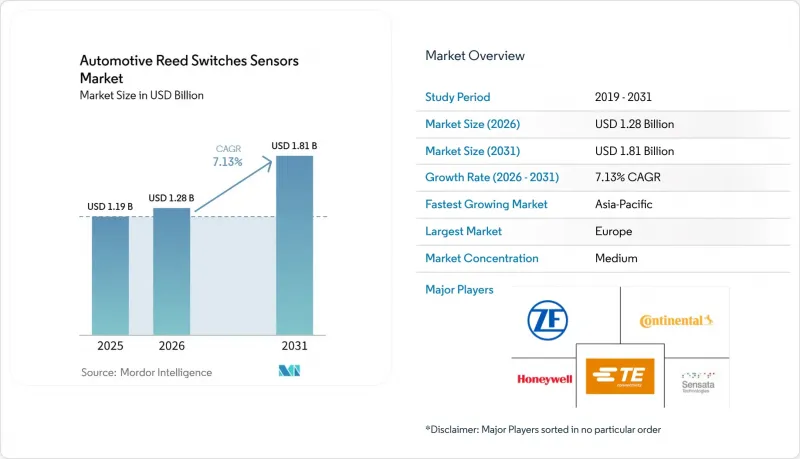
本報告按車輛系統(動力傳動系統和電池管理、ADAS和安全系統等)、安裝類型(表面黏著技術、通孔等)、車輛類型(乘用車、輕型商用車等)、銷售管道(OEM和售後市場)以及地區進行細分。市場規模和預測均以美元計價。
全球汽車簧片開關感測器市場趨勢及洞察
電動車產量的增加推高了對確保電池安全的簧片開關感測器的需求。
全球電動車 (EV) 產量持續快速成長,如今所有高壓電池組均採用多簧片開關,以確保控制電路和電源電路之間實現無火花隔離。這些簧片開關具有零待機電流,可最大限度地延長車輛的續航里程,並滿足嚴格的安全要求。大陸集團最新的馬達轉子溫度感測器展現出朝向更嚴格的公差(±3 度C)邁進的顯著趨勢。這使得稀土元素磁鐵的品質得以降低,從而降低了馬達的整體成本,同時採用氣密封裝簧片磁芯實現電氣隔離。泰方科技已開始量產電池智慧監控系統,該系統採用簧片觸發器來檢測碰撞引起的形變,並符合 ECE R100 標準,這表明這些開關正被納入電動車安全標準,作為預設的第二道防線保護裝置。此技術強大的磁靈敏度確保即使在不同等級車輛的電池組屏蔽、電芯數量和隔熱墊存在差異的情況下,也能實現精確運作。因此,製造商在模組切割點周圍增加了額外的蓋節點,以支援預測性維護分析,從而開闢了新的以服務為導向的收入來源。
在全球範圍內,被動安全法規正變得越來越嚴格。
監管機構持續收緊高級緊急煞車、緊急車道維持和駕駛員疲勞偵測等技術的部署計畫。歐盟通用安全法規II(General Safety Regulation II)於2024年7月生效,強制要求所有新型M1和N1車輛的安全帶扣和乘員模組中整合冗餘狀態感測器,其中乾簧管觸點可提供可靠的閉合確認。美國國家公路交通安全管理局(NHTSA)的法規要求,到2029年9月,車輛必須在時速高達90英里(約145公里)的情況下實現自動緊急制動,並要求光學和雷達子系統配備故障備用系統,以滿足夜間性能基準值。在這些項目中,簧片開關作為經濟高效的監控裝置,可在關鍵固態通道發生故障時向控制單元發出警報。 2024年5月公佈的歐7排放氣體標準新增了防篡改的車載診斷埠。此連接埠通常採用密封專屬式內的簧片開關,進一步增強了其在確保長期合規性方面的作用。
霍爾效應和AMR感測器的價格降低
如預期,隨著製程節點的小型化,半導體成本不斷下降,這使得霍爾效應感測器供應商能夠以更低的系統成本整合訊號調理和LIN匯流排輸出。 AMR(抗磁阻)感測器的各種變體具有更高的靈敏度和全極性檢測能力,深受尋求佈局柔軟性的設計工程師的青睞。 Allegro MicroSystems最新的TMR-VHT系列符合ISO 26262 ASIL D自我診斷要求,並在以往需要離散冗餘的安全迴路中,從傳統的簧片開關手中奪取了市場佔有率。雖然固態元件仍然存在靜態電流,但每年8-10%的成本節省正在縮小價格差距,促使半導體解決方案在對零電流要求不高的經濟型汽車中得到更廣泛的應用。
細分市場分析
到2025年,ADAS和安全模組將佔據汽車簧片開關感測器市場34.22%的佔有率,以滿足監管機構對碰撞避免功能中故障安全感測器冗餘的要求。動力傳動系統和電池管理領域預計將以11.98%的複合年成長率實現最高成長,這主要得益於所有牽引電池組都需要多個簧片開關來滿足高壓隔離和熱失控控制的要求。與車身舒適性電子設備相關的汽車簧片開關感測器市場規模保持穩定,座椅導軌、天窗和HVAC風門感測的需求強勁。隨著OEM廠商確保對空中下載(OTA)軟體閘道器的防篡改訪問,資訊娛樂系統外殼的銷售量預計將實現溫和成長。
銷售細分數據揭示了電氣化和安全法規如何影響感測器架構。簧片觸點與霍爾感測器和自適應微控制器(AMR)矽感測器配合使用,構成了一種多樣化的感測組合,滿足 ISO 26262 獨立性要求。在整個預測期內,快速成長的動力傳動系統系統有望縮小與高級駕駛輔助系統(ADAS)之間的差距。特別是,隨著固態電池組對更精細的監控需求日益成長,汽車簧片開關感測器市場將進一步擴張。
預計到2025年,表面黏著技術封裝將佔汽車簧片開關感測器市場51.48%的佔有率,複合年成長率預計為11.25%,這主要得益於自動化貼片生產線降低了人工成本並實現了更高密度的PCB佈局。同時,在機械緊固至關重要的高衝擊環境下,例如動力傳動系統支架中,通孔式封裝仍被應用。螺絲式面板模組和直插式插件則用於診斷端口,方便車隊營運商進行現場更換。
表面黏著技術的蓬勃發展反映了產業向緊湊型控制器(例如整合在電池托盤、馬達逆變器和智慧型執行器模組中的控制器)轉型的趨勢。這些機殼通常要求基板與蓋板之間的間隙小於1毫米,因此低矮的引線封裝更受歡迎。隨著汽車製造商將能夠承受-40 度C至150 度C溫度波動的回流焊接焊料合金標準化,表面黏著技術技術將繼續超越所有其他安裝方式,進一步鞏固其在汽車簧片開關感測器市場的主導地位。
區域分析
預計到2025年,歐洲將佔汽車簧片開關感測器市場銷售額的27.12%,主要得益於嚴格的安全和排放氣體法規,這些法規強制要求冗餘感測和防篡改診斷。德國在深度整合方面處於主導,而法國和義大利正在加速推進電池式電動車(BEV)項目,以增加每輛車的簧片節點數量。歐7車輛監控法規透過明確使用密封簧片開關的密封網路基地台,進一步推動了市場需求。
亞太地區是成長最快的地區,複合年成長率達10.86%,這主要得益於中國在電動車生產領域的絕對優勢,從而顯著提升了對電池組開關的需求。日本在感測器技術領域仍保持強勁勢頭,不斷推出針對48V架構最佳化的緊湊型簧片開關。韓國和印度正透過出口導向汽車專案獲得發展動力,其應用範圍已從低價位擴展到高階市場。
在北美,受美國國家公路交通安全管理局 (NHTSA) 煞車法規以及部分進口商品加徵 25% 關稅導致零件供應回歸國內市場的推動,汽車簧片開關市場呈現強勁成長。加拿大和墨西哥正在整合其區域製造體系,以經濟高效的方式組裝簧片開關組件,滿足美國原始設備製造商 (OEM) 的規格要求。重型車輛的電氣化和自動駕駛卡車的示範應用也促進了感測器出貨量的成長,並擴大了汽車簧片開關感測器市場的規模。
其他好處:
- Excel格式的市場預測(ME)表
- 3個月的分析師支持
目錄
第1章:引言
- 研究假設和市場定義
- 調查範圍
第2章:調查方法
第3章執行摘要
第4章 市場狀況
- 市場概覽
- 市場促進因素
- 電動車產量的增加推高了對電池相容型磁簧感應器的需求。
- 全球更嚴格的被動安全標準(例如,聯合國R152)
- 向線控轉向和線控刹車系統過渡到冗餘迴路。
- 智慧無鑰匙進入和門鎖系統的快速普及。
- OEM廠商致力於研發零待機電流組件
- 氫燃料電池汽車液位監測
- 市場限制因素
- 霍爾效應和AMR感測器價格下降
- 玻璃導線在劇烈電軸振動下的脆弱性。
- 鎳鐵合金供應鏈風險
- 由於 RoHS 法規的實施,含汞導線即將被淘汰。
- 價值鍊和供應鏈分析
- 監理情勢
- 技術展望
- 波特五力模型
第5章 市場規模與成長預測
- 車輛系統
- 動力傳動系統和電池管理
- ADAS和安全系統
- 車身及舒適性相關電子設備
- 資訊娛樂和互聯
- 暖通空調和溫度控管
- 其他
- 按安裝類型
- 表面黏著技術
- 通孔
- 螺絲類型/面板
- 內聯/插件
- 車輛類型
- 搭乘用車
- 輕型商用車
- 中型和大型商用車輛
- 二輪車和三輪車
- 非公路用車及特殊車輛
- 按銷售管道
- OEM
- 售後市場
- 按地區
- 北美洲
- 美國
- 加拿大
- 其他北美國家
- 南美洲
- 巴西
- 阿根廷
- 其他南美國家
- 歐洲
- 德國
- 英國
- 法國
- 義大利
- 西班牙
- 俄羅斯
- 其他歐洲國家
- 亞太地區
- 中國
- 日本
- 印度
- 韓國
- 印尼
- 越南
- 菲律賓
- 澳洲
- 其他亞太國家
- 中東和非洲
- 沙烏地阿拉伯
- 阿拉伯聯合大公國
- 土耳其
- 南非
- 奈及利亞
- 埃及
- 其他中東和非洲國家
- 北美洲
第6章 競爭情勢
- 市場集中度
- 策略趨勢
- 市佔率分析
- 公司簡介
- Standex International Corp.
- Littelfuse Inc.
- TE Connectivity Ltd.
- Coto Technology Inc.
- Nippon Aleph Corp.
- ZF Friedrichshafen AG
- Continental AG
- Omron Corporation
- Honeywell International Inc.
- Infineon Technologies AG
- OKI Electric Industry Co.
- Pickering Electronics Ltd.
- Comus International
- Reed Relays & Electronics India Ltd.
- Magnet-Schultz GmbH
- Sensata Technologies Inc.
- Hamlin Electronics Inc.(brand)
- Melexis NV
第7章 市場機會與未來展望
According to Mordor Intelligence, the automotive reed switches sensors market size is projected to be USD 1.19 billion in 2025, USD 1.28 billion in 2026, and reach USD 1.81 billion by 2031, growing at a CAGR of 7.13% from 2026 to 2031.
This report is Segmented by Vehicle System (Powertrain & Battery Management, ADAS & Safety Systems, and More), Mounting Type (Surface Mount, Through Hole, and More), Vehicle Type (Passenger Cars, Light Commercial Vehicles, and More), Sales Channel (OEM and Aftermarket) and Geography. The Market Sizes and Forecasts are Provided in Terms of Value (USD).
Global Automotive Reed Switches Sensors Market Trends and Insights
Rising EV production boosts demand for battery-safe reed sensors
World electric-vehicle output continues to rise steeply, and every high-voltage battery pack now integrates multiple reed switches that guarantee spark-free isolation between control and power circuits. Their zero-standby-current characteristic maximizes parked-vehicle range, meeting stringent warranty targets. Continental's latest e-motor rotor temperature sensor illustrates the push toward tighter +-3 °C tolerance, which lowers rare-earth magnet mass and reduces total motor cost while relying on hermetically sealed reed cores for galvanic isolation. Taifang Technology already mass-produces a battery intelligent monitoring system that uses reed triggers to detect collision-induced deformation and still meets ECE R100 compliance, showing how EV safety norms embed these switches as default second-line protectors. The technology's robust magnetic sensitivity assures accurate actuation even when pack shielding, cell count, and thermal pads vary between vehicle trims. Manufacturers thus embed additional reed nodes around module disconnects to support predictive maintenance analytics, opening new service-oriented revenue streams.
Stricter Global Passive-safety Mandates
Regulators continue to tighten timelines for advanced emergency braking, emergency lane keeping and driver-drowsiness detection. The EU General Safety Regulation II, effective since July 2024, compels every new M1 and N1 vehicle to integrate redundant status sensors in seat-belt buckles and occupant modules where dry-reed contacts provide reliable closure verification. The United States NHTSA rule will enforce automatic emergency braking at speeds up to 90 mph by September 2029, with nighttime performance thresholds that demand fail-operational backup for optical and radar subsystems . Across these programs, reed switches serve as cost-effective watchdogs that alert control units when primary solid-state channels fail. Euro 7 emissions standards, released in May 2024, add tamper-proof onboard diagnostics ports that often employ reed switches within sealed captive shells, reinforcing the long-term compliance role of the component.
Hall-effect & AMR sensor price erosion
Semiconductor costs fall predictably with node scaling, enabling Hall-effect suppliers to bundle signal conditioning and LIN bus outputs at lower system cost. AMR variants deliver higher sensitivity and omnipolar detection that appeals to design engineers seeking layout flexibility. Allegro MicroSystems' recent TMR-VHT family meets ISO 26262 ASIL D self-diagnostic coverage, cutting into legacy reed share in safety loops that once required discrete redundancy . Although solid-state parts still draw quiescent current, cost reductions of 8-10% per year narrow the price gap, prompting value-segment vehicles to adopt semiconductor solutions where zero current is not mission-critical.
Other drivers and restraints analyzed in the detailed report include:
- Shift Toward Steer-by-wire & Brake-by-wire Redundancy
- Rapid Proliferation Of Smart Keyless-entry and Door-Latch Systems
- Glass Reed Fragility In Harsh E-axle Vibration
For complete list of drivers and restraints, kindly check the Table Of Contents.
Segment Analysis
ADAS and safety modules accounted for 34.22% of the automotive reed switches/sensors market share in 2025, underscoring regulators' insistence that collision-avoiding functions include fail-safe sensor redundancy. Powertrain & battery management posts the fastest 11.98% CAGR because every traction battery string requires multiple reed switches to satisfy high-voltage isolation and thermal runaway containment. The automotive reed switches market size tied to body-comfort electronics remains stable, with steady demand for seat-track, sunroof, and HVAC-damper detection. Infotainment enclosures add moderate volume as OEMs secure tamper-proof access for over-the-air software gateways.
The revenue mix illustrates how electrification and safety legislation influence sensor architectures. Reed contacts sit alongside Hall and AMR silicon, forming diverse sensing trios that address ISO 26262 independence rules. Over the forecast horizon, the faster-growing powertrain segment will narrow the gap with ADAS, especially when solid-state battery packs require even more granular monitoring, further expanding the automotive reed switches market.
Surface-mount packages accounted for 51.48% of the automotive reed switches/sensors market in 2025 and exhibit an 11.25% CAGR, propelled by automated pick-and-place lines that lower labor cost and enable denser PCB layouts. Through-hole styles persist in high-shock powertrain brackets where mechanical retention is crucial. Threaded-panel modules and inline plug-ins serve diagnostic ports, making field replacement easier for fleet operators.
Surface-mount momentum mirrors the industry shift toward compact controllers housed inside battery trays, motor inverters, and smart-actuator pods. These enclosures frequently allocate less than 1 mm board-to-lid clearance, favoring low-profile reed packages. As automakers standardize on reflow-compatible solder alloys to withstand -40 °C to 150 °C excursions, surface-mount penetration will continue to outpace all other mount styles, reinforcing its lead within the broader automotive reed switches market.
Complete Report Scope:
- By Vehicle System
- Powertrain & Battery Management
- ADAS & Safety Systems
- Body & Comfort Electronics
- Infotainment & Connectivity
- HVAC & Thermal Management
- Others
- By Mounting Type
- Surface Mount
- Through Hole
- Threaded / Panel
- Inline / Plug-in
- By Vehicle Type
- Passenger Cars
- Light Commercial Vehicles
- Medium & Heavy Commercial Vehicles
- Two-Wheelers & Three-Wheelers
- Off-Highway & Special Vehicles
- By Sales Channel
- OEM
- Aftermarket
- By Geography
- North America
- United States
- Canada
- Rest of North America
- South America
- Brazil
- Argentina
- Rest of South America
- Europe
- Germany
- United Kingdom
- France
- Italy
- Spain
- Russia
- Rest of Europe
- Asia-Pacific
- China
- Japan
- India
- South Korea
- Indonesia
- Vietnam
- Philippines
- Australia
- Rest of Asia-Pacific
- Middle East and Africa
- Saudi Arabia
- United Arab Emirates
- Turkey
- South Africa
- Nigeria
- Egypt
- Rest of Middle East and Africa
- North America
Geography Analysis
Europe retained 27.12% of the automotive reed switches/sensors market revenue in 2025 on the back of stringent safety and emissions directives that mandate redundant sensing and tamper-proof diagnostics. Germany leads integration depth, whereas France and Italy accelerate battery-electric programs that embed more reed nodes per vehicle. Euro 7 on-board monitoring rules further anchor demand by stipulating sealed access points that the hermetic reed switch supports.
Asia-Pacific is the fastest-growing region at 10.86% CAGR as China's dominance in EV production drives immense volume for battery pack switches. Japan remains a sensor technology powerhouse, regularly launching compact reed variants optimized for 48-V architectures. South Korea and India add momentum through export-oriented vehicle programs, spreading adoption across budget and premium tiers.
North America shows solid expansion influenced by the NHTSA braking mandate and renewed on-shoring of component supply due to 25% tariffs on selected imports. Canada and Mexico integrate regional manufacturing, providing cost-effective assembly for reed packages tailored to US OEM specifications. Heavy-duty electrification and autonomous trucking pilots also lift sensor volume, broadening the reach of the automotive reed switches market.
- Standex International Corp.
- Littelfuse Inc.
- TE Connectivity Ltd.
- Coto Technology Inc.
- Nippon Aleph Corp.
- ZF Friedrichshafen AG
- Continental AG
- Omron Corporation
- Honeywell International Inc.
- Infineon Technologies AG
- OKI Electric Industry Co.
- Pickering Electronics Ltd.
- Comus International
- Reed Relays & Electronics India Ltd.
- Magnet-Schultz GmbH
- Sensata Technologies Inc.
- Hamlin Electronics Inc. (brand)
- Melexis NV
Additional Benefits:
- The market estimate (ME) sheet in Excel format
- 3 months of analyst support
TABLE OF CONTENTS
1 Introduction
- 1.1 Study Assumptions and Market Definition
- 1.2 Scope of the Study
2 Research Methodology
3 Executive Summary
4 Market Landscape
- 4.1 Market Overview
- 4.2 Market Drivers
- 4.2.1 Rising EV production boosts demand for battery-safe reed sensors
- 4.2.2 Stricter global passive-safety mandates (e.g., UN R152)
- 4.2.3 Shift toward steer-by-wire & brake-by-wire redundancy loops
- 4.2.4 Rapid proliferation of smart keyless-entry & door-latch systems
- 4.2.5 OEM drive for zero-standby-current components
- 4.2.6 Hydrogen fuel-cell vehicle fluid-level monitoring
- 4.3 Market Restraints
- 4.3.1 Hall-effect & AMR sensor price erosion
- 4.3.2 Glass reed fragility in harsh e-axle vibration
- 4.3.3 Supply-chain risk for nickel-iron alloys
- 4.3.4 Upcoming RoHS phase-out of mercury-wetted reeds
- 4.4 Value Chain and Supply-Chain Analysis
- 4.5 Regulatory Landscape
- 4.6 Technological Outlook
- 4.7 Porter's Five Forces
- 4.7.1 Threat of New Entrants
- 4.7.2 Bargaining Power of Buyers
- 4.7.3 Bargaining Power of Suppliers
- 4.7.4 Threat of Substitutes
- 4.7.5 Competitive Rivalry
5 Market Size & Growth Forecasts (Value (USD))
- 5.1 By Vehicle System
- 5.1.1 Powertrain & Battery Management
- 5.1.2 ADAS & Safety Systems
- 5.1.3 Body & Comfort Electronics
- 5.1.4 Infotainment & Connectivity
- 5.1.5 HVAC & Thermal Management
- 5.1.6 Others
- 5.2 By Mounting Type
- 5.2.1 Surface Mount
- 5.2.2 Through Hole
- 5.2.3 Threaded / Panel
- 5.2.4 Inline / Plug-in
- 5.3 By Vehicle Type
- 5.3.1 Passenger Cars
- 5.3.2 Light Commercial Vehicles
- 5.3.3 Medium & Heavy Commercial Vehicles
- 5.3.4 Two-Wheelers & Three-Wheelers
- 5.3.5 Off-Highway & Special Vehicles
- 5.4 By Sales Channel
- 5.4.1 OEM
- 5.4.2 Aftermarket
- 5.5 By Geography
- 5.5.1 North America
- 5.5.1.1 United States
- 5.5.1.2 Canada
- 5.5.1.3 Rest of North America
- 5.5.2 South America
- 5.5.2.1 Brazil
- 5.5.2.2 Argentina
- 5.5.2.3 Rest of South America
- 5.5.3 Europe
- 5.5.3.1 Germany
- 5.5.3.2 United Kingdom
- 5.5.3.3 France
- 5.5.3.4 Italy
- 5.5.3.5 Spain
- 5.5.3.6 Russia
- 5.5.3.7 Rest of Europe
- 5.5.4 Asia-Pacific
- 5.5.4.1 China
- 5.5.4.2 Japan
- 5.5.4.3 India
- 5.5.4.4 South Korea
- 5.5.4.5 Indonesia
- 5.5.4.6 Vietnam
- 5.5.4.7 Philippines
- 5.5.4.8 Australia
- 5.5.4.9 Rest of Asia-Pacific
- 5.5.5 Middle East and Africa
- 5.5.5.1 Saudi Arabia
- 5.5.5.2 United Arab Emirates
- 5.5.5.3 Turkey
- 5.5.5.4 South Africa
- 5.5.5.5 Nigeria
- 5.5.5.6 Egypt
- 5.5.5.7 Rest of Middle East and Africa
- 5.5.1 North America
6 Competitive Landscape
- 6.1 Market Concentration
- 6.2 Strategic Moves
- 6.3 Market Share Analysis
- 6.4 Company Profiles (includes Global Level Overview, Market Level Overview, Core Segments, Financials as Available, Strategic Information, Market Rank/Share for Key Companies, Products and Services, SWOT Analysis, and Recent Developments)
- 6.4.1 Standex International Corp.
- 6.4.2 Littelfuse Inc.
- 6.4.3 TE Connectivity Ltd.
- 6.4.4 Coto Technology Inc.
- 6.4.5 Nippon Aleph Corp.
- 6.4.6 ZF Friedrichshafen AG
- 6.4.7 Continental AG
- 6.4.8 Omron Corporation
- 6.4.9 Honeywell International Inc.
- 6.4.10 Infineon Technologies AG
- 6.4.11 OKI Electric Industry Co.
- 6.4.12 Pickering Electronics Ltd.
- 6.4.13 Comus International
- 6.4.14 Reed Relays & Electronics India Ltd.
- 6.4.15 Magnet-Schultz GmbH
- 6.4.16 Sensata Technologies Inc.
- 6.4.17 Hamlin Electronics Inc. (brand)
- 6.4.18 Melexis NV
7 Market Opportunities & Future Outlook
- 7.1 White-space and Unmet-Need Assessment

 汽車用電動離心式幫浦浦市場:全球市場預測,2026-2032年低功率幫浦模組市場:全球市場預測,2026-2032年汽車電磁干擾濾波器市場:全球市場預測,2026-2032年
 汽車車窗電壓監測裝置市場規模、佔有率及成長分析:依電路類型、介面技術、功能、車輛系統應用及地區分類-2026-2033年產業預測汽車電壓檢測IC市場-2026年至2032年全球市場預測
 2026年全球車輛警示放大器市場報告
 燃油幫浦模組總成市場報告:趨勢、預測及競爭分析(至2035年)
 汽車電動幫浦市場 - 全球產業規模、佔有率、趨勢、機會與預測:按類型、車輛類型、需求類別、地區和競爭格局分類,2021-2031年全球薄膜型車用天線市場(按技術、安裝位置、材料、車輛類型和最終用戶分類)預測(2026-2032)汽車電池控制單元市場按動力類型、車輛類型、電壓等級、電池架構和部署管道分類 - 全球預測,2026-2032年