


 |
市場調查報告書
商品編碼
2099298
人工智慧工廠基礎設施:市場佔有率分析、產業趨勢與統計、成長預測(2026-2031 年)AI Factory Infrastructure - Market Share Analysis, Industry Trends & Statistics, Growth Forecasts (2026 - 2031) |
||||||

※ 本網頁內容可能與最新版本有所差異。詳細情況請與我們聯繫。
根據 Mordor Intelligence 預測,人工智慧工廠基礎設施市場規模將從 2025 年的 2,668 億美元成長到 2026 年的 3,815 億美元,然後在 2031 年達到 7,824 億美元,2026 年至 2031 年的複合年成長率為 15.45%。
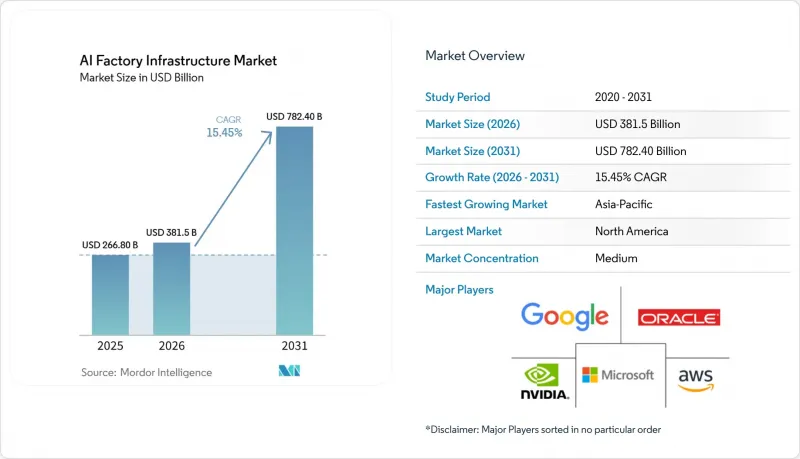
本報告按元件(例如運算基礎設施)、部署模式(例如雲端AI工廠和本地AI工廠)、基礎設施類型(例如AI伺服器叢集)、應用程式(例如生成式AI和大規模語言模型訓練)、最終用戶(例如超大規模資料中心業者和雲端服務供應商)以及地區進行細分。市場預測以美元計價。
全球人工智慧工廠基礎設施市場的趨勢與洞察
超大規模人工智慧基礎設施的快速擴張
超大規模資料中心業者服務商的資本支出正達到重塑人工智慧工廠基礎設施市場格局的水平,其影響涵蓋採購、建造和供應鏈規劃等各個方面。亞馬遜公佈的2025會計年度資本支出為1,283億美元,Alphabet公佈的為914億美元。兩家公司2025年的資本支出總合超過2,190億美元,為2026年的規劃設定了很高的標準。 Meta累計,2026會計年度的基礎設施資本支出將在1,150億美元至1,350億美元之間,這表明主要參與者正將人工智慧能力定位為核心投資項目,而非可選項。微軟2026年第一季財報顯示,儘管Azure營收成長了40%,但智慧雲端的銷貨成本卻成長了43%,這顯示人工智慧基礎設施的快速擴展正在迅速提高營運需求。 NVIDIA 在 2026 會計年度 10-K 報告中指出,資料中心可用性、能源和資金仍將是建置 AI 基礎架構的關鍵因素,並強調了超大規模資料中心業者中心部署速度對整個供應鏈的影響。隨著每個新設施的投入遠遠超出 GPU 層,這一趨勢正在推動整個 AI 工廠基礎設施市場對系統整合、網路架構、冷卻系統和電源設備的需求不斷成長。
訓練生成式人工智慧和大規模語言模型(LLM)的需求日益成長
生成式人工智慧和LLM訓練仍然是人工智慧工廠基礎設施市場的主要驅動力。這是因為大規模訓練仍然需要最高密度的運算環境。推動人工智慧工廠基礎設施市場擴張的另一個因素是,推理能力正在與訓練能力並行構建,而不是取代訓練能力。已部署的人工智慧服務需要低延遲的推理系統,這與最先進的訓練叢集截然不同,從而擴大了營運商必須提供的基礎設施範圍。谷歌雲端的Virgo網路設計頻寬。 AI工廠基礎設施市場的應用配置也反映了類似的轉變,預計到2025年,生成式AI和LLM訓練將主導,而AI推理和配置預計將在2031年之前實現最快的成長。這種組合支援對運算節點、高速交換、儲存吞吐量和散熱控制的並行需求,而不是將投資集中在堆疊的單一層。
在電腦、電源和冷卻系統方面進行了大量資本投資。
人工智慧工廠基礎設施市場仍受到基於最新GPU系統建構運作環境成本的限制。買家不僅投資於計算成本,還投資於液冷迴路、大容量電源系統、UPS升級、網路層以及可隨機架密度擴展的控制軟體。Schneider Electric的工程指南明確指出,整合式電源和冷卻架構如今已成為高密度人工智慧設施的核心要求,甚至在硬體全面部署之前就已推高了專案預算。微軟第一季會計年度第一季財報顯示,其「智慧雲端」業務的毛利率下降了300個基點,這直接歸因於人工智慧基礎設施擴展的成本。這表明,即使是大規模營運商,隨著產能的擴張也面臨財務壓力。這種成本結構正促使人工智慧工廠基礎設施市場中的一些企業放棄從零開始構建,轉而採用託管式人工智慧雲端容量和規模小規模的機架級部署。此外,由於運作時間現在直接影響預算,能夠縮短部署週期並降低整合複雜性的供應商變得越來越有價值。
細分市場分析
到2025年,計算基礎設施將佔據AI工廠基礎設施市場71.53%的佔有率。這反映了GPU採購在每個大規模引進週期中的核心地位。這一主導地位源自於NVIDIA平台(包括H100、Blackwell和Vera Rubin)的世代更迭,使得運算能力繼續成為超超大規模資料中心業者和專業AI雲端服務供應商的首要資本配置重點。 NVIDIA確認Vera Rubin將於2026年4月全面投入生產。參與此系統建置的廠商包括戴爾科技、HPE、聯想和超微電腦。儲存基礎設備基礎設施和管理軟體仍然至關重要,因為持續的吞吐量、工作負載調度和更高的GPU利用率是買家經濟高效地實現高密度叢集的必要條件。
預計到2031年,網路基礎設施將以16.18%的複合年成長率成長,成為人工智慧工廠基礎設施市場中成長最快的組成部分。網路相關支出不斷成長的驅動力在於,需要在大規模的GPU架構上傳輸數據,同時避免交換層出現瓶頸。 NVIDIA的Vera Rubin平台包含Spectrum-X乙太網路選項,顯示開放式乙太網路架構在機架級人工智慧系統設計中變得越來越重要。此外,隨著叢集規模的擴大,低延遲和卓越的能源效率變得至關重要,因此共封裝光元件也日益受到關注。這進一步拓寬了人工智慧工廠基礎設施市場供應商的競爭格局,因為性能指標不再局限於加速器層,而是涵蓋了運算、交換、架構設計和系統整合等各個方面。
到2025年,基於雲端的AI工廠將佔AI工廠基礎設施市場的65.36%,這反映了AWS、微軟Azure和Google雲端的建設速度和規模。公共雲端仍然佔據核心地位,因為超大規模資料中心業者商管理大部分運作容量,能夠在短時間內支援大規模的訓練和推理工作負載。另一方面,對於那些需要高度敏感運算、國家級資料管理或低延遲推理(公有雲無法完全滿足這些需求)的組織而言,公共雲端的AI工廠仍然發揮著至關重要的作用。歐盟委員會、英國和加拿大都已將2026年的政策重點轉向“主權計算”,這進一步強化了在法規環境下對國內管理的基礎設施的需求。
混合型人工智慧工廠預計到 2031 年將以 16.53% 的複合年成長率成長,成為人工智慧工廠基礎設施市場中成長最快的部署模式。最初採用純雲端策略的企業現在正尋求平衡突發容量和成本波動、資料移動限制以及延遲要求。這種轉變推動了對編配軟體的需求,該軟體能夠在雲端、本地端、區域和邊緣環境中部署工作負載,而不會浪費 GPU 容量。 HPE AI Grid 於 2026 年 4 月發布,透過將人工智慧工廠和分散式推理叢集跨多個站點連接起來,直接滿足了這一需求。混合部署的普及也擴大了人工智慧工廠基礎設施市場的相關支出。這是因為,隨著運算從集中式轉向分散式,網路架構、儲存協調和策略控制的重要性日益凸顯。
區域分析
到2025年,北美將佔據人工智慧工廠基礎設施市場62.35%的佔有率,這反映了該地區在超大規模資料中心業者資料中心支出和運作中資料中心容量方面的主導地位。亞馬遜和Alphabet預計2025年的總資本支出將超過2,190億美元,這將進一步鞏固北美在人工智慧工廠基礎設施市場的核心地位及其在拓展新計畫的優勢。該地區還擁有密集的原始設備製造商(OEM)、雲端服務供應商、專業建築商以及電力和冷卻供應商生態系統,這使得大型專案能夠快速從設計到部署。加拿大正透過其主權運算計畫(Sovereign Compute Program)將自身打造為支援中心,該計畫將投資高達10億加幣(7.3億美元)用於在加拿大境內開發高效能人工智慧基礎設施。電力供應仍然是短期內的主要阻礙因素,提前鎖定電網容量的營運商可能在價格、交貨時間和可擴展性方面保持優勢。
預計到2031年,亞太地區將以16.91%的複合年成長率成長,成為人工智慧工廠基礎設施市場成長最快的地區。這項成長主要得益於日本、印度和東南亞等國家優先發展運算能力的舉措,以及中國國內人工智慧基礎設施的擴張。此外,該地區對人工智慧級資料中心設計的興趣日益濃厚,效率、溫度控管和本地控制在採購決策中變得越來越重要。因此,儘管北美目前仍保持市場規模主導,但亞太地區將在人工智慧工廠基礎設施市場的下一階段成長中繼續發揮核心作用。
歐洲、南美洲以及中東和非洲雖然目前規模較小,但在人工智慧工廠基礎設施市場中都佔有重要的戰略地位。在歐洲,人們對國家主導的運算需求日益成長,同時也努力平衡電力網路和授權程序的延誤。歐盟委員會計劃於2026年6月公佈的「技術主權一攬子計畫」預計將促進國內人工智慧的普及和雲端主權認證。英國也透過支援“人工智慧硬體計畫”和“人工智慧成長區”,在其國家規劃中日益重視人工智慧基礎設施。中東和非洲,特別是阿拉伯聯合大公國和沙烏地阿拉伯,因其充足的電力供應和資料中心的經濟可行性而備受關注,而南美仍處於發展初期,其重點集中在巴西的主要城市。
其他好處:
- Excel格式的市場預測(ME)表
- 3個月的分析師支持
目錄
第1章:引言
- 研究假設和市場定義
- 調查範圍
第2章:調查方法
第3章執行摘要
第4章 市場狀況
- 市場概覽
- 市場促進因素
- 超大規模人工智慧基礎設施的快速擴張
- 對訓練生成式人工智慧和大規模語言模型的需求日益成長
- 遷移到人工智慧原生資料中心架構
- 企業對混合人工智慧部署模式的偏好
- 功率密度工程作為競爭優勢因素
- 基於本地的人工智慧主權和強制性國內計算
- 市場限制因素
- 對計算、電源和冷卻系統進行大量資本投資
- 電網連接延遲和電力供應限制
- 半導體和高密度硬體供應瓶頸
- 人工智慧基礎設施工程人才短缺
- 產業價值鏈分析
- 技術展望
- 宏觀經濟因素對市場的影響
- 波特五力分析
第5章 市場規模與成長預測
- 按組件
- 計算基礎設施
- 網路基礎設施
- 儲存基礎設備基礎設施
- 基礎設施管理軟體
- 其他規則
- 按部署模式
- 基於雲端的人工智慧工廠
- 本地人工智慧工廠
- 混合人工智慧工廠
- 依基礎設施類型
- AI伺服器叢集
- 整合式人工智慧吊艙/機架秤系統
- 大規模人工智慧叢集
- 客製化人工智慧叢集
- 透過使用
- 生成式人工智慧和大規模語言模式的訓練
- 人工智慧推理與部署
- 自主系統的發展
- 科學與研究計算
- 數位孿生和工業人工智慧
- 醫療和藥物發現人工智慧
- 最終用戶
- 超大規模資料中心業者和雲端服務供應商
- 公司
- 研究和學術機構
- 醫療與生命科學相關組織
- 銀行、金融服務和保險 (BFSI) 公司
- 工業/製造公司
- 政府和國防機構
- 按地區
- 北美洲
- 美國
- 加拿大
- 墨西哥
- 歐洲
- 德國
- 英國
- 法國
- 義大利
- 其他歐洲國家
- 亞太地區
- 中國
- 日本
- 韓國
- 印度
- 東南亞
- 其他亞太國家
- 南美洲
- 中東和非洲
- 北美洲
第6章 競爭情勢
- 市場集中度
- 策略趨勢
- Vendor Positioning Analysis
- 公司簡介
- NVIDIA Corporation
- Amazon Web Services, Inc.
- Microsoft Corporation
- Google LLC
- Oracle Corporation
- Advanced Micro Devices, Inc.
- Intel Corporation
- Dell Technologies Inc.
- Hewlett Packard Enterprise Development LP
- Super Micro Computer, Inc.
- Lenovo Group Limited
- Cisco Systems, Inc.
- CoreWeave, Inc.
- Lambda Labs, Inc.
- Alibaba Cloud
- Tencent Holdings Limited
- Vertiv Group Corp.
- Schneider Electric SE
第7章 市場機會與未來展望
According to Mordor Intelligence, the AI factory infrastructure market size is expected to grow from USD 266.8 billion in 2025 to USD 381.5 billion in 2026 and is forecast to reach USD 782.4 billion by 2031 at 15.45% CAGR over 2026-2031.
This report is Segmented by Component (Compute Infrastructure, and More), Deployment (Cloud-Based AI Factories, On-Premise AI Factories, and More), Infrastructure Type (AI Server Clusters, and More), Application (Generative AI and Large Language Model Training, and More), End User (Hyperscalers and Cloud Providers, and More), and Geography. The Market Forecasts are Provided in Terms of Value (USD).
Global AI Factory Infrastructure Market Trends and Insights
Rapid Expansion of Hyperscale AI Buildouts
Hyperscaler capital spending has moved to a level that is reshaping the AI factory infrastructure market across procurement, construction, and supply planning. Amazon reported USD 128.3 billion in capital expenditure for FY2025, while Alphabet reported USD 91.4 billion, pushing their combined 2025 spending above USD 219 billion and setting a high baseline for 2026 planning. Meta also committed USD 115 billion to USD 135 billion in 2026 infrastructure capex, which showed that large operators are treating AI capacity as a core investment line rather than a discretionary program. Microsoft's Q1 FY2026 filing showed Azure revenue grew 40%, while Intelligent Cloud cost of revenue grew 43%, indicating how quickly AI infrastructure scale is pushing operating requirements higher. NVIDIA stated in its FY2026 10-K that data center availability, energy, and capital remain key factors for AI infrastructure buildout, which underlines how hyperscaler deployment pace is shaping the wider supply chain. This pattern is driving demand for system integration, networking fabrics, cooling systems, and power equipment across the AI factory infrastructure market, as each new build locks in spending far beyond the GPU layer.
Rising Generative AI And Large Language Model Training Demand
Generative AI and LLM training remain a major driver of the AI factory infrastructure market, as large-scale training still requires the highest-density compute environments. The AI factory infrastructure market is also expanding because inference capacity is being built alongside training capacity, rather than replacing it. Deployed AI services require low-latency inference systems that differ from frontier training clusters, widening the infrastructure surface area operators must provision. Google Cloud's Virgo network design showed the scale of this requirement by linking 134,000 chips with up to 47 petabits per second of non-blocking bisectional bandwidth in a single fabric. The application mix inside the AI factory infrastructure market reflects the same shift, with generative AI and LLM training leading in 2025 and AI inference and deployment posting the fastest forecast growth through 2031. This combination supports parallel demand for compute nodes, high-speed switching, storage throughput, and thermal control, rather than concentrating spending in a single layer of the stack.
High Capex for Compute, Power, and Cooling Systems
The AI factory infrastructure market remains constrained by the cost of building production-ready environments around modern GPU systems. Buyers are not only paying for compute, but also funding liquid-cooling loops, higher-capacity power systems, UPS upgrades, networking layers, and control software that scale with rack density. Schneider Electric's engineering guidance made clear that an integrated power and cooling architecture is now a core requirement for high-density AI facilities, pushing project budgets upward even before full hardware deployment begins. Microsoft's Q1 FY2026 filing showed a 300-basis-point decline in Intelligent Cloud gross margin, tied directly to AI infrastructure scaling costs, indicating that even large operators are under financial pressure as capacity expands. This cost profile is steering some organizations toward managed AI cloud capacity or smaller rack-scale deployments instead of greenfield builds across the AI factory infrastructure market. It is also increasing the value of vendors that can shorten deployment time or reduce integration complexity because time-to-production now has a direct budget effect.
Other drivers and restraints analyzed in the detailed report include:
- Shift Toward AI-Native Data Center Architectures
- Enterprise Preference for Hybrid AI Deployment Models
- Grid Interconnection Delays and Power Availability Constraints
For complete list of drivers and restraints, kindly check the Table Of Contents.
Segment Analysis
Compute infrastructure held 71.53% of the AI factory infrastructure market share in 2025, which reflected the central role of GPU procurement in every large deployment cycle. That lead was tied to successive NVIDIA platform generations, including H100, Blackwell, and Vera Rubin, which kept compute at the front of capital allocation for both hyperscalers and specialist AI cloud operators. NVIDIA confirmed in April 2026 that Vera Rubin moved into full production, with Dell Technologies, HPE, Lenovo, and Super Micro Computer serving as system builders. Storage infrastructure and management software still matter because buyers need sustained throughput, workload scheduling, and tighter GPU utilization to make dense clusters economically viable.
Networking infrastructure is projected to grow at a 16.18% CAGR through 2031, making it the fastest-growing component of the AI factory infrastructure market. The rise of networking spend reflects the need to move data across larger GPU fabrics without creating bottlenecks at the switch layer. NVIDIA's Vera Rubin platform includes Spectrum-X Ethernet options, which shows that open Ethernet architectures are becoming a more visible part of rack-scale AI system design. Co-packaged optics are also entering the discussion because lower latency and better power efficiency become more valuable as cluster sizes expand. This is creating a wider vendor field in the AI factory infrastructure market because performance is now being judged across compute, switching, fabric design, and system integration rather than at the accelerator layer alone.
Cloud-based AI factories held a 65.36% share of the AI factory infrastructure market in 2025, reflecting the build pace and scale of AWS, Microsoft Azure, and Google Cloud. Public cloud remains central because hyperscalers control much of the commissioned capacity that can support large training and inference workloads at short notice. At the same time, on-premises AI factories remain relevant for organizations that need classified compute, national data control, or low-latency inference that the public cloud cannot fully provide. The European Commission, the United Kingdom, and Canada each moved policy attention toward sovereign compute in 2026, which supported the case for domestically controlled infrastructure in regulated environments.
Hybrid AI factories are projected to grow at a 16.53% CAGR through 2031, which makes them the fastest-growing deployment model in the AI factory infrastructure market. Organizations that began with cloud-only strategies are now balancing burst capacity against cost volatility, data movement limits, and latency requirements. That shift is widening demand for orchestration software that can place workloads across cloud, on-premise, regional, and edge environments without wasting GPU capacity. HPE AI Grid, launched in April 2026, directly addressed this requirement by linking AI factories and distributed inference clusters across multiple sites. Hybrid adoption also strengthens adjacent spending in the AI factory infrastructure market because network fabrics, storage coordination, and policy controls become more important when compute is distributed instead of centralized.
Complete Report Scope:
- By Component
- Compute Infrastructure
- Networking Infrastructure
- Storage Infrastructure
- Infrastructure Management Software
- Other Components
- By Deployment Model
- Cloud-Based AI Factories
- On-Premise AI Factories
- Hybrid AI Factories
- By Infrastructure Type
- AI Server Clusters
- Integrated AI Pod / Rack-Scale Systems
- Large-Scale AI Superclusters
- Custom AI Clusters
- By Application
- Generative AI and Large Language Model Training
- AI Inference and Deployment
- Autonomous Systems Development
- Scientific and Research Computing
- Digital Twin and Industrial AI
- Healthcare and Drug Discovery AI
- By End User
- Hyperscalers and Cloud Providers
- Enterprises
- Research and Academic Institutions
- Healthcare and Life Sciences Organizations
- BFSI Companies
- Industrial and Manufacturing Companies
- Government and Defense Organizations
- By Geography
- North America
- United States
- Canada
- Mexico
- Europe
- Germany
- United Kingdom
- France
- Italy
- Rest of Europe
- Asia-Pacific
- China
- Japan
- South Korea
- India
- Southeast Asia
- Rest of Asia-Pacific
- South America
- Middle East and Africa
- North America
Geography Analysis
North America held 62.35% of the AI factory infrastructure market share in 2025, which reflected the region's lead in hyperscaler spending and commissioned data center capacity. Amazon and Alphabet together reported more than USD 219 billion in capital expenditure in 2025, keeping North America at the center of the AI factory infrastructure market and reinforcing their advantage in scaling new projects. The region also benefits from a dense ecosystem of OEMs, cloud operators, specialized builders, and power and cooling vendors that can quickly move large projects from design to deployment. Canada is becoming a supporting node because its sovereign compute program committed up to CAD 1 billion (USD 730 million) for domestic high-performance AI infrastructure. Power access remains the main near-term limit, meaning operators with pre-secured grid capacity are likely to retain an advantage in pricing, delivery timing, and expansion options.
Asia-Pacific is projected to grow at a 16.91% CAGR through 2031, which makes it the fastest-growing geography in the AI factory infrastructure market. Growth is being supported by sovereign compute priorities in Japan, India, Southeast Asia, and by China's domestically funded expansion of AI infrastructure. The region is also seeing more interest in AI-grade data center design, where efficiency, thermal management, and localized control are becoming more important in procurement decisions. This keeps Asia-Pacific central to the next growth phase of the AI factory infrastructure market, even though North America still leads in current scale.
Europe, South America, and the Middle East and Africa remain smaller in current scale, but each has strategic importance in the AI factory infrastructure market. Europe is balancing stronger sovereign compute ambitions against grid and permitting delays, while the European Commission's June 2026 technology sovereignty package is expected to support domestic deployment and cloud sovereignty certification. The United Kingdom has also elevated AI infrastructure in national planning through its AI Hardware Plan and its support for AI Growth Zones. The Middle East and Africa, especially the UAE and Saudi Arabia, are attracting interest because of available power and favorable data center economics, while South America remains earlier in development and more concentrated in Brazil's primary urban markets.
- NVIDIA Corporation
- Amazon Web Services, Inc.
- Microsoft Corporation
- Google LLC
- Oracle Corporation
- Advanced Micro Devices, Inc.
- Intel Corporation
- Dell Technologies Inc.
- Hewlett Packard Enterprise Development LP
- Super Micro Computer, Inc.
- Lenovo Group Limited
- Cisco Systems, Inc.
- CoreWeave, Inc.
- Lambda Labs, Inc.
- Alibaba Cloud
- Tencent Holdings Limited
- Vertiv Group Corp.
- Schneider Electric SE
Additional Benefits:
- The market estimate (ME) sheet in Excel format
- 3 months of analyst support
TABLE OF CONTENTS
1 INTRODUCTION
- 1.1 Study Assumptions and Market Definition
- 1.2 Scope of the Study
2 RESEARCH METHODOLOGY
3 EXECUTIVE SUMMARY
4 MARKET LANDSCAPE
- 4.1 Market Overview
- 4.2 Market Drivers
- 4.2.1 Rapid Expansion of Hyperscale AI Buildouts
- 4.2.2 Rising Generative AI and Large Language Model Training Demand
- 4.2.3 Shift Toward AI-Native Data Center Architectures
- 4.2.4 Enterprise Preference for Hybrid AI Deployment Models
- 4.2.5 Power-Density Engineering as a Competitive Differentiator
- 4.2.6 Localized AI Sovereignty and Onshore Compute Mandates
- 4.3 Market Restraints
- 4.3.1 High Capex for Compute, Power, and Cooling Systems
- 4.3.2 Grid Interconnection Delays and Power Availability Constraints
- 4.3.3 Semiconductor and High-Density Hardware Supply Bottlenecks
- 4.3.4 Scarcity of AI Infrastructure Engineering Talent
- 4.4 Industry Value Chain Analysis
- 4.5 Technological Outlook
- 4.6 Impact of Macroeconomic Factors on the Market
- 4.7 Porter's Five Forces Analysis
- 4.7.1 Bargaining Power of Suppliers
- 4.7.2 Bargaining Power of Buyers
- 4.7.3 Threat of New Entrants
- 4.7.4 Threat of Substitutes
- 4.7.5 Industry Rivalry
5 MARKET SIZE AND GROWTH FORECASTS (VALUE)
- 5.1 By Component
- 5.1.1 Compute Infrastructure
- 5.1.2 Networking Infrastructure
- 5.1.3 Storage Infrastructure
- 5.1.4 Infrastructure Management Software
- 5.1.5 Other Components
- 5.2 By Deployment Model
- 5.2.1 Cloud-Based AI Factories
- 5.2.2 On-Premise AI Factories
- 5.2.3 Hybrid AI Factories
- 5.3 By Infrastructure Type
- 5.3.1 AI Server Clusters
- 5.3.2 Integrated AI Pod / Rack-Scale Systems
- 5.3.3 Large-Scale AI Superclusters
- 5.3.4 Custom AI Clusters
- 5.4 By Application
- 5.4.1 Generative AI and Large Language Model Training
- 5.4.2 AI Inference and Deployment
- 5.4.3 Autonomous Systems Development
- 5.4.4 Scientific and Research Computing
- 5.4.5 Digital Twin and Industrial AI
- 5.4.6 Healthcare and Drug Discovery AI
- 5.5 By End User
- 5.5.1 Hyperscalers and Cloud Providers
- 5.5.2 Enterprises
- 5.5.3 Research and Academic Institutions
- 5.5.4 Healthcare and Life Sciences Organizations
- 5.5.5 BFSI Companies
- 5.5.6 Industrial and Manufacturing Companies
- 5.5.7 Government and Defense Organizations
- 5.6 By Geography
- 5.6.1 North America
- 5.6.1.1 United States
- 5.6.1.2 Canada
- 5.6.1.3 Mexico
- 5.6.2 Europe
- 5.6.2.1 Germany
- 5.6.2.2 United Kingdom
- 5.6.2.3 France
- 5.6.2.4 Italy
- 5.6.2.5 Rest of Europe
- 5.6.3 Asia-Pacific
- 5.6.3.1 China
- 5.6.3.2 Japan
- 5.6.3.3 South Korea
- 5.6.3.4 India
- 5.6.3.5 Southeast Asia
- 5.6.3.6 Rest of Asia-Pacific
- 5.6.4 South America
- 5.6.5 Middle East and Africa
- 5.6.1 North America
6 COMPETITIVE LANDSCAPE
- 6.1 Market Concentration
- 6.2 Strategic Moves
- 6.3 Vendor Positioning Analysis
- 6.4 Company Profiles (includes Global Level Overview, Market Level Overview, Core Segments, Financials as available, Strategic Information, Market Rank/Share, Products and Services, Recent Developments)
- 6.4.1 NVIDIA Corporation
- 6.4.2 Amazon Web Services, Inc.
- 6.4.3 Microsoft Corporation
- 6.4.4 Google LLC
- 6.4.5 Oracle Corporation
- 6.4.6 Advanced Micro Devices, Inc.
- 6.4.7 Intel Corporation
- 6.4.8 Dell Technologies Inc.
- 6.4.9 Hewlett Packard Enterprise Development LP
- 6.4.10 Super Micro Computer, Inc.
- 6.4.11 Lenovo Group Limited
- 6.4.12 Cisco Systems, Inc.
- 6.4.13 CoreWeave, Inc.
- 6.4.14 Lambda Labs, Inc.
- 6.4.15 Alibaba Cloud
- 6.4.16 Tencent Holdings Limited
- 6.4.17 Vertiv Group Corp.
- 6.4.18 Schneider Electric SE
7 MARKET OPPORTUNITIES AND FUTURE OUTLOOK
- 7.1 White-Space and Unmet-Need Assessment

 2026 年雲端基礎設施十大成長機遇
 通訊業者雲端市場預測——按組件、雲端服務模型、部署模型、組織規模、應用程式、最終用戶和地區分類的全球分析——2034 年雲端伺服器基礎設施晶片市場預測至2034年—按晶片類型、應用、最終用戶和地區分類的全球分析
 NeoCloud全球市場報告20262026 年全球雲端基礎設施十大策略要務:2026年全球遠端直接記憶體存取(RDMA)加速軟體市場報告2026年全球邊緣快取平台市場報告通訊雲端基礎設施市場預測至2034年:按組件、功能、服務模型、部署類型、組織規模、最終用戶和區域分類的全球分析軟體即服務(SAA) 健康雲端全球市場報告(2026 年)
 雲端基礎設施存取控制市場:按組件、部署模型、組織規模和應用程式分類-2026-2032年全球預測