


 |
市場調查報告書
商品編碼
2099289
醫療保健和生命科學專業人士的技術:市場佔有率分析、行業趨勢和統計數據以及成長預測(2026-2031 年)Frontline Worker Technology In Healthcare and Life Sciences - Market Share Analysis, Industry Trends & Statistics, Growth Forecasts (2026 - 2031) |
||||||

※ 本網頁內容可能與最新版本有所差異。詳細情況請與我們聯繫。
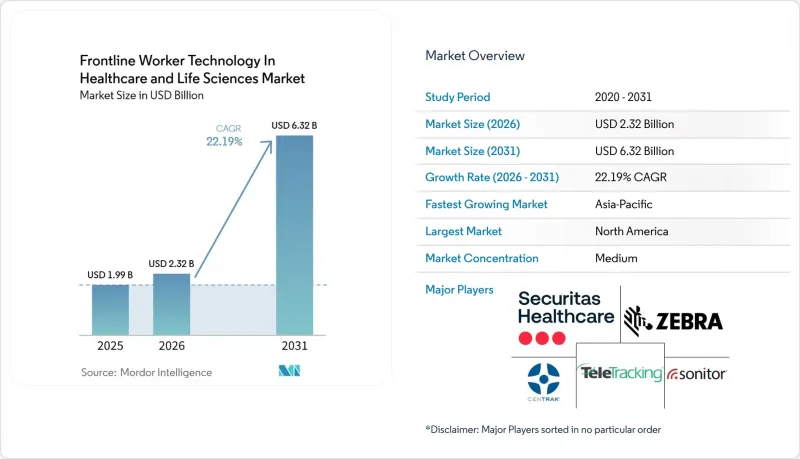
根據 Mordor Intelligence 預測,醫療和生命科學領域現場導向技術的市場規模預計將從 2025 年的 19.9 億美元成長到 2026 年的 23.2 億美元,到 2031 年將達到 63.2 億美元。
預計從 2026 年到 2031 年,其複合年成長率將達到 22.19%。
本報告按元件(軟體和服務)、部署類型(雲端、混合、本地部署)、組織規模(大型企業等)、應用程式(員工溝通與互動等)、最終用戶產業(醫院和醫療保健系統等)以及地區進行細分。市場預測以美元計價。
全球醫療和生命科學領域現場工作人員技術市場趨勢和洞察。
擴大免手持臨床工作流程工具的應用
隨著護理師和護理團隊需要在不中斷患者護理工作的情況下快速記錄信息,免持工作流程支持正成為醫療保健和生命科學領域技術市場中面向醫療專業人員的核心實用功能。 2026年發表在《JMIR Nursing》雜誌上的一項研究表明,基於語音辨識和大規模語言模型的語音護理記錄系統在生成結構化記錄方面達到了0.82的F1分數,從而減輕了日常護理中的記錄負擔。這項結果意義重大,因為記錄的品質和速度會影響交班、病歷完整性和護理協調,因此,對於醫療保健和生命科學領域的技術市場而言,床邊易用性比功能繁多更為重要。 2025年,德國電信宣布推出一款人工智慧驅動的護理記錄解決方案,可在其位於德國的資料中心實現床邊語音聽寫和結構化報告產生。這表明,免持記錄不再僅僅被視為消費者的附加功能,而是正在適應嚴格的醫療數據處理要求。梅奧診所在2025年也採用了類似的方法,在其電子健康記錄(EHR)系統中引入了一款面向護理師的虛擬助理。這凸顯了臨床團隊需要能夠與日常護理中已使用的現有記錄系統整合的工具,而不是獨立的應用程式。因此,醫療保健和生命科學領域面向現場的技術市場正在轉向能夠減少手動資料輸入,同時保持工作流程連續性和臨床管理效率的解決方案。
人員短缺帶來的壓力以及緩解職業倦怠的迫切性
醫療保健和生命科學領域第一線員工技術市場最顯著的成長要素之一仍然是持續的人員短缺。這是因為醫療服務提供者在人員配備極少的情況下,仍需努力維持醫療服務的正常運轉,同時也要應付繁重的文件工作。根據 Incredible Health 2025 年的報告顯示,基於美國超過一百萬名護理專業的數據,71% 的護理師表示人員短缺正在影響護理品質。這些壓力正在改變評估數位化投資的標準。如今,工作流程工具的價值不僅在於其效率提升,還在於其能夠提高員工留任率、減少不必要的工作量以及支援更安全的人員配置選擇。在醫療保健和生命科學領域的第一線員工技術市場,這推動了人們對排班工具、工作流程調整、行動錄製和分析工具的日益關注,這些工具能夠幫助管理者在壓力源升級為缺勤或人員流動問題之前識別它們。醫院、診所和居家照護機構也出現了類似的趨勢。每個工作場所都依賴員工,他們必須在更短的時間內完成更多的工作,同時還要滿足品質和合規標準。因此,即使醫療機構收緊預算,醫療和生命科學領域第一線工作人員所需的技術市場仍保持著廣泛的需求。
臨床和法規環境中的高檢驗負擔
在使用者導向的醫療保健和生命科學領域,驗證仍然是一項重要的限制因素。這是因為醫療工具的使用環境決定了文件的品質和可靠性以及設備的性能,而這些因素都會影響醫療決策。美國食品藥物管理局 (FDA) 發布的 2026 年品質管理系統法規說明明確指出,該法規納入了 ISO 13485:2016 標準,並將網路安全驗證納入醫療設備品質框架,從而提高了互聯臨床軟體和穿戴式裝置的合規標準。這一點至關重要,因為即使是工作流程價值高的產品,如果醫院在採購前要求提供設計控制、測試程序和風險管理方面的證據,其引進週期也可能很長。在面向使用者的醫療保健和生命科學技術市場,這些負擔往往有利於那些擁有完善的品質系統、全面的監管文件以及了解醫院病患驗證要求的部署團隊的供應商。小規模的供應商仍然具有競爭力,但進入嚴格的監管醫療保健領域需要時間,他們通常會先從較簡單的領域開始。因此,合規準備不僅影響獲利時間,還決定了您可以先觸達哪些應用程式場景和客戶群。
細分市場分析
到2025年,軟體將佔據81.22%的市場佔有率,成為醫療保健和生命科學領域技術市場的核心商業層。這一主導地位反映了工作流程應用程式、通訊平台、分析儀表板和文件工具無需等待大規模硬體更新周期即可部署在現有設備上的能力。醫院和醫療網路通常會在進行更廣泛的設備和基礎設施變更之前,尋求實際的工作流程改善。因此,軟體仍然是許多醫療服務提供者的首選產品。在醫療保健和生命科學領域技術市場,這一趨勢使軟體供應商能夠儘早贏得客戶,並為長期的模組擴展提供廣泛的機會。這也解釋了為什麼儘管其他服務的重要性日益增加,但市場仍然高度關注軟體。
預計到2031年,服務業將以23.14%的複合年成長率成長,成為該市場中成長最快的細分領域。這種成長速度表明,醫療服務提供者日益認知到,實施問題往往並非僅源於產品功能不足,而是源自於工作流程設計、培訓、整合和變更管理。 2026年發表在《BMC健康服務研究》期刊上的一項系統性研究表明,技術壓力、工作流程影響和任務動態是成功實施電子病歷(EHR)的關鍵。這凸顯了在臨床環境中提供更深入的實施支援的必要性。對於醫療保健和生命科學行業的從業人員而言,服務透過將工具與人員配置模式、臨床角色和本地操作流程相匹配,幫助他們將軟體融入日常實踐。隨著服務提供者尋求的是可衡量的工作流程改進,而不僅僅是平台存取權限,服務交付水準將繼續成為競爭優勢。
到2025年,基於雲端的部署將佔據醫療保健和生命科學領域技術領域78.61%的市場佔有率,顯著超越混合部署和本地部署解決方案。這一主導地位反映了對即時協作的實際需求,因為分散式團隊需要隨時隨地存取最新的日程安排、任務、警報和文檔,無論他們處於哪個班次或工作地點。基於雲端的部署也更符合許多醫療機構的預算趨勢,因為它們可以降低資本投入,並允許在無需大規模基礎設施改造的情況下添加新功能。在醫療保健和生命科學領域技術領域,當醫療機構採用共用營運模式支援機構團隊和現場團隊時,這種柔軟性尤其重要。因此,雲端架構不再被視為小眾選擇,而是日益成為新部署的標準起點。
預計到2031年,該細分市場將以24.39%的複合年成長率成長,在規模和成長動能方面均引領市場。這表明,新舊客戶仍在朝著同一方向發展,而非回歸傳統的託管模式。服務提供者要求更快的部署、更便捷的更新和更廣泛的行動訪問,這些需求與醫療保健和生命科學領域現場應用技術市場的雲端主導平台設計高度契合。在因資料儲存、舊有系統或內部管治需要放緩遷移速度的情況下,混合部署仍發揮作用。儘管如此,整體趨勢是傾向於採用雲端原生營運模式,將其作為通訊、分析、調度和現場執行工具的基礎。
區域分析
到2025年,北美將佔據41.11%的市場佔有率,成為醫療保健和生命科學領域第一線員工技術的最大區域市場。該地區受益於醫院對科技的大力投資、電子健康記錄的廣泛應用以及嚴重的勞動力短缺,第一線員工的生產力正日益成為一個戰略性問題,而不僅僅是一個IT問題。此外,該地區還擁有大規模的企業級醫療保健系統部署基礎,一旦在早期用例中驗證了其營運價值,便可支援工作流程、文件管理和人員配置應用程式的廣泛部署。醫療保健和生命科學領域第一線員工技術市場的這種結構,既支援在大型系統中進行迭代部署,也滿足了對更專業化應用程式的持續需求。儘管安全和合規審查日益嚴格,但北美在短期內仍然是最穩定的收入來源。
由於各國醫療服務提供者的資金籌措模式、數據法規和採用率各不相同,歐洲市場雖然重要,但卻十分分散。德國在醫院數位化方面取得了顯著進展,例如,韋塞爾福音醫院(Evangelisches Krankenhaus Wesel)於2025年實施的封閉回路型藥房管理系統,展現了醫療機構中現場文件和用藥流程的更緊密整合。此外,德國電信於2025年發布的AI驅動型護理記錄解決方案也表明,歐洲醫療服務提供者正在尋求符合各國資料處理要求的床邊生產力工具。這表明,儘管針對第一線醫護人員的歐洲醫療保健和生命科學市場正獲得廣泛關注和發展,但在地化應用模式和合管治性也日益受到重視。
預計到2031年,亞太地區將以27.99%的複合年成長率成長,成為醫療健康與生命科學領域技術領域市場成長最快的區域市場。中國國家衛生健康委員會等部門於2025年底發布了「人工智慧+醫療健康」實施細則,為未來幾年人工智慧輔助診斷和工作流程的應用奠定了更堅實的政策基礎。此外,2026年中國大規模醫院部署人工智慧輔助病患導航系統,例如江西湘雅醫院的人工智慧病患導航系統,顯示面向現場應用的人工智慧正進一步進入營運階段。印度和東南亞也在推動該地區的發展前景,智慧型手機主導的工作流程和遠端醫療基礎設施為溝通、排班和現場工作人員協調提供了切實可行的切入點。儘管中東和非洲的銷售額仍然小規模,但海灣國家對醫療系統的系統性數位化投資為該地區的醫療健康與生命科學領域技術領域市場帶來了巨大的長期成長潛力。
其他好處:
- Excel格式的市場預測(ME)表
- 3個月的分析師支持
目錄
第1章:引言
- 研究假設和市場定義
- 調查範圍
第2章:調查方法
第3章執行摘要
第4章 市場狀況
- 市場概覽
- 市場促進因素
- 擴大免手持臨床工作流程工具的應用
- 緩解人員短缺和職業倦怠的壓力是當務之急。
- 與電子病歷、即時定位系統和藥物管理系統的互通性。
- 整合音訊、影像和感測器以提高床邊工作效率
- 醫療設備感染控制和消毒要求
- 拓展分散式臨床試驗和生命科學領域的業務活動。
- 市場限制因素
- 臨床和法規環境中的高檢驗負擔
- 網路安全、隱私和身分管治的複雜性。
- 培訓期間的變更管理和工作流程中斷
- 電池續航力、設備耐用性和消毒能力之間的權衡
- 宏觀經濟因素對市場的影響
- 產業價值鏈分析
- 科技趨勢
- 監理情勢
- 波特五力分析
第5章 市場規模與成長預測
- 按組件
- 軟體
- 服務
- 不同的發展
- 基於雲端的
- 混合
- 現場
- 按組織規模
- 大公司
- 小型企業
- 透過使用
- 員工溝通與參與
- 勞動力執行與任務管理
- 人員排班和協調
- 學習與知識應用
- 勞動分析與績效管理
- 安全與合規管理
- 其他用途
- 按最終用戶行業分類
- 醫院和醫療系統
- 診所及門診醫療中心
- 長期照護機構及專業照護機構
- 居家醫療服務提供者
- 老年住家周邊設施及輔助住家周邊設施
- 按地區
- 北美洲
- 美國
- 加拿大
- 墨西哥
- 南美洲
- 巴西
- 阿根廷
- 其他南美國家
- 歐洲
- 德國
- 英國
- 法國
- 義大利
- 西班牙
- 俄羅斯
- 其他歐洲國家
- 亞太地區
- 中國
- 印度
- 日本
- 韓國
- 澳洲
- 其他亞太國家
- 中東和非洲
- 中東
- 沙烏地阿拉伯
- 阿拉伯聯合大公國
- 其他中東國家
- 非洲
- 南非
- 奈及利亞
- 其他非洲國家
- 中東
- 北美洲
第6章 競爭情勢
- 市場集中度
- 策略趨勢
- 市佔率分析
- 公司簡介
- 36Zero Group Ltd.
- Aatmunn, Inc.
- Aetheer, Inc.
- Augmentir, Inc.
- Epicore Biosystems, Inc.
- Garmin Ltd.
- Hexagon AB
- Honeywell International Inc.
- Abridge Inc.
- Librestream Technologies Inc.
- MakuSafe Inc.
- Microsoft Corporation
- PTC Inc.
- UKG Inc.
- RealWear Inc.
- Hippocratic AI
- Siemens AG
- SlateSafety, Inc.
- Zebra Technologies Corporation
- Vuzix Corporation
第7章 市場機會與未來展望
According to Mordor Intelligence, the frontline worker technology in healthcare and life sciences market size is expected to increase from USD 1.99 billion in 2025 to USD 2.32 billion in 2026 and reach USD 6.32 billion by 2031, growing at a CAGR of 22.19% over 2026-2031.
This report is Segmented by Component (Software, and Services), Deployment (Cloud-Based, Hybrid, and On-Premises), Organization Size (Large Enterprises, and More), Application (Employee Communication and Engagement, and More), End-User Industry (Hospitals and Health Systems, and More), and Geography. The Market Forecasts are Provided in Terms of Value (USD).
Global Frontline Worker Technology In Healthcare and Life Sciences Market Trends and Insights
Rising Adoption of Hands-Free Clinical Workflow Tools
Hands-free workflow support is moving into the practical core of the frontline worker technology in healthcare and life sciences market because nurses and care teams need faster ways to capture information without stepping away from patient-facing tasks. A 2026 study in JMIR Nursing showed that a voice-based nursing documentation system built on speech recognition and large language models achieved an F1-score of 0.82 for structured record generation and reduced perceived documentation burden during routine care. That result matters because documentation quality and speed influence shift handoffs, chart completeness, and care coordination, making bedside usability more important than broad feature count in the frontline worker technology market for healthcare and life sciences. Deutsche Telekom presented an AI-supported nursing documentation solution in 2025 that enabled bedside voice dictation and structured report generation within German data centers, demonstrating that hands-free documentation is being adapted to strict healthcare data-handling requirements rather than treated as a consumer-style add-on. Mayo Clinic moved in a similar direction in 2025 by deploying a nurse virtual assistant embedded within its EHR, underscoring that clinical teams want tools that fit the record system already used in daily care rather than separate, standalone applications. As a result, the frontline worker technology in healthcare and life sciences market is leaning toward solutions that reduce manual input while preserving workflow continuity and clinical control.
Staffing Pressure and Burnout Reduction Imperative
Workforce strain remains one of the clearest growth drivers for the frontline worker technology in healthcare and life sciences market because providers are trying to stabilize care delivery with lean staffing and high documentation demand. In 2025, Incredible Health reported, based on data from more than 1 million nursing professionals in the United States, that 71% of nurses said understaffing was harming care quality. That pressure changes how digital spending is evaluated, since workflow tools are now judged not only by efficiency gains but also by their ability to improve retention, reduce avoidable workload, and support safer staffing choices. In the frontline worker technology in healthcare and life sciences market, this has raised interest in scheduling tools, workflow coordination, mobile documentation, and analytics that help managers spot stress points before they become absenteeism or turnover problems. The same dynamic is evident across hospitals, clinics, and home-based care operations, as each setting relies on workers who must handle more tasks in less time while still meeting quality and compliance standards. This keeps demand broad-based across the frontline worker technology in healthcare and life sciences market even when provider budgets are selective.
High Validation Burden in Clinical and Regulated Environments
Validation remains a meaningful restraint for the frontline worker technology in healthcare and life sciences market because healthcare tools are used in settings where documentation quality, reliability, and device behavior can affect care decisions. Coverage of the FDA Quality Management System Regulation in 2026 noted that the rule incorporates ISO 13485:2016 and clarifies the inclusion of cybersecurity validation within the medical device quality framework, raising the compliance standard for connected clinical software and wearables. This matters because even products with strong workflow value may face longer deployment cycles when hospitals require evidence of design controls, testing discipline, and risk management before procurement. In the frontline worker technology in healthcare and life sciences market, that burden tends to favor vendors with established quality systems, stronger regulatory documentation, and implementation teams that understand inpatient validation requirements. Smaller vendors can still compete, but they often face slower entry into highly regulated provider environments and may gain traction first in lower-complexity settings. As a result, compliance readiness affects not only time-to-revenue but also which use cases and customer groups can be reached first.
Other drivers and restraints analyzed in the detailed report include:
- Interoperability With EHR, RTLS, and Medication Safety Systems
- Voice, Vision, and Sensor Fusion for Bedside Productivity
- Cybersecurity, Privacy, and Identity Governance Complexity
For complete list of drivers and restraints, kindly check the Table Of Contents.
Segment Analysis
Software accounted for 81.22% of the market in 2025, which made it the core commercial layer across the frontline worker technology in healthcare and life sciences market. That lead reflects how workflow applications, communication platforms, analytics dashboards, and documentation tools can be rolled out on existing devices without waiting for a large hardware refresh cycle. Software also remains the first purchase in many provider settings because hospitals and care networks typically want visible workflow gains before committing to broader device or infrastructure changes. In the frontline worker technology in healthcare and life sciences market, this gives software vendors an early position in customer accounts and a wider opening for module expansion over time. It also explains why the market continues to show strong software concentration even as other parts of the offering become more important.
Services are projected to grow at a 23.14% CAGR through 2031, making them the fastest-growing segment of this market. That pace suggests providers increasingly understand that adoption problems are often rooted in workflow design, training, integration, and change management rather than missing product features alone. A 2026 systematic review in BMC Health Services Research found that technostress, workflow impact, and task dynamism were central to successful EHR adaptation, which supports the need for deeper implementation support in clinical settings. In the frontline worker technology in healthcare and life sciences industry, services help turn software into daily practice by aligning tools with staffing models, clinical roles, and local operating routines. Over time, service intensity is likely to remain a competitive differentiator because providers want measurable workflow improvement, not just access to a platform.
Cloud-based deployment held 78.61% share in 2025, which placed it well ahead of hybrid and on-premises models across the frontline worker technology in healthcare and life sciences market. This dominance reflects a practical need for real-time coordination, as dispersed teams require current schedules, tasks, alerts, and access to documentation across shifts and care locations. Cloud-based deployment also aligns better with budgetary patterns in many healthcare settings because it reduces capital requirements and allows organizations to add functionality without a major infrastructure overhaul. In the frontline worker technology in healthcare and life sciences market, that flexibility is especially useful where providers are supporting both facility-based and field-based teams from a shared operating model. The result is that cloud architecture is no longer viewed as a niche option; it is increasingly the normal starting point for new deployments.
The same segment is projected to grow at a 24.39% CAGR through 2031, making it the leader in both scale and momentum. That combination shows that new buyers and existing customers are still moving in the same direction rather than shifting back to legacy hosting models. Providers want faster implementation, easier updates, and broader mobile access, and those needs closely align with cloud-led platform design in the frontline worker technology market for healthcare and life sciences. Hybrid deployments still retain a role where data residency, legacy systems, or internal governance require a slower transition path. Even so, the broader trajectory points toward cloud-native operating models as the preferred foundation for communication, analytics, scheduling, and frontline execution tools.
Complete Report Scope:
- By Component
- Software
- Services
- By Deployment
- Cloud-Based
- Hybrid
- On-Premises
- By Organization Size
- Large Enterprises
- Small and Medium Enterprises
- By Application
- Employee Communication and Engagement
- Workforce Execution and Task Management
- Workforce Scheduling and Coordination
- Learning and Knowledge Enablement
- Workforce Analytics and Performance Management
- Safety and Compliance Management
- Other Applications
- By End-user Industry
- Hospitals and Health Systems
- Clinics and Ambulatory Care Centers
- Long-Term Care and Skilled Nursing Facilities
- Home Healthcare Agencies
- Senior Living and Assisted Living Facilities
- By Geography
- North America
- United States
- Canada
- Mexico
- South America
- Brazil
- Argentina
- Rest of South America
- Europe
- Germany
- United Kingdom
- France
- Italy
- Spain
- Russia
- Rest of Europe
- Asia-Pacific
- China
- India
- Japan
- South Korea
- Australia
- Rest of Asia-Pacific
- Middle East and Africa
- Middle East
- Saudi Arabia
- United Arab Emirates
- Rest of Middle East
- Africa
- South Africa
- Nigeria
- Rest of Africa
- Middle East
- North America
Geography Analysis
North America held 41.11% of the market in 2025 and represented the largest regional base within the frontline worker technology in healthcare and life sciences market. The region benefits from stronger hospital technology spending, wider use of digital records, and acute workforce pressure that makes frontline productivity a strategic issue rather than a narrow IT concern. It also has a large installed base of enterprise healthcare systems that can support broader rollout of workflow, documentation, and staffing applications once early use cases show operational value. In the frontline worker technology in healthcare and life sciences market, that mix supports both repeat deployment within large systems and ongoing demand for more specialized applications. Even with tighter security and compliance review, North America remains the clearest near-term revenue center.
Europe remains an important but mixed opportunity because provider funding models, data rules, and implementation pace differ across countries. Germany has made visible progress in hospital digitalization, and Evangelisches Krankenhaus Wesel's closed-loop medication management rollout in 2025 demonstrated how frontline documentation and medication processes are being more closely connected within care settings. Deutsche Telekom's 2025 AI-assisted nursing documentation solution also showed that European providers are pursuing bedside productivity tools that align with domestic data processing expectations. This means the frontline worker technology in healthcare and life sciences market in Europe is advancing with strong interest, but with greater emphasis on localized deployment models and governance fit.
Asia Pacific is projected to advance at a 27.99% CAGR through 2031 and is the fastest-growing regional segment in the frontline worker technology in healthcare and life sciences market. China's National Health Commission and other ministries issued implementation guidelines for AI plus healthcare in late 2025, which placed AI-assisted diagnostic and workflow coverage on a much firmer policy footing for the years ahead. China also saw scaled hospital deployment in 2026, including an AI-powered patient navigation agent system at Xiangya Jiangxi Hospital, demonstrating that frontline AI is moving further into operational use. India and Southeast Asia add to the regional outlook because smartphone-led workflows and telemedicine infrastructure create practical entry points for communication, scheduling, and field-worker coordination. Middle East and Africa remain smaller in revenue terms, yet organized digital investment in Gulf healthcare systems gives the frontline worker technology in healthcare and life sciences market a meaningful long-term runway there as well.
- 36Zero Group Ltd.
- Aatmunn, Inc.
- Aetheer, Inc.
- Augmentir, Inc.
- Epicore Biosystems, Inc.
- Garmin Ltd.
- Hexagon AB
- Honeywell International Inc.
- Abridge Inc.
- Librestream Technologies Inc.
- MakuSafe Inc.
- Microsoft Corporation
- PTC Inc.
- UKG Inc.
- RealWear Inc.
- Hippocratic AI
- Siemens AG
- SlateSafety, Inc.
- Zebra Technologies Corporation
- Vuzix Corporation
Additional Benefits:
- The market estimate (ME) sheet in Excel format
- 3 months of analyst support
TABLE OF CONTENTS
1 INTRODUCTION
- 1.1 Study Assumptions and Market Definition
- 1.2 Scope of the Study
2 RESEARCH METHODOLOGY
3 EXECUTIVE SUMMARY
4 MARKET LANDSCAPE
- 4.1 Market Overview
- 4.2 Market Drivers
- 4.2.1 Rising Adoption of Hands-Free Clinical Workflow Tools
- 4.2.2 Staffing Pressure and Burnout Reduction Imperative
- 4.2.3 Interoperability With EHR, RTLS, and Medication Safety Systems
- 4.2.4 Voice, Vision, and Sensor Fusion for Bedside Productivity
- 4.2.5 Infection Control and Device Sanitization Requirements
- 4.2.6 Expansion of Decentralized Trials and Life Sciences Field Operations
- 4.3 Market Restraints
- 4.3.1 High Validation Burden in Clinical and Regulated Environments
- 4.3.2 Cybersecurity, Privacy, and Identity Governance Complexity
- 4.3.3 Workflow Disruption During Change Management and Training
- 4.3.4 Battery Life, Device Durability, and Sanitization Trade-Offs
- 4.4 Impact of Macroeconomic Factors on the Market
- 4.5 Industry Value Chain Analysis
- 4.6 Technology Outlook
- 4.7 Regulatory Landscape
- 4.8 Porter's Five Forces Analysis
- 4.8.1 Threat of New Entrants
- 4.8.2 Bargaining Power of Suppliers
- 4.8.3 Bargaining Power of Buyers
- 4.8.4 Threat of Substitutes
- 4.8.5 Intensity of Competitive Rivalry
5 MARKET SIZE AND GROWTH FORECASTS (VALUE)
- 5.1 By Component
- 5.1.1 Software
- 5.1.2 Services
- 5.2 By Deployment
- 5.2.1 Cloud-Based
- 5.2.2 Hybrid
- 5.2.3 On-Premises
- 5.3 By Organization Size
- 5.3.1 Large Enterprises
- 5.3.2 Small and Medium Enterprises
- 5.4 By Application
- 5.4.1 Employee Communication and Engagement
- 5.4.2 Workforce Execution and Task Management
- 5.4.3 Workforce Scheduling and Coordination
- 5.4.4 Learning and Knowledge Enablement
- 5.4.5 Workforce Analytics and Performance Management
- 5.4.6 Safety and Compliance Management
- 5.4.7 Other Applications
- 5.5 By End-user Industry
- 5.5.1 Hospitals and Health Systems
- 5.5.2 Clinics and Ambulatory Care Centers
- 5.5.3 Long-Term Care and Skilled Nursing Facilities
- 5.5.4 Home Healthcare Agencies
- 5.5.5 Senior Living and Assisted Living Facilities
- 5.6 By Geography
- 5.6.1 North America
- 5.6.1.1 United States
- 5.6.1.2 Canada
- 5.6.1.3 Mexico
- 5.6.2 South America
- 5.6.2.1 Brazil
- 5.6.2.2 Argentina
- 5.6.2.3 Rest of South America
- 5.6.3 Europe
- 5.6.3.1 Germany
- 5.6.3.2 United Kingdom
- 5.6.3.3 France
- 5.6.3.4 Italy
- 5.6.3.5 Spain
- 5.6.3.6 Russia
- 5.6.3.7 Rest of Europe
- 5.6.4 Asia-Pacific
- 5.6.4.1 China
- 5.6.4.2 India
- 5.6.4.3 Japan
- 5.6.4.4 South Korea
- 5.6.4.5 Australia
- 5.6.4.6 Rest of Asia-Pacific
- 5.6.5 Middle East and Africa
- 5.6.5.1 Middle East
- 5.6.5.1.1 Saudi Arabia
- 5.6.5.1.2 United Arab Emirates
- 5.6.5.1.3 Rest of Middle East
- 5.6.5.2 Africa
- 5.6.5.2.1 South Africa
- 5.6.5.2.2 Nigeria
- 5.6.5.2.3 Rest of Africa
- 5.6.5.1 Middle East
- 5.6.1 North America
6 COMPETITIVE LANDSCAPE
- 6.1 Market Concentration
- 6.2 Strategic Moves
- 6.3 Market Share Analysis
- 6.4 Company Profiles (includes Global Level Overview, Market Level Overview, Core Segments, Financials as available, Strategic Information, Market Rank/Share, Products and Services, Recent Developments)
- 6.4.1 36Zero Group Ltd.
- 6.4.2 Aatmunn, Inc.
- 6.4.3 Aetheer, Inc.
- 6.4.4 Augmentir, Inc.
- 6.4.5 Epicore Biosystems, Inc.
- 6.4.6 Garmin Ltd.
- 6.4.7 Hexagon AB
- 6.4.8 Honeywell International Inc.
- 6.4.9 Abridge Inc.
- 6.4.10 Librestream Technologies Inc.
- 6.4.11 MakuSafe Inc.
- 6.4.12 Microsoft Corporation
- 6.4.13 PTC Inc.
- 6.4.14 UKG Inc.
- 6.4.15 RealWear Inc.
- 6.4.16 Hippocratic AI
- 6.4.17 Siemens AG
- 6.4.18 SlateSafety, Inc.
- 6.4.19 Zebra Technologies Corporation
- 6.4.20 Vuzix Corporation
7 MARKET OPPORTUNITIES AND FUTURE OUTLOOK
- 7.1 White-Space and Unmet-Need Assessment

 2026年企業培訓人工智慧(AI)全球市場報告2026年全球籃球訓練服務市場報告
 2034年工業訓練市場預測-按培訓類型、交付方式、技術、公司規模、最終用戶和地區分類的全球分析循環經營模式平台市場預測至2034年:按平台類型、經營模式、部署方式、平台功能、最終用戶和地區分類的全球分析
 企業培訓市場-2026-2032年全球市場預測訓練模擬器市場-2026-2032年全球市場預測第一線員工培訓市場-2026-2032年全球市場預測銷售培訓市場預測至2034年-按培訓類型、交付方式、內容、實施方法、應用、最終用戶和地區分類的全球分析全球企業培訓市場:機會與策略展望(至2035年)2034年循環經營模式教育培訓市場預測:按培訓類型、交付方式、經營模式、最終用戶和地區分類的全球分析