


 |
市場調查報告書
商品編碼
2099198
衛星電視:市場佔有率分析、產業趨勢與統計、成長預測(2026-2031)Satellite TV - Market Share Analysis, Industry Trends & Statistics, Growth Forecasts (2026 - 2031) |
||||||

※ 本網頁內容可能與最新版本有所差異。詳細情況請與我們聯繫。
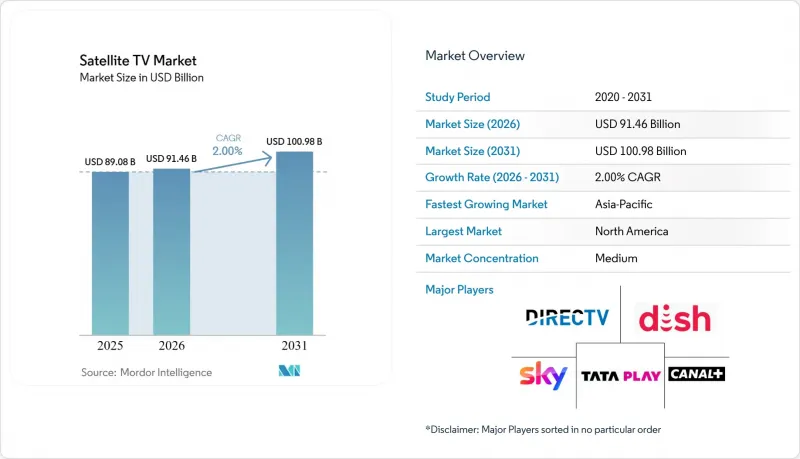
據 Mordor Intelligence 稱,衛星電視市場在 2025 年的價值為 890.8 億美元,預計到 2031 年將達到 1009.8 億美元,而 2026 年為 914.6 億美元,預測期(2026-2031 年)的複合成長率為 2.00%。
本報告按服務類型(直播衛星電視、衛星付費電視、免費電視、商業電視、混合電視和加值服務)、收入模式(訂閱、廣告和交易/按次付費)、最終用戶(住宅、商業用戶和機構用戶)以及地區(北美、南美、歐洲、亞太地區及其他地區)進行細分。市場預測以美元計價。
全球衛星電視市場趨勢及洞察
觀看優質體育賽事和實況活動正在推動用戶成長。
在衛星電視市場,付費運動賽事仍然是最有效的客戶維繫策略之一,因為觀眾仍然非常重視能夠可靠地觀看實況活動。 DIRECTV推出的每月69.99美元的「MySports Genre Pack」套餐,表明該營運商正將體育賽事從其全頻道套餐中分離出來,以更好地適應當前的觀看習慣。此舉意義重大,因為雖然許多家庭不再需要大規模的娛樂套餐,但如果體育賽事直播更簡單、更具吸引力,他們仍然願意付費觀看。此外,美國聯邦通訊委員會(FCC)在2026年2月就體育廣播實踐和市場趨勢徵求意見時,也強調了消費者獲取付費體育賽事管道的碎片化程度。在此背景下,如果營運商能夠簡化其服務,並以更統一的方式提供體育賽事觀看服務,衛星電視市場將從中受益。這也有助於套餐的穩定性,因為大型賽事和聯賽的轉播權持續吸引那些可能不會續訂更廣泛付費電視服務的臨時觀眾。
農村地區和基礎設施不足地區的DTH普及率
在電視接收仍主要依賴訊號覆蓋而非家庭寬頻環境的地區,直播衛星電視(DTH)存取仍然是衛星電視市場的重要結構支撐。在許多農村地區,衛星接收比擴展密集的地面電波網路更容易擴展,因為單一平台即可覆蓋廣闊區域,無需為每個地區建造冗餘的「最後一公里」連接。這使得衛星電視市場即使在消費者隨著時間推移在付費和免費觀看選項之間切換時也能保持其存在。衛星天線接收的持續重要性也意味著,已安裝的設備、熟悉的觀看方式以及頻道切換習慣在短期內不會消失。這一點至關重要,因為營運商可以利用這一現有基礎,在每個家庭中保持其相關性,同時圍繞價值、內容和柔軟性重新思考其服務。這項因素的最大受益者仍集中在亞太、非洲和南美洲地區,在這些地區,當地情況和經濟環境對電視接取的影響比成熟的寬頻市場更為直接。
停掉有線電視服務和OTT替代方案
用戶取消有線電視服務(停掉有線電視服務)仍然是衛星電視市場最大的結構性限制因素,因為它影響用戶數量以及家庭願意為各種電視套餐支付的費用。尼爾森報告稱,到2025年,串流媒體的收視人數將首次超過廣播和有線電視的總合,這表明日常觀看行為發生了顯著轉變。隨著串流媒體成為主要的觀看方式,衛星電視市場不僅面臨提供內容的壓力,還面臨證明其套餐多樣性合理性的更大壓力。這不僅僅是技術替代的問題;點播觀看正在改變觀眾對「時間」、「控制」和「娛樂成本」的固有認知。因此,綜合娛樂套餐比體育、混合或活動套餐更容易受到衝擊。所以,衛星電視市場需要更具針對性的套餐配置、更清晰的價值提案以及更強大的服務整合,以遏制那些不再認為傳統龐大頻道陣容具有日常價值的觀眾流失。
細分市場分析
到2025年,DTH衛星電視服務將佔據衛星電視市場42.22%的佔有率,並繼續保持其在收入方面的主導地位。這一地位反映了長期以來對直播到戶傳輸、接收器生態系統、安裝網路和品牌用戶關係等方面的投入,這些投入在短期內難以被取代。衛星電視市場仍然高度依賴DTH,因為它是與家庭認知度和全國覆蓋範圍最緊密連結的服務模式。 DTH在服務所有細分市場方面也繼續發揮著至關重要的作用:都市區高階用戶、中等收入家庭以及寬頻選擇不如大城市豐富的偏遠地區家庭。儘管成長速度放緩,但這一細分市場仍然是衛星電視市場的基石,保持著有史以來最高的部署規模,並且與每月訂閱收費的聯繫最為緊密。
在那些價格、機構接觸或普遍接觸比高級付費方案更重要的地區,免費電視、商業電視和其他衛星主導服務對於維持受眾覆蓋率仍然至關重要。這些服務類別繼續將衛星電視市場與普通觀眾、商業環境以及可能無法透過傳統高級直播衛星電視套餐覆蓋的低收入家庭聯繫起來。混合型和增值型衛星電視服務預計到2031年將以5.11%的複合年成長率成長,成為衛星電視市場中成長最快的服務類型。這種成長反映了用戶接收方式從衛星天線接收轉向將網路回傳路徑、應用程式聚合和點播功能整合到單一介面的服務。衛星電視產業正經歷服務配置轉型期的最重大變革,因為未來的收入結構將不再那麼依賴僅使用天線接收,而是更依賴於營運商如何將線性電視和數位電視的便利性打包在一起。
區域分析
到2025年,北美將佔衛星電視市場佔有率的26.11%,成為收入最高的地區。儘管串流媒體持續發展,但北美仍佔據重要地位,因為優質體育賽事、成熟的直播衛星電視品牌以及高價值的電視觀看習慣將繼續支持付費服務。此外,北美衛星電視市場正面臨著「剪線潮」 (停掉有線電視服務 cutting )帶來的最直接壓力,這意味著營運商比以往任何時候都更需要清晰的產品定義。 DIRECTV於2026年1月推出的「MySports Genre Pack」正是這種轉變的體現,它不再僅依賴傳統的全頻道套餐,而是轉向更聚焦、以賽事主導的產品。這種區域性轉變意義重大,因為北美往往決定著其他成熟市場之後會以更具選擇性的方式採納的商業模式。
歐洲仍是衛星電視市場的重要支柱,衛星接收與強大的光纖和IPTV基礎設施並存,並未消失。該地區受益於歷史悠久的在軌分發系統、深厚的公共和私營廣播傳統,以及大量仍在使用線性電視的家庭。 2025年1月,歐洲通訊衛星公司(Eutelsat)與Polsat Plus集團續簽了長期合作關係,繼續透過HOTBIRD衛星星座進行影像分發,這確認了衛星在歐洲電視分發領域將繼續發揮重要作用。此外,CANAL+在完成對總合的收購後,公佈了2025年總收入達86.65億歐元(94.02億美元)的業績,凸顯了其在成熟市場和成長型市場中的規模優勢。因此,憑藉其覆蓋範圍、產品組合規模以及廣播公司的持續投入,歐洲仍然是衛星電視市場保持戰略重要性的地區。
預計到2031年,亞太地區將以3.42%的複合年成長率成長,成為衛星電視市場成長最快的地區。這一成長主要得益於寬頻普及率不均衡、龐大的農村人口以及不同收入階層對大規模電視分發的持續需求。此外,亞太衛星電視市場也受惠於營運商迅速適應多樣化的觀賞習慣,而非固守傳統的電視模式。 Astro計劃於2026年整合Disney+,並廣泛關注本地內容,這表明區域供應商正在將全球串流媒體服務與其本地電視產業結合。儘管南美洲和中東及非洲的整體規模仍然較小,但其廣泛的廣播覆蓋、體育賽事觀看以及基於價格的訂閱模式,使其在全部區域繼續保持重要地位,並在衛星電視市場佔據重要地位。
其他好處:
- Excel格式的市場預測(ME)表
- 3個月的分析師支持
目錄
第1章:引言
- 研究假設和市場定義
- 調查範圍
第2章:調查方法
第3章執行摘要
第4章 市場狀況
- 市場概覽
- 市場促進因素
- 高畫質和超高清直播的需求日益成長
- 農村地區及基礎建設低度開發市場的DTH普及率
- 觀看優質體育賽事和實況活動是付費電視價值的體現。
- 結合衛星廣播和OTT的混合配套服務將有助於提高客戶維繫和ARPU值。
- 重複利用頻段和波束定向容量增強將提高獲利能力。
- 機上盒的更換週期正在產生升級主導的需求。
- 市場限制因素
- 停掉有線電視服務和OTT替代方案
- 對價格敏感的家庭訂閱付費電視的意願下降。
- 來自衛星容量和發射成本的壓力
- 內容版權的零碎化正在推高解約率和客戶獲取成本。
- 產業價值鏈分析
- 監理情勢
- 技術展望
- 宏觀經濟因素對市場的影響
- 波特五力分析
第5章 市場規模與成長預測
- 按服務類型
- 家庭衛星電視服務
- 衛星付費電視服務
- 免費衛星電視服務
- 商業衛星電視服務
- 混合型和加值衛星電視服務
- 按收入模式
- 訂閱制
- 基於廣告
- 交易型/按次付費觀看
- 最終用戶
- 住宅
- 商業和公共機構
- 按地區
- 北美洲
- 美國
- 加拿大
- 墨西哥
- 南美洲
- 巴西
- 阿根廷
- 智利
- 其他南美國家
- 歐洲
- 德國
- 英國
- 法國
- 義大利
- 西班牙
- 其他歐洲國家
- 亞太地區
- 中國
- 日本
- 印度
- 韓國
- 澳洲
- 其他亞太國家
- 中東
- 沙烏地阿拉伯
- 阿拉伯聯合大公國
- 卡達
- 其他中東國家
- 非洲
- 南非
- 埃及
- 奈及利亞
- 其他非洲國家
- 北美洲
第6章 競爭情勢
- 市場集中度
- 策略趨勢
- Vendor Positioning Analysis
- 公司簡介
- DIRECTV, LLC
- EchoStar Corporation
- Sky Group Limited
- Tata Play Limited
- Sun Direct TV Private Limited
- CANAL+SA
- MEO-Servicos de Comunicacoes e Multimedia, SA
- Orange SA
- Astro Malaysia Holdings Berhad
- SKY Perfect JSAT Corporation
- TrueVisions Group Co., Ltd.
- StarTimes Software Technology Co., Ltd.
- Vrio Corp.
- Cignal TV, Inc.
- DISH TV India Limited
- Grupo Televisa, SAB
- Bell Canada
- Foxtel Management Pty Ltd
- Shaw Satellite Services Inc.
- Eutelsat Communications SA
第7章 市場機會與未來展望
According to Mordor Intelligence, the satellite TV market size was valued at USD 89.08 billion in 2025 and estimated to grow from USD 91.46 billion in 2026 to reach USD 100.98 billion by 2031, at a CAGR of 2.00% during the forecast period (2026-2031).
This report is Segmented by Service Type (DTH, Satellite Pay-TV, Free-To-Air, Commercial, and Hybrid and Value-Added), Revenue Model (Subscription-Based, Advertisement-Based, and Transactional/PPV), End User (Residential Households, and Commercial and Institutional), and Geography (North America, South America, Europe, Asia-Pacific, and More). The Market Forecasts are Provided in Terms of Value (USD).
Global Satellite TV Market Trends and Insights
Premium Sports And Live Event Viewing Fueling Subscriptions
Premium sports remains one of the clearest retention tools in the satellite TV market because viewers still place high value on reliable live event access. DIRECTV launched its MySports Genre Pack at USD 69.99 per month, which showed how operators are separating sports from the full channel bundle to better match current viewing behavior. This move matters because many households no longer want large entertainment bundles, but they still pay for live sports when the offer is simpler and easier to justify. The FCC also sought comment in February 2026 on sports broadcasting practices and marketplace developments, which highlighted how fragmented access to premium sports has become for consumers. In that setting, the satellite TV market benefits when operators can reduce service complexity and present sports viewing in a more unified way. This driver also supports package stability because major tournaments and league rights continue to bring back occasional viewers who may not otherwise retain a broad pay-TV subscription.
DTH Penetration in Rural and Infrastructure-Underserved Areas
DTH access remains a basic structural support for the satellite TV market in areas where television coverage still depends more on signal reach than on household broadband capability. In many rural locations, satellite reception remains easier to scale than dense terrestrial network expansion because one platform can serve a wide footprint without local last-mile duplication. This allows the satellite TV market to remain present even when consumers move between paid and free viewing options over time. The continued importance of dish-based reception also means that the installed base of equipment, viewing familiarity, and channel navigation habits does not disappear quickly. That matters because operators can use this installed base to defend household relevance while they reshape offers around value, content, and flexibility. The strongest benefit from this driver remains concentrated in Asia-Pacific, Africa, and South America, where geography and affordability still shape television access more directly than in mature broadband markets.
Cord-Cutting and OTT Substitution
Cord-cutting remains the strongest structural restraint on the satellite TV market because it affects both subscriber counts and the amount households are willing to pay for broad television packages. Nielsen reported in 2025 that streaming exceeded the combined share of broadcast and cable viewing for the first time, which marked a clear change in everyday viewing behavior. Once streaming became the larger viewing destination, the satellite TV market faced more pressure to justify package breadth rather than only content availability. The problem is not limited to technology substitution because on-demand viewing also changes how households think about timing, control, and entertainment spending. That leaves general entertainment bundles more exposed than sports-led, hybrid, or event-focused offers. The satellite TV market therefore needs narrower packaging, clearer value positioning, and stronger service integration to slow the loss of viewers who no longer see daily value in large traditional channel lineups.
Other drivers and restraints analyzed in the detailed report include:
- Rising Demand For HD and UHD Linear Broadcasting
- Hybrid Satellite-OTT Bundling Improves Retention
- Declining Pay-TV Willingness in Price-Sensitive Markets
For complete list of drivers and restraints, kindly check the Table Of Contents.
Segment Analysis
DTH Satellite TV Services held 42.22% of the satellite TV market share in 2025, which kept it as the leading service type by revenue. This position reflects years of investment in direct household delivery, receiver ecosystems, installation networks, and branded subscription relationships that remain difficult to replace quickly. The satellite TV market still depends heavily on DTH because it is the service format most closely tied to broad household familiarity and national coverage. DTH also remains important because it works across premium urban users, mid-income families, and remote households that do not have the same broadband options as large cities. Even in slower-growth conditions, this segment continues to anchor the satellite TV market because it holds the widest historical installed base and the clearest connection to monthly subscription billing.
Free-to-air, commercial, and other satellite-led service types remain meaningful because they preserve audience reach in places where price, institutional use, or universal access matter more than deep premium bundling. These categories keep the satellite TV market connected to public viewing needs, business environments, and lower-income households that may not enter through a traditional premium DTH plan. Hybrid and Value-Added Satellite TV Services is projected to expand at a 5.11% CAGR through 2031, making it the fastest-growing service type in the satellite TV market size. That growth reflects the shift toward integrated services that combine dish-based reception with internet return paths, app aggregation, and on-demand features inside one interface. The satellite TV industry is changing most clearly at this edge of the service mix because the future revenue layer will depend less on dish-only viewing and more on how operators package linear television with digital convenience.
Complete Report Scope:
- By Service Type
- Direct-to-Home Satellite TV Services
- Satellite Pay-TV Services
- Free-to-Air Satellite TV Services
- Commercial Satellite TV Services
- Hybrid and Value-added Satellite TV Services
- By Revenue Model
- Subscription based
- Advertisement Based
- Transactional / Pay-Per-View
- By End User
- Residential Households
- Commercial and Institutional
- By Geography
- North America
- United States
- Canada
- Mexico
- South America
- Brazil
- Argentina
- Chile
- Rest of South America
- Europe
- Germany
- United Kingdom
- France
- Italy
- Spain
- Rest of Europe
- Asia-Pacific
- China
- Japan
- India
- South Korea
- Australia
- Rest of Asia-Pacific
- Middle East
- Saudi Arabia
- United Arab Emirates
- Qatar
- Rest of Middle East
- Africa
- South Africa
- Egypt
- Nigeria
- Rest of Africa
- North America
Geography Analysis
North America held 26.11% of the satellite TV market in 2025, which made it the largest regional contributor by revenue. The region remains important because premium sports, established DTH brands, and high-value television habits still support paid services even as streaming gains further ground. The satellite TV market in North America is also under the most direct pressure from cord-cutting, which means operators need sharper product definitions than they did in earlier years. DIRECTV's launch of the MySports Genre Pack in January 2026 reflected this change by moving toward a narrower, event-led offer instead of relying only on the traditional full channel bundle. This regional shift matters because North America often sets the commercial pattern that other mature markets later adapt in more selective form.
Europe remained a major pillar of the satellite TV market because satellite reception continues to coexist with strong fiber and IPTV infrastructure rather than disappearing under it. The region benefits from long-established orbital distribution, strong public and private broadcast traditions, and households that still use linear television at scale. Eutelsat renewed its long-running partnership with Polsat Plus Group in January 2025 for video distribution from the HOTBIRD neighborhood, which reinforced the continuing role of satellite in European television delivery. CANAL+ also reported combined 2025 revenue of EUR 8,665 million (USD 9,402 million) after completing the MultiChoice acquisition, which highlighted the value of scale across mature and growth-oriented territories. Europe therefore remains a region where the satellite TV market preserves strategic relevance through distribution reach, portfolio scale, and continued broadcaster commitment.
Asia-Pacific is projected to grow at a 3.42% CAGR through 2031, making it the fastest-growing regional part of the satellite TV market. Growth in this region is supported by uneven broadband penetration, large rural populations, and continuing demand for mass television distribution across diverse income groups. The satellite TV market in Asia-Pacific also benefits from operators that are adapting quickly to mixed viewing behavior rather than defending legacy television formats without change. Astro's 2026 Disney+ integration and broader local content positioning showed how regional providers are blending global streaming access with local television relationships. South America, the Middle East, and Africa remain smaller in overall value, but they continue to matter to the satellite TV market because broad coverage, sports viewing, and price-tiered reception models still support ongoing relevance across those regions.
- DIRECTV, LLC
- EchoStar Corporation
- Sky Group Limited
- Tata Play Limited
- Sun Direct TV Private Limited
- CANAL+ S.A.
- MEO - Servicos de Comunicacoes e Multimedia, S.A.
- Orange S.A.
- Astro Malaysia Holdings Berhad
- SKY Perfect JSAT Corporation
- TrueVisions Group Co., Ltd.
- StarTimes Software Technology Co., Ltd.
- Vrio Corp.
- Cignal TV, Inc.
- DISH TV India Limited
- Grupo Televisa, S.A.B.
- Bell Canada
- Foxtel Management Pty Ltd
- Shaw Satellite Services Inc.
- Eutelsat Communications S.A.
Additional Benefits:
- The market estimate (ME) sheet in Excel format
- 3 months of analyst support
TABLE OF CONTENTS
1 INTRODUCTION
- 1.1 Study Assumptions and Market Definition
- 1.2 Scope of the Study
2 RESEARCH METHODOLOGY
3 EXECUTIVE SUMMARY
4 MARKET LANDSCAPE
- 4.1 Market Overview
- 4.2 Market Drivers
- 4.2.1 Rising Demand For HD and UHD Linear Broadcasting
- 4.2.2 DTH Penetration In Rural and Infrastructure-Constrained Markets
- 4.2.3 Premium Sports and Live Event Viewing Retains Pay-TV Value
- 4.2.4 Hybrid Satellite-OTT Bundling Improves Retention and ARPU
- 4.2.5 Spectrum Reuse and Beam-Targeted Capacity Gains Improve Monetization
- 4.2.6 Set-Top Box Renewal Cycles Create Upgrade-Led Demand
- 4.3 Market Restraints
- 4.3.1 Cord-Cutting and OTT Substitution
- 4.3.2 Declining Pay-TV Willingness in Price-Sensitive Households
- 4.3.3 Satellite Capacity and Launch Cost Pressure
- 4.3.4 Content Rights Fragmentation Raises Churn and Acquisition Cost
- 4.4 Industry Value Chain Analysis
- 4.5 Regulatory Landscape
- 4.6 Technological Outlook
- 4.7 Impact Of Macroeconomic Factors On The Market
- 4.8 Porter's Five Forces Analysis
- 4.8.1 Threat Of New Entrants
- 4.8.2 Bargaining Power Of Suppliers
- 4.8.3 Bargaining Power Of Buyers
- 4.8.4 Threat Of Substitutes
- 4.8.5 Industry Rivalry
5 MARKET SIZE AND GROWTH FORECASTS (VALUE)
- 5.1 By Service Type
- 5.1.1 Direct-to-Home Satellite TV Services
- 5.1.2 Satellite Pay-TV Services
- 5.1.3 Free-to-Air Satellite TV Services
- 5.1.4 Commercial Satellite TV Services
- 5.1.5 Hybrid and Value-added Satellite TV Services
- 5.2 By Revenue Model
- 5.2.1 Subscription based
- 5.2.2 Advertisement Based
- 5.2.3 Transactional / Pay-Per-View
- 5.3 By End User
- 5.3.1 Residential Households
- 5.3.2 Commercial and Institutional
- 5.4 By Geography
- 5.4.1 North America
- 5.4.1.1 United States
- 5.4.1.2 Canada
- 5.4.1.3 Mexico
- 5.4.2 South America
- 5.4.2.1 Brazil
- 5.4.2.2 Argentina
- 5.4.2.3 Chile
- 5.4.2.4 Rest of South America
- 5.4.3 Europe
- 5.4.3.1 Germany
- 5.4.3.2 United Kingdom
- 5.4.3.3 France
- 5.4.3.4 Italy
- 5.4.3.5 Spain
- 5.4.3.6 Rest of Europe
- 5.4.4 Asia-Pacific
- 5.4.4.1 China
- 5.4.4.2 Japan
- 5.4.4.3 India
- 5.4.4.4 South Korea
- 5.4.4.5 Australia
- 5.4.4.6 Rest of Asia-Pacific
- 5.4.5 Middle East
- 5.4.5.1 Saudi Arabia
- 5.4.5.2 United Arab Emirates
- 5.4.5.3 Qatar
- 5.4.5.4 Rest of Middle East
- 5.4.6 Africa
- 5.4.6.1 South Africa
- 5.4.6.2 Egypt
- 5.4.6.3 Nigeria
- 5.4.6.4 Rest of Africa
- 5.4.1 North America
6 COMPETITIVE LANDSCAPE
- 6.1 Market Concentration
- 6.2 Strategic Moves
- 6.3 Vendor Positioning Analysis
- 6.4 Company Profiles (includes Global Level Overview, Market Level Overview, Core Segments, Financials as available, Strategic Information, Products and Services, Recent Developments)
- 6.4.1 DIRECTV, LLC
- 6.4.2 EchoStar Corporation
- 6.4.3 Sky Group Limited
- 6.4.4 Tata Play Limited
- 6.4.5 Sun Direct TV Private Limited
- 6.4.6 CANAL+ S.A.
- 6.4.7 MEO - Servicos de Comunicacoes e Multimedia, S.A.
- 6.4.8 Orange S.A.
- 6.4.9 Astro Malaysia Holdings Berhad
- 6.4.10 SKY Perfect JSAT Corporation
- 6.4.11 TrueVisions Group Co., Ltd.
- 6.4.12 StarTimes Software Technology Co., Ltd.
- 6.4.13 Vrio Corp.
- 6.4.14 Cignal TV, Inc.
- 6.4.15 DISH TV India Limited
- 6.4.16 Grupo Televisa, S.A.B.
- 6.4.17 Bell Canada
- 6.4.18 Foxtel Management Pty Ltd
- 6.4.19 Shaw Satellite Services Inc.
- 6.4.20 Eutelsat Communications S.A.
7 MARKET OPPORTUNITIES AND FUTURE OUTLOOK
- 7.1 White-Space And Unmet-Need Assessment

