


 |
市場調查報告書
商品編碼
2099185
資料中心記憶體:市場佔有率分析、產業趨勢與統計、成長預測(2026-2031)Data Center Memory - Market Share Analysis, Industry Trends & Statistics, Growth Forecasts (2026 - 2031) |
||||||

※ 本網頁內容可能與最新版本有所差異。詳細情況請與我們聯繫。
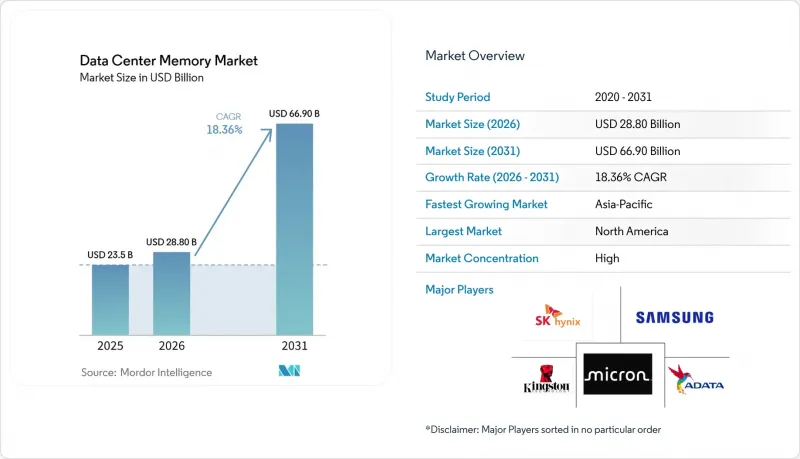
根據 Mordor Intelligence 預測,資料中心記憶體市場規模預計將在 2025 年達到 235 億美元,2026 年達到 288 億美元,到 2031 年達到 669 億美元,2026 年至 2031 年的複合年成長率為 18.36%。
本報告按記憶體類型(DRAM、高頻寬記憶體等)、模組和外形尺寸(RDIMM、LRDIMM、MRDIMM等)、容量(32 GB以下、32 GB至64 GB等)、資料速率(5600 MT/s以下等)、最終用途(雲端服務供應商、企業資料中心等)和地區(北美地區(北美地區等)細分。市場預測以美元(USD)計價。
全球資料中心記憶體市場趨勢及洞察
人工智慧伺服器記憶體密度的不斷提高正在推動結構性需求。
由於人工智慧系統對每個加速器和每個主機伺服器的記憶體容量需求不斷成長,以及對持續頻寬的需求(不僅在訓練期間,而且在推理期間),資料中心記憶體市場正在擴張。記憶體已成為以推理為中心的部署的瓶頸,買家的關注點也從簡單的容量數字轉向了每個伺服器在實際工作負載下能夠維持的實用頻寬和效率。供應商正透過提高堆疊密度、I/O端口數量和電源效率來應對這一變化,這表明產品藍圖的製定是基於人工智慧的結構性需求,而不是短期的更新週期。三星計劃於2026年出貨其首款商用HBM4,這也表明,當效能提升能夠支援人工智慧叢集的經濟效益時,買家正在接受更快的產品過渡,從而縮短資料中心記憶體市場的代際更替時間。隨著模型上下文長度的增加以及推理進入持續生產環境,需求基準不斷向上調整。這就是為什麼資料中心記憶體市場的發展更像是戰略容量市場,而不是傳統的組件市場。
向專用於DDR5的伺服器CPU的轉變將加速平台現代化。
此外,伺服器CPU向DDR5專用平台的轉變也推動了資料中心記憶體市場的發展。這是因為在購買新伺服器時,系統級記憶體升級(而不僅僅是模組級升級)正變得越來越必要。英特爾在2026年6月發布的伺服器公告進一步強化了這一趨勢,其對至強6+處理器的支持,以及針對人工智慧和網路工作負載的高通道DDR5伺服器記憶體配置,都強化了這一趨勢。這種轉變不僅限於人工智慧叢集,隨著企業客戶取代老舊的DDR4基礎設施並遷移到具有更高頻寬和更高基準容量的平台,通用伺服器的資料中心記憶體市場價值組成也隨之提升。 JEDEC的MRDIMM藍圖增加了另一層升級空間,透過更先進的模組化架構,提升DDR5效能並延長同一平台系列的商業生命週期。因此,資料中心記憶體市場將與伺服器的資本化週期、主機板更新換代和電源更換更加緊密地聯繫在一起,記憶體成長將與整個基礎設施的現代化改造掛鉤,而不僅僅是單一模組的更換。
HBM 的高容量需求限制了傳統 DDR5 的供應,並限制了其廣泛應用。
在資料中心記憶體市場,短期內最大的限制因素是生產資源向HBM的轉移,因為主要廠商優先發展能夠帶來更高策略和財務回報的高階AI記憶體產品線。這些廠商在先進DRAM的供應中也扮演著核心角色,因此每次向HBM生產轉移都會導致面向大眾市場的傳統伺服器DDR5記憶體供應趨緊。客戶趨勢顯示了這個限制因素的嚴重性,大型科技公司紛紛超越標準採購流程,直接投資建造未來的晶圓廠和生產線。這意味著,那些採購能力不如大型廠商的企業資料中心和託管服務供應商可能面臨更長的前置作業時間和更大的成本壓力,即使工作負載需求不斷成長,也可能導致產能擴張受阻。因此,儘管資料中心記憶體市場在高階領域可能強勁成長,但更廣泛的伺服器市場的部分領域仍可能受到供不應求和預算超支的困擾。
細分市場分析
到2025年,DRAM將佔據資料中心記憶體市場74.87%的佔有率,其主導地位源自於DRAM在超大規模、企業級、託管和研究應用程式等基於CPU的伺服器記憶體中的多功能應用。隨著DDR5伺服器平台的廣泛普及,DRAM受益於此領域的成長,各大OEM廠商的新系統紛紛採用更高的頻寬和更大的基礎容量作為標準配置,以支援人工智慧和通用工作負載。持久記憶體和儲存層級記憶體仍然是市場佔有率最小的細分市場,其應用受到每位元成本高於主流DRAM模組以及認證流程冗長的限制。因此,DRAM在資料中心記憶體市場中繼續佔據核心地位,尤其是在那些更重視可預測的供應和廣泛的平台支援而非高階加速器級頻寬的環境中。
高頻寬記憶體 (HBM) 預計將在 2026 年至 2031 年間以 18.97% 的複合年成長率 (CAGR) 成長,其成長反映出 AI 加速器買家越來越重影片寬和能源效率,而非簡單的容量比較。 SK 海力士已完成全球首款 HBM4 的研發,並已做好量產準備。同時,三星已於 2026 年開始 HBM4 的商用出貨,這印證了頂級記憶體產品認證和上市週期的加速。 HBM 在價格和效能方面也佔據著獨特的地位,儘管傳統 DRAM 仍然支撐著大規模的伺服器部署基礎,但其在銷售中的重要性卻在不斷提升。這種平衡意味著,資料中心記憶體市場在規模上仍將依賴 DRAM,而 HBM 將在 AI 加速器平台的價值成長方面佔據主導地位。
2025年,RDIMM佔據了62.39%的銷售佔有率,這反映了其作為大多數企業和雲端平台預設伺服器記憶體模組的穩固地位。其主導地位源自於成熟的認證體系、廣泛的OEM支援以及與大規模DDR5伺服器部署的強大相容性,使其在2025年全年都能保持資料中心記憶體市場的核心地位。 LRDIMM繼續被應用於某些高容量系統,但隨著RDIMM密度的提高以及通用伺服器設計開始在不遷移到專用格式的情況下吸收更多容量,其應用範圍有所縮小。其他伺服器記憶體模組,包括新型低功耗和CXL連接型,市佔率有所增強,儘管其市場規模仍然較小,因為面向推理的系統設計開始考慮標準DIMM框架之外的其他方案。
預計從2026年到2031年,MRDIMM的複合年成長率將達到19.18%,這一前景與DDR5伺服器效能的下一階段密切相關。 JEDEC在2026年4月發布的關於MRDIMM的最新報告以及英特爾的「Diamond Rapids」技術表明,MRDIMM正從狹隘的實驗性領域走向更加明確的商業引進週期。量產MRDIMM伺服器的學術測試也證實了其顯著的頻寬提升和能耗降低,即使目前尚不需要進行平台級的更換,業者也有理由進行模組級升級。因此,MRDIMM正在成為資料中心記憶體市場的重要組成部分,因為它既能擴展DDR5基礎設施的價值,又能為記憶體受限的伺服器工作負載帶來更高的效能。
區域分析
到2025年,北美將佔據資料中心記憶體市場46.28%的佔有率,憑藉超大規模園區、託管中心和企業基礎設施的混合配置,為區域銷售做出最大貢獻。美國仍是這一地位的核心,亞馬遜、微軟、谷歌和Meta等公司持續支援高密度部署,以提升先進資料中心的容量,這種集中部署直接轉化為大規模的伺服器記憶體採購計畫。與「星際之門」(Stargate)相關的美國基礎設施建設計畫將進一步提升長期運算需求,支援未來部署中伺服器數量的增加和更強大的記憶體配置。美國本土記憶體製造也日益重要,美光科技確認了其在美國的大規模擴張計劃,並獲得了用於本地產能建設的公共資金,這進一步加強了不斷成長的區域需求與供應鏈韌性之間的聯繫。加拿大透過其國家級人工智慧計畫為該全部區域增添了新的元素,而墨西哥則憑藉著營運商日益成長的近岸外包興趣,鞏固了其在北美地區的地位,這些營運商希望擴大其在北美的部署選擇。
預計亞太地區2026年至2031年將以19.28%的複合年成長率成長,成為資料中心記憶體市場成長最快的地區。這主要歸功於該地區人工智慧基礎設施建設和記憶體投資的集中度較高。韓國在這一成長前景中仍佔據核心地位,三星和SK海力士繼續在先進記憶體生產領域發揮核心作用,並不斷擴大投資以滿足未來人工智慧的需求。中國正透過國家支持的人工智慧資料中心的擴張來建立自身的國內需求基礎,但與韓國的主要供應商相比,其在頂級HBM領域的競爭力仍然有限。印度、新加坡、泰國和台灣地區也透過引進新的需求中心、資本流入或在支撐整個資料中心記憶體市場的封裝和半導體生態系統中扮演重要角色,推動該地區的成長。
歐洲呈現更穩定的成長模式,主要得益於各國政府人工智慧計畫、節能基礎設施設計以及高效能伺服器記憶體架構的逐步普及所帶來的需求成長。Softbank Corporation在法國的園區計畫表明,歐洲大規模人工智慧資料中心計畫正成為影響未來記憶體採購的大規模因素。南美洲雖然規模仍然較小,但在巴西和智利等主要經濟體的推動下,透過擴展託管和雲端服務,其區域市場持續發展。中東和非洲是推動巨大需求的催化劑,沙烏地阿拉伯和阿拉伯聯合大公國等國的國家主導的人工智慧專案正在創建新的叢集,需要在北美和東北亞等傳統核心區域之外部署高密度記憶體。
其他好處:
- Excel格式的市場預測(ME)表
- 3個月的分析師支持
目錄
第1章:引言
- 研究假設和市場定義
- 調查範圍
第2章:調查方法
第3章執行摘要
第4章 市場狀況
- 市場概覽
- 市場促進因素
- 提高人工智慧伺服器的記憶體密度
- 遷移到 DDR5 專用伺服器 CPU
- CXL連接的記憶體擴展
- 提高電力受限資料中心的“每瓦頻寬”
- 主權人工智慧與超大規模建設
- 記憶體刷新周期由高容量伺服器平台驅動
- 市場限制因素
- 對 HBM 的需求不斷成長,限制了傳統 DDR5 的供應。
- EUV光刻在高密度晶片中的良率和大規模生產面臨挑戰
- 中國出口限制與本土化之間的兩極化
- 新興模組標準認證的複雜性
- 產業供應鏈分析
- 宏觀經濟因素對市場的影響
- 監理情勢
- 技術展望
- 波特五力分析
第5章 市場規模與成長預測
- 按記憶體類型
- DRAM
- 高頻寬內存
- 持久記憶體和儲存類別內存
- 按模組和外形規格
- 註冊式 DIMM (RDIMM)
- 負載降低型 DIMM(LRDIMM)
- 連接複用秩 DIMM (MRDIMM)
- 其他伺服器記憶體模組
- 按產能
- 32 GB 或更少
- 32 GB~64 GB
- 64 GB~128 GB
- 128 GB 或更多
- 按數據速率
- 最高可達 5600 噸/秒
- 6400 MT/s
- 7200噸/秒或以上
- 按最終用途
- 雲端服務供應商
- 企業資料中心
- 託管服務提供者
- 政府和研究機構的資料中心
- 邊緣資料中心
- 按地區
- 北美洲
- 美國
- 加拿大
- 墨西哥
- 歐洲
- 德國
- 英國
- 法國
- 義大利
- 其他歐洲國家
- 亞太地區
- 中國
- 日本
- 韓國
- 台灣
- 印度
- 其他亞太國家
- 南美洲
- 中東和非洲
- 北美洲
第6章 競爭情勢
- 市場集中度
- 策略趨勢
- 市佔率分析
- 公司簡介
- Samsung Electronics Co., Ltd.
- SK hynix Inc.
- Micron Technology, Inc.
- Kingston Technology Company, Inc.
- ADATA Technology Co., Ltd.
- SMART Modular Technologies, Inc.
- Transcend Information, Inc.
- Innodisk Corporation
- Corsair Gaming, Inc.
- G.SKILL International Enterprise Co., Ltd.
- Team Group Inc.
- Apacer Technology Inc.
- Patriot Memory, LLC
- Netlist, Inc.
- Super Micro Computer, Inc.
- Dell Technologies Inc.
- Hewlett Packard Enterprise Company
- Lenovo Group Limited
- NVIDIA Corporation
- Advanced Micro Devices, Inc.
- Intel Corporation
- Marvell Technology, Inc.
- Rambus Inc.
- Astera Labs, Inc.
- JEDEC Solid State Technology Association
第7章 市場機會與未來展望
According to Mordor Intelligence, the data center memory market size is projected to be USD 23.50 billion in 2025, USD 28.80 billion in 2026, and reach USD 66.90 billion by 2031, growing at a CAGR of 18.36% from 2026 to 2031.
This report is Segmented by Memory Type (DRAM, High Bandwidth Memory, and More), Module and Form Factor (RDIMM, LRDIMM, MRDIMM, and More), Capacity (Up To 32 GB, 32 GB To 64 GB, and More), Data Rate (Up To 5600 MT/S, and More), End-Use Application (Cloud Service Providers, Enterprise Data Centers, and More), and Geography (North America, and More). The Market Forecasts are Provided in Terms of Value (USD).
Global Data Center Memory Market Trends and Insights
AI Server Memory Density Scaling Drives Structural Demand
The data center memory market is moving higher because AI systems now need more memory per accelerator, more memory per host server, and more sustained bandwidth during inference rather than only during training. Memory has become a limiting factor in inference-heavy deployments, shifting buyer attention away from simple capacity counts toward usable bandwidth and efficiency each server can sustain under live workloads. Suppliers are responding by raising stack density, input and output counts, and power efficiency, indicating that product roadmaps are being built around structural AI demand rather than short replacement cycles. Samsung's first commercial HBM4 shipments in 2026 also indicate that buyers are accepting faster product transitions when the performance gain supports AI cluster economics, thereby shortening the time between one generation and the next in the data center memory market. As model context lengths increase and inference moves into continuous production settings, the demand baseline keeps resetting upward, which is why the data center memory market is behaving more like a strategic capacity market than a traditional component market.
DDR5-Only Server CPU Transition Accelerates Platform Refresh
The data center memory market is also being boosted by the server CPU transition to DDR5-only platforms, as new server purchases now require a system-level memory upgrade rather than a module-level upgrade alone. Intel's June 2026 server announcements reinforced this direction with Xeon 6+ support built around high-channel DDR5 server memory configurations for AI and networking workloads. The shift matters beyond AI clusters because enterprise buyers replacing aging DDR4 infrastructure are moving to a platform generation that standardizes higher bandwidth and higher baseline capacity, which raises the value mix of the data center memory market across general-purpose servers. JEDEC's MRDIMM roadmap adds another upgrade layer, pushing DDR5 performance higher and extending the commercial runway of the same platform family through more advanced module architectures. This makes the data center memory market more closely tied to server capital spending cycles, motherboard refreshes, and power-delivery changes, keeping memory growth linked to full infrastructure modernization rather than isolated module replacement.
HBM Capacity Pull Constraining Conventional DDR5 Supply Limits Broad Access
The strongest near-term restraint in the data center memory market is the capacity pull from HBM, as leading manufacturers prioritize premium AI memory lines that offer stronger strategic and financial returns. The same manufacturers also sit at the core of advanced DRAM supply, so every shift toward HBM production tightens the availability of conventional server DDR5 for the broader market. Customer behavior shows how serious that constraint has become, with large technology buyers moving beyond standard procurement and providing direct funding for future fab equipment and production lines. That raises lead times and cost pressures for enterprise data centers and colocation providers that lack the same purchasing leverage, and it can delay capacity additions even as their own workload demand rises. The result is that the data center memory market can expand strongly at the high end while still leaving parts of the wider server market exposed to tight supply and elevated budgets.
Other drivers and restraints analyzed in the detailed report include:
- CXL-Attached Memory Expansion Unlocks A New Addressable Surface
- Bandwidth-Per-Watt Gains Redefine Purchase Priorities
- EUV Yield And Ramp Challenges Slow Practical Capacity Expansion
For complete list of drivers and restraints, kindly check the Table Of Contents.
Segment Analysis
DRAM held 74.87% of the data center memory market share in 2025, and that leadership came from its universal role in CPU-attached server memory across hyperscale, enterprise, colocation, and research deployments. The category benefited from the broad move toward DDR5 server platforms, because new systems from major OEMs are aligning around higher bandwidth and larger baseline capacities that support both AI and general-purpose workloads. Persistent and storage-class memory remained the smallest segment, with its use limited by higher per-bit costs and longer qualification paths in comparison with mainstream DRAM modules. This kept DRAM at the center of the data center memory market, especially in environments where predictable volume availability and broad platform support mattered more than premium accelerator-tier bandwidth.
High Bandwidth Memory is projected to expand at an 18.97% CAGR from 2026 to 2031, and its rise reflects the fact that AI accelerator buyers increasingly value delivered bandwidth and power efficiency over simple capacity comparisons. SK hynix completed the world-first HBM4 development and positioned the product for mass production, while Samsung began commercial HBM4 shipments in 2026, confirming that the top end of the memory stack is moving toward faster qualification and launch cycles. HBM also sits in a separate pricing and performance tier, which lifts its revenue importance even though conventional DRAM still serves the larger installed server base. That balance means the data center memory market will continue to rely on DRAM for scale, while HBM captures an outsized share of value growth in AI accelerator platforms.
RDIMMs held a 62.39% revenue share in 2025, reflecting their entrenched use as the default server memory module across most enterprise and cloud platforms. Their advantage came from a mature qualification base, wide OEM support, and strong compatibility with the first large wave of DDR5 server deployments, which kept them central to the data center memory market through 2025. LRDIMMs continued to serve selected high-capacity systems, yet their addressable role narrowed as RDIMM densities improved and broader server designs absorbed more capacity without moving into specialized formats. Other server memory modules, including newer low-power and CXL-linked options, remained small but became more visible as inference-focused system designs started to look beyond standard DIMM assumptions.
MRDIMMs are projected to record a 19.18% CAGR from 2026 to 2031, and that outlook is closely tied to the next step in server performance within the DDR5 generation. JEDEC's April 2026 MRDIMM updates and Intel's Diamond Rapids support path show that this format is moving into a clearer commercial adoption cycle rather than staying in a narrow experimental niche. Academic testing on production MRDIMM servers also showed meaningful bandwidth gains and energy savings, providing operators with a case for module-level upgrades where full platform replacement is not yet necessary. This makes MRDIMMs important to the data center memory market because they can extend the value of DDR5 infrastructure while still delivering a new performance tier for memory-bound server workloads.
Complete Report Scope:
- By Memory Type
- DRAM
- High Bandwidth Memory
- Persistent and Storage-Class Memory
- By Module and Form Factor
- Registered DIMM (RDIMM)
- Load-Reduced DIMM (LRDIMM)
- Multiplexed Rank DIMM (MRDIMM)
- Other Server Memory Modules
- By Capacity
- Up to 32 GB
- 32 GB to 64 GB
- 64 GB to 128 GB
- Above 128 GB
- By Data Rate
- Up to 5600 MT/s
- 6400 MT/s
- 7200 MT/s and Above
- By End-Use Application
- Cloud Service Providers
- Enterprise Data Centers
- Colocation Providers
- Government and Research Data Centers
- Edge Data Centers
- By Geography
- North America
- United States
- Canada
- Mexico
- Europe
- Germany
- United Kingdom
- France
- Italy
- Rest of Europe
- Asia-Pacific
- China
- Japan
- South Korea
- Taiwan
- India
- Rest of Asia-Pacific
- South America
- Middle East and Africa
- North America
Geography Analysis
North America held 46.28% of the data center memory market share in 2025, making it the largest regional revenue contributor through its mix of hyperscale campuses, colocation hubs, and enterprise infrastructure. The United States remained the core of that position because Amazon, Microsoft, Google, and Meta continue to anchor a very dense installed base of advanced data center capacity, and that concentration translates directly into large server memory purchasing programs. The planned Stargate-related wave of U.S. infrastructure activity adds another layer of long-term compute demand, which supports both higher server unit counts and richer memory configurations in future deployments. Domestic memory manufacturing also gained strategic weight, with Micron confirming major U.S. expansion plans and public funding support for local capacity, which ties regional demand growth more closely to supply-chain resilience. Canada added to the regional picture through sovereign AI planning, while Mexico's role improved through nearshoring-related interest from operators seeking wider North American deployment options.
Asia-Pacific is projected to grow at a 19.28% CAGR from 2026 to 2031, making it the fastest-growing region in the data center memory market, as demand-side AI buildout and supply-side memory investment are both concentrated there. South Korea remains central to that outlook, since Samsung and SK hynix continue to anchor advanced memory production while also expanding investment programs aimed at future AI demand. China adds a separate domestic demand layer through state-backed AI data center expansion, even though its ability to compete in the highest-end HBM tier remains more limited than that of South Korea's leading suppliers. India, Singapore, Thailand, and Taiwan also strengthen the regional case, because they add new demand locations, capital flows, or packaging and semiconductor ecosystem roles that support the wider data center memory market.
Europe contributes a steadier growth pattern, with demand shaped by sovereign AI commitments, power-aware infrastructure design, and gradual adoption of efficient server memory architectures. SoftBank's France campus project shows that large AI data center commitments are now material enough in Europe to influence future memory procurement at scale. South America remains smaller, but the regional market continues to develop through colocation and cloud expansion led by larger economies such as Brazil and Chile. Middle East and Africa adds an important demand catalyst, because sovereign AI programs in countries such as Saudi Arabia and the UAE are creating new clusters that require dense memory provisioning outside the traditional North American and Northeast Asian core.
- Samsung Electronics Co., Ltd.
- SK hynix Inc.
- Micron Technology, Inc.
- Kingston Technology Company, Inc.
- ADATA Technology Co., Ltd.
- SMART Modular Technologies, Inc.
- Transcend Information, Inc.
- Innodisk Corporation
- Corsair Gaming, Inc.
- G.SKILL International Enterprise Co., Ltd.
- Team Group Inc.
- Apacer Technology Inc.
- Patriot Memory, LLC
- Netlist, Inc.
- Super Micro Computer, Inc.
- Dell Technologies Inc.
- Hewlett Packard Enterprise Company
- Lenovo Group Limited
- NVIDIA Corporation
- Advanced Micro Devices, Inc.
- Intel Corporation
- Marvell Technology, Inc.
- Rambus Inc.
- Astera Labs, Inc.
- JEDEC Solid State Technology Association
Additional Benefits:
- The market estimate (ME) sheet in Excel format
- 3 months of analyst support
TABLE OF CONTENTS
1 INTRODUCTION
- 1.1 Study Assumptions and Market Definition
- 1.2 Scope of the Study
2 RESEARCH METHODOLOGY
3 EXECUTIVE SUMMARY
4 MARKET LANDSCAPE
- 4.1 Market Overview
- 4.2 Market Drivers
- 4.2.1 AI Server Memory Density Scaling
- 4.2.2 DDR5-Only Server CPU Transition
- 4.2.3 CXL-Attached Memory Expansion
- 4.2.4 Bandwidth-Per-Watt Gains For Power-Constrained Data Centers
- 4.2.5 Sovereign AI And Hyperscale Buildout
- 4.2.6 Memory Refresh Cycles Driven By High-Capacity Server Platforms
- 4.3 Market Restraints
- 4.3.1 HBM Capacity Pull Constraining Conventional DDR5 Supply
- 4.3.2 EUV Yield And Ramp Challenges On High-Density Dies
- 4.3.3 Export-Control And China-Localization Bifurcation
- 4.3.4 Qualification Complexity Across Emerging Module Standards
- 4.4 Industry Supply Chain Analysis
- 4.5 Impact of Macroeconomic Factors on the Market
- 4.6 Regulatory Landscape
- 4.7 Technological Outlook
- 4.8 Porter's Five Forces Analysis
- 4.8.1 Bargaining Power of Suppliers
- 4.8.2 Bargaining Power of Buyers
- 4.8.3 Threat of New Entrants
- 4.8.4 Threat of Substitutes
- 4.8.5 Intensity of Competitive Rivalry
5 MARKET SIZE AND GROWTH FORECASTS (VALUE)
- 5.1 By Memory Type
- 5.1.1 DRAM
- 5.1.2 High Bandwidth Memory
- 5.1.3 Persistent and Storage-Class Memory
- 5.2 By Module and Form Factor
- 5.2.1 Registered DIMM (RDIMM)
- 5.2.2 Load-Reduced DIMM (LRDIMM)
- 5.2.3 Multiplexed Rank DIMM (MRDIMM)
- 5.2.4 Other Server Memory Modules
- 5.3 By Capacity
- 5.3.1 Up to 32 GB
- 5.3.2 32 GB to 64 GB
- 5.3.3 64 GB to 128 GB
- 5.3.4 Above 128 GB
- 5.4 By Data Rate
- 5.4.1 Up to 5600 MT/s
- 5.4.2 6400 MT/s
- 5.4.3 7200 MT/s and Above
- 5.5 By End-Use Application
- 5.5.1 Cloud Service Providers
- 5.5.2 Enterprise Data Centers
- 5.5.3 Colocation Providers
- 5.5.4 Government and Research Data Centers
- 5.5.5 Edge Data Centers
- 5.6 By Geography
- 5.6.1 North America
- 5.6.1.1 United States
- 5.6.1.2 Canada
- 5.6.1.3 Mexico
- 5.6.2 Europe
- 5.6.2.1 Germany
- 5.6.2.2 United Kingdom
- 5.6.2.3 France
- 5.6.2.4 Italy
- 5.6.2.5 Rest of Europe
- 5.6.3 Asia-Pacific
- 5.6.3.1 China
- 5.6.3.2 Japan
- 5.6.3.3 South Korea
- 5.6.3.4 Taiwan
- 5.6.3.5 India
- 5.6.3.6 Rest of Asia-Pacific
- 5.6.4 South America
- 5.6.5 Middle East and Africa
- 5.6.1 North America
6 COMPETITIVE LANDSCAPE
- 6.1 Market Concentration
- 6.2 Strategic Moves
- 6.3 Market Share Analysis
- 6.4 Company Profiles (includes Global Level Overview, Market Level Overview, Core Segments, Financials as available, Strategic Information, Products and Services, Recent Developments)
- 6.4.1 Samsung Electronics Co., Ltd.
- 6.4.2 SK hynix Inc.
- 6.4.3 Micron Technology, Inc.
- 6.4.4 Kingston Technology Company, Inc.
- 6.4.5 ADATA Technology Co., Ltd.
- 6.4.6 SMART Modular Technologies, Inc.
- 6.4.7 Transcend Information, Inc.
- 6.4.8 Innodisk Corporation
- 6.4.9 Corsair Gaming, Inc.
- 6.4.10 G.SKILL International Enterprise Co., Ltd.
- 6.4.11 Team Group Inc.
- 6.4.12 Apacer Technology Inc.
- 6.4.13 Patriot Memory, LLC
- 6.4.14 Netlist, Inc.
- 6.4.15 Super Micro Computer, Inc.
- 6.4.16 Dell Technologies Inc.
- 6.4.17 Hewlett Packard Enterprise Company
- 6.4.18 Lenovo Group Limited
- 6.4.19 NVIDIA Corporation
- 6.4.20 Advanced Micro Devices, Inc.
- 6.4.21 Intel Corporation
- 6.4.22 Marvell Technology, Inc.
- 6.4.23 Rambus Inc.
- 6.4.24 Astera Labs, Inc.
- 6.4.25 JEDEC Solid State Technology Association
7 MARKET OPPORTUNITIES AND FUTURE OUTLOOK
- 7.1 White-Space and Unmet-Need Assessment


