


 |
市場調查報告書
商品編碼
2099122
LLM基礎設施GPU:市場佔有率分析、產業趨勢與統計、成長預測(2026-2031年)LLM Infrastructure GPU - Market Share Analysis, Industry Trends & Statistics, Growth Forecasts (2026 - 2031) |
||||||

※ 本網頁內容可能與最新版本有所差異。詳細情況請與我們聯繫。
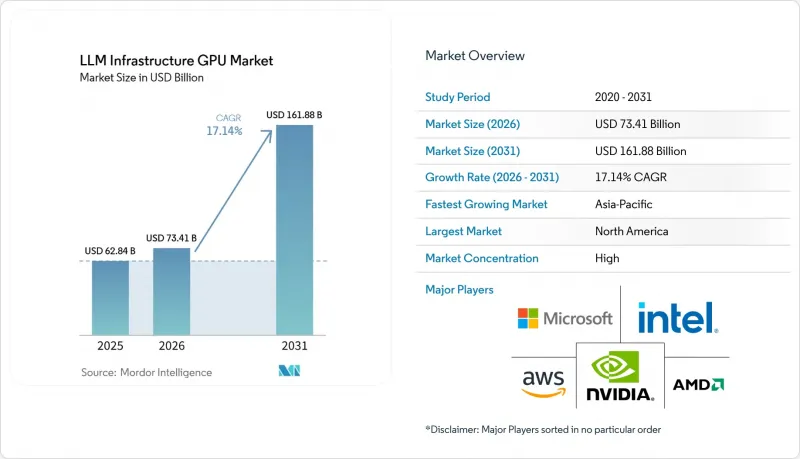
據 Mordor Intelligence 稱,LLM 基礎設施的 GPU 市場預計將從 2025 年的 628.4 億美元成長到 2026 年的 734.1 億美元,到 2031 年達到 1,618.8 億美元,預計 2026 年至 2031 年的複合年成長率為 17.4%。
本報告依部署模式(雲端資料中心、企業和私人資料中心等)、工作負載類型(訓練GPU等)、最終用戶(超大規模資料中心業者雲端服務商和雲端服務供應商、企業等)、GPU整合方式(基於PCIe的GPU等)、冷卻方式(風冷GPU、水冷GPU)和地區進行細分。市場預測以美元(USD)為單位。
全球GPU市場趨勢及LLM基礎設施洞察
基礎模型訓練對高密度 GPU叢集的需求不斷成長。
機器學習基礎設施GPU市場正受到基礎模型訓練規模快速擴張的推動,從數千個加速器的叢集擴展到數萬個加速器的集群。 NVIDIA宣布,Vera Rubin NVL72將於2026年5月全面投產,其配置為統一運算域,在一個機架中整合72個GPU。這顯示機器學習基礎設施GPU市場對機架密度的預期發生了多麼迅速的變化。 NVIDIA也報告稱,CoreWeave、IBM和NVIDIA已將其MLPerf Training v6.0提交結果擴展到8192個Blackwell GPU的規模,這是MLCommons同行評審框架(NVIDIA.COM)中檢驗的最大叢集。同時,NVIDIA在2026年1月提交給美國證券交易委員會(SEC)的文件中披露,已向CoreWeave投資20億美元,以加速人工智慧工廠的建設,目標是在2030年前實現超過5吉瓦的產能。這表明,產能規劃的製定已提前數年完成。這種轉變正在將LLM基礎設施的GPU市場從簡單的硬體採購週期轉變為長期基礎設施市場,未來的資本投入決定了進入許可權。此外,儘早鎖定容量的機構在擴展訓練規模、快速推出服務以及跨模型世代復用基礎設施方面具有優勢,從而進一步拉大了超大規模買家和小規模運營商之間的差距。
在LLM開發和服務交付中擴大GPU加速雲端服務的應用。
LLM 基礎設施的 GPU 市場也受益於 GPU 雲端使用量的激增,因為許多買家需要快速獲取最新一代硬體,而無需事先建立完全私有的資料中心。 2025 年 10 月,AMD 和 OpenAI 宣佈建立 6 吉瓦的策略夥伴關係。首批 1 吉瓦的 AMD Instinct MI450 部署計劃於 2026 年下半年進行,這表明雲端容量的合約規模已達到基礎設施等級。 2026 年 3 月,IBM 和 NVIDIA 擴大了合作關係,宣布 IBM Cloud 將於 2026 年第二季提供 NVIDIA Blackwell Ultra GPU,用於大規模訓練和推理。這反映了對受管理且合規的 GPU 存取日益成長的需求。隨後,在 2026 年 4 月,CoreWeave 擴大了與 Meta 簽訂的價值 210 億美元的長期 AI 雲契約,並與 Jane Street 簽署了一份價值 60 億美元的 AI 雲契約。這凸顯了基於承諾的容量合約如何塑造 LLM 基礎設施 GPU 市場的雲端經濟格局。這一趨勢表明,買家越來越重視硬體存取、工作負載調優和運維支持,而不是簡單的按小時計費。此外,專用GPU雲端正在拓展新型雲端供應商的角色,因為它們能夠以比通用雲端環境更低的平台開銷處理LLM工作負載。
細分市場分析
到 2025 年,雲端資料中心將佔據 71.22% 的市場佔有率,成為 LLM 基礎架構 GPU 市場最大的部署基礎。這一主導地位反映了超大規模資料中心業者資料中心和新型雲端設施的作用,它們能夠支援高密度水冷機架、大規模訓練作業以及廣泛的開發者存取權限。在目前的 LLM 基礎設施 GPU 市場結構中,雲端部署仍然是實現大規模訓練的最快途徑,因為它將 GPU、網路和編配整合在一個平台上。買家還可以利用短期使用和容量承諾模式,而無需累計土地、電力和冷卻等所有成本計入資產負債表。然而,集中式雲端容量不再是唯一選擇,資料管理、延遲要求和推理經濟性等因素正促使越來越多的組織考慮混合部署和私有部署。
邊緣資料中心仍是LLM基礎架構GPU市場中小規模的部署模式,但在需要亞毫秒響應時間和本地處理的場景中,其重要性日益凸顯。預計到2031年,企業和私人資料中心將以17.57%的複合年成長率成長,隨著企業從先導計畫轉向持續的AI運營,該領域的LLM基礎設施GPU市場正在加速擴張。 Cloudian在2026年3月進行的一項調查發現,73%的受訪者計劃在未來24個月內將其AI工作負載遷移到本地或混合基礎設施。這種遷移並不意味著企業放棄雲,而是意味著他們將公共雲端容量用於突發訓練,同時將推理、合規性敏感型工作負載和內部工具部署在他們自行管理的基礎設施上。從實際角度來看,LLM基礎架構GPU市場正朝向混合部署模式轉變,雲端仍然是規模化的主要驅動力,而私有環境對於穩定狀態的服務交付和受監管的資料工作負載正變得越來越重要。
預計到 2025 年,訓練用 GPU 將佔市場佔有率的 66.59%,這意味著模型開發仍然是 LLM 基礎設施 GPU 市場的主要支出方向。大規模訓練運作成本仍然很高,需要長期存取高密度叢集、高頻寬網路以及涵蓋數千個加速器的協作軟體環境。因此,大量資金持續投入 LLM 基礎設施 GPU 市場,用於開發針對大規模預訓練和模型更新周期最佳化的平台。然而,隨著許多公司不再從零開始建立基礎模型,而是轉向構成比現有查核點或部署特定領域的應用程式,市場結構正在轉變。因此,專門用於訓練的運算資源比例正在逐漸下降,訓練和配置工作負載之間的平衡正在逐漸形成。
預計到 2031 年,推理 GPU 的複合年成長率將達到 17.88%,使其成為 LLM 基礎設施 GPU 市場中成長最快的工作負載領域。 NVIDIA 表示,使用 DFlash 進行推測性解碼可以將 Blackwell GPU 的推理效能提升高達 15 倍。這顯示軟體效率正成為硬體採購決策中的重要因素。此外,PyTorch 在 2026 年 6 月宣布,在 NVIDIA GB300 上使用 SGLang 運行 DeepSeek-V4 時,吞吐量提高了 5 倍,且互動性相當。這凸顯了對專用於推理而非訓練的服務堆疊的需求。這一點至關重要,因為 LLM 基礎設施 GPU 產業不再依賴單一叢集設計來處理所有工作負載,買家現在區分高密度訓練系統和地理分散式推理系統。這種轉變導致 LLM 基礎設施 GPU 市場更加分散,記憶體頻寬、延遲特性、軟體調度和地理位置等因素與純粹的運算規模同等重要。
區域分析
到2025年,北美將佔據LLM基礎設施GPU市場47.12%的佔有率,成為該市場的領先地區。該地區仍然是超大規模資料中心業者服務商採購、新雲端擴張以及廠商主導的AI工廠合作的關鍵樞紐。 2026年1月,NVIDIA宣布向CoreWeave投資20億美元,以支持2030年建成超過5吉瓦的AI工廠。同樣在2026年5月,NVIDIA和IREN宣佈建立新的策略合作夥伴關係,目標是部署高達5吉瓦的AI基礎設施。這表明,資本和供應承諾正匯聚於北美地區的擴張。因此,北美LLM基礎設施GPU市場與大規模雲端擴張、長期硬體採購合約以及水冷容量的快速普及密切相關。南美仍處於起步階段,部署主要集中在主要雲端區域,政府和企業擁有的AI基礎設施規模仍然小規模。
在歐洲,隨著公共政策和企業資料管理需求推動在地化應用,LLM基礎設施GPU市場的重要性日益凸顯。英國政府的「人工智慧硬體計畫」已獲得7.5億英鎊(約9.52億美元)的預算,其中包括4億英鎊用於下一代硬體採購,這使得該地區的公共投資路徑更加清晰。此外,歐洲對本地託管、模型管治和營運課責的要求不斷提高,也影響市場需求,凸顯了私有資料中心和主權雲端環境的重要性。簡言之,歐洲LLM基礎架構GPU市場不僅關乎硬體;除了效能之外,託管位置和管治結構也越來越影響採購決策。
預計到2031年,亞太地區將以18.22%的複合年成長率成長,成為LLM基礎設施GPU市場成長最快的地區。日本和韓國已展現出強勁的發展動能。日本理研宣布將於2026年6月推出「Riku」超級電腦,NAVER和NVIDIA也宣布達成協議,將在NAVER位於世宗市的GAK工廠建設一座千兆瓦級全球人工智慧工廠,首期裝置容量為55兆瓦。該地區LLM基礎設施GPU市場的發展也受到國內加速器項目、企業基礎設施建設增加以及對國家級運算能力日益重視等因素的影響。中國對頂級進口硬體的限制正在推動國產替代方案的普及,即使尖端GPU的供應仍然有限,供應商格局也在改變。中東和非洲地區也積極推動國家主導的運算基礎設施建設,將使LLM基礎設施GPU市場的未來地域覆蓋範圍超越長期以來佔據核心地位的北美地區。
其他好處:
- Excel格式的市場預測(ME)表
- 3個月的分析師支持
目錄
第1章:引言
- 研究假設和市場定義
- 調查範圍
第2章:調查方法
第3章執行摘要
第4章 市場狀況
- 市場概覽
- 市場促進因素
- 用於訓練基礎模型的高密度GPU叢集的需求日益成長
- 擴大GPU加速雲端服務在LLM開發與交付的應用
- 擴大主權人工智慧和國內模式託管計劃
- 我們正朝著最佳化推理和提供低延遲服務的方向發展。
- 高效節能的水冷機架設計提高了可實現的運算密度。
- LLM基準和叢集採購框架的標準化
- 市場限制因素
- HBM 和先進封裝的供應限制
- 大規模GPU叢集整體擁有成本高昂
- 出口限制和跨境進口限制
- 軟體、互連和叢集堆疊中的供應商鎖定
- 產業價值鏈分析
- 監理情勢
- 技術展望
- 宏觀經濟因素對市場的影響
- 波特五力分析
第5章 市場規模與成長預測
- 按部署模式
- 雲端資料中心
- 企業和私人資料中心
- 邊緣資料中心
- 依工作負載類型
- 訓練 GPU
- 用於推理的GPU
- 最終用戶
- 超大規模資料中心業者和雲端服務供應商
- 公司
- 政府和研究機構
- GPU整合與互連
- 基於 PCIe 的 GPU
- 高頻寬互連GPU
- 按類型分類的冷卻技術
- 風冷式GPU
- 液冷GPU
- 按地區
- 北美洲
- 美國
- 加拿大
- 墨西哥
- 歐洲
- 德國
- 英國
- 法國
- 義大利
- 其他歐洲國家
- 亞太地區
- 中國
- 日本
- 韓國
- 印度
- 東南亞
- 其他亞太國家
- 南美洲
- 中東和非洲
- 北美洲
第6章 競爭情勢
- 市場集中度
- 策略趨勢
- Market Positioning Analysis
- 公司簡介
- NVIDIA Corporation
- Advanced Micro Devices, Inc.
- Intel Corporation
- Microsoft Corporation
- Amazon Web Services, Inc.
- Google LLC
- Meta Platforms, Inc.
- Oracle Corporation
- Tencent Holdings Limited
- Alibaba Group Holding Limited
- Huawei Technologies Co., Ltd.
- Super Micro Computer, Inc.
- Dell Technologies Inc.
- Hewlett Packard Enterprise Company
- Lenovo Group Limited
- Cisco Systems, Inc.
- IBM Corporation
- CoreWeave, Inc.
- Cerebras Systems, Inc.
- SambaNova Systems, Inc.
- Lambda Labs
- Tenstorrent Inc.
- Marvell Technology Group
- Giga Computing Technology Co., Ltd.
- ASUSTeK Computer Inc.
第7章 市場機會與未來展望
According to Mordor Intelligence, the LLM infrastructure GPU market size is expected to increase from USD 62.84 billion in 2025 to USD 73.41 billion in 2026 and reach USD 161.88 billion by 2031, growing at a CAGR of 17.14% over 2026-2031.
This report is Segmented by Deployment Model (Cloud Data Centers, Enterprise and Private Data Centers, and More), Workload Type (Training GPUs, and More), End User (Hyperscalers and Cloud Service Providers, Enterprises, and More), GPU Integration (PCIe-Based GPUs, and More), Cooling (Air-Cooled GPUs, and Liquid-Cooled GPUs), and Geography. The Market Forecasts are Provided in Terms of Value (USD).
Global LLM Infrastructure GPU Market Trends and Insights
Growing Demand for High-Density GPU Clusters for Foundation Model Training
The LLM infrastructure GPU market is being pushed upward by the rapid scaling of foundation model training from clusters measured in thousands of accelerators to fleets measured in tens of thousands. NVIDIA stated that Vera Rubin NVL72 ramped into full production in May 2026 and that one rack integrates 72 GPUs as a unified compute domain, which shows how quickly rack density expectations have shifted in the LLM infrastructure GPU market. NVIDIA also reported that CoreWeave, IBM, and NVIDIA scaled MLPerf Training v6.0 submissions to 8,192 Blackwell GPUs, which marked the largest validated cluster under the MLCommons peer-reviewed framework NVIDIA.COM. In parallel, NVIDIA disclosed through an SEC filing in January 2026 that it invested USD 2 billion in CoreWeave to help accelerate more than 5 gigawatts of AI factory buildout by 2030, which shows that capacity planning is now being contracted years ahead. This shift is changing the LLM infrastructure GPU market from a hardware procurement cycle into a long-horizon infrastructure market where forward capital commitments determine access. It also increases the gap between hyperscale buyers and smaller operators, because the organizations that secure early capacity are better positioned to scale training, launch services faster, and reuse infrastructure across model generations.
Rising Adoption of GPU-Accelerated Cloud Services for LLM Development and Serving
The LLM infrastructure GPU market is also benefiting from a sharp rise in GPU cloud consumption, because many buyers need fast access to current-generation hardware without building a full private data center first. AMD and OpenAI announced a 6-gigawatt strategic partnership in October 2025, with the first 1-gigawatt AMD Instinct MI450 deployment scheduled for the second half of 2026, which shows how cloud capacity is now being contracted at infrastructure scale. IBM and NVIDIA expanded their collaboration in March 2026, and IBM Cloud said it would offer NVIDIA Blackwell Ultra GPUs for large-scale training and inferencing in the second quarter of 2026, which reflects rising demand for managed and compliant GPU access. CoreWeave then expanded a USD 21 billion long-term AI cloud agreement with Meta in April 2026 and signed a separate USD 6 billion AI cloud agreement with Jane Street, which highlights how committed-capacity contracts are shaping cloud economics in the LLM infrastructure GPU market. These moves show that buyers increasingly value hardware access, workload tuning, and operational support over simple hourly pricing. They also widen the role of neocloud providers, because dedicated GPU clouds can target LLM workloads with less platform overhead than general-purpose cloud environments.
Other drivers and restraints analyzed in the detailed report include:
- Expansion of Sovereign AI and In-Country Model Hosting Programs
- Increasing Shift Toward Inference Optimization and Low-Latency Serving
For complete list of drivers and restraints, kindly check the Table Of Contents.
Segment Analysis
Cloud data centers held 71.22% share in 2025, which made them the largest deployment base in the LLM infrastructure GPU market. That leadership reflects the role of hyperscaler campuses and neocloud facilities that can support dense liquid-cooled racks, large training jobs, and broad developer access. In the current structure of the LLM infrastructure GPU market, cloud deployment still offers the fastest route to large-scale training because it concentrates GPUs, networking, and orchestration in one location. It also lets buyers use short-term and committed-capacity models without carrying the full cost of land, power, and cooling on their own balance sheets. Even so, centralized cloud capacity is no longer the only default, because data control, latency requirements, and inference economics are pushing more organizations to look at hybrid and private footprints.
Edge data centers remain the smallest deployment path in the LLM infrastructure GPU market, but they are gaining relevance where sub-10-millisecond response times or local processing requirements matter. Enterprise and private data centers are projected to grow at a 17.57% CAGR through 2031, and the LLM infrastructure GPU market size for this segment is expanding faster as organizations move from pilot projects into sustained AI operations. Cloudian's March 2026 survey said that 73% of respondents planned to shift AI workloads toward on-premises or hybrid infrastructure over the next 24 months. That shift does not mean enterprises are abandoning cloud, but it does mean they are reserving public capacity for burst training while placing inference, compliance-sensitive workloads, and internal tooling on infrastructure they control. In practical terms, the LLM infrastructure GPU market is moving toward a mixed deployment model where cloud remains the scale engine, while private environments become more important for steady-state serving and regulated data workloads.
Training GPUs held a 66.59% share in 2025, which shows that model development still accounted for the largest portion of spending in the LLM infrastructure GPU market. Large training runs remain expensive because they require extended access to dense clusters, high-bandwidth fabrics, and coordinated software environments across thousands of accelerators. That is why the LLM infrastructure GPU market continued to direct significant capital toward platforms optimized for large-scale pretraining and model refresh cycles. At the same time, the mix is beginning to shift because more enterprises now fine-tune existing checkpoints and deploy domain-specific applications instead of building foundation models from scratch. As a result, the share of compute dedicated only to training is gradually giving way to a broader balance between training and deployment workloads.
Inference GPUs are projected to grow at a 17.88% CAGR through 2031, making them the fastest-growing workload segment in the LLM infrastructure GPU market. NVIDIA reported that DFlash speculative decoding can improve inference performance by up to 15x on Blackwell GPUs, which shows why software efficiency is becoming part of hardware buying decisions. PyTorch said in June 2026 that DeepSeek-V4 on NVIDIA GB300 with SGLang delivered 5x higher throughput at the same interactivity, which reinforces the demand for serving stacks tailored to inference rather than training. This is important because the LLM infrastructure GPU industry is no longer relying on one cluster design for every workload, and buyers are separating dense training systems from geographically distributed inference systems. That change is creating a more segmented LLM infrastructure GPU market where memory bandwidth, latency behavior, software scheduling, and regional placement matter just as much as raw compute scale.
Complete Report Scope:
- By Deployment Model
- Cloud Data Centers
- Enterprise and Private Data Centers
- Edge Data Centers
- By Workload Type
- Training GPUs
- Inference GPUs
- By End User
- Hyperscalers and Cloud Service Providers
- Enterprises
- Government and Research Institutions
- By GPU Integration And Interconnect
- PCIe-Based GPUs
- High-Bandwidth Interconnect GPUs
- By Cooling Technology
- Air-Cooled GPUs
- Liquid-Cooled GPUs
- By Geography
- North America
- United States
- Canada
- Mexico
- Europe
- Germany
- United Kingdom
- France
- Italy
- Rest of Europe
- Asia-Pacific
- China
- Japan
- South Korea
- India
- Southeast Asia
- Rest of Asia-Pacific
- South America
- Middle East and Africa
- North America
Geography Analysis
North America held 47.12% share in 2025, giving it the leading regional position in the LLM infrastructure GPU market. The region remains the main center for hyperscaler procurement, neocloud expansion, and vendor-led AI factory partnerships. NVIDIA disclosed in January 2026 that it invested USD 2 billion in CoreWeave to support more than 5 gigawatts of AI factory buildout by 2030, and NVIDIA and IREN announced another strategic partnership in May 2026 targeting up to 5 gigawatts of AI infrastructure deployment, which shows how capital and supply commitments are clustering around North American expansion. This keeps the LLM infrastructure GPU market in North America closely tied to large-scale cloud buildouts, long-term hardware commitments, and rapid adoption of liquid-cooled capacity. South America remains at an earlier stage, with deployments still centered on major cloud regions and a smaller base of sovereign or enterprise-owned AI infrastructure.
Europe is becoming more important to the LLM infrastructure GPU market as public policy and enterprise data control requirements support local deployment choices. The UK government's AI Hardware Plan committed GBP 750 million, equal to USD 952 million, and included a GBP 400 million procurement opportunity for next-generation hardware, which gives the region a clearer public investment path. European demand is also shaped by stronger requirements around regional hosting, model governance, and operational accountability, which make private data centers and sovereign-style cloud environments more relevant. That means the LLM infrastructure GPU market in Europe is not only a hardware story, because hosting location and governance structure increasingly influence procurement choices alongside raw performance.
Asia-Pacific is projected to expand at an 18.22% CAGR through 2031, making it the fastest-growing geography in the LLM infrastructure GPU market. Japan and South Korea already show visible momentum, as RIKEN announced its "Riku" deployment in June 2026 and NAVER and NVIDIA announced a gigawatt-scale global AI factory agreement beginning at 55 MW at NAVER's GAK Sejong facility. The regional LLM infrastructure GPU market is also being shaped by domestic accelerator programs, rising enterprise buildout, and a stronger focus on national compute capacity. China's access restrictions on top-end imported hardware are encouraging domestic substitution, which changes the supplier mix even when frontier GPU availability remains constrained. The Middle East and Africa are also moving more actively into sovereign compute buildout, and that broadens the future geographic footprint of the LLM infrastructure GPU market beyond the long-established North American core.
- NVIDIA Corporation
- Advanced Micro Devices, Inc.
- Intel Corporation
- Microsoft Corporation
- Amazon Web Services, Inc.
- Google LLC
- Meta Platforms, Inc.
- Oracle Corporation
- Tencent Holdings Limited
- Alibaba Group Holding Limited
- Huawei Technologies Co., Ltd.
- Super Micro Computer, Inc.
- Dell Technologies Inc.
- Hewlett Packard Enterprise Company
- Lenovo Group Limited
- Cisco Systems, Inc.
- IBM Corporation
- CoreWeave, Inc.
- Cerebras Systems, Inc.
- SambaNova Systems, Inc.
- Lambda Labs
- Tenstorrent Inc.
- Marvell Technology Group
- Giga Computing Technology Co., Ltd.
- ASUSTeK Computer Inc.
Additional Benefits:
- The market estimate (ME) sheet in Excel format
- 3 months of analyst support
TABLE OF CONTENTS
1 INTRODUCTION
- 1.1 Study Assumptions and Market Definition
- 1.2 Scope of the Study
2 RESEARCH METHODOLOGY
3 EXECUTIVE SUMMARY
4 MARKET LANDSCAPE
- 4.1 Market Overview
- 4.2 Market Drivers
- 4.2.1 Growing Demand for High-Density GPU Clusters for Foundation Model Training
- 4.2.2 Rising Adoption of GPU-Accelerated Cloud Services for LLM Development and Serving
- 4.2.3 Expansion of Sovereign AI and In-Country Model Hosting Programs
- 4.2.4 Increasing Shift toward Inference Optimization and Low-Latency Serving
- 4.2.5 Power-Efficient Liquid-Cooled Rack Designs Improving Deployable Compute Density
- 4.2.6 Standardization of LLM Benchmarking and Cluster Procurement Frameworks
- 4.3 Market Restraints
- 4.3.1 HBM and Advanced Packaging Supply Constraints
- 4.3.2 High Total Cost of Ownership for Large GPU Fleets
- 4.3.3 Export Controls and Cross-Border Availability Restrictions
- 4.3.4 Vendor Lock-In Across Software, Interconnect, and Cluster Stacks
- 4.4 Industry Value Chain Analysis
- 4.5 Regulatory Landscape
- 4.6 Technological Outlook
- 4.7 Impact of Macroeconomic Factors on the Market
- 4.8 Porter's Five Forces Analysis
- 4.8.1 Threat of New Entrants
- 4.8.2 Bargaining Power of Buyers
- 4.8.3 Bargaining Power of Suppliers
- 4.8.4 Threat of Substitutes
- 4.8.5 Industry Rivalry
5 MARKET SIZE AND GROWTH FORECASTS (VALUE)
- 5.1 By Deployment Model
- 5.1.1 Cloud Data Centers
- 5.1.2 Enterprise and Private Data Centers
- 5.1.3 Edge Data Centers
- 5.2 By Workload Type
- 5.2.1 Training GPUs
- 5.2.2 Inference GPUs
- 5.3 By End User
- 5.3.1 Hyperscalers and Cloud Service Providers
- 5.3.2 Enterprises
- 5.3.3 Government and Research Institutions
- 5.4 By GPU Integration And Interconnect
- 5.4.1 PCIe-Based GPUs
- 5.4.2 High-Bandwidth Interconnect GPUs
- 5.5 By Cooling Technology
- 5.5.1 Air-Cooled GPUs
- 5.5.2 Liquid-Cooled GPUs
- 5.6 By Geography
- 5.6.1 North America
- 5.6.1.1 United States
- 5.6.1.2 Canada
- 5.6.1.3 Mexico
- 5.6.2 Europe
- 5.6.2.1 Germany
- 5.6.2.2 United Kingdom
- 5.6.2.3 France
- 5.6.2.4 Italy
- 5.6.2.5 Rest of Europe
- 5.6.3 Asia-Pacific
- 5.6.3.1 China
- 5.6.3.2 Japan
- 5.6.3.3 South Korea
- 5.6.3.4 India
- 5.6.3.5 Southeast Asia
- 5.6.3.6 Rest of Asia-Pacific
- 5.6.4 South America
- 5.6.5 Middle East and Africa
- 5.6.1 North America
6 COMPETITIVE LANDSCAPE
- 6.1 Market Concentration
- 6.2 Strategic Moves
- 6.3 Market Positioning Analysis
- 6.4 Company Profiles (includes Global Level Overview, Market Level Overview, Core Segments, Financials as available, Strategic Information, Market Rank/Share, Products and Services, Recent Developments)
- 6.4.1 NVIDIA Corporation
- 6.4.2 Advanced Micro Devices, Inc.
- 6.4.3 Intel Corporation
- 6.4.4 Microsoft Corporation
- 6.4.5 Amazon Web Services, Inc.
- 6.4.6 Google LLC
- 6.4.7 Meta Platforms, Inc.
- 6.4.8 Oracle Corporation
- 6.4.9 Tencent Holdings Limited
- 6.4.10 Alibaba Group Holding Limited
- 6.4.11 Huawei Technologies Co., Ltd.
- 6.4.12 Super Micro Computer, Inc.
- 6.4.13 Dell Technologies Inc.
- 6.4.14 Hewlett Packard Enterprise Company
- 6.4.15 Lenovo Group Limited
- 6.4.16 Cisco Systems, Inc.
- 6.4.17 IBM Corporation
- 6.4.18 CoreWeave, Inc.
- 6.4.19 Cerebras Systems, Inc.
- 6.4.20 SambaNova Systems, Inc.
- 6.4.21 Lambda Labs
- 6.4.22 Tenstorrent Inc.
- 6.4.23 Marvell Technology Group
- 6.4.24 Giga Computing Technology Co., Ltd.
- 6.4.25 ASUSTeK Computer Inc.
7 MARKET OPPORTUNITIES AND FUTURE OUTLOOK
- 7.1 White-Space and Unmet-Need Assessment

 ONU 和 ONT 市場規模、佔有率和成長分析:按產品類型、技術、應用、最終用戶、分銷管道和地區分類-2026-2033 年產業預測
 應用傳遞控制器市場:按類型、組織規模、部署模式、應用類型和產業分類-2026-2032年全球市場預測
 通訊即平台 (MaaP) 市場規模、佔有率和成長分析:按訊息類型、部署模式、應用、最終用戶產業和地區分類——2026-2033 年產業預測
 銀行即服務 (BaaS) 市場規模、佔有率和成長分析:按服務類型、組件、企業規模、最終用戶、部署模式、應用程式和地區分類-2026-2033 年產業預測
 2026年全球私有5G即服務市場報告
 應用傳遞控制器市場規模、佔有率、趨勢和預測:按類型、組件、公司規模、行業和地區分類,2026-2034 年大規模語言模型(LLM)的圖形處理器(GPU)池化全球市場報告(2026年)2026年全球圖形處理單元(GPU)編配平台市場報告2026年全球政策控制即服務(PCFaaS)市場報告2026年全球向量資料庫即服務市場報告