


 |
市場調查報告書
商品編碼
2099075
行動銀行:市場佔有率分析、產業趨勢與統計、成長預測(2022-2031)Mobile Banking - Market Share Analysis, Industry Trends & Statistics, Growth Forecasts (2022 - 2031) |
||||||

※ 本網頁內容可能與最新版本有所差異。詳細情況請與我們聯繫。
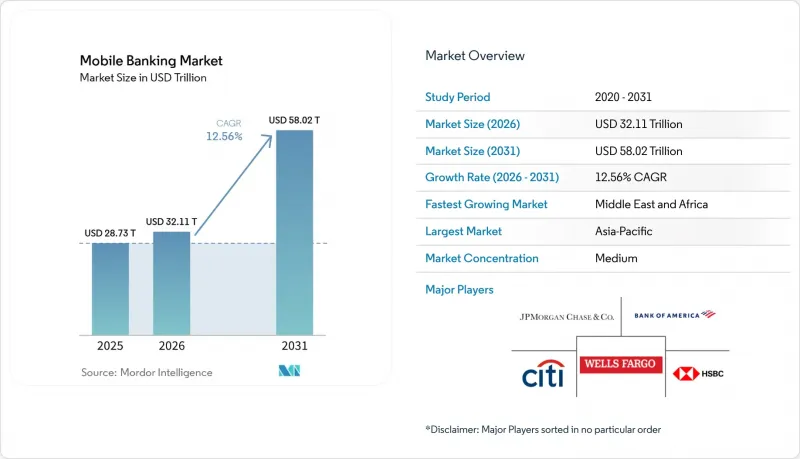
據 Mordor Intelligence 稱,2025 年行動銀行市值為 28.73 兆美元,預計到 2031 年將達到 58.02 兆美元,而 2026 年為 32.11 兆美元,預測期(2026-2031 年)的複合年成長率為 12.56%。
本報告按服務類型(例如,匯款、發票支付)、交易類型(例如,個人對個人交易、個人對企業交易)、最終用戶(例如,個人/消費者、中小企業)和地區(例如,北美、南美)進行分類。市場預測以美元計價。
全球行動銀行市場趨勢與洞察
「行動優先」的主要銀行服務成為預設管道。
目前,行動裝置已成為許多大型金融機構日常銀行交易的主要網路基地台。美國銀行報告稱,到2025年,其已驗證的數位用戶將達到5,900萬,數位登入次數將達到166億次,數位互動覆蓋了81%的消費者和小規模企業家庭。摩根大通表示,其行動平台擁有約6,300萬有效用戶,其2026年的應用程式重新設計重點在於讓用戶更快存取其數位錢包“Zelle”,並為年輕客戶提供儲蓄促進功能。隨著使用率的不斷提高,應用程式的角色正在發生變化,成為客戶服務、支付和產品發現的主要視窗。因此,能夠簡化和提升行動體驗的銀行將能夠在行動銀行市場中加深客戶互動,並與客戶保持更牢固的關係。
對即時P2P支付和發票支付的需求日益成長
在行動銀行市場,即時支付已成為客戶的基本需求。根據美國銀行預測,到2025年,Zelle用戶將完成18億筆交易,總額達5,560億美元,其中Zelle向中小企業的支付額將達到1,260億美元,年增23%。此外,GSMA的一份報告顯示,到2025年,行動支付交易額將達到2兆美元,過去30天內活躍帳戶數量增加15%,達到5.93億,這顯示主導支付習慣在新興市場廣泛應用。頻繁的支付活動促使用戶反覆使用同一應用程式,從而提升了行動管道對銀行和金融平台的價值。隨著這些支付習慣的養成,客戶更有可能在同一行動銀行環境中使用儲蓄、貸款和投資工具等相關功能。
透過社交工程和帳戶劫持進行的持續詐欺活動。
隨著行動電話成為數百萬用戶的主要金融工具,詐欺仍然是影響行動銀行市場信心的重大因素。根據美國聯邦調查局(FBI)報告顯示,自2025年1月以來,已收到超過5,100起帳戶盜用詐騙申訴,損失超過2.62億美元。主要作案手法包括透過電話、文字訊息和電子郵件冒充金融機構客服人員。由於用戶可能在應用程式之外受到操控,因此僅靠介面設計難以解決此風險。因此,銀行需要在保持便利性的同時,增加對更強大的身份驗證、更清晰的警報和更嚴格的交易監控的投入。信心受損會導致部分用戶延後或減少高額交易,減緩行動銀行市場的成長速度。
細分市場分析
2025年,「資金轉帳」佔據了行動銀行市場佔有率的29.8%,繼續保持領先地位,因為資金轉帳仍然是行動端用戶最常進行的銀行業務活動。 「帳單支付」和「貸款」緊隨其後,用戶越來越希望能夠一鍵完成定期付款,並在同一應用程式內快速獲得貸款核准。 「投資與資產管理」是成長最快的細分市場,預計2026年至2031年將以16.2%的複合年成長率成長。這一轉變表明,行動銀行市場不再僅僅以交易便利性為定義,因為銀行正擴大將更複雜的金融決策整合到行動環境中。 「保險」和「存款相關服務」也繼續作為服務組合的一部分,因為金融機構正在單一應用程式中建立更全面的金融體驗。
隨著行動用戶逐漸習慣在不離開銀行應用程式的情況下做出更高價值的財務決策,「投資和資產管理」領域正蓬勃發展。道明銀行於2026年第一季發布了全新設計的行動優先應用程式「TD Easy Trade」。這表明,這家老牌金融機構如今不再將投資僅視為一項獨立的數位附加功能,而是將其定位為核心行動體驗。這項產品策略至關重要,因為投資活動可以提高客戶留存率,並提升超越簡單支付交易的客戶關係價值。這也反映了行動銀行產業的更廣泛轉變,銀行和數位服務提供者正在將業務拓展至諮詢服務、自助交易和更廣泛的個人財富管理領域。隨著時間的推移,資產管理活動將成為行動銀行日常使用的一部分,而不再是小眾的延伸功能,這將改變服務格局。
區域分析
預計到2025年,亞太地區將成為最大的區域市場,佔據46.6%的行動銀行市場佔有率,顯著領先其他地區。該地區擁有大規模的用戶群體、根深蒂固的主導支付習慣以及向基於應用程式的帳戶使用的快速轉變。世界銀行的一份報告指出,行動電話技術正在支持開發中國家正規儲蓄的成長,這也是行動金融活動在廣大的亞太地區持續深化和擴展的原因之一。亞太地區憑藉其成熟的數位化習慣和大規模的新興用戶群體,仍然是行動銀行市場的核心。因此,該地區在日常交易使用、產品普及和普惠金融方面都取得了顯著進展。
北美和歐洲仍然是行動銀行市場最成熟的地區,許多客戶已經將應用程式作為其主要的銀行介面。美國銀行報告稱,其在2025年擁有5,900萬認證的數位用戶;摩根大通表示,其行動平台擁有近6,300萬有效用戶,這清楚地表明了美國主要金融機構目前的市場規模。 Chime在2026年第一季達到了1,020萬活躍用戶,並上調了其全年營收預期。這表明,即使在成熟的市場中,以數位優先的新興企業仍然有成長空間。在歐洲,荷蘭國際基本客群,這證實了即使在成熟的銀行體系中,行動主導的成長仍然至關重要。所有這些因素共同作用,使得北美和歐洲在應用程式的成熟度、產品豐富度和競爭力方面成為行動銀行市場的關鍵中心。
中東和非洲是行動銀行市場成長最快的區域市場,預計2026年至2031年將以15.0%的複合年成長率成長。根據GSMA的報告,預計到2025年,行動支付交易額將達到2兆美元,過去30天內活躍帳戶數量增加至5.93億,其中大部分成長勢頭來自撒哈拉以南非洲地區。在該地區,由於分店基礎設施分佈不均,對「行動優先」的金融服務需求強勁,因為行動電話金融服務能夠彌補實際的網點覆蓋缺口。此外,行動通路能夠大規模處理小額、高頻交易,這符合該地區眾多客戶的需求,並有助於市場成長。鑑於以上原因,中東和非洲地區將在預測期內成為行動銀行市場的關鍵擴張區域。
其他好處:
- Excel格式的市場預測(ME)表
- 3個月的分析師支持
目錄
第1章:引言
- 研究假設和市場定義
- 調查範圍
第2章:調查方法
第3章執行摘要
第4章 市場狀況
- 市場概覽
- 市場促進因素
- 對即時P2P和發票支付流程的需求日益成長
- 「行動優先」的主要銀行服務將成為預設管道。
- 生物識別和密碼認證降低了進入門檻。
- 嵌入式金融正在增加應用程式內銀行交易的頻率。
- 人工智慧驅動的個人化金融諮詢可以提高客戶維繫率。
- 透過輕量級、相容於 USSD 的服務,為農村和低度開發地區提供接入服務。
- 市場限制因素
- 透過社交工程和帳戶劫持進行的持續詐欺活動。
- 舊版核心的整合減緩了功能部署的速度。
- 分散式資料儲存帶來的負擔以及遵守應用商店規定的義務。
- 低信任度的用戶群阻礙了向功能齊全的應用程式銀行的過渡。
- 價值鏈分析
- 監理情勢
- 技術展望
- 波特五力分析
第5章 市場規模與成長預測
- 按服務類型
- 資金轉帳
- 發票付款
- 融資
- 存款和提款
- 投資和資產管理
- 保險
- 其他
- 按交易類型
- 個人對個人(C2C)交易
- 從消費者到企業(B2C)
- 企業對企業 (B2B) 交易
- 最終用戶
- 個人零售客戶/消費者
- 中小企業
- 大型企業和營業單位
- 按地區
- 北美洲
- 美國
- 加拿大
- 墨西哥
- 南美洲
- 巴西
- 阿根廷
- 其他南美國家
- 歐洲
- 英國
- 德國
- 法國
- 義大利
- 西班牙
- 其他歐洲國家
- 亞太地區
- 印度
- 中國
- 日本
- 澳洲
- 韓國
- 東南亞(新加坡、馬來西亞、泰國、印尼、越南、菲律賓)
- 其他亞太國家
- 中東和非洲
- 阿拉伯聯合大公國
- 沙烏地阿拉伯
- 南非
- 奈及利亞
- 其他中東和非洲國家
- 北美洲
第6章 競爭情勢
- 市場集中度
- 策略趨勢
- 市佔率分析
- 公司簡介
- JPMorgan Chase and Co.
- Bank of America Corporation
- Wells Fargo and Company
- Citigroup Inc.
- Banco Santander SA
- HSBC Holdings plc
- State Bank of India
- BBVA Group
- Barclays plc
- PayPal Holdings Inc.
- ING Group
- HDFC Bank Limited
- ICICI Bank Limited
- Standard Chartered plc
- DBS Bank Ltd
- Nu Holdings Ltd
- Revolut Ltd
- Chime Financial Inc.
- Monzo Bank Ltd
- KakaoBank Corp.
第7章 市場機會與未來展望
According to Mordor Intelligence, the mobile banking market size was valued at USD 28.73 trillion in 2025 and is estimated to grow from USD 32.11 trillion in 2026 to reach USD 58.02 trillion by 2031, at a CAGR of 12.56% during the forecast period (2026-2031).
This report is Segmented by Service Type (Fund Transfers, Bill Payments, and More), by Transaction Type (Consumer-To-Consumer, Consumer-To-Business, and More), by End-User (Retail Individuals / Consumers, Small and Medium Enterprises (SMEs), and More), and by Geography (North America, South America, and More). The Market Forecasts are Provided in Terms of Value (USD).
Global Mobile Banking Market Trends and Insights
Mobile-First Primary Banking Becomes the Default Channel
Mobile is now the primary access point for routine banking activity across many large institutions. Bank of America reported 59 million verified digital users in 2025, along with 16.6 billion digital logins and digital engagement across 81% of its consumer and small business households. JPMorgan Chase said its mobile platform serves nearly 63 million active users, and its 2026 app redesign focused on faster access to Zelle, the digital wallet, and savings prompts for younger customers. This level of usage changes the app's role, making it the primary surface for customer service, payments, and product discovery. As a result, banks that make the mobile journey simpler and more reliable can deepen engagement and retain a greater share of the customer relationship in the mobile banking market.
Rising Demand for Real-Time P2P and Bill Payment Journeys
Real-time settlement has become a basic customer expectation in the mobile banking market. Bank of America said Zelle users completed 1.8 billion transactions worth USD 556 billion in 2025, while small business Zelle payments reached USD 126 billion and grew 23% year over year. GSMA also reported that mobile money transactions reached USD 2 trillion in 2025 and that active 30-day accounts rose 15% to 593 million, indicating that mobile-led transaction habits are widening across emerging markets. Frequent payment activity keeps users returning to the same app, thereby increasing the value of the mobile channel for banks and financial platforms. Once that payment behavior is established, customers are more likely to adopt adjacent features, such as savings, borrowing, and investment tools, within the same mobile banking environment.
Persistent Fraud Losses from Social Engineering and Account Takeover
Fraud remains a meaningful drag on confidence in the mobile banking market because the phone has become a central financial device for millions of users. The FBI reported more than 5,100 account takeover fraud complaints since January 2025, with losses exceeding USD 262 million, and it identified impersonation of financial institution support staff through calls, texts, and emails as the primary method. This makes the risk difficult to solve through interface design alone because customers can still be manipulated outside the app. Banks, therefore, have to invest in stronger authentication, clearer alerts, and tighter transaction monitoring while still keeping the experience usable. If trust weakens, some users delay higher-value transactions or limit their activity, slowing the pace of expansion in the mobile banking market.
Other drivers and restraints analyzed in the detailed report include:
- Biometric and Passkey Authentication Reduces Friction
- Embedded Finance Expands In-App Banking Frequency
- Legacy Core Integration Slows Feature Rollout
For complete list of drivers and restraints, kindly check the Table Of Contents.
Segment Analysis
Fund Transfers held 29.8% of the mobile banking market share in 2025, keeping this category in the lead, as payment movement remains the most frequent banking task in a mobile session. Bill Payments and Lending followed as large use cases because users increasingly expect one-touch access to recurring obligations and fast credit decisions inside the same app. Investments and Wealth Management is the fastest-growing sub-segment, projected to expand at a 16.2% CAGR between 2026 and 2031. This shift shows that the mobile banking market is no longer defined solely by transaction utility, as banks are increasingly bringing more complex financial decisions into the mobile environment. Insurance and deposit-related services also remain part of the service mix as institutions build more complete financial journeys within a single application.
Investments and Wealth Management is gaining momentum as mobile users become more comfortable making higher-value financial decisions without leaving the banking app. TD Bank launched a fully redesigned mobile-first TD Easy Trade app in Q1 2026, which shows how established institutions are now treating investing as a core mobile experience rather than a separate digital add-on. That product direction matters because investment activity can deepen customer retention and raise the value of the relationship beyond payments alone. It also reflects a wider change in the mobile banking industry, where banks and digital players are expanding into advisory, self-directed trading, and broader personal finance management. Over time, this changes the service mix by making wealth activity a more regular part of mobile banking behavior instead of a niche extension.
Complete Report Scope:
- By Service Type
- Fund Transfers
- Bill Payments
- Lending
- Deposits and Withdrawals
- Investments and Wealth Management
- Insurance
- Others
- By Transaction Type
- Consumer-to-Consumer
- Consumer-to-Business
- Business-to-Business
- By End User
- Retail Individuals / Consumers
- Small and Medium Enterprises (SMEs)
- Large Corporates and Businesses
- By Geography
- North America
- United States
- Canada
- Mexico
- South America
- Brazil
- Argentina
- Rest of South America
- Europe
- United Kingdom
- Germany
- France
- Italy
- Spain
- Rest of Europe
- Asia-Pacific
- India
- China
- Japan
- Australia
- South Korea
- South East Asia (Singapore, Malaysia, Thailand, Indonesia, Vietnam, and Philippines)
- Rest of Asia-Pacific
- Middle East and Africa
- United Arab Emirates
- Saudi Arabia
- South Africa
- Nigeria
- Rest of Middle East and Africa
- North America
Geography Analysis
Asia-Pacific held 46.6% of the mobile banking market share in 2025, which made it the largest regional base by a wide margin. The region combines very large user populations with strong mobile-led payment behavior and a fast transition toward app-based account use. The World Bank reported that mobile-phone technology is supporting greater formal savings in developing economies, which helps explain why large parts of Asia continue to add depth and scale to mobile financial activity. This keeps Asia-Pacific at the center of the mobile banking market, as the region encompasses both mature digital behavior and large pools of newly engaged users. The result is a geography where daily transaction use, broader product adoption, and financial inclusion are advancing simultaneously.
North America and Europe remain the most mature parts of the mobile banking market, as many customers already rely on apps as their primary banking interface. Bank of America reported 59 million verified digital users in 2025, while JPMorgan Chase said its mobile platform serves nearly 63 million active users, which shows the scale now present among major United States institutions. Chime reached 10.2 million active members in Q1 2026 and raised its full-year revenue guidance, indicating that digital-first challengers still have room to expand in a mature market. In Europe, ING reported a mobile primary customer base of 15.4 million in FY2025, which confirms that mobile-led growth remains relevant even in established banking systems. Together, these conditions keep North America and Europe important to the mobile banking market as centers of app refinement, product depth, and competitive intensity.
The Middle East and Africa is the fastest-growing regional segment in the mobile banking market and is forecast to expand at 15.0% CAGR between 2026 and 2031. GSMA reported that mobile money transactions reached USD 2 trillion in 2025 and active 30-day accounts rose to 593 million, with much of the momentum coming from Sub-Saharan Africa. This region benefits from strong demand for mobile-first access because branch infrastructure is uneven and handset-based finance solves a real access gap. Growth is also supported by the fact that mobile channels can handle low-value, high-frequency activity at large scale, which fits many customer needs in the region. That makes the Middle East and Africa a key expansion zone for the mobile banking market over the forecast period.
- JPMorgan Chase and Co.
- Bank of America Corporation
- Wells Fargo and Company
- Citigroup Inc.
- Banco Santander S.A.
- HSBC Holdings plc
- State Bank of India
- BBVA Group
- Barclays plc
- PayPal Holdings Inc.
- ING Group
- HDFC Bank Limited
- ICICI Bank Limited
- Standard Chartered plc
- DBS Bank Ltd
- Nu Holdings Ltd
- Revolut Ltd
- Chime Financial Inc.
- Monzo Bank Ltd
- KakaoBank Corp.
Additional Benefits:
- The market estimate (ME) sheet in Excel format
- 3 months of analyst support
TABLE OF CONTENTS
1 INTRODUCTION
- 1.1 Study Assumptions and Market Definition
- 1.2 Scope of the Study
2 RESEARCH METHODOLOGY
3 EXECUTIVE SUMMARY
4 MARKET LANDSCAPE
- 4.1 Market Overview
- 4.2 Market Drivers
- 4.2.1 Rising Demand for Real-Time P2P and Bill Payment Journeys
- 4.2.2 Mobile-First Primary Banking Becomes the Default Channel
- 4.2.3 Biometric and Passkey Authentication Reduces Friction
- 4.2.4 Embedded Finance Expands In-App Banking Frequency
- 4.2.5 AI-Personalized Financial Guidance Improves Retention
- 4.2.6 Rural and Underserved Access via Lightweight and USSD-Enabled Experiences
- 4.3 Market Restraints
- 4.3.1 Persistent Fraud Losses from Social Engineering and Account Takeover
- 4.3.2 Legacy Core Integration Slows Feature Rollout
- 4.3.3 Fragmented Data-Residency and App Store Compliance Burdens
- 4.3.4 Low-Trust User Segments Limit Migration to Full App Banking
- 4.4 Value Chain Analysis
- 4.5 Regulatory Landscape
- 4.6 Technological Outlook
- 4.7 Porter's Five Forces Analysis
- 4.7.1 Threat of New Entrants
- 4.7.2 Bargaining Power of Suppliers
- 4.7.3 Bargaining Power of Buyers
- 4.7.4 Threat of Substitutes
- 4.7.5 Competitive Rivalry
5 MARKET SIZE AND GROWTH FORECASTS
- 5.1 By Service Type
- 5.1.1 Fund Transfers
- 5.1.2 Bill Payments
- 5.1.3 Lending
- 5.1.4 Deposits and Withdrawals
- 5.1.5 Investments and Wealth Management
- 5.1.6 Insurance
- 5.1.7 Others
- 5.2 By Transaction Type
- 5.2.1 Consumer-to-Consumer
- 5.2.2 Consumer-to-Business
- 5.2.3 Business-to-Business
- 5.3 By End User
- 5.3.1 Retail Individuals / Consumers
- 5.3.2 Small and Medium Enterprises (SMEs)
- 5.3.3 Large Corporates and Businesses
- 5.4 By Geography
- 5.4.1 North America
- 5.4.1.1 United States
- 5.4.1.2 Canada
- 5.4.1.3 Mexico
- 5.4.2 South America
- 5.4.2.1 Brazil
- 5.4.2.2 Argentina
- 5.4.2.3 Rest of South America
- 5.4.3 Europe
- 5.4.3.1 United Kingdom
- 5.4.3.2 Germany
- 5.4.3.3 France
- 5.4.3.4 Italy
- 5.4.3.5 Spain
- 5.4.3.6 Rest of Europe
- 5.4.4 Asia-Pacific
- 5.4.4.1 India
- 5.4.4.2 China
- 5.4.4.3 Japan
- 5.4.4.4 Australia
- 5.4.4.5 South Korea
- 5.4.4.6 South East Asia (Singapore, Malaysia, Thailand, Indonesia, Vietnam, and Philippines)
- 5.4.4.7 Rest of Asia-Pacific
- 5.4.5 Middle East and Africa
- 5.4.5.1 United Arab Emirates
- 5.4.5.2 Saudi Arabia
- 5.4.5.3 South Africa
- 5.4.5.4 Nigeria
- 5.4.5.5 Rest of Middle East and Africa
- 5.4.1 North America
6 COMPETITIVE LANDSCAPE
- 6.1 Market Concentration
- 6.2 Strategic Moves
- 6.3 Market Share Analysis
- 6.4 Company Profiles (includes Global Level Overview, Market Level Overview, Core Segments, Financials as available, Strategic Information, Market Rank/Share, Products and Services, Recent Developments)
- 6.4.1 JPMorgan Chase and Co.
- 6.4.2 Bank of America Corporation
- 6.4.3 Wells Fargo and Company
- 6.4.4 Citigroup Inc.
- 6.4.5 Banco Santander S.A.
- 6.4.6 HSBC Holdings plc
- 6.4.7 State Bank of India
- 6.4.8 BBVA Group
- 6.4.9 Barclays plc
- 6.4.10 PayPal Holdings Inc.
- 6.4.11 ING Group
- 6.4.12 HDFC Bank Limited
- 6.4.13 ICICI Bank Limited
- 6.4.14 Standard Chartered plc
- 6.4.15 DBS Bank Ltd
- 6.4.16 Nu Holdings Ltd
- 6.4.17 Revolut Ltd
- 6.4.18 Chime Financial Inc.
- 6.4.19 Monzo Bank Ltd
- 6.4.20 KakaoBank Corp.
7 MARKET OPPORTUNITIES AND FUTURE OUTLOOK
- 7.1 White-Space and Unmet-Need Assessment

 2026年全球銀行業聊天機器人市場報告
 全球數位銀行市場規模、佔有率、趨勢和成長分析報告(2026-2034)行動銀行市場規模、佔有率、成長、全球產業分析、區域洞察與預測(2026-2034 年)2026年小型辦公室或家庭辦公室(SOHO)行動銀行全球市場報告
 數位銀行平台和服務市場:按組件、銀行類型、整合模型、企業規模、部署類型、應用和最終用戶分類-2026-2032年全球市場預測2026年全球數位帳戶開戶市場報告2026年全球行動銀行市場報告
 行動銀行市場分析及預測(至2035年):依類型、產品類型、服務、技術、組件、應用、設備、部署類型、最終用戶及功能分類
 日本數位銀行市場規模、佔有率、趨勢及預測(按服務、實施類型、技術、產業及地區分類,2026-2034年)
 數位銀行市場-全球產業規模、佔有率、趨勢、機會、預測:按銀行、服務、模式、最終用戶、地區和競爭對手分類,2021-2031年