


 |
市場調查報告書
商品編碼
2098595
網路安全人才培養與模擬平台:市場佔有率分析、產業趨勢與統計、成長預測(2026-2031)Cybersecurity Workforce Training and Simulation Platforms - Market Share Analysis, Industry Trends & Statistics, Growth Forecasts (2026 - 2031) |
||||||

※ 本網頁內容可能與最新版本有所差異。詳細情況請與我們聯繫。
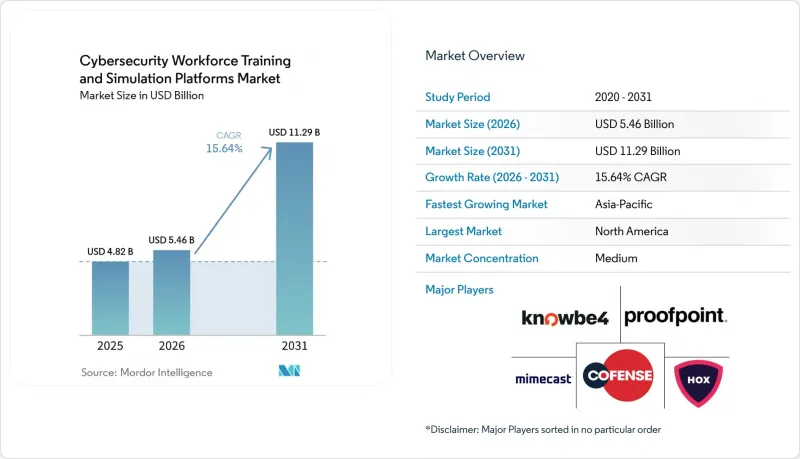
根據 Mordor Intelligence 預測,網路安全人才發展和模擬平台的市場規模預計將在 2025 年達到 48.2 億美元,在 2026 年達到 54.6 億美元,在 2031 年達到 112.9 億美元,從 2026 年到 2031 年的複合年成長率為 15.15%。
本報告按組件(軟體、服務)、部署方式(雲端、本地部署、混合部署)、企業規模(大型企業、中小企業)、應用領域(安全意識提升培訓等)、最終用戶行業(銀行、金融服務和保險、醫療保健和生命科學等)以及地區進行細分。市場預測以美元計價。
全球網路安全人才培育與模擬平台市場趨勢及洞察
基於人工智慧的攻擊日益增多,使得網路釣魚防範措施的不足之處進一步擴大。
人工智慧驅動的攻擊日益增多,使得以往認為員工僅憑語法錯誤、通用問候語或視覺不一致就能識別網路釣魚攻擊的假設過時。 Hoxhunt 報告稱,到 2026 年,人工智慧驅動的網路釣魚攻擊將增加 14 倍,這表明所有員工管道的攻擊品質都在迅速提升。雲端安全聯盟 (CSA) 指出,人工智慧工具每小時可產生多達 100 個個人化魚叉式網路釣魚變體,有可能針對更廣泛的員工群體發送客製化訊息。在網路安全人才培養和模擬平台市場,這正在改變產品需求,使其從偶爾的意識更新轉向更快速的內容更新和更具適應性的模擬設計。 KnowBe4 也追蹤到,透過 Microsoft Teams 發動的攻擊增加了 41%,使用日曆邀請的網路釣魚攻擊增加了 49%,這表明供應商需要提供電子郵件以外的更廣泛的模擬覆蓋範圍。因此,網路安全人才培養和模擬平台市場的買家越來越傾向於選擇能夠在幾天內(而不是按季度)將新的威脅模式融入實際演練的平台。
網路保險和審計要求,以落實可衡量的人力風險管理措施
網路安全人才發展和模擬平台市場正因保險和審計流程的日益重視而蓬勃發展。這些流程不僅關注政策的存在,也更關注可衡量的員工行為。如今,買家更重視那些能夠以可重複使用的格式向風險管理和合規團隊呈現網路釣魚模擬結果、特定角色完成狀態和報告狀態的平台。這一點意義重大,因為培訓計畫現在正與更廣泛的管理框架(例如 HIPAA、PCI-DSS、SOC 2 和 CMMC)相結合進行審查,這強調了對書面證據而非通用考勤記錄的需求。提案的HIPAA 安全規則修訂凸顯了人們對電子受保護醫療資訊 (ePHI) 保護日益成長的期望,這將推動醫療保健機構採用更正式的員工網路安全管理方法。實際上,這正促使網路安全員工培訓和模擬平台市場轉向能夠導出可用於審計的數據並留下易於在審計中辯護的證據痕蹟的平台。因此,採購決策正從人力資源主導的內容選擇轉向以風險主導、具有更詳細報告功能的平台選擇。
透過減少違規次數來直接證明投資報酬率的限制。
在網路安全人才培養和模擬平台市場,最大的預算挑戰仍然是:更高品質的培訓是否能直接轉化為成功攻擊事件的減少。這很難回答,因為可預防的事件無法直接觀察,財務部門往往難以證明模擬活動與避免損失之間的關聯性。 SANS 的一項調查發現,27% 的組織曾因能力不足而遭受攻擊,這凸顯了培訓的必要性,但仍無法解決董事會通常要求的「萬無一失」的問題。供應商正在透過將網路釣魚攻擊趨勢、報告率和風險評分整合到統一的儀表板中來解決這個問題,以促進進展討論。然而,當買家將培訓成本與具有更直接的事件和基礎設施指標的工具進行比較時,網路安全人才培養和模擬平台市場仍然存在摩擦。這個問題可能會使那些能夠用審計、保險和財務團隊都能理解的語言解釋行為變化而無需額外解釋的供應商獲得競爭優勢。
細分市場分析
到2025年,軟體將佔據網路安全人才培養和模擬平台市場59.87%的佔有率,顯示市場正顯著向集中式平台轉型。軟體持續佔據較大佔有率的原因在於,買家偏好可擴展的內容庫、更便捷的用戶管理以及能夠跨分散式團隊實現廣泛整合的方案。在網路安全人才培養和模擬平台市場,雲端交付軟體還有助於大規模部署自適應模擬,而不會顯著增加營運負擔。這項優勢確保了軟體在買家評估中仍佔據核心地位,即便服務的重要性日益凸顯。
預計到2031年,該服務將以16.72%的複合年成長率成長,這表明價值鏈的另一個環節正在加強。許多中型企業和資源有限的買家現在尋求的是專案管理、宣傳活動設計、分析結果解讀和報告的支持,而不僅僅是獨立的授權。根據ISC2的報告,77%的公司採用內部資源和第三方供應商相結合的方式來提供培訓,凸顯了向託管支援模式的廣泛轉變。在網路安全人才發展和模擬平台產業,託管服務不僅僅是附加功能,它們還能幫助買家將平台使用轉化為可衡量的營運流程。此外,行為數據、宣傳活動歷史記錄和報告邏輯被整合到供應商關係中,而不再局限於軟體層面,從而提高了合約續約率。
到2025年,雲端平台將佔據網路安全人才發展和模擬平台市場52.91%的佔有率。這反映了雲端平台易於全球部署和持續內容維護的優勢。買家更青睞雲端模式,因為它簡化了更新流程,縮短了部署時間,並且能夠與企業中已有的身分管理、人力資源和協作系統完美整合。網路安全人才發展和模擬平台市場也受益於這種模式,因為無需對本地基礎設施進行任何操作即可部署新的內容、模擬模板和管理變更。對於那些已經將大部分安全性和生產力架構標準化為SaaS的企業而言,雲端模式尤其適用。
混合模式預計到2031年將以16.83%的複合年成長率成長,顯示架構選擇正朝著以合規性為導向的方向轉變。受監管產業越來越希望利用雲端內容管理和人工智慧模擬的優勢,同時將行為證據、員工檔案和其他敏感記錄保留在受控的本地環境中。 SoSafe僅在歐盟的資料駐留模式凸顯了主權和隱私要求如何影響歐洲的部署選擇。在國防和關鍵基礎設施等領域,由於仍需要空氣間隙和高度隔離的環境,本地部署模式仍然至關重要。在網路安全人才培養和模擬平台市場,混合模式的成長表明,未來的選擇將從雲端與本地部署的二元對立,轉向關注特定資料元素的存放位置是否合理。
區域分析
到2025年,北美將佔據網路安全人才培養和模擬平台市場31.12%的佔有率,成為最大的區域市場。該地區受益於成熟的企業採購系統、更嚴格的安全支出規範以及與培訓、保險和審計要求的明確關聯性。美國的需求受到多重義務的驅動,例如CMMC、美國證券交易委員會(SEC)的網路安全揭露要求以及與HIPAA相關的人才要求,這些義務提升了各行業培訓記錄的價值。美國國防部首席資訊長辦公室於2026年4月啟動了網路註冊學徒計劃,顯示政府持續投資於基於模擬的網路技能發展。此外,美國國家標準與技術研究院(NIST)在2025年向13個州提供了超過300萬美元的資金,用於支持網路安全人才發展,從而加強了區域網路安全人才培養和模擬平台的人才和培訓生態系統。
預計到2025年,歐洲在網路安全人才培養和模擬平台領域仍將佔據第二大市場佔有率,其需求主要受監管法規的驅動。 NIS2擴大了受網路安全義務約束的組織數量,而DORA則進一步促使金融機構維持更強的營運韌性和人才儲備。德國IT安全市場預計在2025年將成長10.1%,達到111億歐元(119.9億美元),並在2026年成長9.9%,達到122億歐元(133億美元),顯示培訓和安全軟體部署的支出環境強勁。 SoSafe憑藉其符合GDPR的資料處理、專注於歐盟的託管服務以及符合當地合規性和主權要求的多語言內容,從這個市場環境中獲益。
預計到2031年,亞太地區將以17.27%的複合年成長率成長,成為網路安全人才培育和模擬平台市場成長最快的地區。該地區最大的成長要素是嚴重的人才短缺,數據顯示,到2025年,該地區預計將出現340萬名專業人員的缺口。在印度,由於更嚴格的數位化監管,醫療保健和企業部門的需求正在成長。同時,日本NICT於2026年4月啟動了針對註冊安全專業人員的新一輪網路模擬實戰訓練。在馬來西亞,預計到2026年,對網路安全專業人員的需求將達到28,068人,而目前的供應量僅為16,765人,凸顯了該地區巨大的培訓缺口。在南美洲,隨著巴西《通用資料保護法》(LGPD)的實施和金融業的整體數位轉型,市場正在擴張。同時,中東和非洲地區雖然規模較小,但依然活躍,因為在監管嚴格的金融環境下,以結果為導向的培訓的重要性日益凸顯。因此,網路安全人才培訓和模擬平台的市場在威脅暴露和人才短缺同時加劇的地區成長最為迅速。即使這些地區的預算規模不如北美成熟,趨勢依然成立。
其他好處:
- Excel格式的市場預測(ME)表
- 3個月的分析師支持
目錄
第1章:引言
- 研究假設和市場定義
- 調查範圍
第2章:調查方法
第3章執行摘要
第4章 市場狀況
- 市場概覽
- 市場促進因素
- 隨著人工智慧攻擊的增加,網路釣魚攻擊的技能差距正在擴大。
- 網路保險的審計要求和可量化的人力風險管理措施
- 從旨在提高意識的內容轉向基於模擬的持續技能檢驗。
- 保全行動團隊和事件回應團隊對特定角色培訓的需求日益成長。
- 中型企業正在擴大雲端原生、支援 API 的培訓平台的採用。
- 擴大公共部門網路安全專業人員的技能發展計劃
- 市場限制因素
- 透過減少違規行為發生頻率來直接證明投資報酬率的能力有限。
- 多區域部署中維修成本。
- 與 LMS、SIEM、IAM 和 GRC 系統整合時的摩擦
- 模擬演練造成的疲勞以及員工敬業度隨時間推移而下降。
- 產業價值鏈分析
- 監理情勢
- 技術展望
- 波特五力分析
第5章 市場規模與成長預測
- 按組件
- 軟體
- 服務
- 介紹
- 雲
- 現場
- 混合
- 按公司規模
- 大公司
- 小型企業
- 透過使用
- 安全意識提升培訓
- 模擬網路釣魚和社交工程
- 網路靶場與實用技術培訓
- 紅隊/藍隊/紫隊演習
- 事件應變與危機管理培訓
- 安全編碼和DevSecOps培訓
- 合規培訓
- 對內部威脅的認知
- 按最終用戶行業分類
- BFSI
- 醫療保健和生命科學
- 資訊科技/通訊
- 零售與電子商務
- 工業製造
- 政府/公共部門
- 其他
- 按地區
- 北美洲
- 美國
- 加拿大
- 墨西哥
- 南美洲
- 巴西
- 阿根廷
- 其他南美國家
- 歐洲
- 德國
- 英國
- 法國
- 義大利
- 西班牙
- 俄羅斯
- 其他歐洲國家
- 亞太地區
- 中國
- 印度
- 日本
- 韓國
- 澳洲
- 其他亞太國家
- 中東和非洲
- 中東
- 沙烏地阿拉伯
- 阿拉伯聯合大公國
- 其他中東國家
- 非洲
- 南非
- 奈及利亞
- 其他非洲國家
- 中東
- 北美洲
第6章 競爭情勢
- 市場集中度
- 策略趨勢
- 市佔率分析
- 公司簡介
- KnowBe4, Inc.
- Proofpoint, Inc.
- Cofense, Inc.
- Hoxhunt Oy
- Mimecast Limited
- Barracuda Networks, Inc.
- CybeReady Ltd.
- Terranova Security Inc.
- Infosec Institute, Inc.
- SANS Institute
- NINJIO, Inc.
- Curricula, Inc.
- Fishbone Inc.
- Hook Security LLC
- AwareGO ehf.
- Phished.io BV
- SoSafe GmbH
- Blackbird.AI, Inc.
- Wizer Security, Inc.
- Cyberbit Ltd.
第7章 市場機會與未來展望
According to Mordor Intelligence, the cybersecurity workforce training and simulation platforms market size is projected to be USD 4.82 billion in 2025, USD 5.46 billion in 2026, and reach USD 11.29 billion by 2031, growing at a CAGR of 15.64% from 2026 to 2031.
This report is Segmented by Component (Software and Services), Deployment (Cloud, On-Premises, and Hybrid), Enterprise Size (Large Enterprises, and Small and Medium Enterprises), Application (Security Awareness Training, and More), End-User Industry (BFSI, Healthcare and Life Sciences, and More), and Geography. The Market Forecasts are Provided in Terms of Value (USD).
Global Cybersecurity Workforce Training and Simulation Platforms Market Trends and Insights
Rising Phishing Proficiency Gaps Driven by AI-Generated Attacks
AI-generated attacks have weakened the old assumption that workers can spot phishing based solely on grammar mistakes, generic greetings, or visual inconsistencies. Hoxhunt reported a 14-fold increase in AI-generated phishing attacks in 2026, demonstrating how quickly attack quality has improved across employee-facing channels. The Cloud Security Alliance noted that AI-enabled tools can produce up to 100 personalized spear-phishing variants per hour, enabling a much wider share of the workforce to be targeted with tailored messages. In the cybersecurity workforce training and simulation platforms market, this changes the product requirement from occasional awareness refreshers to faster content updates and more adaptive simulation design. KnowBe4 also tracked a 41% increase in attacks via Microsoft Teams and a 49% increase in calendar invite phishing, indicating that vendors now need broader simulation coverage than email alone. Buyers in the cybersecurity workforce training and simulation platforms market are therefore favoring platforms that turn new threat patterns into active exercises within days instead of quarters.
Cyber Insurance and Audit Requirements for Measurable Human-Risk Controls
The cybersecurity workforce training and simulation platforms market is also gaining support from insurance and audit processes that increasingly focus on measurable workforce behavior rather than policy existence alone. Buyers now place greater value on platforms that can show phishing simulation outcomes, role-based completion, and reporting behavior in a format that risk and compliance teams can reuse. This matters because training programs are being reviewed alongside broader control frameworks such as HIPAA, PCI-DSS, SOC 2, and CMMC, underscoring the need for documented evidence rather than generic attendance records. The proposed HIPAA Security Rule updates underscore stronger expectations for protecting electronic protected health information, which supports a more formal approach to workforce cybersecurity controls in healthcare settings. In practice, this pushes the cybersecurity workforce training and simulation platforms market toward platforms that export audit-ready data and keep evidence trails that are easier to defend during reviews. The result is that purchasing decisions are moving away from HR-led content selection toward risk-led platform selection with deeper reporting.
Limited Ability To Prove Direct ROI on Reduced Breach Frequency
The hardest budget question in the cybersecurity workforce training and simulation platforms market remains whether better training can be tied directly to fewer successful breaches. This is difficult because prevented incidents are not directly observable, so finance teams often struggle to connect simulation activity with avoided loss. SANS found that 27% of organizations experienced breaches tied to capability gaps, which supports the need for training, but it still does not solve the reverse proof problem that boards often want. Vendors are responding by combining phishing-prone trends, reporting rates, and risk scores into unified dashboards that make progress easier to discuss. Even so, the cybersecurity workforce training and simulation platforms market still faces friction when buyers compare training spend with tools that have more direct incident or infrastructure metrics. This issue is likely to keep favoring vendors that can translate behavior change into language that audit, insurance, and finance teams can use without extra interpretation.
Other drivers and restraints analyzed in the detailed report include:
- Shift From Awareness Content to Continuous Simulation-Based Skill Validation
- Expanding Demand for Role-Based Training Across Security Operations and Incident Response Teams
- Content Localization And Scenario Maintenance Costs for Multi-Region Rollouts
For complete list of drivers and restraints, kindly check the Table Of Contents.
Segment Analysis
Software accounted for 59.87% of the cybersecurity workforce training and simulation platforms market in 2025, underscoring the shift toward centralized platforms. The software base remained larger because buyers preferred scalable content libraries, easier user administration, and broader integration options across distributed workforces. In the cybersecurity workforce training and simulation platforms market, cloud-delivered software also makes it easier to launch adaptive simulations at a large scale without corresponding increases in operational effort. That advantage has kept software at the center of buyer evaluations even as service intensity rises.
Services are projected to grow at a 16.72% CAGR through 2031, which signals that a different part of the value chain is strengthening. Many mid-market and resource-constrained buyers now want program management, campaign design, analytics interpretation, and reporting support instead of a stand-alone license. ISC2 reported that 77% of enterprises used a mix of in-house and third-party providers for training delivery, which supports the wider move toward managed support models. Across the cybersecurity workforce training and simulation platforms industry, this makes services more than an add-on because managed delivery helps buyers convert platform usage into measurable operational routines. It also increases renewal stickiness because behavioral data, campaign history, and reporting logic are embedded in the vendor relationship rather than confined solely to the software layer.
Cloud accounted for 52.91% of the cybersecurity workforce training and simulation platforms market in 2025, reflecting the ease of global rollout and continuous content maintenance. Buyers favored cloud models because they simplified updates, shortened deployment times, and connected well with identity, HR, and collaboration systems already used across the enterprise. The cybersecurity workforce training and simulation platforms market benefited from this model because new content, simulation templates, and administrative changes could be pushed without local infrastructure work. Cloud was especially well aligned with firms that had already standardized large parts of their security and productivity stack around SaaS.
Hybrid is projected to grow at a 16.83% CAGR through 2031, suggesting a more compliance-driven architecture choice. Regulated sectors increasingly want cloud-based content management and AI simulation benefits while keeping behavioral evidence, employee profiles, and other sensitive records in controlled, local environments. SoSafe's positioning around EU-only data residency highlighted how sovereignty and privacy requirements are shaping deployment selection in Europe. On-premises models still retain importance in defense and critical infrastructure settings where air-gapped or tightly isolated environments remain necessary. In the cybersecurity workforce training and simulation platforms market, hybrid growth suggests that the future choice will be less about cloud versus on-premises and more about where specific data elements are allowed to live.
Complete Report Scope:
- By Component
- Software
- Services
- By Deployment
- Cloud
- On-Premises
- Hybrid
- By Enterprise Size
- Large Enterprises
- Small and Medium Enterprises
- By Application
- Security Awareness Training
- Phishing and Social Engineering Simulation
- Cyber Range and Hands-on Technical Training
- Red Team / Blue Team / Purple Team Exercises
- Incident Response and Crisis Management Drills
- Secure Coding and DevSecOps Training
- Compliance Training
- Insider Threat Awareness
- By End-user Industry
- BFSI
- Healthcare and Life Sciences
- Information Technology and Telecom
- Retail and E-commerce
- Industrial Manufacturing
- Government and Public Sector
- Other End-user Industries
- By Geography
- North America
- United States
- Canada
- Mexico
- South America
- Brazil
- Argentina
- Rest of South America
- Europe
- Germany
- United Kingdom
- France
- Italy
- Spain
- Russia
- Rest of Europe
- Asia-Pacific
- China
- India
- Japan
- South Korea
- Australia
- Rest of Asia-Pacific
- Middle East and Africa
- Middle East
- Saudi Arabia
- United Arab Emirates
- Rest of Middle East
- Africa
- South Africa
- Nigeria
- Rest of Africa
- Middle East
- North America
Geography Analysis
North America accounted for 31.12% of the cybersecurity workforce training and simulation platforms market in 2025, making it the largest regional market. The region benefited from mature enterprise procurement, stronger security spending discipline, and a clearer link between training, insurance, and audit expectations. U.S. demand is reinforced by layered obligations such as CMMC, SEC cybersecurity disclosure requirements, and HIPAA-linked workforce expectations, which make documented training evidence more valuable across industries. The U.S. Department of War Office of the CIO launched the Cyber Registered Apprenticeship Program in April 2026, signaling sustained public investment in simulation-based cyber skills development. NIST also awarded more than USD 3 million across 13 states in 2025 to support cybersecurity workforce development, helping strengthen the regional talent and training ecosystem for cybersecurity workforce training and simulation platforms.
Europe remained the second-largest region in the cybersecurity workforce training and simulation platforms market in 2025, with demand shaped strongly by regulation. NIS2 expanded the number of organizations subject to cybersecurity obligations, and DORA added further pressure on financial entities to maintain stronger operational resilience and workforce preparedness. Germany's IT security market rose 10.1% in 2025 to EUR 11.1 billion (USD 11.99 billion) and is projected to grow 9.9% in 2026 to EUR 12.2 billion (USD 13.3 billion), which shows a healthy spending backdrop for training and security software adoption. SoSafe has benefited from this setting by building on GDPR-aligned data handling, EU-focused hosting, and multilingual content that aligns with local compliance and sovereignty expectations.
Asia-Pacific is projected to grow at a 17.27% CAGR through 2031, which makes it the fastest-expanding region in the cybersecurity workforce training and simulation platforms market. The region's biggest growth driver is the severe talent shortfall, which reached 3.4 million professionals in 2025, according to the supplied material. India is seeing stronger healthcare and enterprise demand as digital obligations tighten, while Japan's NICT launched a new cycle of practical cyber simulation training in April 2026 for registered security professionals. Malaysia's projected need for 28,068 cybersecurity professionals by 2026 against an existing base of 16,765 shows how wide the regional training gap remains. South America is advancing on the back of Brazil's LGPD enforcement maturity and the wider financial sector's digitalization, while the Middle East and Africa remain the smallest but still active, as outcome-based training becomes more important in regulated financial settings. The cybersecurity workforce training and simulation platforms market is therefore expanding fastest where threat exposure and workforce shortages are rising together, even if regional budgets remain less mature than in North America.
- KnowBe4, Inc.
- Proofpoint, Inc.
- Cofense, Inc.
- Hoxhunt Oy
- Mimecast Limited
- Barracuda Networks, Inc.
- CybeReady Ltd.
- Terranova Security Inc.
- Infosec Institute, Inc.
- SANS Institute
- NINJIO, Inc.
- Curricula, Inc.
- Fishbone Inc.
- Hook Security LLC
- AwareGO ehf.
- Phished.io B.V.
- SoSafe GmbH
- Blackbird.AI, Inc.
- Wizer Security, Inc.
- Cyberbit Ltd.
Additional Benefits:
- The market estimate (ME) sheet in Excel format
- 3 months of analyst support
TABLE OF CONTENTS
1 INTRODUCTION
- 1.1 Study Assumptions and Market Definition
- 1.2 Scope of the Study
2 RESEARCH METHODOLOGY
3 EXECUTIVE SUMMARY
4 MARKET LANDSCAPE
- 4.1 Market Overview
- 4.2 Market Drivers
- 4.2.1 Rising Phishing Proficiency Gaps Driven by AI-Generated Attacks
- 4.2.2 Cyber Insurance And Audit Requirements For Measurable Human-Risk Controls
- 4.2.3 Shift From Awareness Content To Continuous Simulation-Based Skill Validation
- 4.2.4 Expanding Demand For Role-Based Training Across Security Operations And Incident Response Teams
- 4.2.5 Growing Adoption Of Cloud-Native, API-Ready Training Platforms In Mid-Market Enterprises
- 4.2.6 Expansion Of Public Sector Cyber Workforce Upskilling Programs
- 4.3 Market Restraints
- 4.3.1 Limited Ability To Prove Direct ROI On Reduced Breach Frequency
- 4.3.2 Content Localization And Scenario Maintenance Costs For Multi-Region Rollouts
- 4.3.3 Integration Friction With LMS, SIEM, IAM, And GRC Stacks
- 4.3.4 Simulation Fatigue And Declining Employee Engagement Over Time
- 4.4 Industry Value-Chain Analysis
- 4.5 Regulatory Landscape
- 4.6 Technological Outlook
- 4.7 Porter's Five Forces Analysis
- 4.7.1 Bargaining Power of Buyers
- 4.7.2 Bargaining Power of Suppliers
- 4.7.3 Threat of New Entrants
- 4.7.4 Threat of Substitutes
- 4.7.5 Intensity of Competitive Rivalry
5 MARKET SIZE AND GROWTH FORECASTS (VALUE)
- 5.1 By Component
- 5.1.1 Software
- 5.1.2 Services
- 5.2 By Deployment
- 5.2.1 Cloud
- 5.2.2 On-Premises
- 5.2.3 Hybrid
- 5.3 By Enterprise Size
- 5.3.1 Large Enterprises
- 5.3.2 Small and Medium Enterprises
- 5.4 By Application
- 5.4.1 Security Awareness Training
- 5.4.2 Phishing and Social Engineering Simulation
- 5.4.3 Cyber Range and Hands-on Technical Training
- 5.4.4 Red Team / Blue Team / Purple Team Exercises
- 5.4.5 Incident Response and Crisis Management Drills
- 5.4.6 Secure Coding and DevSecOps Training
- 5.4.7 Compliance Training
- 5.4.8 Insider Threat Awareness
- 5.5 By End-user Industry
- 5.5.1 BFSI
- 5.5.2 Healthcare and Life Sciences
- 5.5.3 Information Technology and Telecom
- 5.5.4 Retail and E-commerce
- 5.5.5 Industrial Manufacturing
- 5.5.6 Government and Public Sector
- 5.5.7 Other End-user Industries
- 5.6 By Geography
- 5.6.1 North America
- 5.6.1.1 United States
- 5.6.1.2 Canada
- 5.6.1.3 Mexico
- 5.6.2 South America
- 5.6.2.1 Brazil
- 5.6.2.2 Argentina
- 5.6.2.3 Rest of South America
- 5.6.3 Europe
- 5.6.3.1 Germany
- 5.6.3.2 United Kingdom
- 5.6.3.3 France
- 5.6.3.4 Italy
- 5.6.3.5 Spain
- 5.6.3.6 Russia
- 5.6.3.7 Rest of Europe
- 5.6.4 Asia-Pacific
- 5.6.4.1 China
- 5.6.4.2 India
- 5.6.4.3 Japan
- 5.6.4.4 South Korea
- 5.6.4.5 Australia
- 5.6.4.6 Rest of Asia-Pacific
- 5.6.5 Middle East and Africa
- 5.6.5.1 Middle East
- 5.6.5.1.1 Saudi Arabia
- 5.6.5.1.2 United Arab Emirates
- 5.6.5.1.3 Rest of Middle East
- 5.6.5.2 Africa
- 5.6.5.2.1 South Africa
- 5.6.5.2.2 Nigeria
- 5.6.5.2.3 Rest of Africa
- 5.6.5.1 Middle East
- 5.6.1 North America
6 COMPETITIVE LANDSCAPE
- 6.1 Market Concentration
- 6.2 Strategic Moves
- 6.3 Market Share Analysis
- 6.4 Company Profiles (includes Global Level Overview, Market Level Overview, Core Segments, Financials as available, Strategic Information, Market Rank/Share, Products and Services, Recent Developments)
- 6.4.1 KnowBe4, Inc.
- 6.4.2 Proofpoint, Inc.
- 6.4.3 Cofense, Inc.
- 6.4.4 Hoxhunt Oy
- 6.4.5 Mimecast Limited
- 6.4.6 Barracuda Networks, Inc.
- 6.4.7 CybeReady Ltd.
- 6.4.8 Terranova Security Inc.
- 6.4.9 Infosec Institute, Inc.
- 6.4.10 SANS Institute
- 6.4.11 NINJIO, Inc.
- 6.4.12 Curricula, Inc.
- 6.4.13 Fishbone Inc.
- 6.4.14 Hook Security LLC
- 6.4.15 AwareGO ehf.
- 6.4.16 Phished.io B.V.
- 6.4.17 SoSafe GmbH
- 6.4.18 Blackbird.AI, Inc.
- 6.4.19 Wizer Security, Inc.
- 6.4.20 Cyberbit Ltd.
7 MARKET OPPORTUNITIES AND FUTURE OUTLOOK
- 7.1 White-Space and Unmet-Need Assessment

 全球網路安全培訓市場規模、佔有率、趨勢和成長分析報告(2026-2034年)
 網路安全培訓市場:按類型、交付方式、目標受眾和最終用戶分類-2026-2032年全球市場預測
 全球網路安全培訓市場
 網路安全培訓市場,全球 2025-2029