


 |
市場調查報告書
商品編碼
2098563
金融服務業的IT服務管理:市場佔有率分析、產業趨勢與統計數據、成長預測(2026-2031年)ITSM In BFSI - Market Share Analysis, Industry Trends & Statistics, Growth Forecasts (2026 - 2031) |
||||||

※ 本網頁內容可能與最新版本有所差異。詳細情況請與我們聯繫。
根據 Mordor Intelligence 預測,BFSI 產業的 ITSM 市場規模預計將在 2025 年達到 27.5 億美元,2026 年達到 31.6 億美元,到 2031 年達到 65.5 億美元,2026 年至 2031 年的複合年成長率為 15.71%。
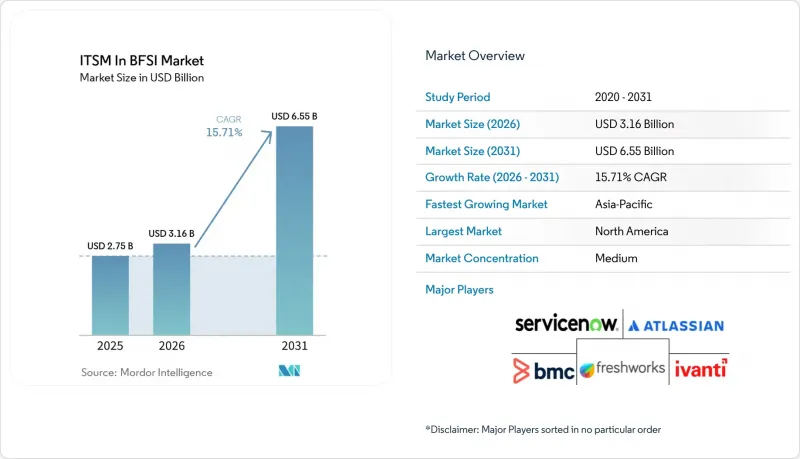
本報告按元件(解決方案、服務)、部署模式(雲端、本地端、混合)、應用程式(服務台和事件管理、資產和配置管理、變更和發布管理、服務請求管理等)、企業規模(大型企業、中小企業)和地區進行細分。市場預測以美元計價。
全球銀行、金融服務和保險 (BFSI) 行業 ITSM 市場的趨勢和見解。
利用 GenAI 實現事件解決和工作流程自動化
金融服務業 (BFSI) 的 IT 服務管理 (ITSM) 正受益於服務工作流程中向生成式人工智慧的顯著轉變,這一趨勢在金融機構尋求更快的初步回應解決速度和更高內部支援可用性的領域尤為明顯。 2025 年,澳洲聯邦銀行透過 Microsoft Teams 向 1000 多名現場員工部署了 ChatIT Assistant。該工具可在兩分鐘內解決設備和連接問題,展示了人工智慧如何取代日常營運中耗時的多階段服務台路由。人工智慧對勞動力重新分配的影響也反映在金融服務業的 ITSM 中。隨著日常工單處理轉向自動化處理,人工團隊將更多精力集中在檢驗異常情況、驗證策略一致性以及驗證自動化操作。 2026 年 1 月,ServiceNow 和 Fiserv 擴大了策略合作夥伴關係,Fiserv 將在其整個 IT 和客戶服務環境中部署 Now Assist,用於金融服務營運和 ITSM,為數千家金融機構客戶提供支援。 2026年4月發表的一項同儕審查研究證實,結合大規模語言模型和工作流程自動化的架構在技術上可行,能夠用於自主IT服務環境中的事件解決、變更管理和問題管理。此外,2026年6月,金融穩定理事會(FSB)指出,金融機構安全部署人工智慧取決於資料品質、模型風險管理以及第三方人工智慧的治理。這表明,管治功能仍然是銀行、金融服務和保險(BFSI)行業IT服務管治(ITSM)的核心要素,而非可選項。
在受監管的銀行、金融服務和保險 (BFSI) 環境中實施雲端原生服務管理
在銀行、金融服務和保險 (BFSI) 行業,隨著合規團隊需要最新的工作流程、穩定的審計證據以及減少對本地修補週期的依賴,IT 服務管理 (ITSM) 對雲端原生解決方案的需求日益成長。歐洲銀行管理局 (EBA) 指出,DORA 已於 2025 年 1 月 17 日生效。該法規將資訊通訊技術 (ICT) 風險管理、事件報告和第三方資訊要求直接整合到歐洲各地金融機構的營運環境中。在此背景下,雲端平台成為 BFSI 產業 ITSM 的首選,因為託管升級可以縮短監管變更與工作流程變更之間的時間差,並減輕維護各個本地環境的營運負擔。此外,變更、事件和合規記錄儲存在雲端平台中,使得採購方對任何可能中斷這些記錄連續性的操作都更加謹慎,這也有助於 BFSI 產業與 ITSM 供應商建立更長期的合作關係。然而,這並不能消除執行風險。過渡仍然需要嚴格的資料清理、清晰的回滾計劃以及分階段的營運變更,而不是一次性切換。因此,BFSI 產業 ITSM 中的雲端採用不僅僅是託管決策,而是與營運彈性相關的管治計畫。
遷移傳統ITSM的風險和流程重組的負擔。
在銀行、金融服務和保險 (BFSI) 行業,IT 服務管理 (ITSM) 仍然面臨著許多挑戰,其中最主要的是那些多年來透過修補程式、自訂連接器和流程變通方案不斷擴展的舊有系統。這阻礙了 BFSI 產業 ITSM 的發展,因為採購者通常需要重新設計工作流程、簡化服務記錄並調整營運模式,才能從新平台中獲得價值。當銀行和保險公司仍然經營基於個別流程例外情況而非通用營運標準建構的過時本地服務台時,這項挑戰尤其突出。即使金融機構致力於現代化,流程通常也需要經歷多個階段,這往往會延遲董事會和營運團隊在大規模平台部署專案後所期望的生產力提升。這種限制並非源自於 BFSI 產業 ITSM 產品功能的不足,而是源自於解決多年來累積的流程差異所帶來的營運負擔。因此,與遷移合作夥伴攜手合作、分階段部署以及完善的管治仍然是 BFSI 產業成功實施 ITSM 的關鍵。
細分市場分析
到2025年,解決方案將佔據銀行、金融服務和保險(BFSI)行業IT服務管理(ITSM)市場佔有率的67.30%。這表明,在法規環境下,金融機構仍然強烈傾向於選擇打包式工作流程解決方案,而不是購買零散的工具。在BFSI產業的ITSM領域,此趨勢反映了預先配置功能(例如變更管理、發現、組態管理資料庫(CMDB)支援和合規性報告)為尋求降低部署風險的金融機構帶來的價值。此外,BFSI行業的ITSM採購方正在利用解決方案驅動的採購方式,減少團隊在內部審查期間需要支援、記錄和課責的平行工具數量。這有助於維持解決方案層的結構穩健性,因為接受審計的金融機構優先考慮工作流程、服務記錄和控制證據的一致性。此外,採購方在初始部署後經常從核心ITSM擴展到相鄰的管治和營運模組,這也推動了大規模平台合約的簽訂。
預計2026年至2031年,服務市場將以15.35%的複合年成長率成長,其中服務領域的成長速度更快,儘管軟體仍然是主要的收入來源。在銀行、金融服務和保險(BFSI)產業的IT服務管理(ITSM)領域,這一趨勢反映出服務內容正從常規部署任務轉向與人工智慧管治、異常處理、營運模式設計和控制協調相關的高價值諮詢服務。 2025年2月,Freshworks和Unisys宣佈建立策略夥伴關係,目標客戶為120多個國家的中型和大型企業客戶。這預示著一種類似於軟體銷售的以服務為導向的通路結構正在形成。因此,在BFSI產業的ITSM領域,自動化不會減少對服務的需求,因為它會將營運轉向更細緻、更專業的任務。事實上,只要金融機構需要遷移支援、人工智慧監管、營運變更管理以及受監管流程的文件準備,BFSI產業的ITSM就將繼續創造業務收益。
到 2025 年,雲端將佔 BFSI 產業 ITSM 市場規模的 68.10%,證實了託管交付已成為大多數新建和擴展部署的標準架構。雲端在 BFSI 產業 ITSM 領域佔據主導地位,是因為金融機構重視更快的升級速度、更高的彈性容量以及在分散式團隊中輕鬆部署更新後的合規工作流程。此外,預計到 2031 年,雲端將以 14.90% 的複合年成長率成長,表明這種領先的部署模式仍然是一個快速成長的領域,而不是一個發展勢頭減弱的成熟領域。 2026 年,ServiceNow 繼續增強其金融服務平台,包括在其季度版本中加入合規性和 PCI 相關功能。這凸顯了持續交付相對於經常延遲的本地補丁週期的優勢。這種營運邏輯增強了買家對雲端傳輸的信心,因為監管時間表和服務連續性依賴於當前的工作流程和控制範本。
在銀行、金融服務和保險 (BFSI) 行業的 IT 服務管理 (ITSM) 中,混合部署和本地部署模式仍然至關重要,因為某些工作負載仍然涉及高度資料敏感度、需要本地管理,或涉及跨多個司法管轄區的分階段現代化計畫。正因如此,儘管雲端是規模最大、成長最快的平台,BFSI 產業的 ITSM 尚未完全轉型為純雲端架構。正如 BMC BBVA 的案例研究所示,即使是大規模的跨區域金融機構,在將分散的區域系統整合到單一營運模式的過程中,仍然可以依靠分階段的架構選擇。對許多金融機構而言,混合部署是一種遷移路徑,可以在資料、整合和內部責任重組的同時,保障服務的連續性。 BFSI 產業的 ITSM 繼續支援這些混合架構,因為管治成熟度因地區、業務部門和用例而異。因此,儘管雲端仍然是戰略投資中心,但混合環境可以保護敏感流程,並確保大規模遷移的可控性。
區域分析
到2025年,北美將佔據銀行、金融服務和保險(BFSI)行業IT服務管理(ITSM)市場佔有率的40.15%,繼續保持其作為最大的區域支出和供應商活動中心的地位。該地區在BFSI ITSM市場的領先地位源於金融機構在嚴格的審計、網路安全、結算和營運監管要求下運營,這些要求需要結構化的服務管理。該地區的優勢還在於其集中了許多大型銀行、保險公司、支付處理商和技術合作夥伴,這些機構能夠大規模支援平台專案。北美BFSI ITSM市場也得益於成熟的供應商生態系統,使買家能夠利用涵蓋先進人工智慧功能、專業服務甚至遷移和管治服務的廣泛合作夥伴網路。雖然這種成熟度加快了產品發布週期,但也增加了供應商評估的難度,因為買家不僅要比較模組的廣度,還要比較人工智慧控制能力、平台間互通性和證據品質。
預計到2031年,亞太地區的IT服務管理(ITSM)市場將以15.30%的複合年成長率成長,成為銀行、金融服務和保險(BFSI)產業ITSM領域成長最快的區域市場。全部區域地區BFSI產業ITSM的成長主要得益於領先金融中心的現代化專案以及快速數位化銀行系統中第一代結構化服務管理的採用。日本尤其突出,因為其機構已將工作流程現代化轉化為實際可見的成果。 SMBC日興證券在2026年4月發布的報告顯示,實施OutSystems系統後,其應用程式開發時間縮短了高達50%,內部開發團隊規模也從5人擴大到20人。此外,透過加強企業人工智慧管治活動,BFSI產業的ITSM也不斷擴大其區域滲透率。例如,瑞穗金融集團計劃在2026年在全公司部署Dify環境,該環境具備存取控制和完整的審計日誌功能。這些例子表明,在該地區,工作流程數位化、內部管治和可擴展服務設計正在以整合的方式推進,而不是作為獨立的階段。
在銀行、金融服務和保險 (BFSI) 行業中,歐洲在資訊科技服務管理 (ITSM) 領域佔據第二大區域佔有率,其中資料外洩風險評估 (DORA) 仍然是其需求模式的最主要促進因素。歐洲銀行管理局 (EBA) 關於 DORA 準備和報告義務的指南進一步強調了金融機構需要持續維護其整個營業單位內的資訊通訊技術 (ICT) 風險、事件和第三方記錄。因此,歐洲 BFSI 產業的 ITSM 優先考慮可審計的工作流程、變更可追溯性和平台級證據產生。除主要區域外,南美洲、中東和非洲以及亞太地區的小規模經濟體在 BFSI 行業的 ITSM 領域也蘊藏著巨大的機遇,儘管規模較小,但這主要得益於數位銀行的持續擴張以及對正式彈性日益成長的期望。
其他好處:
- Excel格式的市場預測(ME)表
- 3個月的分析師支持
目錄
第1章:引言
- 研究假設和市場定義
- 調查範圍
第2章:調查方法
第3章執行摘要
第4章 市場狀況
- 市場概覽
- 市場促進因素
- 在受監管的銀行、金融服務和保險 (BFSI) 環境中實施雲端原生服務管理
- 利用 GenAI 實現事件解決和工作流程自動化
- ITSM中的財務營運與服務成本管治
- 可審計的變更、風險和合規工作流程
- 銀行和保險公司對混合辦公模式服務交付的期望
- 低程式碼企業服務管理正在超越 IT 領域的界線。
- 市場限制因素
- 遷移傳統ITSM的風險和流程重組的負擔。
- 資料居住、隱私和模型管治約束
- 整個核心銀行和安全堆疊的高階整合非常複雜。
- 工具的激增和使用者對採用工具的抵制導致了人們對變革的疲勞。
- 產業價值鏈分析
- 監理情勢
- 技術展望
- 波特五力分析
- 宏觀經濟因素對市場的影響
第5章 市場規模與成長預測
- 按組件
- 解決方案
- 服務
- 按實現類型
- 雲
- 現場
- 混合
- 透過使用
- 服務台和事件管理
- 資產和配置管理
- 變更和發布管理
- 服務請求管理
- 知識管理
- 其他
- 按公司規模
- 大公司
- 中小企業
- 按地區
- 北美洲
- 美國
- 加拿大
- 墨西哥
- 南美洲
- 巴西
- 阿根廷
- 其他南美國家
- 歐洲
- 德國
- 英國
- 法國
- 俄羅斯
- 西班牙
- 其他歐洲國家
- 亞太地區
- 中國
- 日本
- 印度
- 韓國
- 東南亞
- 其他亞太國家
- 中東和非洲
- 中東
- 沙烏地阿拉伯
- 阿拉伯聯合大公國
- 土耳其
- 其他中東國家
- 非洲
- 南非
- 奈及利亞
- 埃及
- 其他非洲國家
- 中東
- 北美洲
第6章 競爭情勢
- 市場集中度
- 策略趨勢
- 市佔率分析
- 公司簡介
- ServiceNow Inc.
- BMC Software, Inc.
- Atlassian Corporation Plc
- Ivanti, Inc.
- Freshworks Inc.
- OpenText Corporation
- IBM Corporation
- Broadcom Inc.
- ManageEngine(Zoho Corporation Pvt. Ltd.)
- SolarWinds Corporation
- EasyVista, Inc.
- SysAid Technologies Ltd.
- TOPdesk BV
- 4me, Inc.
- Hornbill Service Management Ltd.
- Efecte Plc
- NinjaOne, LLC
- Aisera, Inc.
- Halo Service Solutions Ltd.
- InvGate SRL
第7章 市場機會與未來展望
According to Mordor Intelligence, the ITSM in BFSI market size is projected to be USD 2.75 billion in 2025, USD 3.16 billion in 2026, and reach USD 6.55 billion by 2031, growing at a CAGR of 15.71% from 2026 to 2031.
This report is Segmented by Component (Solutions and Services), Deployment (Cloud, On-Premise, and Hybrid), Application (Service Desk and Incident Management, Asset and Configuration Management, Change and Release Management, Service Request Management, and More), Enterprise Size (Large Enterprises and Small and Mid-Size Enterprises (SME)), and Geography. The Market Forecasts are Provided in Terms of Value (USD).
Global ITSM In BFSI Market Trends and Insights
GenAI-Enabled Incident Resolution and Workflow Automation
The ITSM in the BFSI market is benefiting from a clear shift toward generative AI inside service workflows, especially where financial institutions want faster first-contact resolution and better internal support availability. Commonwealth Bank deployed its ChatIT assistant in 2025 through Microsoft Teams for more than 1,000 frontline employees, and the tool resolved device and connectivity incidents within 2 minutes, which showed how AI could replace slower multi-step helpdesk routing in daily operations. The ITSM in the BFSI market is also being shaped by the way AI changes labor allocation, because routine ticket work is moving toward automated handling while human teams focus more on exception review, policy alignment, and validation of automated actions. ServiceNow and Fiserv expanded their strategic commitment in January 2026, with Fiserv deploying Now Assist for Financial Services Operations and ITSM across IT and customer service environments that support thousands of financial institution clients. A peer-reviewed study published in April 2026 confirmed that architectures combining large language models with workflow automation are technically viable for incident resolution, change management, and problem management in autonomous IT service environments. The Financial Stability Board also stated in June 2026 that safe AI adoption in financial institutions depends on data quality, model risk management, and third-party AI governance, which keeps governance capability central to the ITSM in BFSI market rather than optional.
Cloud-Native Service Management Adoption in Regulated BFSI Environments
The ITSM in BFSI market is seeing stronger demand for cloud-native delivery because compliance teams need current workflows, stable audit evidence, and less dependence on local patch cycles. The European Banking Authority noted that DORA became applicable from January 17, 2025, which placed ICT risk management, incident reporting, and third-party information requirements directly into the operating environment of financial entities across Europe. In that setting, the ITSM in BFSI market favors cloud platforms because managed upgrades shorten the lag between regulatory change and workflow change, and they reduce the operational burden of maintaining separate local installations. This driver is also supporting longer vendor relationships in the ITSM in BFSI market, because once change, incident, and compliance records sit inside a cloud platform, buyers become cautious about any move that could interrupt continuity of those records. The same driver does not remove execution risk, because migration still depends on disciplined data cleanup, clear rollback planning, and staged operating changes rather than a single cutover event. As a result, cloud adoption in the ITSM in BFSI market is moving ahead as a governance program tied to operational resilience, not just as a hosting decision.
Legacy ITSM Migration Risk and Process Reengineering Burden
The ITSM in BFSI market still faces a major barrier in the form of legacy estates that were extended for years through patches, custom connectors, and process workarounds. This slows the ITSM in BFSI market because buyers often need to redesign workflows, clean service records, and align operating models before they can gain value from a new platform. The challenge is strongest where banks and insurers still run older on-premise service desks that were built around local process exceptions rather than common operating standards. Even when institutions commit to modernization, the work often stretches over multiple phases and delays the productivity gains that boards and operating teams expect after a large platform program. The restraint is not about a lack of product functionality in the ITSM in BFSI market, but about the operational burden of untangling years of accumulated process variance. That is why migration partners, phased delivery, and governance discipline remain critical to successful adoption in the ITSM in BFSI market.
Other drivers and restraints analyzed in the detailed report include:
- Audit-Ready Change, Risk, and Compliance Workflows
- FinOps and Service Cost Governance Inside ITSM
- Data Residency, Privacy, and Model-Governance Constraints
For complete list of drivers and restraints, kindly check the Table Of Contents.
Segment Analysis
Solutions accounted for 67.30% of the ITSM in BFSI market share in 2025, which shows how strongly institutions still prefer packaged workflow coverage over fragmented tool buying in regulated environments. Within the ITSM in BFSI market, that preference reflects the value of preconfigured capabilities such as change management, discovery, CMDB support, and compliance reporting when institutions want lower deployment risk. Buyers in the ITSM in BFSI market also use solution-led procurement to reduce the number of parallel tools that teams must support, document, and defend during internal review. This keeps the solutions layer structurally strong because audited institutions place a premium on consistency across workflows, service records, and control evidence. It also supports larger platform contracts because buyers often expand from core ITSM into adjacent governance and operations modules after initial adoption.
Services are projected to grow at a 15.35% CAGR from 2026 to 2031, which makes them the faster-moving component even as software remains the larger revenue base. In the ITSM in BFSI market, this pattern reflects the shift from routine implementation work toward higher-value advisory activity around AI governance, exception handling, operating model design, and control alignment. Freshworks and Unisys announced a strategic partnership in February 2025 to target mid-market and large enterprise customers in more than 120 countries, which showed how channel capacity is being built around service delivery as much as around software sales. The ITSM in BFSI industry is therefore not seeing automation remove services demand, because automation shifts the work toward more sensitive and more specialized tasks. In practice, the ITSM in BFSI market keeps generating services revenue wherever institutions need migration support, AI oversight, operating change management, and evidence preparation for regulated processes.
Cloud held 68.10% of the ITSM in BFSI market size in 2025, which confirms that managed delivery has become the default architecture for a large part of new and expanding implementations. In the ITSM in BFSI market, cloud has gained this position because institutions value faster upgrades, elastic capacity, and easier rollout of updated compliance workflows across distributed teams. Cloud is also projected to expand at a 14.90% CAGR through 2031, which shows that the leading deployment model is still the faster-growing one rather than a mature segment losing momentum. ServiceNow continued to widen its financial services platform capabilities in 2026, including compliance and PCI-related features in its quarterly releases, which highlights the advantage of continuous delivery over slower local patching cycles. That operating logic strengthens buyer confidence in cloud delivery, where regulatory timetables and service continuity depend on current workflows and current control templates.
Hybrid and on-premise models remain relevant in the ITSM in BFSI market because some workloads still involve higher data sensitivity, local control expectations, or staged modernization plans across multiple jurisdictions. This is why the ITSM in BFSI market has not shifted into a cloud-only structure even though cloud has the largest and fastest-growing position. BMC's BBVA example showed that a large multi-region institution can still rely on phased architecture choices while it consolidates fragmented regional systems into a single operating model. In many institutions, hybrid deployment acts as a transition path that protects service continuity while data, integrations, and internal responsibilities are reorganized. The ITSM in BFSI industry continues to support these mixed architectures because governance maturity differs across geographies, business units, and use cases. As a result, cloud remains the strategic center of spending, while hybrid environments protect sensitive processes and keep large migrations manageable.
Complete Report Scope:
- By Component
- Solutions
- Services
- By Deployment
- Cloud
- On-premise
- Hybrid
- By Application
- Service Desk and Incident Management
- Asset and Configuration Management
- Change and Release Management
- Service Request Management
- Knowledge Management
- Other Applications
- By Enterprise Size
- Large Enterprises
- Small and Mid-size Enterprises (SME)
- By Geography
- North America
- United States
- Canada
- Mexico
- South America
- Brazil
- Argentina
- Rest of South America
- Europe
- Germany
- United Kingdom
- France
- Russia
- Spain
- Rest of Europe
- Asia-Pacific
- China
- Japan
- India
- South Korea
- Southeast Asia
- Rest of Asia-Pacific
- Middle East and Africa
- Middle East
- Saudi Arabia
- United Arab Emirates
- Turkey
- Rest of Middle East
- Africa
- South Africa
- Nigeria
- Egypt
- Rest of Africa
- Middle East
- North America
Geography Analysis
North America held 40.15% of the ITSM in BFSI market share in 2025, which kept it as the largest regional base for spending and vendor activity. The region leads the ITSM in BFSI market because financial institutions operate under strong audit, cyber, payment, and operational oversight requirements that all favor structured service management. It also benefits from a deep concentration of large banks, insurers, processors, and technology partners that can support complex platform programs at scale. The ITSM in BFSI market in North America is also shaped by a mature vendor ecosystem, which gives buyers access to advanced AI features, specialist services, and wider partner coverage across migration and governance work. That maturity raises product velocity, but it also makes vendor evaluation more demanding because buyers compare not only module breadth but also AI control, platform interoperability, and evidence quality.
Asia-Pacific is projected to grow at a 15.30% CAGR through 2031, making it the fastest-growing regional segment in the ITSM in BFSI market. Growth in the ITSM in BFSI market across Asia-Pacific is being supported by modernization programs in developed financial centers and by first-generation structured service management buying in fast-digitizing banking systems. Japan stands out because institutions are tying workflow modernization to practical delivery gains, and SMBC Nikko Securities reported in April 2026 that its use of OutSystems reduced application build time by up to 50% and expanded its internal developer base from 5 to 20 members. The ITSM in BFSI market is also gaining regional depth through stronger enterprise AI governance activity, including Mizuho Financial Group's 2026 enterprise rollout of its Dify environment with controlled access and full audit logging. These examples show a region where workflow digitization, internal governance, and scalable service design are moving together rather than in separate phases.
Europe held the second-largest regional position in the ITSM in BFSI market, and DORA remains the clearest single catalyst for that demand pattern. The European Banking Authority's guidance around DORA preparation and reporting obligations has reinforced the need for financial institutions to maintain consistent ICT risk, incident, and third-party records across operating entities. The ITSM in BFSI market in Europe therefore places high value on audit-ready workflows, change traceability, and platform-level evidence generation. Outside the largest regions, South America, the Middle East and Africa, and smaller Asia-Pacific economies still represent lower-share but meaningful opportunity in the ITSM in BFSI market as digital banking expansion and formal resilience expectations continue to rise.
- ServiceNow Inc.
- BMC Software, Inc.
- Atlassian Corporation Plc
- Ivanti, Inc.
- Freshworks Inc.
- OpenText Corporation
- IBM Corporation
- Broadcom Inc.
- ManageEngine (Zoho Corporation Pvt. Ltd.)
- SolarWinds Corporation
- EasyVista, Inc.
- SysAid Technologies Ltd.
- TOPdesk BV
- 4me, Inc.
- Hornbill Service Management Ltd.
- Efecte Plc
- NinjaOne, LLC
- Aisera, Inc.
- Halo Service Solutions Ltd.
- InvGate S.R.L.
Additional Benefits:
- The market estimate (ME) sheet in Excel format
- 3 months of analyst support
TABLE OF CONTENTS
1 INTRODUCTION
- 1.1 Study Assumptions and Market Definition
- 1.2 Scope of the Study
2 RESEARCH METHODOLOGY
3 EXECUTIVE SUMMARY
4 MARKET LANDSCAPE
- 4.1 Market Overview
- 4.2 Market Drivers
- 4.2.1 Cloud-Native Service Management Adoption in Regulated BFSI Environments
- 4.2.2 GenAI-Enabled Incident Resolution and Workflow Automation
- 4.2.3 FinOps and Service Cost Governance Inside ITSM
- 4.2.4 Audit-Ready Change, Risk, and Compliance Workflows
- 4.2.5 Hybrid Workforce Service Delivery Expectations in Banks and Insurers
- 4.2.6 Low-Code Enterprise Service Management Expansion Beyond IT
- 4.3 Market Restraints
- 4.3.1 Legacy ITSM Migration Risk and Process Reengineering Burden
- 4.3.2 Data Residency, Privacy, and Model-Governance Constraints
- 4.3.3 High Integration Complexity Across Core Banking and Security Stacks
- 4.3.4 Change Fatigue From Tool Sprawl and User Adoption Resistance
- 4.4 Industry Value Chain Analysis
- 4.5 Regulatory Landscape
- 4.6 Technological Outlook
- 4.7 Porter's Five Forces Analysis
- 4.7.1 Bargaining Power of Suppliers
- 4.7.2 Bargaining Power of Buyers
- 4.7.3 Threat of New Entrants
- 4.7.4 Threat of Substitutes
- 4.7.5 Intensity of Competitive Rivalry
- 4.8 Impact of Macroeconomic Factors on the Market
5 MARKET SIZE AND GROWTH FORECASTS (VALUES)
- 5.1 By Component
- 5.1.1 Solutions
- 5.1.2 Services
- 5.2 By Deployment
- 5.2.1 Cloud
- 5.2.2 On-premise
- 5.2.3 Hybrid
- 5.3 By Application
- 5.3.1 Service Desk and Incident Management
- 5.3.2 Asset and Configuration Management
- 5.3.3 Change and Release Management
- 5.3.4 Service Request Management
- 5.3.5 Knowledge Management
- 5.3.6 Other Applications
- 5.4 By Enterprise Size
- 5.4.1 Large Enterprises
- 5.4.2 Small and Mid-size Enterprises (SME)
- 5.5 By Geography
- 5.5.1 North America
- 5.5.1.1 United States
- 5.5.1.2 Canada
- 5.5.1.3 Mexico
- 5.5.2 South America
- 5.5.2.1 Brazil
- 5.5.2.2 Argentina
- 5.5.2.3 Rest of South America
- 5.5.3 Europe
- 5.5.3.1 Germany
- 5.5.3.2 United Kingdom
- 5.5.3.3 France
- 5.5.3.4 Russia
- 5.5.3.5 Spain
- 5.5.3.6 Rest of Europe
- 5.5.4 Asia-Pacific
- 5.5.4.1 China
- 5.5.4.2 Japan
- 5.5.4.3 India
- 5.5.4.4 South Korea
- 5.5.4.5 Southeast Asia
- 5.5.4.6 Rest of Asia-Pacific
- 5.5.5 Middle East and Africa
- 5.5.5.1 Middle East
- 5.5.5.1.1 Saudi Arabia
- 5.5.5.1.2 United Arab Emirates
- 5.5.5.1.3 Turkey
- 5.5.5.1.4 Rest of Middle East
- 5.5.5.2 Africa
- 5.5.5.2.1 South Africa
- 5.5.5.2.2 Nigeria
- 5.5.5.2.3 Egypt
- 5.5.5.2.4 Rest of Africa
- 5.5.5.1 Middle East
- 5.5.1 North America
6 COMPETITIVE LANDSCAPE
- 6.1 Market Concentration
- 6.2 Strategic Moves
- 6.3 Market Share Analysis
- 6.4 Company Profiles (includes Global Level Overview, Market Level Overview, Core Segments, Financials as available, Strategic Information, Market Rank/Share, Products and Services, Recent Developments)
- 6.4.1 ServiceNow Inc.
- 6.4.2 BMC Software, Inc.
- 6.4.3 Atlassian Corporation Plc
- 6.4.4 Ivanti, Inc.
- 6.4.5 Freshworks Inc.
- 6.4.6 OpenText Corporation
- 6.4.7 IBM Corporation
- 6.4.8 Broadcom Inc.
- 6.4.9 ManageEngine (Zoho Corporation Pvt. Ltd.)
- 6.4.10 SolarWinds Corporation
- 6.4.11 EasyVista, Inc.
- 6.4.12 SysAid Technologies Ltd.
- 6.4.13 TOPdesk BV
- 6.4.14 4me, Inc.
- 6.4.15 Hornbill Service Management Ltd.
- 6.4.16 Efecte Plc
- 6.4.17 NinjaOne, LLC
- 6.4.18 Aisera, Inc.
- 6.4.19 Halo Service Solutions Ltd.
- 6.4.20 InvGate S.R.L.
7 MARKET OPPORTUNITIES AND FUTURE OUTLOOK
- 7.1 White-Space and Unmet-Need Assessment

 分散式人工智慧基礎設施市場規模、佔有率、成長、全球產業分析、區域趨勢及2026年至2034年預測全球分散式人工智慧基礎設施市場規模、佔有率、趨勢和成長分析報告(2026-2034年)
 分散式人工智慧決策網路市場預測至2034年—按網路架構、部署模式、技術、應用、最終用戶和區域分類的全球分析分散式邊緣連接解決方案市場預測至2034年—按解決方案類型、連接類型、應用、最終用戶和地區分類的全球分析
 2026-2030年全球國防IT支出市場
 國防IT支出市場:按類型、服務、應用和地區分類(2026-2034年)
 2026年全球國防IT支出市場報告
 線上旅行社市場規模、佔有率和趨勢分析報告:按服務類型、預訂平台、年齡層、旅行者類型、地區和細分市場預測,2026-2033年
 物聯網在物流市場的支出分析及預測(至2035年),依類型、產品類型、服務、技術、組件、應用、設備、部署類型、最終用戶及解決方案分類
 全球分散式人工智慧運算市場,2025-2029年