


 |
市場調查報告書
商品編碼
2098552
ADAS GPU:市佔率分析、產業趨勢與統計及成長預測(2026-2031)ADAS GPU - Market Share Analysis, Industry Trends & Statistics, Growth Forecasts (2026 - 2031) |
||||||

※ 本網頁內容可能與最新版本有所差異。詳細情況請與我們聯繫。
根據 Mordor Intelligence 預測,ADAS GPU 的市場規模預計將從 2025 年的 43.9 億美元成長到 2026 年的 53.8 億美元,然後從 2026 年到 2031 年以 24.77% 的複合年成長率成長,到 20317 億美元。
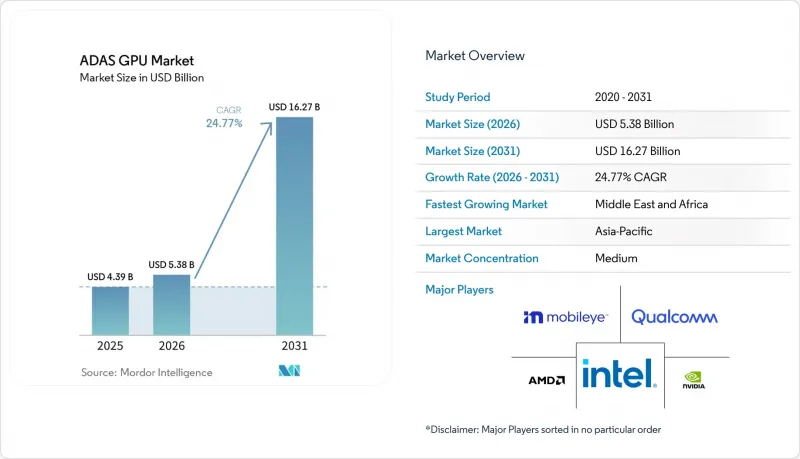
本報告依GPU整合類型(整合GPU/SoC、獨立GPU/加速器)、ADAS應用(感知與感測器融合、路徑規劃、駕駛監控、環景顯示、自動駕駛運算)、車輛類型(乘用車、商用車)、自動駕駛等級(L1、L2、L3及其他)及地區進行細分。市場預測以美元(USD)為單位。
全球ADAS GPU市場趨勢與洞察
每輛車的ADAS功能增加
在ADAS GPU市場,短期內最強勁的成長動力來自於每輛車上安裝的運算密集安全和便利功能的穩定增加。如今,中階車型配備了更多組合功能,包括雷達、環景顯示影像、駕駛員監控、乘客監控以及適用於高速公路和城市道路的駕駛輔助功能,這使得處理需求遠遠超出了傳統控制架構的承受範圍。這種轉變不再局限於豪華車;主流新車也開始採用需要更多並行運算和更快資料處理速度的功能套件。隨著這些功能進入量產階段,供應商在車輛開發週期的早期階段就選擇GPU和SoC,以確保軟體、記憶體和檢驗方案的整合。此外,汽車製造商希望避免為每個新功能添加單獨的處理器,這提升了能夠在同一晶片上支援多種工作負載的平台的價值。因此,ADAS GPU市場不僅受益於配備駕駛輔助功能的車輛數量的增加,也受益於每輛配備這些功能的車輛相比以往車型週期所面臨的更高計算負載。
向軟體定義汽車過渡
向軟體定義汽車的轉變正在改變汽車製造商設計電子系統的方式,並直接推動了ADAS GPU市場的發展。與以往將功能分散在數十個專用控制單元不同,新的架構將感知、決策和使用者介面任務整合到更少的高效能運算節點上。這種模式有利於整合GPU的SoC,因為它們非常適合需要高速並行處理和共用記憶體存取的推理密集型工作負載。高通和寶馬透過將雙方共同開發的驍龍Ride Pilot自動駕駛系統整合到新寶馬iX3中,展示了晶片供應商與汽車製造商在軟體堆疊和硬體平台上的緊密合作。其商業影響力同樣顯著。軟體定義模式使半導體平台供應商能夠在長週期汽車專案中發揮更大的作用,縮小晶片路線圖和車輛藍圖之間的差距。對於ADAS GPU市場而言,這意味著需求不僅與單一車款系列的功能採用相關,而且與整個車系的平台標準化密切相關。
嚴格的汽車認證要求和功能安全負擔
功能安全仍然是ADAS GPU市場面臨的最大限制因素之一,因為汽車認證需要的不僅僅是卓越的運算能力。供應商需要硬體安全機制、冗餘設計、診斷功能、流程控制以及文檔,以滿足整個漫長開發週期內最高的汽車安全標準。這增加了平台進入汽車量產所需的時間、成本和工程投入,而汽車專案對安全性的要求至關重要。 NVIDIA宣布,其DriveOS平台在經過TUV SUD評估後已達到ASIL-D合規性標準,並獲得了ISO 21434網路安全流程認證。這表明建立適用於高級自動駕駛應用的平台需要付出巨大的努力。這些要求縮小了供應商的選擇範圍,因為消費級和資料中心的設計方案無法直接應用於車輛,需要大量的重新設計和檢驗。在ADAS GPU市場,這導致獲得認證的平台供應商數量減少,合規解決方案的價格飆升,以及產能擴張速度低於市場需求應有的水平。
細分市場分析
預計到 2025 年,整合 GPU 和基於 GPU 的 SoC 解決方案將佔 59.46% 的銷售額,繼續在 ADAS GPU 市場佔據核心地位。汽車製造商持續青睞整合設計,因為單晶片簡化了封裝,降低了功耗,並簡化了跨多個功能的安全認證流程。隨著集中式車輛架構的日益普及,這一優勢將進一步增強,因為單一平台可以在共用的運算域內覆蓋感知、資訊娛樂、閘道器和監控等工作負載。 NVIDIA 表示,DRIVE Thor 旨在單一架構上運行自動駕駛和車載體驗,凸顯了整合解決方案在多功能汽車平臺中的價值。
預計到2031年,獨立GPU和加速器解決方案將以24.99%的複合年成長率成長,成為ADAS GPU市場中成長最快的整合格式。這一成長主要由那些需要持續運算能力遠超單一單晶片SoC在典型散熱設計框架下所能提供的運算能力的項目所驅動。 WeRide與聯想共同發表了一款搭載兩顆NVIDIA DRIVE AGX Thor處理器的車規級HPC 3.0平台,充分展現了自動駕駛專案中對獨立運算能力日益成長的需求。同時,Imagination Technologies則著重推廣其以安全為導向的GPU IP,該IP能夠降低功耗和晶片面積,從而支援整合格式在量產車型中保持競爭力。這種平衡解釋了為何整合解決方案目前仍佔據ADAS GPU市場的重要佔有率,而獨立加速器在那些優先考慮運算能力而非封裝簡易性的領域正逐漸獲得發展動力。
到2025年,感知和感測器融合將佔ADAS GPU市場銷售額的33.02%,成為該領域最大的應用領域。所有配備ADAS的車輛都需要感知管線,而這項工作負載在L1、L2及更高等級的自動駕駛配置中都發揮著至關重要的作用。此外,攝影機、雷達和駕駛員監控功能的廣泛應用也受益於此領域的成長,這些功能都依賴高吞吐量的平行處理。因此,即使其他應用領域在ADAS GPU市場中發展迅速,感知領域仍是收入的主要支柱。
預計到2031年,自動駕駛運算將以25.03%的複合年成長率成長,成為ADAS GPU市場中成長最快的應用領域。 NVIDIA指出,比亞迪、吉利、五十鈴和日產在其L4級自動駕駛專案中採用「DRIVE Hyperion」平台,顯示市場對能夠整合環境感知、路徑規劃和車載AI的平台需求日益成長。路徑規劃、決策、環境感知、停車輔助以及駕駛員和乘客監控等功能正不斷擴展,並整合到同一計算堆疊中,而非作為獨立模組運行在不同的硬體上。隨著這些工作負載的整合度不斷提高,能夠將它們整合到單一晶片或運算域中的供應商可以為汽車製造商提供更具吸引力的價值提案。這也是為什麼高級應用堆疊在ADAS GPU市場中的佔有率日益重要的原因,因為最快的成長並非來自簡單的功能添加,而是來自軟體密集型部署。
區域分析
到2025年,亞太地區將佔ADAS GPU市場39.18%的銷售額,成為該市場的領頭羊。該地區受益於大規模的汽車生產、中國快速發展的能力以及與國內汽車項目和計算平台供應商的緊密合作。中國憑藉其龐大的乘用車產量以及集中式運算和高級輔助功能的快速普及,仍然是主要的需求中心。日本透過其在商用車和自動駕駛巴士領域的活動為該地區奠定了基礎,而韓國則透過開發先進的半導體和汽車平臺來增強市場實力。 NVIDIA表示,比亞迪、吉利、五十鈴和日產在其L4級自動駕駛項目中採用「DRIVE Hyperion」平台,凸顯了該地區在乘用車和商用車平台方面的深度參與。
北美和歐洲是ADAS GPU市場的下一個主要叢集,這得益於高階汽車項目、嚴格的安全標準以及主動自動駕駛技術的發展。歐洲新車安全評鑑協會(Euro NCAP)宣布將於2026年全面修訂其安全協議,採用四大支柱安全框架,強調了緊密整合計算對於追求最高安全評分的車輛的重要性。北美仍然是無人駕駛計程車開發、模擬基礎設施以及計算平台供應商與旅遊運營商之間夥伴關係的關鍵參與者。賓士發布了搭載NVIDIA DRIVE AV和L4級自動駕駛架構的新一代S-Class轎車,展現了歐洲透過高階汽車創新在ADAS GPU高階市場持續發揮的影響力。
預計到2031年,中東和非洲地區的年複合成長率將達到25.11%,成為ADAS GPU市場成長最快的區域細分市場。這一成長主要得益於對智慧運輸的投資、對高階汽車的需求以及海灣地區自動駕駛出行生態系統的早期建立。 NVIDIA表示,其2026年6月推出的DRIVE Hyperion生態系統擴展計畫包括與中東旅遊領域的合作夥伴,這表明NVIDIA不僅在探索市場定位,而且積極開展商業性活動。南美洲市場雖然規模相對較小,但由於商用車安全要求的不斷提高以及高階乘用車的普及,本地客製化汽車平臺的計算負載正在逐步增加。
其他好處:
- Excel格式的市場預測(ME)表
- 3個月的分析師支持
目錄
第1章:引言
- 研究假設和市場定義
- 調查範圍
第2章:調查方法
第3章執行摘要
第4章 市場狀況
- 市場概覽
- 市場促進因素
- 每輛車的搭載率正在提高。
- 向軟體定義汽車過渡
- 集中式和分區式車輛架構的發展
- 高解析度數位駕駛座和多顯示系統的普及
- 由於安全法規,計算環境需要升級。
- 汽車產業對人工智慧和感測器融合的需求日益成長。
- 市場限制因素
- 汽車業嚴格的認證要求和功能安全負擔
- 熱容量和電容量限制
- 半導體供應鏈和先進節點供應風險
- 大眾市場汽車平檯面臨的成本壓力
- 宏觀經濟因素對市場的影響
- 市場定位分析
- 監理情勢
- 技術展望
- 波特五力分析
第5章 市場規模與成長預測
- GPU整合類型
- 整合GPU/配備GPU的SoC
- 汽車級獨立GPU/加速器
- 透過ADAS應用程式
- 感知與感測器融合
- 路線規劃與決策
- 駕駛員監控與乘員監控
- 環景顯示和停車輔助
- 用於自動駕駛的計算
- 車輛類型
- 搭乘用車
- 商用車輛
- 按自動化級別
- 一級
- 二級
- 3級
- 4級
- 5級
- 按地區
- 北美洲
- 美國
- 加拿大
- 墨西哥
- 歐洲
- 德國
- 英國
- 法國
- 義大利
- 其他歐洲國家
- 亞太地區
- 中國
- 日本
- 韓國
- 印度
- 東南亞
- 其他亞太國家
- 南美洲
- 中東和非洲
- 北美洲
第6章 競爭情勢
- 市場集中度
- 策略趨勢
- 市場定位分析
- 公司簡介
- NVIDIA Corporation
- Qualcomm Technologies, Inc.
- Intel Corporation
- Advanced Micro Devices, Inc.
- Mobileye Global Inc.
- Renesas Electronics Corporation
- NXP Semiconductors NV
- Infineon Technologies AG
- STMicroelectronics NV
- Texas Instruments Incorporated
- Samsung Electronics Co., Ltd.
- MediaTek Inc.
- Arm Ltd.
- Imagination Technologies Limited
- Huawei Technologies Co., Ltd.
- Horizon Robotics
- Black Sesame Technologies(Hong Kong)Limited
- Valens Semiconductor Ltd.
- Synopsys, Inc.
- Cadence Design Systems, Inc.
- Socionext Inc.
第7章 市場機會與未來展望
According to Mordor Intelligence, the ADAS GPU market size is expected to grow from USD 4.39 billion in 2025 to USD 5.38 billion in 2026 and is forecast to reach USD 16.27 billion by 2031 at 24.77% CAGR over 2026-2031.
This report is Segmented by GPU Integration Type (Integrated GPU/SoC, and Discrete GPU/Accelerator), ADAS Application (Perception and Sensor Fusion, Path Planning, Driver Monitoring, Surround View, and Autonomous Driving Compute), Vehicle Type (Passenger Vehicles, and Commercial Vehicles), Level of Autonomy (Level 1, Level 2, Level 3, More), and Geography. The Market Forecasts are Provided in Terms of Value (USD).
Global ADAS GPU Market Trends and Insights
Rising ADAS Content Per Vehicle
The ADAS GPU market is seeing its strongest near-term push from the steady increase in compute-heavy safety and convenience features per vehicle. Mid-range models now carry broader combinations of radar, surround-view cameras, driver monitoring, occupant monitoring, and highway or city assistance functions, which raises processing needs well beyond older control architectures. That change is no longer limited to premium vehicles, because mainstream launches now use feature bundles that require more parallel compute and faster data handling. As those features move into higher-volume production, suppliers are making GPU and SoC decisions earlier in the vehicle development cycle so they can lock software, memory, and validation plans together. This also raises the value of platforms that can support multiple workloads on the same silicon, since automakers want to avoid adding separate processors for each new function. The ADAS GPU market, therefore, benefits not only from more vehicles using assistance functions but also from each equipped vehicle carrying a higher compute load than the previous model cycle.
Shift Toward Software-Defined Vehicles
The shift toward software-defined vehicles is changing how automakers design electronic systems, and that directly supports the ADAS GPU market. Instead of spreading functions across dozens of dedicated control units, newer architectures move more sensing, decision-making, and user-interface tasks into fewer high-performance compute nodes. That model favors GPU-enabled SoCs because they are better suited to inference-heavy workloads that need fast parallel processing and shared memory access. Qualcomm and BMW introduced Snapdragon Ride Pilot in the all-new BMW iX3 as a jointly developed automated driving system, demonstrating how closely chip vendors now work with automakers on the software stack and hardware platform. The commercial effect is equally important because the software-defined model gives semiconductor platform suppliers a greater role in long-cycle vehicle programs and reduces the gap between the chip and vehicle roadmaps. For the ADAS GPU market, this means demand is increasingly tied to platform standardization across model families, not only to feature adoption in one vehicle line.
High Automotive Qualification And Functional Safety Burden
Functional safety remains one of the biggest constraints on the ADAS GPU market because automotive qualification requires more than strong compute performance. Suppliers need hardware safety mechanisms, redundancy, diagnostics, process controls, and documentation that meet the highest automotive safety standards over long development cycles. That adds time, cost, and engineering effort before a platform can enter production in safety-critical vehicle programs. NVIDIA said its DriveOS platform reached ASIL-D conformance, assessed by TUV SUD, and also achieved ISO 21434 cybersecurity process certification, which shows the scale of work needed to make a platform suitable for advanced autonomous applications. These requirements narrow the supplier base because consumer or data-center designs cannot be moved into vehicles without major redesign and validation. For the ADAS GPU market, the outcome is a smaller group of qualified platform vendors, premium pricing for compliant solutions, and slower capacity expansion than raw demand would otherwise support.
Other drivers and restraints analyzed in the detailed report include:
- Growth Of Centralized And Zonal Vehicle Architectures
- Expansion Of High-Resolution Digital Cockpits And Multi-Display Systems
- Thermal And Power Envelope Constraints
For complete list of drivers and restraints, kindly check the Table Of Contents.
Segment Analysis
Integrated GPU and GPU-enabled SoC solutions accounted for 59.46% of revenue in 2025, which kept this format at the center of the ADAS GPU market. Automakers continue to favor integrated designs because a single chip can simplify packaging, reduce power overhead, and streamline safety qualification across multiple functions. This advantage becomes stronger as centralized vehicle architectures spread, since one platform can cover perception, infotainment, gateway, and monitoring workloads in a shared compute domain. NVIDIA says DRIVE Thor is built to run automated driving and in-vehicle experiences on one architecture, which supports the value case for integrated solutions in multi-function vehicle platforms.
Discrete GPU and accelerator solutions are projected to grow at a 24.99% CAGR through 2031, which makes them the faster-rising integration format within the ADAS GPU market. Their growth comes from programs that need sustained compute far above what a single monolithic SoC can comfortably deliver in a mainstream thermal envelope. WeRide and Lenovo introduced an automotive-grade HPC 3.0 platform using dual NVIDIA DRIVE AGX Thor processors, and that example shows where discrete compute demand is emerging most clearly in autonomous mobility programs. At the same time, Imagination Technologies highlights safety-focused GPU IP that lowers power and die-area overhead, which supports the continued competitiveness of integrated formats in volume vehicle lines. This balance explains why integrated solutions still carry the larger ADAS GPU market size today, while discrete accelerators are building momentum where compute headroom matters more than packaging simplicity.
Perception and sensor fusion accounted for 33.02% of revenue in 2025, giving this category the largest application position in the ADAS GPU market. Every ADAS-equipped vehicle needs a perception pipeline, which keeps this workload relevant across Level 1, Level 2, and higher-autonomy configurations. The segment also benefits from the broad use of cameras, radar, and driver-monitoring functions that all rely on high-throughput parallel processing. That is why perception remains the revenue anchor even as other application categories gain speed within the ADAS GPU market.
Autonomous driving compute is projected to expand at a 25.03% CAGR through 2031, making it the fastest-growing application area in the ADAS GPU market. NVIDIA said BYD, Geely, Isuzu, and Nissan have adopted DRIVE Hyperion for Level 4 vehicle programs, pointing to rising demand for platforms that can handle surround sensing, path planning, and in-cabin AI together. Path planning, decision-making, surround view, parking assistance, and driver or occupant monitoring continue to expand as part of the same compute stack, rather than as isolated modules on separate hardware. As those workloads converge, platform vendors that can unify them on a single chip or compute domain gain a stronger value proposition with automakers. This is also where the ADAS GPU market share of advanced application stacks becomes more meaningful, because the fastest growth is coming from software-rich deployments rather than from simple feature additions alone.
Complete Report Scope:
- By GPU Integration Type
- Integrated GPU / GPU-Enabled SoC
- Discrete Automotive GPU / Accelerator
- By ADAS Application
- Perception and Sensor Fusion
- Path Planning and Decision-Making
- Driver Monitoring and Occupant Monitoring
- Surround View and Parking Assistance
- Autonomous Driving Compute
- By Vehicle Type
- Passenger Vehicles
- Commercial Vehicles
- By Level of Autonomy
- Level 1
- Level 2
- Level 3
- Level 4
- Level 5
- By Geography
- North America
- United States
- Canada
- Mexico
- Europe
- Germany
- United Kingdom
- France
- Italy
- Rest of Europe
- Asia-Pacific
- China
- Japan
- South Korea
- India
- Southeast Asia
- Rest of Asia-Pacific
- South America
- Middle East and Africa
- North America
Geography Analysis
Asia-Pacific held 39.18% of revenue in 2025, which gave it the leading regional position in the ADAS GPU market. The region benefits from large vehicle production volumes, fast feature rollout in China, and strong links between domestic vehicle programs and compute platform suppliers. China remains the main demand center because it combines broad passenger vehicle output with rapid adoption of centralized compute and advanced assistance functions. Japan supports the regional base through commercial vehicle and autonomous bus activity, while South Korea adds strength through advanced semiconductor and vehicle platform development. NVIDIA said BYD, Geely, Isuzu, and Nissan adopted DRIVE Hyperion for Level 4 programs, which underlines the depth of regional engagement across both passenger and commercial platforms.
North America and Europe form the next major cluster in the ADAS GPU market, supported by premium vehicle programs, strict safety expectations, and active autonomous mobility development. Euro NCAP announced a 2026 protocol overhaul with a four-pillar safety framework, and that increases the importance of tightly integrated compute for vehicles targeting top safety scores. North America remains important for robotaxi development, simulation infrastructure, and partnerships between compute platform vendors and mobility operators. Mercedes-Benz presented its next-generation S-Class on NVIDIA DRIVE AV with an L4-ready architecture, which shows how Europe continues to influence the high end of the ADAS GPU market through premium vehicle innovation.
The Middle East and Africa is projected to expand at a 25.11% CAGR through 2031, making it the fastest-growing regional segment in the ADAS GPU market. Growth there is supported by smart mobility investment, premium vehicle demand, and the early buildout of autonomous mobility ecosystems in Gulf markets. NVIDIA said its June 2026 DRIVE Hyperion ecosystem expansion included Middle East mobility collaborations, which signals active commercial interest rather than only exploratory positioning. South America remains smaller, but it is progressing through commercial fleet safety requirements and premium passenger vehicle adoption that gradually raise the compute content of locally relevant vehicle platforms.
- NVIDIA Corporation
- Qualcomm Technologies, Inc.
- Intel Corporation
- Advanced Micro Devices, Inc.
- Mobileye Global Inc.
- Renesas Electronics Corporation
- NXP Semiconductors N.V.
- Infineon Technologies AG
- STMicroelectronics N.V.
- Texas Instruments Incorporated
- Samsung Electronics Co., Ltd.
- MediaTek Inc.
- Arm Ltd.
- Imagination Technologies Limited
- Huawei Technologies Co., Ltd.
- Horizon Robotics
- Black Sesame Technologies (Hong Kong) Limited
- Valens Semiconductor Ltd.
- Synopsys, Inc.
- Cadence Design Systems, Inc.
- Socionext Inc.
Additional Benefits:
- The market estimate (ME) sheet in Excel format
- 3 months of analyst support
TABLE OF CONTENTS
1 INTRODUCTION
- 1.1 Study Assumptions and Market Definition
- 1.2 Scope of the Study
2 RESEARCH METHODOLOGY
3 EXECUTIVE SUMMARY
4 MARKET LANDSCAPE
- 4.1 Market Overview
- 4.2 Market Drivers
- 4.2.1 Rising ADAS Content Per Vehicle
- 4.2.2 Shift Toward Software-Defined Vehicles
- 4.2.3 Growth of Centralized and Zonal Vehicle Architectures
- 4.2.4 Expansion of High-Resolution Digital Cockpits and Multi-Display Systems
- 4.2.5 Safety Regulation-Driven Compute Upgrades
- 4.2.6 Automotive AI and Sensor Fusion Workload Growth
- 4.3 Market Restraints
- 4.3.1 High Automotive Qualification and Functional Safety Burden
- 4.3.2 Thermal and Power Envelope Constraints
- 4.3.3 Semiconductor Supply Chain and Advanced Node Availability Risk
- 4.3.4 Cost Pressure in Mass-Market Vehicle Platforms
- 4.4 Impact of Macroeconomic Factors on the Market
- 4.5 Market Positioning Analysis
- 4.6 Regulatory Landscape
- 4.7 Technological Outlook
- 4.8 Porter's Five Forces Analysis
- 4.8.1 Bargaining Power of Suppliers
- 4.8.2 Bargaining Power of Buyers
- 4.8.3 Threat of New Entrants
- 4.8.4 Threat of Substitutes
- 4.8.5 Intensity of Competitive Rivalry
5 MARKET SIZE AND GROWTH FORECASTS (VALUE)
- 5.1 By GPU Integration Type
- 5.1.1 Integrated GPU / GPU-Enabled SoC
- 5.1.2 Discrete Automotive GPU / Accelerator
- 5.2 By ADAS Application
- 5.2.1 Perception and Sensor Fusion
- 5.2.2 Path Planning and Decision-Making
- 5.2.3 Driver Monitoring and Occupant Monitoring
- 5.2.4 Surround View and Parking Assistance
- 5.2.5 Autonomous Driving Compute
- 5.3 By Vehicle Type
- 5.3.1 Passenger Vehicles
- 5.3.2 Commercial Vehicles
- 5.4 By Level of Autonomy
- 5.4.1 Level 1
- 5.4.2 Level 2
- 5.4.3 Level 3
- 5.4.4 Level 4
- 5.4.5 Level 5
- 5.5 By Geography
- 5.5.1 North America
- 5.5.1.1 United States
- 5.5.1.2 Canada
- 5.5.1.3 Mexico
- 5.5.2 Europe
- 5.5.2.1 Germany
- 5.5.2.2 United Kingdom
- 5.5.2.3 France
- 5.5.2.4 Italy
- 5.5.2.5 Rest of Europe
- 5.5.3 Asia-Pacific
- 5.5.3.1 China
- 5.5.3.2 Japan
- 5.5.3.3 South Korea
- 5.5.3.4 India
- 5.5.3.5 Southeast Asia
- 5.5.3.6 Rest of Asia-Pacific
- 5.5.4 South America
- 5.5.5 Middle East and Africa
- 5.5.1 North America
6 COMPETITIVE LANDSCAPE
- 6.1 Market Concentration
- 6.2 Strategic Moves
- 6.3 Market Positioning Analysis
- 6.4 Company Profiles (includes Global Level Overview, Market Level Overview, Core Segments, Financials as available, Strategic Information, Market Rank/Share, Products and Services, Recent Developments)
- 6.4.1 NVIDIA Corporation
- 6.4.2 Qualcomm Technologies, Inc.
- 6.4.3 Intel Corporation
- 6.4.4 Advanced Micro Devices, Inc.
- 6.4.5 Mobileye Global Inc.
- 6.4.6 Renesas Electronics Corporation
- 6.4.7 NXP Semiconductors N.V.
- 6.4.8 Infineon Technologies AG
- 6.4.9 STMicroelectronics N.V.
- 6.4.10 Texas Instruments Incorporated
- 6.4.11 Samsung Electronics Co., Ltd.
- 6.4.12 MediaTek Inc.
- 6.4.13 Arm Ltd.
- 6.4.14 Imagination Technologies Limited
- 6.4.15 Huawei Technologies Co., Ltd.
- 6.4.16 Horizon Robotics
- 6.4.17 Black Sesame Technologies (Hong Kong) Limited
- 6.4.18 Valens Semiconductor Ltd.
- 6.4.19 Synopsys, Inc.
- 6.4.20 Cadence Design Systems, Inc.
- 6.4.21 Socionext Inc.
7 MARKET OPPORTUNITIES AND FUTURE OUTLOOK
- 7.1 White-Space and Unmet-Need Assessment

 青少年駕駛技術市場-2026-2032年全球市場預測
 ADAS模擬市場:按組件、模擬類型、應用、車輛類型、最終用戶、國家及地區分類-行業分析、市場規模、市場佔有率及2026年至2033年預測ADAS訂閱市場:按訂閱模式、車輛類型、通路、自動駕駛等級、驅動系統、最終用戶、國家和地區分類-全球產業分析、市場規模、市場佔有率和預測(2026-2033)
 共享自動駕駛出行市場預測至2034年-按服務類型、車輛類型、動力系統、自動化程度、應用、最終用戶和地區分類的全球分析高級駕駛輔助系統 (ADAS) 市場:按組件、自動駕駛等級、車輛類型、驅動系統、應用和銷售管道分類-2026-2032 年全球市場預測
 ADAS市場分析及至2035年預測:類型、產品類型、技術、組件、應用、最終用戶、功能、安裝配置、解決方案、模式ADAS(進階駕駛輔助系統)測試設備市場分析及預測(至2035年):類型、產品、服務、技術、組件、應用、功能、安裝類型、設備、解決方案進階駕駛輔助系統 (ADAS) 市場分析及至 2035 年預測:類型、產品、技術、組件、應用、最終用戶、功能、安裝模式、解決方案
 2026年全球高階駕駛輔助系統(ADAS)校準設備市場報告
 ADAS訂閱市場規模、佔有率和成長分析:按訂閱類型、車輛類型、銷售管道、合約期限、驅動系統、最終用戶和地區分類-2026-2033年產業預測