


 |
市場調查報告書
商品編碼
2098522
人形機器人GPU:市佔率分析、產業趨勢與統計及成長預測(2026-2031年)Humanoid Robot GPU - Market Share Analysis, Industry Trends & Statistics, Growth Forecasts (2026 - 2031) |
||||||

※ 本網頁內容可能與最新版本有所差異。詳細情況請與我們聯繫。
據 Mordor Intelligence 稱,人形機器人 GPU 市場預計將從 2025 年的 9,682 萬美元成長到 2026 年的 2.0391 億美元,到 2031 年達到 9.7832 億美元,2026 年至 2031 年的複合年成長率為 36.84%。
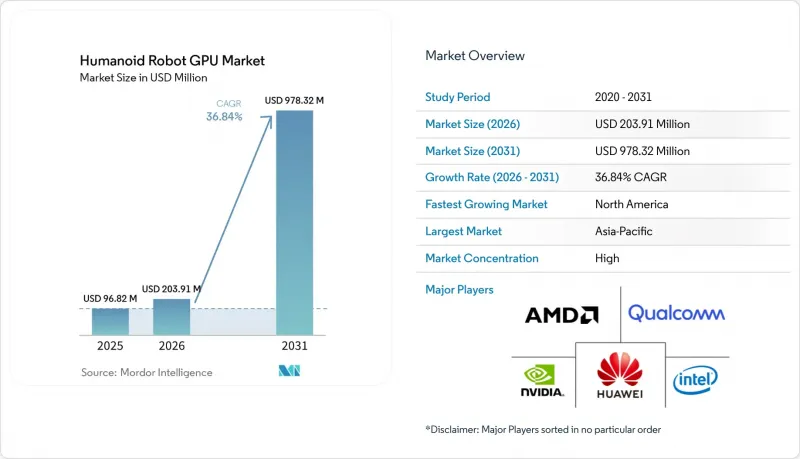
本報告按GPU類型(資料中心訓練GPU、邊緣AI GPU、嵌入式GPU、整合GPU平台)、部署類型(板載運算、混合運算等)、GPU功能(運動規劃與控制等)、機器人功能(優雅操作等)、終端用戶產業(汽車等)及地區進行細分。市場預測以美元計價。
全球人形機器人GPU市場趨勢與洞察
人形機器人物理人工智慧日益成長的運算負荷
人形機器人GPU市場的蓬勃發展,源自於實體AI工作負載不再依賴單一的視覺或控制任務,而是需要同時執行多個模型層。為了滿足這一需求,NVIDIA推出了Jetson AGX Thor T5000,其FP4性能高達2070 teraflops,相比Jetson AGX Orin平台實現了顯著提升,清晰地展現了計算需求的快速成長。此外,記憶體需求也影響人形機器人GPU市場的發展。 NVIDIA在其硬體指南「GR00T」中建議,訓練系統至少需要24GB顯存,邊緣推理系統至少需要128GB整合記憶體。這一點至關重要,因為開發者在從有限的模仿任務轉向更廣泛、更通用的操作時,需要同時擴展訓練和板載推理硬體。此外,NVIDIA已將「雲端到機器人運算」定位為實體AI開發的基礎層,這支撐了對資料中心和嵌入式GPU產品的持續需求。
車載即時推理的需求日益成長
人形機器人GPU市場正朝著板載推理方向發展。這是因為延遲和資料處理能力的限制使得在實際運作環境中繼續依賴雲端變得不切實際。 1X Technologies在2026年指出,Jetson Thor是當時唯一一款能夠滿足NEO機器人即時感測器處理板載運算需求的產品,凸顯了高階嵌入式效能領域的選擇有限。波士頓動力公司也擴大了與NVIDIA的合作,將Jetson Thor整合到Atlas機器人中。這使得機器人本身就具備了伺服器級的推理能力,而無需將繁重的工作負載外包。這種架構轉變對人形機器人GPU市場意義重大,因為每部署一台機器人,就能直接帶來硬體銷售,而無需依賴集中式訓練叢集。隨著部署範圍擴展到生產線和倉庫工作流程,本地推理正逐漸成為標準設計要求,而非可選的高階功能。
高功耗和複雜的散熱設計
人形機器人GPU市場仍面臨直接的運作限制,因為板載運算必須與運動、感測和執行功能共用有限的電池容量。 NVIDIA在Jetson Thor開發者論壇上透露,即使是SoC等級的功耗故障也會為散熱設計團隊帶來實際挑戰,尤其是當開發者試圖在模組可配置的TDP範圍內模擬持續效能時。 NVIDIA也討論了Isaac GR00T,這是一款配備15Ah、0.972kWh電池的參考機器人,運作約3小時。這遠不足以滿足工業生產的需求,因此需要採用電池更換或固定電源等變通方案。在人形機器人GPU市場,這種功耗限制阻礙了其普及,因為尖峰時段推理和執行器負載同時集中在系統上。這也有利於那些能夠投資於整合溫度控管、電源控制和整體系統最佳化的大型供應商。
細分市場分析
到2025年,資料中心訓練GPU將佔據人形機器人GPU市場64.92%的佔有率。這表明,大部分支出仍集中在模型開發的上游工程,而非運作中中的機器人本身。人形機器人GPU市場之所以依賴這個訓練層,是因為通用機器人策略需要在商業機器人叢集擴展之前進行大規模模擬、合成資料產生和持續的模型最佳化。 NVIDIA的「雲端到機器人」實體AI定位反映了這種需求模式,它將資料中心系統與機器人訓練、模擬和部署工作流程直接連接起來。人形機器人GPU市場也凸顯了嵌入式系統的重要性,Jetson Orin支援早期部署,而Jetson Thor則作為更先進的商用人形機器人的板載計算參考。
NVIDIA 生態系統的發展勢頭因 Boston Dynamics 和 1X 的公開承諾而進一步鞏固。這兩家公司都將各自的機器人藍圖整合到 Jetson Thor 中,用於板載推理和感測器處理。預計從 2026 年到 2031 年,整合 GPU 平台的複合年成長率將達到 37.61%,成為市場中成長最快的細分領域。人形機器人 GPU 市場正朝著這個方向發展,因為與移動機器人中純粹的獨立架構相比,整合平台可以降低基板的複雜性,並更好地平衡功耗、散熱和運算能力。高通在 CES 2026 上發布的機器人平台體現了這一轉變,該平台採用將 CPU、GPU 和 AI 加速整合到單一架構中的設計,適用於人形機器人和行動機器人應用。對於人形機器人 GPU 產業而言,這可能意味著未來競爭的重點將從單單元峰值運算效能轉向全端效率。
2025年,離線訓練和模擬佔銷售額的65.38%,顯示人形機器人GPU市場仍高度重視開發基礎設施。供應商和機器人開發商繼續大力投資模擬叢集,因為數位環境使他們能夠以現實世界測試無法企及的規模測試策略。 NVIDIA將其人形機器人開發堆疊與Omniverse、Isaac和Blackwell系統整合,這反映了離線訓練在該市場中持續的核心地位。人形機器人GPU市場也持續支援混合模式,在這種模型中,機器人在本地執行推理,同時在停機期間從雲端或資料中心接收大規模模型更新。這種混合方法非常適合當前的商業階段,因為它允許營運商利用集中式訓練的結果,而無需將所有計算步驟強制交給機器人。
預計到2031年,板載運算將以38.14%的複合年成長率成長,成為人形機器人GPU市場中成長最快的部署方式。這種加速成長的驅動力來自於生產環境,在這些環境中,從延遲、隱私和運行連續性的角度來看,依賴離線運算的合理性降低。 1X和波士頓動力公司都指出,將Jetson Thor整合到機器人上可以實現部署機器人的即時推理和感測器處理,這為該細分市場提供了切實的商業性支援。隨著部署規模的擴大,人形機器人GPU市場預計將朝著更加平衡的配置方向發展,即集中式開發運算資源和分散式嵌入式推理硬體相結合。
區域分析
到2025年,亞太地區將佔全球人形機器人GPU銷售額的47.62%,成為該市場最大的地區。這一主導地位歸功於人形機器人OEM廠商在中國的集中活動、日本和韓國的半導體產業基礎,以及公眾對草案中概述的物理人工智慧計畫的廣泛支持。亞太地區人形機器人GPU市場也受惠於其能夠大規模整合感測器、封裝、記憶體和運算功能的供應鏈。在該地區,國產運算平台正開始湧現,與基於NVIDIA的部署形成互補,這意義重大,因為在地化目標正成為採購決策中越來越重要的因素。儘管如此,亞太地區人形機器人GPU市場仍將高度依賴區域OEM廠商從試點生產過渡到可複製的商業部署的速度。
預計到2031年,北美地區將以38.57%的複合年成長率成長,成為人形機器人GPU市場成長最快的區域市場。該地區在訓練和部署方面都佔據優勢地位,這得益於其在人工智慧基礎設施部署方面的豐富經驗,以及多家最具商業性影響力的人形機器人開發公司的匯聚。 NVIDIA的Jetson Thor藍圖和生態系統訊息顯然正是針對此發展基礎而製定的。同時,Boston Dynamics和1X都在將其機器人堆疊與NVIDIA的板載運算路徑進行整合。北美人形機器人GPU市場也受益於「機器人即服務(RaaS)」模式,該模式將部署方式從一次性設備銷售轉變為對硬體和軟體的持續需求。 Agility Robotics與豐田汽車加拿大製造公司之間的商業協議表明,這種模式正在走向實際的工業應用,從而滿足了單元級嵌入式GPU的需求。
到了2025年,歐洲在人形機器人GPU市場佔相當大的比重。這主要得益於德國汽車產業的應用以及全部區域廣泛的工業自動化基礎設施。 BMW的萊比錫計畫為歐洲帶來了一個在汽車生產中應用物理人工智慧的傑出案例,鞏固了該地區在工業領域早期應用方面的地位。儘管南美和中東及非洲地區的貢獻仍然較小,但Mercado Libre與Agility Robotics在2025年下半年達成的協議為南美地區人形機器人GPU市場打開了明確的入口。在全部區域,隨著商業部署逐漸接近人體協作的常規化,遵守安全標準和確保系統行為的確定性將變得日益重要。
其他好處:
- Excel格式的市場預測(ME)表
- 3個月的分析師支持
目錄
第1章:引言
- 研究假設和市場定義
- 調查範圍
第2章:調查方法
第3章執行摘要
第4章 市場狀況
- 市場概覽
- 市場促進因素
- 人形機器人人工智慧處理負載增加
- 車載即時推理的需求日益成長
- 擴大合成數據和模擬流程的使用
- 汽車製造業試辦計畫擴展
- 人們對邊緣處理的興趣日益濃厚,希望藉此降低延遲並減少對雲端的依賴。
- 主要機器人運算供應商的策略平台鎖定
- 市場限制因素
- 高功耗和複雜的散熱設計
- 零件成本和總擁有成本不斷上漲
- 軟體可移植性和開發者生態系的片段化
- 缺乏針對極端情況的真實世界訓練數據
- 產業價值鏈分析
- 監理情勢
- 技術展望
- 波特五力分析
第5章 市場規模與成長預測
- 按GPU類型
- 用於訓練資料中心的GPU
- 用於邊緣人工智慧的GPU
- 嵌入式GPU
- 整合GPU平台
- 依部署類型
- 機載計算
- 非船上訓練和模擬
- 混合計算
- GPU功能
- 訓練和模擬
- 推理與感知
- 運動規劃與控制
- 數位孿生和合成數據生成
- 機器人能力
- 即時感知
- 運動規劃與控制
- 熟練的操作
- 多模態推理
- 產業最終用途
- 車
- 物流和倉儲
- 製造和組裝
- 研究與教育
- 醫療和生活協助
- 國防與安全
- 按地區
- 北美洲
- 美國
- 加拿大
- 墨西哥
- 歐洲
- 德國
- 英國
- 法國
- 義大利
- 其他歐洲國家
- 亞太地區
- 中國
- 日本
- 韓國
- 印度
- 東南亞
- 其他亞太國家
- 南美洲
- 中東和非洲
- 北美洲
第6章 競爭情勢
- 市場集中度
- 策略趨勢
- Vendor Positioning Analysis
- 公司簡介
- NVIDIA Corporation
- Qualcomm Incorporated
- Intel Corporation
- Advanced Micro Devices, Inc.
- Huawei Technologies Co., Ltd.
- Tesla, Inc.
- Baidu, Inc.
- Horizon Robotics Inc.
- Rockchip Electronics Co., Ltd.
- MediaTek Inc.
- Samsung Electronics Co., Ltd.
- Alphabet Inc.
- Amazon.com, Inc.
- Foxconn Technology Co., Ltd.
- Agility Robotics, Inc.
- Figure AI, Inc.
- Apptronik, Inc.
- Boston Dynamics, Inc.
- UBTECH Robotics Corp Ltd.
- Unitree Robotics
- Sanctuary Cognitive Systems Corporation
- 1X Technologies AS
- Fourier Intelligence Co., Ltd.
- XPENG Inc.
- Siemens AG
- ABB Ltd.
- KUKA AG
第7章 市場機會與未來展望
According to Mordor Intelligence, the humanoid robot GPU market size is expected to increase from USD 96.82 million in 2025 to USD 203.91 million in 2026 and reach USD 978.32 million by 2031, growing at a CAGR of 36.84% over 2026-2031.
This report is Segmented by GPU Type (Data Center Training GPUs, Edge AI GPUs, Embedded GPUs, and Integrated GPU Platforms), Deployment Type (Onboard Compute, Hybrid Compute, and More), GPU Function (Motion Planning and Control, and More), Robot Capability (Dexterous Manipulation, and More), End Use Industry (Automotive, and More), and Geography. The Market Forecasts are Provided in Terms of Value (USD).
Global Humanoid Robot GPU Market Trends and Insights
Rising Physical AI Compute Intensity in Humanoid Robots
The humanoid robot GPU market is expanding because physical AI workloads now run multiple model layers simultaneously rather than relying on a single vision or control task. NVIDIA positioned the Jetson AGX Thor T5000 to address this need with 2,070 FP4 teraflops, a significant leap from the Jetson AGX Orin platform and a clear indication of how quickly compute requirements are rising. The same GPU market for humanoid robots is also being shaped by memory requirements, as NVIDIA listed 24GB and higher VRAM for training systems and 128GB unified memory for edge inference in its GR00T hardware guidance. That matters because a developer moving from narrow imitation tasks to broader generalist behavior has to scale training hardware and onboard inference hardware simultaneously. NVIDIA also framed cloud-to-robot computing for physical AI as a foundational layer for humanoid development, which supports continued demand across both data center and embedded GPU products.
Growing Demand for Onboard Real-Time Inference
The humanoid robot GPU market is shifting toward onboard inference because latency and data-handling limitations make continuous cloud dependence less practical in live operating environments. 1X Technologies stated in 2026 that Jetson Thor was the only product available at the time that met the NEO robot's onboard compute requirement for real-time sensor processing, underscoring how narrow the field still is at the high end of embedded performance. Boston Dynamics also expanded its collaboration with NVIDIA to integrate Jetson Thor into Atlas, bringing server-class reasoning capability onto the robot itself rather than keeping the heavy workload offboard. In the humanoid robot GPU market, that architecture change matters because every additional robot deployed becomes a direct hardware sale rather than depending solely on centralized training clusters. As more deployments move into production lines and warehouse workflows, local inference is becoming a standard design requirement rather than an optional premium feature.
High Power Draw and Thermal Design Complexity
The humanoid robot GPU market still faces a direct operating constraint because onboard compute has to share limited battery capacity with locomotion, sensing, and actuation. NVIDIA developer discussions about Jetson Thor showed that even the SoC-level power breakdown is a practical challenge for thermal design teams, especially when developers try to model sustained performance within the module's configurable TDP range. NVIDIA also described its Isaac GR00T reference robot with a 15Ah and 0.972kWh battery and around 3 hours of operating life, which remains well below a full industrial shift and forces workarounds such as battery swaps or fixed power support. In the humanoid-robot GPU market, that power ceiling slows adoption because peak inference and actuator loads hit the same system simultaneously. It also favors larger vendors that can invest in integrated thermal management, power governors, and full-system optimization.
Other drivers and restraints analyzed in the detailed report include:
- Increasing Use of Synthetic Data and Simulation Pipelines
- Expanding Pilot Deployments in Automotive Manufacturing
- Elevated Bill of Materials and Total Cost Of Ownership
For complete list of drivers and restraints, kindly check the Table Of Contents.
Segment Analysis
Data Center Training GPUs held 64.92% of the humanoid robot GPU market share in 2025, indicating that most spending still sat upstream in model development rather than in fielded robots. The humanoid robot GPU market relied on that training layer because generalist robot policies need large-scale simulation, synthetic data generation, and continuous model refinement before commercial fleets can expand. NVIDIA's cloud-to-robot positioning for physical AI reflected this demand pattern by tying data center systems directly to robot training, simulation, and deployment workflows. The same humanoid robot GPU market also showed why embedded systems matter, as Jetson Orin had supported earlier deployments, and Jetson Thor moved into the role of reference onboard compute for more advanced commercial humanoids.
NVIDIA's ecosystem traction was reinforced by public commitments from Boston Dynamics and 1X, both of which tied their robot roadmaps to Jetson Thor for onboard reasoning and sensor processing. Integrated GPU Platforms are projected to grow at a 37.61% CAGR from 2026 to 2031, making them the fastest-growing segment of this market. The humanoid robot GPU market is moving in that direction because integrated platforms reduce board complexity and can better balance power, thermal load, and compute than purely discrete approaches in mobile robots. Qualcomm's robotics platform launch at CES 2026 reflected this shift with a design built around CPU, GPU, and AI acceleration in one architecture for humanoid and mobile robotics use. For the humanoid robot GPU industry, that means the next phase of competition is likely to center on full-stack efficiency rather than peak standalone compute alone.
Offboard Training and Simulation accounted for 65.38% of revenue in 2025, indicating that the humanoid robot GPU market remained focused on development infrastructure at that time. Vendors and robot developers still spent heavily on simulation clusters because digital environments let them test policies at a much larger scale than real-world trials can support. NVIDIA linked its humanoid development stack to Omniverse, Isaac, and Blackwell systems, which reflects how central offboard training remains in this market. The humanoid robot GPU market also continued to support hybrid models in which robots execute local inference while receiving heavier model updates from the cloud or data centers during downtime. That hybrid approach fits the current commercial stage because it lets operators use centralized training gains without forcing every compute step onto the robot.
Onboard Compute is forecast to expand at a 38.14% CAGR through 2031, which makes it the fastest-growing deployment mode in the humanoid robot GPU market. That acceleration follows from production settings in which latency, privacy, and operational continuity make constant offboard dependence hard to justify. 1X and Boston Dynamics both pointed to onboard Jetson Thor integration as the path to real-time reasoning and sensor processing on deployed robots, which gives this segment tangible commercial backing. As deployments widen, the humanoid robot GPU market is likely to move toward a more balanced split between centralized development compute and distributed embedded inference hardware.
Complete Report Scope:
- By GPU Type
- Data Center Training GPUs
- Edge AI GPUs
- Embedded GPUs
- Integrated GPU Platforms
- By Deployment Type
- Onboard Compute
- Offboard Training And Simulation
- Hybrid Compute
- By GPU Function
- Training and Simulation
- Inference and Perception
- Motion Planning and Control
- Digital Twin and Synthetic Data Generation
- By Robot Capability
- Real-Time Perception
- Motion Planning and Control
- Dexterous Manipulation
- Multi-Modal Reasoning
- By End Use Industry
- Automotive
- Logistics and Warehousing
- Manufacturing and Assembly
- Research and Education
- Healthcare and Assisted Living
- Defense and Security
- By Geography
- North America
- United States
- Canada
- Mexico
- Europe
- Germany
- United Kingdom
- France
- Italy
- Rest of Europe
- Asia-Pacific
- China
- Japan
- South Korea
- India
- Southeast Asia
- Rest of Asia-Pacific
- South America
- Middle East and Africa
- North America
Geography Analysis
Asia-Pacific accounted for 47.62% of revenue in 2025, making it the largest region in the humanoid robot GPU market. That lead came from the concentration of humanoid OEM activity in China, the semiconductor base in Japan and South Korea, and broader public support for physical AI programs described in the draft. The humanoid robot GPU market in Asia-Pacific also benefits from a supply chain that can support sensors, packaging, memory, and compute integration at scale. Domestic compute platforms are beginning to supplement NVIDIA-based deployments in the region, which matters because localization goals are becoming a stronger factor in purchasing decisions. Even with that shift, the humanoid robot GPU market in Asia-Pacific remains closely tied to how quickly regional OEMs can move from pilot output toward repeatable commercial deployment.
North America is projected to expand at a 38.57% CAGR through 2031, making it the fastest-growing regional segment in the humanoid robot GPU market. The region combines a large installed base of AI infrastructure with several of the most commercially visible humanoid developers, which gives it a strong position in both training and deployment. NVIDIA's Jetson Thor roadmap and ecosystem messaging were directed heavily toward this development base, while Boston Dynamics and 1X both linked their robot stacks to NVIDIA's onboard compute path. The humanoid robot GPU market in North America is also supported by the Robots-as-a-Service model, which turns deployments into a recurring hardware and software demand stream instead of a one-time equipment sale. Agility Robotics' commercial agreement with Toyota Motor Manufacturing Canada shows how that model is moving into live industrial operations and supporting embedded GPU demand at the unit level.
Europe accounted for a significant share of 2025 revenue in the humanoid robot GPU market, led by Germany's automotive deployments and the region's broader industrial automation base. BMW's Leipzig program gave Europe a visible reference point for physical AI in automotive production and reinforced the region's role in early industrial adoption. South America and the Middle East and Africa remained smaller contributors, but the humanoid robot GPU market gained a clear South American entry point through Mercado Libre's agreement with Agility Robotics in late 2025. Across these regions, safety compliance and deterministic system behavior are likely to matter more as commercial deployments move closer to routine human-robot collaboration.
- NVIDIA Corporation
- Qualcomm Incorporated
- Intel Corporation
- Advanced Micro Devices, Inc.
- Huawei Technologies Co., Ltd.
- Tesla, Inc.
- Baidu, Inc.
- Horizon Robotics Inc.
- Rockchip Electronics Co., Ltd.
- MediaTek Inc.
- Samsung Electronics Co., Ltd.
- Alphabet Inc.
- Amazon.com, Inc.
- Foxconn Technology Co., Ltd.
- Agility Robotics, Inc.
- Figure AI, Inc.
- Apptronik, Inc.
- Boston Dynamics, Inc.
- UBTECH Robotics Corp Ltd.
- Unitree Robotics
- Sanctuary Cognitive Systems Corporation
- 1X Technologies AS
- Fourier Intelligence Co., Ltd.
- XPENG Inc.
- Siemens AG
- ABB Ltd.
- KUKA AG
Additional Benefits:
- The market estimate (ME) sheet in Excel format
- 3 months of analyst support
TABLE OF CONTENTS
1 INTRODUCTION
- 1.1 Study Assumptions and Market Definition
- 1.2 Scope of the Study
2 RESEARCH METHODOLOGY
3 EXECUTIVE SUMMARY
4 MARKET LANDSCAPE
- 4.1 Market Overview
- 4.2 Market Drivers
- 4.2.1 Rising Physical AI Compute Intensity In Humanoid Robots
- 4.2.2 Growing Demand For Onboard Real-Time Inference
- 4.2.3 Increasing Use Of Synthetic Data And Simulation Pipelines
- 4.2.4 Expanding Pilot Deployments In Automotive Manufacturing
- 4.2.5 Rising Preference For Edge Processing To Reduce Latency And Cloud Dependency
- 4.2.6 Strategic Platform Lock-In By Leading Robotics Compute Vendors
- 4.3 Market Restraints
- 4.3.1 High Power Draw And Thermal Design Complexity
- 4.3.2 Elevated Bill Of Materials And Total Cost Of Ownership
- 4.3.3 Software Portability And Developer Ecosystem Fragmentation
- 4.3.4 Limited Real-World Training Data For Edge Cases
- 4.4 Industry Value Chain Analysis
- 4.5 Regulatory Landscape
- 4.6 Technological Outlook
- 4.7 Porter's Five Forces Analysis
- 4.7.1 Bargaining Power of Suppliers
- 4.7.2 Bargaining Power of Buyers
- 4.7.3 Threat of New Entrants
- 4.7.4 Threat of Substitutes
- 4.7.5 Competitive Rivalry
5 MARKET SIZE AND GROWTH FORECASTS (VALUE)
- 5.1 By GPU Type
- 5.1.1 Data Center Training GPUs
- 5.1.2 Edge AI GPUs
- 5.1.3 Embedded GPUs
- 5.1.4 Integrated GPU Platforms
- 5.2 By Deployment Type
- 5.2.1 Onboard Compute
- 5.2.2 Offboard Training And Simulation
- 5.2.3 Hybrid Compute
- 5.3 By GPU Function
- 5.3.1 Training and Simulation
- 5.3.2 Inference and Perception
- 5.3.3 Motion Planning and Control
- 5.3.4 Digital Twin and Synthetic Data Generation
- 5.4 By Robot Capability
- 5.4.1 Real-Time Perception
- 5.4.2 Motion Planning and Control
- 5.4.3 Dexterous Manipulation
- 5.4.4 Multi-Modal Reasoning
- 5.5 By End Use Industry
- 5.5.1 Automotive
- 5.5.2 Logistics and Warehousing
- 5.5.3 Manufacturing and Assembly
- 5.5.4 Research and Education
- 5.5.5 Healthcare and Assisted Living
- 5.5.6 Defense and Security
- 5.6 By Geography
- 5.6.1 North America
- 5.6.1.1 United States
- 5.6.1.2 Canada
- 5.6.1.3 Mexico
- 5.6.2 Europe
- 5.6.2.1 Germany
- 5.6.2.2 United Kingdom
- 5.6.2.3 France
- 5.6.2.4 Italy
- 5.6.2.5 Rest of Europe
- 5.6.3 Asia-Pacific
- 5.6.3.1 China
- 5.6.3.2 Japan
- 5.6.3.3 South Korea
- 5.6.3.4 India
- 5.6.3.5 Southeast Asia
- 5.6.3.6 Rest of Asia-Pacific
- 5.6.4 South America
- 5.6.5 Middle East and Africa
- 5.6.1 North America
6 COMPETITIVE LANDSCAPE
- 6.1 Market Concentration
- 6.2 Strategic Moves
- 6.3 Vendor Positioning Analysis
- 6.4 Company Profiles (includes Global Level Overview, Market Level Overview, Core Segments, Financials as available, Strategic Information, Market Rank/Share, Products and Services, Recent Developments)
- 6.4.1 NVIDIA Corporation
- 6.4.2 Qualcomm Incorporated
- 6.4.3 Intel Corporation
- 6.4.4 Advanced Micro Devices, Inc.
- 6.4.5 Huawei Technologies Co., Ltd.
- 6.4.6 Tesla, Inc.
- 6.4.7 Baidu, Inc.
- 6.4.8 Horizon Robotics Inc.
- 6.4.9 Rockchip Electronics Co., Ltd.
- 6.4.10 MediaTek Inc.
- 6.4.11 Samsung Electronics Co., Ltd.
- 6.4.12 Alphabet Inc.
- 6.4.13 Amazon.com, Inc.
- 6.4.14 Foxconn Technology Co., Ltd.
- 6.4.15 Agility Robotics, Inc.
- 6.4.16 Figure AI, Inc.
- 6.4.17 Apptronik, Inc.
- 6.4.18 Boston Dynamics, Inc.
- 6.4.19 UBTECH Robotics Corp Ltd.
- 6.4.20 Unitree Robotics
- 6.4.21 Sanctuary Cognitive Systems Corporation
- 6.4.22 1X Technologies AS
- 6.4.23 Fourier Intelligence Co., Ltd.
- 6.4.24 XPENG Inc.
- 6.4.25 Siemens AG
- 6.4.26 ABB Ltd.
- 6.4.27 KUKA AG
7 MARKET OPPORTUNITIES AND FUTURE OUTLOOK
- 7.1 White-Space and Unmet-Need Assessment

 通用人形機器人市場:按硬體、軟體、機器人運動類型、產業和應用分類(2026-2032 年)
 美國人形機器人市場規模、佔有率和趨勢分析報告:按組件、應用、運動類型、分銷管道和細分市場預測(2026-2033 年)
 全球人形機器人市場(2027-2037 年)
 人形機器人市場(2026):多指手的發展趨勢人形機器人市場規模、佔有率、成長、全球產業分析、區域趨勢及2026年至2034年預測。中國人形機器人產業發展:供應鏈自給自足及關鍵零件面臨的挑戰
 全球人形機器人組件市場:按組件、驅動類型、應用、最終用戶和地區分類-市場規模、產業動態、機會分析和預測(2026-2035 年)
 人形機器人市場:2026-2032年全球市場預測(依產品、作業類型、自主等級、動力來源、應用和銷售管道分類)人形機器人產業的十字路口:2026年上半年展會將揭示實體人工智慧的新競爭格局
 全球人形機器人市場(至 2035 年):按類型(雙足/輪式)及組件(線性及旋轉致動器、馬達、攝影機及視覺感測器、諧波及行星齒輪箱、編碼器、加速度計、扭力加速感應器、運動及關節控制器)分類