


 |
市場調查報告書
商品編碼
2098485
非洲飼料礦物質:市場佔有率分析、產業趨勢與統計及成長預測(2026-2031 年)Africa Feed Minerals - Market Share Analysis, Industry Trends & Statistics, Growth Forecasts (2026 - 2031) |
||||||

※ 本網頁內容可能與最新版本有所差異。詳細情況請與我們聯繫。
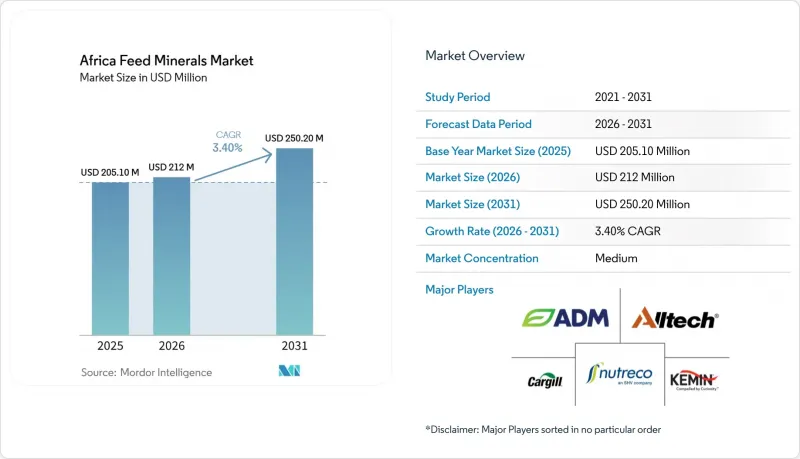
根據 Mordor Intelligence 預測,非洲飼料礦物質市場規模將從 2025 年的 2.051 億美元和 2026 年的 2.12 億美元成長到 2031 年的 2.502 億美元,2026 年至 2031 年的年複合成長率(CAGR)為 3.40%。
本報告按添加劑類型(主要礦物質和微量礦物質)、目標動物(水產養殖、家禽、反芻動物、豬和其他動物)以及地區(南非、埃及、奈及利亞、肯亞和其他非洲國家)進行細分。市場預測以價值(美元)和數量(公噸)表示。
非洲飼料礦物質市場趨勢與洞察
非洲各地對商業家禽和反芻動物飼料的需求不斷成長
根據《Alltech 2025年農業食品展望》,2024年非洲新建了40家飼料廠,使飼料廠總數達到2228家,從而擴大了非洲飼料礦物質市場的持續供應基礎。報告也指出,2024年非洲牛飼料產量增加了32.2%,牛飼料貨量增加了25.7%。這顯示反芻動物生產系統中商業飼料的引入取得了進一步進展。 《經合組織-糧農組織2025-2034年農業展望》也預測,未來十年畜牧業生產力和產量將持續提高,並強調了均衡礦物質營養對於尋求更高效率和畜牧業生產力的商業生產者的重要性日益凸顯。因此,非洲飼料礦物質市場正獲得家禽和反芻動物產業的雙重支持,而不只依賴家禽的需求。這拓寬了礦物質供應商的基本客群,並降低了成長集中於單一畜牧類別的風險。
在高產量農場推廣精準礦物質營養
在非洲各地的商業肉雞和乳牛養殖場,支持特定品種生產力目標的營養方案正變得日益重要,這為非洲飼料礦物質市場創造了對生物利用度高的礦物質產品的需求。 2025年發表在《動物》(Animals)雜誌上的一項Meta分析表明,用蛋白鹽微量元素替代50%至80%的無機微量元素,可使每隻雞的飼料量減少7克,平均日增重提高1.67克,飼料轉化率降低4.5%,銅、鐵、錳錳和鋅的21%。這些生產力提昇在商業化生產系統中特別顯著。鑑於飼料穀物價格飆升,提高飼料轉換率有助於抵消螯合態和蛋白質鹽態礦物質的高昂成本。隨著一體化生產者更加重視生產力、穩定性和營養利用效率,非洲飼料礦物質市場對高品質微量元素的接受度越來越高,這預示著除了銷售量成長之外,還蘊藏著巨大的商業機會。
在以小規模農戶為主導的市場中,商業飼料生產的滲透率較低。
非洲大部分牲畜仍未納入商業飼料體系,限制了它們直接獲取礦物質營養,並限制了非洲飼料礦物質市場的成長。根據Hatchery FM引用的馬拉博-蒙彼利埃專家小組2025年水產養殖和畜牧業報告指出,飼料品質差和商業投入品獲取管道有限仍然是小規模提高生產力的主要障礙。非洲科學組織(Science Africa)發布的肯亞2025年飼料產業改革計畫也指出,儘管飼料佔畜牧業生產成本的60-70%,但主要商業區以外的生產者仍面臨產品品質不穩定和供應鏈分散等挑戰。小規模農戶往往缺乏規模和購買力來定期使用高品質的礦物質飼料,導致大規模商業生產系統的需求更為強勁。除非透過整合機制、合作飼料模式和政策支持擴大農村市場取得商業飼料的管道,否則非洲飼料礦物質市場的成長在各國和各畜牧業部門之間可能仍將不平衡。
細分市場分析
到2025年,常量礦物質將佔非洲飼料礦物質市場58%的佔有率,成為家禽、反芻動物和水產飼料添加劑類別中佔比最大的類別。鈣、磷和鎂仍然是商業飼料飼料中必不可少的營養成分,對這些產品的需求與整體飼料生產密切相關,而不僅僅是作為性能增強劑。南非的飼料法規結構要求商業飼料產品必須符合標籤和成分要求,這支撐了對具有檢驗品質的認證常量礦物質原料的需求。此外,Solevo集團與Phossphere公司於2024年合作,在非洲銷售磷酸一鈣、磷酸二鈣和磷酸氫鈣,凸顯了非洲飼料礦物質產業為加強商業性供應管道所做的持續努力。因此,常量礦物質作為大多數市售飼料配方的基礎成分,在銷售量成長中繼續發揮核心作用。
在非洲飼料礦物質市場,微量元素預計在2026年至2031年間以6.8%的複合年成長率(CAGR)實現最高成長。這反映了常規飼料通路正逐步轉向以性能為導向的營養理念。 2025年發表在《動物》(Animals)雜誌上的一項Meta分析表明,用蛋白微量元素部分替代無機微量元素,可使銅、鐵、錳和鋅的排泄量減少14%至21%,同時提高家禽生產力,從而凸顯了先進微量元素產品的提案。鋅、銅、錳和硒仍然是重要的商業微量元素類別,硒在土壤礦物質缺乏影響牲畜健康的地區尤其重要。隨著非洲水產養殖業的擴張和商業飼料配方的日益標準化,對成分穩定的微量元素的需求預計將會增加。因此,儘管傳統的無機鹽繼續在低成本飼料系統中佔據主導地位,但微量礦物質預計將繼續成為非洲飼料礦物質市場中成長最快的領域。
其他好處:
- Excel格式的市場預測(ME)表
- 3個月的分析師支持
目錄
第1章:引言
- 研究假設和市場定義
- 調查範圍
第2章:調查方法
第3章執行摘要
第4章 市場狀況
- 市場概覽
- 市場促進因素
- 非洲各地對商業家禽和反芻動物飼料的需求不斷增加。
- 非洲商業飼料廠基礎設施迅速擴張
- 在高產量農場推廣精準礦物質營養管理
- 從散裝原料向複合飼料原料的大規模轉變
- 高溫氣候下生產系統中對螯合物和有機微量元素的需求不斷增加。
- 在原物料價格波動的情況下,提高飼料轉換率的需求日益成長。
- 市場限制因素
- 在以小規模農戶為主導的市場中,商業飼料生產的廣泛應用受到限制。
- 螯合礦物產品和特殊礦物產品的高成本成本
- 分散的通路中品管的差異以及仿冒品的風險。
- 部分內陸市場的低溫運輸和配送基礎設施存在脆弱性
- 技術展望
- 監理情勢
- 波特五力分析
第5章 市場規模與成長預測
- 按添加劑類型
- 大量礦物質
- 微量元素
- 動物
- 水產養殖
- 魚
- 蝦
- 其他養殖物種
- 家禽
- 肉雞
- 產蛋母雞
- 其他家禽
- 反芻動物
- 肉牛
- 乳牛
- 其他反芻動物
- 豬
- 其他動物
- 水產養殖
- 國家
- 南非
- 埃及
- 奈及利亞
- 肯亞
- 其他非洲國家
第6章 競爭情勢
- 市場集中度
- 策略趨勢
- 市佔率分析
- 公司簡介
- Archer Daniels Midland Company
- Alltech, Inc.
- Agri-Vet
- BASF SE
- Bluestone Metals and Chemicals
- Biochem Zusatzstoffe Handels-und Produktionsgesellschaft mbH
- Cargill, Incorporated
- De Heus
- Elanco Animal Health Incorporated
- Kemin Industries, Inc.
- Kimleigh Chemicals SA
- Novus International, Inc.
- SHV Holdings NV
- Phibro Animal Health Corporation
- U-MIX
第7章 市場機會與未來展望
According to Mordor Intelligence, the Africa feed minerals market size is projected to expand from USD 205.10 million in 2025 and USD 212 million in 2026 to USD 250.20 million by 2031, registering a CAGR of 3.40% between 2026 and 2031.
This report is Segmented by Sub Additive (Macrominerals and Microminerals), by Animal (Aquaculture, Poultry, Ruminants, Swine, and Other Animals), and by Geography (South Africa, Egypt, Nigeria, Kenya, and the Rest of Africa). The Market Forecasts are Provided in Terms of Value (USD) and Volume (Metric Tons).
Africa Feed Minerals Market Trends and Insights
Rising Commercial Poultry and Ruminant Feed Demand Across Africa
According to the Alltech Agri-Food Outlook 2025, Africa added 40 new feed mills in 2024, bringing the total number of facilities to 2,228 and expanding the recurring procurement base for mineral in the Africa feed minerals market. The same report showed that cattle feed production in Africa increased by 32.2% in 2024, while dairy feed volumes grew by 25.7%, indicating stronger adoption of commercial feed practices within ruminant production systems. The OECD-FAO Agricultural Outlook 2025-2034 also projects continued gains in livestock productivity and output over the coming decade, increasing the importance of balanced mineral nutrition for commercial producers seeking higher efficiency and animal performance. As a result, the Africa feed minerals market is gaining support from both poultry and ruminant sectors rather than depending solely on poultry demand. This broadens the customer base for mineral suppliers and reduces the risk of growth being concentrated in a single livestock category.
Expansion of Precision Mineral Nutrition in High-Performing Farms
Commercial broiler and dairy operations across parts of Africa are increasingly emphasizing nutrition programs that support breed performance targets, creating opportunities for bioavailability-assured mineral products in the Africa feed minerals market. A 2025 meta-analysis published in Animals found that replacing inorganic trace minerals with proteinate trace minerals at 50% to 80% substitution reduced feed intake by 7 g per bird, improved average daily gain by 1.67 g, reduced feed conversion ratio by 4.5%, and lowered copper, iron, manganese, and zinc excretion by 14% to 21%. These performance improvements are particularly relevant in commercial production systems, where better feed efficiency can help offset the higher cost of chelated and proteinate mineral forms when feed grain prices are elevated. As more integrated producers focus on productivity, consistency, and nutrient utilization, the Africa feed minerals market is becoming increasingly receptive to premium trace mineral formats, suggesting a value opportunity beyond simple volume growth.
Limited Penetration of Commercial Feed Milling in Smallholder-Dominated Markets
A large share of Africa's livestock population still operates outside the commercial feed system, limiting direct access to minerals-based nutrition and constraining volume growth in the Africa feed minerals market. According to the Malabo Montpellier Panel's 2025 report on aquaculture and livestock, as cited by Hatchery FM, poor feed quality and limited physical access to commercial inputs remain major constraints on smallholder productivity. Kenya's 2025 feed sector reform announcement, reported by Science Africa, also noted that feed accounts for 60% to 70% of livestock production costs, while producers outside major commercial zones continue to face inconsistent product quality and fragmented supply channels. Smaller farms often lack the scale and purchasing power needed to justify regular use of premium mineral, resulting in stronger demand from larger commercial production systems. Until aggregation mechanisms, cooperative feed models, and policy support expand commercial feed access to wider rural markets, growth in the Africa feed minerals market is likely to remain uneven across countries and livestock sectors.
Other drivers and restraints analyzed in the detailed report include:
- Wider Shift from Bulk Raw Materials to Formulated Feed Inputs
- Rising Demand for Chelated and Organic Trace Minerals in Hot Climate Production Systems
- High Cost Premium of Chelated and Specialty Mineral Products
For complete list of drivers and restraints, kindly check the Table Of Contents.
Segment Analysis
Macrominerals held 58% of the Africa feed minerals market share in 2025, making them the largest sub-additive category across poultry, ruminant, and aquaculture feed. Calcium, phosphorus, and magnesium remain essential nutritional inputs in commercial formulations, and demand for these products is closely linked to overall feed production rather than optional performance enhancements. South Africa's feed regulatory framework requires commercial feed products to comply with labeling and composition requirements, supporting demand for certified macromineral inputs with verifiable quality. In addition, Solevo Group's 2024 partnership with Phosphea to distribute monocalcium phosphate, monodicalcium phosphate, and dicalcium phosphate across Africa highlights ongoing efforts to strengthen commercial supply channels within the Africa feed minerals industry. As a result, macrominerals remain central to volume growth because they constitute a fundamental component of most commercial feed formulations.
Microminerals are projected to register the fastest CAGR of 6.8% during 2026-2031 in the Africa feed minerals market, reflecting the gradual shift toward performance-oriented nutrition in formal feed channels. According to a 2025 meta-analysis published in Animals, partial substitution of inorganic trace minerals with proteinate trace minerals reduced the excretion of copper, iron, manganese, and zinc by 14% to 21% while improving bird performance, supporting the value proposition of advanced trace mineral products. Zinc, copper, manganese, and selenium remain the principal commercial trace mineral categories, with selenium being particularly important in regions where soil mineral deficiencies affect livestock health. As aquaculture production expands and commercial feed formulations become increasingly standardized across Africa, demand for consistent trace mineral profiles is projected to increase. This should enable microminerals to remain the fastest-growing segment of the Africa feed minerals market, even as conventional inorganic salts continue to dominate lower-cost feed systems.
Complete Report Scope:
- By Sub Additive
- Macrominerals
- Microminerals
- By Animal
- Aquaculture
- Fish
- Shrimp
- Other Aquaculture Species
- Poultry
- Broiler
- Layer
- Other Poultry Birds
- Ruminants
- Beef Cattle
- Dairy Cattle
- Other Ruminants
- Swine
- Other Animals
- Aquaculture
- By Country
- South Africa
- Egypt
- Nigeria
- Kenya
- Rest of Africa
List of Companies Covered in this Report:
- Archer Daniels Midland Company
- Alltech, Inc.
- Agri-Vet
- BASF SE
- Bluestone Metals and Chemicals
- Biochem Zusatzstoffe Handels- und Produktionsgesellschaft mbH
- Cargill, Incorporated
- De Heus
- Elanco Animal Health Incorporated
- Kemin Industries, Inc.
- Kimleigh Chemicals SA
- Novus International, Inc.
- SHV Holdings N.V.
- Phibro Animal Health Corporation
- U-MIX
Additional Benefits:
- The market estimate (ME) sheet in Excel format
- 3 months of analyst support
TABLE OF CONTENTS
1 INTRODUCTION
- 1.1 Study Assumptions and Market Definition
- 1.2 Scope of the Study
2 RESEARCH METHODOLOGY
3 EXECUTIVE SUMMARY
4 MARKET LANDSCAPE
- 4.1 Market Overview
- 4.2 Market Drivers
- 4.2.1 Rising Commercial Poultry and Ruminant Feed Demand Across Africa
- 4.2.2 Rapid Expansion of Commercial Feed Mill Infrastructure Across Africa
- 4.2.3 Expansion of Precision Mineral Nutrition in High-Performing Farms
- 4.2.4 Wider Shift from Bulk Raw Materials to Formulated Feed Inputs
- 4.2.5 Rising Demand for Chelated and Organic Trace Minerals in Hot Climate Production Systems
- 4.2.6 Increasing Need for Feed Efficiency Under Volatile Ingredient Costs
- 4.3 Market Restraints
- 4.3.1 Limited Penetration of Commercial Feed Milling in Smallholder-Dominated Markets
- 4.3.2 High Cost Premium of Chelated and Specialty Mineral Products
- 4.3.3 Inconsistent Quality Control and Counterfeit Product Risk in Fragmented Trade Channels
- 4.3.4 Weak Cold Chain and Distribution Infrastructure in Several Inland Markets
- 4.4 Technological Outlook
- 4.5 Regulatory Landscape
- 4.6 Porter's Five Forces Analysis
- 4.6.1 Bargaining Power of Suppliers
- 4.6.2 Bargaining Power of Buyers
- 4.6.3 Threat of New Entrants
- 4.6.4 Threat of Substitutes
- 4.6.5 Intensity of Competitive Rivalry
5 MARKET SIZE AND GROWTH FORECASTS (VALUE AND VOLUME)
- 5.1 By Sub Additive
- 5.1.1 Macrominerals
- 5.1.2 Microminerals
- 5.2 By Animal
- 5.2.1 Aquaculture
- 5.2.1.1 Fish
- 5.2.1.2 Shrimp
- 5.2.1.3 Other Aquaculture Species
- 5.2.2 Poultry
- 5.2.2.1 Broiler
- 5.2.2.2 Layer
- 5.2.2.3 Other Poultry Birds
- 5.2.3 Ruminants
- 5.2.3.1 Beef Cattle
- 5.2.3.2 Dairy Cattle
- 5.2.3.3 Other Ruminants
- 5.2.4 Swine
- 5.2.5 Other Animals
- 5.2.1 Aquaculture
- 5.3 By Country
- 5.3.1 South Africa
- 5.3.2 Egypt
- 5.3.3 Nigeria
- 5.3.4 Kenya
- 5.3.5 Rest of Africa
6 COMPETITIVE LANDSCAPE
- 6.1 Market Concentration
- 6.2 Strategic Moves
- 6.3 Market Share Analysis
- 6.4 Company Profiles (Includes Global Level Overview, Market Level Overview, Core Segments, Financials as Available, Strategic Information, Market Rank/Share, Products and Services, Recent Developments)
- 6.4.1 Archer Daniels Midland Company
- 6.4.2 Alltech, Inc.
- 6.4.3 Agri-Vet
- 6.4.4 BASF SE
- 6.4.5 Bluestone Metals and Chemicals
- 6.4.6 Biochem Zusatzstoffe Handels- und Produktionsgesellschaft mbH
- 6.4.7 Cargill, Incorporated
- 6.4.8 De Heus
- 6.4.9 Elanco Animal Health Incorporated
- 6.4.10 Kemin Industries, Inc.
- 6.4.11 Kimleigh Chemicals SA
- 6.4.12 Novus International, Inc.
- 6.4.13 SHV Holdings N.V.
- 6.4.14 Phibro Animal Health Corporation
- 6.4.15 U-MIX


