


 |
市場調查報告書
商品編碼
2097464
人工智慧驅動的視覺檢測:市場佔有率分析、行業趨勢和統計數據、成長預測(2026-2031 年)AI-powered Visual Inspection - Market Share Analysis, Industry Trends & Statistics, Growth Forecasts (2026 - 2031) |
||||||

※ 本網頁內容可能與最新版本有所差異。詳細情況請與我們聯繫。
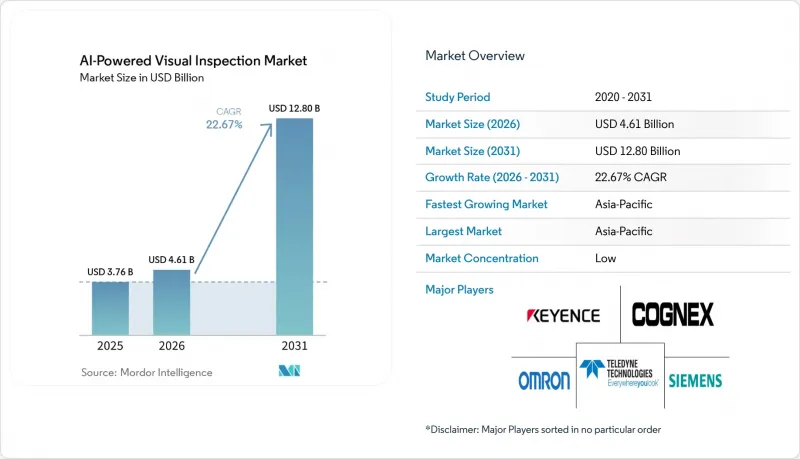
根據 Mordor Intelligence 預測,人工智慧驅動的視覺偵測市場預計將從 2025 年的 37.6 億美元成長到 2026 年的 46.1 億美元,到 2031 年將達到 128 億美元,2026 年至 2031 年的複合年成長率為 22.67%。
本報告按商業外形規格(整合式人工智慧視覺系統、獨立式人工智慧軟體、人工智慧視覺平台和API等)、部署架構(邊緣/嵌入式人工智慧、本地伺服器/工作站、混合式人工智慧軟體、人工智慧視覺平台和API等)、部署架構(邊緣/嵌入式人工智慧、本地伺服器/工作站、混合式部署)以及最終用戶產業(電子與半導體、電動車和電池製造等)進行細分。市場預測以美元計價。
全球人工智慧驅動的視覺檢測市場趨勢與洞察
深度學習模型在缺陷檢測和分類方面達到了超越人類能力的準確率。
在許多受控工業環境中,精度不再是首要考慮因素,這正推動著人工智慧視覺檢測市場的發展。 2026年1月發表在《感測器》(Sensors)雜誌上的一篇綜述報告指出,多種應用方案的精度均超過95%,例如,使用R-CNN進行引擎零件檢測的精度達到99.9%,使用YOLOv8進行組裝檢測的檢測和分類精度達到98%。這正在改變人工智慧視覺檢測市場的競爭格局,因為買家現在更加關注訓練工作量、標註時間以及模型在不同產品變體之間的遷移能力。 2026年4月,康耐視(Cognex)發表了In-Sight 6900視覺控制器,進一步強化了這個趨勢。控制器配備了「少樣本分類」工具,僅需10-20張訓練影像即可應用於生產環境。實際上,人工智慧視覺檢測市場將從漫長的部署週期轉向更快的工業部署,從而克服影像稀缺這一曾經阻礙其普及的難題。 《感測器》雜誌的同一篇評論也指出,77% 的基於機器學習的視覺部署仍處於原型或試點階段,這凸顯了快速檢驗和減少資料準備負擔對於擴展到商業規模的重要性。
電動車和電池製造:在更嚴格的缺陷接受度下,對高通量測試的需求不斷成長。
人工智慧驅動的視覺檢測市場需求強勁,尤其是在電池生產領域。該行業面臨嚴峻的營運環境挑戰,其高產能和嚴格的缺陷接受度使得人工和基於規則的檢測難以奏效。歐洲和美國的超級工廠年產能達38吉瓦時,每天大約要處理600萬個圓柱形電芯,其中電極懸垂接受度可達數百微米,污染容差限值更是低至個微米。經濟效益也顯而易見。根據一項研究顯示,電池組在保固期內的現場故障率為2.5%,這意味著每千瓦時電池的成本約為7.50美元,而線上2DX光檢測的成本僅為每千瓦時0.05美元。這一差異凸顯了人工智慧驅動的視覺檢測在電池電芯、極耳、焊接和包裝等各個環節的價值,因為單一電芯的缺陷可能會影響整個電池組。此外,UnitX Labs 已證明其專門設計的 AI 系統每天可處理 16,000 個電池極耳和焊點,循環時間不到一秒,這印證了該領域對高度專業化處理能力的需求。因此,AI 驅動的視覺檢測市場在該領域穩步發展,品質良率的提升並非線性成長,而是由人們對包裝可靠性和安全性的期望共同驅動的。
取得標籤的訓練資料和模型檢驗需要高成本和大量的精力。
人工智慧驅動的視覺檢測市場仍面臨諸多限制因素,包括建構針對特定產品、表面和失效模式的缺陷庫所需的大量成本和精力。在法規環境中,檢驗結果必須以符合審核要求的格式記錄和存儲,這進一步加劇了這一負擔。美國食品藥物管理局 (FDA) 於 2025 年 9 月最終確定的關於製造和品質系統軟體的電腦軟體保證 (CSA) 指南重申了基於風險的檢驗的必要性,這增加了製藥生產中使用的人工智慧驅動的品質系統的工作量。當製造商處理大量產品變體時,整個人工智慧驅動的視覺檢測市場都會面臨同樣的問題,因為每次產品變更都需要新的標籤、測試和檢驗。供應商正在透過合成缺陷生成和「少樣本」工作流程等解決方案來應對這項挑戰。例如,康耐視的「少樣本分類」功能和 OverviewAI 的「OV 自動缺陷創建工作室」都旨在減少對大規模真實世界缺陷庫的依賴。然而,與汽車和家用電子電器產業相比,航太、醫療設備和製藥業的AI視覺檢測市場可能需要更長的引進週期。這是因為合規性工作量的減少速度遠不及模型訓練所需工作量的減少速度。
細分市場分析
到2025年,整合式AI視覺系統將佔據商用外形規格市場48.37%的佔有率,在AI視覺檢測市場中佔據最大佔有率。這一領先地位反映了買家對整合攝影機、照明、嵌入式計算、檢測軟體和服務責任的封裝式系統的偏好,這些系統整合在一個檢驗的單元中。這種配置可以將週期時間縮短到毫秒級,並降低工廠的整合風險,因為在這些工廠中,因供應商溝通不良造成的停機是不可接受的。這在汽車和電子行業中尤其重要,因為這些行業的營運商要求單一供應商提供可靠的生產線性能和清晰的支援模式。因此,在AI視覺檢測市場,能夠縮短試運行時間並減少保固、培訓和服務責任不確定性的承包解決方案備受青睞。
預計到2031年,人工智慧視覺平台和API細分市場將以23.49%的複合年成長率成長,成為人工智慧視覺檢測市場中成長最快的外形規格。這反映出買家群體更需要模型可移植性、集中式管治以及跨多個站點的快速部署,而非對單一硬體陽極的精細控制。康耐視於2026年5月正式推出OneVision,進一步強化了這個發展方向。在測試階段,超過100家客戶使用了該平台,其中許多客戶在幾天內就完成了從單線部署到多站點部署的過渡。對於已經擁有視覺硬體且僅需更高級模型層的製造商而言,獨立的人工智慧軟體仍然非常實用;而對於那些傾向於將開發、檢驗和營運外包的買家來說,託管式檢測服務則更為合適。透過這些選擇,人工智慧視覺檢測產業正朝著更大的商業性柔軟性邁進,但市場對兼顧快速部署和可靠生產責任的解決方案的需求仍然強勁。
區域分析
預計到2025年,亞太地區將佔據人工智慧視覺檢測市場41.97%的佔有率,並將以22.78%的複合年成長率持續成長至2031年。該地區擁有非常廣泛的工業檢測系統基礎,這得益於其高度集中的半導體製造、大規模的消費性電子產品組裝能力以及快速成長的電池生產。韓國和台灣仍然是重要的市場,因為在先進的記憶體、顯示器和邏輯產品的生產中,對缺陷檢測精度和製程一致性有著極高的要求。隨著鋰離子電池產量的增加以及國內電動車製造商提高出口市場的品質標準,中國市場的需求正在進一步擴大。在日本和印度,產業政策和對電子製造業的投資正逐步增加未來支援人工智慧檢測的資源,從而擴大區域商業機會。
預計到2025年,北美將成為人工智慧視覺檢測的第二大市場。美國仍然是重要的商業化中心,Cognex、Landing AI、Instrumental和AWS等公司正在引領製造業各領域的企業採用路徑。 《晶片與科學法案》推動半導體生產回流,擴大了國內晶圓製造能力,從而增加了整個前端和後端流程的檢測機會。受監管行業的買家也越來越重視檢驗和可追溯性,這與FDA關於生產和品質系統軟體的指導意見中概述的對高品質軟體的更廣泛期望相一致。
到2025年,歐洲將在人工智慧驅動的視覺檢測市場佔據顯著佔有率,這主要得益於德國、英國、法國和義大利及其成熟的汽車和工業生產基地。該地區憑藉其成熟的品管系統和已充分認知到檢測自動化在精密製造中價值的用戶群體,佔據了有利地位。另一方面,歐盟人工智慧法案延長了一些關鍵製造企業的採購週期,因為買家在進行大規模部署之前必須評估相關文件、風險管理和人工監督。雖然這些合規要求可能會延遲訂單,但對於擁有符合審計要求的平台以及在受監管和品質敏感型行業擁有長期業績記錄的供應商而言,這也是一項優勢。目前,世界其他地區的市場佔有率仍然較小,但系統成本的下降和整合能力的提升,以及墨西哥待開發區智慧工廠和海灣國家工業多元化計畫的投資,正在推動未來的需求成長。
其他好處:
- Excel格式的市場預測(ME)表
- 3個月的分析師支持
目錄
第1章:引言
- 研究假設和市場定義
- 調查範圍
第2章:調查方法
- 調查結果
- 研究的先決條件
- 調查階段
第3章執行摘要
第4章 市場狀況
- 市場概覽
- 機器視覺的模式轉移:從基於規則的偵測智慧到人工智慧主導的偵測智慧。
- 市場促進因素
- 深度學習模型在缺陷檢測和分類方面達到了超越人類能力的準確率。
- 電動車和電池製造:更嚴格的缺陷容差催生了對高通量測試的需求。
- 邊緣人工智慧硬體成本的降低使得在工廠環境中大規模部署成為可能。
- 全球品質控制領域人手不足正在加速人工智慧帶來的自動化進程。
- 對數位化工廠和工業4.0的投資正在推動人工智慧檢測預算的增加。
- 藥品和醫療設備生產中的監管可追溯性要求
- 市場限制因素
- 取得標籤的訓練資料和模型檢驗需要投入大量成本和精力。
- 與傳統MES、ERP和SCADA系統整合的複雜性。
- 雲端連接人工智慧偵測平台中的網路安全和智慧財產權問題
- 在多品種、小批量生產環境中,模型漂移和檢驗的負擔日益加重。
- 產業價值鏈分析
- 監理情勢
- FDA 21 CFR 第 11 部分和人工智慧驅動的藥品生產品質記錄
- IATF 16949 和 ISO 9001:人工智慧偵測在汽車和一般製造業的檢驗
- 歐盟人工智慧法律與新的人工智慧管治框架:對工業人工智慧應用的影響
- 人工智慧技術的發展趨勢
- 卷積類神經網路和視覺變壓器在基於影像的檢查中的應用
- 結合傳統機器學習和基於規則系統的混合系統
- 當標記資料有限時,用於異常檢測的基礎模型和生成式人工智慧。
- 在資料敏感型製造環境中進行聯邦學習和設備端學習
- 用例整體情況
- 缺陷檢測與自動缺陷分類
- 尺寸測量和幾何檢驗
- 表面和紋理檢測
- 裝配檢驗和完整性檢查
- 光學字元辨識(OCR)和可追溯性標記
- 宏觀經濟因素對人工智慧測試引入的影響
- 波特五力分析
第5章 市場規模與成長預測
- 按商業外形尺寸
- 整合人工智慧視覺系統
- 獨立人工智慧軟體(授權和訂閱)
- AI視覺平台和API(基於雲端)
- AI測試服務(專業服務和託管測試)
- 依部署架構
- 邊緣/嵌入式人工智慧
- 本地伺服器/工作站
- 雲/SaaS
- 混合(邊緣+雲)
- 按最終用戶行業分類
- 電子和半導體
- 電動車和電池製造
- 藥品和醫療設備
- 食品/飲料
- 汽車(內燃機及一般製造)
- 航太/國防
- 其他(包裝、印刷、紡織等)
- 按地區
- 北美洲
- 美國
- 加拿大
- 墨西哥
- 歐洲
- 德國
- 英國
- 法國
- 義大利
- 其他歐洲國家
- 亞太地區
- 中國
- 日本
- 韓國
- 印度
- 其他亞太國家
- 世界其他地區
- 中東和非洲
- 南美洲
- 北美洲
第6章 競爭情勢
- 市場集中度和分散度概述
- 重大策略舉措(合併、收購、合作、新產品發布 - 2022-2025 年)
- 市佔率分析(以商業外形規格)
- 公司簡介
- Cognex Corporation(ViDi Suite)
- Landing AI(LandingLens)
- MVTec Software GmbH(HALCON/Deep Learning Tools)
- ISRA VISION GmbH(Atlas Copco Group)
- Keyence Corporation
- Microsoft Corporation(Azure AI Vision)
- Google LLC(Cloud Vision AI/Vertex AI Vision)
- Amazon Web Services Inc.(Lookout for Vision/Rekognition)
- Instrumental Inc.
- Zebra Technologies Corporation(Matrox Imaging)
- Basler AG(Basler AI)
- Teledyne Technologies Incorporated(DALSA AI Vision)
- Neurala Inc.
- Sight Machine Inc.
- Omron Corporation(AI Vision Systems)
- Datalogic SpA
- Visionify Inc.
- Qualitas Technologies
- Pleora Technologies
- Radiant Vision Systems LLC
第7章 市場機會與未來展望
According to Mordor Intelligence, the AI-powered visual inspection market size is expected to grow from USD 3.76 billion in 2025 to USD 4.61 billion in 2026 and is forecast to reach USD 12.80 billion by 2031 at 22.67% CAGR over 2026-2031.
This report is Segmented by Commercial Form Factor (Integrated AI Vision Systems, Standalone AI Software, AI Vision Platform and API, and More), Deployment Architecture (Edge/Embedded AI, On-Premise Server/Workstation, Cloud/SaaS, and Hybrid), End-User Industry (Electronics and Semiconductor, EV and Battery Manufacturing, and More). The Market Forecasts are Provided in Terms of Value (USD).
Global AI-powered Visual Inspection Market Trends and Insights
Deep Learning Models Achieving Super-Human Accuracy in Defect Detection and Classification
The AI-powered Visual Inspection Market is benefiting from a point where accuracy is no longer the main question in many controlled industrial settings. A January 2026 review in Sensors documented several deployments above 95% accuracy, including 99.9% precision for engine part inspection using R-CNN and 98% detection and classification accuracy for assembly inspection using YOLOv8. This changes the basis of competition in the AI-powered Visual Inspection Market, because buyers now pay closer attention to training effort, labeling time, and model transfer across product variants. Cognex reinforced that direction in April 2026 when it launched the In-Sight 6900 Vision Controller with a Few Sample Classification tool that needs only 10 to 20 training images for production use. The practical effect is that the AI-powered Visual Inspection Market can move from long setup cycles to much faster industrial adoption, overcoming the image scarcity that used to block deployment. The same Sensors review also noted that 77% of machine learning-based vision implementations remained at the prototype or pilot scale, underscoring why faster validation and lower data preparation effort matter so much for commercial scale-up.
EV and Battery Manufacturing Creating High-Throughput Inspection Demand At Tighter Defect Tolerances
The AI-powered Visual Inspection Market is seeing especially strong pull from battery production, where throughput and defect tolerance create a difficult operating environment for manual or rule-based inspection. A 38GWh-per-year western gigafactory processes nearly 6 million cylindrical cells per day, while electrode overhang tolerances range into the hundreds of microns and contamination thresholds reach single-digit microns. The economics are also direct, because the cited study showed that a 2.5% battery pack field failure rate during warranty translates to nearly USD 7.50 per kWh in cost exposure versus USD 0.05 per kWh for inline 2D X-ray inspection. That gap is driving the value of the AI-powered Visual Inspection Market in battery cell, tab, weld, and pack workflows, where a single weak cell can affect the entire pack. UnitX Labs has also shown that purpose-built AI systems can process 16,000 pieces per day with sub-second cycle times in battery tab and weld inspection, which supports the view that this vertical needs highly specialized throughput. As a result, the AI-powered Visual Inspection Market is gaining ground in a sector where quality yield improvement does not rise in a straight line, but rather compounds with pack reliability and safety expectations.
High Cost and Effort of Labeled Training Data Acquisition and Model Validation
The AI-powered Visual Inspection Market still faces a major constraint, the high cost and effort required to build defect libraries tailored to product, surface, and failure mode. That burden grows in regulated environments where validation must be documented and retained in a form that can pass audit review. The FDA guidance finalized in September 2025 on Computer Software Assurance for production and quality system software reinforced the need for risk-based validation, which raises the workload for AI-enabled quality systems used in pharmaceutical manufacturing. The problem is repeated across the AI-powered Visual Inspection Market when manufacturers run many product variants, as each changeover can trigger new labeling, testing, and validation activities. Vendors are responding with synthetic defect generation and few-shot workflows, including Cognex's Few Sample Classification feature and Overview AI's OV Auto-Defect Creator Studio, both aimed at reducing dependence on large real-world defect libraries. Even so, the AI-powered Visual Inspection Market is likely to face longer deployment cycles in aerospace, medical device, and pharmaceutical settings than in automotive or consumer electronics, because compliance work does not shrink as quickly as model training effort.
Other drivers and restraints analyzed in the detailed report include:
- Declining Edge AI Hardware Costs Enabling Factory-Floor Deployment At Scale
- Global Labor Shortages in Quality Inspection Roles Accelerating AI Automation
- Integration Complexity With Legacy MES, ERP, And SCADA Systems
For complete list of drivers and restraints, kindly check the Table Of Contents.
Segment Analysis
Integrated AI Vision Systems accounted for 48.37% of the commercial form factor segment in 2025, giving them the largest position within the AI-powered Visual Inspection Market. Their lead reflects buyer preference for packaged systems that combine cameras, illumination, embedded compute, inspection software, and service accountability into a single validated unit. That structure lowers integration risk for plants where cycle times are measured in milliseconds and downtime from a failed handoff between vendors is unacceptable. It is especially relevant in automotive and electronics settings, where operators want deterministic line performance and a clear support model from a single supplier. The AI-powered Visual Inspection Market has therefore rewarded turnkey offerings that shorten commissioning time and reduce uncertainty around warranty, training, and service ownership.
The AI Vision Platform and API segment is projected to grow at a 23.49% CAGR through 2031, making it the fastest-growing form factor in the AI-powered Visual Inspection Market. This reflects a buyer group that wants model portability, centralized governance, and faster rollout across multiple facilities rather than deeper control over each hardware node. Cognex strengthened that direction when OneVision reached general availability in May 2026, after more than 100 customers used the platform during beta, with many moving from a single line to a multi-site rollout in days. Standalone AI Software remains relevant for manufacturers that already own vision hardware and only need a more advanced model layer, while managed inspection services suit buyers who prefer to outsource development, validation, and operations. Across these choices, the AI-powered visual inspection industry is moving toward greater commercial flexibility, but the strongest demand still comes from solutions that offer fast deployment and reliable production accountability.
Complete Report Scope:
- By Commercial Form Factor
- Integrated AI Vision Systems
- Standalone AI Software (License and Subscription)
- AI Vision Platform and API (Cloud Consumption)
- AI Inspection Services (Professional Services and Managed Inspection)
- By Deployment Architecture
- Edge / Embedded AI
- On-Premise Server / Workstation
- Cloud / SaaS
- Hybrid (Edge + Cloud)
- By End-User Industry
- Electronics and Semiconductor
- EV and Battery Manufacturing
- Pharmaceutical and Medical Devices
- Food and Beverage
- Automotive (ICE and General Manufacturing)
- Aerospace and Defense
- Others (Packaging, Printing, Textile, and More)
- By Geography
- North America
- United States
- Canada
- Mexico
- Europe
- Germany
- United Kingdom
- France
- Italy
- Rest of Europe
- Asia-Pacific
- China
- Japan
- South Korea
- India
- Rest of Asia-Pacific
- Rest of World
- Middle East and Africa
- South America
- North America
Geography Analysis
Asia Pacific accounted for 41.97% of the AI-powered Visual Inspection Market share in 2025 and is projected to expand at a 22.78% CAGR through 2031. The region combines dense semiconductor fabrication, large consumer electronics assembly capacity, and rapid expansion of battery manufacturing, creating a very broad installed base for industrial inspection systems. South Korea and Taiwan remain important because advanced memory, display, and logic production place exceptional demands on defect detection accuracy and process consistency. China adds another major layer of demand as lithium-ion battery output rises and domestic EV producers tighten internal quality expectations for export markets. Japan and India are also expanding regional opportunities as industrial policy and electronics manufacturing investments add more assets that can support AI-enabled inspection over time.
North America ranked second in the AI-powered Visual Inspection Market in 2025. The US remains a major commercialization hub, with Cognex, Landing AI, Instrumental, and AWS all shaping enterprise adoption pathways across manufacturing verticals. Semiconductor reshoring under the CHIPS and Science Act is expanding domestic wafer fabrication capacity, thereby increasing inspection opportunities across front-end and back-end processes. Buyers in regulated sectors are also placing greater weight on validation and traceability, which aligns with the broader quality software expectations outlined in FDA guidance for production and quality system software.
Europe held a meaningful share of the AI-powered Visual Inspection Market in 2025, supported by Germany, the UK, France, and Italy, and their established automotive and industrial production bases. The region benefits from mature quality systems and a user base that already understands the value of inspection automation in precision manufacturing. At the same time, the EU AI Act is lengthening procurement cycles in some critical manufacturing settings because buyers must assess documentation, risk controls, and human oversight before large deployments move forward. That compliance burden can slow orders, but it also creates an advantage for vendors with audit-ready platforms and long records in regulated or quality-sensitive industries. The rest of the world remains smaller today, though greenfield smart factory investment in Mexico and industrial diversification programs in the Gulf are widening future demand as system costs fall and integration capability improves.
- Cognex Corporation (ViDi Suite)
- Landing AI (LandingLens)
- MVTec Software GmbH (HALCON / Deep Learning Tools)
- ISRA VISION GmbH (Atlas Copco Group)
- Keyence Corporation
- Microsoft Corporation (Azure AI Vision)
- Google LLC (Cloud Vision AI / Vertex AI Vision)
- Amazon Web Services Inc. (Lookout for Vision / Rekognition)
- Instrumental Inc.
- Zebra Technologies Corporation (Matrox Imaging)
- Basler AG (Basler AI)
- Teledyne Technologies Incorporated (DALSA AI Vision)
- Neurala Inc.
- Sight Machine Inc.
- Omron Corporation (AI Vision Systems)
- Datalogic S.p.A.
- Visionify Inc.
- Qualitas Technologies
- Pleora Technologies
- Radiant Vision Systems LLC
Additional Benefits:
- The market estimate (ME) sheet in Excel format
- 3 months of analyst support
TABLE OF CONTENTS
1 INTRODUCTION
- 1.1 Study Assumptions and Market Definition
- 1.2 Scope of the Study
2 RESEARCH METHODOLOGY
- 2.1 Study Deliverables
- 2.2 Study Assumptions
- 2.3 Research Phases
3 EXECUTIVE SUMMARY
4 MARKET LANDSCAPE
- 4.1 Market Overview
- 4.2 The Machine Vision Paradigm Shift: From Rule-Based to AI-Led Inspection Intelligence
- 4.3 Market Drivers
- 4.3.1 Deep Learning Models Achieving Super-Human Accuracy in Defect Detection and Classification
- 4.3.2 EV and Battery Manufacturing Creating High-Throughput Inspection Demand at Tighter Defect Tolerances
- 4.3.3 Declining Edge AI Hardware Costs Enabling Factory-Floor Deployment at Scale
- 4.3.4 Global Labor Shortages in Quality Inspection Roles Accelerating AI Automation
- 4.3.5 Digital Factory and Industry 4.0 Investments Expanding AI Inspection Budgets
- 4.3.6 Regulatory Traceability Mandates in Pharmaceutical and Medical Device Manufacturing
- 4.4 Market Restraints
- 4.4.1 High Cost and Effort of Labeled Training Data Acquisition and Model Validation
- 4.4.2 Integration Complexity With Legacy MES, ERP, and SCADA Systems
- 4.4.3 Cybersecurity and IP Concerns for Cloud-Connected AI Inspection Platforms
- 4.4.4 Model Drift and Revalidation Burden in High-Mix, Low-Volume Manufacturing Environments
- 4.5 Industry Value Chain Analysis
- 4.6 Regulatory Landscape
- 4.6.1 FDA 21 CFR Part 11 and AI-Based Quality Records in Pharmaceutical Manufacturing
- 4.6.2 IATF 16949 and ISO 9001: AI Inspection Validation in Automotive and General Manufacturing
- 4.6.3 EU AI Act and Emerging AI Governance Frameworks: Implications for Industrial AI Deployment
- 4.7 AI Technology Landscape
- 4.7.1 Convolutional Neural Networks and Vision Transformers for Image-Based Inspection
- 4.7.2 Classical Machine Learning and Rule-Based Hybrid Systems
- 4.7.3 Foundation Models and Generative AI for Anomaly Detection With Limited Labeled Data
- 4.7.4 Federated and On-Device Learning for Data-Sensitive Manufacturing Environments
- 4.8 Use Case Landscape
- 4.8.1 Defect Detection and Automated Defect Classification
- 4.8.2 Dimensional Measurement and Geometric Verification
- 4.8.3 Surface and Texture Inspection
- 4.8.4 Assembly Verification and Completeness Checking
- 4.8.5 Optical Character Recognition (OCR) and Traceability Marking
- 4.9 Impact of Macroeconomic Factors on AI Inspection Adoption
- 4.10 Porter's Five Forces Analysis
- 4.10.1 Threat of New Entrants
- 4.10.2 Bargaining Power of Buyers
- 4.10.3 Bargaining Power of Suppliers
- 4.10.4 Threat of Substitutes
- 4.10.5 Intensity of Competitive Rivalry
5 MARKET SIZE AND GROWTH FORECASTS (VALUE)
- 5.1 By Commercial Form Factor
- 5.1.1 Integrated AI Vision Systems
- 5.1.2 Standalone AI Software (License and Subscription)
- 5.1.3 AI Vision Platform and API (Cloud Consumption)
- 5.1.4 AI Inspection Services (Professional Services and Managed Inspection)
- 5.2 By Deployment Architecture
- 5.2.1 Edge / Embedded AI
- 5.2.2 On-Premise Server / Workstation
- 5.2.3 Cloud / SaaS
- 5.2.4 Hybrid (Edge + Cloud)
- 5.3 By End-User Industry
- 5.3.1 Electronics and Semiconductor
- 5.3.2 EV and Battery Manufacturing
- 5.3.3 Pharmaceutical and Medical Devices
- 5.3.4 Food and Beverage
- 5.3.5 Automotive (ICE and General Manufacturing)
- 5.3.6 Aerospace and Defense
- 5.3.7 Others (Packaging, Printing, Textile, and More)
- 5.4 By Geography
- 5.4.1 North America
- 5.4.1.1 United States
- 5.4.1.2 Canada
- 5.4.1.3 Mexico
- 5.4.2 Europe
- 5.4.2.1 Germany
- 5.4.2.2 United Kingdom
- 5.4.2.3 France
- 5.4.2.4 Italy
- 5.4.2.5 Rest of Europe
- 5.4.3 Asia-Pacific
- 5.4.3.1 China
- 5.4.3.2 Japan
- 5.4.3.3 South Korea
- 5.4.3.4 India
- 5.4.3.5 Rest of Asia-Pacific
- 5.4.4 Rest of World
- 5.4.4.1 Middle East and Africa
- 5.4.4.2 South America
- 5.4.1 North America
6 COMPETITIVE LANDSCAPE
- 6.1 Market Concentration and Fragmentation Overview
- 6.2 Key Strategic Moves (Mergers, Acquisitions, Partnerships, and Product Launches - 2022-2025)
- 6.3 Market Share Analysis (by Commercial Form Factor)
- 6.4 Company Profiles (includes Global Level Overview, Market Level Overview, Core AI Offerings, Financials as available, Strategic Information, Market Rank/Share for Key Companies, Products and Services, and Recent Developments)
- 6.4.1 Cognex Corporation (ViDi Suite)
- 6.4.2 Landing AI (LandingLens)
- 6.4.3 MVTec Software GmbH (HALCON / Deep Learning Tools)
- 6.4.4 ISRA VISION GmbH (Atlas Copco Group)
- 6.4.5 Keyence Corporation
- 6.4.6 Microsoft Corporation (Azure AI Vision)
- 6.4.7 Google LLC (Cloud Vision AI / Vertex AI Vision)
- 6.4.8 Amazon Web Services Inc. (Lookout for Vision / Rekognition)
- 6.4.9 Instrumental Inc.
- 6.4.10 Zebra Technologies Corporation (Matrox Imaging)
- 6.4.11 Basler AG (Basler AI)
- 6.4.12 Teledyne Technologies Incorporated (DALSA AI Vision)
- 6.4.13 Neurala Inc.
- 6.4.14 Sight Machine Inc.
- 6.4.15 Omron Corporation (AI Vision Systems)
- 6.4.16 Datalogic S.p.A.
- 6.4.17 Visionify Inc.
- 6.4.18 Qualitas Technologies
- 6.4.19 Pleora Technologies
- 6.4.20 Radiant Vision Systems LLC
7 MARKET OPPORTUNITIES AND FUTURE OUTLOOK
- 7.1 White-Space and Unmet-Need Assessment
- 7.2 Emerging Opportunities by End-User Vertical
- 7.3 AI Inspection Investment and Partnership Landscape Outlook

 人工智慧驅動的品管系統市場預測至2034年:按組件、檢測類型、技術、應用、最終用戶和地區分類的全球分析
 人工智慧(AI)AOI系統市場:按類型、技術、最終用戶、國家和地區分類-全球產業分析、市場規模、市場佔有率及2026年至2033年預測
 視覺引導檢測設備全球市場規模、佔有率、趨勢和成長分析報告(2026-2034年)
 自動化光學檢測市場-全球市場預測(2026-2032年)自動化光學檢測系統市場:2026-2032年全球市場預測(依產品、產品類型、平台、相機配置、應用、產業、組織規模及部署模式分類)
 2026年全球自動化光學檢測市場報告全球人工智慧驅動的視覺檢測解決方案市場規模、佔有率、趨勢和成長分析報告(2026-2034年)人工智慧驅動的品質檢測市場預測至2034年——按組件、技術、產業、應用、最終用戶和地區分類的全球分析全球自動化光學偵測 (AOI) 市場成長機會:2025-2030 年
 自動光學檢測系統市場規模、佔有率和成長分析:按系統類型、技術、應用、最終用戶產業、分銷管道和地區分類-2026-2033年產業預測