


 |
市場調查報告書
商品編碼
2097396
用於電池的鋰化合物:市場佔有率分析、行業趨勢和統計數據以及成長預測(2026-2031 年)Lithium Compound for Battery Application - Market Share Analysis, Industry Trends & Statistics, Growth Forecasts (2026 - 2031) |
||||||

※ 本網頁內容可能與最新版本有所差異。詳細情況請與我們聯繫。
據 Mordor Intelligence 稱,2025 年電池應用鋰化合物市值為 109 萬 LCE,預計到 2031 年將從 2026 年的 133 萬 LCE 成長至 363 萬 LCE,2026 年至 2031 年的年複合成長率(CAGR)為 22.23%。
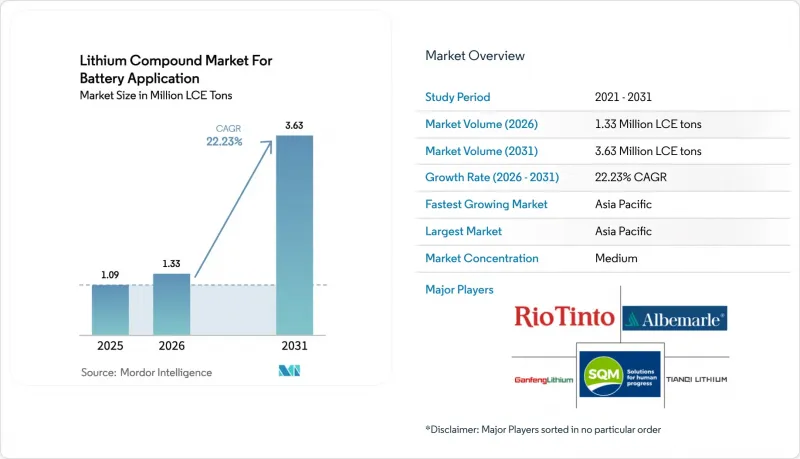
本報告按化合物(碳酸鋰、氫氧化鋰、氯化鋰及其他)、終端用戶產業(汽車、家用電子電器、能源儲存系統及其他產業)和地區(亞太、北美、歐洲、南美以及中東和非洲)進行細分。市場預測以鋰當量噸(LCE噸)為基礎。
全球鋰化合物市場趨勢及洞察,重點在於電池應用領域
電動車的廣泛應用
到2025年,全球乘用車和商用電動車的銷售將突破一個重要的里程碑,從而鞏固對電池級鋰化合物的強勁需求。在歐洲和北美,延長續航里程是汽車產業的首要任務,推動了鎳含量更高的電池的普及。這些電池也促進了氫氧化鋰的廣泛應用。同時,中國扮演著至關重要的角色。國內汽車製造商利用低成本的磷酸鋰鐵(LFP)電池組(由碳酸鋰衍生而來)生產了大量電動車。由於《通貨膨脹控制法案》的激勵措施,北美已批准興建多家電池工廠。預計每家工廠每年的供應量將相當於碳酸鋰當量(LCE)。隨著高鎳電池和磷酸鐵鋰電池之間的差距不斷擴大,預計碳酸鋰和氫氧化鋰市場將同步成長。此外,從城市公車到中型卡車等商用車的電氣化進程,也創造了全年穩定的需求。
擴大可再生能源儲存系統的應用
隨著太陽能和風能發電規模的擴大,對電網穩定能力的需求將日益成長,公用事業規模的電池部署預計將持續擴大。加州的自發電獎勵計畫已批准為使用磷酸鐵鋰電池(LFP)的住宅系統提供大量資金,而磷酸鋰電池主要成分是碳酸鋰。中國新近實施的針對風電和太陽能發電廠的強制性儲能政策正在推動對磷酸鐵鋰電池組件的需求。在印度,儲能系統競標正在進行中,這凸顯了該國日益成長的電網穩定需求,儘管其資金籌措模式傾向於對鋰依賴性較低的短期儲能資產。鐵空氣電池等長期儲能化學電池預計將在本十年後半期發展出利基市場,但其商業化仍處於早期階段,這意味著鋰可能至少在2031年之前仍將保持其主導地位。
供應鏈瓶頸和鋰輝石短缺
2025年,受鋰輝石價格下跌的影響,澳洲礦商縮減了鋰輝石精礦的產量。這減少了對中國精煉廠的原料供應,並將精煉廠的庫存降至最低水準。通常情況下,新建硬岩礦從最終投資決策到首批產品下線需要數月時間。因此,目前項目的取消預示著電動車(EV)市場可能出現供不應求,而電動車市場預計將在2020年代末期擴張。 Liontown公司推遲Kathleen Valley專案意味著供應鏈中又一個供應來源的缺失。隨著電動車銷售預計逐年成長,未來幾年對鋰輝石的需求可能會超過經濟可行的供應水準。從鹽水中提取鋰可以緩解部分供應短缺,但這會帶來環境挑戰,而直接鋰萃取技術仍處於測試階段。如果沒有持續的價格回升來支撐礦山現金流,鋰化合物市場可能會面臨週期性的供應緊張,這可能會危及下游製程的穩定規劃。
細分市場分析
到2025年,碳酸鋰將佔鋰供應量的64.31%,主要歸功於其在磷酸鐵鋰(LFP)正極材料中的關鍵作用。這些正極材料是中國快速成長的大眾市場電動車(EV)和固定式能源產業的基礎。磷酸鐵鋰電池組已取得顯著進展,其系統總成本大幅降低,從而提升了其競爭力,凸顯了其相對於鎳基電池的顯著優勢,並進一步推動了對碳酸鋰的需求。受摩托車快速電動化和儲能領域日益成長的關注度的驅動,預計碳酸鋰應用領域的鋰化合物市場規模將以22.79%的複合年成長率成長。同時,氫氧化鋰雖然在2025年仍將佔據大部分產量,但其價格較高,導致其銷售佔有率不成比例地高。這主要是由於電池級氫氧化鋰的高價。這兩種產品之間的動態體現了一種策略平衡:碳酸鋰確保了銷售量的穩定,而氫氧化鋰則提供了更高的利潤率和更大的議價能力。
氯化鋰、氟化鋰、氧化鋰和硫化鋰等二次化合物在2025年僅佔總產量的約6%,但它們在某些特定應用領域的重要性卻不容忽視。例如,全固體電解質的開發商正在使用高純度氯化鋰,這對於硫化物基薄膜的製造至關重要。這些薄膜的離子電導率超過10 mS/cm,這是主流碳酸鹽基方法難以達到的基準值。同時,氟化鋰作為高壓電解質添加劑發揮關鍵作用,能夠防止4.5 V奈米金屬正極過渡金屬的溶解。尤其值得一提的是,這些特殊鹽的價格可能超過碳酸鹽基產品的基準價格。此外,對這些化合物的需求與主要原始設備製造商(OEM)設定的研發里程碑密切相關。隨著中試生產線從克級實驗轉向噸級生產,特種化學品製造商可望開拓盈利的細分市場。這些充滿知識底蘊的市場可能交易量不高,但預計能創造巨大的價值。
區域分析
亞太地區在鋰化合物市場佔據領先地位,預計到2025年將佔全球市場佔有率的64.86%,並預計在2031年之前以23.85%的複合年成長率成長。中國作為主要市場參與者,已提煉了大量的鋰化合物,主要供應廣東、江蘇和四川等省份的電池工廠。贛鋒新餘精煉廠年產能達到一定水平,並能根據鎳價波動靈活地在碳酸鋰和氫氧化鋰的生產之間切換。印度在2025年仍嚴重依賴進口來滿足其大部分鋰化合物需求,但該國正在加快在查謨和克什米爾地區的國內探勘活動,並計劃在本十年末降低其進口依賴度。日本和韓國均為淨進口國,但它們正透過Panasonic和LG能源解決方案等大型企業利用加工技術,並將鋰化合物共同用於圓柱形電池和軟包電池的生產。
預計到2025年,北美將佔據相當大的鋰需求佔有率。 Albemarle公司的Silver Peak海水礦場生產碳酸鋰,該公司正推進在Kings Mountain建設氫氧化鋰生產設施的計劃,目標是2027年運作。 Lithium Americas公司的Soccer Pass專案已獲得聯邦政府批准,並計劃於2027年開始生產碳酸鋰。在加拿大魁北克省,Nemasca公司已恢復運營,採用更環保的水力發電加工方法提高氫氧化鋰的產量。同時,在墨西哥快速發展的電動車中心新萊昂州,預計到2028年,鋰當量(LCE)的年需求量將達到2028年,南美洲的海水和索諾拉州的潛在資源預計將成為其供應來源。
2025年,儘管受到當地礦藏短缺的限制,歐洲仍確保了在全球鋰產量中佔有一席之地。德國巴爾幹能源公司(Balkan Energy)正率先從地熱鹵水中提取鋰,目標是在2026年開始生產氫氧化鋰,並雄心勃勃地計劃在2028年擴大產量。在法國,伊梅里斯公司(Imerys)正在評估其位於博瓦爾(Beauvoir)的工廠從2028年開始提取氫氧化鋰的可行性。英國雖然受惠於汽車轉型基金(Automotive Transformation Fund)提供的電池組裝津貼,但仍面臨精煉能力不足的問題,不得不依賴從亞洲進口氫氧化鋰。在南美洲,智利和阿根廷在2025年佔據了大部分原生鋰產量。同時,在中東,沙烏地阿拉伯正在投資一個利用紅海鹵水直接提取鋰(DLE)的試點項目,這預示著一種新的低碳鋰源正在興起。
其他好處:
- Excel格式的市場預測(ME)表
- 3個月的分析師支持
目錄
第1章:引言
- 研究假設和市場定義
- 調查範圍
第2章:調查方法
第3章執行摘要
第4章 市場狀況
- 市場概覽
- 市場促進因素
- 電動汽車的快速普及
- 可再生能源儲存系統的擴展
- 家用電器和電動工具市場擴張
- 新興國家電池供應鏈本地化
- 透過高鎳體系和固體化學提高鋰密度
- 市場限制因素
- 供應鏈瓶頸和鋰輝石供不應求
- 嚴格的用水和環境法規
- 鋰價波動源自投機行為
- 價值鏈分析
- 波特五力分析
第5章 市場規模與成長預測
- 化合物
- 碳酸鋰
- 氫氧化鋰
- 氯化鋰
- 其他(氧化鋰、氟化鋰、硫化鋰、硫酸鋰)
- 按最終用戶行業分類
- 汽車(電動車)
- 家用電子產品
- 能源儲存系統
- 其他行業(電動工具、航太等)
- 按地區
- 亞太地區
- 中國
- 日本
- 印度
- 韓國
- 其他亞太國家
- 北美洲
- 美國
- 加拿大
- 墨西哥
- 歐洲
- 德國
- 英國
- 法國
- 義大利
- 其他歐洲國家
- 南美洲
- 巴西
- 阿根廷
- 其他南美國家
- 中東和非洲
- 沙烏地阿拉伯
- 南非
- 其他中東和非洲國家
- 亞太地區
第6章 競爭情勢
- 市場集中度
- 策略趨勢
- 市佔率和排名分析
- 公司簡介
- Albemarle Corporation
- Jiangxi Ganfeng Lithium Group Co., Ltd.
- LevertonHELM Limited
- Lithium Americas Corp.
- Lithium Argentina AG
- Mineral Resources
- PLS(Pilbara Minerals)
- Rio Tinto
- Shandong Ruifu Lithium Co., Ltd.
- SQM SA
- Tianqi Lithium Co., Ltd.
第7章 市場機會與未來展望
According to Mordor Intelligence, the lithium compound for Battery Application Market Industry size was valued at 1.09 LCE million tons in 2025 and is estimated to grow from 1.33 LCE million tons in 2026 to reach 3.63 LCE million tons by 2031, at a CAGR of 22.23% during the forecast period (2026-2031).
This report is Segmented by Compound (Lithium Carbonate, Lithium Hydroxide, Lithium Chloride, and Others), End-User Industry (Automotive, Consumer Electronics, Energy Storage Systems, and Other Industries), and Geography (Asia-Pacific, North America, Europe, South America, and Middle-East and Africa). Market Forecasts are Provided in Terms of Volume (LCE Tons).
Global Lithium Compound for Battery Application Market Trends and Insights
Surge in Electric-Vehicle Adoption
In 2025, global sales of passenger and commercial electric vehicles (EVs) surpassed significant milestones, solidifying a robust demand for battery-grade lithium compounds. Fleets in Europe and North America, emphasizing higher mileage, are gravitating towards nickel-rich cells. These cells are driving a surge in hydroxide adoption. Meanwhile, China plays a crucial role: domestic OEMs dispatched a substantial number of EVs, capitalizing on cost-effective lithium iron phosphate (LFP) packs derived from carbonate feedstock. Thanks to incentives from the Inflation Reduction Act, North America saw a flurry of commitments for cell plants. Each plant is poised to draw in an annual supply of lithium carbonate equivalent (LCE). As the divide between high-nickel and LFP strategies widens, both carbonate and hydroxide markets are set for simultaneous growth. Furthermore, the electrification of commercial vehicles, spanning from city buses to medium-duty trucks, introduces a consistent demand throughout the year.
Growth in Renewable-Energy Storage Deployments
Utility-scale battery installations are expected to continue climbing as solar and wind build-outs require firming capacity. California's Self-Generation Incentive Program has authorized significant funding for residential systems, predominantly utilizing LFP cells that depend on lithium carbonate. China's newly introduced storage-mandate policy for wind and solar plants is spurring demand for LFP modules. In India, a tender for storage underscores the nation's escalating grid-balancing demands, even as financing models lean towards shorter-duration assets with reduced lithium reliance. While long-duration chemistries like iron-air are poised to carve out niches in the latter part of the decade, they remain in their commercial infancy, ensuring lithium's dominance at least until 2031.
Supply-Chain Bottlenecks and Spodumene Shortages
In 2025, Australian miners curtailed spodumene concentrate production as prices fell. This move reduced feedstock for Chinese converters and brought refinery inventories down to minimal levels. Typically, new hard-rock capacities take several months from the final investment decision to produce their first product. Thus, today's cancellations hint at potential shortages for the growing electric vehicle (EV) market in the late decade. Liontown's delay of the Kathleen Valley project means a loss of additional supply from the chain. With EV sales set to grow annually, demand for spodumene could surpass economically viable supply in the coming years. While brines offer some respite, they come with environmental challenges, and direct lithium extraction technologies are still in the pilot phase. Without a consistent price rebound to bolster mine cash flows, the lithium compound market may face periodic squeezes, jeopardizing stable planning downstream.
Other drivers and restraints analyzed in the detailed report include:
- Localization of Battery Supply Chains in Emerging Economies
- Higher Li-Intensity from High-Nickel and Solid-State Chemistries
- Stringent Water-Use and Environmental Regulations
For complete list of drivers and restraints, kindly check the Table Of Contents.
Segment Analysis
Lithium carbonate held 64.31% of the 2025 volume, primarily due to its pivotal role in LFP cathodes. These cathodes are the backbone of China's burgeoning mass-market electric vehicle (EV) and stationary energy segments. LFP battery packs achieved a notable milestone, reaching total system costs that underscored their competitiveness and highlighted a significant advantage over nickel-based chemistries, further bolstering the demand for lithium carbonate. The lithium compound market size for carbonate applications is projected to advance at a 22.79% CAGR, driven by the swift electrification of two-wheelers and a growing emphasis on energy storage. Meanwhile, lithium hydroxide, while accounting for a significant portion of the 2025 output, commanded a premium, contributing a disproportionately higher share of revenue. This was largely due to battery-grade premiums. The dynamics between the two products reveal a strategic balance: while lithium carbonate ensures volume stability, lithium hydroxide offers enhanced profit margins and greater bargaining power.
While second-tier compounds like lithium chloride, fluoride, oxide, and sulfide constituted about 6% of the 2025 volume, their significance looms large in niche applications. For instance, developers of solid-state electrolytes turn to high-purity lithium chloride, essential for crafting sulfide-based films. These films boast ionic conductivities exceeding 10 mS/cm, a benchmark that mainstream carbonate routes struggle to achieve. Lithium fluoride, on the other hand, plays a crucial role as a high-voltage electrolyte additive, preventing transition-metal dissolution in 4.5-V NM cathodes. Notably, prices for these specialty salts can outstrip carbonate benchmarks. Furthermore, demand for these compounds closely follows research and development milestones set by major OEMs. As pilot production lines transition from gram-scale experiments to ton-scale operations, specialty producers stand poised to carve out lucrative micro-markets. These markets, rich in intellectual property, may not boast high tonnage but promise significant value.
Complete Report Scope:
- By Compound
- Lithium Carbonate
- Lithium Hydroxide
- Lithium Chloride
- Others (Lithium Oxide, Lithium Fluoride, Lithium Sulfide, and Lithium Sulfate)
- By End-user Industry
- Automotive (Electric Vehicles)
- Consumer Electronics
- Energy Storage Systems
- Other Industries (Power tools, Aerospace, etc.)
- By Geography
- Asia-Pacific
- China
- Japan
- India
- South Korea
- Rest of Asia-Pacific
- North America
- United States
- Canada
- Mexico
- Europe
- Germany
- United Kingdom
- France
- Italy
- Rest of Europe
- South America
- Brazil
- Argentina
- Rest of South America
- Middle-East and Africa
- Saudi Arabia
- South Africa
- Rest of Middle-East and Africa
- Asia-Pacific
Geography Analysis
Asia-Pacific controlled 64.86% of the 2025 volume and 23.85% CAGR through 2031, reinforcing the region's stewardship of the lithium compound market. China, a significant player, refined a substantial amount of LCE, primarily servicing cell plants in its Guangdong, Jiangsu, and Sichuan provinces. Ganfeng's Xinyu refinery, with an annual capacity, adeptly shifts between producing carbonate and hydroxide, responding to fluctuations in nickel prices. While India imported a substantial percentage of its LCE requirement in 2025, the nation is accelerating domestic exploration efforts in Jammu and Kashmir, with hopes of curbing its import reliance by the decade's end. Both Japan and South Korea, despite being net importers, leverage their processing expertise through giants like Panasonic and LG Energy Solution, collectively utilizing LCE for their cylindrical and pouch-cell productions.
North America accounted for a notable share of the 2025 demand. At Albemarle's Silver Peak brine site, carbonate was produced, and the company is pushing forward with plans for an annual capacity hydroxide facility at Kings Mountain, aiming for a 2027 launch. Lithium Americas' Thacker Pass project, having navigated federal approvals, is set to commence in 2027 with an output of carbonate. In Quebec, Canada's Nemaska is reviving operations to add hydroxide, utilizing hydropower for a greener processing approach. Meanwhile, Mexico's growing electric vehicle hub in Nuevo Leon anticipates a demand of LCE annually by 2028, with supplies expected from both South American brines and potential resources in Sonora.
Europe secured a portion of the global lithium volume in 2025, hampered by a scarcity of local ore. Germany's Vulcan Energy is pioneering geothermal-brine extraction, targeting an output of hydroxide in 2026, with ambitions to scale up by 2028. In France, Imerys is evaluating the feasibility of extracting hydroxide from its Beauvoir site starting in 2028. The UK, while benefiting from grants under the Automotive Transformation Fund for cell assembly, still faces refining shortfalls, leading to a reliance on hydroxide imports from Asia. In South America, both Chile and Argentina were responsible for a significant share of the primary lithium output in 2025. Meanwhile, in the Middle East, Saudi Arabia is investing in direct lithium extraction (DLE) pilots on Red Sea brines, hinting at the emergence of new low-carbon supply sources.
- Albemarle Corporation
- Jiangxi Ganfeng Lithium Group Co., Ltd.
- LevertonHELM Limited
- Lithium Americas Corp.
- Lithium Argentina AG
- Mineral Resources
- PLS (Pilbara Minerals)
- Rio Tinto
- Shandong Ruifu Lithium Co., Ltd.
- SQM S.A.
- Tianqi Lithium Co., Ltd.
Additional Benefits:
- The market estimate (ME) sheet in Excel format
- 3 months of analyst support
TABLE OF CONTENTS
1 Introduction
- 1.1 Study Assumptions and Market Definition
- 1.2 Scope of the Study
2 Research Methodology
3 Executive Summary
4 Market Landscape
- 4.1 Market Overview
- 4.2 Market Drivers
- 4.2.1 Surge in electric-vehicle adoption
- 4.2.2 Growth in renewable-energy storage deployments
- 4.2.3 Expansion of consumer electronics and power tools
- 4.2.4 Localization of battery supply chains in emerging economies
- 4.2.5 Higher Li-intensity from high-nickel and solid-state chemistries
- 4.3 Market Restraints
- 4.3.1 Supply-chain bottlenecks and spodumene shortages
- 4.3.2 Stringent water-use and environmental regulations
- 4.3.3 Lithium-price volatility driven by speculation
- 4.4 Value Chain Analysis
- 4.5 Porter's Five Forces Analysis
- 4.5.1 Bargaining Power of Suppliers
- 4.5.2 Bargaining Power of Buyers
- 4.5.3 Threat of New Entrants
- 4.5.4 Threat of Substitutes
- 4.5.5 Degree of Competition
5 Market Size and Growth Forecasts (Volume)
- 5.1 By Compound
- 5.1.1 Lithium Carbonate
- 5.1.2 Lithium Hydroxide
- 5.1.3 Lithium Chloride
- 5.1.4 Others (Lithium Oxide, Lithium Fluoride, Lithium Sulfide, and Lithium Sulfate)
- 5.2 By End-user Industry
- 5.2.1 Automotive (Electric Vehicles)
- 5.2.2 Consumer Electronics
- 5.2.3 Energy Storage Systems
- 5.2.4 Other Industries (Power tools, Aerospace, etc.)
- 5.3 By Geography
- 5.3.1 Asia-Pacific
- 5.3.1.1 China
- 5.3.1.2 Japan
- 5.3.1.3 India
- 5.3.1.4 South Korea
- 5.3.1.5 Rest of Asia-Pacific
- 5.3.2 North America
- 5.3.2.1 United States
- 5.3.2.2 Canada
- 5.3.2.3 Mexico
- 5.3.3 Europe
- 5.3.3.1 Germany
- 5.3.3.2 United Kingdom
- 5.3.3.3 France
- 5.3.3.4 Italy
- 5.3.3.5 Rest of Europe
- 5.3.4 South America
- 5.3.4.1 Brazil
- 5.3.4.2 Argentina
- 5.3.4.3 Rest of South America
- 5.3.5 Middle-East and Africa
- 5.3.5.1 Saudi Arabia
- 5.3.5.2 South Africa
- 5.3.5.3 Rest of Middle-East and Africa
- 5.3.1 Asia-Pacific
6 Competitive Landscape
- 6.1 Market Concentration
- 6.2 Strategic Moves
- 6.3 Market Share/Ranking Analysis
- 6.4 Company Profiles (includes Global-level Overview, Market-level Overview, Core Segments, Financials as available, Strategic Information, Products and Services, Recent Developments)
- 6.4.1 Albemarle Corporation
- 6.4.2 Jiangxi Ganfeng Lithium Group Co., Ltd.
- 6.4.3 LevertonHELM Limited
- 6.4.4 Lithium Americas Corp.
- 6.4.5 Lithium Argentina AG
- 6.4.6 Mineral Resources
- 6.4.7 PLS (Pilbara Minerals)
- 6.4.8 Rio Tinto
- 6.4.9 Shandong Ruifu Lithium Co., Ltd.
- 6.4.10 SQM S.A.
- 6.4.11 Tianqi Lithium Co., Ltd.
7 Market Opportunities and Future Outlook
- 7.1 White-space and Unmet-Need Assessment

 鋰萃取化學品市場預測至2034年-按產品、萃取技術、鋰原料、製程、最終用戶和地區分類的全球分析
 鋰化合物市場:2026-2032年全球市場預測(依產品類型、純度等級、製造流程、形態、應用及分銷通路分類)矽酸鋰市場:2026-2032年全球市場預測(依產品類型、等級、製造流程、應用及通路分類)
 鋰化合物市場報告:按類型、應用和地區分類(2026-2034 年)
 全球矽酸鋰市場規模、佔有率、趨勢和成長分析報告(2026-2034年)依純度等級、粒徑、製造製程和應用分類的鋰錳鎳氧化物粉末市場-2026-2032年全球預測鋰錳鎳氧化物尖晶石市場按產品類型、形態、應用和最終用途產業分類 - 全球預測 2026-2032
 鋰化合物市場規模、佔有率和成長分析(按應用、產品類型、最終用途產業、純度等級、製造流程和地區分類)-2026-2033年產業預測
 鋰化學品的全球市場,規模,佔有率,趨勢,產業分析報告:各產品,各應用領域,各終端用戶,各地區 - 市場預測,2025年~2034年
 鋰化學品市場規模、佔有率、趨勢分析報告:按產品、最終用途、地區、細分市場預測,2025-2030 年