


 |
市場調查報告書
商品編碼
2097316
生質能固態燃料:市場佔有率分析、產業趨勢和統計數據、成長預測(2025-2030 年)Biomass Solid Fuel - Market Share Analysis, Industry Trends & Statistics, Growth Forecasts (2025 - 2030) |
||||||

※ 本網頁內容可能與最新版本有所差異。詳細情況請與我們聯繫。
據 Mordor Intelligence 稱,生質能固態燃料市場預計在 2025 年達到 287.7 億美元,預計在預測期(2025-2030 年)內將以 10.33% 的複合年成長率成長,到 2030 年達到 470.3 億美元。
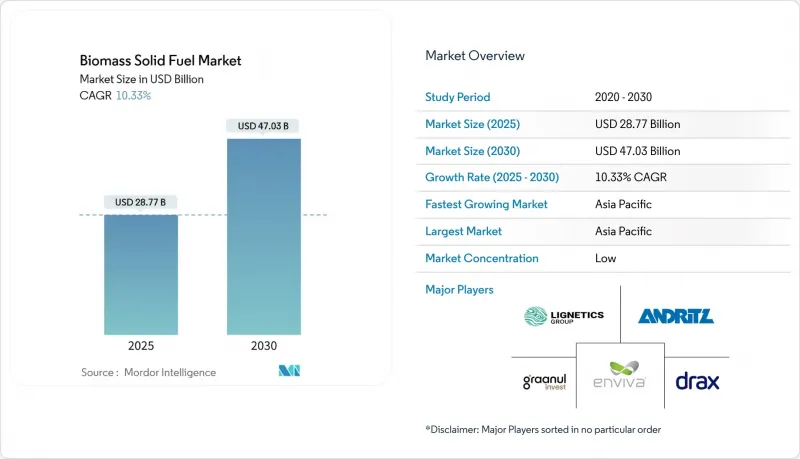
本報告按類型(木質顆粒、煤球、鋸末/木片等)、應用(住宅供暖、商業/公共供暖、工業供熱等)、最終用戶(一般家庭、中小型商業機構、大型工業、公共產業和獨立發電商 (IPP))以及地區(北美、歐洲、亞太地區、南美、中東和非洲)進行分類。
全球生質能固態燃料市場趨勢與洞察
歐盟強制要求暖氣產業快速脫碳
成員國須在2030年前將可再生能源在最終消費中的佔比提高到42.5%,而供暖行業是實現這一目標最有效的途徑。在奧地利,2024年初安裝了19,181台新的顆粒鍋爐。補貼覆蓋了75%的投資成本,每台鍋爐最高可獲得18,000歐元的補貼。德國也採取了類似的政策,提供高達70%的補貼,但由於政治情勢的變化,2025年後補貼條件可能會有所調整。根據RED III修訂的級聯原則,材料利用優先於能源利用,這迫使公共產業競相爭奪高品質的顆粒燃料。供應鏈正轉向成本較低的巴西進口產品,其交付價格比波羅的海鮮每噸便宜50多美元。鑑於這些經濟狀況,公共產業優先考慮簽訂長期採購契約,以確保獲得價格可預測的認證供應。
工業領域從煤炭轉向生質能轉變的擴大。
為了降低擱淺資產的風險,電力公司正在將混燒比例從10%提高到完全取代現有燃料。巴布科克-威爾科克斯公司正在維修密西根州的一座發電廠,使其能夠運作木質生質能燃料,並整合碳捕獲技術,目標是實現每年55萬噸的淨負二氧化碳排放。韓華能源計畫在韓國轉向熱電聯產,顯示即使補貼削減迫在眉睫,亞洲各地對這種能源方式的採用率也不斷提高。蒸氣爆破預處理可以提高生質能的熱值,使其無需對破碎設備進行重大升級即可在粉煤燃燒裝置中燃燒。就初始工程成本而言,擁有燃料處理系統的現有電力公司具有優勢,這進一步擴大了它們相對於小規模的新進入者的競爭優勢。
與人造板和紙漿行業的原料競爭
人造板廠正以高價收購優質鋸末,導致原本可用於顆粒生產線的廢料高達15%被挪作他用。隨著安德里茨公司銷售的先進造紙廠能夠有效率地處理多種樹種,競爭日益激烈。牛皮紙漿廠升級為生物精煉,提取木質素、乙醇和綠色化學品,利潤率高於通用能源顆粒。預計到2024年,美國林產品產業的產值將達到241億美元,使其在原物料採購方面擁有強大的議價能力。因此,顆粒生產商需要簽訂長期供應契約,或在靠近二次伐木廢料來源地的地方建立生產設施,以避免競標戰。
細分市場分析
儘管木質顆粒在生質能固態燃料市場佔據主導地位,但熱處理顆粒正在推動市場成長。截至2024年,木質顆粒的市佔率為60.8%,但預計到2030年,熱處理顆粒和黑色顆粒的複合年成長率將達到21.4%。採用蒸氣爆破的高密度技術提高了顆粒的耐久性,並將運輸成本降低了30%,加速了電力公司對可粉碎性燃料作為煤炭替代品的採用。在歐洲,由於現有爐灶的需要,大尺寸的煤球佔據了一定的市場佔有率。東南亞地區豐富的農業殘餘物顆粒由於灰分含量不穩定而面臨挑戰,這使得品質認證變得複雜。然而,棕櫚仁出口的成長表明,透過標準化分級系統可以釋放潛在的供應。熱處理燃料符合海運的能量密度標準,目前正在擴大產能的供應商已做好充分準備,在歐盟燃油運輸法規生效後滿足船用燃料的需求。預計熱處理生質能固態燃料的市場規模將從 2024 年的 20.2 億美元成長到 2030 年的 53.5 億美元。
熱處理製程的熱效率高達96%,產生的燃料熱值與煤炭相當,且不排放硫。投資者傾向於選擇整合式熱解和造粒廠,以最大限度地降低雙重處理成本,而終端用戶則要求顆粒的耐久性達到97%或更高。農業廢棄物原料的優點在於原料成本較低,但由於其鉀含量高,在筒倉儲存方面面臨挑戰,因為這會增加結渣的風險。供應商之間的差異化取決於能夠確保煤粉鍋爐燃燒穩定性的測試方案。
區域分析
預計到2024年,亞太地區將佔據38.1%的市場佔有率,並以11.2%的複合年成長率成長。 2025年3月,日本棕櫚仁殼進口量達67萬噸,而隨著46兆瓦伊万裡發電廠等新設施的運作,木質顆粒進口量較去年同期成長29%,達到68.5萬噸。在韓國,由於2024年12月補助削減,新計畫受到抑制,但由於既得權益的適用,在建工程的維修工程仍在繼續。中國計畫在2030年利用5,800萬噸生質能(以標準煤當量計),主要來自農業殘餘物。印尼、馬來西亞和泰國正在擴大出口,但對森林砍伐問題的日益嚴格審查可能會導致對原料更嚴格的審查。
歐洲擁有世界上最嚴格的永續性評估體系。 2023年,暖冬導致顆粒燃料消耗量下降1.2%,至2,450萬噸,但住宅鍋爐的補貼緩解了這一降幅。奧地利創紀錄的安裝量凸顯了相關政策在刺激需求方面的成效。在芬蘭和瑞典,梯級利用原則優先考慮將木材用作建築材料而非能源,這導致了資源分配的衝突。自2026年起,更嚴格的RED III法規將要求生產商證明其符合森林生質能標準,預計將促進波羅的海地區以外供應來源的多元化。
北美地區主導生質燃料出口,預計2024年出口量將達887萬噸,較上年增加3%。受天然氣價格走低和冬季氣溫偏暖的影響,北美國內消費量下降了14%。德拉克斯公司(Drax)一項投資125億美元的美國發電廠計畫可能會將部分出口轉向國內市場,這可能會改變生質能固態燃料市場的格局,導致全球海運運輸趨緊。美國生物能源公司(USA Bioenergy)簽署了一份價值28億美元的永續航空燃料綜合體長期供應契約,該合約將確保220萬噸原料的供應,雖然這將減少出口量,但預計將提升該地區的價值創造。
其他好處:
- Excel格式的市場預測(ME)表
- 3個月的分析師支持
目錄
第1章:引言
- 研究假設和市場定義
- 調查範圍
第2章:調查方法
第3章執行摘要
第4章 市場狀況
- 市場概覽
- 市場促進因素
- 歐盟強制要求暖氣產業快速脫碳
- 在從煤炭過渡到生質能的過程中,工業混燒計畫的擴張
- 碳中和企業採購計畫(RE100、SBTi)
- 作為直接替代船用燃料,熱處理顆粒的運輸需求
- 東南亞地區鋸木廠廢料供應充足,推動了出口量的成長。
- 利用蒸氣爆炸技術實現高密度技術的商業化,可降低物流成本。
- 市場限制因素
- 與人造板和紙漿行業爭奪原料
- 非政府組織和金融機構對永續性和土地利用的審查
- 歐盟 RED III:從 2026 年起實施更嚴格的森林生質能標準。
- 由於顆粒工廠存在火災和爆炸風險,保險費正在上漲。
- 供應鏈分析
- 監理情勢
- 技術展望
- 波特五力模型
第5章 市場規模與成長預測
- 按類型
- 木質顆粒
- 煤炭球
- 鋸末和木屑
- 農業殘渣顆粒
- 烘焙顆粒和黑色顆粒
- 其他(例如,木炭塊、椰殼顆粒)
- 透過使用
- 住宅暖氣
- 商業和公共設施的供暖
- 工業熱源
- 大規模發電
- 熱電聯產(CHP)
- 最終用戶
- 普通家庭
- 中小型商業設施
- 大型工業
- 公共產業及獨立電力生產商(IPP)
- 按地區
- 北美洲
- 美國
- 加拿大
- 墨西哥
- 歐洲
- 英國
- 德國
- 法國
- 西班牙
- 北歐國家
- 俄羅斯
- 其他歐洲國家
- 亞太地區
- 中國
- 印度
- 日本
- 韓國
- 東南亞國協
- 澳洲和紐西蘭
- 其他亞太國家
- 南美洲
- 巴西
- 阿根廷
- 哥倫比亞
- 其他南美國家
- 中東和非洲
- 阿拉伯聯合大公國
- 沙烏地阿拉伯
- 南非
- 埃及
- 其他中東和非洲國家
- 北美洲
第6章 競爭情勢
- 市場集中度
- 策略趨勢(併購、聯盟、購電協議)
- 市場佔有率分析(主要公司的市場排名和佔有率)
- 公司簡介
- Enviva Inc.
- Drax Group plc
- Andritz AG
- AS Graanul Invest
- Pinnacle Renewable Energy
- Lignetics, Inc.
- Pacific BioEnergy Corp.
- Westervelt Renewable Energy
- Fram Renewable Fuels
- German Pellets GmbH
- Abellon CleanEnergy
- Georgia Biomass, LLC
- CM Biomass Partners
- Zilkha Biomass Energy
- EcoPellets Tasmania
- Stora Enso Oyj(Biomaterials div.)
- Land Energy Girvan Ltd
- Asia Biomass Co., Ltd.
- Polkky Oy(Pellet business)
- La Societe Generale des Granules(Sogenor)
第7章 市場機會與未來展望
According to Mordor Intelligence, the biomass solid fuel market size is estimated at USD 28.77 billion in 2025, and is expected to reach USD 47.03 billion by 2030, at a CAGR of 10.33% during the forecast period (2025-2030).
This report is Segmented by Type (Wood Pellets, Briquettes, Sawdust and Wood Chips, and More), Application (Residential Heating, Commercial and Institutional Heating, Industrial Heat Generation, and More), End User (Households, Small and Medium Commercial, Large Industrial, and Utilities and IPPs), and Geography (North America, Europe, Asia-Pacific, South America, and Middle East and Africa).
Global Biomass Solid Fuel Market Trends and Insights
Rapid Decarbonization Mandates in the EU Heating Sector
Member states must reach 42.5% renewable energy in final consumption by 2030, and heating is the fastest lever to pull. Austria logged 19,181 new pellet-boiler installations during early 2024, with subsidies meeting 75% of capital cost, up to EUR 18,000 per unit. Germany mirrors this policy, offering up to 70% subsidy coverage, though potential political shifts may revise terms after 2025. The revised cascading principle under RED III gives material uses priority over energy, forcing utilities to compete for premium-grade pellets. Supply chains are pivoting toward lower-cost Brazilian imports that undercut Baltic shipments by more than USD 50 per tonne on a delivered basis. Facing these economics, Utilities are favoring long-term offtake deals to lock in certified volumes at predictable prices.
Expansion of Industrial Coal-to-Biomass Conversions
Power firms are pushing co-firing blends from 10% toward full fuel substitution, avoiding stranded-asset risks. Babcock & Wilcox retrofitted a Michigan plant to run on woody biomass and integrated carbon capture, targeting net-negative 550,000 tCO2 annually.Hanwha Energy's planned combined-heat-and-power switch in South Korea underlines broader Asian uptake even as subsidy cuts loom. Steam-explosion pretreatment boosts calorific value, letting pulverized units burn biomass without extensive mill upgrades. The upfront engineering costs favor incumbent utilities that own fuel-handling systems, widening the moat against smaller entrants.
Feedstock Competition with Panelboard & Pulp Industries
Panelboard mills offer premium pricing for fine sawdust, diverting up to 15% of residue that would otherwise feed pellet lines. Advanced mills marketed by ANDRITZ process mixed species efficiently, sharpening competition. Kraft pulp plants upgrading into biorefineries extract lignin, ethanol, and green chemicals, enabling higher margins than commodity energy pellets. In the United States, the forest-products sector contributed USD 24.1 billion in 2024 output, giving it negotiating muscle for feedstock. Pellet producers must therefore secure longer rotation contracts or co-locate capacity near secondary harvest residues to sidestep bidding wars.
Other drivers and restraints analyzed in the detailed report include:
- Carbon-Neutral Corporate Procurement Programs
- Maritime Demand for Torrefied Pellets as Drop-In Bunker Fuel
- Sustainability & Land-Use Scrutiny by NGOs and Financiers
For complete list of drivers and restraints, kindly check the Table Of Contents.
Segment Analysis
Wood pellets dominate the biomass solid fuel market, but torrefied variants headline growth. The segment commanded a 60.8% share in 2024, while torrefied and black pellets will post a 21.4% CAGR to 2030. Steam-explosion densification raises durability and reduces freight expenditure by 30%, spurring uptake among utilities that need coal-substitute grindability. Briquettes retain a niche in European households where existing stoves favor larger formats. Agricultural-residue pellets, abundant in Southeast Asia, struggle with variable ash content that complicates quality certification. Despite this, rising palm-kernel exports suggest a path for standardized grading systems to unlock latent volumes. Torrefied fuels meet maritime energy-density thresholds, positioning suppliers that build capacity now to capture bunker-fuel demand once FuelEU Maritime rules start. The biomass solid fuel market size for torrefied products is forecast to rise from USD 2.02 billion in 2024 to USD 5.35 billion by 2030.
The torrefaction process records up to 96% thermal efficiency, creating a near-coal calorific value without sulfur emissions. Investors favor plants that integrate torrefaction and pelletizing to minimize double-handling costs, while end users require pellets with >97% durability. The agricultural-residue subsegment benefits from lower feedstock prices yet faces silo-storage challenges due to higher potassium content that elevates slagging risks. Supplier differentiation rests on testing protocols that assure combustion stability in pulverized boilers.
Complete Report Scope:
- By Type
- Wood Pellets
- Briquettes
- Sawdust and Wood Chips
- Agricultural Residue Pellets
- Torrefied Pellets and Black Pellets
- Others (e.g., Char-briquettes, Coconut-shell pellets)
- By Application
- Residential Heating
- Commercial and Institutional Heating
- Industrial Heat Generation
- Utility-scale Power Generation
- CHP (Combined Heat and Power)
- By End User
- Households
- Small and Medium Commercial
- Large Industrial
- Utilities and IPPs
- By Geography
- North America
- United States
- Canada
- Mexico
- Europe
- United Kingdom
- Germany
- France
- Spain
- Nordic Countries
- Russia
- Rest of Europe
- Asia-Pacific
- China
- India
- Japan
- South Korea
- ASEAN Countries
- Australia and New Zealand
- Rest of Asia-Pacific
- South America
- Brazil
- Argentina
- Colombia
- Rest of South America
- Middle East and Africa
- United Arab Emirates
- Saudi Arabia
- South Africa
- Egypt
- Rest of Middle East and Africa
- North America
Geography Analysis
Asia-Pacific held a 38.1% share in 2024 and is projected to expand at a 11.2% CAGR. Japan's palm-kernel shell imports hit 670,000 t in March 2025, while wood-pellet inflows grew 29% year-on-year to 685,000 t as new units such as the 46 MW Imari plant came online. South Korea's December 2024 subsidy rollback curtails new projects, but retrofits already in construction continue under grandfathered terms. China aims for 58 million t of standard-coal-equivalent biomass by 2030, focusing on agricultural residues. Indonesia, Malaysia, and Thailand are scaling exports, yet mounting deforestation scrutiny may prompt stricter feedstock audits.
Europe enforces the world's most stringent sustainability screens. Pellet consumption slipped 1.2% in 2023 to 24.5 million t after a mild winter, but residential boiler subsidies cushioned the decline. Austria's record installations underline policy potency in stimulating demand. Finland and Sweden face resource-allocation clashes as cascading use principles prioritize timber for material applications over energy. From 2026, tighter RED III rules require producers to demonstrate forest-biomass compliance, likely spurring supply diversification outside the Baltic region.
North America dominates export supply, shipping 8.87 million t in 2024, up 3% year-on-year. Domestic consumption dipped 14%, reflecting cheaper natural-gas prices and mild winters. Drax's USD 12.5 billion investment plan for US plants could redirect tonnage inward, shifting the biomass solid fuel market equilibrium toward tighter global seaborne balances. USA Bioenergy's long-dated supply deal for a USD 2.8 billion sustainable-aviation-fuel complex locks in 2.2 million t of feedstock, shrinking export availability but raising in-region value capture.
- Enviva Inc.
- Drax Group plc
- Andritz AG
- AS Graanul Invest
- Pinnacle Renewable Energy
- Lignetics, Inc.
- Pacific BioEnergy Corp.
- Westervelt Renewable Energy
- Fram Renewable Fuels
- German Pellets GmbH
- Abellon CleanEnergy
- Georgia Biomass, LLC
- CM Biomass Partners
- Zilkha Biomass Energy
- EcoPellets Tasmania
- Stora Enso Oyj (Biomaterials div.)
- Land Energy Girvan Ltd
- Asia Biomass Co., Ltd.
- Polkky Oy (Pellet business)
- La Societe Generale des Granules (Sogenor)
Additional Benefits:
- The market estimate (ME) sheet in Excel format
- 3 months of analyst support
TABLE OF CONTENTS
1 Introduction
- 1.1 Study Assumptions & Market Definition
- 1.2 Scope of the Study
2 Research Methodology
3 Executive Summary
4 Market Landscape
- 4.1 Market Overview
- 4.2 Market Drivers
- 4.2.1 Rapid decarbonisation mandates in the EU heating sector
- 4.2.2 Expansion of industrial co-firing projects in coal-to-biomass conversions
- 4.2.3 Carbon-neutral corporate procurement programmes (RE100, SBTi)
- 4.2.4 Maritime demand for torrefied pellets as drop-in bunker fuel
- 4.2.5 Abundant sawmill residue supply in SE-Asia driving export volumes
- 4.2.6 Commercialisation of steam-explosion densification cutting logistics cost
- 4.3 Market Restraints
- 4.3.1 Feedstock competition with panelboard & pulp industries
- 4.3.2 Sustainability & land-use scrutiny by NGOs and financiers
- 4.3.3 EU RED III tightening forest-biomass criteria from 2026
- 4.3.4 Rising insurance premiums for pellet-plant fire/explosion risk
- 4.4 Supply-Chain Analysis
- 4.5 Regulatory Landscape
- 4.6 Technological Outlook
- 4.7 Porter's Five Forces
- 4.7.1 Threat of New Entrants
- 4.7.2 Bargaining Power of Suppliers
- 4.7.3 Bargaining Power of Buyers
- 4.7.4 Threat of Substitutes
- 4.7.5 Competitive Rivalry
5 Market Size & Growth Forecasts
- 5.1 By Type
- 5.1.1 Wood Pellets
- 5.1.2 Briquettes
- 5.1.3 Sawdust and Wood Chips
- 5.1.4 Agricultural Residue Pellets
- 5.1.5 Torrefied Pellets and Black Pellets
- 5.1.6 Others (e.g., Char-briquettes, Coconut-shell pellets)
- 5.2 By Application
- 5.2.1 Residential Heating
- 5.2.2 Commercial and Institutional Heating
- 5.2.3 Industrial Heat Generation
- 5.2.4 Utility-scale Power Generation
- 5.2.5 CHP (Combined Heat and Power)
- 5.3 By End User
- 5.3.1 Households
- 5.3.2 Small and Medium Commercial
- 5.3.3 Large Industrial
- 5.3.4 Utilities and IPPs
- 5.4 By Geography
- 5.4.1 North America
- 5.4.1.1 United States
- 5.4.1.2 Canada
- 5.4.1.3 Mexico
- 5.4.2 Europe
- 5.4.2.1 United Kingdom
- 5.4.2.2 Germany
- 5.4.2.3 France
- 5.4.2.4 Spain
- 5.4.2.5 Nordic Countries
- 5.4.2.6 Russia
- 5.4.2.7 Rest of Europe
- 5.4.3 Asia-Pacific
- 5.4.3.1 China
- 5.4.3.2 India
- 5.4.3.3 Japan
- 5.4.3.4 South Korea
- 5.4.3.5 ASEAN Countries
- 5.4.3.6 Australia and New Zealand
- 5.4.3.7 Rest of Asia-Pacific
- 5.4.4 South America
- 5.4.4.1 Brazil
- 5.4.4.2 Argentina
- 5.4.4.3 Colombia
- 5.4.4.4 Rest of South America
- 5.4.5 Middle East and Africa
- 5.4.5.1 United Arab Emirates
- 5.4.5.2 Saudi Arabia
- 5.4.5.3 South Africa
- 5.4.5.4 Egypt
- 5.4.5.5 Rest of Middle East and Africa
- 5.4.1 North America
6 Competitive Landscape
- 6.1 Market Concentration
- 6.2 Strategic Moves (M&A, Partnerships, PPAs)
- 6.3 Market Share Analysis (Market Rank/Share for key companies)
- 6.4 Company Profiles (includes Global level Overview, Market level overview, Core Segments, Financials as available, Strategic Information, Products & Services, and Recent Developments)
- 6.4.1 Enviva Inc.
- 6.4.2 Drax Group plc
- 6.4.3 Andritz AG
- 6.4.4 AS Graanul Invest
- 6.4.5 Pinnacle Renewable Energy
- 6.4.6 Lignetics, Inc.
- 6.4.7 Pacific BioEnergy Corp.
- 6.4.8 Westervelt Renewable Energy
- 6.4.9 Fram Renewable Fuels
- 6.4.10 German Pellets GmbH
- 6.4.11 Abellon CleanEnergy
- 6.4.12 Georgia Biomass, LLC
- 6.4.13 CM Biomass Partners
- 6.4.14 Zilkha Biomass Energy
- 6.4.15 EcoPellets Tasmania
- 6.4.16 Stora Enso Oyj (Biomaterials div.)
- 6.4.17 Land Energy Girvan Ltd
- 6.4.18 Asia Biomass Co., Ltd.
- 6.4.19 Polkky Oy (Pellet business)
- 6.4.20 La Societe Generale des Granules (Sogenor)
7 Market Opportunities & Future Outlook
- 7.1 White-space & Unmet-need Assessment

 生質能固態燃料市場規模、佔有率和成長分析:按原料類型、產品類型、發電應用、最終用途產業和地區分類-2026-2033年產業預測
 全球固態再生燃料市場規模、佔有率、趨勢和成長分析報告(2026-2034)
 生質能固態燃料市場:依原料及地區分類
 全球固態再生燃料市場:市場規模、佔有率和趨勢分析(按燃料等級、加工技術、最終用途和地區分類),細分市場預測(2026-2033 年)黑顆粒市場規模、佔有率和趨勢分析報告:按應用、地區和細分市場預測,2026-2040 年
 固態再生燃料市場規模、佔有率和成長分析(按廢棄物類型、應用、等級和地區分類)—產業預測(2026-2033 年)
 全球木質燃料市場木質燃料顆粒市場(按應用、最終用戶分類)預測(2026-2032 年)
 生質能固體燃料市場報告:2031 年趨勢、預測與競爭分析