


 |
市場調查報告書
商品編碼
2097307
中高精度GPS接收器:市場佔有率分析、產業趨勢與統計數據以及成長預測(2026-2031年)Mid and High-Level Precision GPS Receiver - Market Share Analysis, Industry Trends & Statistics, Growth Forecasts (2026 - 2031) |
||||||

※ 本網頁內容可能與最新版本有所差異。詳細情況請與我們聯繫。
根據 Mordor Intelligence 預測,中高精準度 GPS接收器的市場規模預計將從 2025 年的 35.3 億美元和 2026 年的 38.9 億美元成長到 2031 年的 62.6 億美元,2026 年至 2031 年的複合年成長率為 9.98%。
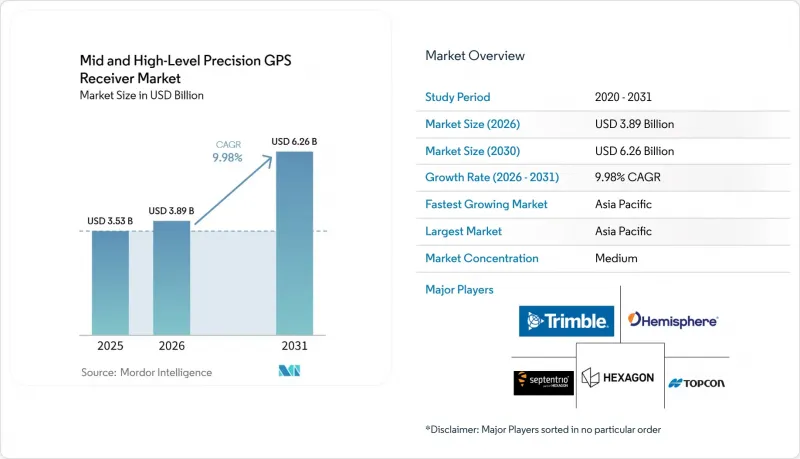
本報告依校正技術(RTK、PPP-RTK混合等)、頻率範圍(單頻L1、雙頻L1/L2等)、外形規格(模組化OEM板等)、終端應用產業(測繪、精密農業等)及地區(北美、歐洲等)進行細分。市場預測以美元計價。
中高精度GPS接收器的全球市場趨勢與洞察
精密農業自動化程度的提高
大型農民正將即時動態接收器整合到變數播種機和臂架式攝影機中,這些攝影機能夠識別雜草,從而減少高達 80% 的除草劑用量。巴西大豆種植者目前採用 15 公分的行距,實現了機械化耕作並降低了化學品支出。阿根廷糧食生產商正在將自動駕駛曳引機與聯合收割機連接起來,從而延長了 2-3 小時的收割時間。小於 100 毫秒的收斂精度使得曳引機能夠以超過 12 公里/小時的速度行駛。這些改進的綜合作用提高了產量穩定性並縮短了投資回收期,從而推動了中高精度 GPS接收器市場的快速成長。
建築和採礦機械控制系統的廣泛應用。
在澳洲和智利的礦場中,自動駕駛運輸卡車借助多頻接收器和慣性測量裝置,以每小時 60 公里的速度行駛,精度可達 10 公分。配備智慧機器控制系統的推土機可減少 30% 的材料浪費並降低油耗。美國的公路建設者已實現路面深度測量的自動化,精度優於 2 厘米,從而將項目工期縮短了 10% 至 15%。歐洲和新加坡強制推行的建築資訊模型 (BIM) 要求建商將測量資料與數位檔案交叉比對,這推動了接收器的升級。天線價格的下降和 RTK 覆蓋範圍的擴大,使得這些系統更容易被中型建築商所接受,從而提升了它們在中高精度 GPS接收器市場的佔有率。
對公分級接收器的高額資本投入
測量級設備價格昂貴,售價在 5,000 美元到 25,000 美元之間,這對新興市場的小規模農場和測量員來說是一大障礙。多頻段晶片組、高精度振盪器和自適應天線推高了組件成本,並延長了更新週期。雖然 u-blox 發布了 ZED-X20P 模組,聲稱其總體擁有成本降低了 90%,但其定價仍然面向工業級買家。 Emlid 和 ArduSimple 的開放原始碼產品入門價格較低,但缺乏企業級保固和支援。除非批量採購帶來價格下降,否則中高精度 GPS接收器市場可能會在注重成本的用戶群中失去成長動力。
細分市場分析
2025年,即時動態定位(RTK)解決方案佔據市場主導地位,佔中高精度GPS接收器市場佔有率的48.84%,這反映了其在測繪、建築和農業等領域的廣泛應用。 PPP-RTK混合定位方案目前年成長率達10.67%,因為它們無需依賴基地台,並將收斂時間縮短至一分鐘以內。差分GNSS和SBAS方法在航空航太和海事領域仍然得到應用,因為20公分的精度已足夠。精密單點定位(PPP)曾經受限於其較長的收斂時間,但隨著伽利略系統透過E6訊號提供免費的校正訊息,其重要性也日益凸顯。 Trimble的PULSAR整合方案正是全球轉型為低延遲校正資訊的典型例證。
混合服務結合了公私合營(PPP)的覆蓋範圍和即時定位(RTK)的速度,正在改變採購經濟格局。離岸風力發電專案營運商和遠端採礦作業者選擇這些連接方案,以避免建造昂貴的陸上網路。校正資料提供者正在將雲端分析功能與服務捆綁在一起,以實現預測性維護和全機群效能儀錶板。因此,在中高精度GPS接收器市場,業務收益已經超過了硬體利潤率。監管機構歡迎帶有嵌入式完整性標誌的認證訊號,這增強了人們對安全關鍵型工作流程的信心。
到2025年,雙頻GPS接收機憑藉其均衡的性價比,佔據了中高精度GPS接收器市場46.39%的佔有率。多頻段GPS接收機由於其快速解模糊、抗干擾能力強,以及能夠利用新的伽利略E6和北斗B2b訊號,正以每年11.06%的速度成長。單頻段GPS接收機仍然是低成本的選擇,但隨著雙頻模組晶片價格跌破50美元,其銷量正在下降。
Septentrio 的「mosaic-G5」透過縮小尺寸 60% 和降低功耗 40%,打破了機器人領域高密度感測器融合的傳統壁壘。汽車設計師更青睞 L1-L5 配置,因為 L5 導引組件能夠提升系統在都市區峽谷環境中的可靠性。 E6 中整合的認證資料支援對自動駕駛至關重要的位置完整性檢查。這些優勢正推動多頻段產品線的高階消費,進而擴大中高精度 GPS接收器市場的成長潛力。
區域分析
預計亞太地區將成為最大的市場,到2025年將佔全球銷售額的42.42%,並在2031年之前維持10.83%的複合年成長率。中國正在強制要求將北斗系統整合到智慧型手機和聯網汽車中,這有效地保障了出貨量的基準。在印度,已部署了1500個參考站,使專案啟動成本降低了30%,並方便了小規模測繪公司進行設備升級。在日本,QZSS增強服務正在為水稻插秧機提供支持,使產量提高了8%,這為生產者帶來了實際的投資回報。
預計到2025年,北美和歐洲合計佔總銷售額的近45%。美國航空業正在將廣角增強系統(WAAS)升級為雙頻功能,以便在二級機場實現精準進場。德國建築公司正在為挖土機配備多頻段接收器,以滿足數位孿生檢驗要求,精度達到2公分。英國擴展的OS Net提高了洪水管理測量的精確度,從而促進了面向土木工程師的接收器銷售。
到2025年,中東、非洲和南美洲合計將佔據13%的市場佔有率,預計強勁成長動能將持續。在沙烏地阿拉伯,NEOM計畫正在建造一個新的大地測量網路,以指導大型基礎設施的部署。巴西大豆生產商正在使用雙頻板實現糧食加工自動化,從而協調收割物流。南非的深層礦井正在部署多頻段接收器,以追蹤GPS訊號無法覆蓋的隧道中的礦石開採情況;而埃及蘇伊士運河管理局則正在使用水文測量設備來維持疏浚後的水深。這些措施的綜合需求正在推動全球中高精度GPS接收器市場持續擴張。
其他好處:
- Excel格式的市場預測(ME)表
- 3個月的分析師支持
目錄
第1章:引言
- 研究假設和市場定義
- 調查範圍
第2章:調查方法
第3章執行摘要
第4章 市場狀況
- 市場概覽
- 市場促進因素
- 精密農業自動化快速發展
- 建築和採礦機械控制系統的廣泛應用。
- 自動駕駛車輛的檢驗和測試的需求日益成長
- 低地球軌道PPP-RTK校正服務的部署
- 數位孿生基礎設施計畫的推廣
- GNSS與5G NTN融合實現公分級室內定位
- 市場限制因素
- 公分級接收器的高昂資本投資成本
- 更正服務範圍及使用費的限制
- 多衛星群板的出口限制和ITAR限制
- 5G 和 Ligado 的引入導致相鄰頻寬出現射頻干擾
- 宏觀經濟因素對市場的影響
- 產業供應鏈分析
- 監理情勢
- 技術展望
- 波特五力分析
第5章 市場規模與成長預測
- 校正方法
- 即時動態定位(RTK)
- 精密單點定位(PPP)
- PPP-RTK混合
- 差分GNSS/SBAS
- 頻率相容性
- 單頻(L1)
- 雙頻(L1/L2)
- 雙頻(L1/L5)
- 多頻(3個或更多頻段)
- 按外形規格
- 模組化OEM板
- 整合智慧天線
- 堅固耐用的手持終端機和控制器
- 背包式/桿式探測車
- 產業最終用途
- 測量和地圖繪製
- 精密農業
- 建築和採礦
- 船舶與疏浚
- 自主地面和空中車輛
- 按地區
- 北美洲
- 美國
- 加拿大
- 墨西哥
- 歐洲
- 德國
- 英國
- 法國
- 義大利
- 其他歐洲國家
- 亞太地區
- 中國
- 日本
- 印度
- 韓國
- 澳洲
- 其他亞太國家
- 南美洲
- 中東和非洲
- 北美洲
第6章 競爭情勢
- 市場集中度
- 策略趨勢
- 市佔率分析
- 公司簡介
- Trimble Inc.
- Hexagon AB(Leica Geosystems Division)
- Topcon Positioning Systems Inc.
- Hemisphere GNSS Inc.
- Septentrio NV
- CHC Navigation(Shanghai)Co., Ltd.
- ComNav Technology Ltd.
- Swift Navigation Inc.
- SingularXYZ Intelligent Technology Ltd.
- NavCom Technology Inc.
- u-blox Holding AG
- Hemisphere(Stonex)Srl
- Carlson Software Inc.
- Emlid Ltd.
- Geneq Inc.
- ArduSimple SL
- SBG Systems SAS
- Outset Navigation Ltd.
- Harxon Corporation
- Topcon(Sokkia Co., Ltd.)
- Antcom Corporation
- Hi-Target Surveying Instrument Co., Ltd.
- Eos Positioning Systems Inc.
第7章 市場機會與未來展望
According to Mordor Intelligence, the mid and High-Level Precision GPS Receiver market size is projected to expand from USD 3.53 billion in 2025 and USD 3.89 billion in 2026 to USD 6.26 billion by 2031, registering a CAGR of 9.98% between 2026 and 2031.
This report is Segmented by Correction Technique (RTK, PPP-RTK Hybrid, and More), Frequency Capability (Single-Frequency L1, Dual-Frequency L1/L2, and More), Form Factor (Modular OEM Boards, and More), End-Use Industry (Surveying and Mapping, Precision Agriculture, and More), and Geography (North America, Europe, and More). The Market Forecasts are Provided in Terms of Value (USD).
Global Mid and High-Level Precision GPS Receiver Market Trends and Insights
Surge in Precision Agriculture Automation
Large growers are embedding real-time kinematic receivers into variable-rate planters and boom-mounted cameras that identify individual weeds, reducing herbicide use by up to 80%. Brazilian soybean operations now maintain 15-centimeter row spacing that enables mechanical cultivation and lowers chemical outlays. Argentinian grain producers synchronize autonomous carts with combines to extend harvest windows by two to three hours. Convergence below 100 milliseconds supports tractors traveling faster than 12 kilometers per hour. Collectively, these improvements increase yield consistency and shorten payback cycles, keeping the Mid and High-Level Precision GPS Receiver market on a steep adoption curve.
Uptake of Construction and Mining Machine Control Systems
Autonomous haul trucks in Australian and Chilean mines maintain 10-centimeter accuracy at 60 kilometers per hour through multi-frequency receivers paired with inertial units. Dozers equipped with intelligent machine control cut material waste by 30% and reduce fuel consumption. Highway contractors in the United States automate paving depths within 2 centimeters, trimming project schedules 10% to 15%. Building information modeling mandates across Europe and Singapore compel contractors to verify as-built data against digital files, driving receiver upgrades. Falling antenna prices and wider RTK coverage extend these systems to mid-tier contractors, widening the Mid and High-Level Precision GPS Receiver market footprint.
High Capital Expenditure for Centimeter-Grade Receivers
Survey-grade devices cost USD 5,000 to USD 25,000, a hurdle for small farms and emerging-market surveyors. Multi-band chipsets, precision oscillators, and adaptive antennas push bill-of-material costs high enough to slow replacement cycles. u-blox unveiled the ZED-X20P module, claiming 90% lower total ownership, yet pricing still targets industrial buyers. Open-source options from Emlid and ArduSimple lower entry prices, but lack enterprise warranty and support. Absent volume price erosion, the Mid and High-Level Precision GPS Receiver market loses momentum among cost-sensitive users.
Other drivers and restraints analyzed in the detailed report include:
- Rising Demand for Autonomous Vehicle Validation and Testing
- Roll-out of Low Earth Orbit PPP-RTK Correction Services
- Limited Coverage and Subscription Cost of Correction Services
For complete list of drivers and restraints, kindly check the Table Of Contents.
Segment Analysis
Real-time kinematic solutions dominated 2025 with 48.84% of the Mid and High-Level Precision GPS Receiver market share, reflecting their use in surveying, construction, and row-crop farming. PPP-RTK hybrids now grow at 10.67% annually because they remove base-station dependencies and reduce convergence to under 1 minute. Differential GNSS and SBAS methods linger in aviation and maritime sectors that accept 20-centimeter accuracy. Precise point positioning, once limited by long convergence, gains relevance as Galileo offers free corrections via E6 signals. Trimble's PULSAR integration exemplifies the pivot toward global, low-latency corrections.
Hybrid services rewrite procurement economics by blending PPP coverage with RTK speed. Operators in offshore wind projects and remote mining choose these links to avoid building costly terrestrial networks. Correction providers bundle cloud analytics, enabling predictive maintenance and fleet-wide performance dashboards. As a result, service revenue overtakes hardware margin inside the Mid and High-Level Precision GPS Receiver market. Regulatory bodies welcome authenticated signals that embed integrity flags, reinforcing trust in safety-critical workflows.
Dual-frequency units accounted for 46.39% of the Mid and High-Level Precision GPS Receiver market in 2025, thanks to a balanced cost-to-performance ratio. Multi-band boards expand at 11.06% per year as they resolve ambiguities faster, resist jamming, and exploit new Galileo E6 and BeiDou B2b signals. Single-band devices remain a low-cost option, but volumes slide as chip prices for dual-frequency modules drop below USD 50.
Septentrio's mosaic-G5 shrank its footprint by 60% and reduced power by 40%, removing past barriers to dense sensor fusion in robotics. Automotive designers favor L1-L5 configurations because L5's pilot component improves urban canyon resilience. Authentication data embedded in E6 enables position integrity checks essential for automated driving. These advantages funnel premium spending into multi-band lines, extending the runway for the Mid and High-Level Precision GPS Receiver market.
Complete Report Scope:
- By Correction Technique
- Real-Time Kinematic (RTK)
- Precise Point Positioning (PPP)
- PPP-RTK Hybrid
- Differential GNSS / SBAS
- By Frequency Capability
- Single-Frequency (L1)
- Dual-Frequency (L1/L2)
- Dual-Frequency (L1/L5)
- Multi-Frequency (?3 Bands)
- By Form Factor
- Modular OEM Boards
- Integrated Smart Antennas
- Rugged Handhelds and Controllers
- Backpack / Pole-Mounted Rovers
- By End-Use Industry
- Surveying and Mapping
- Precision Agriculture
- Construction and Mining
- Marine and Dredging
- Autonomous Ground and Aerial Vehicles
- By Geography
- North America
- United States
- Canada
- Mexico
- Europe
- Germany
- United Kingdom
- France
- Italy
- Rest of Europe
- Asia-Pacific
- China
- Japan
- India
- South Korea
- Australia
- Rest of Asia-Pacific
- South America
- Middle East and Africa
- North America
Geography Analysis
Asia-Pacific led with 42.42% revenue in 2025 and is projected to retain a 10.83% CAGR through 2031. China mandates BeiDou integration across smartphones and connected cars, effectively guaranteeing baseline shipment volumes. India is rolling out 1,500 reference stations that cut project setup costs by 30% and encourage small survey firms to upgrade equipment. Japan's QZSS augmentation service underpins rice transplanters that raise yields 8%, confirming return on investment for growers.
North America and Europe together contributed nearly 45% of the 2025 turnover. The U.S. aviation sector is upgrading WAAS for dual-frequency use to allow precision approaches at secondary airports. Germany's contractors fit multi-band receivers onto excavators to comply with digital twin validation at a 2-centimeter tolerance. The United Kingdom's expanded OS Net improves mapping accuracy for flood management, boosting receiver sales among civil engineers.
The Middle East, Africa, and South America together held 13% share in 2025, yet show strong upside. Saudi Arabia's NEOM project establishes new geodetic networks to guide mega-infrastructure layouts. Brazil's soybean growers automate grain handling with dual-band boards that coordinate harvest logistics. South Africa's deep mines add multi-band receivers to track ore removal in GPS-denied shafts, while Egypt's Suez Canal Authority maintains dredged depths using hydrographic kits. Collective demand from these initiatives keeps the Mid and High-Level Precision GPS Receiver market expanding worldwide.
- Trimble Inc.
- Hexagon AB (Leica Geosystems Division)
- Topcon Positioning Systems Inc.
- Hemisphere GNSS Inc.
- Septentrio NV
- CHC Navigation (Shanghai) Co., Ltd.
- ComNav Technology Ltd.
- Swift Navigation Inc.
- SingularXYZ Intelligent Technology Ltd.
- NavCom Technology Inc.
- u-blox Holding AG
- Hemisphere (Stonex) Srl
- Carlson Software Inc.
- Emlid Ltd.
- Geneq Inc.
- ArduSimple SL
- SBG Systems SAS
- Outset Navigation Ltd.
- Harxon Corporation
- Topcon (Sokkia Co., Ltd.)
- Antcom Corporation
- Hi-Target Surveying Instrument Co., Ltd.
- Eos Positioning Systems Inc.
Additional Benefits:
- The market estimate (ME) sheet in Excel format
- 3 months of analyst support
TABLE OF CONTENTS
1 INTRODUCTION
- 1.1 Study Assumptions and Market Definition
- 1.2 Scope of the Study
2 RESEARCH METHODOLOGY
3 EXECUTIVE SUMMARY
4 MARKET LANDSCAPE
- 4.1 Market Overview
- 4.2 Market Drivers
- 4.2.1 Surge in Precision Agriculture Automation
- 4.2.2 Uptake of Construction and Mining Machine-Control Systems
- 4.2.3 Rising Demand for Autonomous Vehicle Validation and Testing
- 4.2.4 Roll-out of Low Earth Orbit PPP-RTK Correction Services
- 4.2.5 Proliferation of Digital Twin Infrastructure Programs
- 4.2.6 Integration of GNSS with 5G NTN for Centimeter-Level Indoor Positioning
- 4.3 Market Restraints
- 4.3.1 High Capital Expenditure for Centimeter-Grade Receivers
- 4.3.2 Limited Coverage and Subscription Cost of Correction Services
- 4.3.3 Export Control and ITAR Restrictions on Multi-Constellation Boards
- 4.3.4 Adjacent-Band RF Interference from 5G and Ligado Deployments
- 4.4 Impact of Macroeconomic Factors on the Market
- 4.5 Industry Supply-Chain Analysis
- 4.6 Regulatory Landscape
- 4.7 Technological Outlook
- 4.8 Porter's Five Forces Analysis
- 4.8.1 Threat of New Entrants
- 4.8.2 Bargaining Power of Suppliers
- 4.8.3 Bargaining Power of Buyers
- 4.8.4 Threat of Substitutes
- 4.8.5 Intensity of Competitive Rivalry
5 MARKET SIZE AND GROWTH FORECASTS (VALUE)
- 5.1 By Correction Technique
- 5.1.1 Real-Time Kinematic (RTK)
- 5.1.2 Precise Point Positioning (PPP)
- 5.1.3 PPP-RTK Hybrid
- 5.1.4 Differential GNSS / SBAS
- 5.2 By Frequency Capability
- 5.2.1 Single-Frequency (L1)
- 5.2.2 Dual-Frequency (L1/L2)
- 5.2.3 Dual-Frequency (L1/L5)
- 5.2.4 Multi-Frequency (?3 Bands)
- 5.3 By Form Factor
- 5.3.1 Modular OEM Boards
- 5.3.2 Integrated Smart Antennas
- 5.3.3 Rugged Handhelds and Controllers
- 5.3.4 Backpack / Pole-Mounted Rovers
- 5.4 By End-Use Industry
- 5.4.1 Surveying and Mapping
- 5.4.2 Precision Agriculture
- 5.4.3 Construction and Mining
- 5.4.4 Marine and Dredging
- 5.4.5 Autonomous Ground and Aerial Vehicles
- 5.5 By Geography
- 5.5.1 North America
- 5.5.1.1 United States
- 5.5.1.2 Canada
- 5.5.1.3 Mexico
- 5.5.2 Europe
- 5.5.2.1 Germany
- 5.5.2.2 United Kingdom
- 5.5.2.3 France
- 5.5.2.4 Italy
- 5.5.2.5 Rest of Europe
- 5.5.3 Asia-Pacific
- 5.5.3.1 China
- 5.5.3.2 Japan
- 5.5.3.3 India
- 5.5.3.4 South Korea
- 5.5.3.5 Australia
- 5.5.3.6 Rest of Asia-Pacific
- 5.5.4 South America
- 5.5.5 Middle East and Africa
- 5.5.1 North America
6 COMPETITIVE LANDSCAPE
- 6.1 Market Concentration
- 6.2 Strategic Moves
- 6.3 Market Share Analysis
- 6.4 Company Profiles (includes Global Level Overview, Market Level Overview, Core Segments, Financials as available, Strategic Information, Market Rank/Share, Products and Services, Recent Developments)
- 6.4.1 Trimble Inc.
- 6.4.2 Hexagon AB (Leica Geosystems Division)
- 6.4.3 Topcon Positioning Systems Inc.
- 6.4.4 Hemisphere GNSS Inc.
- 6.4.5 Septentrio NV
- 6.4.6 CHC Navigation (Shanghai) Co., Ltd.
- 6.4.7 ComNav Technology Ltd.
- 6.4.8 Swift Navigation Inc.
- 6.4.9 SingularXYZ Intelligent Technology Ltd.
- 6.4.10 NavCom Technology Inc.
- 6.4.11 u-blox Holding AG
- 6.4.12 Hemisphere (Stonex) Srl
- 6.4.13 Carlson Software Inc.
- 6.4.14 Emlid Ltd.
- 6.4.15 Geneq Inc.
- 6.4.16 ArduSimple SL
- 6.4.17 SBG Systems SAS
- 6.4.18 Outset Navigation Ltd.
- 6.4.19 Harxon Corporation
- 6.4.20 Topcon (Sokkia Co., Ltd.)
- 6.4.21 Antcom Corporation
- 6.4.22 Hi-Target Surveying Instrument Co., Ltd.
- 6.4.23 Eos Positioning Systems Inc.
7 MARKET OPPORTUNITIES AND FUTURE OUTLOOK
- 7.1 White-Space and Unmet Need Assessment


